Regenerative Endodontic Treatment Without Discoloration of Infected Immature Permanent Teeth Using Retro MTA : Two Case Reports
Yujeong Kim, Seonmi Kim, Namki Choi
Department of Pediatric Dentistry, School of Dentistry, Chonnam National University
Regenerative endodontic treatment has the potential to heal a necrotic pulp, which can affect root development in immature teeth. However, several drawbacks and unfavorable outcomes are associated with regenerative endodontic treatment, of which the most significant is coronal discoloration due to the presence of minocycline in triple antibiotic paste and mineral trioxide aggregate (MTA).
To prevent tooth discoloration following pulp treatment, the modified triple antibiotics (ciprofloxacin, metronidazole, clindamycin) were used as canal disinfectants and Retro MTA, a ZrO
2-containing calcium aluminate cement, was used to seal the canal. Following access cavity acquisition, the canal was copiously irrigated with 2.5% sodium hypochlorite. A modified triple antibiotic paste was then applied to the canal. Once the tooth was asymptomatic (after between 3 and 8 weeks), Retro MTA was carefully placed over the blood clot or a collagen plug. Follow-up radiographs revealed normal periodontal ligament space and root development. In two cases, successful regenerative endodontic treatment of the infected immature tooth, without discoloration, was achieved with disinfection using modified triple antibiotics and Retro MTA sealing.
Key words : Regenerative endodontics, Tooth discoloration, Triple antibiotics, Retro MTA Abstract
Corresponding author : Namki Choi
Department of Pediatric Dentistry, School of Dentistry, Chonnam National University, 77 Yongbong Street, Buk-Gu, Gwangju, 500-757, Korea Tel : +82-62-530-5668 / Fax +82-62-530-5669 / E-mail : [email protected]
Received June 19, 2014 / Revised October 8, 2014 / Accepted October 8, 2014
Ⅰ. Introduction
In endodontics, treatment of necrotic immature teeth is challenging. Weakness, shortness, and susceptibility to fracture are typical characteristics of immature roots.
Performance of chemomechanical debridement, and the creation of an effective apical seal using conventional en- dodontic treatment methods, is problematic for most clinicians. Apexification, using traditional and contempo- rary methods, allows for the management of immature teeth with necrotic pulps. However, a major drawback is that, in cases of root fracture, non-restorability eventu- ally leads to the loss of these teeth
1,2).
Regenerative endodontic procedures have recently
been advocated in the treatment of necrotic immature
teeth. Here, the root canal system is thoroughly disin-
fected, following which bleeding from the apical papilla is
stimulated to fill the root chamber with a blood clot
2). A
host of growth factors in this area then act on dental
stem cells, primarily from the apical papilla, using the
clot as a scaffold and differentiating into healthy cells
that can reach physiologic root maturation
3). There are a
number of cases of successful clinical and radiographic
outcomes using this treatment
1,2,4,5). However, several
shortcomings and unfavorable outcomes should also be
considered
6,7), as follows: (1) coronal discoloration; (2)
insufficient bleeding; and (3) collapse of mineral trioxide aggregate (MTA) material into the canal.
Coronal discoloration is a particularly important aes- thetic concern. Kim et al.
8)demonstrated that tooth dis- coloration following regenerative endodontic treatment is problematic due mostly to the presence of minocycline in the triple antibiotic paste: the main cause of staining following treatment was contact between minocycline with coronal dentinal walls. An effective method of pre- venting discoloration involves replacing minocycline with a non-staining antibiotic.
Although minocycline is the major cause of discol- oration following regenerative endodontic treatment, several studies have demonstrated that gray MTA
5,9)and white MTA
6,7,10)can also lead to discoloration. The iron and manganese contained within GMTA and WMTA are potentially responsible for coronal discoloration
9). Retro MTA
�(BioMTA, Korea) is a recently produced ZrO 2 - containing calcium aluminate cement that uses hy- draulic calcium zirconia complex as its contrast media and no heavy metals. According to the manufacturer, Retro MTA does not cause discoloration even in in- stances of blood contamination
11).
This case report describes regenerative endodontic treatment, without coronal discoloration of immature permanent teeth with apical inflammation, using a mod- ified triple antibiotics paste (ciprofloxacin, metronida- zole, clindamycin) as a canal disinfectant, and Retro MTA, produced by hydration of zircornia complex, to seal the canal.
Ⅱ. Case Reports 1. Case 1
A 10-year-old boy presented to the Department of Pediatric Dentistry, Chonnam National University Dental Hospital with pain in the mandibular right sec- ond premolar upon chewing. In clinical examinations, a fractured tubercle, in a dens evaginatus on the occlusal surface, was observed. The tooth was tender to percus- sion and palpation, with mild mobility. A periapical radi- ograph revealed incomplete tooth development and peri- radicular radiolucency (Fig. 1A). The tooth was diag- nosed with pulp necrosis and acute apical periodontitis.
Under rubber dam isolation, without local anesthesia,
Fig. 1. Periapical views of case 1. (A) Preoperative radiograph showing an open apex, periradicular radiolucency and dens evaginatus of the mandibular
right second premolar. (B) The canal was sealed with MTA. (C) A radiograph at the 1-month follow-up showing root lengthening and narrowing of the
canal space. (D, E, F) Follow-up radiographs showing root development at 4, 8 and 11 months, respectively. Periapical radiographs revealed root wall
thickening and root lengthening.
an access cavity was prepared for the mandibular right second premolar. Root canal length was estimated using an endodontic #15 K-file. A 20-gauge needle was situat- ed within 3 mm of the apex, and the canal was copiously and gently irrigated using 10 mL of 2.5% sodium hypochlorite and saline without instrumentation. The canal was then dried with paper points. A triple antibi- otic mix, of 250 mg ciprofloxacin, 250 mg metronidazole, and 150 mg clindamycin
12), with sterile saline as a vehi- cle, was introduced into the root canal below the CEJ as a creamy paste using a Centrix syringe. Hoshino et al.
13)originally recommended the use of minocycline, but, due to its tendency to stain teeth, clindamycin was substi- tuted instead. The access cavity was temporarily sealed using a cotton pellet and Caviton (GC Co, Tokyo, Japan).
After 3 weeks, the tooth was asymptomatic, with the patient reporting no postoperative pain. Anesthesia, with 3% mepivacaine (Septodont, Cedex, France) with- out a vasoconstrictor, was given. Following isolation with a rubber dam, the access cavity was reopened, and
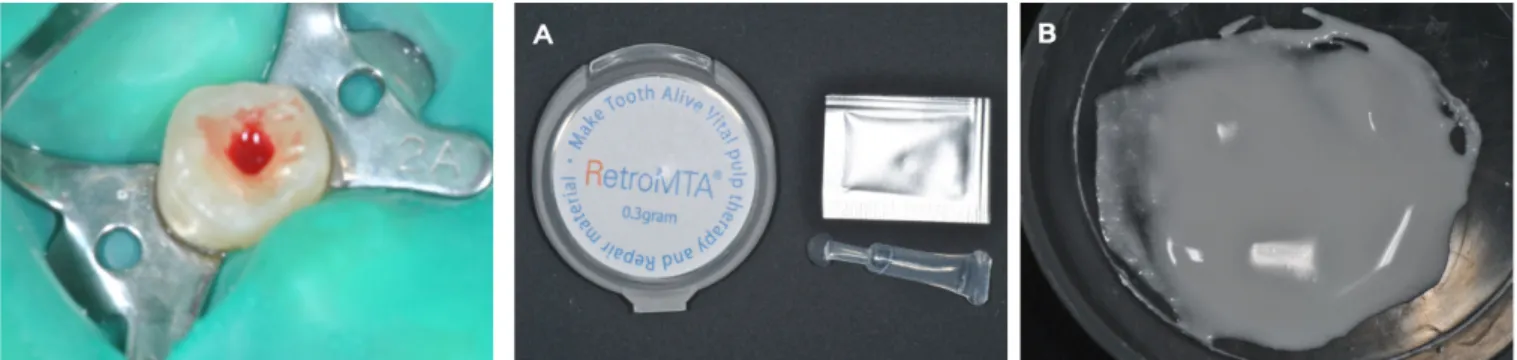
the canal was irrigated twice. The canal was then dried using paper points. An endodontic #20 K-file was intro- duced into the canal up to the apex; the apical vital tis- sue was irritated by gentle scraping, precipitating bleed- ing into the canal (Fig. 2). A cotton pellet was subse- quently placed into the canal, 3 mm below the CEJ, and remained in place for 15 min to ensure clot formation.
The presence of the blood clot was confirmed visually.
Approximately 3-mm thickness of Retro MTA
�(BioMTA, Korea) was then carefully placed over the blood clot, with a moist cotton pellet over the MTA. The tooth was then temporized with Caviton (Fig. 1B, 3A, 3B). The patient was assessed after 1 week; the Caviton was replaced with composite resin restoration and fur- ther recall visits were scheduled.
The patient was recalled at 1, 4, 8 and 11 months fol- lowing treatment. In clinical examinations, the tooth was asymptomatic. In radiographic examinations, the tooth exhibited increased root length and root wall thick- ness (Fig. 1C-F). Moreover, at 11 months, the tooth displayed no discoloration (Fig. 4).
Fig. 2. Blood clot was obtained at the level of the cementoenamel junction using an endodontic #20 K-file.
Fig. 3. (A) Retro MTA
�(BioMTA, Korea). (B) Mixing of Retro MTA with sterile saline.
Fig. 4. Intraoral views of case 1. (A) Occlusal view, and (B) buccal view, 11 months following mandibular right second premolar treatment. The tooth
exhibited no discoloration.
2. Case 2
A 7.11-year-old boy was referred to the Department of Pediatric Dentistry, Chonnam National University Dental Hospital with an uncomplicated crown fracture in the maxillary right central incisor due to trauma (Fig.
5A, 6A). His maxillary right central incisor was treated by reattaching a fractured tooth fragment using compos-
ite resin (Fig 5B). At 2 months, the patient returned due to pain and localized swelling in the anterior region of the maxilla. On clinical examination, swelling and fis- tula formation in the maxillary right central incisor were observed. A periapical radiograph revealed a radiolucent lesion on the open apex of the maxillary right central in- cisor (Fig. 6B). The tooth was diagnosed with an infect- ed necrotic pulp and acute apical abscess.
Fig. 5. Intraoral views of case 2. (A) Initial examination; maxillary right central incisor with an uncomplicated crown fracture, and (B) view following reat- tachment of a fractured tooth fragment. The fracture was very close to the pulp, but not involving the pulp.
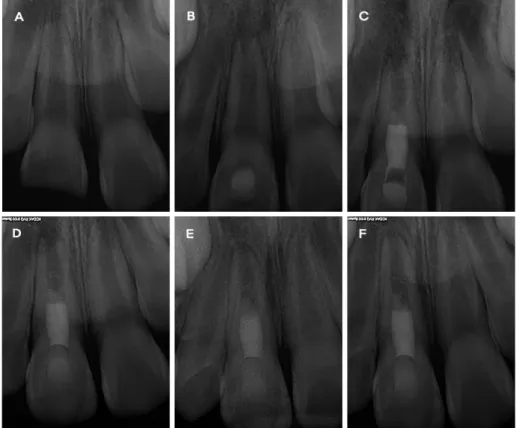
Fig. 6. Periapical views of case 2. (A) Initial visit; maxillary right central incisor with an open apex and uncomplicated crown fracture. (B) At 2 months
post-trauma; access cavity opening was prepared with a diagnosis of pulp necrosis. (C) The canal was sealed with MTA over a Teruplug. (D, E, F) Follow-
up radiographs showing root development at 1, 4 and 8 months, respectively. Lengthening of roots, with normal periodontal ligament space, was observed.
Under isolation with a rubber dam, an access cavity was prepared. Root canal length was estimated using an endodontic #15 K-file. The canal was gently irrigated us- ing 10 mL of 2.5% sodium hypochlorite and saline. The canal was then dried with paper points, and a triple an- tibiotic paste (ciprofloxacin, metronidazole, clindamycin) was introduced into the root canal below the CEJ using a Centrix syringe. The access cavity was sealed using a cotton pellet and Caviton.
After 5 weeks, although the fistula had disappeared, the tooth was tender to percussion and palpation. The access cavity was reopened and the canal was irrigated.
The triple antibiotic paste was reapplied to the root canal. The next appointment was scheduled 3 weeks subsequent, at which time the patient reported no pain.
Anesthesia, with 3% mepivacaine without epinephrine, was given and the canal was copiously irrigated. An en- dodontic K-file was introduced into the canal up to the apex to induce bleeding. However, insufficient bleeding into the canal was observed. A collagen sponge (Teruplug
TM; Terumo Biomaterials Co, Tokyo, Japan), used as a scaffold, was cut into small pieces, soaked with blood, and placed into the canal (Fig. 7A).
Approximately 3-mm thickness of Retro MTA was then
carefully placed over a collagen plug, and a moist cotton pellet was placed over the MTA (Fig. 6C, 7B). The tooth was temporized with Caviton. The patient visited again after 1 week, to have the Caviton replaced with compos- ite resin restoration.
The patient was recalled at 1, 4 and 8 months follow- ing treatment. In clinical examinations, the tooth was asymptomatic. In radiographic examinations, the tooth exhibited increased root length and normal periodontal ligament space (Fig. 6D-F). In addition, the tooth ex- hibited no discoloration (Fig. 8).
Ⅲ. Discussion
Regenerative endodontic treatment enables infected canal spaces to repair or regenerate tissues in the pulp, thereby allowing for resumption of their sensory, im- munocompetency, root development, and formation roles
1). The introduction of stem cells from the apical papilla into the canal by disorganizing the apical papilla tissue with an endodontic file and transferring it into the root canal in accordance with blood clot formation from the periapical tissues has been suggested. When pulp necrosis causes incomplete root development, this en-
Fig. 7. (A) Teruplug
TM(Terumo Biomaterials Co, Tokyo, Japan). (B) MTA filling over a Teruplug of the maxillary right central incisor.
Fig. 8. Intraoral views of case 2. (A) Labial view, and (B) palatal view, 8 months following maxillary right central incisor treatment. The tooth exhibited no
discoloration.
dodontic intervention can increase root length and canal wall thickness
2-4). Significantly higher tooth survival rates were reported when regenerative endodontic treat- ment (100%) was applied instead of MTA (95%) or CaOH 2 apexification (77%). The percentage increase in root length and thickness was also significantly higher using regenerative endodontics instead of either apexifi- cation procedure
1). However, despite these advantages, several drawbacks and unfavorable outcomes are also associated with regenerative endodontic treatment
6,7).
A favorable environment in which pulp and periapical cells can participate in tissue repair and regeneration can be provided by controlling root canal infection follow- ing injury
14). Hoshino et al.
13)demonstrated the effective- ness of a combination of ciprofloxacin, metronidazole and minocycline for eradication of bacteria from the infected root canal. This triple antibiotic paste, when used as an intracanal medication in immature teeth with necrotic pulps, can facilitate further development of the pulp-dentin complex following regenerative endodontic treatment.
Although a triple antibiotic paste is useful for disin- fecting the root canal, it can also induce severe discol- oration. Kim et al.
8)reported that the major reason for coronal discoloration following treatment was minocy- cline in the triple antibiotic paste. Sato et al.
14)and Hoshino et al.
13)suggested that minocycline could be re- placed by amoxicillin, cefaclor, cefroxadin, fosfomycin or rokitamycin. The combination of metronidazole and ciprofloxacin with any antibiotic has proven equally suc- cessful in the sterilization of carious and endodontic le- sions
15). In our protocol, minocycline was replaced with clindamycin
12): this resolved tooth discoloration, and al- lowed for simultaneous control of root canal infections.
Several studies reported that following regenerative endodontic treatment, gray MTA can result in discol- oration
5,9). Due to the potential discoloration of teeth treated with GMTA, WMTA has been introduced in- stead; however, tooth discoloration can still occur using this agent
6,7,10)because even though the concentrations of carborundum (Al 2 O 3 ), periclase (MgO), and FeO are lower in WMTA compared with GMTA these metal ox- ides are nonetheless still present
9). According to Steffen and van Waes
16), bismuth oxide, used as a radiopacifier in MTA, is a possible factor in tooth discoloration. These researchers reported that bismuth oxide is the only dif- ference between Portland cement (PC) and MTA.
Further clinical studies of the effects of PC on discol- oration are therefore required. Although the material it-
self may cause discoloration, another possible mecha- nism has been suggested. Both material and subsequent tooth discoloration might occur with the slow hydrating process of WMTA permitting the absorption and subse- quent hemolysis of erythrocytes from the adjacent pulpal tissue
10).
Zirconium oxide represents a possible alternative ra- diopacifier to bismuth oxide. It can act as an inert filler, and does not participate in the hydration reaction of the PC
17). However, adding even a minimal amount of ra- diopacifier to cement can alter its chemistry, biocompati- bility and physical properties. Development of cement, using radiopacifier as a component rather than as an ad- junct, might be beneficial; in this respect ZrO 2 -contain- ing calcium aluminate (Ca 7 ZrAl 6 O 18 ) cement has excel- lent potential
18). Retro MTA
�(BioMTA, Korea) is a calci- um zirconium aluminate cement containing 60 - 80%
calcium carbonate (CaCO 3 ), 5 - 15% silicon dioxide (SiO 2 ), 5 - 10% aluminum oxide and 20 - 30% calcium zirconia complex. According to the manufacturer, Retro MTA has short setting time, contains no heavy metal, possesses no cell toxicity and causes no discoloration, even in the context of blood contamination
11). Che and Kim
19)reported that Retro MTA has similar properties, in terms of compressive strength and solubility, to ProRoot MTA, and further that the setting time of Retro MTA is only 18 min, shorter than that of ProRoot MTA (at 279 min). In both of our presently reported cases, Retro MTA effected a successful outcome. However, the number of studies pertaining to the various clinical ap- plications of new composition of MTA is very limited.
Although the manufacturer claims that a better color stability is achieved with Retro MTA (in comparison to WMTA), no study has investigated color changes using Retro MTA in endodontic procedures. Furthermore, Retro MTA is characterized by certain drawbacks, in- cluding difficult in handling, high cost, absence of a known solvent, and difficulty of removal after curing
20).
Other drawbacks associated with regenerative en-
dodontics include failure to produce bleeding and col-
lapse of MTA material into the canal
6,7). Blood clots al-
lows for the migration of mesenchymal stem cells into
the canal, a phenomenon not observed in the absence of
blood clots inside a disinfected root canal
3,4). To induce
sufficient bleeding, non-epinephrine local anesthetics
could be used
5,6,8), with MTA material placed over the
blood clot. MTA has a setting time of between 3 and 4
hours
16); the blood clot is often insufficiently strong to
hold the MTA, resulting in MTA collapse within the root canal
4,6,7). Placing a collagen matrix above the blood clot can serve as a solid absorbable matrix against which the MTA can be packed
4,6). However, in one study the amount of bleeding was inadequate, but Teruplug
TM, an absorbable collagen sponge, allowed for a successful out- come. A recent case report suggested use of platelet-rich plasma instead of a blood clot inside the root canal space to resolve this problem
5).
Ⅳ. Summary
The most significant disadvantage associated with re- generative endodontic treatment is coronal discoloration.
The present case reports demonstrate successful regen- erative endodontics without coronal discoloration of in- fected immature permanent teeth using modified triple antibiotics (ciprofloxacin, metronidazole, clindamycin) and Retro MTA. Retro MTA as a aesthetic material can potentially replace WMTA, but further study is required to determine its efficacy.
References
1. Jeeruphan T, Jantarat J, Yanpiset K, et al. : Mahidol study 1: comparison of radiographic and survival outcomes of immature teeth treated with either regenerative endodontic or apexification meth- ods-a retrospective study. J Endod, 38:1330-1336, 2012.
2. Iwaya SI, Ikawa M, Kubota M : Revascularization of an immature permanent tooth with apical periodon- titis and sinus tract. Dent Traumatol, 17:185-187, 2001.
3. Lovelace TW, Henry MA, Hargreaves KM, Diogenes A : Evaluation of the delivery of mesenchymal stem cells into the root canal space of necrotic immature teeth after clinical regenerative endodontic proce- dure. J Endod, 37:133-138, 2011.
4. Yamauchi N, Yamauchi S, Yamauchi, M, et al. : Tissue engineering strategies for immature teeth with apical periodontitis. J Endod, 37:390-397, 2011.
5. Torabinejad M, Turman M : Revitalization of tooth with necrotic pulp and open apex by using platelet- rich plasma: a case report. J Endod, 37:265-268, 2011.
6. Dabbagh B, Alvaro E, Schwartz S, et al. : Clinical
complications in the revascularization of immature necrotic permanent teeth. Pediatr Dent, 34:414- 417, 2012.
7. Nosrat A, Homayounfar N, Oloomi K : Drawbacks and unfavorable outcomes of regenerative endodontic treatments of necrotic immature teeth: a literature review and report of a case. J Endod, 38:1428-1434, 2012.
8. Kim J, Kim Y, Jung I, et al. : Tooth discoloration of immature permanent incisor associated with triple antibiotic therapy: a case report. J Endod, 36:1086- 1091, 2010.
9. Asgary S, Parirokh M, Eghbal MJ, Brink F : Chemical differences between white and gray miner- al trioxide aggregate. J Endod, 31:101-103, 2005.
10. Daniel F, Peter P : Coronal tooth discoloration and white mineral trioxide aggregate. J Endod, 39:484- 487, 2013.
11. Assessments on Bio filling. Available from URL:
http://www.biofilling.com/index.php?mm_code=740
&sm_code=741 (Accessed on June 14, 2014) 12. Casamassimo PS, Fields HW, McTigue DJ, Nowak
A : Pediatric Dentistry: Infancy Through Adolescence. 5
thedition. W.B. Sauders, Elsevier Science Health div, Philadelphia, 507-508, 2012.
13. Hoshino E, Kurihara-Ando N, Sato I, et al. : In-vit- ro antibacterial susceptibility of bacteria taken from infected root dentine to a mixture of ciprofloxacin, metronidazole and minocycline. Int Endod J, 29:125-130, 1996.
14. Sato I, Ando-Kurihara N, Hoshino E, et al. : Sterilization of infected root canal dentin by topical application of a mixture of ciprofloxacin, metronida- zole, and minocycline in situ. Int Endod J, 29:118- 124, 1996.
15. Kakehashi S, Stanley HR, Fitzgerald RJ : The effect of surgical exposures of dental pulps in germfree and conventional rats. Oral Surg Oral Med Oral Pathol, 20:340-349, 1965.
16. Steffen R, Van W : Understanding mineral trioxide aggregate/Portland-cement: a review of literature and background factors. Eur Arch Paediatr Dent, 10:93-97, 2009.
17. Camilleri J, Cutajar A, Mallia B : Hydration charac- teristics of zirconium oxide replaced Portland cement for use as a root-end filling material. Dent Mater J, 27:845-854, 2011.
18. Kang EH, Yoo JS, Hong SH, et al. : Synthesis and
hydration behavior of calcium zirconium aluminate (Ca 7 ZrAl 6 O 18 ) cement. Cement and Concrete Research, 56:106-111, 2014.
19. Che JL, Kim SM : Comparison of setting time, com- pressive strength, solubility, and pH of four kinds of MTA. Department of Dental Science Graduate
School, Chonnam National University, 2014.
20. Parirokh M, Torabinejad M : Mineral trioxide aggre- gate: a comprehensive literature review-part III:
clinical applications, drawbacks, and mechanism of
action. J Endod, 36:400-412, 2010.
주요어: 재생적 근관치료, 치아 변색, Triple antibiotics, Retro MTA
치수 괴사된 미성숙 영구치에서 Retro MTA를 이용한 변색 없는 재생적 근관치료 : 증례 보고