Research Report
Changes in Quality and Vigour of Cucumber and Paprika Transplants as Affected by Storage Temperature under Dark Conditions
Yurina Kwack 1 and Changhoo Chun 1,2*
1
Research Institute of Agriculture and Life Sciences, Seoul 151-921, Korea
2
Department of Plant Science, Seoul National University, Seoul 151-921, Korea
Abstract: Cucumber and paprika transplants were stored at 9, 12, 15, and 18°C under dark conditions for 15 days and then grown in a greenhouse for 14 days after transplanting. To determine the effects of low storage temperature and long-term continuous darkness on the quality and vigour of transplants, we investigated the quality of transplants during storage and the growth of stored transplants after transplanting. In cucumber transplants, decreasing storage temperature reduced stem elongation and decrease in SPAD value. The quality of cucumber transplants stored at 9°C was well preserved during storage, but they did not survive after transplanting due to chilling damage. Growth and development after transplanting were significantly greater when cucumber transplants were stored at 12°C. In paprika transplants, the quality of transplants did not significantly differ before and after storage. After transplanting, there was no significant difference in the survival rate and growth, but the number of flower buds was greater in the paprika transplants stored at lower temperatures (9 and 12°C). These results indicate that the responses of transplants to the conditions of low temperature and darkness differed between cucumber and paprika, and storage temperature in darkness must be controlled carefully considering species-specific responses to reduce quality deterioration during storage and improve the recovery of transplants after transplanting.
Additional key words: chilling, chlorophyll degradation, seedling, stem elongation, storability
*Corresponding author: [email protected]
※ Received 13 April 2015; Revised 3 June 2015; Accepted 12 June 2015. This study was supported by the Advanced Production Technology Development Program (Project No. 312034-04-2-HD050) of Korea Institute of Planning and Evaluation for Technology in Food, Agriculture, Forestry, and Fisheries.
Ⓒ 2015 Korean Society for Horticultural Science
Introduction
Transplant production using plugs has been widely used in vegetable crops because it has several advantages. Trans- plants can be produced more uniformly and their growth can be controlled more easily, improving the overall quality by using plug-type production system. High-quality transplant production affects the success of final crop quality and yield.
Transplant storage is necessary for coordinating the supply of transplants with variable demand (Sato et al., 2004). Transplant production has seasonal market demand, and millions of transplants should be intensively produced during a narrow window of time at a planting season (Justus and Kubota, 2010). Additionally, delays in trans-
planting have frequently occurred due to labour shortages and bad weather conditions. Holding the transplants for several weeks is useful for transplant producers because extending the production time for a certain volume of transplants can distribute and reduce labour. Farmers also can adjust crop scheduling and labour management by storing the transplants prior to transplanting (Kubota et al., 2002).
For successful transplant storage, the growth and develop-
ment of transplants must be suppressed but their quality
must be maintained. Lowering temperature during dark
storage is the most common and easiest method for main-
taining transplant quality. Many researchers have reported that
low temperature can reduce the deterioration of transplant
quality during dark storage due to decreases in the carbo-
hydrate contents of transplants (Kaczperski and Armitage, 1992; Sato et al., 1999). The deterioration of transplants quality such as succulent elongation, chlorophyll degradation, and dry weight loss were also found when the transplants were stored in darkness (Kubota and Kroggel, 2006). Additionally, it has been suggested that the interruption of photosynthesis combined with low temperature stress affects physiological changes of transplants during low temperature storage (Ning et al., 2006; Ding et al, 2011). However, the responses of transplants to low storage temperature under dark condition may differ among species, and the conditions of low temperature storage need to be evaluated considering species-specific responses.
The objectives of this study were to investigate changes in the quality of cucumber and paprika transplants at different temperatures during storage in darkness and to examine the effect of storage temperature on vigour of transplants after transplanting them to production sites.
Materials and Methods Plant materials
We used cucumber (Cucumis sativus L. cv. Cool) and paprika (Capsicum annuum L. cv. Special) transplants supplied by Poseung Agricultural Association Cooperation (N 36.6°, E 127.1°; Pyeongtaek, Korea) and Hoban Agricultural Associa- tion Cooperation (N 37.5°, E 127.4°; Chuncheon, Korea), respectively. Cucumber and paprika transplants were culti- vated conventionally using 40-cell trays filled with a commercial substrate mix in greenhouses for 30 and 40 days, respectively.
Storage conditions
Cucumber and paprika transplants in 40-cell trays were input in cardboard boxes commonly used for transplant shipping and the boxes were placed in four dark chambers set at 9, 12, 15, and 18°C for 15 days. During storage, transplants were not irrigated and the relative humidity was maintained at ≥ 80%.
Measurement of transplant quality before and after dark storage
Transplants from each treatment were sampled just before the start of storage and after 15 days of storage. We sampled plants from each treatment and measured plant height, number of leaves, and fresh and dry weights of shoot and root. Root/Shoot ratio was calculated with dry weights of shoot and root. To determine the chlorophyll content of transplants before and after storage, the SPAD value
was measured using a chlorophyll meter (SPAD-502; Minolta Co. Ltd., Osaka, Japan).
Greenhouse cultivation after storage
After storage under dark conditions, the transplants were cultivated for 14 days in the greenhouse at the experimental field, Seoul National University, Suwon (E 127.0°, N 37.3°).
Plants were transplanted into a plastic pot (Ø 10 cm) with a commercial substrate mix and irrigated with tap water once a day.
Assessment of transplant growth after transplanting To evaluate the recovery of transplants from low tempera- ture storage stress, we examined survival rate and growth of the stored transplants after transplanting to a greenhouse.
Plant height; numbers of internodes, leaves, and flowers;
SPAD value; leaf area; and fresh and dry weights of shoot and root were measured 14 days after transplanting.
Statistical analysis
The experimental data were analysed using SAS statistical software (SAS Institute Inc., Cary, NC, USA). Duncan’s multiple range tests (p ≤ 0.05) were performed to determine if a significant difference was observed among the treatments subjected to various temperatures during dark storage.
Results and discussion
Quality of cucumber and paprika transplants after dark storage
Plant height of cucumber transplants increased with
increasing storage temperature (Fig. 1). Plant height is
regarded as one of the more important morphologic charac-
teristics with respect to the quality of transplants because
growers prefer strong-looking transplants with shorter
internodes rather than elongated transplants (Kubota and
Kroggel, 2006). SPAD values of cucumber transplants after
storage were lower than those before storage at all storage
temperatures. Decreases in chlorophyll content were more
pronounced at the high storage temperatures. Chlorophyll
is susceptible to degradation under dark condition; therefore,
etiolation is often observed during dark storage (Toivonen
and Sweeney, 1998; Ding et al., 2011). The number of leaves
and the fresh weight of cucumber transplants increased
during storage, while the dry weight remained almost
unchanged (Table 1). Succulent stem elongation during
storage contributed to increases in fresh weight. Kubota
et al. (2002) observed that the fresh weight of stem after
Table 1. Number of leaves, fresh weight, and dry weight of cucumber transplants as affected by temperature during 15 days of dark storage.
Storage
temperature (°C) No. of leaves (/plant)
Fresh weight (g/plant) Dry weight (g/plant)
Root/Shoot
Shoot Root Shoot Root
Before storage 4.0 b
z08.75 c 3.69 b 0.87 a 0.20 ab 0.23 bc
18 4.9 a 11.09 a 4.23 ab 0.87 a 0.20 ab 0.24 bc
15 4.3 b 10.68 ab 4.10 ab 0.83 ab 0.17 b 0.21 c
12 4.2 b 09.84 bc 4.40 a 0.76 ab 0.20 ab 0.26 b
9 4.0 b 09.46 c 4.26 ab 0.72 b 0.25 a 0.34 a
z
Means in columns with different letters are significantly different based on Duncan’s multiple range tests at p ≤ 0.05.
A
B
Fig. 1. Plant height and SPAD value of cucumber transplants as affected by temperature during 15 days of dark storage.
BS = before storage. Means in columns with different letters are significantly different based on Duncan’s multiple range tests at p ≤ 0.05.
A
B
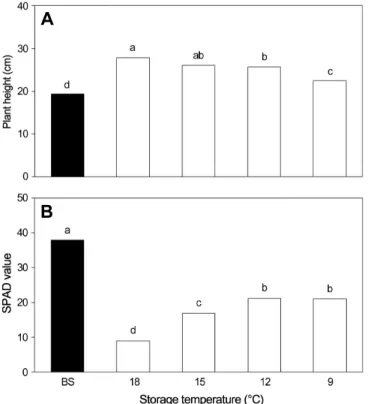
Fig. 2. Plant height and SPAD value of paprika transplants as affected by temperature during 15 days of dark storage.
BS = before storage. Means in columns with different letters are significantly different based on Duncan’s multiple range tests at p ≤ 0.05.
dark storage increased by 2 0% compared to that before storage. Root/shoot ratio in the cucumber transplants stored at 9°C was much higher than that in the non-stored cucumber transplants. Kubota et al. (1997) reported that carbohydrate composition in plant organs was changed due to an altered pattern of carbohydrate allocation at low temperature.
Source/sink relationship was affected by low temperature, which was generally related to the effects on root/shoot relationship (Hällgren and Ӧquist, 1990). It indicated that
more carbohydrates can be partitioned into roots during storage at low temperature in cucumber transplants.
Paprika transplants showed little elongation and chlorophyll
degradation rates after storage (Fig. 2). Many researchers
have reported that lowering the temperature slows metabolic
processes such as respiration and chlorophyll degradation,
and significantly decreases quality deterioration of transplants
during storage (Heins et al., 1995; Sato et al., 1999; Kubota
et al., 2002). In paprika, however, there was no significant
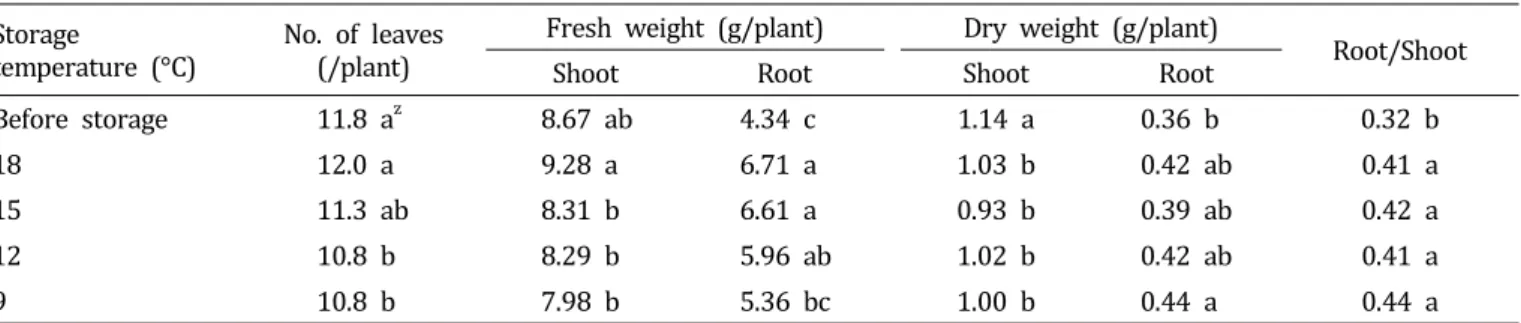
Table 2. Number of leaves, fresh weight, and dry weight of paprika transplants as affected by temperature during 15 days of dark storage.
Storage
temperature (°C) No. of leaves (/plant)
Fresh weight (g/plant) Dry weight (g/plant)
Root/Shoot
Shoot Root Shoot Root
Before storage 11.8 a
z8.67 ab 4.34 c 1.14 a 0.36 b 0.32 b
18 12.0 a 9.28 a 6.71 a 1.03 b 0.42 ab 0.41 a
15 11.3 ab 8.31 b 6.61 a 0.93 b 0.39 ab 0.42 a
12 10.8 b 8.29 b 5.96 ab 1.02 b 0.42 ab 0.41 a
9 10.8 b 7.98 b 5.36 bc 1.00 b 0.44 a 0.44 a
z
Means in columns with different letters are significantly different based on Duncan’s multiple range tests at p ≤ 0.05.
Table 3. Survival rate, plant height, number of leaves and flowers, SPAD value, leaf area, fresh and dry weight of cucumber transplants 14 days after transplanting.
Storage temperature (°C)
Survival rate (%)
Plant height (cm)
No. of leaves (/plant)
No. of flowers (/plant)
SPAD value
Leaf (cm area
2/plant)
Fresh weight (g) Dry weight (g)
Shoot Root Shoot Root
18 90 41.3 b
z9.6 b 5.1 b 30.7 a 341.1 c 13.62 c 2.41 b 1.05 c 0.13 b
15 100 52.6 b 9.9 b 7.4 a 32.0 a 579.1 b 22.74 b 3.09 b 1.59 b 0.15 b
12 90 64.3 a 11.2 a 8.1 a 32.0 a 765.3 a 30.34 a 5.13 a 1.99 a 0.24 a
9 0 ND
yND ND ND ND ND ND ND ND
z
Means in columns with different letters are significantly different based on Duncan's multiple range tests at p ≤ 0.05.
y
No data available because all the plants did not survive 14 days after transplanting.
relationship between storage temperature and stem elongation/
chlorophyll degradation of transplants. The number of leaves decreased with decreasing storage temperature, and root/
shoot ratio in paprika transplant increased after storage (Table 2). Paprika transplants stored at 9 and 12°C had significant decreases in the number of leaves due to wilting and leaf senescence from chilling injury. Maintaining the number of leaves during storage is important to keep the photosynthetic surface area of transplants after transplanting (Justus and Kubota, 2010).
Growth of stored cucumber and paprika transplants after transplanting
Fourteen days after transplanting, cucumber transplants stored at 9°C for 15 days did not survive, although the deterioration of quality during storage was low (Table 3).
Prolonged exposure to low temperatures during storage may have deleterious effects on the growth of transplants after transplanting. Cucumber transplants stored at 12°C showed the highest growth after transplanting. Lower con- sumption of carbohydrate at 12 °C than at 15 and 18°C due to dark respiration during storage may affect the growth of cucumber transplants after transplanting. When cucumber
transplants were stored at 18°C, the SPAD value decreased from 37.9 to 8.9 (Fig. 1); however, the chlorophyll contents were almost fully recovered after transplanting (Table 3).
All paprika transplants survived after transplanting, and no significant difference was observed in the growth of transplants stored at different temperatures (Table 4).
However, the number of flower buds was significantly greater in paprika transplants stored at 9 and 12°C. Kubota et al. (1997) and Sato et al. (1999) reported that high storage temperatures, especially in darkness, reduced car- bohydrate contents of transplants. Carbohydrate contents allocated to flower organs in transplants stored at higher temperatures (15 and 18°C) may be smaller than those in transplants stored at lower temperatures (9 and 12°C), and it may cause a delay in flower development.
These results indicate that it is important not only to
reduce the quality deterioration during storage, but also
to preserve the vigour of transplants and ensure regrowth
after transplanting for successful transplant storage. In the
present experiment, we determined not to compare the
growth after transplanting of non-stored from the stored
transplants. It was because that the non-stored transplants
should be cultivated at the exactly same environment
Table 4. Survival rate, plant height, number of leaves and flower buds, SPAD value, leaf area, fresh and dry weight of paprika transplants 14 days after transplanting.
Storage temperature (°C)
Survival rate (%)
Plant height (cm)
No. of leaves (/plant)
No. of flower buds
(/plant)
SPAD value
Leaf (cm area
2/plant)
Fresh weight (g) Dry weight (g)
Shoot Root Shoot Root
18 100 31.2 a
z29.5 a 12.4 b 55.1 a 499.1 a 25.09 ab 12.83 a 2.94 a 1.01 a
15 100 29.4 b 27.1 a 12.0 b 55.4 a 470.8 a 22.58 b 12.66 a 2.63 b 0.98 a
12 100 32.7 a 29.1 a 17.3 a 56.3 a 508.2 a 25.68 a 13.13 a 3.08 a 0.98 a
9 100 32.6 a 28.6 a 15.1 a 53.7 a 525.2 a 24.56 ab 12.48 a 2.95 a 0.94 a
z