• 검색 결과가 없습니다.

Synthesis of Fe<sub>3</sub>O<sub>4</sub>/porous Carbon Composite for Efficient Cu<sup>2+</sup> Ions Removal

N/A
N/A
Protected

Academic year: 2021

Share "Synthesis of Fe<sub>3</sub>O<sub>4</sub>/porous Carbon Composite for Efficient Cu<sup>2+</sup> Ions Removal"

Copied!
6
0
0

로드 중.... (전체 텍스트 보기)

전체 글

(1)

DOI: https://doi.org/10.14579/MEMBRANE_JOURNAL.2019.29.6.308

1. Introduction 1)

Heavy metal ions dissolved in water turn up a huge hazard by accumulating in a living organism[1]. When waste water which contains toxic heavy metal ions is discharged into an environment without any purifica- tion process, the toxicity will be accumulated in the in- side of plants, marine organisms[2]. Thus, several puri- fication systems have to be conducted before discharg- ing of the waste water. In the purification systems, there are chemical precipitation, ion exchange, biosorption, reverse osmosis, membrane adsorption[3-7].

Cu

2+

ions are known as one of the most existed heavy metals in the waste water[8]. Likewise other heavy met- als such as mercury or lead, copper metals cause a big problem when they flow into the inside of a living organism. For example, when organism inhales spray containing copper metal, the possibility for having can- cer increases[9].

Iron oxide nanoparticles such as Fe

3

O

4

are used for arsenic adsorption in many years, it confirmed that they have a good affinity into heavy metals[10,11]. From their small sizes, they have a high specific surface area, relatively small resistance as well as their magnetic

Corresponding author(e-mail: [email protected], http://orcid.org/0000-0002-4164-9397)

효과적인 Cu2+ 이온 제거를 위한 산화철(Fe3O4)/다공성 탄소 복합체 합성

석 도 형⋅김 영 훈⋅손 희 상

광운대학교 화학공학과

(2019년 8월 30일 접수, 2019년 8월 30일 수정, 2019년 9월 1일 채택)
Synthesis of Fe

3

O

4

/porous Carbon Composite for Efficient Cu

2+

Ions Removal

Dohyeong Seok, Younghun Kim, and Hiesang Sohn

Department of Chemical Engineering, Kwangwoon University, Seoul 01897, Republic of Korea (Received August 30, 2019, Revised August 30, 2019, Accepted September 1, 2019)

요 약: 본 연구에서는 구리 이온(Cu

2+

ion) 제거를 위한 산화철(Fe

3

O

4

)/다공성 탄소 복합체를 합성하였으며, 이를 바탕으 로 구리 이온 제거에 대한 특성 평가를 실시하였다. SEM, XRD 분석을 진행하여 수열합성(hydrothermal) 반응을 이용한 산 화철/다공성 탄소 복합체의 형태와 구조를 확인하였다. BET 분석을 통해 비표면적과 기공 크기를 확인하였으며, UV-vis 장 비를 통해 성능 평가를 실시하여 자성이 있는 Fe

3

O

4

와 다공성 탄소와의 시너지효과를 통해 액체 상태에서 존재하는 구리 이 온을 제거할 수 있는 가능성을 제시하였다.

Abstract: In this study, the Fe

3

O

4

/porous carbon composite was synthesized by hydrothermal method for removal of Cu

2+

ions and the characteristic of Cu

2+

ions removal was performed. The Fe

3

O

4

/porous carbon composite was investigated via using SEM, XRD for its morphology and structure. BET analysis was conducted to conform a specific area and pore size distribution of the composite. For the investigation of the performance for removal of Cu

2+

ions in the solution, UV-vis spectrometer was used. It suggests that a synergetic effect between magnetic Fe

3

O

4

and porous carbon shows an improvement for removal of Cu

2+

ions.

Keywords: Fe

3

O

4

/porous carbon composite, copper ion removal, membrane, water treatment

(2)

tion process. In addition, it improves the chemical, me- chanical properties of composite. In this study, we syn- thesized porous carbon and Fe

3

O

4

via their optimal composition and reaction conditions and identified the possibility for selective adsorption for Cu

2+

ions as membrane.

2. Experimental

2.1. Materials

Dextrose and Fe(NO

3

)

3

⋅9H

2

O were used as pre- cursors for carbon and iron oxide each. Poly acrylic acid was used for synthesizing porous carbon.

2.2. Synthesis of Fe

3

O

4

/porous carbon com- posite

2 g PAA were mixed in 50 mL DI water and soni- cation process were carried out for 15 mins. Adding 2.49 g Fe(NO

3

)

3

⋅9H

2

O, 2 mL HNO

3

, additional soni- cation process were conducted. The solution was trans- ferred into a beaker, 3.332 g dextrose were added and stirred for 1 h.

Synthesis of Fe

3

O

4

/porous carbon composite is as follows: the solution was transferred into a teflon-lined autoclave and the hydrothermal reaction was carried out at 180°C for 18 h. The solution was cooled down at room temperature and washed several times with ethanol, DI water. The sample was obtained by cen- trifugation and dried in a convection oven at 50°C for 12 h. The Fe

3

O

4

/porous carbon composite were ob- tained by the carbonization and oxidation process. The sample were heated to 900°C for 2 h in a electrical

room temperature. For measuring a specific surface area and pore size distribution, Brunauere-Emmett-Teller measurement using Quantachrome NOVAtouch

TM

was used.

2.4. Adsorption experiments

Cu

2+

ions adsorption experiment for were carried out using thermostat shaker at 30°C. 50 mg Fe

3

O

4

, Fe

3

O

4

/ porous carbon composite were transferred in 50 mL, 150 ppm Cu

2+

solution each. The adsorption was per- formed with 120 rpm rotating speed for 1 h. The pH value of the solution were fixed at 5.5 (± 0.1) using 0.1M NaOH. After the adsorption test, the residual con- centration of Cu

2+

ions were analyzed using the UV-vis spectra (Shimadzu, UV1800) with a maximum absorb- ance wavelength at 810 nm.

3. Results and Discussion

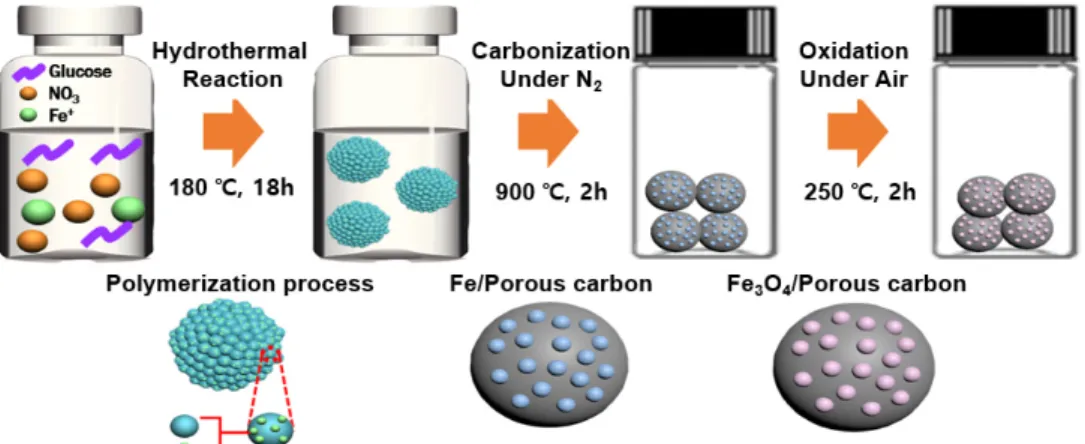
The synthetic process of Fe

3

O

4

/porous carbon com- posite is described in Scheme 1. For avoiding aggrega- tion among Fe

3

O

4

nanoparticles, porous structured car- bon acts as matrix. Nitric acid was used for dissolving Fe(NO

3

)

3

⋅9H

2

O, and dextrose was added additionally.

The homogeneous solution was transferred into tef- lon-lined reactor for polymerization process. After that, following carbonization, oxidation were carried out to synthesize Fe

3

O

4

/porous carbon composite.

The Fe

3

O

4

/porous carbon composite was synthesized

with 3 : 1 ratio of dextrose : Fe(NO

3

)

3

⋅9H

2

O, 2.0 g

PAA was used for its porous structure. XRD analysis

were performed to identify structure of the composite.

(3)

Fig. 1. XRD pattern of Fe

3

O

4

/porous carbon composite.

Fig. 1 shows that the composite included Fe

3

O

4

was successfully synthesized from the XRD peaks. The peaks of Fe

3

O

4

/porous carbon composite at 26°, which shows broad carbon peak and Fe

3

O

4

peaks at the same time. In comparing the Fe

3

O

4

peaks (JCPDS 75-0449), the composite confirms that it is constructed with car- bon and Fe

3

O

4

.

As shown in Fig. 2(a), (b), the composite has about 3~5 µm size with spherical shape. They show the com- posite consists of porous carbon matrix. From these porous structures, we can expect that the increased sur- face area will allow to facilitate the adsorption for Cu

2+

ions. In Fig. 2(c), the SEM image of reference Fe

3

O

4

particles shows that about 500 nm size of Fe

3

O

4

nanoparticles compose nano-micro particles.

BET measurement were performed to analyze the

Fig. 2. SEM images of (a) Fe

3

O

4

/porous carbon composite, (b) an enlarged view of the Fe

3

O

4

/porous carbon compo- site, (c) Fe

3

O

4

particles.

specific surface area and pore size distributions of Fe

3

O

4

, Fe

3

O

4

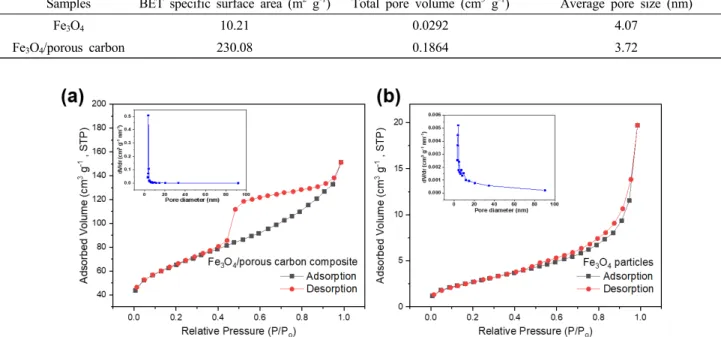
/porous carbon composite. As shown in Fig. 3(a), the Fe

3

O

4

/porous carbon composite represents IV types isotherm which demonstrates a capillary condensation at mesoporous region[15]. In other words, hysteresis loop occurs between 0.4~0.95 relative pressure and the composite is mainly composed of mesoporous. In addi- tion, the adsorption of Cu

2+

ions can be expected to be more effective based on the specific surface area and the total pore volume of the Fe

3

O

4

/porous carbon com- posite than the Fe

3

O

4

particles (Table 1). On the other hand, in the case of Fe

3

O

4

particles, the hystersis loop is formed relatively small, which indicates that meso- porous are significantly less than the Fe

3

O

4

particles/

Scheme 1. Synthesis of Fe

3

O

4

/porous carbon composite.

(4)

porous composite.

Adsorption experiments were conducted to identify that the Fe

3

O

4

/porous carbon selectively adsorb Cu

2+

ions, one of the heavy metal ions. The adsorption ex- periments were performed in the condition that the Cu

2+

ions are dissolved in the liquid phase. After 1 hour adsorption, the residual solution was analyzed by UV-visible spectra. As shown in Fig. 4(a), Cu

2+

ions

shows the maximum peak near the wavelength at 810 nm. Since Cu

2+

ions tend to precipitate in the form of Cu(OH)

2

in a solution having a pH value of about 6.5 or higher[16], the adsorption experiment was conducted after adjusting the pH of the initial solution about 5.5.

In comparison to the adsorption capacity of Cu

2+

ions at the wavelength of 810 nm, the adsorption capacity of the Fe

3

O

4

particles shows 9.38 mg/g after 50 mins, Fig. 3. N

2

adsorption-desorption isotherms and pore size distributions of (a) Fe

3

O

4

/porous carbon composite, (b) Fe

3

O

4

particles.

Fig. 4. (a) The UV-visible spectra for adsorption of Cu

2+

ions of Fe

3

O

4

particles and Fe

3

O

4

/porous carbon composite. The in-

set in (a) presents adsorption capacity of Fe

3

O

4

/porous carbon composite and Fe

3

O

4

particles. (b) Schematic image of the ad-

sorption affinity between Fe

3

O

4

/porous carbon composite and copper ion.

(5)

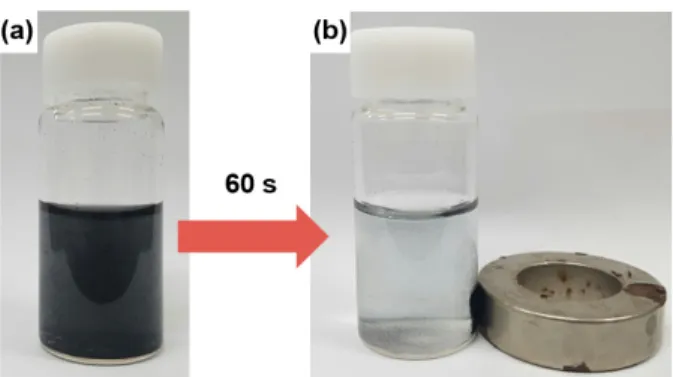
Fig. 5. Photographs of the separation process of Fe

3

O

4

/ porous carbon composite: (a) without external magnetic field and (b) with external magnetic field.

whereas the adsorption capacity of the Fe

3

O

4

/porous carbon composite shows 17.14 mg/g [Fig. 4(a) inset].

In this reason, the Fe

3

O

4

/porous carbon composite has greater adsorption capacity, about 1.8 times higher than Fe

3

O

4

particles. On the basis of the experimental re- sults, the adsorption capacity is increased from less ag- gregated during adsorption process and its higher spe- cific surface area of Fe

3

O

4

/porous carbon composite.

That is, the interaction between positively charged Cu

2+

ions and negatively charged Fe

3

O

4

particles, the syn- ergetic effect of preventing the aggregation of the Fe

3

O

4

nanoparticles and increasing the contacting area enable its higher adsorption capacity [Fig. 4(b)][14].

In order to confirm the magnetic characteristic of the Fe

3

O

4

/porous carbon composite, it was dispersed in a solution in which Cu

2+

ions contained, and the external magnetic force was applied. The Fe

3

O

4

/porous carbon composite is easily dispersed in DI water containing Cu

2+

ions [Fig. 5(a)], and the solution becomes black due to the Fe

3

O

4

/porous carbon composite. As soon as the neodymium magnet was placed near the vial, the Fe

3

O

4

/porous carbon composite interacted rapidly and gathered near the magnet. After 60 seconds, most of the Fe

3

O

4

/porous carbon composite was collected [Fig.

5(b)]. On the basis of this, when the Fe

3

O

4

/porous car- bon composite is used as a membrane, handy separa- tion using external magnetic force will be possible in the solution where the heavy metals are dissolved.

4. Conclusions

Hydrothermal synthesis was used to synthesize the Fe

3

O

4

/porous carbon composite for the effective adsorp- tion of Cu

2+

ions. The composite consists of a porous carbon matrix in which Fe

3

O

4

nanoparticles are em- bedded in. It shows an improved adsorption capacity of Cu

2+

ions by increasing the contacting area based on the relatively high specific surface area. Aggregation during the adsorption process, which is a drawback of the Fe

3

O

4

nanoparticles for Cu

2+

ions adsorption, can be alleviated through the porous carbon matrix of the composite. In addition, the composite can be easily separated from a heavy meal ions containing solution by using an external magnetic force, suggesting the possibility of using it as a membrane for selective ad- sorption of Cu

2+

ions.

Acknowledgements

This research was supported by the Nano-Material Technology Development Program through the National Research Foundation of Korea (NRF), funded by the Ministry of Science, ICT and Future Planning (2009- 0082580). It was also supported by an NRF grant funded by the Korean government (MSIT) (No. NRF- 2018R1C1B5033164).

Reference

1. N. Boujelben, J. Bouzid, and Z. Elouear, “Adsorp- tion of nickel and copper onto natural iron ox- ide-coated sand from aqueous solutions: Study in single and binary systems”, J. Hazard. Mater.,

163(1), 376 (2009).

2. L. Järup, “Hazards of heavy metal contamination”, Br. Med. Bull., 68(1), 167 (2003).

3. S. A. Ong, E. Toorisaka, M. Hirata, and T. Hano,

“Adsorption and toxicity of heavy metals on acti- vated sludge”, ScienceAsia, 36(3), 204 (2010).

4. Y. Nuhoglu and E. Oguz, “Removal of copper (II)

(6)

7. A. Z. M. Badruddoza, A. S. H. Tay, P. Y. Tan, K.

Hidajat, and M. S. Uddin, “Carboxymethyl-β-cy- clodextrin conjugated magnetic nanoparticles as nano-adsorbents for removal of copper ions: Syn- thesis and adsorption studies”, J. Hazard. Mater.,

185(2-3), 1177 (2011).

8. D. Karabelli, C. Üzüm, T. Shahwan, A. E. Eroglu, T. B. Scott, K. R. Hallam, and I. Lieberwirth,

“Batch removal of aqueous Cu

2+

ions using nano- particles of zero-valent iron: A study of the capacity and mechanism of uptake”, Ind. Eng. Chem. Res.,

47(14), 4758 (2008).

9. B. Yu, Y. Zhang, A. Shukla, S. S. Shukla, and K.

L. Dorris, “The removal of heavy metal from aque- ous solutions by sawdust adsorption-removal of copper”, J. Hazard. Mater., 80(1-3), 33 (2000).

10. R. Chen, C. Zhi, H. Yang, Y. Bando, Z. Zhang, N.

Sugiur, and D. Golberg, “Arsenic (V) adsorption

13. M. D. Ma, H. Wu, Z. Y. Deng, and X. Zhao,

“Arsenic removal from water by nanometer iron oxide coated single-wall carbon nanotubes”, J. Mol.

Liq., 259, 369-375 (2018).

14. Z. Wu, W. Li, P. A. Webley, and D. Zhao, “Ge- neral and controllable synthesis of novel meso- porous magnetic iron oxide@carbon encapsulates for efficient arsenic removal”, Adv. Mater., 24(4), 485 (2012).

15. K. S. W. Sing, “Reporting physisorption data for gas/solid systems with special reference to the de- termination of surface area and porosity (Recommen- dations 1984)”, Pure Appl. Chem., 57(4), 603 (1985).

16. Y. Lin, H. Chen, K. Lin, B. Chen, and C. Chiou,

“Application of magnetic particles modified with

amino groups to adsorb copper ions in aqueous

solution”, J. Environ. Sci., 23(1), 44 (2011).

수치

Fig. 1. XRD pattern of Fe 3 O 4 /porous carbon composite.
Fig. 4. (a) The UV-visible spectra for adsorption of Cu 2+  ions of Fe 3 O 4  particles and Fe 3 O 4 /porous carbon composite
Fig. 5. Photographs of the separation process of Fe 3 O 4 /  porous carbon composite: (a) without external magnetic  field and (b) with external magnetic field

참조

관련 문서

Consequently, the Stress Coping Training Program is effective for improving children's school adjustment and sub-factors of school adjustment such as

For job characteristics sub-factors, while the average of functional diversity was high in graduate school graduates, the average of task importance, job

Second, as a result of the IPA analysis of the sub-factors of audience perception, the factors of entry route were located in the first quadrant, the

This is because that the thermal conductivity and solar weighted absorption fraction of MWCNT/Fe 3 O 4 hybrid nanofluid is lower than those of MWCNT

This study was conducted to recognize the importance of self - management of dance major students and to understand the relationship between the sub -

Among the sub-factors, confidence, The factors of setting, team harmony, image and will power were higher in the group with national representative

Piles do not support the load rather acts as a medium to transmit the load from the foundation to the resisting sub-stratum – Friction pile( 마찰말뚝 ): driven at a site where

The results of this study are as follows: ⑴ 4 basic directions, 16 themes, and 64 sub-themes of the vocational high school development are established, and