Ti-(44-54)at.%Al 열처리 주조합금의 미세조직과 인장특성에 관한 연구
정재영†
경북대학교 자동차부품소재연구소
A Study on the Microstructures and Tensile Properties of Heat-Treated Cast Ti-(44-54)at.%Al Alloys
Jae-Young Jung†
Automobile Parts & Materials Research Center, Kyungpook National University, Daegu 41566, Korea
Abstract
In this study, the variations of microstructures and tensile properties of Ti-(44-54)at.%Al binary alloys were investigated. The heat-treated microstructure depended greatly on their solidification structure and annealing temperature. We measured the variations of volume fractions of primary and secondary lamellar structure as a function of the heat treatment temperature in a Ti-47at.%Al alloy. The variation of ductility as a function of Al content was in good agreement with the change of fracture mode in the tensile fracture surface. It can be inferred that the variations of yield stress and hardness of γ phase in a single γ-phase field region are enhanced by anti-site defects created by deviations from the stoichiometric composition. In a Ti-47at.%Al alloy within the (α2+γ) two-phase field, the yield stress tended to be the maximum at a near equal volume fraction of lamellar and γ grains. The ductility depended sensitively on the overall grain size and Al content. The calculation of fracture strain using Chan’s model indicated that the change of ductility as a function of annealing temperature was primarily determined by the variations in the overall grain size and lamellar volume fraction.
Key words : Ti-(44-54)at.%Al alloys, Tensile properties, Cast Ti-Al binary alloys, Heat-treated cast microstructures, Tensile fracture mode
1. 서 론
감마 타이타늄알루미나이드는 컴프레스 케이스, 테빈블레이 드 같은 고온구조재료에 대한 잠재적인 후보로 빠르게 성장 하고 있다[1,2]. 또한 타이타늄알루미나이드 제조공정에 대한 연구가 일반 Ti 합금에도 문제가 되는 알파 케이스 형성이나 cold hearth 도가니가 아닌 CaO 도가니로 대체하는 공정연 구도 진행되고 있다[3,4]. 그러나 낮은 연성은 여전히 감마 타이타늄알루미나이드의 일반화를 이끌지 못하고 있다. 주조 감마 타이타늄알루미나이드는 열처리 조건에 따라 각각 특징 적인 기계적 특성을 나타내는 near gamma, duplex, near
lamellar 조직 등 여러가지 미세조직을 갖게 된다[5].
이러한 다양한 미세조직의 전개는 크게 응고조직에 의존한 다. 주조조직에서 덴드라이트간 응고에 의해 형성된 고립된 γ 상의 결정립의 존재는 주로 near gamma나 듀플렉스 미세조 직의 생성에 기여한다[5]. Al함량에 따른 파괴인성, 크립 및 인장특성 등과 같은 기계적 특성은 주조상태 잉곳에서 약 47at.%Al 조성에서 최대치를 보인다[6-8]. 이러한 기계적 특 성변화는 응고조직의 결정입도 또는 덴드라이트 셀 크기가 열처리 미세조직 변화에 영향을 받기 때문이다.
본 연구의 목적은 Ti-(44-54)at.%Al 열처리 주조합금의 미 세조직과 기계적 특성을 상세하게 조사하는 것이다. 인장특성
Received: Sep. 29, 2017 ; Revised: Dec. 14, 2017 ; Accepted: Dec. 16, 2017
†
Corresponding author: Jae-Young Jung (Kyungpook Nat'l Univ.) Tel: +82-53-950-7504, Fax: +82-53-950-7505
E-mail: [email protected]
Journal of Korea Foundry Society 2017. Vol. 37 No. 6, pp. 199~206 http://dx.doi.org/10.7777/jkfs.2017.37.6.199 pISSN 1598-706X / eISSN 2288-8381
© Korea Foundry Society, All rights reserved.
This is an Open-Access article distributed under the terms of the Creative Commons Attribution Non-Commercial License (http://creative-
commons.org/licenses/by-nc/3.0) which permits unrestricted non-commercial use, distribution, and reproduction in any medium, provided the
original work is properly cited.
−
200−
정재영의 체계적인 연구는 주로 Al함량과 어닐링온도 변화에 따른 열처리 주조조직의 변화에 대해 이루어졌다. 특별한 강조는 미세조직 형태에 따라 크게 변하는 인장 연성에 두었다. 그 러므로 본 연구는 TiAl 금속간화합물의 인장연성을 개선하기 위한 금속학적인 근거를 제공할 수 있을 것으로 예상한다.
2. 실험 방법
고순도 약 12 g의 버턴모양의 Ti-(44-54)at.%Al 합금이 첫 째로 Ar 분위기하에서 진공아크용해로에서 용해되고 주조되었 다. 시가모양의 잉곳은 이들 두개의 버턴을 함께 재용해함으 로써 만들어졌다. 합금조성은 EDS, DX-4가 장착된 Philips SEM-515에서 분석되었고 그 결과는 표준 샘플인 Ti-50at.%Al 의 결과와 비교하여 체크하였다.
주조상태의 잉곳은 진공을 뽑고 Ar으로 채운 석영관에 봉 합되었다. 주조 잉곳들은 Fig. 1의 평형상태도에 표시된 α 또는 α+γ (또는 α2+γ)상 영역에 해당하는 여러가지 온도에 서 열처리된 후에 상온까지 공냉되었다. 열처리 주조조직은 시 가 모양의 잉곳의 중심부를 이용하였고, 엣칭액은 66%H2SO4 + 26%HNO3+ 8%HF을 이용하였다.
인장시험용 시편은 시가 모양의 잉곳을 그라인딩에 의해 기계가공되었다. 인장시편은 18 mm 게이지 길이와 3 mm 직 경을 갖는 smooth-head bar 모양이다. 인장시편은 1000- 1300oC에서 24시간 또는 1380oC에서 0.5시간 동안 열처리되 었고 공냉되어 900oC에서 4시간동안 시효처리되었다. 상온 인 장시험은 Instron 4206을 이용하여 공칭변형속도, 5 × 10⁻⁴s−1 로 수행되었다. 인장시험 후, 일부 시편의 파단면이 SEM에
의해 관찰되었다.
3. 연구 결과 및 고찰 3.1 열처리 주조조직
첫째로 열처리 주조조직은 Al함량의 함수로써 관찰되었고 그 생성과정은 Ti-Al 상태도와 상변태의 관점으로 해석되었 다. 그리고 Fig. 1은 Ti-Al상태도에 현재 합금조성 범위를
Fig. 1.
Ti-Al phase diagram shows which phases are to be expected at equilibrium for different combinations of aluminum content (expressed in atomic %) and temperature (in oC).The Ti-Al phase diagram was calculated with Thermo-Calc, coupled with SSOL2 thermodynamic database. (http://
www.calphad.com/titanium-aluminum.html).
Fig. 2.
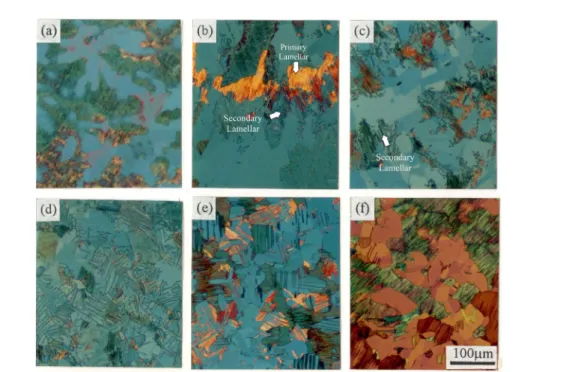
Optical micrographs of cast structures heat-treated at 1200oC for 24hr and air-cooled as a function of Al content: (a) Ti-44at.%Al; (b) Ti- 45%Al; (c) Ti-47at.%Al; (d) Ti-49%Al; (e) Ti-50at.%Al; (f) Ti-52%Al.라인A로 표시하였다. Fig. 2는 1200oC에서 24시간동안 열처 리되고 공냉한 Ti-(44-54)at.%Al 합금의 미세조직 변화를 보 여준다. 주조상태의 앞서 관찰로부터 우리는 그것들의 열처리 미세조직의 전개가 응고조직에 크게 의존한다는 사실을 예상 할 수 있다[9]. 열처리 Ti-rich 주조합금(~44at.%Al)은 미세 한 라멜라 간격을 갖는 미변태 1차 라멜라 영역과 조대한 2 차 라멜라 셀로 구성되어 있다. 조대한 라멜라 셀은 불연속 조대화 반응의 전형적인 미세조직이다[10]. 보다 더 Al함량을 갖는 금속간 화합물(~47at.%Al)에서는, 많은 양의 등축 γ상 과 덴드라이트 코어의 흔적이었던 조대한 2차 라멜라 셀을 보인다. 2차 라멜라 조직의 성장속도는 α와 γ상 분률에 민 감하게 의존하는 것으로 알려져 있고, α와 γ상이 각각 비슷 한 상분률에서 가장 빠른 성장속도를 보인다[11-13]. SEM의 EDS를 이용한 화학성분분석은 주조상태 잉곳의 덴드라이트 코어에서 조성이 ~44.9at.%Al이었고 이것은 Ti-47at.%합금에 서 고온 β상 내에서 dendrite coring으로 인한 조성변화와 일치하는 값이다. 이 조성은 또한 1200oC에서 α와 γ상이 동등한 상분률을 갖는 조성인 45.1%Al에 근접하다. 그리고 (α+γ)/γ 상 경계보다 Al 함량(~50at.%Al)이 보다 더 증가함 에 따라, 미세조직은 γ상 단일상을 보여준다. 그리고 γ상 결 정립도는 단일 γ상 영역에서 Al 함량이 증가함에 따라 증가 한다.
두 번째로 Ti-47at.%Al 합금에서 열처리 온도의 함수로써 열처리 주조조직의 변화가 관찰되었고 그 형성과정은 Ti-Al 상태도와 상변태에 대해 해석되었다. Fig. 3은 1000-1380oC 에서 열처리되고 공냉된 γ기지 금속간 화합물(~Ti-47at.%Al)
의 미세조직 변화를 보여준다. Fig. 1의 Ti-Al상태도에 Ti- 47at.%Al합금에 대한 열처리온도 범위를 라인B로 표시하였다.
γ기지 합금의 주조조직은 열처리에 의해 차이나는 fully lamellar (FL), near lamellar (NL), duplex (D), 그리고 near gamma (NG) 미세조직의 네가지 형태로 조절될 수 있다.
Ti-47at.%Al합금의 1차 라멜라 조직의 체적분률은 크게 어닐 링 온도에 의해 변화하고 1150-1250oC온도 범위에서는 존재
Fig. 3.
Optical micrographs of cast structures of a Ti-47at.%Al alloy, which heat-treated at various temperatures for 24hr and air-cooled: (a)1000oC; (b)1100oC; (c) 1150oC; (d) 1250oC; (e) 1300oC; (f) 1330oC.
Fig. 4.
Variations of volume fractions of primary and secondary lamellar structure as a function of heat treatment temperature in a Ti-47at.%Al alloy.−
202−
정재영하지 않는다(Fig. 4). 저온영역에서의 1차 라멜라 조직의 증 가는 불연속 조대화 반응에 대한 최대 성장속도를 갖는 화학 성분의 천이와 그들의 더 느린 성장속도로부터 야기된다. 고 온영역에서 1차 라멜라 조직의 증가는 냉각중에 고온 α상내 에 γ상 판의 빠른 형성 속도에 기인한다. 1150-1300oC 온도 범위에서 2차 라멜라 조직은 미세한 라멜라 조직으로 구성된 덴드라이트 영역에서의 주로 불연속조대화 반응에 의한 것이 다. 2차 라멜라 조직의 체적분률은 또한 열처리 온도에 따라 변화하고 약 1250oC에서 최대치를 보인다. 이러한 결과들은 어닐링 온도에 따라 α상과 γ상의 체적분률이 같아지는 Al 조성의 변화와 연계된다.
3.2 기계적 특성
Ti-Al 이원합금의 인장특성은 Al함량과 열처리 온도의 효 과들에 의해 평가되었다. 특히 인장연성의 예측은 위에 관찰 하였던 주조잉곳재의 열처리 미세조직을 근거로 수행하였다.
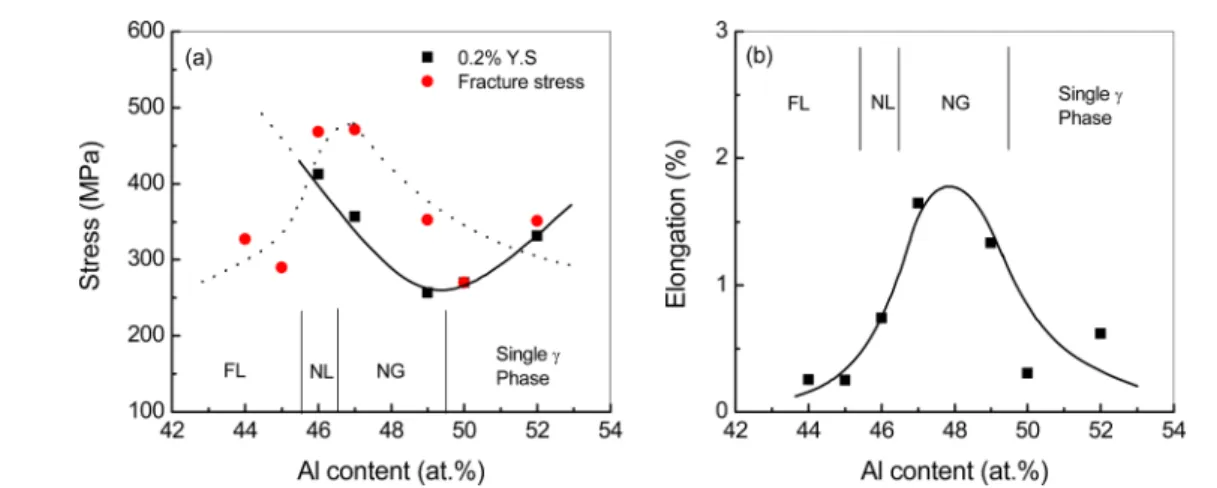
Fig. 5는 Al함량의 함수로써 인장특성의 변화를 나타내었다.
본 시험에 사용된 금속간화합물들은 1200oC에서 24시간동안 열처리되었고 공냉된 후에 최종적으로 900oC에서 시효처리되 었다. Al함량의 함수로써 인장 연성의 변화는 약 48at.%Al 에서 최대치를 보인다.
Ti-rich 화합물(44-45at.%Al)의 연성은 작은 라멜라 셀 크 기에도 불구하고 매우 취성이 크다. 이것은 합금들의 인장 파단면 관찰에서 명백해진다. Lamellar delamination이 미세한 라멜라 구조에서 지배적인 파괴모드이고 반면에 translamellar 파괴는 불연속 조대화된 라멜라 조직에서 지배적인 파괴모드 로 나타난다(Fig. 6a). 불연속조대화된 라멜라 조직에서 translamellar 파괴가 주로 일어나는 경향은 2차 라멜라 셀과 소량의 등축 γ상 결정립으로 구성된 Ti-46.at%Al 합금의 파 단면에서 더 명백해진다(Fig. 6b). 이것은 또한 Ti-rich 화합 물의 취성(lamellar delamination)이 미변태된 미세한 라멜라 영역과 관련된다는 것을 보여주고 있다. Al 함량이 더 많은
금속간화합물에 대해서는 등축 γ상 결정립의 transgranular cleavage가 이들 합금에서 지배적인 파괴모드이다(Fig. 6c).
단일 γ상 영역쪽으로 Al 함량을 보다 더 증가시키면, 파괴모 드는 지배적인 transgranular cleavage모드에 덧붙여 결정립 계 파괴가 일부 나타나는 경향이 있다(Fig. 6d). Al-rich 화
Fig. 5.
Variations of tensile yield and fracture stress (a) and of tensile elongation (b), as a function of Al content, of cast structure heat-treated acondition of (1200oC/24hr/AC+900oC/4hr).
Fig. 6.
Scanning electron micrographs of tensile fracture surfaces illustrating the fracture mode, as a function of Al content, of heat-treated cast structures (1200oC/24hr/AC+900oC/4hr):(a) Ti-45%Al; (b) Ti-46%Al; (c) Ti-47%Al; (d) Ti-50%Al.
합물에 대한 연성저하는 Al함량 증가함에 따라 공유결합 특 성, c/a비의 증가와 관련된다고 알려져 있다[5,14].
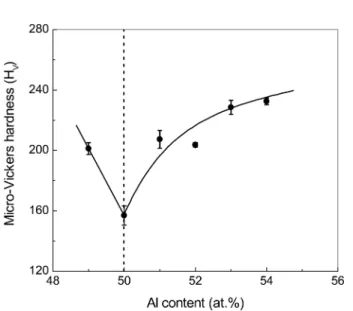
반면에 Al 함량에 따른 인장 항복강도의 변화는 약 49.5at.%Al에서 최소치를 보인다. Ti-rich 화합물에 대한 항 복강도의 강화는 주로 2차 라멜라 셀의 미세화와 α2상의 증 가에 기인한다. Al-rich 화합물에서, 항복강도는 단일 γ상 영 역에서 γ 결정립도의 증가함에도 불구하고 Al 함량이 증가함 에 따라 증가한다. 이것은 단일 γ상 합금에서 비화학양론적 편차에 의한 anti-site 결함으로 인한 강화 효과로 인한 것이 다. γ상에서 화학양론적 편차는 공공보다는 anti-site 결함을 형성하는 것으로 알려져 있다[15,16]. 이 사실은 또한 단일 γ상의 Al 함량이 증가함에 따라 경도가 높아지는 변화에 의 해 확인된다(Fig. 7).
어닐링 온도의 함수로써 Ti-47at.%Al 합금의 인장 특성변 화는 Table 1에 요약하였다. 미세조직과 인장특성의 상관성은 어닐링 온도와 함께 구성상(감마와 라멜라 결정립)의 체적분
률과 결정립 크기가 변하기 때문에 복잡하다. 그러나 기계적 특성에 미치는 미세조직의 효과의 트랜드가 시험결과에서 나 타난다. 일반적으로 약 50%의 라멜라 조직을 갖는 듀플렉스
Fig. 7.
Variation of hardness of γ phase as a function of Al content insingle γ-phase.
Table 1.
Values of parameters used in the calculation of fracture strain using Chan’s model and the variation of tensile properties as a function of annealing temperature in a Ti-47at.%Al alloy.Annealing Temperature (oC) fα n KIC* (MPa) d (μm) 0.2% Y.S (MPa) F.S (MPa) ε (%)
1000 0.51 3.11 19.60 104.6 419.1 471.2 0.74
1100 0.16 5.28 17.50 98.8 352.0 442.6 1.13
1200 0.27 6.38 18.40 78.2 356.7 471.1 1.65
1250 0.32 4.70 18.75 67.4 341.8 491.5 1.95
1300 0.41 3.18 19.20 66.1 396.0 419.0 0.77
1330 0.76 3.10 20.30 312.2 325.2 386.9 0.86
1380 1.00 3.00 22.75 1300.0 307.4 307.4 0.30
*Data from Ref.23-26
Fig. 8.
Variations of tensile yield stress (a) and elongation (b) as a function of lamellar volume fraction and overall grain size in a Ti-47at.%Al alloy, respectively.−
204−
정재영조직(1000 and 1300oC)은 다른 미세조직에 비해 더 높은 항복강도를 보여준다(Fig. 8a). 이 결과는 보다 낮은 라멜라 체적분률에 대한 항복강도의 저하는 높은 Hall-Petch 상수, ky값(~4.6MPa )[1,17]을 갖는 라멜라 구조로 인한 강화효 과가 감소하기 때문이다. 라멜라 분률이 높은 미세조직에서 항복강도의 감소는 주로 레멜라 결정립 크기가 크게 증가하 여 강도가 낮아지기 때문이다. 이 결과는 2상 미세조직에 대 한 modified extended Hall-Petch 식에 의해 별도의 논문에 서 정량적으로 분석되었다[18].
반면에 라멜라 조직의 체적분율은 직접적으로 연성에 관련 되지 않는 것으로 보여진다. 그러나 Fig. 8b는 인장연성과 전체 결정립 크기간에 일정한 경향을 보여준다. 그리하여 미 세한 전체 결정립 크기는 더 높은 연성을 유도한다. 전체 결 정립 크기, 는 각 구성상의 평균 결정립 크 기에 상 분률을 곱하여 계산될 수 있다. 단 fα and dα는 각각 라멜라 체적분률과 결정립 크기이고 fγ and dγ는 각각 γ 상의 체적분률과 결정립 크기이다.
Chan[19]은 파괴연신률을 예측하는 내부 균열길이, 2a를 포함하는 둥근 바 형태의 시편의 J-integral에 대한 Dowling 의 이론[20]을 적용함으로써 하나의 모델을 제안하였다. 그 모델은 파괴가 tearing modulus가 TR→ 0일 때, 균열 불안정 기준 J/JIC≥ 1 에 의해 지배된다고 가정하였다. fully lamellar structure의 tearing modulus는 상온에서 무시할 수 있다. 반 면에 듀플렉스와 near gamma조직의 tearing modulus도 거 의 영이다[19]. 본 모델에서 내부 균열길이, 2a를 결정립 크 기, d로 가정함으로써 하기와 같이 주어진다.
(1)
단 Je, Jz and Jp는 각각 elastic loading, Irwin’s plastic zone term, 그리고 plastic loading에 대한 J-integral이다.
σ∞와 σy는 flow 및 항복강도이다. Je, Jz/Je, Jp/Je에 대한 표 현식은 power law hardening으로 표현된 탄.소성물질에 대 해 Dowling에 의해 유도되어 있다. Jz/Je항은 (σ∞/σy)과 가 공경화지수의 역수, n의 함수이다. Jp/Je 항은 (εp/εe)과 가공
경화지수의 역수, n의 함수이고 는 각각 파괴에서 εe와 εp는 탄성 연신률과 소성 연신률이다. 이 때 εp는 Ramberg- Osgood 식으로 표현된다.
(2)
단 εe는 σ∞/E로 εy는 σy/E 로 주어진다. 그것은 Jp/Je 항 이 또한 (σ∞/σy)과 n 에 의존하는 함수로 만든다. 우리는 J/
JIC= 1조건을 적용함으로써 식(1)을 이용하여 파단시 flow stress를 계산할 수 있다. 우리는 식(1)로부터 파단시 σ∞를 얻으면, 우리는 그 때 식(2)를 사용하여 εp를 계산하고 εe(=σ∞/E)과 εp의 합인 총 파괴연신률을 계산할 수 있었다.
n과 α'의 값은 현재 인장실험 데이터에서 얻어졌다. 문헌조사 는 near gamma조직의 KIC 는 대부분 near gamma조직에 존재하는 합금조성이라기 보다는 제2상 분율에 영향을 받는 다고 보여준다. 예를 들면, α2상을 ~17.2 vol.% 를 갖는 듀 플렉스 조직에서 KIC는 ~11.4MPa [21]인 반면에 단일상 γ 합금은 ~8MPa 이다[22]. KIC 값은 열처리 주조 Ti-47Al- 2Mn-2V 합금에서 라멜라 체적분률에 따른 파괴인성 측정에 얻어진 논문과 앞선 연구에서 측정된 γ상 체적분률에 따른 Ti-Al 합금의 파괴인성을 요약하였다[23-26]. 바꾸어 말하면, 라멜라 조직이 상보다 더 높은 파괴인성을 갖는 미세조직으 로 보인다. 특징적인 사실은 fully 라멜라 조직에서 약 10%
γ상의 존재는 파괴인성을 크게 감소시킨다. 그러나 단일 γ상 구조에서 약 10%의 라멜라 조직의 생성은 파괴인성을 크게 증가시키는 것으로 판단된다.
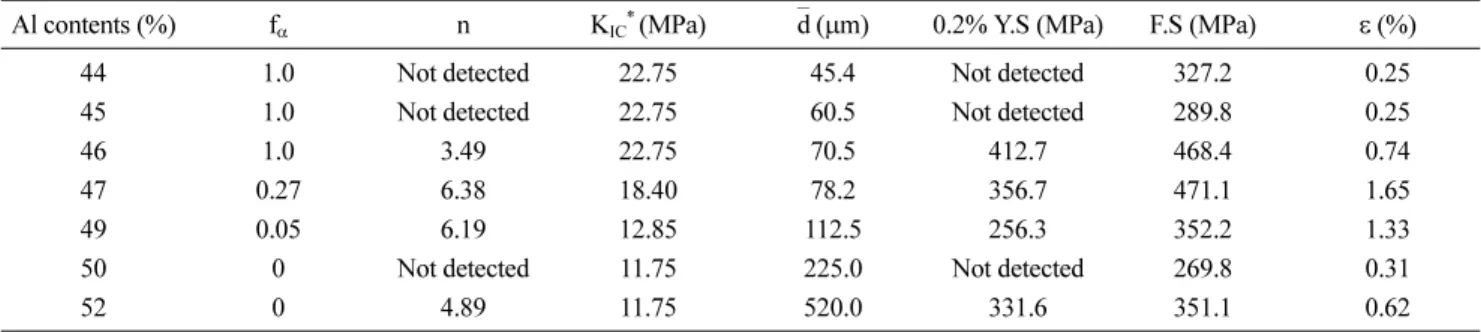
γ상 함량에 따른 가공경화지수의 역수, n은 Table 1, 2에 보여준다. Table 1, 2는 γ상 함량이 증가하면 n이 다소 증 가하는 것으로 판단된다. 다시 말하면 라멜라 조직이 γ상보다 가공경화에 대해서는 훨씬 더 유리한 미세조직이라는 것을 의미한다. Chan의 모델에 필요한 모든 변수는 현재 합금의 인장연성을 예측하는데 필요한 모든 데이터로부터 얻어졌다.
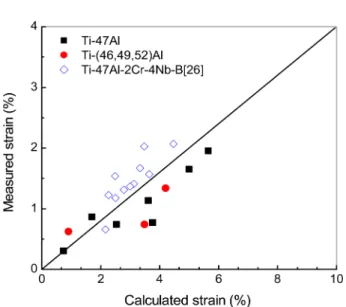
그 분석 결과(Fig. 9)는 계산 및 측정된 파괴연신률간에 직 선관계를 보여준다. Ti-47Al-2Cr-4Nb-B 합금의 파괴 인장 연신률도 또한 함께 도식화하였다[27]. 이것은 이 모델이 모 m
d(=dαfα+dγfγ)
J JIC
--- 0.405πdσy2 2KIC2 --- σ∞
σy ---
⎝ ⎠⎛ ⎞2 1 Jz Je ---- Jp
Je + +----
⎝ ⎠
⎛ ⎞
=
εp α′εy σ∞ σy ---
⎝ ⎠⎛ ⎞n
=
m m
Table 2.
Values of parameters used in the calculation of fracture strain using Chan’s model and the variation of tensile properties as a function of Al content in Ti-(44-52)at.%Al alloys (1200oC/24hr/AC+900oC/4hr).Al contents (%) fα n KIC* (MPa) d (μm) 0.2% Y.S (MPa) F.S (MPa) ε (%)
44 1.0 Not detected 22.75 45.4 Not detected 327.2 0.25
45 1.0 Not detected 22.75 60.5 Not detected 289.8 0.25
46 1.0 3.49 22.75 70.5 412.7 468.4 0.74
47 0.27 6.38 18.40 78.2 356.7 471.1 1.65
49 0.05 6.19 12.85 112.5 256.3 352.2 1.33
50 0 Not detected 11.75 225.0 Not detected 269.8 0.31
52 0 4.89 11.75 520.0 331.6 351.1 0.62
*Data from Ref.23-26
든 미세조직의 연성변화 거동을 아주 합리적으로 잘 예측할 수 있다고 보여진다. 계산된 파괴 연신률이 실험적으로 측정 된 것에 비하여 3배 정도 더 크다. 이것은 본 계산에 사용 된 KIC값의 과대평가로 인한 것일 수 있다. 일반적으로 chevron-notched short rod 시편으로 측정된 파괴인성은 compact tension specimen[21,22]을 사용하는 것에 비해 더 큰 값으로 측정되는 것으로 나타나기 때문이다.
4. 결 론
본 연구에서는 Ti-(44-54)at.%Al합금을 이용하여 Al 함량 과 열처리 온도의 함수로써 열처리 주조조직과 기계적 특성 을 조사한 결과, 다음과 같은 결론을 얻었다.
Ti-(44-54)at.%Al 합금의 열처리 미세조직은 응고조직과 어 닐링 온도에 크게 의존하였다. Al 함량의 함수로써 연성의 변화는 인장 파단면의 파괴모드 변화와 함께 잘 일치하였다.
단일 γ 상 영역에서 γ 상의 항복강도와 경도의 변화는 화학 양론적 조성으로부터 편차에 의해 만들어지는 anti-site 결함 에 의해 강화된다고 추론할 수 있었다.
(α2+γ) 이상영역내 Ti-47at.%Al합금에서, 항복강도는 라멜 라와 γ 상의 체적분율이 거의 같을 때 최고치를 보이는 경 향이 있었다. 연성은 전체 평균 결정립크기에 민감하게 의존 하였다. Chan의 모델을 이용한 파괴연신률의 계산은 어닐링 온도의 함수로써 연성 변화가 전체 결정립 크기와 라멜라 체 적분율의 변화에 의해 결정된다는 것을 가르킨다.
감사의 글
본 논문은 국방과학연구소(TEMD-411-950763)의 재정적인
지원에 의해 수행되었으며 이에 감사드립니다.
References
[1] Kim YW, Wilfried Smarsly, Junpin Lin, Dennis Dimiduk, Fritz Appel, eds., Gamma Titanium Aluminide Alloys 2014, TMS, Warrendale, PA (2014).
[2] Kunal Kothari, Ramachandran Radhakrishnan and Norman M. Wereley, Progress in Aerospace Sciences, “Advances in Gamma Titanium Aluminides and Their Manufacturing Techniques”, 55 (2012) 1-16.
[3] Lee SH, Kim MG, Sung SY and Kim YJ, J. Korea Foundry Society, “Effects of Process Parameter on Alpha-Case For- mation of Ti and TiAl Castings”, 23 (2003) 137-146.
[4] Kim MG, Sung SY and Kim YJ, J. Korea Foundry Society,
“CaO Crucible Induction Melting and Investment Casting of TiAl Alloys”, 22 (2002) 75-81.
[5] M.Takeyama, Mater. Sci. Eng., “Microstructural Evolution and Tensile Properties of Titanium-Rich TiAl Alloy”, A152 (1992) 269-276.
[6] S.Tsuyama, S.Mitao and K.Minakawa, Microstructure/
Property Relationships in Titanium Aluminides and Alloys,
“Effects of Aluminum Content and Microstructure on Fracture Toughness of Binary TiAl Alloys”, TMS, Warrendale, PA (1991) 213-226.
[7] S.Mitao, S.Tsuyama and K.Minakawa, Microstructure/Pro- perty Relationships in Titanium Aluminides and Alloys,
“Effect of Aluminum Content on Creep Deformation Be- haviour of Gamma-Titanium Aluminides”, TMS, Warrendale, PA (1991) 297-311.
[8] Y.Nishyama, T.Miyashita, S.Isobe and T.Noda, High Tem- perature Aluminides and Intermetallics, “Development of Titanium Aluminide Turbo-Charger Rotors”, TMS, Warrendale, PA (1990) 557-584.
[9] Jung JY, Park JK and Chun CH, Gamma Titanium Aluminides '95, “Solidification Structures of Ti-(35-58) at%Al Inter- metallic Compounds”, TMS, Warrendale PA (1995) 459-466.
[10] Park JK, Lee YC, Jung JY, and Lee YT, in Proc. 3rd Japan SAMPE Symp. on “Advanced Materials” -New Processes and Reliability-, “Discontinuous Coarsening of Cellular Structure in a Ti-44at.%Al Intermetallic Compound”, JIM, Chiba, Japan 2 (1993) 1359-1364.
[11] Y.Yamabe, N.Honjo and M.Kikuchi, Proceedings of Int'l Symp. Intermetallic Compounds - Structure and Mechanical Properties- “Discontinuous Coarsening of γ/α2 Lamellae in Titanium Aluminides”, JIM, Sendai, Japan (1991) 821-824.
[12] Jung JY and Park JK, Phil. Mag. A, “Influence of the γ-phase Volume Fraction on the Growth Kinetics of Discontinuous Coarsening of the Lamellar Structure in Ti-(40-46) at.% Al Intermetallic Compounds”, 80 (2000) 1127-1138.
[13] Jung JY and Park JK, Acta mater., “Growth Kinetics of Discontinuous Coarsening of the Lamellar Structure in Ti-44 at.% Al(-0.5 at.% Cr) Intermetallic Compounds”, 46 (1998) 4123-4130.
[14] M.Morinaga, J.Saito, N.Yukawa and H.Adachi, Acta Metall.,
“Electronic Effect on the Ductility of Alloyed TiAl Com- pound”, 38 (1990) 25-29.
Fig. 9.
Comparison of measured fracture strain and of the calculated fracture strain using Chan's model (eq. (2)).−
206−
정재영[15] R.P.Elliott and W.Rostoker, Acta Metall., “The Influence of Aluminum on the Occupation of Lattice Sites in the TiA1 Phase”, 2 (1954) 884-885.
[16] Y.Shirai and M.Yamaguchi, Mater. Sci. & Eng., “Studies of Vacancies and Dislocations in TiAl by Positron Annihilation”, A152 (1992) 173-181.
[17] Jung JY and Park JK, Scripta Metall. Mater., “Influence of Microstructure on the Mechanical Properties of Heat-treated Cast Lamellar Structure”, 34 (1996) 1581-1587.
[18] Jung JY, Park JK, Chun CH and Her SM, Mater. Sci. & Eng.,
“Hall-Petch relation in two-Phase TiAl alloys”, A220 (1996) 185-190.
[19] Chan KS, Metall. Mater. Trans., “Tensile Ductility of Extrinsically Toughened Intermetallics”, 25A (1994) 299-308.
[20] N.E.Dowling, Eng. Frac. Mech., “J-integral Estimates for Cracks in Infinite Bodies”, 26 (1987) 333-348.
[21] Chan KS and Kim YW, Metall. Trans., “Influence of Microstructure on Crack-tip Micromechanics and Fracture Behaviors of a Two-phase TiAl Alloy”, 23A (1992) 1663- 1677.
[22] H.E.Deve and A.G.Evans, Acta Metall. Mater., “Twin Toughening in Titanium Aluminide”, 39 (1991) 1171-1176.
[23] S.L.Kampe, P.Sadler, D.E.Larsen and L.Christodoulou, in Proc. Symp. on Microstructure/Property Relationships in Titanium Aluminides and Alloys, “Microstructure Mor- phology Effects on Fracture Toughness of a Cast Near- Gamma Titanium Aluminide Alloy”, TMS, Warrendale, PA (1991) 313-322.
[24] P. Bowen, N.J. Rogers and A.W. James, in Gamma Titanium Aluminides, “Fracture and Fatigue of Cast Gamma TiAl Based Aluminides”, TMS, Warrendale, PA (1995) 849-865.
[25] J.D. Shi, Z.J. Pu and K.H. Wu, in Gamma Titanium Aluminides ’95, “Influence of Grain Size on Tensile Pro- perties and Fracture Toughness of TiAl Based Alloy”, TMS, Warrendale, PA (1995) 709-716.
[26] W.O. Soboyejo, S.J. Midea, D.S. Schwartz and M.J.
Parzuchowski, in Proc. Symp. on Microstructure/Property Relationships in Titanium Aluminides and Alloys, “Micro- structure and the Fracture Behavior of a Binary Gamma Alloy”, TMS, Warrendale, PA (1991) 197-212.
[27] Jung JY and Park JK, J. Mater. Res., “Influence of Elemental B Addition on the Heat-treated Cast Structures of Ti-47Al- 2Cr-(2-4)Nb Alloys”, 12 (1996) 665-680.