Received April 8, 2010; Revised May 11, 2010; Accepted June 17, 2010
Corresponding author: Yun Kyung Shin
Tel: +82 (51) 720-2423 e-mail: [email protected] 1225-3480/24347
WSF(Water Soluble Fraction) 가 북방전복,
Haliotis discus hannai
(Ino, 1952) 의 유생 및 치패발생에미치는 영향
진영국, 정춘구, 오봉세, 전제천
1, 신윤경
1남서해수산연구소 해역산업과, 1국립수산과학원 양식관리과
Effects of the water soluble fraction of crude oil on the abalone, Haliotis discus hannai (Ino, 1952) early life stage
Young Guk Jin, Choon Koo Jung, Bong se Oh, Je Cheon Jun
1and Yun Kyung Shin
1 Southwest Sea Fisheries Research Institute, NFRDI, Yeosu 556-823, Korea1Aquaculture management Division, NFRDI, Busan 619-705, Korea
ABSTRACT
This study was carried out to investigate the toxic effect of WSF (Water Soluble Fraction) on development time, development rate, attachment rate, survival rate and growth of the larvae during the early life stage of the abalone, Haliotis discus hannai. Also, observed effect of water temperature on the survival rate and histological change of gill in the early young shell. In the abalone, it takes around 12 hours in all experimental groups. Development and attachment rate of the abalone significantly lower more than 0.4 mg/L WSF compared to control group (P < 0.05).
Survival rate of abalone larva and spot was significantly lower more than 0.4 mg/L and 2.4 mg/L WSF compared to control group, respectively (P < 0.05). Shell growth of the abalone were significantly lower more than 2.4 mg/L WSF compared control group (P < 0.05). Survival rate lower more than 25℃ exposure group compared water temperature 17℃ exposure group in the early young shell. The gill of abalone exposed water temperature 17℃
and 25℃ was showed atrophy of nucleus and breakdown of the filament, vacuolation of filament epithelial cell.
Key words: crude oil, Haliotis discus hannai, embryo development, survival rate, growth, gill
서 론
국내외에서 빈번하게 발생하고 있는 유류 노출사고는 국내 의 허베이스프리트호 유류사고나 멕시코만 유전에서의 기름유 출에서 나타난 것과 같이 생태계에 막대한 영향을 미친다. 유 류에 의한 해양오염은 유출당시 기름막 제거를 최우선적으로 진행해 육안적인 방제효과를 보이지만, 간과하기 쉬운 유류성 분의 독성학적 영향은 생물, 환경, 지리학적 위치 등 여러 가 지 다양한 여건들과 맞물려 매우 복잡하게 나타나기 때문에 피 해규모 및 방제효과를 가늠하기 어렵다 (Clark and Finley,
1977; Capuzzo, 1987; Venkateswaran et al., 1995;
Wake, 2005).
유출된 유류의 독성학적 영향들은 주로 Naphthalene, Fluorene, Pyrene 등과 같은 다환방향족탄화수소 (PAHs:
polycyclic aromatic hydrocarbons) 에서 나타나며 (Kennedy and Farrell, 2005; Ramachandran et al., 2006; Yasunori et al., 2008), 해양생물종들 중 어류의 유영 력을 감소시키고, 성장을 지연시키며 생존율에도 악영향을 미 친다 (Alkindi et al., 1996; Brown et al., 1996; Carls et al., 1999; Heintz et al., 2000). 해양무척추동물의 경우에도 생존 및 성장 감소, 기형 증가, 생식소발달 지연, 배발생 및 유 생발달 저해 등을 일으킨다 (Stegrman and Teal, 1973;
Wu and Zhou, 1992; Stekoll et al., 1996; Cajaraville et al., 2002; Hamdoun et al., 2002; Ramachandran et al., 2006).
이러한 유류의 독성학적 영향을 관찰하기 위해선 무엇보다
Species Stage Size (μm) Number (N)
H. discus hannai
fertilized egg D 228.34 ± 1.6 3,655 ± 20.51
spat SL 265.55 ± 3.8 3,367 ± 34.2
early young shell SL 12.53 ± 1.08 mm 300
* D: Diameter, SH: Shell height, SL: Shell length
Table 1. Size and number of the abalone, H. discus hannai exposed to WSF (water soluble fraction) of crude oil 도 먼저 서식 범위가 한정된 이매패류나, 복족류 등의 무척추
동물들을 활용하는 것이 가장 효율적이다 (Zarragoitia and Cajaraville, 2006). 하지만 다양한 연구결과들을 보여주고 있는 국외와 달리 국내의 경우 일부 (Lee et al., 1975; Ahn and Chin, 1986; Chang et al., 2000; Shin et al., 2009) 를 제외하고 그 보고가 많지 않을 실정이다.
따라서 본 연구는 국내에서 높은 상품성을 가진 북방전복, Haliotis discus hannai의 수정란을 이용하여 유류의 수용 성 성분인 WSF의 농도에 따른 발생 소요시간, 생존율, 발생 률 및 유생과 부착치패의 성장 그리고 수온에 따른 치패의 생 존과 아가미에서 나타나는 조직학적 변화를 조사하였으며, 유 류의 노출이 해양 생물종에 미치는 영향 및 해양 생태계의 관 리와 보전에 대한 기초자료를 제공하고자 하였다.
재료 및 방법
1. 실험재료본 연구에 사용된 북방전복, H. discus hannai의 수정란 과 치패는 경상남도 수산자원연구소에서 분양받아 실험에 이 용하였다. 부착치패는 분양 받은 수정란이 정상적으로 발생되 어 부착판에 부착한 개체들을 이용하였다. 시험에 사용된 수정 란 및 부착치패의 크기와 개체 수는 Table 1과 같다.
2. 실험방법
실험기간은 수정란의 경우 수정-부착기, 부착치패의 경우 부 착 직후부터 부착 후 14일 그리고 치패는 21일 이었다. 실험 수온은 수정란과 부착치패 모두 23 ± 0.5℃, 치패는 17℃와 25℃로 설정하였다. 실험 용기는 각 생물종들의 시험단계에 따라 5 L 원형수조 및 0.3-3 L 유리 비-커를 사용하여 3회 반 복 실험을 하였다. 실험 용액은 두바이산 원유를 사용하였으 며, Paine et al. (1992) 와 Carmel and Holdway (2002) 등의 방법을 참고하여 원유:해수 = 1:9로 24시간 혼합하였다.
그 후 분액 깔때기에서 24시간 방치 후 분리된 유막층 아래의 수용액을 추출하여 WSF로 사용하였다. 실험용액의 농도는 gas chromatography를 이용하여 분석하였으며, total petroleum hydrocarbons (TPH) 는 19.84 mg/L였다. 이 것을 실험원액으로 하였고, 영향농도가 매우 다양하게 나타나
는 점을 고려하여 (Pelletier et al., 1997; Aherns et al., 2002) 수정란의 경우 대조구, 0.04, 0.4, 0.8, 1.6, 2.4, 3.2 및 4.0 mg/L, 부착 치패의 경우 대조구, 0.4, 0.8, 1.6, 2.4, 3.2 및 4.0 mg/L, 치패의 경우 대조구, 60, 125, 250 및 500 μg/L 를 실험 농도로 설정하였다. 실험 용액은 빛 등에 의한 휘발성을 최소화하기 위하여 비닐랩으로 실험용 비커를 밀봉 하였으며, 검은 천을 이용하여 외부로부터의 빛을 최소한으로 차단하였다. 또한 24시간 간격으로 실험 용액의 50%를 교환 하였다.
먹이는 부착기유생에 도달하기까지는 공급하지 않았으며, 부착기 유생 이후부터는 부착성 규조류가 배양된 부착 기질을 통해 공급하였다.
발생 소요시간은 수정-피면자 유생 및 부착기유생이 최소 50% 이상의 발생율을 나타내는 시점을 기준으로 설정하였으 며, 광학현미경 (Olympus, CX31) 으로 관찰하여 기록하였 다. 발생률 및 부착률은 전체 개체수를 기준으로 하여 각 단계 에 도달한 개체들을 누적백분율 (%) 로 표시하였다. 부착률을 조사하기 위해 각 유생이 부착기유생에 도달하였을 때 부착성 규조류가 미리 배양된 파판을 넣어 부착을 유도하였으며, 이후 전체 실험 개체수와 부착기질에 부착한 마리수를 계수한 후 이 를 백분율 (%) 로 표시하였다.
유생의 생존율은 수정란에서 부착기 유생까지 단계별 누적 생존율 (%) 로 표시하였다. 부착 치패 및 치패의 경우 부착판 에서 탈락한 개체들을 현미경으로 검경하여 움직임이 없는 개 체들을 사망한 개체들로 간주하였으며, 전체 개체수에서 누적 사망 개체수를 뺀 값을 생존율 (%) 로 환산하였다.
각 농도별 유생 및 부착치패의 성장을 비교하기 위하여 Image Measurement System (FOCUS technology, 2005) 을 이용하였다. 북방전복의 경우 피면자, 부착기 유생 및 부착치패 (부착 후 7일과 14일) 의 각장 (mm) 을 측정하 였다. 각 농도구별로 30개체를 측정한 후 그 평균값을 기재하 였다.
17℃와 25℃에 노출된 치패의 아가미에서 나타나는 조직학 적 변화를 관찰하기 위해 노출 종료일인 21일째에 생존 개체 의 아가미를 Bouin's solution에 고정하였다. 이후 파라핀 포 매법에 의해 조직표본을 제작하여 H-E 염색을 진행하였으며,
Species Exposure group(mg/L)
Control 0.04 0.4 0.8 1.6 2.4 3.2 4.0
Haliotis discus hannai
Veliger 0:17:10 0:17:10 0:17:10 0:17:14 0:17:26 0:17:26 0:18:00 0:18:00 early
juvenile 2:14:15 2:14:15 2:14:25 2:14:15 2:14:28 2:14:36 2:17:36 2:17:50
* d (day): h (hour): m (minute)
Table 2. Development time of fertilized eggs of abalone, Haliotis discus hannai exposed to WSF of crude oil
* * *
*
*
*
*
*
0 20 40 60 80
Fertilized egg~Veliger Veliger~Pediveliger Development stage
Survival rate (%)
Control 0.04 ㎎/L 0.4 ㎎/L 0.8 ㎎/L 1.6 ㎎/L 2.4 ㎎/L 3.2 ㎎/L 4.0 ㎎/L
Fig. 2. Survival rate of the abalone, H. discus hannai larval.
(*): significantly lower from control(P < 0.05).
* * *
*
*
* *
*
*
* *
*
* *
0 10 20 30 40 50 60 70
Veliger Pediveliger Attachment rate
Development stage
Larval development/ attachment rate (%) Control 0.04 ㎎/L 0.4 ㎎/L 0.8 ㎎/L 1.6 ㎎/L 2.4 ㎎/L 3.2 ㎎/L 4.0 ㎎/L
Fig. 1. Development and attachment rate of the abalone, H.
discus hannai larval. (*): significantly lower from control (P < 0.05).
**
*
75 80 85 90 95 100 105
0 2 4 6 8 10 12 14
Exposure time (day)
Survival rate (%)
Control 0.4 ㎎/L 0.8 ㎎/L
1.6 ㎎/L 2.4 ㎎/L 3.2 ㎎/L
4.0 ㎎/L
Fig. 3. Survival rate of the attached abalone, H. discus hannai spats. (*): significantly lower from control (P <
0.05).
완성된 표본은 광학현미경 (Olympus, CX31) 으로 관찰하였 다.
실험농도에 따른 대조구와 농도구간의 차이는 SPSS 통계 패키지를 이용하여 independent t-test를 실시한 후 그 유의 성 여부를 검증하였다.
결 과
1. 유생의 단계별 발생소요시간, 발생률 및 부착률
북방전복의 유생 발생소요시간은 Table 2에서 보는 바와 같이 각 발생 단계별로 대조구와 비교해 0.8 mg/L 이상의 농 도에서 느린 발생 속도를 나타냈다. 발생률은 Fig. 1과 같이 대조구에 비해 모든 노출 농도구들에서 낮은 경향을 나타냈으 며, 그 중 피면자 유생은 3.2 및 4.0 mg/L에서, 부착기유생 및 부착률은 0.4 mg/L 이상의 농도에서 모두 유의적인 차이 를 보였다 (P < 0.05).
2. 유생 및 부착치패의 생존률과 성장
북방전복 유생의 생존율은 Fig. 2와 같이 수정란에서 피면 자 유생으로 발달하는 동안 대조구에 비해 모든 노출 농도구에 서 낮은 경향을 보였으며, 그 중 3.2 및 4.0 mg/L에 노출된 개체들이 특히 낮았다 (P < 0.05). 피면자 유생에서 부착기유 생으로 발달하는 동안의 생존율 역시 대조구에 비해 노출농도 구들에서 낮았으며, 0.04 mg/L에 노출된 개체들을 제외하고 모든 노출 농도구들에서 유의적인 감소가 관찰되었다(P <
0.05). 부착치패의 생존율은 Fig. 3과 같이 대조구와 비교해 0.4-1.6 mg/L에 노출된 개체들은 별다른 차이를 보이지 않았 지만, 2.4 mg/L 이상의 농도에 노출된 개체들에서 낮은 경향 을 보였다 (P < 0.05).
유생의 각장은 Fig. 4와 같이 피면자 유생 및 부착기 유생 모두 대조구에 비해 노출 농도구들에서 낮게 나타났으며, 그 중 피면자 유생은 3.2 mg/L, 부착기 유생은 2.4 mg/L 이상의 농도에서 특히 낮았다 (P < 0.05). 부착치패의 각장은 Fig. 5 와 같이 노출 7일과 14일째 모두 대조구에 비해 노출 농도구 들에서 낮은 경향을 보였으며, 그 중 노출 7일째는 4.0 mg/L 에서, 노출 14일째는 2.4 mg/L 이상의 농도에서 유의적인 차 이가 나타났다 (P < 0.05).
*
*
*
*
0 20 40 60 80 100 120
1 7 14 21
Exposure time (day)
Survival rate (%)
Control 60 ㎍/L
125 ㎍/L 250 ㎍/L 500 ㎍/L
Fig. 6. Survival rate of abalone, H. discus hannai early young shell exposed to water soluble fraction of crude oil (water temperature: 17℃). (*): significantly lower from control(P < 0.05).
*
*
* 0
20 40 60 80 100 120
1 7 14 21
Exposure time (day)
Survival rate (%)
Control 60 ㎍/L 125 ㎍/L 250 ㎍/L 500 ㎍/L
Fig. 7. Survival rate of abalone, H. discus hannai early young shell exposed to water soluble fraction of crude oil (water temperature: 25℃). (*): significantly lower from control(P < 0.05).
* *
* * *
0 0.1 0.2 0.3 0.4 0.5
Veliger Pediveliger
Development stage
Shell length (㎜)
Control 0.04 ㎎/L 0.4 ㎎/L 0.8 ㎎/L 1.6 ㎎/L 2.4 ㎎/L 3.2 ㎎/L 4.0 ㎎/L
Fig. 4. Shell length (mm) of the abalone, H. discus hannai larval. (*): significantly lower from control (P < 0.05).
* * *
*
0 0.1 0.2 0.3 0.4 0.5
1d after atachment 7d after atachment 14d after attachment Exposure time (day)
Shell length (㎜)
Control 0.04 ㎎/L 0.4 ㎎/L 0.8 ㎎/L 1.6 ㎎/L 2.4 ㎎/L 3.2 ㎎/L 4.0 ㎎/L
Fig. 5. Shell length (mm) of the attached abalone, H. discus hannai spats. (*): significantly lower from control (P <
0.05).
3. 수온에 따른 치패의 생존율 및 아가미의 조직학적 변화 17℃의 WSF에 노출된 치패의 생존율은 Fig. 6과 같이 노 출 종료일에 대조구의 경우 96.3%를 나타냈지만, 125 μg/L 이상의 WSF 농도에서는 76.3%를 이하를 나타냈다. 그 중 250 μg/L의 WSF에 노출된 개체들은 58.8%로 가장 낮았다.
25℃의 WSF에 노출된 치패의 생존율은 Fig. 7과 같이 대조 구의 경우 노출 7일 이후 급격히 감소하기 시작하여 노출 종 료일에 60%를 나타냈다. 노출구들은 노출 개시일 부터 급격 히 감소하여 60-250 μg/L의 WSF에 노출된 개체들은 노출 종료일에 20-26.7%의 생존율을 나타냈고, 500 μg/L의 WSF 에 노출된 개체들은 노출 7일 이전에 전 개체가 사망하였다.
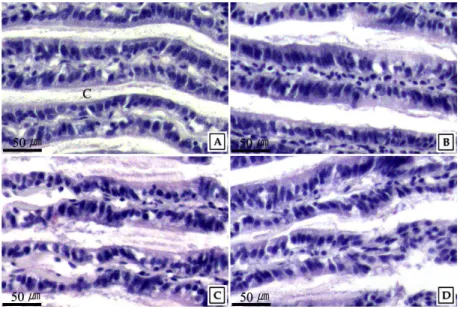
17℃의 WSF에 노출된 치패의 아가미는 대조구와 비교하여 500 μg/L의 WSF 농도에 노출된 개체들에서 새엽 상피세포 핵의 응축 및 상피세포의 괴사를 동반한 새엽 상피층의 붕괴가 두드러지게 관찰되었다 (Fig. 8). 25℃의 WSF에 노출된 치패 의 아가미는 대조구와 비교해 60 μg/L의 WSF 농도에서 새 엽 상피층의 붕괴가 관찰되기 시작하여 고농도로 갈수록 새엽 상피세포의 곤포화 및 핵 응축 그리고 상피층의 붕괴가 두드러 지게 나타났다 (Fig. 9).
고 찰
유류에 노출된 해양 무척추동물의 유생은 대부분 발달이 저 해된다. Blue mussel, Mytilus edulis는 1.25 mg/L 이상의 농도에서 유생발달이 저해되었으며 (We and Zhou, 1992), sea urchin, Arbacia puntulata 유생의 경우 가장 낮은 농 도인 0.22 mg/L의 WSF에 노출된 개체들에서도 발달이 저해 되었고, 2.2 mg/L에서는 초기 낭배기에서 더 이상의 발달이 불가능하였다 (Hamdoun et al., 2002). 이는 생존율의 감소 와도 밀접하게 연관되며, 대부분 유류에 노출된 종들에게서 유 생발달과 비례하여 나타난다 (Byrne and Calder, 1977;
Stickle et al., 1985; Stromgren and Nielsen, 1991; We and Zhou, 1992).
본 연구에서 북방전복의 발생소요시간, 발생률 및 부착률 등 은 기존 대부분의 보고들과 마찬가지로 대조구에 비해 노출 농 도구에서 유의한 영향을 나타내었으며, 발생이 진행될수록 0.4 mg/L이하의 농도에서 발생률의 저하가 나타났다. 생존율 역 시 2.4 mg/L 이상의 농도에서 유의한 차이가 나타났으며, 특
Fig. 8. Histological change of the gill of abalone, H. discus hannai early young shell exposed to water soluble fraction of crude oil (water temperature: 1 7℃). A: Control. B: 60 μg/L WSF. C: 250 μg/L WSF. D: 500 μg/L WSF. Note the breakdown of epithelial layer C: cilia.
Fig. 9. Histological change of the gill of abalone, H. discus hannai early young shell exposed to water soluble fraction of crude oil (water temperature:
25℃). A: Control. B: 60 μg/L WSF. Note the vacuolation of filament epithelial cell. C: 125 μg/L WSF, D: 500 μg/L WSF. Note the atrophy of nucleus and breakdown of the filament epithelial layer in the group exposed 125 and 500 μg/L WSF.
히 치패의 경우 수온에 따라 사망률이 증가하는 현상이 나타났 다.
Stromgren and Nielsen (1991) 은 WSF에 노출된 blue mussel, Mytilus edulis 유생은 10 μg/L에 노출된 개체들 에서 유의적인 성장감소가 나타난다고 하였고, We and Zhou (1992) 은 성장저해 농도를 동일종에서 1.25 mg/L 이상의 농
도로 보고하였다. 또한 Byrne and Calder (1977) 은 quahog clam, Mercenaria sp의 유생에서 나타난 성장저해 농도는 220-4,200 μg/L로 매우 다양하며, 초기생활사 중 유 생발생단계에 가장 강한 독성학적 영향을 받는다고 하였다.
WSF 중 xyline에 노출된 clam, Gafrarium divaricatum의 아가미에서 나타난 새엽 기저부분의 공포화,
상피세포와 상피층의 파괴, 아가미 새엽의 변성, 괴사조직의 증가 (Agwuocha et al., 2009) 등은 본 연구결과에서 나타난 변화들과 상당부분 동일한 반응을 보여주고 있었으며, 이러한 구조적 변화는 결국 가장 중요한 호흡기관 중 하나인 아가미의 기능의 정지시켜 생존에 악영향을 미칠 것으로 보인다.
Anthracene에 대한 coot clam, Mulinia lateralis 난 및 유생의 반수치사농도 (LC50) 는 각각 4.26과 13.3 mg/L로 나 타나며 (Pelletier et al., 1997), Naphthalene에 노출된 Dungeness crab, Cancer magister Dana의 유생은 2 mg/L 이상에서 관찰된다 (Caldwell et al., 1977). 또한 PAH에 노출된 sea urchin, Arbacia puntulata과 blue mussel, Mytilus edulis 유생의 영향농도는 각각 0.42 mg/L 와 28.5 μg/L로 보고되고 있다 (Johnson, 1988; Neff et al., 2000).
본 연구에서 관찰된 영향농도는 발생 및 부착률의 경우 시 험종 모두 0.4 mg/L 이상에서 나타나며, 성장의 경우 2.4 mg/L 이상의 농도에서 영향을 받는 것으로 보여 진다. 또한 노출기간이 길어질수록 저농도에서도 생존과 성장에 영향을 주는 것으로 보인다.
요 약
원유의 WSF가 북방전복의 유생 및 치패 발생에 미치는 영 향을 알아보기 위하여 발생소요시간, 발생률 및 부착률, 생존 율, 유생 및 부착치패의 각성장 그리고 수온에 따른 치패의 생 존율 및 아가미의 조직학적 변화를 조사하였다. 발생 소요시간 은 대조구에 비해 노출구에서 느리게 나타났다. 발생률 및 부 착률은 0.4 mg/L 이상의 농도에서 대조구에 비해 유의적인 감소를 보였다 (P < 0.05). 북방전복 유생의 생존율은 0.4 mg/L 이상에서, 부착치패는 2.4 mg/L 이상에서 유의적인 감 소가 나타났다 (P < 0.05). 각성장은 2.4 mg/L 이상의 농도 에서 대조구에 비해 감소하였다 (P < 0.05). 수온에 따른 치 패의 생존율은 17℃와 25℃ 모두 노출농도에서 감소하였으며, 특히 고수온에서 전체적인 생존율이 낮게 나타났다. 또한 아가 미에서 나타난 조직학적 변화는 주로 새엽 상피세포 핵의 위축 및 상피세포의 공포화 그리고 상피층의 괴사를 동반한 붕괴 등 이 관찰되었으며, 이는 17℃에 노출된 개체들 보다는 고수온 인 25℃에 노출된 개체들에서 심하게 나타났다.
감사의 글
이 연구는 농림수산식품부 허베이스프리트호 유류사고 관련 농특회계지원에 따라 국립수산과학원 ‘태안어장 정밀조사 및 양식어장 복원사업' (RP-2010-AQ-030) 의 지원에 의해 운영 되었습니다.
REFERENCES
Agwuocha, S., KuIkarni, B.G. and Pandey, A.K. (2009) Histopathological alterations in gill of intertidal clam, Gafrarium divaricatum exposed chronically to xylene, benzene and gear oil-WSF. Journal of Ecophysiology and Occupational Health, 9: 18-26.
Ahn, K.W. and Chin, P. (1986) Acute toxicity of Kuwait crude oil (WSF) to mysid, Neomysis awatschensis.
Bulletin Korean Fisheries Society, 19(6): 599-607.
Ahrens, M.J., Nieuwenhuis, R. and Hickey, C.W. (2002) Sensitivity of juvenile Macomona liliana (bivalvia) to UV-photoactivated fluoranthene toxicity.
Environmental Toxicology, 17: 567-577.
Alkindi, A.Y.A., Brown, J.A., Waring, C.P. and Collins, J.E. (1996) Endocrine, osmoregulatory, respiratory and haematological parameters in flounder exposed to the water-soluble fraction of crude oil. Journal of Fish Biology, 49: 1291-1305.
Brown, E.D., Baker, T.T., Hose, J.E., Kocan, R.M., Marty, G.D., McGurk, M.D., Norcross, B.L. and Short, J.W. (1996) Injury to the early fife history stages of Pacific herring in Prince William Sound after the Exxon Valdez oil spill. Americal Fisheries Society Symposium, 18: 448-462.
Byrne, C.J. and Calder, J.A. (1997) Effect of the water soluble fractions of crude, refined and waste oils on the embryonic and larval stages of the quahog clam, Mercenaria s. Marine Biology (Berl) 40: 225-231.
Cajaraville, M.P., Marigomez, J.A. and Angulo, E.
(1992) Comparative effects of the water accommodated fraction of three oils on mussels- 1.
Survival, growth and gonad development.
Comparative Pharmacology, 102: 103-112.
Capuzzo, J.M. (1987) Biological effects of petroleum hydrocarbons: Assessments from experimental results. In: long-term environmental effects of offshore oil and gas development, Boesch DF and Rabalais NN. eds. Elsevier Applied Science New York, pp 343-410.
Carls, M., Rice, S. and Hose, J. (1999) Sensitivity of fish embryos to weathered crude oil: I. Low-level exposure during incubation causes malformations, genetic demage, and mortality in larval Pacific herring, Clupea pallasi. Environmental Toxicology and Chemistry, 18: 481-493.
Carmel, A.P. and Douglas, A.H. (2002) Toxicity testing of crude oil and related compounds using early life stages of the crimson-spotted rainbowfish, Melanotaenia fluviatilis. Ecotoxicology and Environmental Safety, 52: 180-189.
Chang, Y.J., Lee, K.H., Kang, D.Y. and Chin, P. (2000) Effects of the water soluble fraction from Kuwait crude oil on the early larval stages of three cultured fish species. The Korean Journal of Aquaculture, 13: 69-78.
Clark, R.C. and Finley, J.S. (1977) Effects of oil spills in arctic and subarctic environments. Chapter 9 In:
Malins DC. (ed.) Effects of petroleum on arctic and subarctic marine Organisms. Vol II. biological Effects. New York Academic Press Inc, pp 411-476.
Coldwell, R.S., Caldarone, E.M. and Mollon, M.H.
(1977) Effects of a seawater soluble fraction of Cook Inlet crude oil and its major aromatic components on larval stage of the Dungeness crab, Cancer magister Dana. In: Wolfe DA. (ed.) Fate and effects of petroleum hydrocarbons in marine ecosystems and organisms. Pergamon Press New York, pp.
210-220.
Hamdoun, A.M., Griffin, F.J. and Cherr, G.N. (2002) Tolerance to biodegraded crude oil in marine invertebrate embryos and larvae is associated with expression of a multixenobiotic resistance transporter. Aquatic Toxicology, 61: 127-140.
Heintz, R.A., Rice, S.D., Wertheimer, A.C., Bradshaw, R.F., Thrower, F.P., Joyce, J.E. and Short, J.W.
(2000) Delayed effects on growth and marine survival of pink salmon, Oncorhynchus gorbuscha after exposure to crude oil during embryonic development. Marine Ecology Progress Series, 208:
205-216.
Johnson, D. (1988) Development of Mytilus edulis embryos: a bioassay for polluted waters. Marine Ecology Progress Series, 46: 135-138.
Kennedy, C.J. and Farrell, A,P. (2005) Ion homeostasis and interregnal stress responses in juvenile Pacific herring, Clupea pallasi exposed to the water-soluble fraction of crude oil. Journal of Experimental Marine Biology and Ecology, 323: 43-56.
Lee, B.D., Lee, T.Y. and Chin, P. (1975) Effects of crude oil ingredients on the development and oxygen uptake of hard clam, Meretrix lusoria (RODING). Publishing Institute Marine Science National Fisheries University Pusan, 8: 31-38.
McAuliffe, C.D. (1987) Organism exposure to volatile/soluble hydrocarbons from crude oil spills-a field and laboratory comparison. In: oil spill conference. American Petrol Industries Washington DC, pp. 357-363.
Paine, M.D., Leggett, W.C., McRuer, J.K. and Frank, K.T. (1992) Effects of Hibernia crude oil on capelin, Mallotus villosus embryos and larvae. Marine Environmental Research, 33: 159-187.
Pelletier, M.C., Burgess, R.M., Ho, K.T., Kuhn, A., McKinney, R.A. and Ryba, S.A. (1997) Phototoxicity of individual polycyclic aromatic hydrocarbons and petroleum to marine invertebrate larvae and juveniles. Environmental Toxicology and Chemistry, 16: 2190-2199.
Ramachandran, S.D., Sweezey, M.J., Hodson, P.V., Boudreau, M., Courtenay, S.C., Lee, K., King, T.
and Dixon, J.A. (2006) Influence of salinity and fish species on PAH uptake from dispersed crude oil.
Marine Pollution Bulletin, 52: 1182-1189.
Shin, Y.K., Cho, K.C., Jang, D.J. and Jin, Y.G. (2009) Effect of crude oil on early life stage of flounder, Paralichthys olivaceus. Journal of Environmental Toxicology, 24: 119-125.
Stegeman, J.J. and Teal, J.M. (1973) Accumulation, release and retention of petroleum hydrocarbons by the oyster Crassostrea virginica. Marine Biology, 22:
37-44.
Stekoll, M.S., Deysher, L., Highsmith, R.C., Saupe, S.M., Guo, Z., Erickson, W.P., McDonald, L. and Strickland, D. (1996) Coastal habitat injury assessment: intertidal communities and the Exxon Valdez iol spill. American Fisheries Society Symposium, 18: 177-192.
Stickle, W.B., Rice, S.D., Villars, C. and Metcalf, W.
(1985) Bioenergetics and survival of the marine mussel, Mytilus edulis L. during long-term exposure to the water soluble fraction of Cook lnlet crude oil.
In: Vernberg FJ, Calabrese A, Thurgerg FP and Vernberg WB. (eds), Physiological responses of marine biota to pollutants, Academic Press London New York San Francisco.
Stromgren, T. and Nielsen, M.V. (1991) Spawning frequency, growth and mortality of Mytilus edulis larvae, exposed to copper and diesel oil. Aquatic Toxicology, 21: 171-180.
Venkateswaran, K., Hoaki, T., Kato, M. and Maruyama, T. (1995) Microbial degradation of resins fractionated from Arabian light crude oil. Canadian Journal Microbiology, 41: 418-424.
Wake, H. (2005) Oil refineries: a review of their ecological impacts on the aquatic environment.
Estuarine, Coastal and Shelf Science, 62: 131-140.
Wu, J. and Zhou, X. (1992) A study of the effects of petroleum on the early development of mussel, Mytilus edulis. Trans Oceanol Lmnol Haiyang Huzhao Tongbao, 2: 46-50.
Yasunori M, Kitamura SI, Nakayama K, Matsuoka S, and Sakaguchi H. (2008) Effects of heavy oil in the developing spotted halibut, Verasper variegatus.
Marine Pollution bulletin, 57: 524-528.
Zarragoitia, M.O. and Cajaraville, M.P. (2006) Biomarkers of exposure and reproduction-related effects in mussel exposed to endocrine disruptors.
Archives of Environmental Contamination and Toxicology, 50: 361-369.