협력 기지국을 가진 2-셀 다중 안테나 환경에서 공간적 다중화 이득 분석
정회원 김 재 신*
Analysis of Spatial Multiplexing Gain in a Two-cell MIMO Environment with Coordinated Base Stations
Jaesin Kim
* Regular Member 요 약본 논문은 상호 간 간섭을 주는 두 개의 다중입력 다중출력 간섭 브로드캐스트 채널 (MIMO-IBC: Multiple input multiple output-interfering broadcast channel)에서 공통된 잡음 없는 백본(backbone)망을 통해 두 기지국이 상호간의 사용자 데이터를 공유할 수 있을 때의 공간적 다중화 이득 (SMG: Spatial multiplexing gain)의 일반적 인 공식을 유도하였다. 본 MIMO-IBC 모델은 다중안테나를 갖는 두 개의 기지국과 각각 다수의 다중안테나 사 용자가 있고, 모두 고정된 채널을 통해 독립적인 메시지를 송신한다고 가정한다. 최종 유도된 결과로부터 다양한 상황의 안테나 분포뿐 만 아니라 기지국 협력 유무에 따른 공간적 다중화 이득의 변화를 정량적으로 관찰할 수 있다. 그리고 사용자들 사이에 완전한 협력이 되는 상황과 본 MIMO-IBC 모델에서의 유도된 SMG 결과를 비교 하였다.
Key Words : Spatial multiplexing gain, multiple-input multiple-output (MIMO), broadcast channel (BC), coordinated base station, 공간 다중화 이득, 다중입력 다중출력, 브로드캐스트 채널, 협력 기지국
ABSTRACT
In this paper, we provide a general expression of spatial multiplexing gain (SMG) for two mutually interfering multiple-input multiple-output (MIMO) broadcast channels, referred to as MIMO-IBC, when some of user messages are made available to base stations through a common noiseless backbone line. The MIMO-IBC has two base stations and multiple users, each equipped with multiple antennas, where independent messages are transmitted over fixed channels. From the derived results, we observe the variation of the SMG with respect to the presence of a coordination as well as various antenna distributions, and compare the derived result to the SMG of the case with full cooperation among users.
※ This research was supported in part by tactical mobile communication system (TMCS) and multi-hop WiBro based relay system projects.
* 국방과학연구소 제2기술연구본부 3부 ([email protected];[email protected])
논문번호:KICS2011-11-586, 접수일자:2011년 11월 30일, 최종논문접수일자:2012년 5월 17일
Ⅰ. Introduction
Although there is recent interest in multipoint to multipoint networks, the capacity region of
most multipoint to multipoint communication scenarios is still an open problem[1]. Alternatively, some approximations are needed to evaluate the system capacity performance. The number of
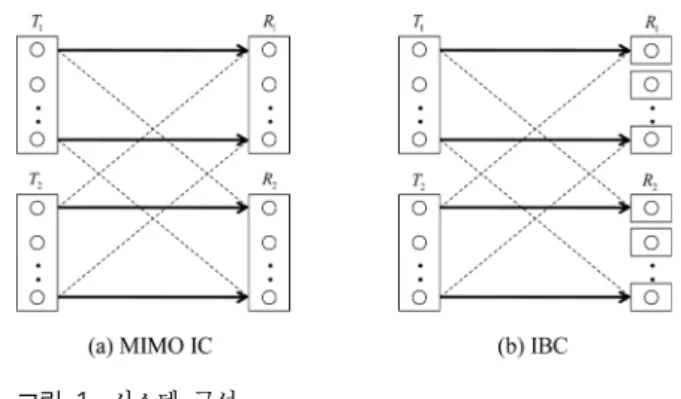
그림 1. 시스템 구성
Fig. 1. System Configurations converges to zero as SNR goes to infinity. The
DOFs of various multiuser multiple-input multiple output (MIMO) systems have been determined by several researchers[2-7]. Especially, the DOFs for a two-user MIMO interference channel (IC) and a two-cell interfering multiple-input single-output (MISO) broadcast channel (BC) have been derived in [2] and [5], respectively. Figure 1 describes the structure of both systems. Note that [2] and [5]
address the DOF in terms of exploiting space dimensions under the assumption of full channel state information (CSI) at all nodes.
Authors in [2] focus on the two-user MIMO IC where transmitter
with antennas has a message for receiver
with antennas
, which will be referred to as
IC in this paper. They provided the precise number of the DOF on the MIMO IC. Note that in the two-user MIMO BC with
transmit antennas and , receive antennas, the distributed processing at the receiver side does not cause any loss on the DOF compared to a point-to-point (PTP) MIMO channel with
transmit antennas and
receive antennas[8-10]. In the MIMO IC, however, there may be a significant loss on the DOF due to the distributed processing at both transmitter and receiver sides.Recently, an expression of the DOF for two mutually interfering broadcast channels (IBC) was derived as a function of arbitrary numbers of transmit antennas and users[5]. The IBC where each transmitter equipped with antennas sends messages to its corresponding single-antenna receivers
is referred to as
IBC. The IBC differs from the MIMO IC in a sense that receive antennas in cell
are disconnected and cannot cooperate with each other. Although one might think that theDOF of the IBC would be the same as that of the MIMO IC, the derived result shows that disabling receive cooperation of the MIMO IC causes a DOF loss for certain antenna configurations.
Since it is not trivial to analytically derive the DOFs in many IC environments, we consider a spatial multiplexing gain (SMG) measure. Here, the SMG is defined as the pre-log factor of the sum rate of the system when linear transceivers are only spatially exploited. Since the DOF of the two-user MIMO IC allows only integer values with respect to the number of antennas[4], we can readily show that the SMG of the IC is the same as the DOF presented in [2]. From [11] and [12], we can extend the previous analysis of the two-cell IBC to the case of multiple-antenna users, which will be referred to as MIMO-IBC to distinguish from the IBC with single antenna users. The derived SMG expression of the MIMO-IBC is a general equation including the SMG results of the IC and the IBC.
In this paper, we consider a coordinated message sharing method to compensate for the SMG loss caused by the distributed processing between two base stations. Message sharing in the manner of coordinated base stations assumes that one base station’s message is made available non-causally to the other base station through a common noiseless backbone line[13-14]. Here, we derive the SMG for the MIMO-IBC in the presence of various coordinated scenarios. By utilizing the results of [7] and [15], we explore
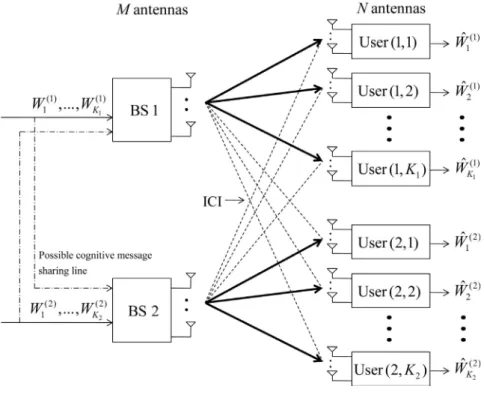
그림 2.
구성의 MIMO-IBC 모델 Fig. 2. The
MIMO-IBC modelthe SMG variation caused by the nature of coordinated base stations in the MIMO-IBC. Thus, we offer a quantitative analysis on how the SMG is compensated by the coordination between two base stations as well as how the SMG can be limited by the distribution of user antennas.
The remainder of this paper is organized as follows: In Section II, we introduce the MIMO-IBC model and the definition of the SMG.
In Section III, the SMG of the MIMO-IBC with a coordination is derived, and also analyzed. The paper is closed with conclusion in Section IV.
Ⅱ. System Model
In this section, we describe a system model for the MIMO-IBC illustrated in Figure 2. Each base station (BS) equipped with antennas supports its corresponding users with antennas (
), which will be referred to as
MIMO-IBC. Also, we represent the
-th user in the
-th cell as user
. Denoting
as the signal vector received by user
, the MIMO-IBC is mathematically described as
(1) where
x
i stands for the signal vector of length transmitted from BS
,n
li is the additive Gaussian noise for user
with unit variance,H
li denotes the ×
channel matrix from BS
to user
andZ
li indicates the channel matrix representing the interference from BS
to user
. Here we define
and
. It is assumed that the channel elements are sampled from independent identically distributed (i.i.d.) complex Gaussian random variables with zero mean and unit variance so that the probability of the channel being rank-deficient converges to zero. Also, all channel realizations are assumed to be perfectly known atin l due to a path loss, we consider the most challenging case where all of them have unit power. This situation arises for users located in cell boundaries.
For realistic implementations, we consider a space-division multiplexing system with linear transceiver in the two-cell environment. The maximum sum rate for given power constraint is denoted as m ax
. The total power constraint should be satisfied such that
∥ x
i ∥
≤ P
. Finally, different from the definition of the original DOF with respect to the sum capacity, the SMG of the MIMO-IBC is defined aswhich provides the pre-log factor of the MIMO-IBC with respect to the maximum sum rate m ax
. Due to the page limitation, we omit the specific equations of the transceiver and the sum rate used in here. Refer to [12]. Unlike our assumptions of the system model, the transceiver structures optimized under certain constraints might produce different SMG results.Ⅲ. Impact of Coordinated Base Stations on the Spatial Multiplexing Gain
In this section, we consider the MIMO-IBC model in the presence of the message sharing scenarios between two BSs. Especially, we focus on the situation of the coordinated message sharing through a common and noiseless backbone line between BSs. For simplicity of presentation, we define the indicator function as
if BS
knows the user messages of BS
, , and
otherwise, and also represent
as
. A specific coordinated
. Then, by utilizing the SMG results of the IBC and the IC with coordination in [7]and [15], respectively, we characterize the SMG of the
MIMO-IBC with coordination.From [7], the SMG of the
IBC with or without coordinated BSs is given as(2)
where
∨
and⊥
denote the OR and NOR operators, respectively. This result means that the IBC system with
or
coordination scenarios can achieve the SMG of the IC with the corresponding transmit coordination regardless of the antenna configurations. Here the SMG of the
IC with coordinations is derived in [15] as(3)
Especially, for the
case, the
IBC model reduces to a single-cell MISO BC with
BS antennas and
users, which has the SMG ofmin
.Additionally, for the
case, it is important to notice that the SMGs of the IC and the IBC with
configuration are given as그림 4. MIMO-IBC에서 증가와 다양한 협력 시나리오 에 따른 SMG 향상도
Fig. 4. The SMG improvement according to various coordination scenarios and for the MIMO-IBC
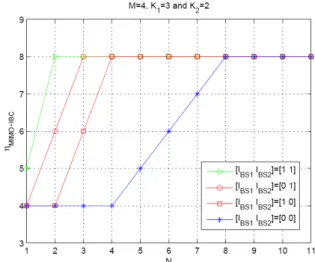
그림 3. MIMO-IBC에서 증가와 다양한 협력 시나리오 에 따른 SMG 향상도
Fig. 3. The SMG improvement according to various coordination scenarios and for the MIMO-IBC (4)
(5)
respectively. Setting
and
in (4) and (5), we observe that the IBC can achieve the SMG of IC as long as
≥ min
despite the lack of receive cooperations[5]. In other works, disabling receive cooperation of the IC causes a SMG loss for certain antenna configurations. Here, since the MIMO-IBC can be considered as a system with partial cooperation among receive antennas compared to the IBC, it follows(6)
Therefore, we are interested in the SMG derivation for the case where the number of total user antennas in each cell is greater than that of the BS antennas in (6). From this starting point, we can derive that the SMG in the
MIMO-IBC is exactly given as[12].(7)
Now we can readily analyze the SMG of the MIMO-IBC in the presence of coordinated BSs.
From (2) and (3), we can characterize the SMG equations at the same antenna configurations as
As a result, if there exists at least one coordinated BS, the IBC does not incur a performance loss in the context of the SMG compared to the IC with coordinations.
Furthermore, as distributed receive antennas cannot increase the SMG, it is also possible for the
MIMO-IBC with coordinations to achieve the SMG of the
IC with the same coordinations except when
and
min
[12]. As derived in [12]for the case of
, the
MIMO-IBC results in a SMG loss compared to the IC only if min
. In summary, we provide the SMG for the MIMO-IBC with coordinations in the following corollary.Corollary 1: The SMG of the MIMO-IBC with coordinated message sharing at the BSs is given by
In Figure 3, we plot
as a function of the number of BS antennas for the case of
and
. From this figure, wecan see that some of the SMG loss from distributed processing is recovered by allowing coordinated message sharing between two distributed BSs (also see [16]). However, for all coordination scenarios, the SMG cannot be greater than
min
. Figure 4 shows
with respect to the number of user antennas for the case of
,
and
. Especially, when
≥
, the SMG loss of the MIMO-IBC induced by partially disabling receive cooperation is significantly recovered by the coordinated BS.Based on (2), (3) and Corollary 1, a couple of observations can be made about the SMG, which are summarized in Table 1.
Ⅳ. Conclusion
In this paper, a two-cell multiuser MIMO downlink system has been modeled as two mutually interfering MIMO broadcast channels.
Studying the MIMO-IBC brings out some
interesting aspects of multicell multiuser MIMO transmission scenarios since the IC and the IBC are special cases of this channel. Motivated by the earlier work about the IC and the IBC, we have investigated the SMG with the transmitter cooperation as well as the distributed receive antennas. From a coordinated message sharing scheme, we have shown that if one of two BSs is a coordinated one, the SMG of the MIMO-IBC has no degradation compared to the IC with full receive cooperation. For the future work, finding an exact expression of the DOF of the MIMO-IBC with time-varying/frequencyselective channels would be a challenging and meaningful work.
참 고 문 헌
[1] R. H. Etkin, D. N. C. Tse, and H. Wang, “Gaussian interference channel capacity to within one bit,”
IEEE Transactions on Information Theory, vol. 54, no. 12, pp. 5534-5562, December 2008.
[2] S. A. Jafar and M. J. Fakhereddin, “Degrees of freedom for the MIMO interference channel,” IEEE Transactions on Information Theory, vol. 53, pp.
2637-2642, July 2007.
[3] V. R. Cadambe and S. A. Jafar, “Interference alignment and degrees of freedom of the K-user interference channel,” IEEE Transactions on Information Theory, vol. 54, pp. 3425-3441, August 2008.
[4] S. A. Jafar and S. Shamai (Shitz), “Degrees of freedom region of the MIMO X channel,” IEEE Transactions on Information Theory, vol. 54, pp.
151-170, January 2008.
[5] S.-H. Park and I. Lee, “Degrees of freedom and sum-rate maximization for two mutually interfering broadcast channels,” in Proc. IEEE ICC, June 2009.
[6] S.-H. Park and I. Lee, “Degrees of freedom for mutually interfering broadcast channels,” IEEE Transaction on Information Theory, vol. 58, No. 1, pp. 393-402, January 2012.
[7] S.-H. Park and I. Lee, “Analysis of degrees of freedom of interfering MISO broadcast channels,”
in Proc. IEEE Globecom, November 2009.
[8] P. Viswanath and D. N. C. Tse, “Sum capacity of the vector Gaussian broadcast channel and uplink-downlink duality,” IEEE Transactions on Information Theory, vol. 49, pp. 1912-1921, August 2003.
[9] S. Vishwanath, N. Jindal, and A. Goldsmith,
“Duality, achievable rates, and sum-rate capacity of Gaussian MIMO broadcast channels,” IEEE Transactions on Information Theory, vol. 49, pp.
2658-2668, October 2003.
[10] W. Yu and J. M. Cioffi, “Sum capacity of Gaussian vector broadcast channels,” IEEE Transactions on Information Theory, vol. 50, pp. 1875-1892, September 2004.
[11] J. Kim, S.-H. Park, H. Sung, and I. Lee, “Sum rate analysis of two-cell MIMO broadcast channels:
spatial multiplexing gain,” in Proc. IEEE ICC, May 2010.
[12] J. Kim, S.-H. Park, H. Sung, and I. Lee, “Spatial multiplexing gain for two interfering MIMO broadcast channels based on linear transceiver,”
IEEE Transaction on Wireless Communications, vol. 9, no. 10, pp. 3012-3018, October 2010.
[13] N. Devroye, P. Mitran, and V. Tarokh, “Achievable rates in cognitive radio channels,” IEEE Transaction on Information Theory, vol. 52, no. 5, pp. 1813-1827, May 2006.
[14] N. Devroye, P. Mitran, and V. Tarokh, “Limits on communications in a cognitive radio channel,”
IEEE Communications Magazine, vol. 44, no. 6, pp.
44-49, June 2006.
[15] C. Huang and S. A. Jafar, “Degrees of freedom of the MIMO interference channel with cooperation and cognition,” IEEE Transactions on Information Theory, vol. 55, no. 9, pp. 4211-4220, September 2009.
[16] H. Charmchi and M. Nasiri-Kenari, “Achievable rates for two interfering broadcast channels with a cognitive transmitter,” in Proc. IEEE ISIT, July 2008, pp. 1358-1362
2010년 2월 고려대학교 전자전 기공학과 석사
2010년 3월~현재 국방과학연 구소 제2기술연구본부 3부 연구원
<관심분야> Digital communication, signal processing and information theory applied to wireless communication