Exploring Alignments among International Baccalaureate, Next Generation Science Standards, and the 2015 Science Curriculum of Korea,
Focusing on Elementary Science
Myeong-Kyeong Shin
1and Eun-Jeong Kim
2,*
1
Gyeongin National University of Education, Incheon 21044, Korea
2
Seoryeong Elementary School, Chungcheongnamdo 32007, Korea
Abstract: This study aimed to explore alignments among three curricula based on the contents of the university level curriculum. The 2015 revised curriculum, International Baccalaureate(IB), and Next Generation Science Standards(NGSS) were selected for this study, and a college textbook was analyzed to compare the curricula. As the age groups studying the curricular were different, we reorganized them according to school ages prior to conducting the study. The results of the analysis were: first, the contents of the 2015 revised curriculum did not sufficiently elaborate on the natural hazards related to humans, unlike the university level, IB PYP, and NGSS curricula. Third, there are different ways of introducing scientific vocabulary curricula, meaning that the number of scientific vocabularies in the 2015 revised curriculum was less than that in the IB, PYP, and NGSS.
Keywords: Alignment, 2015 Revised Curriculum, IB, NGSS, Elementary Science
Introduction
The OECD has a significant role in today’s international education reform program, especially the DeSeCo project, released in the mid-2000s, was a prototype of competency-based curriculum. Under the circumstance of focusing on competency-based curriculum, it would be the opportunity to reflect on 2015 revised curriculum the by reviewing NGSS and the International Baccalaureate Primary Years Program (IB PYP). The United States announced NGSS to reform science education and IB PYP is an internationally accredited curriculum created by the International Baccalaureate Organization (IBO).
The research conducted between the curriculum in Korea and the NGSS or IB is as follows. Kim & Lee (2016) compared and analyzed the achievement standards and textbook terms of the 2009 revised
curriculum with the NGSS according to lack of articulation. As a result, they found that the 2009 revised curriculum stated the achievement standards in detail compared to the NGSS, but not enough articulation. In addition, based on the comparative study of the 2009 revised science curriculum and the NGSS, it was found that the NGSS included various types of cognitive processes and that a wide range of performance expectations were frequently used (Dong, Ha, Kim, 2015). Kim et al. (2021) found that 2015 revised curriculum reduces the amount of learning by reducing the number of content elements, whereas IBO increased content elements in IB DP to help students to understand academic knowledge throughly.
The approach to interdisciplinary knowledge suggested in the 2015 revised curriculum aims to integrate the subject-centered knowledge suggested by the OECD learning framework, but the actual learning content tends to be separated. In the IB DP, By clearly providing other academic knowledge that can be learned in languages, teachers reconstruct it to form interdisciplinary teaching and learning, or students can engage in activities that connect multiple academic knowledge through project learning.
Therefore, the purpose of this study was at the
*Corresponding author: [email protected]
*Tel: +82-41-664-0754
This is an Open-Access article distributed under the terms of the Creative Commons Attribution Non-Commercial License (http://
creativecommons.org/licenses/by-nc/3.0) which permits unrestricted non-commercial use, distribution, and reproduction in any medium, provided the original work is properly cited.
elementary level, the alignment among the 2015 revised curriculum, IB, and NGSS with the contents of university level. We did not focus on the specific book for students, but tried to find the common knowledge for them. Furthermore, we tried to find out what implications for constructing next Korean science curriculum can be seen through this.
Method
In this study, university-level textbooks, the 2015 revised curriculum, IB PYP, and NGSS were selected as domestic and foreign related literature, and a method was used to analyze them. The 2015 revised curriculum was the time when core competencies were directly emphasized in Korea, and five core competencies were selected for the science education. However, as the structure of subject knowledge, ‘core concepts’
and ‘generalized knowledge’ existed, and this study focused on subject knowledge and carried out the analysis. Also, in IB, one of the foreign literature, the learning goals that students must achieve differ depending on the unit school. This is because, in developing the school curriculum, it provides the IB scope and sequence of learning according to the domain, but it allows to borrow and apply the standards at the national or regional (state) level accordingly. According to these characteristics, this study looked at the learning contents through the contents of IB scope and sequence for the study of IB literature. Finally, the analysis was conducted through the contents of the performance expectations developed by integrating the three dimensions of disciplinary core ideas, science and engineering practice, cross- cutting concepts provided by NGSS.
In this study, in order to examine the relationship between university-level content and elementary-level
curriculum, the sequence of each curriculum was first analyzed to select comparison targets for each grade group (Table 1). However, the IB PYP for linking the 2015 revised curriculum and the grade group is based on the age group in four groups: 3-5, 5-7, 7-9, 9-12, and the NGSS elementary level is 5-7, 8 -10 were divided into two groups. According to these limitations, the age group was somewhat different, but a comparative analysis was conducted with grade groups that could be linked in the curriculum. After that, coding was carried out through repeated discussions in order to compare and analyze scientific contents.
Consensus results were drawn through repeated discussions on areas where there was no agreement among researchers.
Results
Curriculum alignment mapping
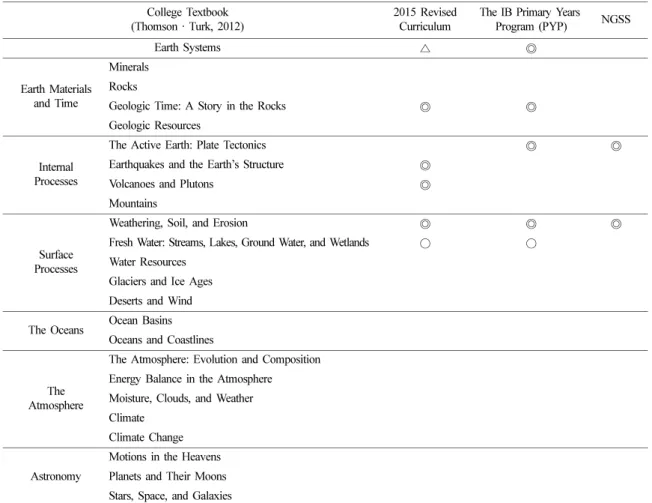
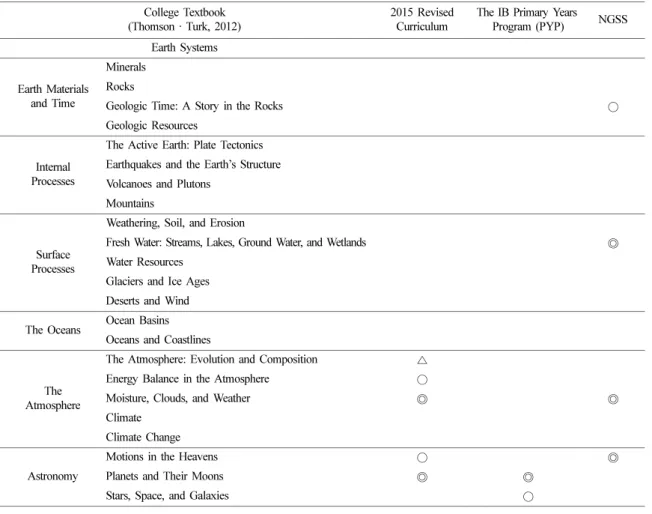
Tables 2 and 3 show the results of analyzing how much university-level science content is being dealt with in the elementary-level 2015 revised curriculum.
For instance, Earth system is slightly associated with in 2015 revised curriculum, and is significant associated with IB. Among the literature to be analyzed, the titles of each chapter were selected for university-level science content, and those grouped into units were also indicated. Accordingly, it was largely represented as 6 units of Earth Materials and Time, Internal Processes, Surface Processes, The Oceans, The Atmosphere, and Astronomy. IB, and NGSS. Table 2 shows curriculum alignment in grade 3-4 of 2015 revised curriculum and table 3 shows in grade 5-6.
According to Table 2, in the 3rd and 4th grade levels of the 2015 revised curriculum, the IB PYP and NGSS mentioned all the details of the Earth that can be seen around our lives, especially Weathering, Soil,
Table 1. School Years and Age Grouping
2015 Revised Curriculum (elementary 3-6) The IB Primary Years Program (PYP) NGSS
School years Typical age in years Typical age in years School years Typical age in years
Grade 3-4 9-10 7-9 K-2 5-7
Grade 5-6 11-12 9-12 3-5 8-10
and Erosion, but there was no information about The Oceans, The Atmosphere, Astronomy. In addition, it was analyzed that the 2015 revised curriculum covers 6 contents and IB covers 5 contents, whereas NGSS covers 2 contents. If we look at this trend in more detail, we can look at the study of Kim & Lee (2016), who comparatively analyzed the 2009 revised curriculum and NGSS. Since the NGSS shows various cognitive processes and performance expectations compared to the 2015 revised curriculum, it can be seen that the results of this study are similar to the results analyzed in this study.
Based on analyzing the level of the 5th and 6th grades of the 2015 revised curriculum, it can be seen that both the 2015 revised curriculum and the IB PYP focus on a few categories (Table 3). In other words,
the 2015 revised curriculum covered various contents of The Atmosphere and Astronomy, but it was shown that the IB PYP focused on Astronomy contents. That was similar to the result of the previous study, found out that IB PYP was usually conducted for a period of 5-6 weeks on one subject(Lim, Kim, and Ahn, 2018). However, the IB DP tend to add content elements for a complete understanding of academic knowledge in high school level (Kim et al., 2021).
The View of Natural Hazard
If you look at the content at the university level, many chapters dealt with natural disasters in relation to humans. Accordingly, Table 4 summarizes the contents related to natural disasters in each chapter.
Among the seven categories, five categories except
Table 2. Curriculum Alignment in Grade 3-4 of 2015 Revised Curriculum College Textbook
(Thomson · Turk, 2012)
2015 Revised Curriculum
The IB Primary Years Program (PYP) NGSS
Earth Systems △ ◎
Earth Materials and Time
Minerals Rocks
Geologic Time: A Story in the Rocks ◎ ◎
Geologic Resources
Internal Processes
The Active Earth: Plate Tectonics ◎ ◎
Earthquakes and the Earth’s Structure ◎
Volcanoes and Plutons ◎
Mountains
Surface Processes
Weathering, Soil, and Erosion ◎ ◎ ◎
Fresh Water: Streams, Lakes, Ground Water, and Wetlands ○ ○ Water Resources
Glaciers and Ice Ages Deserts and Wind The Oceans Ocean Basins
Oceans and Coastlines
The Atmosphere
The Atmosphere: Evolution and Composition Energy Balance in the Atmosphere Moisture, Clouds, and Weather Climate
Climate Change
Astronomy
Motions in the Heavens Planets and Their Moons Stars, Space, and Galaxies
◎: significantly associated, ○: associated, △: slightly associated
‘Earth Materials and Time’ and ‘Astronomy’ dealt with natural disasters. For example, ‘the Earthquakes, Earth’s Structure’ introduced measures to reduce damage by predicting earthquakes. In addition, in the content of landslides, the types of landslides were suggested, and what geologists were doing to predict and prevent them was dealt with.
On the other hand, the frequency of these contents appearing in the 2015 revised curriculum was low. In grades 3-6, the terms related to natural disasters were
‘volcano’ and ‘earthquake’, and all that dealt with coping was ‘how to deal with earthquakes’. However, the IB PYP did not use the term natural hazard directly, but dealt with the human impact on the earth
system in the trans-disciplinary theme of ‘How the world works’. In addition, the NGSS dealt with natural disasters and human impacts on the earth system in K-ESS3 ‘Earth and Human Activity.
In view of these results, it was regrettable that the contents related to natural disasters that could affect human life were omitted from the 2015 revised curriculum among the contents at the university level.
In particular, we could see that it was stated in the curriculum that floods and earthquakes, which could be seen as sudden changes, were not covered.
However, IB PYP and NGSS introduced phenomena such as natural disasters, referring to the exchange of influences between nature and humans.
Table 3. Curriculum Alignment in Grade 5-6 of 2015 Revised Curriculum College Textbook
(Thomson · Turk, 2012)
2015 Revised Curriculum
The IB Primary Years Program (PYP) NGSS Earth Systems
Earth Materials and Time
Minerals Rocks
Geologic Time: A Story in the Rocks ○
Geologic Resources
Internal Processes
The Active Earth: Plate Tectonics Earthquakes and the Earth’s Structure Volcanoes and Plutons
Mountains
Surface Processes
Weathering, Soil, and Erosion
Fresh Water: Streams, Lakes, Ground Water, and Wetlands ◎
Water Resources Glaciers and Ice Ages Deserts and Wind The Oceans Ocean Basins
Oceans and Coastlines
The Atmosphere
The Atmosphere: Evolution and Composition △
Energy Balance in the Atmosphere ○
Moisture, Clouds, and Weather ◎ ◎
Climate Climate Change
Astronomy
Motions in the Heavens ○ ◎
Planets and Their Moons ◎ ◎
Stars, Space, and Galaxies ○
◎: significantly associated, ○: associated, △: slightly associated
The Usage of Scientific Vocabulary
In the 2015 revised curriculum, scientific vocabularies were not clearly presented. There was a characteristic that the terminology was not introduced even though it was the content the students were learning. For example, although the third and fourth graders learned about weathering and erosion, the curriculum suggested that the term ‘weathering’ was not introduced.
However, at age of 7-9, students were expected to learn ‘identify the long-term and short-term changes on Earth (for example, plate tectonics, erosion, floods, deforestation). In addition, we can find out that NGSS stressed ‘4-ESS2-1. Make observations and/or measurements to provide evidence of the effects of
weathering or the rate of erosion by water, ice, wind, or vegetation’.
Discussion
This study compares university-level science content by examining the content covered in the 2015 revised curriculum, IB, and NGSS at the elementary level. As a result, the following conclusions were drawn.
First, the categories covered at the 3rd and 4th grade level of the 2015 revised curriculum appeared the same in all three curricula. However, compared to the NGSS, the number of contents covered in the 2015 revised curriculum and IB PYP was slightly
Table 4. The Contents related to Natural Hazard in college textbookEarth Systems Humans and Earth Systems
Earth Materials and Time
Minerals Rocks
Geologic Time: A Story in the Rocks Geologic Resources
Internal Processes
The Active Earth: Plate Tectonics
Earthquakes and the Earth’s Structure
Earthquakes and Tectonic Plate Boundaries Earthquake Prediction
Earthquake Damage and Hazard Mitigation Volcanoes and Plutons
Mountains Mountains and Earth Systems
Surface Processes
Weathering, Soil, and Erosion Landslides/Types of Landslides Predicting and Avoiding Landslides Fresh Water: Streams, Lakes, Ground Water, and
Wetlands
Floods Wetlands
Water Resources Dams and Diversion
Glaciers and Ice Ages Deserts and Wind The Oceans Ocean Basins
Oceans and Coastlines Beaches/Global Warming and Sea-Level Rise
The Atmosphere
The Atmosphere: Evolution and Composition Air Pollution/Depletion of the Ozone Layer Energy Balance in the Atmosphere
Moisture, Clouds, and Weather Thunderstorms/Tornadoes and Tropical Cyclones Hurricane Katrina/El Niño
Climate Urban Climates
Climate Change Greenhouse Effect: The Carbon Cycle and Global Warming Feedback and Threshold Mechanisms in Climate Change
Astronomy
Motions in the Heavens Planets and Their Moons Stars, Space, and Galaxies
different. On the other hand, as a result of analysis at the 5th and 6th grade levels of the 2015 revised curriculum, both the 2015 revised curriculum and the IB PYP dealt with the same category of content.
However, in the IB PYP, it was possible to see that it was conducted in depth with a small number of contents. This was similar to the result of analyzing the characteristics of the IB PYP performed previously (Lim, Kim, and Ahn, 2018).
Second, it was revealed the different point of view between the curricula. It was found that related contents appeared in 5 categories out of 7 categories at the university level. In the 2015 revised curriculum, natural disasters related to volcanoes and earthquakes were stated, and only earthquakes were dealt with. In contrast, IB PYP and NGSS dealt with various types of natural hazards.
Third, there was a difference in the method of presenting scientific vocabularies for the content students were learning. The ability of students to communicate with each other using scientific terminology is an important topic in the science curriculum.
However, despite this importance, it was found that some scientific vocabularies were not be introduced to students in the 2015 revised curriculum.
This study was a comparative analysis of university- level science content appearing in the elementary-level curriculum. Accordingly, suggestions for the further discussions are as follows.
First, in this study, IB PYP and NGSS were analyzed according to the school years in the 2015 revised curriculum. However, there was a difference between the typical age in years between the curricula, and accordingly, the analysis was conducted according to the school years in the curriculum rather than the typical age. This is a limitation in this study and a point to be considered when conducting further studies.
Second, as a result of analyzing the three curricula
based on university-level science content, there are differences between the curricula. However, it can be said that this is not a view of curriculum evaluation, but rather a suggestion for the future direction of our science education. It is thought that it can be used as basic data for the development of the science curriculum by proceeding with the evaluation of the differences between the curricula in the follow-up study.
Third, different viewpoints on the use of scientific vocabularies appeared between the curricula. Although there was no significant difference in the content of what the students learned, there was a difference in the use of vocabularies Considering that research on the importance of the use of scientific vocabularies in science education is steadily being conducted, it can be said that a discussion on the use of scientific vocabularies is necessary.
References
International Baccalaureate Organization, 2008, Science scope and sequence. Wales, UK: International Baccalaureate.
National Research Council, 2012, A Framework for K-12 Science Education: Practices, crosscutting Concepts, and Core Ideas. Committee on a Conceptual Framework for New K-12 Science education Standards, Washington, DC: National Academy Press.
Kim, K. H., H. Y. Lee., 2016, The 2009 Revised Science Curriculum Articulation Analysis and Compare with the U.S. Next Generation Science Standards (NGSS):
Focusing Hydrosphere and Atmosphere in Earth Science. Secondary Education Research, 64(1), 23-47.
(in Korean)
Lim, Y.N., Kim, S. E., An, S. H., 2018, Characteristics and Implications of the International Baccalaureate Primary Years Program. The Journal of Curriculum Studies, 36(2), 25-54. (in Korean)
Ministry of Education, 2015, 2015 Revised Science National Curriculum. Ministry of Education. (in Korean) Thompson, G. R., & Turk, J., 2012, Earth Systems Science
1 (Korean Edition). Seoul, Korea: Bookshill.
Thompson, G. R., & Turk, J., 2012, Earth Systems Science 2 (Korean Edition). Seoul, Korea: Bookshill.
Manuscript received: August 8, 2021 Revised manuscript received: August 20, 2021 Manuscript accepted: August 20, 2021