표준분류에 기준한 컴퓨터 및 소프트웨어 관련 전공의 제4차 산업혁명중심 교육과정 운영 현황 분석
최진일*ㆍ최철재**
Analysis on the Current Status of the Fourth Industrial Revolution-Oriented Curriculum of the Computer and Software-Related Majors Based on the Standard Classification
Jin-Il Choi
*ㆍChul-Jae Choi
**요 약
본 논문은 4차 산업 혁명에 필요한 핵심 IT 관련 기술을 교육하는 컴퓨터 및 소프트웨어 관련 전공의 교 육과정을 분석하였다. 분석은 대학교육협의회 표준분류위원회의 대학교육 편제단위 표준분류에 따라 응용 소 프트웨어와 컴퓨터과학 및 컴퓨터공학으로 분류 된 158개 전공을 대상으로 수행하였다. 해당 학과의 교육내 용 중 사물인터넷과 모바일, 클라우드와 빅데이터, 인공지능, 그리고 정보보안의 분야로 구분한 교과과정의 도 입 현황을 분석하였으며, 분석결과 각 교육과정 군에 대해 평균 81.6%의 전공이 관련 교과목을 교과과정에 편성한 것으로 나타났다. 교육분야별 트랙 운영 등에 가중치를 부여하여 계산한 전공별 4차산업혁명 대응지수 는 100점 만점에 평균 27.5로 나타났으며, 사물인터넷 및 모바일 분야가 42.3점으로 가정 높게 나타났다.
ABSTRACT
This paper analyzed the curriculum of computer and software-related majors educating the core IT-related skills needed for the 4th Industrial Revolution. The analysis was conducted on 158 majors classified as applied software, computer science and computer engineering according to the standard classification of university education units by the Standard Classification Committee of the Korean Council of University Education. The current status of introduction of curricular divided into the fields of Internet of Things(IoT) & mobile, cloud & big data, artificial intelligence(AI), and information security was analyzed among the contents of education in the relevant departments. According to the analysis, an average of 81.6% of the majors for each group of curricular organized related subjects into the curriculum.
The Curriculum Response Index for the 4th industrial revolution(CRI4th) by major, calculated by weighting track operations by education sector, averaged 27.5 point out of 100 point. And the IoT & mobile sector had the highest score of 42.3 points.
키워드
The 4th Industrial Revolution, Standard Classification, Curriculum, IoT, Big Data 4차 산업 혁명, 표준 분류, 교육 과정, 사물 인터넷, 빅 데이터
* 경동대학교 소프트웨어학과([email protected])
** 교신저자 : 경동대학교 소프트웨어학과 ㆍ접 수 일 : 2020. 05. 15
ㆍ수정완료일 : 2020. 05. 30 ㆍ게재확정일 : 2020. 06. 15
ㆍReceived : May. 15, 2020, Revised : May. 30, 2020, Accepted : Jun. 15, 2020 ㆍCorresponding Author : Chul-Jae Choi
Dept. of Cyber Security for information, Kyungdong University.
Email : [email protected]
http://dx.doi.org/10.13067/JKIECS.2020.15.3.587
Ⅰ. Introduction
The fourth industrial revolution(4
thIR) merges with the ‘real world’ created by the first and second industrial revolutions and the ‘virtual world’
created by the third industrial revolution. There is even a connection between lifeless devices and humans. Data flows back and forth between connected networks and accumulates. And expressed with structured intelligence. Lee Min-hwa said the fourth industrial revolution can be defined as "real and virtual convergence for humans," meaning "for humans" leads to questions about human needs, while "real and virtual convergence" presents the issue of justification and technology as the topic[1].
In particular, around 2015, the era of the 4
thIR, in which people, objects, and spaces are super-connected and super-intelligent through new science and ICT-based technologies such as artificial intelligence(AI), internet of things(IoT), cloud computing, big data, network, and bio, has arrived, and it is time to prepare a lot for changes.[2]
As such, IT utilization technologies such as the IoT, AI, and big data are essential in the era of the 4
thIR, and in particular, IT personnel in the era of the 4
thIR need to develop adaptability and coding capabilities for technology[3-4].
With the advent of the era of the 4
thIR, the importance of software education, based on critical thinking skills, is growing more and more so that creative knowledge can be developed through communication and collaboration. The curriculum of software-related majors for the 4
thIR are closely related to fostering core human resources in intelligent information technology, which creates new value through the convergence of AI technology and so-called ICBMs (IoT, Cloud, Big data, and Mobile), and the scope of related curriculum is as follows[2][5-7].
Table 1. Classification of the 4th Industrial Revolution-oriented Curriculum
Curriculum Keyword
IoT &
Mobile
Technology that collects data from all machines and
humans ∙ Data creation
of all things
∙ Real-time reaction
∙ Autonomous evolution
∙ Unmanned decision making Cloud &
Big data
Technology to accumulate and analyze data through advanced information processing
AI
Technology for judging and deciding by cognition, learning and reasoning
Ⅱ. Current Status of Curriculum by Standard Classification
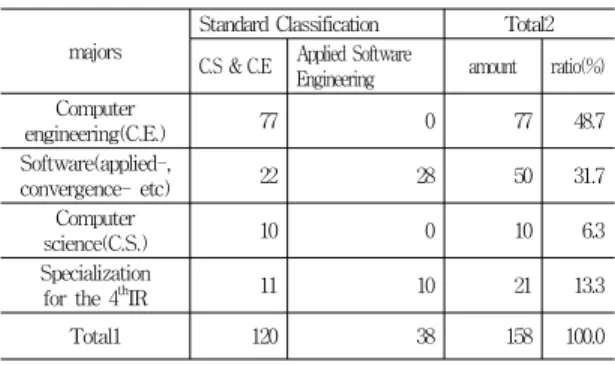
The status analysis was conducted based on the standard classification of educational units organized by the Korean Council for University Education. Data analysis was conducted on 158 computer and software-related majors with engineering category, divisions in electricity, electronics and computers, and subdivisions classified as applied software, computer science and computer engineering. The 158 majors of 115 universities(including 3 cyber universities, 1 broadcasting and communication university, and 1 industrial university) analyzed[8-9]. Table 2 shows the analysis results.
Table 2. Current status of computer and software related majors
majors
Standard Classification Total2 C.S & C.E Applied Software
Engineering amount ratio(%) Computer
engineering(C.E.) 77 0 77 48.7
Software(applied-,
convergence- etc) 22 28 50 31.7
Computer
science(C.S.) 10 0 10 6.3
Specialization
for the 4thIR 11 10 21 13.3
Total1 120 38 158 100.0
* Excluding majors classified as information and communication engineering
According to the standard classification of related majors, 120 majors(75.9%) were classified as computer science and computer engineering, and 38 majors(24.1%) were classified as applied software engineering.
Among the 158 majors, 77 were computer engineering majors, accounting for a majority of the total(48.7%), software majors (including convergence software majors) accounting for 31.7% with 50 majors and 6.3% with 10 computer science majors.
The 21 majors that claim to be specialized in the 4th industrial revolution education account for 13.3%, including 2 smart IoT majors, 2 AI software majors, 2 big data majors and 6 information security majors. They were changed or newly established for education to cope with the Fourth Industrial Revolution.
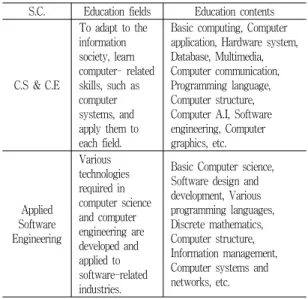
Major subjects according to the existing standard classification are as follows, and basic subjects traditionally trained in existing majors, such as basic programming, software design, network, and basic computer hardware, were excluded from the analysis(Table 3).
Table 3. Education fields and major education contents in the standard classification
S.C. Education fields Education contentsC.S & C.E
To adapt to the information society, learn computer- related skills, such as computer systems, and apply them to each field.
Basic computing, Computer application, Hardware system, Database, Multimedia, Computer communication, Programming language, Computer structure, Computer A.I, Software engineering, Computer graphics, etc.
Applied Software Engineering
Various technologies required in computer science and computer engineering are developed and applied to software-related industries.
Basic Computer science, Software design and development, Various programming languages, Discrete mathematics, Computer structure, Information management, Computer systems and networks, etc.
The analysis was conducted on 158 majors that secured the curriculum for the 2019 school year.
The curriculum status analysis was conducted based on the subjects shown in Table 4. The classification of subjects was divided into the Internet of Things, mobile, cloud and big data, artificial intelligence, and information security[5-7] [10].
Table 4. Example of Subjects by Area for Analysis
Classification subjects
IoT &
Mobile
Internet of Things, IoT communication systems, intelligent IoT systems, ICT convergence, robot software (drone, robotics, etc.) embedded systems and programming, sensors and interfaces, VR and AR systems, mobile systems and programming, human-computer interaction (HCI), etc.
Cloud &
Big data
Cloud (computing) systems, data science, big data and machine learning, big data and deep learning, big data (computing, programming, platform, analysis), big data mining (text mining, search mining, data science), data center programming, etc.
A.I
AI Overview, Artificial Intelligence, Artificial Intelligence System, Artificial Intelligence and Robot, Virtual Reality and Augmented Reality, Machine Learning (Mechanical Learning), Deep Learning, Human-Computer Interaction (HCI), Artificial Intelligence, Computer Vision, etc.
Information Security
Information protection overview, information protection system, computer system security, network/Internet security, blockchain, etc.
* The classification of some subjects may vary depending on the curriculum contents, etc. of each major.
Table 5. Current Status of Subjects for Response to the 4
thIR by Standard Classification
Field
C.S & C.E Applied Software
Engineering Total
120 majors 38 majors 158 majors amount ratio
(%) amount ratio
(%) amount ratio (%) IoT &
Mobile 108 90.0 36 94.7 144 91.1
Cloud &
Big data 81 67.5 28 73.7 109 69.0
AI 103 85.8 33 86.8 136 86.1
Informatio
n Security 94 78.3 33 86.8 127 80.3
Table 5 shows the results of an analysis of the introduction of curricula related to the 4
thIR in each field of computer and software related majors classified according to the standard classification.
The ratio of subjects organized by field was the
highest with 91.1% in the IoT & mobile sector introduced by 144 majors, and the lowest with 69.0% in the field of Cloud & Big Data(109 majors including related subjects).
Based on the standard classification of curriculum[11-13], it was found that there were relatively many introductory curriculum related to the 4th industrial revolution in the applied software engineering field rather than the computer science and computer engineering field.
According to the current status of the introduction of curriculum according to the classification of each major group, the overall ratio of 10 majors belonging to the computer science group to open related courses is high.
Computer engineering groups and software groups have the highest rate of subjects renovation in the Internet of Things & mobile and artificial intelligence sectors(Table 6).
Table 6. Current Status of Subjects by Majors Group
Group
Computer
Engineering Software Computer
science
77 Majors 50 Majors 10 Majors
amou nt
ratio(
%) amou
nt ratio(
%) amou
nt ratio(
%) IoT &
Mobile 70 90.9 45 90.0 10 100.0
Cloud&
Big data 44 57.1 39 78.0 9 90.0
AI 68 88.3 45 90.0 9 90.0
Informatio
n Security 59 76.6 43 86.0 8 80.0
Ⅲ. Analysis of 4
thIR-oriented curriculum
In this paper, the 'Curriculum Response Index for the 4
thIR (CRI
4th)' was introduced to quantify the degree of response to the 4
thIR by each major.
‘CRI
4th’was calculated by weighting the operation of tracks in each field (two semesters or more, three or more subjects) and converting them into a perfect score of 100.
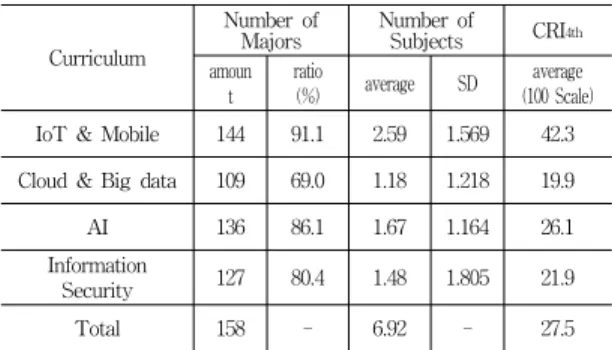
According to the analysis, the amount of subjects opened in response to the 4
thIR in 158 majors averaged 6.92. By sector, the IoT & mobile sector was the highest with 2.59. And the analysis showed that the overall average was 27.5 points out of 100, and that the response to the IoT &
mobile sector was relatively high(Table 7).
Table 7. Analysis Results of CRI
4thCurriculum
Number of
Majors Number of
Subjects CRI4th
amoun t
ratio
(%) average SD average
(100 Scale)
IoT & Mobile 144 91.1 2.59 1.569 42.3
Cloud & Big data 109 69.0 1.18 1.218 19.9
AI 136 86.1 1.67 1.164 26.1
Information
Security 127 80.4 1.48 1.805 21.9
Total 158 - 6.92 - 27.5
As a result of the analysis considering the characteristics of each university's establishment type, private universities showed higher curriculum response indexes than national and public universities in all areas except artificial intelligence, and were calculated to be 5.1 points higher overall.
Table 8. CRI
4thby University's establishment type
Curriculum
University's establishment type Total Private(A) public(B)
(A-B 125 )
Majors 33 Majors 158개
IoT& Mobile 43.8 36.4 7.4 42.3
Cloud& Big data 21.3 14.5 6.8 19.9
A.I 25.9 26.7 -0.8 26.1
Information
Security 23.4 16.4 7.0 21.9
An analysis of the index considering the location
of universities showed that the curriculum response
index of universities located in the Seoul
metropolitan area averaged 4.8 points higher than
that of universities located in provincial areas for
all curriculum groups(Table 9).
Table 9. CRI
4thby Location of Universities
Curriculum
Location of Universities
Total Seoul
Metropolitan area(A)
Local
(B) A-B
66 Majors 92Majors 158
IoT& Mobile 43.9 41.1 2.8 42.3
Cloud& Big
data 23.6 17.2 6.4 19.9
AI 29.4 23.7 5.7 26.1
Information
Security 30.1 25.7 4.4 21.9
Finally, an analysis based on the Software-focused university project organized by the Ministry of Education showed that the universities selected for the project averaged 8.9 points higher than non-selected universities.
However, in the case of information security-related curriculums, the response index of non-selected universities was high(Table 10).
Table 10. CRI
4thby Selection of Software-focused University project
Curriculum
Software-focused university
Total selected
(A)
non-selected
(B) A-B
45 Majors 113 Majors 158
Majors
IoT& Mobile 54.7 37.3 17.4 42.3
Cloud& Big
data 27.6 16.8 10.8 19.9
AI 32.9 23.4 9.5 26.1
Information
Security 20.4 22.5 -2.1 21.9