새로운 묘지공원을 위한 디자인
The Design for New Cemetery Park
박태수*, 최선영**
몽골국제대학교*, 한국방송통신대학교**
Tae-Su Park([email protected])*, Sun-Young Choi([email protected])**
요약
한국 정부는 매장지의 부족으로 인해 추모공원의 경우 제한된 시간동안 매장을 하고 기한이 끝나면 유골 을 화장하여 처리하는 방법을 택하고 있다. 본 연구에서 제안하는 새로운 묘지 디자인은 한국의 도시권에 서 한정된 매장지에 대한 체계적이고 효과적인 해결방안이 될 수 있다. 목적에 맞는 묘지 디자인 개발을 위해 게로[1] 의 FBS 모델을 이용하였다. 이 모델은 기능, 행위, 구조를 중심으로 동적인 성격의 맥락을 포함하고 있다. 이 연구는 단순한 묘지의 공학적 건설에 관심을 두기보다는 환경친화적 묘지라는 새로운 묘지 개념을 발전시키고자 한다. 즉, 종래의 단순한 묘지 기능에서 자연공원의 기능을 부가하기 위한 디자 인 모형을 제시하며 이를 통해 지속 가능한 묘지 건설을 위한 새로운 비지니스 모델을 제시하고자 한다.
■ 중심어 :∣추모공원∣묘지 디자인∣매장문화∣
Abstract
Research should explore techniques that will allow disposal of the dead to help the living by providing public space, protecting the environment, and contributing to economic development.
Its design might bring a cemetery back into community life and make a present of a park. This new design for a cemetery can provide a structural solution for limited burial sites on the metropolitan area of Korea. It is based on the shared sense of a cemetery, a joint ownership or co-ownership of the space of a cemetery. FBS model by Gero[1] is used for engineering a cemetery design development. This framework contains a dynamic character of the context where such design takes place among its function, behavior and structure. This study suggests a new cemetery concept rather than a simple civil engineering work for a cemetery. It aims for people to have a new perspective on a cemetery and contribute to the society through an eco-friendly business model, so FBS may be an adequate model for such design. It can be one of the innovative business models and designs for engineering cemeteries, implementing sustainable environment and changing the design from a cemetery to a natural park.
■ keyword :∣Memorial Park∣Cemetery Design∣New Cemetery∣
접수일자 : 2017년 05월 02일 수정일자 : 2017년 08월 18일
심사완료일 : 2017년 09월 18일
교신저자 : 최선영, e-mail : [email protected]
1. Introduction
Koreans inherently believe that their body should
be laid to rest underground and their spirit will live forever in another world after they have passed away.
Due to the insufficient supply of cemeteries in South
Korea, the government has also encouraged people to use cremation, and to scatter the cremated ashes after placing limited term at the public cemetery[2].
Although this method gradually has become more acceptable to South Koreans in the recent years, some still reject it because it contradicts traditional beliefs and preferences of South Koreans.
Siu[3] suggested ‘invisible niche’, a new concept in sustainable environment and product design for a densely populated metropolitan area of Hong Kong. It involves putting the ashes of the deceased into degradable urns to be buried underground. This allows ashes to enrich the environment. After the ashes have completely decomposed, the land will be ready for more ashes. Thus, the space for cremated ashes is unlimited. The important point is that the ashes will be underground, which is in accord with the beliefs and attitudes of the Chinese towards death.
That is "Returning to the earth and being at peace."
Siu’s model[3] is to solve the management problems of cemeteries and columbaria. However, it has too much emphasis on the problems caring for their ancestors' graves during several generations and the solution for the limited amount of available land in Hong Kong. On the other hand, he misses some important values of burial, such as relationships between the dead and the descendants and the meanings of burial methods on the space and time and on the space and materiality.
As the global landscape becomes increasingly populated, so disposal choice becomes a critical environmental issue. Disposal of the dead is an essential aspect of our existence; it is an inevitable activity, which cannot be avoided[4].
Engineering a cemetery innovatively must be allowed to keep pace with the burial law for each country. The research findings after thorough qualitative study indicated that current burial policy
and methods cannot satisfy the cultural needs and preferences of cemeteries in Korea[2].
The aging of the baby boomer generation portends a dramatic increase in the elderly population in the coming years, which will inevitably increase demand for cemetery space[5]. Yet, the ethnic and religious diversity of the baby boomer generation will also demand a range of other afterdeath treatments. In any case, the future landscapes of the dead are unlikely to resemble the sprawling, park-like burial grounds prevalent during the better part of the 20th century[6].
Through considering the increased presence of death and the dead body in a range of socio-cultural, economic and political contexts, both studies of, and some spaces of, death, dying and disposal are becoming less 'alternative' but remain highly ambiguous nonetheless[7]. This argument is addressed through a specific focus on three key interlinked spaces: cemeteries, corpses and sites of dark tourism[7].
Urban burial grounds in the 19th century were originally envisaged as public open spaces, and were professionally designed to be attractive places to visit in their own right[8]. Today, many cemeteries are neglected, with little to attract anyone apart from those visiting specific burial plots[8]. This lack of design, planning and ambition means that the potential health and environmental benefits of cemeteries are not being realized[8].
Research and practice should explore techniques that will allow disposal of the dead to help the living by providing public space, protecting the environment, and contributing to economic development[9].
Designs that accommodate multiple uses and conservation space might bring burial facilities back into community life and simultaneously contribute to a community’s green infrastructure[9].
The existing model of burial or inhumation makes
it appear as cutaneous cancer on the surface of forests which cause serious devastation. I suggest the innovative design for engineering cemeteries, implementing sustainable environment and changing the business model of the cemetery management.
Also, the goal of this paper is to improve the environment design of current cemeteries in densely populated metropolitan area of Korea.
2. The research for new design
2.1 Cremation
The UK has one of the highest cremation rates in the world[8]. People choose cremation for a variety of reasons including efficiency, hygiene, cost, and not wanting to leave behind 'burden' of a grave to maintain[8]. Where people die without their preference for burial or cremation clear, surviving family generally choose cremation[8].
Burial as a means of removing the dead has been practiced since the Stone Age[9]. Although ritual associated with it vary, burial is common around the world and across religions[4]. For example, the traditional preference in China was for methods of disposal that would delay decay, including the use of thick wooden coffins into which clothing and shrouds were packed. These coffins were then contained in tombs made of wood, stone, or brick[10].
In comparison with other body-disposal methods, cremation is actually designed to dispose of two things, the body and the spirit[11]. A cremation rite is a ritual involving three elements of transformation. It is partly cosmological, as the deceased moves from one location in the landscape to another; it is partly social as s/he is returned to the ancestors, and finally, it is partly ontological as s/he is transformed into a different entity and state of being[12]. Cremation is
transformation. It is a medium of change and transmutation[13]. Thus cremation can be analyzed as a result of three different but interdependent processes; first as a technological transformation, secondly as a social transformation and finally as a ritual transformation.
A Cremation and subsequent burial can be analyzed as a set of technological transformations. It consists of three parts: first, the place where the body was burnt or cremated; secondly, the intermediary period in time and space, where the cleaned bones are often transported somewhere else; this interval increases the room for maneuver in those aspects which are concerned with the renewal, reorganization and re-legitimization of relations between the living; and, finally, the place where the ashes or the bones were deposited or buried, which may be the same place where the body was cremated, but normally the urn is transported to another place or cemetery[13].
From an environmental perspective, the simpler the method of preparing the corpse for burial, the fewer natural resources are used and the fewer substances can subsequently contaminate the area surrounding the burial sites, which would typically be designated cemeteries in the vicinity of residential areas. Possible contaminants from coffins include preservatives, varnishes, and sealers on wood coffins, and lead, zinc, copper, and steel in metal coffins[14].
Historically, the marketing of hardwood or metal caskets promoted their capacity to protect the body from the elements of nature[15]. Where preservatives are not used, a wooden coffin might not be a major contaminant source, but an untreated coffin will decompose and leach its contents more quickly[14].
Water and land resources can be contaminated by the leachate by this method.
Not only do the processes of burial affect the land in which the bodies are placed, but using land for
burial purposes also has important environmental consequences because: cemeteries require maintenance, such that they provide an acceptable setting in which to honor and maintain relationships with the dead that land is then restricted in being able to support other activities cemeteries have capacity constraints[14]. Land is a valuable resource with man’s use of burial and location of sites conflicting at times with farming, industrial, residential, and leisure activities. Cemeteries have to be located such that they do not impinge on these other activities yet have sufficient capacity for and are readily accessible to the communities they are meant to serve[4]. The nature of land usage and cemetery capacity brings out the severe conflict with regard to burial.
Space for cemeteries is a particular issue for countries large and small. In the UK, there are between 12,000 and 20,000 graveyards, cemeteries, and burial grounds, but in spite of this number, the country is facing major constraints, with some cemeteries reaching capacity and others having run out of space completely[8]. This means that families either have to pay increased fees for the remaining burial plots or have to locate plots at sites that are some distance away, breaking the relationship between the dead and the living[8]. Thus, while across cultures the spatially oriented problems of burial are similar but with different degrees of criticality depending on land availability, how consumer demand is managed is likely to be different according to cultural and social requirements, as well as economic and market contexts[4].
Cremation in the Britain saw a dramatic increase in cremation following the Second World War, rising from 6% of all deaths in 1945 to 72% by 2002[9]. This was not directly associated with religious or cultural factors; rather it was a means by which local authorities could address capacity constraints and
provide the public with an economical means of disposal[4].
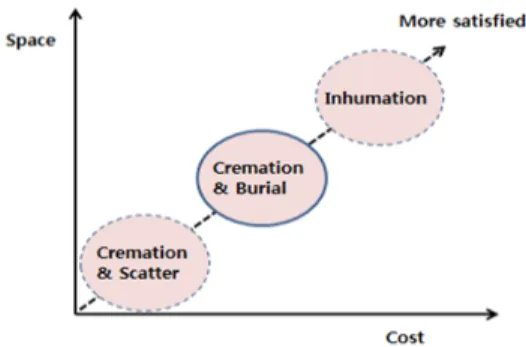
Hong Kong has also introduced cremation in part as a means of resolving physical land constraints associated with land burial[3]. The use of cremation is also culturally embedded. It will be in the model of
‘cremation & scatter’ of [Fig. 1]. Cremation is the traditional method of disposing of the dead in countries influenced by Hindu and Sikh religions, and is the common form of removing corpses in regions informed by the Buddhist faith[4].
Having been legalized in 1884, cremation is now the most common form of disposal in Britain[16], and while it is not an accepted practice amongst the Jewish and Muslim religions[17], in many countries it is becoming or has become the predominant or at least an accepted disposal method[4].
Walter[15] suggests that, in the West, cremation has become the norm where there has been state encouragement and no significant resistance of a religious or commercial nature. While in countries such as Bali cremation can be elaborate and expensive, it does provide an affordable means of disposal in many countries.
Following cremation, the final disposal of a body might be by scattering remains at a site symbolic to the dead or their mourners, or discarding the ashes into water such as in the Sikh and Hindu tradition, but can also involve the containment of ashes in urns and burial in columbaria. Cremation might reduce the amount of land actually required to dispose of corpses, but burial of remains in ceremonial containers and the construction of memorial sites that can be visited by the bereaved presents problems akin to cemeteries, that is, land requirements, the landscaping and maintenance of sites, and the costs (natural and financial) incurred in doing this (CABE[8]; Siu[3]). While scattering of ashes might
seem a logical response to this, the management of the final remains is carefully controlled in some countries, and mourners’ requirements for ways to memorialize the deceased may lead them to seek a permanent repository for ashes[4].
Koreans think the management of the dead a heavy burden because their land is at a premium. According to CABE[8], Siu[3], Hong[2], and Park & Choi[18], Space and cost matrix for the treatment of a corpse can be drawn as below. We can design the new cemetery concept at the 'cremation & burial' to solve the current problems of the model of ‘cremation &
scatter’ and ‘inhumation.’
Fig. 1. Burial methods on the space and cost
2.2 New burial concept for a cemetery
To this time, human being has used several methods of the burial in order to overcome limited land for the corpse. According to traditions and cultural beliefs and preferences, their burial practices may be chosen differently. Double decker, columbarium and lawn cemetery have been used to this time as existing burial concepts for saving a limited land.We can develop new burial concept, using the basic one of condominium, a room or set of rooms that is owned by the people who live there and that is part of a larger building containing other similar sets of rooms, might be required. ‘Condominium’ is split into
identified units and each of these units is also a condominium.
We can see the meaning of ‘condominium’ at the dictionary, an apartment house, office building, or other multiple-unit complex, the units of which are individually owned, each owner receiving a recordable deed to the individual unit purchased, including the right to sell, mortgage, etc., that unit and sharing in joint ownership of any common grounds, passageways, etc. (www.dictionary.com/browse/condominium). In addition, we find the modern Latin meaning of condominium is "joint rule or sovereignty," combining con-, "together," and dominum, "right of ownership"
(www.vocabulary.com/dictionary/condominium).
Oxforddictionaries.com says the meaning of condominium, the system of by which condominiums, in which have full to the individual or house and an in the shared parts of the property.
3. New burial design development
The Function-Behaviour-Structure Model as a Design Framework
FBS model by Gero[1] is used for re-engineering a cemetery design development. According to Howard, Culley & Dekoninck[19], the design process has two frames, including engineering design and creative process from cognitive psychology. Engineering design is linear representations so used for simple designs, but lacks in creative and complex design research including divergent and convergent processes. Howard, Culley & Dekoninck[19]
mentioned FBS framework by Gero[1] as the model integrating the advantages of both processes. Gero[1]
suggested a framework applicable much to design processes, based on function, behavior, and structure of a design target. This framework contains a
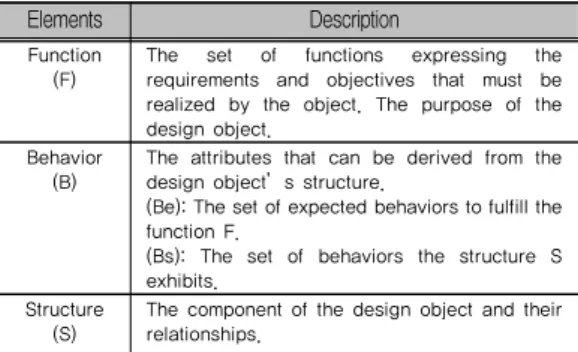
dynamic character of the context where such design takes place among its function, behavior and structure. This study suggests a new cemetery rather than a simple civil engineering work. It aims for people to have a new perspective on a cemetery and contribute to the society through an eco-friendly business model, so FBS may be an adequate model for such design. The following [Table 1] is detailed FBS model.
Table 1. The elements of FBS framework Elements Description Function
(F)
The set of functions expressing the requirements and objectives that must be realized by the object. The purpose of the design object.
Behavior (B)
The attributes that can be derived from the design object’s structure.
(Be): The set of expected behaviors to fulfill the function F.
(Bs): The set of behaviors the structure S exhibits.
Structure (S)
The component of the design object and their relationships.
3.1 New cemetery design development by FBS framework
In order to suggest an efficient design model in the increasingly diversified and complicated design, this study aimed to formulate concepts of the FBS design model and maintain consistency within a category of the Systematic design.
Hence, concepts of the FBS design model are to be established by identifying meanings and correlations of purpose, function, behavior and structure that design system has, making the overall FBS frame from steps of Formulation, Synthesis, Analysis, Evaluation as a design activity converting design information and applying a condominium-typed burial design in order.
FBS has an advantage over the existing design technique centered on size in that it recognizes the importance of Function so has function-oriented
design.
In this study, the top-level function, in other words, purpose is the designing the condominium-typed burial structure and sub-functions include firstly burial, secondly commemoration, thirdly sustainability and fourthly maintenance. Besides, each sub-function needs for another sub-function. As for the sub-function of easy to bury, urns as infrastructure should be easy to assemble and disassemble functionally and the minimum space should be used. For commemoration, it is required to construct a symbolic and friendly memorial for psychological bond along with easy to access anytime. Finally, for an eco-friendly model, urns and blocks connecting urns should have no effect on the ecosystem on the ground. Such sub-functions should be organized in an organic manner to perform the top-level function.
Fig. 2. “COLUMBARIUM” function hierarchy
A specific structure may be designed through segmentation into Expected Behavior(Be) and Actual Behavior(Bs) to execute such functions and there are 6 steps as follows.
Firstly, it is Formulation of a task. Expected Behavior is derived from a general function. This process is called Formulation. In other words, formulation corresponding to the Burial Function has something to do with those, for instance, how to process cremation and inhumation, how to construct a
commemorable space families want to visit constantly and how to build a symbolic monument. Furthermore, it is a step to consider how to make an urn used for burial and unit for covering it for the sake of sustainability and also predict the least workers and expenses for maintenance.
The second step is Synthesis. Behavioral variables of the expected behavior come to be formulated as a specific design alternative having the material property and size of shape and texture, and such a process is called the synthesis. Therefore, it is the step to design and construct all kinds of facilities including size and positioning of an actual structure for realizing the Expected behavior. As for structure, a type of condominium, to put corpses as many as possible into minimum area, is suggested. It means to collect cremated corpses into urns having an individual identification number and bury them collectively. Plants and trees on the ground are not influenced by a large rock below. Accordingly, the ground can be made into a park and underground becomes a large condominium-typed cemetery having a vertical structure through units of urn with ashes.
In this process, specific size and material of an urn, those of a unit for covering an urn are designed including a shape for uniting both as [Fig. 3] and a columbarium like [Fig. 4], [Fig. 5]. In addition, shape, size and location of a memorial should be designed in a concrete manner. Also, in case of constructing a ground park, specific plan about infrastructure and landscaping should be prepared.
The third step is Analysis. When design generated from the synthesis is executed actually, aside from expected performance, it reveals real performance or behavior realized from physical properties and the resulting analysis is conducted. In other words, it is the step analysing the results shown from a case where each urn combined as a condominium-type is
to be buried and a ground park centered on a memorial is to be constructed.
The fourth step is Evaluation. Bs shown from the analysis comes to have a little difference from the expected behavior intended at the early design of a condominium-typed columbarium. It is the step identifying such a difference and verifying a design alternative.
The fifth step is Reformulation. As a result of the evaluation, from the expected behavior, a new type of a columbarium is suggested or an expected behavior newly adjusted is generated as a result of execution.
This process is called the reformulation of a design task.
The sixth step is Documentation. The final design plan created from many feedbacks, circulations and repetitions is composed of drawings and documents and it is called documentation.
FBS model is not a design tool but a design paradigm to develop a design framework available continually while maintaining the design consistency.
Fig. 3. The unit of plate and urn
Fig. 4. The motive of columbarium
Fig. 5. The partition of a stone
4. Further Perspectives And Conclusions
As population grows older, interring the dead will almost certainly become a more pressing public issue in communities of Korea. Disposal methods will affect the landscape of burial in Korea and will almost certainly worsen the problems of setting aside large amounts of land in perceptions that cemeteries are nuisances, and the effects of our disposal methods on environmental quality. It will become increasingly important to set aside permanent space that sensitively balances sociocultural expectations with environmental and economic concerns.Cemeteries are rarely part of comprehensive plans, revitalization plans, or community conversations, even though dealing with human mortality has been an inescapable public function for a very long time[20].
Due to the insufficient supply of cemeteries in South Korea, the government has also encouraged people to use cremation, and to scatter the cremated ashes after placing limited term at the public cemetery. Although this method gradually has become more acceptable to South Koreans in the recent years, some still reject it because it contradicts traditional beliefs and preferences of Korea[2].
Siu[3] suggested ‘invisible niche’, a new concept in sustainable environment and product design for a densely populated metropolitan area of Hong Kong. It involves putting the ashes of the deceased after cremation into degradable urns to be buried
underground. Thus, the space for cremated ashes is unlimited. His model is to solve the management problems of cemeteries and columbaria. However, it has too much emphasis on the problems caring for their ancestors' graves during several generations and the solution for the limited amount of available land in Hong Kong. On the other hand, he missed some true values of traditional custom, and overlooked the relationships between the dead and the living.
There is a body of literature on death and dying largely emanating from the disciplines of sociology and anthropology[21], very little has been written from the design perspective. This model provides a structural solution for the space of the corpse in a heavily densely populated area, is based on the shared sense of a cemetery, a joint ownership or co-ownership of the space of a cemetery. Also, this design adds the environment - friendly design to a current cemetery in Korea. This model can provide the chance that a cemetery becomes an afforested land or a natural park. Therefore, it can be one of the innovative designs for engineering cemeteries, implementing sustainable environment and changing the business model of the cemetery management.
Research and practice should explore techniques that will allow disposal of the dead to help the living by providing public space, protecting the environment, and contributing to economic development[9]. Thus, I conclude with similar suggested areas for future research. First, it would be very desirable to have detailed case studies about how to redesign cemeteries to better integrate them into natural parks.
New business model of re-engineering a memorial park and a cemetery might be required in the future research. Further, its model, a cemetery being well reflected in the space, time, and materiality, should be researched into more.
Second, planners would benefit from the research and the design that explored how to permit alternative methods of disposal that would reduce the toxic chemicals, concrete, and wood used to make cemeteries. This design might allow cremated burials in the same space as cemeteries. Later, as the policies restrict cemeteries to use for the limited time in Korea, alternative practices could be more accepted, and the new cemetery designed for the cremation burial could be a part of their daily lives.
Third, open public planning processes can resolve problems that emerge when cemeteries are expanded or constructed. Researchers and planners should search for the better examples outside Korea, and they attempt to integrate current practices within existing burial spaces and new ones in other countries.
Fourth, when planners modify existing cemeteries to accommodate additional uses, adopting policies that encourage alternatives to burial, they confront deeply rooted cultural practices, some related to religious beliefs. The designers of the new cemetery should take care of making burial cemeteries more socially acceptable as well as more ecologically sensitive.
Fifth, planners make plans to carry out the better design for increasing direct confrontation of an urn, providing psychological well-being to the remainers.
참 고 문 헌
[1] J. S. Gero and N. Kannengiesser, “The situated function-behavior-structure framework,”
Design Studies, Vol.25, No.4, pp.373-391, 2004.
[2] S. Hong, “The future of a space of corpse on the metropolitan region,” Journal of Korea Association for land administration, Vol.5, pp.162-196, 2003.
[3] K. W. M. Siu, “Culture and Design: A New
Burial Concept in a Densely Populated Metropolitan Area,” Massachusetts Institute of Technology, Design issues, Vol.21, pp.79-89, 2005.
[4] A. L. Spongberg and P. M. Becks, “Inorganic soil contamination from cemetery leachate.
Water,” Air and Soil Pollution, Vol.117, No.1-4, pp.313-327, 2000.
[5] R. Smith, The death care industry in the United
States, Jefferson, NC: McFarland & Company,
1996.[6] M. Harris, Grave matters: A journey through
the modern funeral industry to a natural way of burial, New York, NY: Scribner, 2007.
[7] C. Young and D. Light, “Interrogating spaces of and for the dead as 'alternative space':
cemeteries, corpses and sites of Dark Tourism,”
International Review of Social Research, Vol.6 No.2, pp.61-72, 2016.
[8] CABE, "Briefing: Cemeteries, churchyards and b urial grounds," 2007. http://webarchive.nationala rchives.gov.uk/20110 118095356/http:/www.cab e.org.uk/files/cemeteries-churchyards-and-buri al-grounds.pdf
[9] C. Basmajian and C. Coutts, "Planning for the Disposal of the Dead," Journal of the American Planning Association, Vol.76, No.3, pp.305-317, 2010.
[10] P. Ebrery, "Cremation in Sung China," The American Historical Review, Vol.95, No.2, pp.406-428, 1990.
[11] P. Barber, “Cremation,” The Journal of Indo-European studies, Vol.18, No.3-4, pp.379-388, 1990.
[12] P. Vitebsky, Dialogues with the Dead, Cambridge University Press, 1993.
[13] T. Oestigaard, “Cremations as transformations:
When the dual cultural hypothesis was
cremated and carried away in urns,” European Journal of Archaeology, Vol.2, No.3, pp.345-364, 1999.
[14] L. Canning and I. Szmigin, “Death and disposal:
The universal, environmental dilemma,” Journal of Marketing Management, Vol.26, pp.1129-1142, 2010.
[15] T. Walter, "Three ways to arrange a funeral:
Mortuary variation in the modern West,"
Mortality, Vol.10, No.3, pp.173-192, 2005.
[16] L. Kellaher, D. Prendergast, and J. Hockey, "In the shadow of the traditional grave," Mortality, Vol.10, No.4, pp.237-250, 2005.
[17] G. Jonker, "The knife’s edge: Muslim burial in the diaspora," Mortality, Vol.1, No.1, pp.27-43, 1996.
[18] T. Park and S. Choi, “New business model and design of re-engineering a cemetery from cemeteries to natural park,” Journal of Culture and Tourism Research, Vol.18, No.1, pp.15-21, 1999.
[19] T. J. Howard, S. J. Culley, and E. Dekoninck
“Describing the creative design process by the integration of engineering design and cognitive psychology literature,” Design Studies, Vol.29, No.2, pp.160-180, 2008.
[20] L. Mumford, The city in history, New York, NY: Penguin, 1961.
[21] D. Turley, "A postcard from the very edge:
Mortality and marketing," S. Brown and D.
Turley (Eds.), Consumer research: Postcards
from the edge, London: Routledge, pp.350-377,
1997.저 자 소 개
박 태 수(Tae-Su Park) 정회원
▪2004년 2월 : 세종대학교(호텔경 영학 박사)
▪2005년 3월 ∼ 2007년 8월 : 경 남대학교 관광학부 전임강사
▪2014년 9월 ∼ 현재 : 몽골국제 대학교 부교수
<관심분야> : 호텔회계, 호텔재무, 관광상품디자인
최 선 영(Sun-Young Choi) 정회원
▪2014년 2월 : 서울대학교(생활과 학 박사)
▪2015년 9월 ∼ 2016년 2월 : 몽골 국제대학교 패션디자인학과 교 수
▪2016년 2월 ∼ 현재 : 한국방송 통신대학교 전임대우 강의교수
<관심분야> : 디자인 프로세스, 창의적 발상, 복식미학