• 검색 결과가 없습니다.

An Analysis of Information Security Curriculum in Elementary School practical arts, Secondary School Informatics Teaching and Suggestions for Improvement

N/A
N/A
Protected

Academic year: 2021

Share "An Analysis of Information Security Curriculum in Elementary School practical arts, Secondary School Informatics Teaching and Suggestions for Improvement"

Copied!
7
0
0

로드 중.... (전체 텍스트 보기)

전체 글

(1)

JKSCI

An Analysis of Information Security Curriculum in Elementary School practical arts, Secondary School Informatics Teaching and

Suggestions for Improvement

1)

Choungbae Kim*

*Professor, The Korea Chamber of Commerce & Industry, Seoul, Korea

[Abstract]

Although various information and communication technologies occupy a place in daily life in the face of the fourth industrial revolution, the contents related to information security in elementary and secondary education courses are mainly related to personal information protection, and the contents and countermeasures of rapidly changing security threats are low in textbooks, and they are far behind the changes. To improve this, this paper suggests that education contents related to information security are included in elementary school real and middle school information textbooks, educational contents related to wireless network and PC security are included to cope with rapidly changing security threats that may arise from the age of the Internet of Things, non-face-to-face classes, and case-based information ethics education can be organized to eradicate curiosity about hacking. Through this paper, we will help prevent information security accidents by establishing basic security measures on our own and strengthening security awareness in the information age.

▸Key words: Information security curriculum, elementary school practical course,

middle and high school informatics subject, security threat, Security Education Improvement

[요 약]

4차 산업혁명 시대를 당면하며 다양한 정보통신기술이 일상생활에 자리를 차지하고 있으나, 초, 중등 교육과정에서의 정보보안에 관련된 내용은 개인정보보호와 관련된 내용이 주를 이루며, 급 변하는 보안위협에 대한 내용과 대응방안에 대해서는 교과서에서 다루고 있는 비중이 낮으며, 변 화에 많이 뒤쳐져있다. 본 논문에서는 이를 개선하기 위해 초등학교 실과 및 중학교 정보 교과서 에 정보보안과 관련된 교육 콘텐츠 수록하고, 사물인터넷 시대, 비대면 수업 등으로 발생할 수 있 는 급변하는 보안위협을 대응하기 위해 무선 네트워크, PC보안과 관련된 교육 콘텐츠를 수록하며, 사례 중심형 정보 윤리교육을 구성하여 해킹에 대한 호기심을 근절할 수 있도록 제안한다. 본 논 문을 통해 정보화 시대에서 기본적인 보안 대책을 스스로 세우고 보안 인식을 강화하여 정보보안 사고를 예방하는 데 도움이 될 것이다.

▸주제어: 정보보안 교육과정, 초등 실과, 중등 정보교과, 보안위협, 보안교육개선

∙First Author: Choungbae Kim, Corresponding Author: Choungbae Kim

*Choungbae Kim ([email protected]), The Korea Chamber of Commerce & Industry

∙Received: 2020. 09. 14, Revised: 2020. 10. 12, Accepted: 2020. 10. 12.

Copyright ⓒ 2020 The Korea Society of Computer and Information http://www.ksci.re.kr pISSN:1598-849X | eISSN:2383-9945
(2)

I. Introduction

산업혁명을 급격히 겪은 우리나라의 시대적 경험에 비 추어 우리의 일상생활에서도 새로운 기술을 창출하는 데 연구개발이 주를 이루고 있듯이, 교육 분야에서도 이러한 특성이 적용되어 새로운 가치 창출을 중점으로 다루고 있 다. 정보통신기술 분야의 교육과정인 초등 실과, 중등 정 보 교과의 내용을 보면 문제 해결과 프로그래밍 영역이 가 장 큰 비중을 차지하고 있다. 이에 초·중·고등학교 학생들 은 자연스레 알고리즘을 활용한 프로그래밍을 비중 있게 접하게 되고, 국가 정책도 초등학교 수업에 코딩 교육을 의무화하여 창의성을 강화하기 위해 방향을 잡고 있다.

하지만 현 시대는 다른 시각에서 바라볼 필요가 있다.

이전 시대에서 ‘데이터’라는 것은 기업의 업무용 데이터로 전통적인 서버에 업무용으로 저장되어있는 전자식 정보를 의미했지만, 4차 산업혁명 시대를 겪고 있는 지금의 ‘데이 터’는 스마트폰, 태블릿 PC, Wearable Device에서 냉장 고, 공기청정기, 에어컨까지 우리의 일상생활 주변에 항상 존재하는 정보가 되었다. 이러한 다양한 데이터를 보호 없 이 사용에만 목적을 두고 있다면, 주변에 존재하는 다양한 정보보안 취약성들로 인하여 데이터가 유실, 위·변조 등 다양한 침해사고가 발생할 수 있다. 또한, 이러한 보안 취 약성, 위협들이 급변하며 고도화, 지능화되고 있어 지속적 인 관심이 없으면 대응조차 어려운 것이 현실이다. 이러한 시대적 변화에 맞춰 정보보안 인식 개선을 위해 프로그래 밍 중심의 교육 과정을 개편해야 될 필요성을 느끼고, 새 로운 기술을 창출함과 동시에 정보를 보호하는 지식도 함 께 함양할 수 있도록 본 논문에서 초등 실과, 중등 정보 교 과의 정보보안 교육 내용을 분석하고, 정보보안 관점의 교 육 내용을 개선할 수 있도록 제언하고자 한다.

II. Preliminaries

1. Related works

1.1 Education course analysis

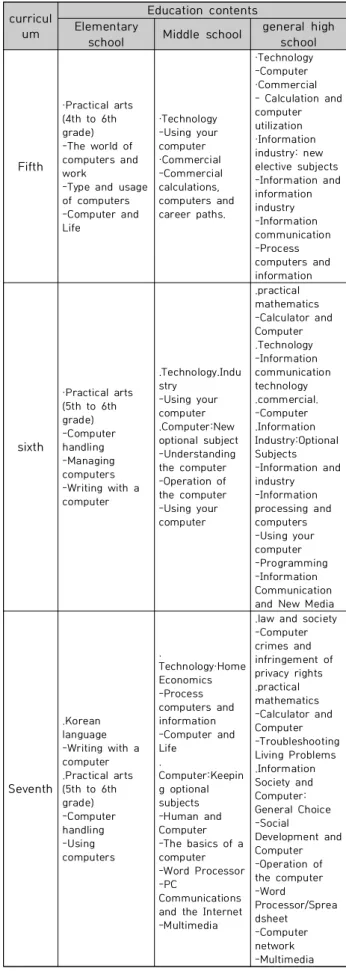
우리나라 정보 관련 교육과정의 변화된 모습을 Table 1 [1] 과 같이 보면, 컴퓨터의 기초를 다루는 내용부터 인터 넷 시대가 오게 되는 2000년대에 인터넷을 배울 수 있게 교육이 변화하고, 가장 최근 개정된 2015 교육과정에서는 소프트웨어 코딩, 프로그래밍이 주를 이루고 있다.

curricul um

Education contents Elementary

school Middle school general high school

Fifth

·Practical arts (4th to 6th grade) -The world of computers and work

-Type and usage of computers -Computer and Life

·Technology -Using your computer

·Commercial -Commercial calculations, computers and career paths.

·Technology -Computer

·Commercial - Calculation and computer utilization

·Information industry: new elective subjects -Information and information industry -Information communication -Process computers and information

sixth

·Practical arts (5th to 6th grade) -Computer handling -Managing computers -Writing with a computer

.Technology.Indu stry

-Using your computer .Computer:New optional subject -Understanding the computer -Operation of the computer -Using your computer

.practical mathematics -Calculator and Computer .Technology -Information communication technology .commercial.

-Computer .Information Industry:Optional Subjects -Information and industry -Information processing and computers -Using your computer -Programming -Information Communication and New Media

Seventh

.Korean language -Writing with a computer .Practical arts (5th to 6th grade) -Computer handling -Using computers

.

Technology·Home Economics -Process computers and information -Computer and Life

.

Computer:Keepin g optional subjects -Human and Computer -The basics of a computer -Word Processor -PC

Communications and the Internet -Multimedia

.law and society -Computer crimes and infringement of privacy rights .practical mathematics -Calculator and Computer -Troubleshooting Living Problems .Information Society and Computer:

General Choice -Social

Development and Computer -Operation of the computer -Word Processor/Sprea dsheet -Computer network -Multimedia

Table 1. Changes in Information-Related Curriculum

(3)

curricul um

Education contents Elementary

school Middle school General high school

2007 Revised

·Practical arts (5th to 6th grade) -Information devices and cyberspace -Internet and information

․Technology·Ho me Economics -Information communication technology .Informatics:Opt ional Subject -Configuration and operation of the information device -Expression and management of information -Troubleshootin g Methods and Procedures -Information society and information technology

.Informatics:Opti onal Subject -Configuration and operation of the information device

-Expression and management of information -Troubleshootin g Methods and Procedures -Information society and information technology

2009 Revised

·Practical arts (5th to 6th grade) -Life and Information -Life and electricity.

Electronics

․Technology·Ho me Economics -Information and

communication technology .Informatics:Opt ional Subject -Information science and information ethics -Configuration and operation of the information device -Expression and management of information -Troubleshootin g Methods and Procedures

.Informatics:Adv anced Optional Subject -Information science and information ethics -Configuration and operation of the information device

-Expression and management of information -Troubleshootin g Methods and Procedures

2015 Revised

·Practical arts (5th to 6th grade) -Software Principle Training -Understands software coding by leveraging software tools

.Informatics:Re quired Subject -Software Principle Training -

Understanding algorithms and developing program production skills through problem-solving learning

.informatics:Gen eral elective courses -Creating creative outputs through computer convergence activities and learning how to link university careers -Programming language learning

Table 1. Changes in Information-Related Curriculum

이러한 교육과정 변화의 추이를 보며 정보기술이 발전 하고 있다는 점을 짐작할 수 있다. 정보기술이 발전함에 따라 논리적 데이터의 범위가 지속적으로 늘어나고 있는

데, 이에 대한 정보의 보안 방안에 대해 학습할 수 있는 부 문은 중등 정보 교과 교육과정의 내용체계인 Table 2와 같이 개인정보 보호에 대한 부문이 ‘정보 윤리’ 핵심 개념 중 내용 요소의 하나의 항목으로 구성되어 있으며, 정보보 안에 대한 내용은 구성되어 있지 않다.

Area core

concept generalized

knowledge content

element

informat ion culture

information society

Information society is a society centered on the production and utilization of information, and new jobs related to information are emerging.

·Characteristic and career path of information society

information ethics

Information ethics is the right values and patterns of behavior that members must keep in the information society.

·Personal information and copyright protection

· Cyber ethics

data and informat

ion

presentation of data and information

Analog data such as numbers, letters, pictures and sounds are digitally converted and processed inside the computer.

·Type of data and digital representation

analysis of data and information

The collection and analysis of data and information needed to solve the problem is done by means of search, classification, processing, and structure.

·Collection of data

·Structured information

troubles hooting and program

ming

abstract painting

Abstracting is the process of understanding and analyzing problems and removing unnecessary elements for problem solving or dividing them into small problems.

·Understanding the problem

·Extracting core elements

algorithm

Algorithm is an efficient method and procedure for solving problems.

·Understanding algorithm

·Algorithm representation

programmi ng

Programming is the process of automating the solution of a problem by implementing it in programming language.

·Input and output

· Variables and calculations

·Control structure

·Programming application

computi ng system

how compute systems work

An organic combination of hardware and software provides data input from the outside, processing efficiently, and outputting it.

·Principles of composition and operation of computing devices

physical computing

It organizes and controls physical computing systems with microcontrollers and various input and output devices through programming.

·Sensor-based program implementation

Table 2. Content System for Secondary Informatics

Subjects[2]

(4)

2015개정 교육과정에 따른 검인정 교과서 중 초등 실과 2종[3], [4], 중학교 정보 4종[5], [6], [7], [8], 고등학교 정 보 4종[9], [10], [11], [12]의 교과서 내용을 조사한 결과, 단원 구성은 교육부 내용체계를 기반으로 되어있으며, 내 용의 구성은 Table 3과 같이 초등 실과의 경우 1%대, 중 등 정보 교과의 경우 3~6%대로 정보보안의 비율이 현저히 낮은 편이다.

school and curriculum

publishing house

total quan tity

Informati on Security Related Quantities

Informati on Security Education

Ratio Elementa

ry school practical arts 6th

Kyohaksa 128p 2p 1.7%

CHUNJAE

TEXTBOOK 132p 2p 1.5%

Middle School Informati

cs

MIRAE N 170p 11p 6.5%

Sunganda

ng 184p 8p 4.3%

CHUNJAE

TEXTBOOK 188p 9p 4.8%

Hanbit

Academy 170p 8p 4.7%

High school informati

cs

GYOMOON PUBLISHE

RS 211p 13p 6.2%

Kumsung

Publishing 232p 8p 3.4%

CMASS 252p 16p 6.3%

CHUNJAE

TEXTBOOK 244p 14p 5.7%

* Round from Double Decimal Digits.

Table 3. The percentage of information security in textbooks

Table 3에서 조사한 검인정 교과서의 정보보안 관련 내 용을 보면 초등 실과와 중학교 정보의 경우 개인정보보호 와 관련된 내용만 다루고 있으며, 고등학교 정보 교과의 경우 정보보안과 관련 법규를 다루고 있다.

초등 실과 교과서의 개인정보보호는 개인정보의 정의, 개인정보 유출방지 방법인 온라인 계정의 비밀번호 복잡 도 설정 및 주기적 변경, 공공장소에서의 컴퓨터 사용 후 로그아웃, 출처가 불분명한 온라인 자료 다운로드 금지 등 개괄적인 내용들만 1~2page 분량으로 수록되어 있다.

중학교 정보 교과서의 개인정보보호는 개인정보보호법 에서 명시한 개인정보의 정의를 인용하여 좀 더 구체적으 로 표현하였으며, 스팸, 스미싱, 피싱 등 개인정보 침해위 협 방식에 대해 설명하고, 개인정보보호방안, 개인정보 침 해사고 발생 시 신고 방안에 대해 다루고 있다.

고등학교 정보 교과서의 정보보안은 정보보안의 3대 요 소인 기밀성, 무결성, 가용성을 토대로 정보보안의 개념과 중요성, 바이러스, 악성코드, 랜섬웨어 등 보안위협의 종 류, 방화벽, 암호화, 바이러스백신 등 정보보안 위협의 대 응방안에 대해 다루고 있으며, 정보통신망 이용촉진 및 정 보보호 등에 관한 법률, 통신비밀보호법 등 정보보안 관련 법규에 대해 간략히 설명하고 있다.

1.2 National policy direction analysis for information security

기획재정부에서 ‘2020 한국판 뉴딜’ 정책을 발표하며 디지털 뉴딜 분야로 ‘D.N.A. 생태계 강화’를 선정했다.

Data-Network-AI 생태계를 강화하기 위해 디지털 신제 품·서비스 창출 및 경제의 생산성 제고를 위해 전 산업의 데이터·5G·AI활용·융합가속화를 추진하여 2025년까지 총 사업비 38.5조원을 투자, 일자리 56.7만개를 창출하겠다는 방침이다.[13]

Fig. 1. 2020 Korean New Deal

과학기술정보통신부에서는 ‘제2차 정보보호산업 진흥계 획’ 정책을 발표하며 디지털 경제 사회 전환에 필수적인 정보보호 강화 요구를 차세대 핵심 산업으로 육성을 위해 제1차 정보보호산업 진흥계획(‘16~’20년)을 통해 양적 성 장 달성에 이어, 최근 코로나19에 따른 전 산업의 디지털 전환과 비대면 서비스 확산으로 새로운 사이버 위협 대응 을 목적으로 정보보호 산업의 질적 성장과 체질 개선을 위 해 제2차 정보보호산업 진흥계획(‘21~’25년)을 수립했다.

중점 추진과제로는 Fig. 2와 같이 디지털 전환에 따른 정

보보호 新 시장 창출, 민간의 사이버 복원력 확보를 위한

정보보호 투자 확대, 지속성장 가능한 정보보호 생태계 조

성 총 세 가지 과제로 추진한다.[14]

(5)

Fig. 2. 2

nd

Plan for Promotion of Information Protection Industry

한국인터넷진흥원에서는 ‘2020년 2분기 사이버위협 동 향 보고서’를 발표하며 코로나19로 인해 준비하지 못 한 원격근무, 원격교육 상황이 시작되었고, 정보보안의 관점 에서 검토해야 될 부문이 다수 발생하고 있다고 의견을 제 시하고 있다.[15]

Fig. 3. Cyber Threat Trend Report for Q2, 2020

이와 같이 국가의 정책 또한 정보화 사회로 발전하고 있 는 현 상황에서 정보보안에 대해 중요성을 인지하고, 다양 한 정책으로 정보보안을 강화하고 있는 것으로 분석된다.

III. The Proposed Scheme

해마다 크고 작은 정보보안 관련 사고가 기업 및 기관, 개인에게 발생하고 있으며, 이는 보안 관련 담당부서 또는 담당자, 정보보안 전문가만이 해당 업무를 수행함으로 보 안성을 강화할 수 있는 것은 아니다. 기업 및 기관의 직원, 나아가 전 국민 개인이 스스로 보안의식을 갖고 강화하게 되면 개인, 기업, 기관, 국가적으로 더 나은 정보보안 체계 를 갖출 수 있을 것으로 전망한다.

정보보안 전문가의 인터뷰를 통해 정보보안 교육의 필 요성을 확인할 수 있다. 사이버보안 전문기업 옵티브 (Optiv)의 CISO(정보보호 최고책임자)인 전무이사 돈 마리 허친슨(Dawn-Marie Hutchinson)과의 인터뷰 내용을 보 면, 정보보안은 흔히 기술적인 문제로 생각되 기업 내 모 든 구성원의 문제라고 생각하지 않는다. 학생들은 어릴 때 부터 기술에 둘러싸인 채 성장하지만, 기술 인력의 일원이 될 때 까지 정보보안과 관련한 실천을 전혀 접하지 못한다 고 한다. 정보시스템 오류 탐지 전문기업 블루벡터 (BlueVector)의 CEO(최고경영자) 크리스 러브조이(Kris Lovejoy)의 인터뷰 내용 중 “일찍부터 보안이나 프라이버 시 훈련을 더 많이 시행해야 하는 이유 중 하나는 데이터 가 얼마나 구석구석에 있는지 사람들이 이해하도록 돕고, 만약 데이터를 보호하지 않을 경우 개인의 삶에 어떤 영향 이 있을 수 있는지 이해하도록 돕는 것”이라는 내용에서도 정보보안 교육의 중요성을 강조하고 있다.[16] 이처럼 정 보 교과에서의 정보보안 교육 강화의 필요성은 여러 분야 에서 부각되고 있다.

기업에서 보안 교육을 실시한 빈도에 따라 임직원 보안 의식 함양에 미치는 영향에 대한 연구결과를 보면, 9개 기 업 555명의 설문 데이터를 통해 임직원 성향이나 특성을 고 려하여 맞춤형 교육이 이루어지는 기업이 임직원의 긍정적 인 교육 반응을 일으킨다는 결과가 있다. 이처럼 초·중등 교 육에서도 피교육자의 성향에 맞는 교육이 이루어지면 충분 히 효과적인 교육이 이루어질 것으로 보인다.[17]

초·중등 정규 교육과정에서 정보보안에 대한 기초 지식 을 함양하기 위해 기존 교육 콘텐츠에 다음과 같은 내용을 학생들이 학습할 수 있도록 교육 콘텐츠 및 이론 지식을 추가하도록 제안한다.

첫째, 초등학교 실과, 중학교 정보 교과서에 개인정보보 호와 함께 고등학교 정보 교과서와 같이 정보보안과 관련 된 교육 콘텐츠 수록한다. 초등학교 실과, 중학교 정보 교 과는 공통과목이라 모든 학생이 필수로 학습을 하게 되지 만, 고등학교 정보 교과는 선택과목으로 분류되어 정보 교 과를 선택하지 않은 학생들은 정보보안에 대한 내용을 학 습할 수 없게 된다. 개인정보보호는 정보보안이라는 포괄 적 범위 내에 속하고, 정보보안을 학습하며 개인정보보호 도 함께 학습할 수 있기 때문이다.

둘째, 다양한 정보자산 위협의 종류와 최신 공격위협에

대한 대응방안을 교과서에 수록한다. 시대적 흐름에 맞는

위협의 변화를 인지할 수 있도록 하고 고전적인 위협이 아

닌 최신 위협에 대해 개인이 취할 수 있는 보호조치를 할

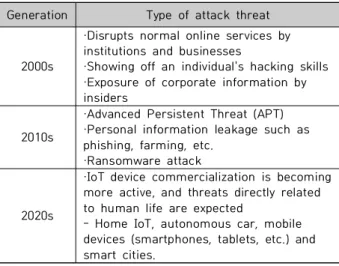
수 있는 수준으로 교육 콘텐츠를 제공한다. Table 4는 시

대적 흐름에 따른 보안 위협의 종류이다.

(6)

Generation Type of attack threat

2000s

·Disrupts normal online services by institutions and businesses

·Showing off an individual's hacking skills

·Exposure of corporate information by insiders

2010s

·Advanced Persistent Threat (APT)

·Personal information leakage such as phishing, farming, etc.

·Ransomware attack

2020s

·IoT device commercialization is becoming more active, and threats directly related to human life are expected

- Home IoT, autonomous car, mobile devices (smartphones, tablets, etc.) and smart cities.

Table 4. changing times of information security threats

최신 보안 위협 중 IoT 단말에 대한 보안 위협이 증가하 며 무선 네트워크에 대한 중요성이 부각되고 있다. 단순히 스마트 디바이스에서 무선인터넷을 사용하기 위한 수준이 아닌, 이제는 일상생활과 밀접한 IoT 단말을 사용하기 위해 무선 통신(Wi-Fi, Bluetooth 등)에 대한 개념 학습도 필요 하다. 스마트폰으로 IoT 디바이스를 조종하는 무선 통신을 공격자가 위·변조하여 비정상 작동을 유발하는 연구 결과 [18]를 보며 최신 보안위협에 대한 개념을 정보보안 전문가 만 분석하는 것이 아니라, 전 국민이 기본교육에서 중요성을 인지하고 보안에 대한 기본적인 대응만 잘 하더라도 보안 사고가 발생할 확률은 많이 줄어들 것으로 예측된다.[19]

특히 최근 코로나19로 인해 각종 교육이 비대면 방식으 로 진행이 되며 PC가 비대면 교육에 필수 요소가 되었고, PC에서 개인용무 외에 공적인 교육도 실시되며 end point 보안의 중요성도 높아지게 되었다. 이미 중앙행정기 관, 공공기관에서는 매 월 셋째 주 수요일을 ‘사이버 보안 진단의 날’로 지정하여 Windows 보안 업데이트 여부, CMOS 및 OS 패스워드 설정 여부, 이동식 저장매체 자동 실행 여부, 공유폴더 설정 여부 등의 항목으로 임직원 PC 보안 준수 여부를 점검하고 있다. 이러한 end point 보안 강화를 통해 PC 내 보유중인 개인정보, 중요정보를 보호 할 수 있는 효과를 보고 있으므로, Table 5와 같이 초·중 등 교육에서도 PC보안 체크리스트 형식으로 만들어 수업 시간에 교사와 함께 학습하며 점검을 진행하고, 매 월 주 기적 과제를 실시함으로서 지속적, 반복적인 보안 교육을 진행하면 반복적 학습과 함께 긍정적인 교육 효과를 일으 킬 것이다.

No. Checklist

1 Anti-virus installation and latest security patch 2 Operating system latest security patch 3

Set operating system login password and stability (English+number+special character combination of at least 8 digits)

4 Screen saver setting

5 Check for unauthorized program installation 6 Latest security patches for key programs (such

as document editors)

Table 5. personal computer security diagnostic checklist

또한 2020년대에 접어들며 보안 위협이 기존 기업, 기 관에 피해를 주는 방식에서 개인, 특히 생명까지 위협할 수 있는 피해를 줄 수 있다는 부문이 교육에서 정보보안의 영역을 넓혀야 되는 중요한 이유 중 하나이다. 상용 소프 트웨어 제공 기업에서 개발 단계에서부터 보안을 적용하 여 상용화를 하겠지만, 개인 스스로도 지켜야 되는 부문이 분명히 존재하며, 기업에만 보안에 대한 모든 책임과 의무 를 요구할 경우 더 높은 보안성을 기대하기는 어렵다.

마지막으로, 이러한 위협을 통해 공격을 감행하는 침입 자가 발생하지 않도록 정보 윤리 교육 콘텐츠에 실제 피해 사례와 이에 따른 법적 처벌 등 실제 사례를 통한 내용 구 성으로 해킹 등 사이버 범죄에 대한 경각심을 강화시킨다.

학생들은 정보나열형인 이론적인 교육보다는 실제 사례를 통해 학습하는 사례중심형 교육이 흥미도가 더욱 높으며, 실천할 수 있는 가치를 사람들에게 가르칠 수 있는 최상의 방법은 실제 사례를 직접 보여주는 것이라는 점에서 효용 성이 있으며, 실제 발생했던 사례가 충분히 공감할 수 있 는 이야기를 담아서 보여주면 효과를 더욱 높일 수 있다는 연구 결과도 있다.[20] 나이가 어린 사이버 범죄자(해커)들 이 사전에 이러한 정규 교육을 받았다면 범죄자가 되지 않 을 수 있을 것이라 사료된다.

IV. Conclusions

본 연구에서는 초·중등 교육에서의 정보보안 교육이 차

지하는 비율과 교육과정의 내용체계, 이를 바탕으로 검인

정 교과서에서 다루는 정보보안 관련 교육내용에 대해 조

사하고, 정보보안 관련 국가 정책 방향을 통해 정보화 시대

의 정보보안이 지속적으로 부각되고 있는 것을 확인할 수

있었다. 실생활에서 정보화 시대가 많이 변화된 것에 비해

정보를 보호할 수 있는 교육의 내용은 비중이 낮은 것으로

(7)

보인다. 이를 개선하기 위해 본 연구에서 교육과정에 대한 세 가지 방안에 대해 개선방향을 제언하였다. 첫째, 초등학 교 실과 및 중학교 정보 교과서에 고등학교 정보 교과서와 같이 정보보안과 관련된 교육 콘텐츠를 수록해야 되며, 둘 째, IoT단말의 실생활 공급이 늘어나고, 코로나19로 인한 비대면 교육으로 인한 PC사용 증가로 PC보안 및 무선 네 트워크 보안 등 최신 보안위협에 대한 기본적인 개념과 대 응할 수 있는 교육을 교과서에 수록해야 되며, 마지막으로 보안위협에 대한 법적 처벌 등 실제 사례를 통한 정보 윤리 교육을 구성하여 사이버 범죄에 대한 경각심을 강화, 해킹 에 대한 호기심의 근원 자체를 근절하는 방안이다.

해당 연구를 토대로 현재 초등, 중등 정보보안 교육에 대한 실효성과 필요성, 구체화 등에 관한 설문 등을 학생 및 교사를 대상으로 실시하여 구체적이고 신뢰도를 높인 제언을 위해 향후 연구를 진행할 계획이다.

최신 정보보안 위협에 대해 미리 대비하고 정보보안의 중요성을 지금보다 더 비중을 높여 초·중등 교육에서 학생 들이 정보보안에 대한 인식을 더욱 고취시키고 나아가 국 가의 정보자산을 보호하는데 앞장설 수 있도록 향후 개정 될 교육과정에서 내실이 강화된 정보보안 교육과정 편성 에 본 연구가 도움이 될 것으로 사료된다.

REFERENCES

[1] EUN – HEE KIM, “A Study and Suggestions on the Informatics curriculum of Secondary school in the 4th Industrial Revolution Era”, Department of Computer Science Education Graduate School of Education, Kangwon National University, pp. 5-6, 2018.

[2] Ministry of Education, “Ministry of Education Notice No. 2015-74 [Attachment 10], Practical (technical and home)/Information curriculum”, Ministry of Education, pp. 97-98, 2015.

[3] Sungbong Jung, "elementary school practical course, 6th grade", Kyohaksa, 2019.

[4] Choonsik Lee, "elementary school practical course, 6th grade", CHUNJAETEXTBOOK, 2020.

[5] Wonkyu Lee, "Middle School Informatics", MIRAE N, 2019.

[6] Sunkwan Han, "Middle School Informatics", Sungandang, 2017.

[7] Hyunchul Kim, "Middle School Informatics", CHUNJAETEXT BOOK, 2020.

[8] Jonghoon Kim, "Middle School Informatics", Hanbit Academy, 2018.

[9] Jaehyun Kim, "High School Informatics", GYOMOON PUBLIS HERS, 2018.

[10] Youngil Kim, "High School Informatics", Kumsung Publishing,

2018.

[11] Shinchun Kang, "High School Informatics", CMASS, 2018.

[12] Hyunchul Kim, "High School Informatics", CHUNJAETEXT BOOK, 2020.

[13] Ministry of Economy and Finance, "2020 Korean New Deal", Ministry of Economy and Finance press release, 2020.

[14] Ministry of Science and ICT, "2

nd

Plan for Promotion of Information Protection Industry", Ministry of Science and ICT press release, 2020.

[15] Korea Internet & Security Agency, "Cyber Threat Trend Report for Q2, 2020", Korea Internet & Security Agency press release, 2020.

[16] Thebn Co., Ltd., "New or overlooked, eight information security threats under the lamp", https://www.boannews.com/media/view.

asp?idx=54992&page=3&kind=1

[17] Park, Se-Rak · Park, Hyeon-Ae · Lee, Hwan-Soo, "Effect of the frequency of security training on the enhancement of employees’

consciousness of security in terms of technology protection", Korean Journal of Industrial Security, Vol.10, No.1, 2020.

[18] Seung-woo Kim, “Security of the Hacking Attack and Vulnerability on Autonomous Vehicles and AI Dronebot”, Department of Convergence Engineering, Graduate School of Venture, Hoseo University, pp. 79-97, 2020.

[19] Jeon, DongJin, “A Study on Individual’s Information Security Behavior”, Department of Business Adminstration Incheon National University, pp. 67-68, 2020.

[20] Jung Youn Young, “The Application and Effect Analysis of Case-Based Courseware for Information and Communication Ethics Education”, Major in Elementary Computer Education Graduate school of Education, Chuncheon National University of Education, pp. 50-55, 2004.

Authors

Choungbae Kim received the B.S. degree in Information Security from Soonchunhyang University, Korea, in 2011 and M.S. degree in Information Security from Sungkyunkwan University, Korea, in 2018.

He joined the faculty of The Korea Chamber of Commerce

& Industry, Seoul, Korea, in 2018. He is currently a Professor in The Korea Chamber of Commerce & Industry.

He is interested in network security, deep neural network,

and cloud computing security.

수치

Table  1.  Changes  in  Information-Related  Curriculum
Table  2.  Content  System  for  Secondary  Informatics  Subjects[2]
Table  3.  The  percentage  of  information  security  in  textbooks Table 3에서 조사한 검인정 교과서의 정보보안 관련 내 용을  보면  초등  실과와 중학교  정보의  경우  개인정보보호 와  관련된  내용만  다루고  있으며,  고등학교  정보  교과의  경우  정보보안과  관련  법규를  다루고  있다
Fig.  3.  Cyber  Threat  Trend  Report  for  Q2,  2020
+2

참조

관련 문서

This research aims to investigate elementary school teacher`s perception and needs of computer and information literacy education to provide basic materials

An Analysis on the Elementary School teacher’s Literacy about Software Education Contents, In preparation for the 2015 Revised National Curriculum.. 1) Dong Man Kim*,

CCD publishes statistical information annually by school year for approximately 100,000 public elementary and secondary schools, approximately 18,000 local education

This study analyzed the current status of software (SW) and ar- tificial intelligence (AI) education among different types of information education programs in elementary schools

In this study, we developed a data science education program using spreadsheet, applied it after educational method to improve elementary school student 's

milk nutrition education has improved nutrition knowledge and recognition on milk in elementary, middle, and high school students.. To improve their milk eating