서 론
우리나라는 하절기에 강우가 집중되어 있고, 천연호소가 적어 수자원 이용 효율이 제한적인데, 이 를 극복하기 위해 이미 삼한시대부터 농업용 저수지를 축조하였고, 근대에 들어서는 다목적댐을 비 롯한 다수의 대규모 인공호를 건설하여 왔다. 우리나라에 존재하는 대부분의 호수는 인공호로서 15 개의 대형 다목적 댐을 제외하고는 대부분 중소형 저수지이며, 전국적으로 17,956개의 농업용 저수 지가 산재되어 있다(농림부, 2000). 또한 인공 저수지는 수력발전, 유량 조절, 유로 변경 및 위락의 목 적으로 조성되어 왔으며, 하천 계곡에 댐이나 제방을 쌓아 물을 가두어 놓는 방식으로 인공적인 수 생태계를 형성한다(Kim et al., 2012). 이처럼 댐과 보와 같은 구조물은 하천 상․하류 간의 유량을 변 화시키고, 생태학적 단절을 초래할 수 있어 생물 서식처에 영향을 미칠 가능성이 크며, 이로 인해 새
수원시 일대 저수지의 저서성 대형무척추동물상
김 필 재·공 동 수 경기대학교 생명과학과
Benthic Macroinvertebrates Fauna of the Reservoirs Located in Suwon-si, South Korea
KIM, Pil jae․Dongsoo KONG
Department of Life Science, Kyonggi University, Suwon, Korea
ABSTRACT
Benthic macroinvertebrates fauna was investigated at the reservoirs located in Suwon-si, Gyeonggi-do, South Korea from October, 2012 to March, 2013. Six reservoirs (Gwanggyo, Sindae, Woncheon, Ilwol, Ilwang and Seoho) were selected for quantitative (Dredge, 50×50cm, mesh size 1mm) and qualitative (Hand net, mesh size 1mm) sampling of benthic macroinvertebrates. Total taxa of benthic macroinvertebrates were 34 species, 19 families, 10 orders, 6 classes in 4 phyla. Aquatic insects were composed of 23 species, 11 families, 5 orders, 1 class in 1 phylum. The dominant species and the subdominant species based on abundance were Limnodrilus gotoi and Tanypodinae sp. with 24.4% and 21.5% of dominance respectively. Dominance indices and richness indices of benthic macroinvertebrate communities showed the range of 0.60 ∼0.95 and 0.36∼1.53 respectively.
Dominance indices showed a negative correlation with chemical oxygen demand (r= —0.64, p<0.01), total nitrogen (r= —0.56, p<0.05), total phosphorus (r=—0.54, p<0.05) and chlorophyll (r= —0.61, p<0.05).
Key words : benthic macroinvertebrates, biotic index, reservoir, Suwon
로운 생태계가 형성될 수 있다(Kang et al., 2010).
저서성 대형무척추동물은 담수생태계에서 가장 다양하고 풍부한 무리일 뿐만 아니라, 영양단계에 서 저차 소비자로서의 역할을 하기 때문에 생태계의 구성원으로서 중요하다(Hynes, 1970; Ward, 1992; William and Feltmate, 1992). 하천의 유수생태계에서 정수생태계로의 변화는 퇴적물의 축적과 오염에 따라 저서성 대형무척추동물의 서식처 교란으로 연결되며(Gray, 1981; Hartley, 1982; Pearson and Rosenberg, 1978), 유속, 수온, 하상의 변화로 저서성 대형무척추동물의 군집 구조와 종 다양성에 직접적인 영향을 주게 된다(Doeg and Koehn, 1994; Tiemann et al., 2004).
호소생태계의 주요 구성원이자 어류의 주요 먹이원인 저서성 대형무척추동물은 대부분의 생활사 를 수중에서 보내며, 이동성이 적고 개체수가 풍부하여 담수생태계의 먹이사슬에 중요한 역할을 하 고 있을 뿐만 아니라(Ward, 1992; Rosenberg and Resh, 1993), 오염물질과 서식환경에 민감하게 반응하 는 분류군으로 생물학적 지표 및 환경변화를 평가하는 생태학적 모니터링에 유용하게 이용될 수 있 다(Kim et al., 2005; Lee et al., 2009; Woon et al., 1981, 1992; Won et al., 2005).
그러나 국내 호소에 대한 연구는 주로 수질과 수문을 중심으로 진행되어 왔으며, 생물상에 대한 연구는 어류, 식물플랑크톤, 수생식물을 위주로 수행되어 왔다. 즉, 호소의 저서성 대형무척추동물은 하천과 같은 유수생태계에 비해 현저히 낮은 비중으로 다루어져 왔다. 특히 경기도 수원시에 위치한 중․소형 저수지는 Park et al. (2006)에 의해 식물플랑크톤의 종조성 및 영양단계에 관하여 연구되었 을 뿐, 저서성 대형무척추동물에 관한 연구는 미흡한 실정이다.
따라서 본 연구는 수원시 일대 저수지의 저서성 대형무척추동물상을 파악하고, 이를 호소생태계 관리를 위한 기초자료로 제공하고자 한다.
조사내용 및 방법
1. 조사기간
경기도 수원시에 위치한 광교저수지를 비롯한 6개의 저수지에 대하여 2011년 6월과 9월, 2012년 10월, 2013년 3월에 걸쳐 총 4회의 현장조사를 실시하였다.
2. 조사지점 개황
경기도 수원시 관할지역에는 4개의 주요 하천이 흐르고 있으며, 각 하천의 중상류에 6개의 저수지 가 위치하고 있다(Fig. 1). 각각의 저수지의 수문학적 특징은 Park et al. (2006)의 수원시 일대와 경기 도 남부에 위치한 저수지 연구를 참고하였다(Table. 1).
․ 광교저수지(R1) : 경기도 수원시 장안구 연무동(N: 37°18'13.58", E: 127°1'42.11")
․ 신대저수지(R2) : 경기도 수원시 영통구 원천동(N: 37°17'4.03", E: 127°4'29")
․ 원천저수지(R3) : 경기도 수원시 영통구 원천동(N: 37°17'0.02", E: 127°3'38.05")
․ 일월저수지(R4) : 경기도 수원시 장안구 율천동(N: 37°17'9.71", E: 126°58‘23.86")
․ 일왕저수지(R5) : 경기도 수원시 장안구 송죽동(N: 37°17'55.02", E: 127°0'1.01")
․ 서호저수지(R6) : 경기도 수원시 팔달구 화서2동(N: 37°16'42.6", E: 126°59'18.53")
Fig. 1. A map showing the 6 sampling sites in the Suwon-si, Gyeonggi-do (R1 : Gwanggyo, R2 : Sindae, R3 : Woncheon, R4 : Ilwol, R5 : Ilwang, R6 : Seoho).
Table 1. The hydrologic characteristics of 6 reservoirs in Suwon-si, Gyeonggi-do (after Park et al., 2006)
Site Watershed area /
Reservoir surface area Storage volume (×
m
3)
R1 (Gwanggyo) 10.98 2,480
R2 (Sindae) 6.53 1,443
R3 (Woncheon) 8.96 1,988
R4 (Ilwol) 2.37 299
R5 (Ilwang) 4.16 377
R6 (Seoho) 20.66 678
3. 조사 방법
저서성 대형무척추동물을 Dredge (50 × 50cm, 망목 1mm)를 이용해 2회 정량 채집하였고, 미소 서 식처의 경우 휴대용 뜰채를 이용하여 정성 채집하였다. 95% ethyl alcohol을 이용하여 채집된 저서성 대형무척추동물을 현장에서 고정하였으며, 실험실에서 동정한 후 80% ethyl alcohol에 보존하였다.
수원시청의 하천․호소 수질자료(http://www.suwon.go.kr)와 물환경 정보시스템의 수질자료(http://water.
nier.go.kr)를 이용하여 군집지수와의 상관성을 분석하였다.
1) 동정
Merritt and Cummins (1984, 1996), Kawai (1985) 및 Won et al. (2005), Woon et al. (1988, 1995)을 참 고하여 저서성 대형무척추동물을 동정하였다. 깔따구류는 Wiederholm (1983)을 이용하여 외부형태, 특히 체장, 체색, mouth part 형태, abdominal tuble의 유무, 강모의 형태 등의 특징을 고려하여 과 수준 (family level)에서 동정하였다.
2) 군집분석
군집구조를 비교하기 위해 정량채집 자료를 이용하여 우점종과 아우점종을 구하고, McNaughton (1967)의 우점도 지수(Dominance index; DI), Margalef(1958)의 풍부도 지수(Richness index; R), Sha- nnon-Weaver (1949)의 다양도 지수(Diversity index; H'), Pielou (1975)의 균등도 지수(Evenness index; J) 를 산출하였다.
(1) 우점도지수(Dominance Index: DI)
각 조사지점의 출현 개체수에서 제1우점종과 제2우점종을 선정하였고, McNaughton’s dominant index (DI)를 산출하였다.
: 총 개체수
: 제 1,2 우점종의 개체수(2) 다양도지수(Diversity index: H')
Margalef의 정보이론에 의하여 유도된 Shannon-Weaver function (H')(Shannon and Weaner, 1949)을 Lloyd & Gheraldi가 변형한 공식을 이용하였다.
′
log
:
번째 종의 개체수
:
번째 종의 개체수 비율(3) 풍부도지수(Richness index: R)
군집의 종구성이 풍부함을 나타내는 것으로 Margalef (1958)의 지수를 적용하였다.
ln
: 총 종수
: 총 개체수(4) 균등도지수(Evenness index: J)
군집 내 종 구성의 균일한 정도를 나타내는 것으로 Pielou (1975)의 지수를 적용하였다.
log
′
′
= Shannon 지수
: 총 종수결과 및 고찰
1. 이화학적 수질환경 요인
각 조사 월에 해당하는 수질의 평균치로 볼 때 pH는 광교저수지와 원천저수지에서 다소 높은 값 을 보였고, 나머지 저수지는 큰 차이를 보이지 않았다(Table 2). 부유물질(SS) 농도는 원천, 일월, 서 호 저수지에서 매우 높고 분산도가 컸다. 광교, 일왕 저수지의 부유물질 농도는 상대적으로 낮았고, 분산도 역시 작았다. 총질소(T-N)와 총인(T-P) 농도는 전반적으로 매우 높아 부영양(Eutrophic) 또는 과영양(Hypertrophic)의 상태를 보였다. 특히 일월저수지와 서호저수지는 매우 심한 과영양 상태였으 며, 이에 따라 Chl.-
α
와 COD 농도가 매우 높았다. 서호저수지의 경우 Chl.-α
의 농도가 최대 306.7 mg/m3까지 나타나는 등 조류 발생이 극심하였다. 일월저수지와 서호저수지는 주거 밀집지역에 위치 하며, 저수지 주변에 조성된 공원으로부터 유입되는 오염원으로 인하여 수질이 불량하게 나타난 것 으로 판단된다.2. 저서성 대형무척추동물상
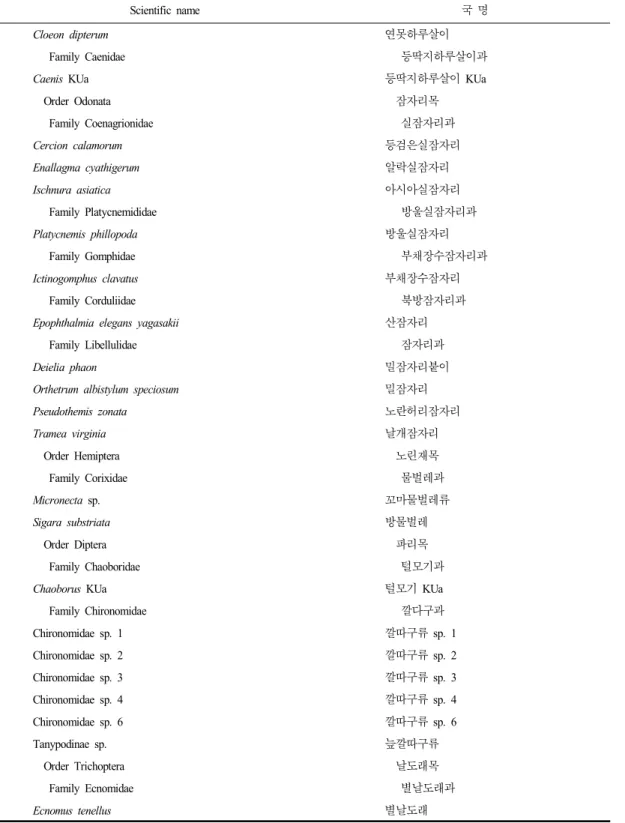
조사지점에서 출현한 저서성 대형무척추동물의 총 분류군은 4문 6강 10목 19과 34종이었다. 수서 곤충류는 하루살이목 3종, 잠자리목 10종, 노린재목 2종, 파리목 7종, 날도래목 1종으로 총 23종이 출 현하였다. 비곤충류는 편형동물문 1종, 연체동물문 3종, 환형동물문 5종, 갑각강 2종으로 총 11종이 출현하였다(Table 3). Lee et al. (2011)의 울산지역 주요 호소의 수질 및 저서성 대형무척추동물 군집 구조 분석 연구에서도 지점에 따라 16∼36종이 출현하였으며, 깔따구류와 실지렁이류가 높은 개체수 점유율을 차지하여 본 연구 결과와 유사한 경향을 보였다.
Site pH SS(mg/L) COD(mg/L) T-N(mg/L) T-P(mg/L) Chl.-(mg/m
3)
R1 8.2±0.3 4.65±3.79 3.78±1.04 2.156±0.655 0.110±0.108 15.3±13.3
R3 7.9±0.3 24.85±15.63 5.08±0.18 1.721±0.135 0.066±0.028 5.1±6.5
R4 7.6±0.7 27.50±34.46 15.73±5.92 3.259±1.593 0.250±0.190 109.5±57.7
R5 7.2±0.2 9.50±6.01 6.35±1.75 1.879±0.415 0.072±0.037 34.6±10.5
R6 7.6±0.4 22.83±13.15 11.26±6.30 8.250±2.649 0.503±0.327 116.8±127.3
Table 2. Average and standard deviation of water quality items in the reservoirs
Table 3. Taxonomic list of benthic macroinvertebrates collected at the sampling sites, Suwon-si, Gyeonggi-do
Scientific name 국 명
Phylum Platyhelminthes 편형동물문
Class Turbellaria 와충강
Order Tricladida 삼기장목
Family Planariidae 플라나리아과
Dugesia sp.
플라나리아류Phylum Mollusca 연체동물문
Class Gastropoda 복족강
Order Basommatophora 기안목
Family Lymnaeidae 물달팽이과
Radix auricularia
물달팽이Family Physidae 왼돌이물달팽이과
Physa acuta
왼돌이물달팽이Family Planorbidae 또아리물달팽이과
Hippeutis cantori
수정또아리물달팽이Phylum Annelida 환형동물문
Class Oligochaeta 빈모강
Order Archioligochaeta 물지렁이목
Family Tubificidae 실지렁이과
Branchiura sowerbyi
아가미지렁이Limnodrilus gotoi
실지렁이Class Hirudinia 거머리강
Order Rhynchobdellida 부리거머리목
Family Glossiponidae 넙적거머리과
Alboglossiphonia heteroclita
달팽이넙적거머리Alboglossiphonia lata
조개넙적거머리Helobdella stagnalis
민물넙적거머리Phylum Arthropoda 절지동물문
Class Crustacea 갑각강
Order Decapoda 십각목
Family Atyidae 새뱅이과
Cardinia denticulata denticulata
새뱅이Family Palaemonidae 징거미새우과
Palaemon paucidens
줄새우Class Insecta 곤충강
Order Ephemeroptera 하루살이목
Family Baetidae 꼬마하루살이과
Baetis fuscatus
개똥하루살이Table 3. Continued
Scientific name 국 명
Cloeon dipterum
연못하루살이Family Caenidae 등딱지하루살이과
Caenis KUa
등딱지하루살이 KUaOrder Odonata 잠자리목
Family Coenagrionidae 실잠자리과
Cercion calamorum
등검은실잠자리Enallagma cyathigerum
알락실잠자리Ischnura asiatica
아시아실잠자리Family Platycnemididae 방울실잠자리과
Platycnemis phillopoda
방울실잠자리Family Gomphidae 부채장수잠자리과
Ictinogomphus clavatus
부채장수잠자리Family Corduliidae 북방잠자리과
Epophthalmia elegans yagasakii
산잠자리Family Libellulidae 잠자리과
Deielia phaon
밀잠자리붙이Orthetrum albistylum speciosum
밀잠자리Pseudothemis zonata
노란허리잠자리Tramea virginia
날개잠자리Order Hemiptera 노린재목
Family Corixidae 물벌레과
Micronecta sp.
꼬마물벌레류Sigara substriata
방물벌레Order Diptera 파리목
Family Chaoboridae 털모기과
Chaoborus KUa
털모기 KUaFamily Chironomidae 깔다구과
Chironomidae sp. 1 깔따구류 sp. 1
Chironomidae sp. 2 깔따구류 sp. 2
Chironomidae sp. 3 깔따구류 sp. 3
Chironomidae sp. 4 깔따구류 sp. 4
Chironomidae sp. 6 깔따구류 sp. 6
Tanypodinae sp. 늪깔따구류
Order Trichoptera 날도래목
Family Ecnomidae 별날도래과
Ecnomus tenellus
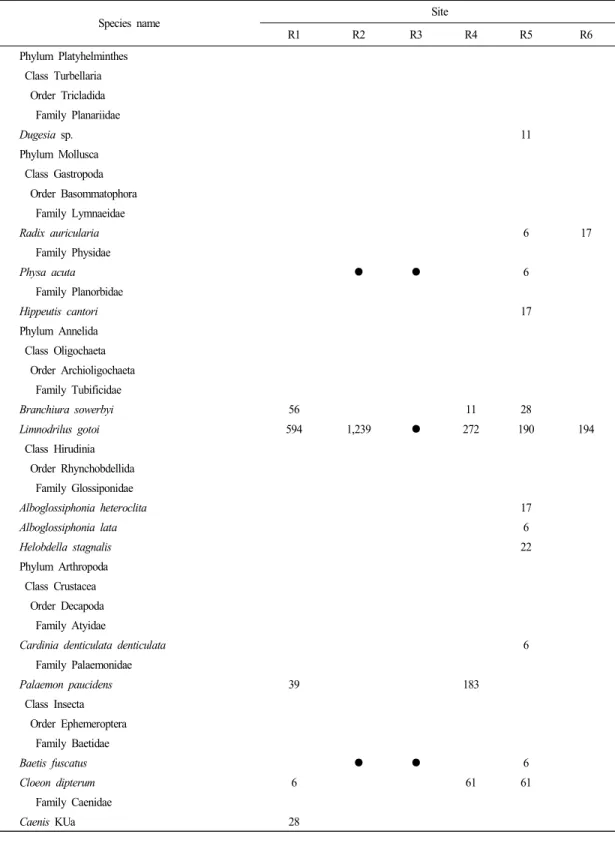
별날도래일반적으로 계류나 하천 등과 같은 유수생태계에서는 하루살이류와 날도래류 그리고 강도래류의 점유율이 높게 나타나는 반면, 호수나 연못 등과 같은 정수생태계에서는 잠자리류, 노린재류, 딱정벌 레류의 점유율이 높은 것으로 알려져 있다(Ward, 1992). 본 조사에서도 잠자리목에서 가장 많은 종이 출현하였고, 날도래목의 종은 가장 적게 나타났다(Table 4).
저서성 대형무척추동물의 종풍부도는 하상구조와 밀접한 관련이 있으며(Waters, 1995), 조립질 하 상에서 다양한 종이 출현하는 경향을 보인다. 반면, 세립질로 구성된 하상은 산소의 이용과 물리적인 서식환경의 제한으로 저서성 대형무척추동물의 종 다양성은 매우 낮은 것으로 알려져 있다(Allan, 1995; Merritt et al., 2008). 조사지점의 하상구조 또한 대부분 세립질로 구성되어 단순한 서식환경을 보였으며, 각 조사지점에서 매우 적은 종이 출현하였다. 이에 따라 세립질의 하상구조를 선호하며, 오염에 내성이 강한 깔따구류와 실지렁이 등이 개체수의 대부분을 차지하였다. 일왕저수지의 출현종 은 25종으로 비교적 많은 종이 출현하였으나, 대부분 유속이 느린 환경을 선호하는 종들이었다. 수질 이 상대적으로 좋은 일왕, 광교, 원천 저수지에서 출현종수가 많음에 반해, 수질이 불량한 서호, 일월 저수지에서 출현종수가 적었다.
3. 군집분석
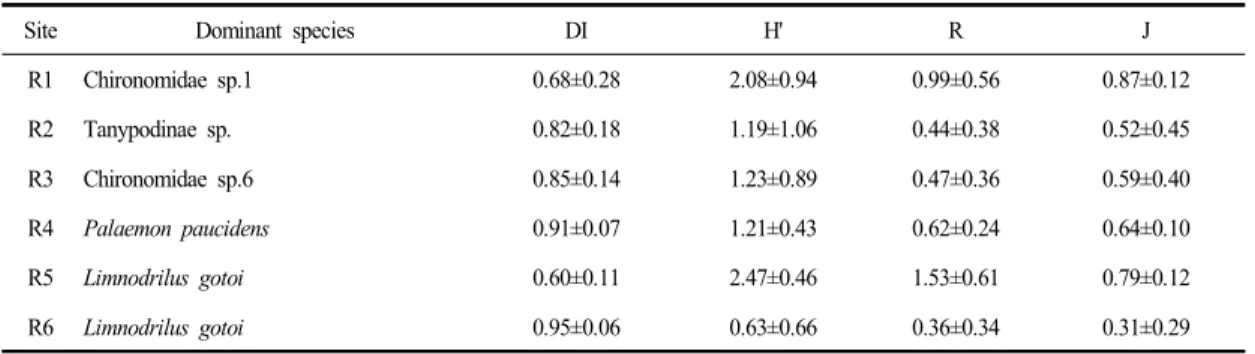
조사지점 전반적으로 깔따구류(Chironomidae sp.)와 실지렁이(Limnodrilus gotoi)가 우점종으로 나타 났으며, 수생식물이 많았던 일월저수지에서는 줄새우(Palaemon paucidens)가 우점하였다.
모든 조사지점에서 우점도지수(DI)는 높고, 다양도지수(H'), 풍부도지수(R), 균등도지수(J)는 낮았다 (Table 5). Lee et al. (2011)의 울산 지역 주요 호수 연구에서 평균 다양도지수(0.97∼1.95), 종풍부도지 수(1.32∼2.17), 균등도지수(0.38∼0.59)가 또한 매우 낮게 나타나 본 조사와 유사한 경향을 보였다. 특 히 수질이 불량한 일월, 서호 저수지에서 우점도지수가 높은 반면 다양도지수는 낮았다. 수질이 불량 하고 인공적으로 형성된 정수생태계는 다양한 저서성 대형무척추동물이 서식하기에 안정적인 환경 을 제공하지 못하는 것으로 판단된다.
4. 상관관계 분석
우점도지수는 COD와 통계적으로 유의한 양의 상관관계(r=0.52, p<0.05)를 보였다. 다양도지수는 COD(r=—0.64, p<0.01)와 T-N(r=—0.56, p<0.05), T-P(r=—0.54, p<0.05), Chl-
α
(r=—0.61, p<0.05)와 통계 적으로 유의한 음의 상관관계를 보였다. 균등도지수는 COD와 Chl-α
, T-P와 통계적으로 유의한 음의 상관관계를 나타냈다. 풍부도지수는 수질항목과 유의한 상관관계를 보이지 않았다(Table 6).저서성 대형무척추동물의 군집은 물리적 서식환경뿐만 아니라, 수질 요인에도 큰 영향을 받으며, 특히 유기물 오염에 의한 교란은 출현종수를 감소시키지만, 특정종의 개체수를 증가시키므로(Mac- Kenthum, 1969) 저서성 대형무척추동물 군집의 안정성을 확보하고 유지하기 위해서는 저수지의 수질 관리가 필요하다고 판단된다.
Table 4. Individual number of benthic macroinvertebrates at the sampling sites (Number : total average of quantitative result,
●: qualitative result)
Species name
Site
R1 R2 R3 R4 R5 R6
Phylum Platyhelminthes Class Turbellaria Order Tricladida Family Planariidae
Dugesia sp.
11Phylum Mollusca Class Gastropoda Order Basommatophora Family Lymnaeidae
Radix auricularia
6 17Family Physidae
Physa acuta
● ● 6Family Planorbidae
Hippeutis cantori
17Phylum Annelida Class Oligochaeta Order Archioligochaeta Family Tubificidae
Branchiura sowerbyi
56 11 28Limnodrilus gotoi
594 1,239 ● 272 190 194Class Hirudinia Order Rhynchobdellida Family Glossiponidae
Alboglossiphonia heteroclita
17Alboglossiphonia lata
6Helobdella stagnalis
22Phylum Arthropoda Class Crustacea Order Decapoda Family Atyidae
Cardinia denticulata denticulata
6Family Palaemonidae
Palaemon paucidens
39 183Class Insecta Order Ephemeroptera Family Baetidae
Baetis fuscatus
● ● 6Cloeon dipterum
6 61 61Family Caenidae
Caenis KUa
28Table 4. Continued
Species nameSite
R1 R2 R3 R4 R5 R6
Order Odonata Family Coenagrionidae
Cercion calamorum
6 22Enallagma cyathigerum
17Ischnura asiatica
6 22 56Family Platycnemididae
Platycnemis phillopoda
6Family Gomphidae
Ictinogomphus clavatus
6Family Corduliidae
Epophthalmia elegans yagasakii
17Family Libellulidae
Deielia phaon
● 6Orthetrum albistylum speciosum
28 11Pseudothemis zonata
6 ● 11Tramea virginia
6Order Hemiptera Family Corixidae
Micronecta sp.
39 ● ● ● ●Sigara substriata
61Order Diptera Family Chaoboridae
Chaoborus KUa
22Family Chironomidae
Chironomidae sp. 1 467 833 333 22 144 11
Chironomidae sp. 2 417 111 161 39 56 22
Chironomidae sp. 3 28 2
Chironomidae sp. 4 167 5
Chironomidae sp. 6 344 511 239 11 350 277
Tanypodinae sp. 122 1,244 722 17 78 6
Order Trichoptera Family Ecnomidae
Ecnomus tenellus
6 6 6 6Total species number 17 11 14 10 25 8
Total individual number 2,339 3,952 1,578 644 1,133 533
Table 5. Dominant species and average of biotic indices at the reservoirs
Site Dominant species DI H' R J
R1 Chironomidae sp.1 0.68±0.28 2.08±0.94 0.99±0.56 0.87±0.12
R2 Tanypodinae sp. 0.82±0.18 1.19±1.06 0.44±0.38 0.52±0.45
R3 Chironomidae sp.6 0.85±0.14 1.23±0.89 0.47±0.36 0.59±0.40
R4
Palaemon paucidens
0.91±0.07 1.21±0.43 0.62±0.24 0.64±0.10R5
Limnodrilus gotoi
0.60±0.11 2.47±0.46 1.53±0.61 0.79±0.12R6
Limnodrilus gotoi
0.95±0.06 0.63±0.66 0.36±0.34 0.31±0.29Table 6. Pearson’s correlation for biotic indices and average of water quality data
pH SS COD T-N T-P Chl-
Dominant index (DI) —0.38 0.24 0.52* 0.40 0.35 0.46
Diversity index (H') 0.32 —0.39 —0.64** —0.56* —0.54* —0.61*
Richness index (R) 0.15 —0.24 —0.46 —0.48 —0.44 —0.47
Evenness index (J) 0.10 —0.55 —0.64** —0.48 —0.57* —0.65**
*: p<0.05, **: p<0.01.
인용문헌
농림부. 2000. 농업용수 수질개선 시험사업 보고서(IV). 농업기반공사.
Allan, J. D. 1995. Stream Ecology. Structure and Function of Running Waters. Chapman & Hall, Landon.
Doeg, T. J. and J. D. Koehn. 1994. Effects of draining and desilting a small weir on downstream fish and macroinvertebrates. Regulated Rivers; Research and Management. 9 pp. 263-277.
Gray, J. S. 1981. Detecting pollution induced changes in communities using the olg-normal distribution of individuals among species. Mar. Pollut. Bull. 12(5): 173-176.
Hartley, J. P. 1982. Methods for monitoring offshore macobenthos. Mar. Pollut. Bull. 13 pp. 153-154.
Hynes, H. B. N. 1970. The Ecology of Running Waters. Liverpool Univ. Press, Liverpool, U. K.
Kang, H. S., D. K. Im and K. H. Kim. 2010. Numerical Investigations of Physical Habitat Changes for Fish induced by the Hydropeaking in the Downstream River of Dam. Korean Society of Civil Engineers.
30(2B): 107-250.
Kawai, T. 1985. All Illustrated Book of Aquatic Insects of Japan. Tokai Univ. Press, Tokyo. pp. 409.
Kim, Y. K., Y. J. Bae, G. S. Yoo, D. H. Yeom, S. K. Lee, S. H. Lee, J. H. Lee, and K. J. Cho. 2005.
Invertebrate Biological Indicators and Environmental Risk Assessment. Junghaengsa, pp. 211.
Kim, K. W., S. N. Jin, H. J. Cho and K. H. Cho. 2012. Distribution, vegetation structure and biomass of submerged macrophytes in a small agricultural reservoir, Keumpoong Reservoir, Korea. Korean J.
Limnol. 45 (1): 52-61.
Lee, J. H., S. K. Lee, Y. J. Bae, K. J. Cho, G. S. Yoo, Y. K. Kim and M. P. Jung. 2009. Invertebrates Using Biological Indicators of Heavy Metal Pollution Ecological Impact Assessment Technique Field.
Junghaengsa, pp. 90.
Lee. M. J., H. K. Kwon, H. J. Lee, J. K. Seo, J. K. Lee and J. E. Lee. 2011. Community structure of benthic macroinvertebrates and water quality in the major lakes(Lake Sayeon, Lake Daeam, Seonam Reservoir, Lake Hoeya) of Ulsansi. Korean J. Limnol. 44(4): 396-406.
MacKenthum, K. M. 1969. The practice of water pollution biology. U.S. Federal Water Pollution Control Administration, Wasnington. pp. 152-211.
Margalef, R. 1958. Information theory in ecology. General Systematics. 3 pp. 36-71.
McNaughton, S. J. 1967. Relationship among functional properties of California Grassland. Nature. 216, pp.
168-169.
Merritt, R. W. and K. W. Cummins. 1984. An Introduction to the Aquatic Insects of North America. 2nd ed. Kendall/ Hunt Publishing Company, Dubuque, Iowa
Merritt, R. W. and K. W. Cummins. 1988. An Introduction to the Aquatic Insects of North America. 3rd ed. Kendall/ Hunt Publishing Company, Dubuque, Iowa
Merritt, R. W. and K. W. Cummins. 2008. An Introduction to the Aquatic Insects of North America. 4th ed. Kendall/ Hunt Publishing Company, Dubuque, Iowa.
Neel, J. K. 1963. Impact of reservoirs. Limnology in North America. pp. 575-593.
Park. J. H., B. R. Moom and O. M. Lee. 2006. The Phytoplankton compositions and trophic states at se- veral lakes of Suwon-si, Korea. Algae. 21(2): 217-228.
Pearson, T. H. and R. Rosenberg. 1978. Macrobenthic succession inrelation to organic enrichment and pollution of the marine environment. Oceanogr. Mar. Biol. Ann. Rev. 16 pp. 229-311.
Pielou, E. C. 1975. Ecological Diversity. John Wiley and Sons, New York, pp. 165
Rosenberg, D. M. and V. H. Resh. 1993) Freshwater Biomonitoring and Benthic Macroinvertebrates. Chap- man and Hall, New York. pp. 488.
Shannon, C. E and W. Weaver. 1949. The Mathematical Theory of Communication. University of Illinois Press, Urbana.
Tiemann, J. S., D. P. Gillette, M. L. Wildhaber and D. R. Edds. 2004. Effects of Lowhead Dams on Riffle- Dwelling Fishes and Macroinvertebrates in a Midwestern River. Transaction of the American Fisheries Society. 133 pp. 705-717.
Ward, J. V. 1992. Aquatic Insect Ecology. John Wiley & Sons, New York.
Waters, T. F. 1995. Sediment in Streams: Sources, Biological Effects, and Control. American Fisheries Society, Monograph 7, Bethesda, Maryland, pp. 251.
Wiederholm, T. 1983. Chironomidae of the holarctic region keys and diagnose. Part Ⅰ - Larvae. Ento-
mologica Scandinavica. 19 pp. 457.
Willams, D. D. and B. W. Feltmate. 1992. Aquatic Insects. C․A․B.
Won, D. H., S. J. Kwon and Y .C. Jeon. 2005. Auqatic insect of Korea. Korea Ecosystem Service. pp. 415.
Yoon, I. B., D. S. Kim and H. U. Byun. 1981. A study on the aquatic insect community in the upper stream of Nakdong River. The Korean J. of Limnology. 14(3): 27-49. (in Korean ith English abstract) Yoon, I. B., D. S. Kong and J. K. Ryu. 1992. Studies on the biological evaluation of water quality by
benthic macroinvertebrates. Korean J. Environ. 10(1): 24-39. (in Korean with English abstract) Yoon, I. B. 1995. Explanatory Diatrams of Aquatic Insects. Jeongheangsa. pp. 262.
요 약