대한외과학회지:제 73 권 제 5 호
□ Case Report □
Vol. 73, No. 5, November, 2007
447
책임저자:이승현, 부산광역시 서구 암남동 34
602-702, 고신대학교 의과대학 외과학교실 Tel: 051-990-6462 Fax: 051-246-6093
E-mail: [email protected]
접수일:2007년 5월 8일, 게재승인일:2007년 8월 8일
Strangulated Small Bowel Hernia through a Drain Site
Department of Surgery, College of Medicine, Kosin University, Busan, Korea
Joong Jae Yoo, M.D., Seung Hyun Lee, M.D., Byung Kwon Ahn, M.D. and Sung Uhn Baek, M.D.
배액관 절개창을 통해 발생한 교액성 소 장 탈장
유중재ㆍ이승현ㆍ안병권ㆍ백승언
Herniation of the small bowel through a drain site is a rare com- plication of surgery. We report here on a case of strangulated small bowel hernia through the site of a drain placed in the right lower quadrant of the abdomen after abdominal surgery.
A 70 year-old male underwent aneurysmoplasty for an abdomi- nal aortic aneurysm through a midline abdominal incision. A sili- cone drain (a sump drain) with an external diameter of 15 mm was inserted through an 18 mm stab incision in the right lower quadrant of the abdomen. The drain was removed after 5 days.
Two hours later, a 25 cm segment of small bowel herniated through the drain site and became strangulated. Segmental re- section of the strangulated small bowel was performed through extended incision of the drain site wound. The patient recovered and he was discharged 17 days later without further com- plications. (J Korean Surg Soc 2007;73:447-448)
Key Words: Hernia, Small bowel, Drain
중심 단어: 탈장, 소장, 배액관
고신대학교 의과대학 외과학교실
INTRODUCTION
The use of intra-peritoneal drains have several ad- vantages which include the prevention of fluid accu- mulation such as peritoneal fluid, blood or in- flammatory exudate, and early detection of anasto- motic leakage. However, complications including secondary infection, adhesions, intestinal perforation and hemorrhage may also occur.(1-3) Prophylactic
drainage following abdominal surgery remains a controversial subject.(4) Although herniation through an abdominal drain site is rare, presents more likely strangulation.(5-10) We report a case of strangulated small bowel hernia through a drain site.
CASE REPORT
A 70-year-old, slender male admitted for abdominal aortic aneurysm. The patient has no history of corticosteroid use and previous abdominal surgery.
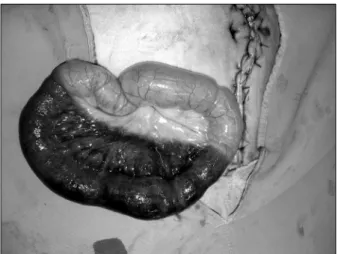
He underwent aneurysmoplasty for an abdominal aortic aneurysm through a low midline abdominal incision measuring 25 cm in length. His body weight, height and body mass index were 60 kg, 171 cm and 20.5 kg/m2 respectively. A separate 18 mm stab wound for drain insertion was made at the right lower abdomen. A silicone drain (all-silicone sump drain?, Sewoon medical, Korea) measuring 15 mm in diameter was inserted. This drain was removed on the fifth postoperative day. Two hours later, a 25 cm segment of small intestine herniated through the drain site and rapidly became strangulated (Fig 1).
An emergent operation was performed through extension of the drain site wound. A 30 cm segment of small intestine was resected with subsequent end to end anastomosis. The remaining unaffected intestine was returned into the abdominal. The patient recovered and was discharged 17 days later without further complications.
DISCUSSION
Although the use of intra-peritoneal drains has their advantages, complications such as secondary infection, adhesions, intestinal perforation and he- morrhage may occur.(1-3) The efficacy and safety of routinely using prophylactic drains following an
448 대한외과학회지:제 73 권 제 5 호 2007
Fig. 1. A 25 cm segment of small intestine became strangulated rapidly after herniation on the drain site located at the right lower abdomen.
abdominal surgery remains a controversial subject.(4) Drain site hernia after abdominal surgery has rarely been reported. Most of the reported cases involved drains with an external diameter of more than 10 mm.(5-7,10) Commonly involved intestinal segments were the small bowel,(5-10) and appendix.(11,12) Hernias through drain sites usually present 3∼8 hours after drain removal,(5-7) and were identified as incarcerate and strangulate state.(5-7,9-11) Increased morbidity and mortality, especially with strangulated hernias, has been reported.(5-7,10) In our case, the drain site incision wound was about 18 mm in length and herniated small bowel became strangulated soon after herniation.
Predisposing factors for herniation through a drain site include general debility, increased intra-abdominal pressure and steroid administration.(7,9) Lee and Raftery(7) suggested that long term steroid therapy, which may delay wound healing and interfere with fibrosis, and adhesions surrounding the drain, may encourage drain site hernias.
To prevent herniation through a drain site, O'riordan et al(11) recommended the use of drains measuring less than 10 mm in external diameter, to use a ‘Z' insertion method, and to make a purse-string suture
for closure of the defect after removal of the drain.
Teasdale et al(6) advised the making of a small stab incision through both the skin and aponeurotic layers, stretching the peritoneum and to insert the drain obliquely. Obliteration of the tract after drain removal is recommended. Shortening of the drain before its removal seemed to prevent this com- plication. They also recommend regular inspection following drain removal.
Drains should be used sparingly, if a drain is indicated, careful insertion and management is necessary.
REFERENCES
1) Manz CW, La Tendresse C, Sako Y. The detrimental effects of drains on colonic anastomoses: an experimental study.
Dis Colon Rectum 1970;13:17-28.
2) Moss JP. Historical and current perspectives on surgical drainage. Surg Gynecol Obstet 1981;152:517-27.
3) Nomura T, Shirai Y, Okamoto H, Hatakeyama K. Bowel perforation caused by silicone drains: a report of two cases.
Surg Today 1998;28:940-2.
4) Pai D, Sharma A, Kanungo R, Jagdish S, Gupta A. Role of abdominal drains in perforated duodenal ulcer patients: a prospective controlled study. Aust N Z J Surg 1999;69:210-3.
5) Mosley JG, Jantet G. Herniation at the site of an abdominal drain. Br J Clin Pract 1978;32:56-8.
6) Teasdale C, Kenyon GS, Jones SM. External strangulated small bowel hernia after intraperitoneal drainage. Lancet 1982;1:459.
7) Lee R, Raftery AT. Evisceration of small bowel at the site of an intra-abdominal drain. A complication of steroid therapy? Br J Clin Pract 1982;36:282-3.
8) Warble Jr J. Small bowel incarceration in a drain site hernia.
N Engl J Med 1986;83:181-2.
9) Loh A, Jones PA. Evisceration and other complications of abdominal drains. Postgrad Med J 1991;67:687-8.
10) Kulkarni S, Krijgsman B, Sharma D, Kaisary AV. Incar- cerated small bowel hernia through drain site. Ann R Coll Surg Engl 2004;86:24-5.
11) O'riordan DC, Horgan LF, Davidson BR. Drain-site herniation of the appendix. Br J Surg 1995;82:1628.
12) Duraker N, Buyukasik K, Helvacioglu Y. Drain site evi- seration of the appendix: report of a case. Surg Today 1997;27:651-2.