Introduction
Worldwide, polycystic ovarian syndrome (PCOS) is the most common heterogeneous endocrine condition and is preva- lent in 6–20% of women of reproductive age [1]. Ovulatory dysfunction, androgen excess, menstrual irregularities [2], infertility, and clinical evidence of hyperandrogenism are the most important symptoms of PCOS that permanently reduce the quality of life of patients [3]. Other than these hormonal disorders, risks such as cardiovascular disorders, dyslipidemia, obesity, and type 2 diabetes mellitus complicate this syn-
Ovarian cysts disappear after 14-day oral regimen of Korean red ginseng extract in letrozole-induced polycystic ovarian syndrome
Niknaz Moradi, PharmD
1, Sepideh Arbabi Bidgoli, PharmD, PhD
2, Shahla Chaichian, MD
31Faculty of Pharmacy and Pharmaceutical Sciences, 2Department of Toxicology and Pharmacology, Faculty of Pharmacy and Pharmaceutical Sciences,
3Department of Gynecology and Obstetrics, Faculty of Medicine, Islamic Azad University, Tehran Medical Sciences University, Tehran, Iran
Objective
Hormonal and inflammatory mechanisms are involved in the pathogenesis of polycystic ovarian syndrome (PCOS), which is a prevalent metabolic disorder among women of reproductive age. We aimed to evaluate the comparative efficiency of short-term oral administration of Korean red ginseng extract (KRGE) and the standard treatment on PCOS by focusing on the histopathological parameters and serum levels of luteinizing hormone (LH), follicle- stimulating hormone (FSH), testosterone, and nuclear factor kappa B (NF-κB).
Methods
A PCOS rat model was established by oral gavage of letrozole (1 mg/kg) for 21 days. The serum levels of LH, FSH, testosterone, and NF-κB were measured, and the morphological features and differences of the ovaries were examined in each group using a light microscope before and after 14 days of treatment with oral regimens—KRGE, oral contraceptives (OCPs), KRGE+OCPs, and carboxymethyl cellulose (CMC).
Results
OCPs alone could not normalize the mean ovarian weights of PCOS rats despite the 14-day oral regimen, but they were more effective in reducing the number and size of cysts compared to others. KRGE alone and in combination with OCPs was effective in normalizing abnormal ovarian weights, decreasing LH serum levels, and dissipating the ovarian cysts in PCOS rats. However, when combined with the standard regimen, KRGE showed additional therapeutic effects by efficiently reducing serum testosterone and NF-κB levels.
Conclusion
Our necropsy and histopathological evidence suggests the efficacy of KRGE as a novel integrative medicine against abnormal multiple follicular cysts. However, antiandrogenic and anti-inflammatory effects were only seen in animals that were administered a combination of KRGE and the standard regimen.
Keywords: Ovarian cysts; Polycystic ovary syndrome; Panax; Luteinizing hormone; NF-kappa B
Received: 2020.04.12. Revised: 2020.07.27. Accepted: 2020.09.06.
Corresponding author: Sepideh Arbabi Bidgoli, PharmD, PhD Department of Toxicology and Pharmacology, Islamic Azad University, Tehran Medical Sciences University, Shariati St., Tehran 19395/1495, Iran
E-mail: [email protected]
https://orcid.org/0000-0003-4830-8680
Articles published in Obstet Gynecol Sci are open-access, distributed under the terms of the Creative Commons Attribution Non-Commercial License (http://creativecommons.
org/licenses/by-nc/3.0/) which permits unrestricted non-commercial use, distribution, and reproduction in any medium, provided the original work is properly cited.
Copyright © 2021 Korean Society of Obstetrics and Gynecology
https://doi.org/10.5468/ogs.20094
eISSN 2287-8580
drome further [4], especially when combined with the psy- chological effects of PCOS, such as anxiety and depression [5], thus worsening the quality of life of patients [6].
Other than the role of environmental toxicants with endo- crine-disrupting properties in the incidence of PCOS [7], it has also been suggested that one’s inflammatory background plays a role, which is closely related to insulin resistance [8]
and oxidative stress [9]. In fact, the serum levels of many inflammatory mediators such as C-reactive protein; white blood cells [9]; interleukins (ILs) such as IL-1, IL-6, and IL-18 [10]; and tumor necrosis factor-alpha could be significantly increased in patients diagnosed with PCOS [11,12]. How- ever, out of the mentioned inflammatory factors, the role of nuclear factor kappa B (NF-κB), one of the most studied key factors in inflammatory pathways, has been poorly under- stood in the pathogenesis and prognosis of PCOS.
In this context, many limitations exist with regard to the prevention, protection, or definite treatment of PCOS, thus increasing the public’s concerns toward alternative medica- tions. Korean red ginseng is one of the most popular herbal remedies in other disease models and is known to have certain anti-inflammatory [13] and antioxidant effects [14]
through activation of the NF-κB pathway [15]. However, the estrogenic effects of Korean red ginseng extract (KRGE) is still conflicting based on in vitro, in vivo [16] and clinical evaluations of sexual disorders [17]. One study in 2011 dem- onstrated how the ovarian morphology of rats and nerve growth factor levels were almost normalized in the regimen that combined KRGE and estradiol valerate. In this study, KRGE lowered the numbers of antral follicles and increased the number of corpora lutea in treated ovaries; this group of researchers was the first to suggest the beneficial effect of KRGE in the treatment of PCOS [17]. Based on this report, we aimed to determine whether oral administration of KRGE can alter the serum levels of PCOS-related prognostic bio- markers and normalize the rat ovaries against PCOS in the letrozole (a nonsteroidal aromatase inhibitor) model. We also aimed to investigate the anti-inflammatory effects of KRGE monotherapy and its combination with a standard oral con- traceptive (OCP) regimen by evaluating the ovarian morphol- ogy and determining the serum levels of NF-κB, testosterone, and gonadotropins.
Materials and methods
1. Animals
Female Wistar rats (n=25), weighing 140 to 160 g, with regular 4-day estrous cycles were purchased from Pasteur In- stitute of Iran. The rats were quarantined and acclimated for 10 days prior to use. The Ethics Committee of Islamic Azad University, Tehran Medical Sciences University (IAUTMU), ap- proved the protocols of this study under the number IR.IAU.
TMU.REC.1397.313, and the animals were cared for in ac- cordance with the Guidelines for Animal Experiments of the Ministry of Health and Medical Education of Iran for the Care and Use of Laboratory Animals and the CCAC Guidelines for Care and Use of Experimental Animals. Rats were caged under standard laboratory indoor conditions with a 12-hour light/dark cycle at room temperature (23±2°C) and 20% rel- ative humidity with free access to tap water and a standard diet for all treatment groups. They were given free access to the standard pellet diet and drinking water ad libitum, but daily food and water intake were calculated until the end of the study. The cage cleaning schedule, air filtration, recircula- tion, health checks, and facility maintenance were carried out in accordance with the standard operating procedures and were recorded.
2. Reagents
KRGE was manufactured by Korea Ginseng Corporation (Seoul, Korea) from 6-year-old Korean RG plants (P. Ginseng).
KRGE was purchased in 2018 by the main investigator from the local market of Seoul, Korea as 10 Stick Packs to yield 3,000 mg KRGE. According to the company’s descriptions during the visit of the main site in October 2018, the KRG roots were extracted by steaming fresh Korean ginseng, which was previously harvested on-site, at 90-100°C for 3 hours.
After drying the plant material at 50-80°C, KRGE was ex- tracted by circulating hot water through the dried plant material three times at 85-90°C for 8 hours. We diluted this high-quality KRGE each time with purified water before oral gavage to the rats. According to the literature and company information, the present KRGE sample contained three major ginsenosides, Rg1+Rb1+Rg3, in an 11.6 mg/10 mL concen- tration [18]. Carboxymethyl cellulose (CMC) was obtained from a local branch of the Merck Company in Tehran and diluted with purified water each time before gavage to rats.
Other pharmaceutical-grade active pharmaceutical ingredi-
ents—letrozole (LET), ethinylestradiol (E), and levonorgestrel (L)—were obtained from the Aburaihan Pharmaceutical Company located in Tehran-Iran, which was approved by the quality assurance department of the company. We used ELISA kits (CUSABIO Company, Houston, TX, USA) to analyze the serum levels of NF-κB, follicle-stimulating hormone (FSH), luteinizing hormone (LH), and testosterone in our laboratory (Bahar Toxicology Laboratory, Tehran, Iran).
3. Experimental model
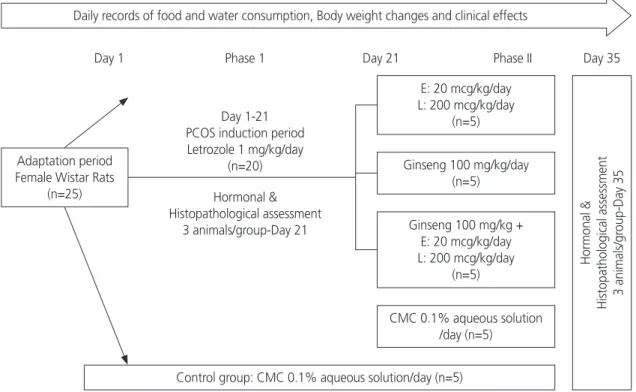
The practical model of the experiment is shown in Fig. 1. A total of 25 healthy female rats were randomly selected and divided into 5 groups; 4 test groups and the control. All test subjects were administered oral gavages 7 days, in a volume not exceeding 1 mL/100 g body weight/rat. Animals from the control group received 0.1% CMC aqueous solution/day by gavage in the same volume. No significant difference was considered regarding the baseline weights of the animals.
Animal body weight changes, food and water consumption, and all clinical signs and symptoms were recorded daily [19].
In the control (vehicle only) group, animals received 0.1%
CMC aqueous solution orally once/day from days 1 to 35.
PCOS groups orally received letrozole at a concentration of 1 mg/kg dissolved in 0.1% CMC solution (2 mL/kg) once
for 21 days [20]. In the second phase of our study, the first PCOS groups received the standard treatment—20 mcg/
kg E+200 mcg/kg L, dissolved in 0.1% CMC (2 mL/kg) for 14 days [20]. In the test group, all 5 animals received KRGE at a dose of 100 mg/kg dissolved in distilled water (2 mL/kg) [21]. In the combination group, animals received the same doses of KRGE and standard treatment together for the same period of time, and the control group received CMC 0.1% (14 days).
4. Hormonal and nuclear factor kappa B assay
In order to determine the serum concentrations of NF-κB, FSH, LH, and testosterone, blood samples were collected according to the standard protocol, and the serum was separated by cold centrifuge and collected in microtubes.
Hormone levels in the treatment groups were compared with those of the control via chemiluminescence immunoassay method using Cobas E411 from the Roche Company, USA with the serial number 15D3-16 [22,23].
5. Recovery studies
A commercial rat serum pool (catalog no. M5905; Sigma Chemical Co., St. Louis, MO, USA) was spiked with various hormone concentrations, and percent recovery and parallel-
Fig. 1. Experimental model of the study. PCOS, polycystic ovarian syndrome; CMC, carboxymethyl cellulose.
Adaptation period Female Wistar Rats
(n=25)
Day 35 Phase II
Day 21 Phase 1
Day 1
Ginseng 100 mg/kg/day (n=5)
CMC 0.1% aqueous solution /day (n=5)
Control group: CMC 0.1% aqueous solution/day (n=5) E: 20 mcg/kg/day L: 200 mcg/kg/day
(n=5)
Ginseng 100 mg/kg + E: 20 mcg/kg/day L: 200 mcg/kg/day
(n=5) Day 1-21
PCOS induction period Letrozole 1 mg/kg/day
(n=20) Hormonal &
Histopathological assessment 3 animals/group-Day 21
Daily records of food and water consumption, Body weight changes and clinical effects
Hormonal & Histopathological assessment 3 animals/gr oup-Day 35
ism to the assay standard curve were determined. The serum pool was spiked for each assay, either with hormones across
the assay range or vehicle, to determine endogenous hor- mone levels in the pool. Samples were run in duplicate, and each assay was repeated to confirm results. Hormonal recov- ery from each spiked sample was determined by subtract- ing hormone values in vehicle-spiked controls from those in spiked hormone samples.
6. Histopathological studies
At the end of the experiments, all rats were anesthetized with ketamine and xylazine, and the dissected ovaries and uteri were placed in a 10% formalin solution. Samples were sectioned at a thickness of 4 μm and stained with hematoxy- lin and eosin. Follicles containing an oocyte with a nucleus were counted and analyzed by an experienced animal pa- thologist. In the ovaries, the corpora lutea and follicles at Table 1. Serum levels of hormones and nuclear factor kappa B
(NF-κB) at the end of polycystic ovarian syndrome induction phase (day 21)
Variables CMC (n=3) LET (n=3) P-value LH (mIU/mL) 8.446±0.292 9.576±0.069 0.020
a)FSH (mIU/mL) 7.606±0.141 6.833±0.161 0.024
a)Testosterone (ng/mL) 1.003±0.067 1.816±0.073 0.001
b)NF-kB (pg/mL) 12.183±0.138 16.87±0.213 0.0001
c)CMC, carboxymethyl cellulose; LET, letrozole; LH, luteinizing hor- mone; FSH, follicle-stimulating hormone.
a)
P<0.05, significant difference;
b)P<0.01, moderately significant dif- ference;
c)P<0.001, highly significant difference.
Fig. 2. Serum levels of luteinizing hormone (LH) (A), follicle-stimulating hormone (FSH) (B), testosterone (C) and nuclear factor kappa B (NF-κB), (D) before and after 14 days of administration of standard regimen (ethinyl estradiol [E]+levonorgestrol [L]), Korean red ginseng extract (KRGE) monotherapy, and their combinational therapy. (A) shows significant difference in LH levels in treatment groups compared to the levels in control group (carboxymethyl cellulose [CMC]), (B) shows significant difference in FSH levels in other groups compared to letrozole group (letrozole [LET]), (C) shows significant difference in serum testosterone levels in E+L and KRGE+E+L groups compared to LET group. (D) shows significant difference in serum NF-κB levels in E+L and KRGE+E+L groups compared to LET group. Different lower- case letters indicate statistically significant differences between the different groups.
a)P<0.05, significant difference;
b)P<0.01, moderately significant difference;
c)P<0.001, highly significant difference.
mIU/mL ng/mL mIU/mL pg/mL
10 9.5 9 8.5 8 7.5 7
2
1.5
1
0.5
0
8 7.5 7 6.5 6
20 15 10 5 0
CMC LET E+L KRGE KRGE+E+L
CMC LET E+L KRGE KRGE+E+L
CMC LET E+L KRGE KRGE+E+L
Groups
CMC LET E+L KRGE KRGE+E+L
Groups LH
Testosterone
FSH
NF-κB a
a)a
a)a
a)a
a)b
b)b
b)b
c)b
b)b
c)b
b A
C
B
D
different developmental stages were examined using a light microscope (Olympus BX-51; Olympus, Tokyo, Japan) and scored.
7. Statistical analysis
In this analysis, treatment and control groups were com- pared. Values were expressed as means±standard deviation (SD). When variances were not significantly different, data were analyzed by the Student’s t-test. We used a post hoc test whenever a significant difference between three or more sample means was revealed by an analysis of variance. The level of significance was set at P<0.05. All statistical methods were performed by SPSS version 21 (IBM Corp., Armonk, NY, USA).
Results
1. Serum analysis
1) Polycystic ovarian syndrome induction period (day 21)
As demonstrated in Table 1, after the induction of PCOS in this model on day 21, LH levels increased (P=0.02), FSH lev- els decreased (P=0.024), and testosterone levels increased
(P=0.001) significantly in the letrozole (PCOS) group. Highly significant elevation of NF-κB in the letrozole group also showed the contribution of this inflammatory factor to other hormonal dysregulations in our PCOS model.
2) Treatment period (day 35)
Luteinizing hormone levels
As demonstrated in Fig. 2A, all three categories of interven- tions were able to reduce the serum LH levels to normal lev- els on day 35 when compared to the levels on day 21, and all treatments normalized the levels similarly.
Follicle-stimulating hormone levels
As shown in Fig. 2B, these 3 categories of interventions did not significantly change the FSH levels compared to letrozole.
However, FSH changes have no therapeutic value in PCOS.
Testosterone levels
As shown in Fig. 2C, KRGE monotherapy did not reduce the serum testosterone levels significantly (1.816±0.073 vs.
1.573±0.148, P=0.099), but its combination with standard treatment could potentiate the antiandrogenic effects of standard treatment.
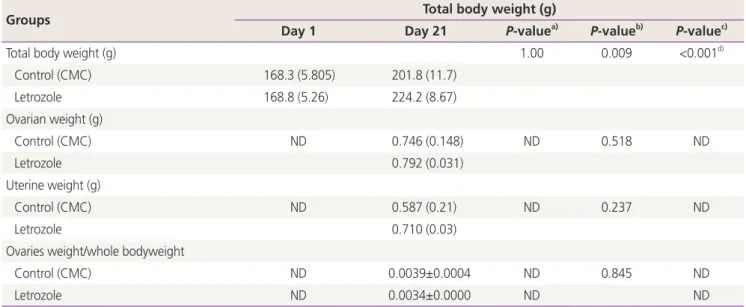
Table 2. Total body and ovarian weight changes during polycystic ovarian syndrome induction phase (days 1-21)
Groups Total body weight (g)
Day 1 Day 21 P-value
a)P-value
b)P-value
c)Total body weight (g) 1.00 0.009 <0.001
d)Control (CMC) 168.3 (5.805) 201.8 (11.7)
Letrozole 168.8 (5.26) 224.2 (8.67)
Ovarian weight (g)
Control (CMC) ND 0.746 (0.148) ND 0.518 ND
Letrozole 0.792 (0.031)
Uterine weight (g)
Control (CMC) ND 0.587 (0.21) ND 0.237 ND
Letrozole 0.710 (0.03)
Ovaries weight/whole bodyweight
Control (CMC) ND 0.0039±0.0004 ND 0.845 ND
Letrozole ND 0.0034±0.0000 ND ND
CMC, carboxymethyl cellulose; ND, not determined.
a)
Compared with CMC (control) at day 1;
b)Compared with CMC (control) at day 21;
c)Compared with baseline level: (paired test);
b)P<0.001,
highly significant difference.
Nuclear factor kappa B levels
As described previously, the serum levels of NF-κB were significantly increased in the LET group, compared with the CMC group (P<0.001). KRGE monotherapy did not affect the NF-κB serum levels significantly, but its combination therapy (KRGE+E+L) caused an marked reduction in serum NF-κB lev- els.
2. Animal weights
1) Total body, ovaries, and uterine weight changes at the induction period (days 1-21)
Table 2 shows the body and organ weights of animals during the induction period. In the beginning, the mean weight of the control group was equal to that of the letrozole group (168.3±5.805 g vs. 168.8±5.26 g, P=1.000), but on day 21, the total body weight of the letrozole group was signifi- cantly higher than that of the control group (201.8±11.7 g
Fig. 3. Histopathological effects of different interventions on ovarian follicular cyst (×100). (A) Ovarian tissue of letrozole (LET) group with multiple cystic follicles (×100); (B) Ovarian tissue with prominent follicular cyst (×100); (C) Mild ovarian atrophy in Korean red gin- seng extract (KRGE) exposed tissues with few follicles (large arrow) and numerous corpus luteum (small arrow). (D) Ovarian tissue of KRGE+ethinyl estradiol (E)+levonorgestrol (L) combination with single follicular cyst (cystic corpora lutea, arrow) (×100).
A B C D
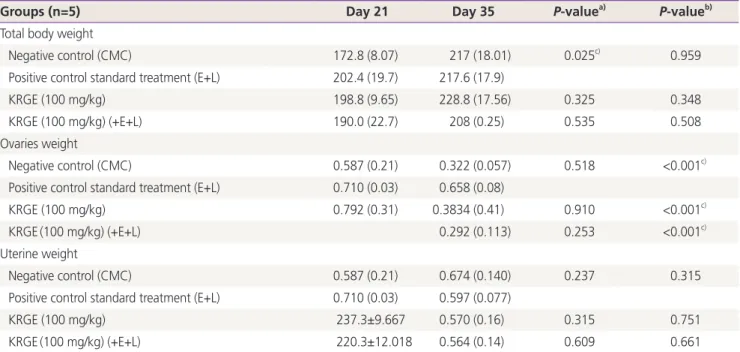
Table 3. Total body and ovarian weight changes during polycystic ovarian syndrome treatment phase (days 21-35)
Groups (n=5) Day 21 Day 35 P-value
a)P-value
b)Total body weight
Negative control (CMC) 172.8 (8.07) 217 (18.01) 0.025
c)0.959
Positive control standard treatment (E+L) 202.4 (19.7) 217.6 (17.9)
KRGE (100 mg/kg) 198.8 (9.65) 228.8 (17.56) 0.325 0.348
KRGE (100 mg/kg) (+E+L) 190.0 (22.7) 208 (0.25) 0.535 0.508
Ovaries weight
Negative control (CMC) 0.587 (0.21) 0.322 (0.057) 0.518 <0.001
c)Positive control standard treatment (E+L) 0.710 (0.03) 0.658 (0.08)
KRGE (100 mg/kg) 0.792 (0.31) 0.3834 (0.41) 0.910 <0.001
c)KRGE (100 mg/kg) (+E+L) 0.292 (0.113) 0.253 <0.001
c)Uterine weight
Negative control (CMC) 0.587 (0.21) 0.674 (0.140) 0.237 0.315
Positive control standard treatment (E+L) 0.710 (0.03) 0.597 (0.077)
KRGE (100 mg/kg) 237.3±9.667 0.570 (0.16) 0.315 0.751
KRGE (100 mg/kg) (+E+L) 220.3±12.018 0.564 (0.14) 0.609 0.661
CMC, carboxymethyl cellulose; E, ethinyl estradiol; L, levonorgestrol; KRGE, Korean red ginseng extract.
a)
![Fig. 2. Serum levels of luteinizing hormone (LH) (A), follicle-stimulating hormone (FSH) (B), testosterone (C) and nuclear factor kappa B (NF-κB), (D) before and after 14 days of administration of standard regimen (ethinyl estradiol [E]+levonorgestrol [L]](https://thumb-ap.123doks.com/thumbv2/123dokinfo/5460910.657019/4.892.75.434.270.380/luteinizing-follicle-stimulating-testosterone-administration-standard-estradiol-levonorgestrol.webp)