Received: 2013.4.10. Revised: 2013.6.4. Accepted: 2013.6.4.
Corresponding author: Bruce Patsner
Yonsei Law School, Yonsei University; Department of Obstetrics and Gynecology, Yonsei University College of Medicine, 50 Yonsei- ro, Seodaemun-gu, Seoul 120-749, Korea
Tel: +82-2-2123-6952 Fax: +82-2-313-8357 E-mail: [email protected]
Articles published in Obstet Gynecol Sci are open-access, distributed under the terms of the Creative Commons Attribution Non-Commercial License (http://creativecommons.
org/licenses/by-nc/3.0/) which permits unrestricted non-commercial use, distribution, and reproduction in any medium, provided the original work is properly cited.
Copyright © 2013 Korean Society of Obstetrics and Gynecology
Introduction
Measurement of serum CA-125 has been an established part of the management of patients with known or suspected invasive ovarian adenocarcinoma for almost 29 years [1] and has been investigated in patients with invasive endometrial adenocarcinoma for almost as long, first in Europe [2] and then in the United States [3]. Serum CA-125 has proved a useful marker for monitoring the treatment of patients with advanced disease following debulking surgery in both ma- lignancies [4,5] and has similar limitations in patients with
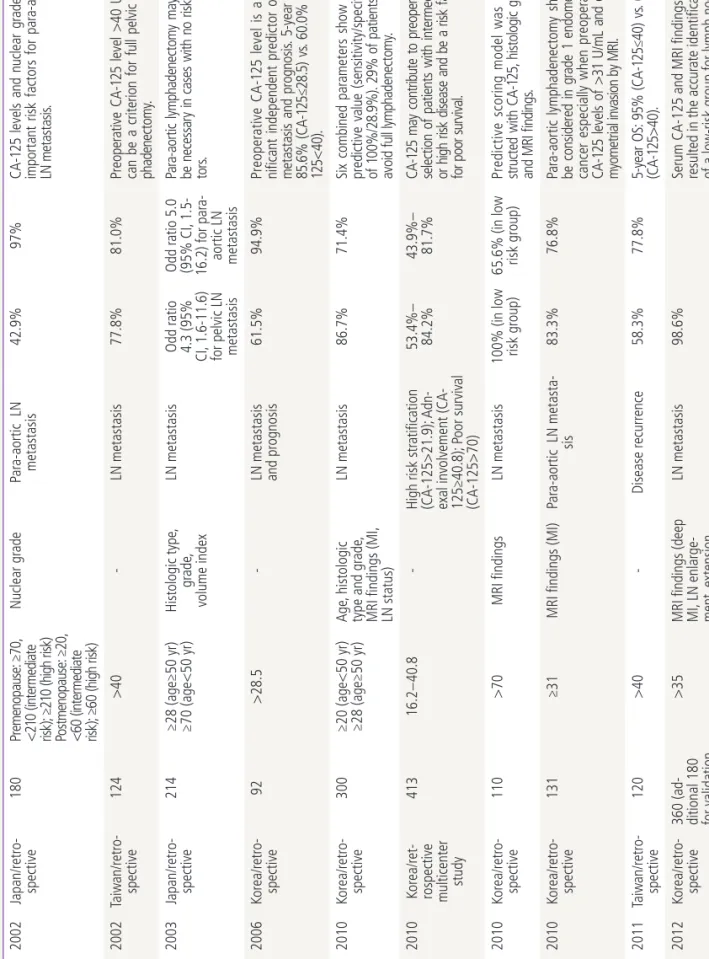
Predictive value of preoperative serum CA-125 levels in patients with uterine cancer: The Asian experience 2000 to 2012
Bruce Patsner 1,2 , Ga Won Yim 2
1