http://e-nrp.org
Using the theory of planned behavior to determine factors influencing processed foods consumption behavior
Sunhee Seo
1§, Og Yeon Kim
2and Soonmi Shim
31Department of Nutritional Science and Food Management, Ewha Womans University, 52, Ewhayeodae-gil, Seodaemun-gu, Seoul 120-750, Korea
2Department of Nutritional Science and Food Management, Ewha Womans University, Seoul 120-750, Korea
3Department of Food Science & Technology and Carbohydrate Bioproduct Research Center, Sejong University, Seoul 143-747, Korea
BACKGROUND/OBJECTIVES: The purpose of this study is to identify how level of information affected intention, using the Theory of Planned Behavior.
SUBJECTS/METHODS: The study was conducted survey in diverse community centers and shopping malls in Seoul, which yielded N = 209 datasets. To compare processed foods consumption behavior, we divided samples into two groups based on level of information about food additives (whether respondents felt that information on food additives was sufficient or not). We analyzed differences in attitudes toward food additives and toward purchasing processed foods, subjective norms, perceived behavioral control, and behavioral intentions to processed foods between sufficient information group and lack information group.
RESULTS: The results confirmed that more than 78% of respondents thought information on food additives was insufficient.
However, the group who felt information was sufficient had more positive attitudes about consuming processed foods and behavioral intentions than the group who thought information was inadequate. This study found people who consider that they have sufficient information on food additives tend to have more positive attitudes toward processed foods and intention to consume processed foods.
CONCLUSIONS: This study suggests increasing needs for nutrition education on the appropriate use of processed foods. Designing useful nutrition education requires a good understanding of factors which influence on processed foods consumption.
Nutrition Research and Practice 2014;8(3):327-335; doi:10.4162/nrp.2014.8.3.327; pISSN 1976-1457 eISSN 2005-6168
Keywords: Processed foods consumption, theory of planned behavior, attitude, subjective norms, information of food additives
INTRODUCTION
14)Developments in food technology and changes in dietary patterns mean more processed foods are produced and consu- med, providing convenience to consumers. Food consumption patterns in Korea have changed remarkably over the past three decades, with consumers demanding and enjoying foods that are nutritious, safe, convenient, and affordable [1,2]. To satisfy consumer desires for value, food additives have become indispensable in producing processed food [3]. However, food additives seem to be among the food safety issues that consu- mers most worry [4], food consumers have shown caution about consuming foods that use additives [5,6].
Some previous studies have evaluated information or aware- ness and concern about food additives [7-9]. Kim et al. [7] found that the most middle school students were unaware of the food additives in processed foods and barely recognized food additive information on product labels. Shim et al. [8] showed that Korean consumers considered food additives as potential hazards and preferred processed foods without additives. This
reflected a general lack of understanding of the functions, advantages, and safety issues of food additives. Consumers may encounter a number of potential hazards through their food choices and consumption. Thus, we must understand exactly what consumers know and what their attitudes are [9].
Findings from previous studies indicate that public concern about food additives grew as misconceptions about food additives and processed foods negatively influenced attitude or intentions to consume processed foods [3,10-14]. Several studies have examined the relationship between knowledge of food additives and attitudes toward processed foods or relationship between attitudes toward food additives and food choice behavior [4,16-19]. Aoki et al. [4] found that information about food additives positively affects attitudes toward food additives and buying intentions. They addressed that informa- tion about food additives was important to consumers in choosing foods. Back and Lee [20] found that consumers had insufficient and incorrect information about food additives, which could influence attitudes or consumption intentions. The results of these studies emphasized education for consumers
§Corresponding Author: Sunhee Seo, Tel. 82-2-3277-4484, Fax. 82-2-3277-2862, Email. [email protected] Received: December 6, 2013, Revised: April 11, 2014, Accepted: April 11, 2014
This is an Open Access article distributed under the terms of the Creative Commons Attribution Non-Commercial License (http://creativecommons.org/licenses/by-nc/3.0/) which permits unrestricted non-commercial use, distribution, and reproduction in any medium, provided the original work is properly cited.
with inaccurate or limited information about food additives.
There is increasing needs for nutrition education on the appropriate use of processed foods. Designing useful nutrition education requires a good understanding of factors which influence on purchase of processed foods. Therefore, this study attempted to promote the healthier use of processed foods.
Awareness and understanding of food label information are an important safety issue although price, nutritional information, and taste were reported as the most important motivating factors that influence on consumption of processed foods [21-24]. The theory of planned behavior offers a sound theore- tical framework to assess perceptions of processed food, for it seeks to explain the reasons underlying individual behaviors [25]. The theory of planned behavior posits that the most important determinant of behavior is intention; intention is, in turn, predicted on attitude, subjective norm, and perceived behavioral control [25]. Attitude is a measure of the degree to which a person evaluates a behavior favorably or unfavorably, so when a person thinks that processed foods and food additives are safe, that person is more likely to intend to consume that food. Subjective norm represents the normative influences or the perceived social pressure to perform or not perform a behavior [25]. In the theory of planned behavior, behaviors are determined by intention as affected by attitude toward the behavior, subjective norm, and perceived behavioral control. Subjective norm suggests the beliefs of reference groups are related to the act, and, in addition, motivation to act adapts to reference group beliefs. Perceived behavioral control refers to the perceived ease of performing a behavior and is determined by resources and opportunities [25]. Therefore, this study examines influences on intention to consume proce- ssed foods by applying the theory of planned behavior. The research must take into account the influence of others, particularly family and friends. If those close to a consumer think using processed foods is safe, the consumer is more likely to use processed foods without concerns. In addition to the influence of friends and family, other influences can affect a consumer’s decision about buying processed foods, particularly the availability of processed foods and the price. If processed foods, with or without additives, are readily available and affordable, adults are more likely to buy them. This volitional control is an important element in the theory of planned behavior.
Although the theory of planned behavior has shown relative success in predicting food choice behaviors [26-29], it has some limitations. However, current literature does not reveal whether the theory of planned behavior variables can predict intention and behavior over and above knowledge. It has been argued that information or knowledge alone is not sufficient for behavior to be performed but whether it can or should be incorporated into theory of planned behavior. Neither is sufficient to actually change behavior, but performing a behavior correctly, as in food safety, may rely heavily on knowledge and information. Thus, this study focused on information about food additives. The purpose of this study is to analyze consumption behavior of processed foods containing food additives using the Theory of Planned Behavior, as well as how attitudes, subjective norms, perceived behavioral control, and behavioral
intentions were different by how much consumers knew about food additives.
SUBJECTS AND METHODOS Data collection
This study targets general consumers over the age of 18 who live in Seoul in 2009. Seoul was selected because it is the most important Korean consumer market, reflecting urban consump- tion patterns within Korea. The adults were recruited from diverse community centers and shopping malls including food marts in Seoul, Korea since we assume that these places are appropriate places to catch adult consumers. None were involved with the food industry, nor worked in any food related area. Before conducting a survey, we explained to the subject purpose and contents of survey, and received oral consent. The consumers who did not want to participate in this survey were excluded. There is possibility of sampling error caused by non-respondents. All respondents were selected through non- probability sampling, especially purposive sampling and were personally interviewed at community centers and shopping malls. All the respondents were responsible for all or part of the food consuming within their households. The final number of respondents was 242 individuals and thirty three incomplete responses were deleted, and thus 209 responses were used in data analysis.
Instrument development
The survey addressed consuming patterns for processed foods (e.g., types of processed foods, the place of consumption, and consuming frequency) and what influenced these consuming decisions. The items were developed based on previous studies [13,19,25,30-31]. Attitudes on consuming processed foods were assessed by two items: “It is a right choice to consume processed foods containing food additives.” and “Consuming processed foods that contain food additives is safe.” Attitudes on food additives were assessed by two items: “It is safe to use food additives approved by the government.” and “Food additives marked on processed foods are safe.” Participants rated items on a 5 point scale (ranging from 1. strongly disagree to 5. strongly agree). Subjective norm was assessed by two items: ‘‘My friends think it is safe to consume processed foods containing food additives.” and “My family thinks it is safe to consume processed foods containing food additives.” Participants used the same 5-point Likert scale. Perceived behavioral control was measured by two items: “It is rare to find processed foods without food additives.” and “It is expensive to buy processed foods not containing food additives.” again using the same 5-point Likert scale. Behavioral intentions to consume processed foods were assessed with three items (BI 1: “I intend to consume processed foods containing food additives less than the others.”; BI 2: “I intend to consume particular processed foods promoted as having safe food additives.”; BI 3: “I intend to consume processed foods regardless of food additives.”), each measured on the same 5-point scale as before. In addition, to measure the level of information on food additives, respondents were asked whether they had received enough information on food additives.
Demographic characteristics (gender, age, marital status, educa-
Demographics
Total (n = 209)
Sufficient information group
(n = 46)
Lack information group (n = 163)
n (%) n (%) n (%)
Gender
Male 34 (16.3%)1) 10 (21.7%)2) 24 (14.7%)3)
Female 173 (82.8%) 35 (76.1%) 138 (84.7%)
Missing data 2 (1.0%) 1 (2.2%) 1 (0.6%)
Marriage
Single 122 (58.4%) 29 (63.0%) 93 (57.1%)
Married 76 (36.4%) 12 (26.1%) 64 (39.3%)
Others 3 (1.4%) 1 (2.2%) 2 (1.2%)
Missing data 8 (3.8%) 4 (8.7%) 4 (2.5%)
Household monthly income ($)
≤2,000 58 (27.8%) 16 (34.8%) 42 (25.8%)
2,000-2,999 40 (19.1%) 9 (19.6%) 31 (19.0%)
3,000-3,999 46 (22.0%) 8 (17.4%) 38 (23.3%)
4,000-4,999 29 (13.9%) 6 (13.0%) 23 (14.1%)
≥5,000 32 (15.3%) 5 (10.9%) 27 (16.6%)
Missing data 4 (1.9%) 2 (4.3%) 2 (1.2%)
Numbers of child in household (person)
0 130 (62.2%) 29 (63.0%) 101 (62.0%)
1 43 (20.6%) 10 (21.7%) 33 (20.2%)
2 27 (12.9%) 5 (10.9%) 22 (13.5%)
≥3 2 (1.0%) 0 (0.0%) 2 (1.2%)
Missing data 7 (3.3%) 2 (4.3%) 5 (3.1%)
Age (yrs)
20-29 45 (21.5%) 8 (17.4%) 37 (22.7%)
30-39 56 (26.8%) 13 (28.3%) 43 (26.4%)
40-49 58 (27.8%) 11 (23.9%) 47 (28.8%)
50-59 34 (16.3%) 6 (13.0%) 28 (17.2%)
≥60 14 (6.7%) 7 (15.2%) 7 (4.3%)
Missing data 2 (1.0%) 1 (2.2%) 1 (0.6%)
Education
≤High school 35 (16.7%) 7 (15.2%) 28 (17.2%)
2-yrs college degree 30 (14.4%) 6 (13.0%) 24 (14.7%) 4-yrs bachelor’s degree 97 (46.4%) 18 (39.1%) 79 (48.5%) Graduate degree 29 (13.9%) 8 (17.4%) 21 (12.9%)
Others 13 (6.2%) 4 (8.7%) 9 (5.5%)
Missing data 5 (2.4%) 3 (6.5%) 2 (1.2%)
1)This percentage is calculated with total of 209 respondents.
2)This percentage is calculated with sufficient information group of 46 respondents.
3)This percentage is calculated with lack information group of 163 respondents.
Table 1. Differences in demographics by the level of information about food additives
tion, number of children under age 18, and occupation) were also included in the questionnaire.
Pre-validated items were used following a pre-test to ensure content validity. Expert review of the questionnaire was perfor- med by two researchers. Prior to data collection, a pilot test was conducted with ten consumers from 20’s to 50’s to check their understanding of the survey items.
Data analysis
Demographic characteristics and consuming patterns were analyzed using SPSS 19.0. We divided samples into two groups based on perceived information level about food additives.
Respondents who answered yes to “Do you think you have enough information of food additives?” were assigned to a group called sufficient information group, and those who answered no were assigned to a second group, lacked information group.
T-test was used to explain the differences between the two groups, specifically their attitudes toward consuming processed foods and food additives, subjective norms, perceived behavioral control, and behavioral intentions to consume processed foods.
Regression analysis was also conducted to determine what factors influenced behavioral intentions to consume processed foods. Statistical significance of P < 0.05 was used for all tests.
RESULTS Demographics
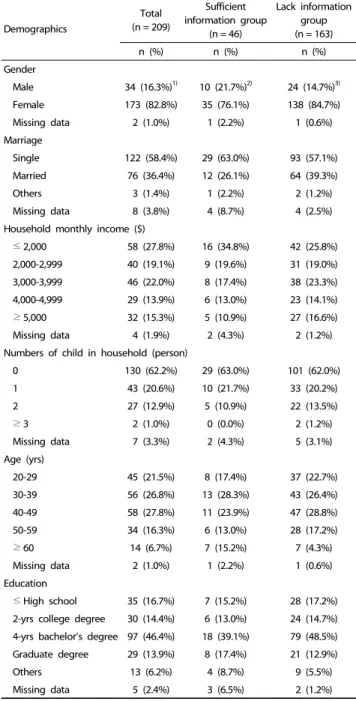
The demographic profiles of the respondents are in Table 1.
Of the 209 respondents, 34 were male, and 173 were female.
Fifty nine percent were single, and 36% were married. Seventy- eight percent of the respondents felt that information on food additives was insufficient, so the data was divided between two groups: sufficient information (n = 46) and lacked information (n = 163). This is similar to previous studies showing that adults know very little about food additives or lack information [6].
Often, despite the large amount of information that is easily available nowadays, adults do not take the initiative to find that information and form their own criteria [6]. For age, 22% were in their 20s, 27% in their 30s, 28% in their 40s, 16% in their 50s, and 7% were older than 60. More than half of the respondents (60%) had a 4-year bachelor’s degree or higher, whereas 17% had not graduated from high school. For monthly household income, 28% earned less than $2,000, 19% earned between $2,000 and $2,999, 22% earned between $3,000 and
$3,999, 14% earned between $4,000 and $4,999, and 15% earned more than $5,000. Among those whose monthly income was less than $2,000, 35% were in the sufficient information group;
among those whose monthly income was more than $5,000, 17% were in the same group. About 62% of the respondents had no children younger than 18 in their household, 21% had one child, and 13% had two children (Table 1).
Consuming patterns of processed foods by the level of information about food additives
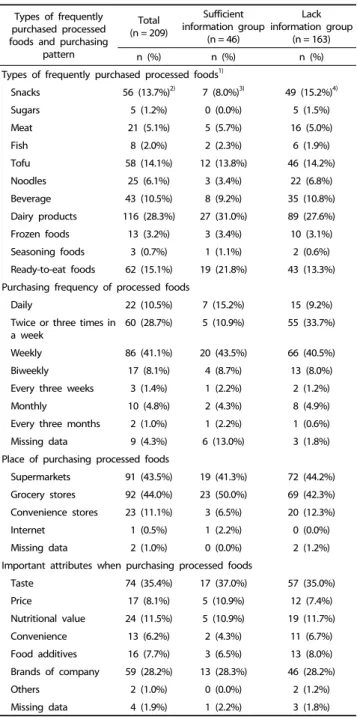
The types of processed food most frequently consumed were dairy products (28%), ready-to-eat-foods (15%), tofu (14%), snacks (14%), and beverages (11%) (Table 2). The differences between the two groups, sufficient information and lacked information,
were interesting, especially in the types of processed food most frequently consumed. Dairy products were the most frequently consumed item, and snacks ranked second in the lacking information group, but ready-to-eat foods ranked second in the sufficient information group. Forty-one percent of the respon- dents consumed processed foods once a week, and 29%
consumed them two or three times a week. Most respondents who consumed processed foods once a week or two or three times a week felt they lacked sufficient information on additives.
Almost half of the respondents (44%) purchased processed
Types of frequently purchased processed foods and purchasing
pattern
Total (n = 209)
Sufficient information group
(n = 46)
Lack information group
(n = 163)
n (%) n (%) n (%)
Types of frequently purchased processed foods1)
Snacks 56 (13.7%)2) 7 (8.0%)3) 49 (15.2%)4)
Sugars 5 (1.2%) 0 (0.0%) 5 (1.5%)
Meat 21 (5.1%) 5 (5.7%) 16 (5.0%)
Fish 8 (2.0%) 2 (2.3%) 6 (1.9%)
Tofu 58 (14.1%) 12 (13.8%) 46 (14.2%)
Noodles 25 (6.1%) 3 (3.4%) 22 (6.8%)
Beverage 43 (10.5%) 8 (9.2%) 35 (10.8%)
Dairy products 116 (28.3%) 27 (31.0%) 89 (27.6%)
Frozen foods 13 (3.2%) 3 (3.4%) 10 (3.1%)
Seasoning foods 3 (0.7%) 1 (1.1%) 2 (0.6%)
Ready-to-eat foods 62 (15.1%) 19 (21.8%) 43 (13.3%) Purchasing frequency of processed foods
Daily 22 (10.5%) 7 (15.2%) 15 (9.2%)
Twice or three times in a week
60 (28.7%) 5 (10.9%) 55 (33.7%)
Weekly 86 (41.1%) 20 (43.5%) 66 (40.5%)
Biweekly 17 (8.1%) 4 (8.7%) 13 (8.0%)
Every three weeks 3 (1.4%) 1 (2.2%) 2 (1.2%)
Monthly 10 (4.8%) 2 (4.3%) 8 (4.9%)
Every three months 2 (1.0%) 1 (2.2%) 1 (0.6%)
Missing data 9 (4.3%) 6 (13.0%) 3 (1.8%)
Place of purchasing processed foods
Supermarkets 91 (43.5%) 19 (41.3%) 72 (44.2%)
Grocery stores 92 (44.0%) 23 (50.0%) 69 (42.3%) Convenience stores 23 (11.1%) 3 (6.5%) 20 (12.3%)
Internet 1 (0.5%) 1 (2.2%) 0 (0.0%)
Missing data 2 (1.0%) 0 (0.0%) 2 (1.2%)
Important attributes when purchasing processed foods
Taste 74 (35.4%) 17 (37.0%) 57 (35.0%)
Price 17 (8.1%) 5 (10.9%) 12 (7.4%)
Nutritional value 24 (11.5%) 5 (10.9%) 19 (11.7%)
Convenience 13 (6.2%) 2 (4.3%) 11 (6.7%)
Food additives 16 (7.7%) 3 (6.5%) 13 (8.0%)
Brands of company 59 (28.2%) 13 (28.3%) 46 (28.2%)
Others 2 (1.0%) 0 (0.0%) 2 (1.2%)
Missing data 4 (1.9%) 1 (2.2%) 3 (1.8%)
1)Multiple responses
2)This percentage is calculated with total of 209 respondents.
3)This percentage is calculated with sufficient information group of 46 respondents.
4)This percentage is calculated with lack information group of 163 respondents.
Table 2. Types of frequently purchased processed foods and purchasing pattern by the level of information about food additives
foods in grocery stores, and 44% purchased them in superstores like WalMart. More of those respondents who purchased processed foods in convenience stores felt they lacked sufficient information about food additives. Respondents were also asked about important attributes in processed foods. Thirty-five percent of the respondents considered taste as the major factor, 29%
said brand, 12% nutritional value, and 8% price. However, the group that felt they lacked information considered nutritional
value more important than the group that felt they had sufficient information, while the sufficient information group considered price more important (Table 2).
Attitudes toward consuming processed foods and food additives, subjective norms, perceived behavioral control, and intentions to consume processed foods by the level of information about food additives
The instruments’ reliability was assessed with Cronbach’s alpha.
The alpha values of attitudes toward consuming processed foods and attitudes toward food additives were 0.64, 0.70, respectively and showed satisfactory levels of internal consis- tency (Table 3). Using level of information about food additives, this study compared attitudes toward consuming processed foods and food additives, subjective norms, perceived beha- vioral control, and intentions to consume processed foods (Table 3). All respondents preferred not to consume processed foods with food additives: "It is a right choice to consume processed foods containing food additives."(mean = 2.39); "Consu- ming processed foods containing food additives is safe." (mean
= 2.33); "It is safe to use food additives approved by the government." (mean = 2.63); and "Food additives marked on processed foods are safe." (mean = 2.31). These results showed significant differences between the two groups (sufficient infor- mation as opposed to lacking information). Though the mean value of attitudes toward consuming processed foods remained below 3 out of 5, the group who felt they had sufficient infor- mation were significantly more positive about consuming processed foods than the other group (t = 2.35, P < 0.05). This indicates that if people have sufficient information about food additives, they are more likely to consume processed foods.
Similarly, the group who thought they had sufficient infor- mation had more positive attitudes toward food additives (t
= 2.25, P < 0.05) than the other group. The group that thought they had sufficient information about food additives was also more positive about consuming processed foods than the group lacking information. The results indicate that the more information adults had about food additives, the more positively they felt about processed foods and food additives.
For the subjective norm, responses were like the following:
"My friends think it is safe to consume processed foods containing food additives." (mean = 2.76), and "My family thinks it is safe to consume processed foods containing food additives."
(mean = 2.52) (Table 3). Participants seem to be more highly affected by friends than families in forming consuming inten- tions to processed foods. Perceived behavior control was examined from the perspective of both opportunity and resources: “It is rare to find processed foods without food additives.” (mean =
4.00), and “It is expensive to buy processed foods not containing food additives.” (mean = 3.79) (Table 3). All respondents showed a high level of perceived behavior control to buy or find processed foods not containing food additives. Respondents developed intentions to consume processed foods based more on perceived resources (price) than opportunity (rare to buy).
Although it was not significant, the mean value for price
indicated perceived resources strongly influenced the group
that thought they had sufficient information. Resources were,
however, more important to perceived behavior control in the
Dependent variable Independent variable F R2 Unstandardized
coefficient (B) Standard error Standardized
coefficient (B) t P
CI 1 Att _Processed
2.719 0.254 -0.368 0.135 -0.402 -2.729 0.009**
SN _Friend -0.313 0.137 -0.339 -2.288 0.027*
CI 2 PBC _Resource 1.665 0.176 -0.365 0.162 -0.382 -2.255 0.030*
CI 3 Att _Processed
3.979 0.332 0.607 0.152 0.558 3.999 0.000***
PBC _Resource 0.380 0.153 0.374 2.482 0.017*
*P< 0.05, **P< 0.01, ***P< 0.001
CI 1; I intend to consume processed foods containing food additives less than the others.
CI 2; I intend to consume particular processed foods that promote that food additives in their products are safe.
CI 3; I intend to consume processed foods regardless of food additives.
Att _Processed; Average of “It is safe to use food additives approved by the government.” and “Food additives marked on processed foods is safe.”
SN _Friends; My friends think it is safe to consume processed foods containing food additives.
PBC _Resource; It is expensive to buy processed foods not containing food additives.
Table 4. Influences of attitudes, subjective norms, and perceived behavior control on consumption intention to processed foods Measurement items1)
Total (n = 209)
Sufficient information group
(n = 46)
Lack information group
(n = 163) t-value Sig.
Mean ± S.D. Mean ± S.D. Mean ± S.D.
Attitude toward consuming processed foods (Cronbach α = 0.64)
It is a right choice to consume processed foods containing food additives. 2.39 ± 0.95 2.72 ± 1.13 2.29 ± 0.87 2.353 0.022*
Consuming processed foods those containing food additives is safe. 2.33 ± 0.91 2.54 ± 1.09 2.26 ± 0.85 1.610 0.113 Attitude toward food additives (Cronbach α = 0.70)
It is safe to use food additives approved by the government. 2.63 ± 1.04 2.93 ± 1.14 2.55 ± 1.00 2.253 0.025*
Food additives marked on processed foods is safe. 2.31 ± 0.82 2.50 ± 1.03 2.25 ± 0.74 1.532 0.131
Subjective norms - Family
My family thinks it is safe to consume processed foods containing food additives. 2.52 ± 0.93 2.48 ± 0.91 2.53 ± 0.94 -0.356 0.722 Subjective norms - Friends
My friends think it is safe to consume processed foods containing food additives. 2.76 ± 0.90 2.87 ± 0.98 2.73 ± 0.88 0.924 0.357 Perceived behavioral control - Opportunity
It is rare to find processed foods not containing food additives. 4.00 ± 1.02 4.04 ± 1.07 3.99 ± 1.00 0.292 0.771 Perceived behavioral control - Resources
It is expensive to buy processed foods not containing food additives 3.79 ± 1.07 3.63 ± 1.06 3.84 ± 1.07 -1.182 0.239 Consumption intention 1
I intend to consume processed foods containing food additives less than the others. 3.77 ± 0.95 3.61 ± 0.91 3.81 ± 0.96 -1.296 0.196 Consumption intention 2
I intend to consume particular processed foods being promoted that food additives
in their products are safe. 3.42 ± 1.01 3.36 ± 1.03 3.44 ± 1.00 -0.519 0.604
Consumption intention 3
I intend to consume processed foods regardless of using food additives. 2.35 ± 1.05 2.65 ± 1.08 2.27 ± 1.02 2.224 0.027*
1)5 point Likert scale; 1 = strongly disagree; 5 = strongly agree
*P< 0.05
Table 3. Differences in attitudes, subjective norms, perceived behavioral control, and consumption intentions by the level of information about food additives
group lacking information (mean = 3.84) than in group with sufficient information (mean = 3.63).
In terms of intention to consume processed foods, responses were as follows: “I intend to consume processed foods contain- ing food additives less than the others.” (mean = 3.77); “I intend to consume particular processed foods promoted as having safe food additives in their products.” (mean = 3.42); “I intend to consume processed foods regardless of food additives.” (mean
= 2.35) (Table 3). In addition, the group with sufficient information had more intention to consume processed foods regardless of food additives (t = 2.22, P < 0.05) than the other group. Again, although it was not statistically significant, respondents who thought they lacked sufficient information
were more likely to intend consuming processed foods than adults with sufficient information, but only if processed foods contained fewer food additives than others or if the foods were promoted as safe to eat.
How attitudes toward consuming processed foods, attitudes toward food additives, subjective norms, and perceived behavioral control influence intentions to consume processed foods
The results of the three regression models are presented in
Table 4. These regression models have different dependent
variables (BI 1: I intend to consume processed foods containing
food additives less than the others.; BI 2: I intend to consume
particular processed foods promoted as having safe food
Fig. 1. Regression analysis results between independent variables and consumption intention 1. *P< 0.05, **P< 0.01, ***P< .001. CI 1; I intend to consume processed foods containing food additives less than the others, Att_Processed; attitude toward consuming processed foods, SN_Friends; subjective norms related with friends, PBC_Resources; perceived behavioral control related to resource
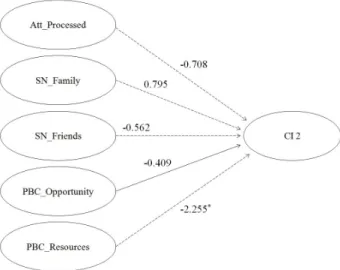
Fig. 2. Regression analysis results between independent variables and consumption intention 2. *P< 0.05, **P< 0.01, ***P< .001. CI 2; I intend to consume particular processed foods being promoted that food additives in their products are safe, Att_Processed; attitude toward consuming processed foods, SN_Friends; subjective norms related with friends, PBC_Resources; perceived behavioral control related to resource
Fig. 3. Regression analysis results between independent variables and consumption intention 3. *P< 0.05, **P< 0.01, ***P< .001. CI 3; I intend to consume processed foods regardless of using food additives, Att_Processed;
attitude toward consuming processed foods, SN_Friends; subjective norms related with friends, PBC_Resources; perceived behavioral control related to resource
additives.; BI 3: I intend to consume processed foods regardless of food additives.) with the same independent variables (attitude toward consuming processed foods, attitude toward food additives, subjective norms _friends, subjective norms _family, perceived behavioral control _resource, and perceived behavioral control _opportunity) (Fig. 1, 2, and 3). Based on the collinearity diagnostic test, no collinearity problems were detected in the three analyses. The R
2for the three regression models were not very high for overall statistical significance as indicated by the F-statistics. In addition, regression analysis was performed to identify what factors influenced consumption
intentions for each group separately. The group that thought they had sufficient information, more positive attitudes toward processed foods, and higher perceived subjective norm, especially among friends, were significantly less likely than other respon- dents to consume processed foods that contain fewer food additives than others. In addition, more positive attitudes toward consuming processed foods and higher perceived behavioral control (for opportunity) influenced the intention to consume processed foods regardless of food additives (Table 4). When food additives are promoted as safe, perceived behavioral control, especially related to opportunity, had a negative influence on consuming intention. Perceived behavioral control, especially related to opportunity and attitudes toward processed foods influenced intention to consume processed foods in opposite directions of caring about the food additives. However, we found no significant influencing factors on consumption intentions in the model for the group that thought they lacked sufficient information.
DISCUSSION
This study used the theory of planned behavior to investigate
the intention to consume processed foods among adults in
South Korea. We focused on how attitudes, subjective norms,
perceived behavioral control, and behavioral intentions were
different by how much they had enough information about
food additives. In this study, respondents were divided into
groups who thought they had sufficient information and lacked
information about food additives. We found that two thirds of
respondents thought they did not have enough information
about food additives. This is similar to Bülent’s study [32]. They
found that only 17% of the consumer thought they understood
food safety fully, but 41% thought they had only moderate or
inadequate knowledge about food safety. Similarly, adults who
do not read labels do not get information about additives or
food safety and cannot seek information on the ingredients and additives in the food to make responsible choices [6]. Lee [33], however, reported that teachers in elementary school considered safety and nutritional value most when consuming processed products, while Kim and Kim [34] found that price was most important to male and female adults living in Seoul, Daegu, and Busan, Korea.
This study found that all respondents felt negatively about food additives and processed foods in general. The results are in agreement with Behrens et al. [35] who reported many Brazilian people showed suspicion and distrust of processing technologies and food additives in particular. In addition, Bredahl [36] stated that, to adults in Europe, products without additives were healthier when they looked for in food products.
Other studies have found that adults considered food additives and processed foods harmful [14,19,37-39]. Unusan [15] also reported that 35% of adults who prepare food in a household tended not to consume food with additives because of concern about health. Of the various items associated with food safety, food additives are among the most controversial: information on food additives is available to adults, but when both positive and negative information were provided simultaneously, negative information was clearly more influential [4].
The results found that respondents with adequate informa- tion about food additives were more positive about food additives and consuming processed foods, which indicates information about food additives affects attitudes toward consuming processed foods. Back and Lee [20] also found similar results that there were differences among parents based on how much they knew about food additives. These studies advised that adults were insufficiently and incorrectly informed about food additives, which could influence attitudes or consumption intentions. Similarly, concern about food additives and processed foods was affected by the accuracy or sufficiency of information about the additives used in producing processed foods. Consumers with incorrect or inadequate knowledge had a more negative attitude toward food additives [11,16]. Indeed, Caswell and Mojduszka [40] studied the relationship between perceived risk and demand for information and they found that when consumers saw little risk, they demanded little additional information, but as perceived risk increased, they wanted more information. Concerns about food additives might be influenced by unfamiliarity with hazards and potential risks [41], so consumers who perceived that they had sufficient information also perceived less risk and had more positive attitudes.
In addition, these results showed that respondents with sufficient information about food additives were more likely to buy processed foods, indicating that information about food additives could affect intention to consume processed foods.
Moreover, we found that adults with sufficient information about food additives would buy processed foods in spite of food additives, while respondents who did not have sufficient information about additives still intended not to buy processed food because they believed promotions that claimed additives were safe. Xu et al. [42] concluded that information of the labeled seafood product affected seafood consumption intention.
Deliza et al. [17] found that respondents with more information about food technology used taste, quality, safety, and health-
giving properties to evaluate processed foods positively, intending to buy them despite their high price. In contrast, respondents with less information did not trust product labels, had little intention of buying processed foods, and wanted processed foods only if the price was reasonable.
These results suggest that offering more information about food additives could improve attitudes toward processed foods.
Thus, education about the functions, advantages, and safety of food additives including both positive and negative sides, as well as label declarations and control programs, should prevent misunderstandings about food additives and reduce the concern of food safety. Rimal et al. [12] concluded that educating consumers on how to prevent food safety threats led to reduced concerns and changes in food consumption habits. Unusan [15]
noted that consumers avoided buying processed foods because they lacked sufficient information about food additives and thought food additives were harmful for their health. Altu and Elmaci [2] also reported that most respondents who considered food additives as potential hazards, even when they were aware of the benefits, did not intend to buy processed foods Consu- mers need appropriate information to take advantage of current food systems and to allay concerns about their health as nutrition labeling helps consumer understanding nutrition facts [43-45]. Thus, knowledge would help them use processed foods to attain food goals.
Food choices may be greatly influenced by how they judge the available information; research on the effect of contradi- ctory information on food choices is extremely important for both policy decision makers and food producers [4]. Because of the increased consumption of processed food, nutritional labels, including food additives, present detailed information about food content and composition becoming therefore an essential vehicle of communication between food manufa- cturers and adults [46]. Adults better understand and subse- quently better comply with nutritional facts about food additives, resulting in healthier food choices [47]. Therefore, manufacturers must move to inform adults about the food additives they use in producing processed foods and explain how food additives are obtained and why they are necessary; these facts, among others, add up to favor the use of additives without causing negative perceptions. The increasing competitiveness of the world food market has fragmented consumer demand, making it heterogeneous and dynamic. Thus, competition in the food industry relies not only on efficiency and quality control but also on increasing the value added to their products. Information will help adults make a reasonable food choice. Nutrition education regarding the information of food additives and processed foods need to be required.
The theory of planned behavior explains factors influenced on intention to consume processed foods. Positive attitudes toward processed foods and the perception that especially friends (subjective norms) supported buying processed food significantly influenced intention to consume processed foods containing food additives less than the other processed foods.
In addition, positive attitudes toward processed foods along
with higher perceived behavioral control, especially related to
opportunity, influenced the intention to consume processed
foods regardless of food additives. Perceived behavioral control
related to opportunity reduced consume intention even if food additives were shown to be safe. Perceived behavioral control, especially related to resources, influenced intention to consume processed foods negatively, even when the food additives were promoted as safe. On the other hand, positive attitudes toward processed foods and higher perceived behavioral control, espe- cially related to resources, influenced the intention to consume processed foods regardless of food additives. The role of perceived behavior control is further supported by Cook et al.
study [48] of genetically modified foods. Subjective norm reduced consume intention while perceived behavior control had more substantial influence on intention than subjective norm. In other words, if processed foods are available, and people have both a positive attitude and approval of friends, they will buy the processed foods. According to Dickson- Spillman et al. [49], future communications about food additives in food could target attitudes, shifting them away from the perception that “synthetic equals dangerous”. People who have strongly negative attitudes towards food additives would be able to judge food hazards more appropriately.
This study suggests several directions for future study. First, properly validated information of food additives instrument is not available, so we used adults’ perceived information sufficiency on food additives. This led to large differences in sample numbers between the group with sufficient information and the group lacking information. More studies about infor- mation on and beliefs about food additives would help deter- mine how adults develop patterns for consuming processed food. Future study could also examine how contradictory information affects consumer decisions about food additives or processed foods [4] or consider what information adults want to know about the specific content of processed foods, including food additives. Comparing the content of processed foods with sources of information about that content could also be useful, especially using both adults who have sufficient knowledge about food additives and those who lack that knowledge. Future research might also especially consider the accuracy and/or reliability of information on food additives and how that information affects attitudes and buying intentions.
REFERENCES
1. Lee CH, Cho YH, Park KH. Assessment of estimated daily intake of nitrite by average consumption of processed foods in Korea.
Food Control 2006;17:950-6.
2. Altu T, Elmaci Y. A consumer survey on food additives. Dev Food Sci 1995;37:705-19.
3. Seo KW, Yang YS, Cho BS, Gang GL, Kim JP, Kim ES, Park JT. The survey on food additives in frequently consumed food. J Food Hyg Saf 2008;23:142-8.
4. Aoki K, Shen J, Saijo T. Consumer reaction to information on food additives: evidence from an eating experiment and a field survey.
J Econ Behav Organ 2010;73:433-8.
5. European Food Information Council (BE). European Food Information Council [Internet]. Brussels: European Food Information Council;
2006 [cited 2013 February 5]. Available from: http://www.eufic.org/.
6. Varela P, Fiszman SM. Exploring consumers' knowledge and percep- tions of hydrocolloids used as food additives and ingredients. Food
Hydrocoll 2013;30:477-84.
7. Kim EJ, Na HJ, Kim Y. Awareness on food additives and purchase of processed foods containing food additives in middle school students. J Korean Living Sci Assoc 2007;16:205-18.
8. Shim SM, Seo SH, Lee Y, Moon GI, Kim MS, Park JH. Consumers' knowledge and safety perceptions of food additives: evaluation on the effectiveness of transmitting information on preservatives. Food Control 2011;22:1054-60.
9. Miles S, Brennan M, Kuznesof S, Ness M, Ritson C, Frewer LJ. Public worry about specific food safety issues. Br Food J 2004;106:9-22.
10. Williams P, Stirling E, Keynes N. Food fears: a national survey on the attitudes of Australian adults about the safety and quality of food. Asia Pac J Clin Nutr 2004;13:32-9.
11. McCarthy M, Brennan M, Ritson C, de Boer M. Food hazard characteristics and risk reduction behaviour: the view of consumers on the island of Ireland. Br Food J 2006;108:875-91.
12. Rimal A, Fletcher SM, McWatters KH, Misra SK, Deodhar S. Percep- tion of food safety and changes in food consumption habits: a consumer analysis. Int J Consum Stud 2001;25:43-52.
13. Brewer MS, Rojas M. Consumer attitudes toward issues in food safety. J Food Saf 2008;28:1-22.
14. Lee HK. Consumers' awareness of food additives. Safe food 2012;
7:21-5.
15. Unusan N. Consumer food safety knowledge and practices in the home in Turkey. Food Control 2007;18:45-51.
16. Stern T, Haas R, Meixner O. Consumer acceptance of wood-based food additives. Br Food J 2009;11:179-95.
17. Deliza R, Rosenthal A, Silva AL. Consumer attitude towards informa- tion on non conventional technology. Trends Food Sci Technol 2003;14:43-9.
18. Worsley A. Nutrition knowledge and food consumption: can nutri- tion knowledge change food behaviour? Asia Pac J Clin Nutr 2002;11 Suppl 3:S579-85.
19. Kim H, Kim M. Consumers' awareness of the risk elements associated with foods and information search behavior regarding food safety. J East Asian Soc Diet Life 2009;19:116-29.
20. Back BS, Lee YH. Consumer's awareness and policies directions on food additives-focusing on consumer information. J Consum Stud 2006;17:133-50.
21. Ababio PF, Adi DD, Amoah M. Evaluating the awareness and importance of food labelling information among consumers in the Kumasi metropolis of Ghana. Food Control 2012;26:571-4.
22. Mahgoub SE, Lesoli PP, Gobotswang K. Awareness and use of nutrition information on food packages among consumers in Maseru (Lesotho). Afr J Food Agric Nutr Dev 2007;7:1-16.
23. Williams ER, Caliendo MA. Nutrition: principles, issues, and applications. New York (NY): McGraw-Hill Inc.; 1984.
24. Sharif Ishak SI, Shohaimi S, Kandiah M. Assessing the children's views on foods and consumption of selected food groups: outcome from focus group approach. Nutr Res Pract 2013;7:132-8.
25. Ajzen I. The theory of planned behavior. Organ Behav Hum Decis Process 1991;50:179-211.
26. Seo HS, Lee SK, Nam S. Factors influencing fast food consumption behaviors of middle-school students in Seoul: an application of theory of planned behaviors. Nutr Res Pract 2011;5:169-78.
27. Pawlak R, Colby S, Herring J. Beliefs, benefits, barriers, attitude, intake and knowledge about peanuts and tree nuts among WIC participants in eastern North Carolina. Nutr Res Pract 2009;3:220-5.
28. Kim K, Reicks M, Sjoberg S. Applying the theory of planned behavior to predict dairy product consumption by older adults. J Nutr Educ Behav 2003;35:294-301.
29. Sun X, Guo Y, Wang S, Sun J. Predicting iron-fortified soy sauce consumption intention: application of the theory of planned behavior and health belief model. J Nutr Educ Behav 2006;38:276-85.
30. Wilcock A, Pun M, Khanona J, Aung M. Consumer attitudes, know- ledge and behaviour: a review of food safety issues. Trends Food Sci Technol 2004;15:56-66.
31. Lobb AE, Mazzocchi M, Traill WB. Modelling risk perception and trust in food safety information within the theory of planned behaviour. Food Qual Prefer 2007;18:384-95.
32. Ergönül B. Consumer awareness and perception to food safety: a consumer analysis. Food Control 2013;32:461-71.
33. Lee JS. Perception on nutrition labeling of the processed food among elementary school teachers in Busan. Korean J Community Nutr 2009;14:430-40.
34. Kim HC, Kim MR. Consumer attitudes towards food additives. J East Asian Soc Diet Life 2005;15:126-35.
35. Behrens JH, Barcellos MN, Frewer LJ, Nunes TP, Franco BD, Destro MT, Landgraf M. Consumer purchase habits and views on food safety: a Brazilian study. Food Control 2010;21:963-9.
36. Bredahl L. Consumers' cognitions with regard to genetically modified foods. Results of a qualitative study in four countries. Appetite 1999;33:343-60.
37. Yoon E, Seo SH. Differences on perceptions and attitudes towards food safety based on behavioral intention to prevent foodborne illness among middle school students in Seoul. Korean J Food Cookery Sci 2012;28:149-58.
38. Worsley A, Scott V. Consumers' concerns about food and health in Australia and New Zealand. Asia Pac J Clin Nutr 2000;9:24-32.
39. Kher SV, De Jonge J, Wentholt MT, Deliza R, de Andrade JC, Cnossen
HJ, Luijckx NB, Frewer LJ. Consumer perceptions of risks of chemical and microbiological contaminants associated with food chains: a cross-national study. Int J Consum Stud 2013;37:73-83.
40. Caswell JA, Mojduszka EM. Using informational labeling to influence the market for quality in food products. Am J Agric Econ 1996;78:1248-53.
41. Raats MM, Shepherd R. Developing a subject-derived terminology to describe perceptions of chemicals in foods. Risk Anal 1996;16:133-46.
42. Xu P, Zeng Y, Fong Q, Lone T, Liu Y. Chinese consumers' willingness to pay for green- and eco-labeled seafood. Food Control 2012;
28:74-82.
43. Kim HY, Lee NR, Lee JS, Choi YS, Kwak TK, Chung HR, Kwon S, Choi YJ, Lee SK, Kang MH. Meal skipping relates to food choice, understanding of nutrition labeling, and prevalence of obesity in Korean fifth grade children. Nutr Res Pract 2012;6:328-33.
44. Kim WK, Kim J. A study on the consumer's perception of front-of- pack nutrition labeling. Nutr Res Pract 2009;3:300-6.
45. Yates AA. Establishing new principles for nutrient reference values (NRVs) for food labeling purposes. Nutr Res Pract 2007;1:89-93.
46. Sharf M, Sela R, Zentner G, Shoob H, Shai I, Stein-Zamir C. Figuring out food labels. Young adults' understanding of nutritional information presented on food labels is inadequate. Appetite 2012;58:531-4.
47. Borgmeier I, Westenhoefer J. Impact of different food label formats on healthiness evaluation and food choice of consumers: a randomized-controlled study. BMC Public Health 2009;9:184.
48. Cook AJ, Kerr GN, Moore K. Attitudes and intentions towards purchasing GM food. J Econ Psychol 2002;23:557-72.
49. Dickson-Spillmann M, Siegrist M, Keller C. Attitudes toward chemicals are associated with preference for natural food. Food Qual Prefer 2011;22:149-56.