• 검색 결과가 없습니다.

Frontoethmoidal Mucocele Presenting as Progressive Enophthalmos

N/A
N/A
Protected

Academic year: 2022

Share "Frontoethmoidal Mucocele Presenting as Progressive Enophthalmos"

Copied!
4
0
0

로드 중.... (전체 텍스트 보기)

전체 글

(1)

212

Case Report

Frontoethmoidal Mucocele Presenting as Progressive Enophthalmos

Ji-Sun Paik

1

, Su-Whan Kim

2

, Suk-Woo Yang

1

1

Department of Ophthalmology and Visual Science, Seoul St. Mary’s Hospital, The Catholic University of Korea College of Medicine, Seoul, Korea

2
Department of Otolaryngology-Head and Neck Surgery, Seoul St. Mary’s Hospital, The Catholic University of Korea College of Medicine, Seoul, Korea pISSN: 1011-8942 eISSN: 2092-9382

Korean J Ophthalmol 2012;26(3):212-215 http://dx.doi.org/10.3341/kjo.2012.26.3.212

For patients presenting with enophthalmos, it is impor- tant to consider a broad differential diagnosis, including orbital trauma, chronic sinusitis, malignant infiltration, contracture and atrophy of the orbital contents (e.g., We- gener’s granulomatosis, external beam irradiation, scleros- ing orbital tumor, etc.), systemic inflammation (scleroder- ma) and pseudoenophthalmos [1]. Very rarely, silent sinus syndrome arising from chronic maxillary sinusitis is relat- ed to progressive enophthalmos and hypoglobus [2]. A few recent case reports have described ethmoidal involvement in silent sinus syndrome and the patients described had en- ophthalmic conditions that did not improve after function- al endoscopic surgery [3,4]. Frontoethmoidal mucoceles are relatively rare and in some cases patients experience ophthalmic manifestations, including orbital displacement, proptosis, restricted ocular movement, diplopia and eyelid swelling [5]. We encountered an unusual case of fronto- ethmoidal mucocele that initially presented as progressive

enophthalmos, yet there was no symptomatic improvement following successful endoscopic marsupialization.

Case Report

A 27-year-old man visited our ophthalmology clinic for an evaluation of the enophthalmos of his right eye that had worsened over the previous 5 months. He had no signifi- cant history of systemic or ocular disease, previous trau- ma, sinus diseases or surgery. The patient denied clinical symptoms such as pain, diplopia, or visual changes. The ophthalmic examination showed that his best-corrected visual acuity was 20 / 20 in both eyes. The pupillary light reflex showed equal reactive size with no afferent pupil- lary defect in both eyes. The ocular alignment examination showed that his ductions were full, his primary alignment was orthophoric and there were no deviating lesions.

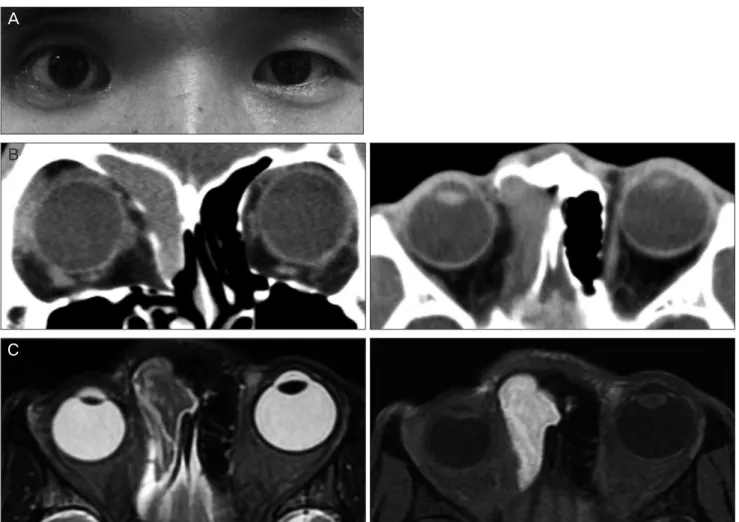
The Hertel exophthalmeter examination with a base of 96 mm showed 10.0 mm in his right eye, and 14.0 mm in his left eye. The intraocular pressure was 16 mmHg in his right eye and 13 mmHg in his left eye. A computed tomog- raphy scan revealed a large filling lesion of soft tissue den- sity in the right frontal and ethmoid sinuses, which pos- sibly originated from a mucocele. A magnetic resonance image showed a lesion that had T2 low signal intensity and

© 2012 The Korean Ophthalmological Society

This is an Open Access article distributed under the terms of the Creative Commons Attribution Non-Commercial License (http://creativecommons.org/licenses /by-nc/3.0/) which permits unrestricted non-commercial use, distribution, and reproduction in any medium, provided the original work is properly cited.

Received: June 9, 2010 Accepted: September 18, 2010

Corresponding Author: Suk-Woo Yang, MD. Department of Ophthal- mology and Visual Science, Seoul St. Mary’s Hospital, The Catholic University of Korea College of Medicine, #222 Banpo-daero, Seocho-gu, Seoul 137-701, Korea. Tel: 82-2-2258-6200, Fax: 82-2-599-7405, E-mail:

[email protected]

In this case report we describe a 27-year-old man who presented with progressive enophthalmos for 5 months without any other associated ocular symptoms such as pain, diplopia, or visual disturbance. Computed tomog- raphy showed that his progressive enophthalmos originated from a frontoethmoidal mucocele and this caused destruction of the lamina papyracea and shrinkage of the ethmoidal air cell. Finally the enlarged orbital space caused an inward deviation of the eyeball. Endoscopic marsupialization was successfully performed by an otolaryngologist and did not result in any ophthalmologic sequelae. Although frontoethmoidal sinus mucoceles mostly frequently originates from orbital mucoceles, enophthalmic manifestations are very rare. Enophthalmic conditions are not as responsive to surgical interventions as exophthalmic conditions.

Key Words: Enophthalmos, Sinus mucocele

(2)

213 JS Paik, et al. Enophthalmic Frontoethmoidal Mucocele

T1 high signal intensity, which may have been due to pro- tein content and a chronic state of sinusitis, suggesting that it was most likely a frontoethmoidal mucocele (Fig. 1). We concluded that this lesion was a chronic mucocele and we referred the patient for otolaryngologic consultation.

The otolaryngologist performed endoscopic sinus drain- age surgery during which a bulging mococele that origi- nated from the right frontal sinus and extended toward the anterior ethmoidal sinus; this mucocele was filled with a white to yellowish mucous discharge. The lamina papyra- cea had a nearly total bony defect, but the orbital muscle was not exposed. All of the mucous material was removed by curved suction and part of the middle turbinate was resected using straight cutting and the mucosal cavity was enlarged by marsupialization.

Eight months after surgery, the lesion was completely resolved, but the patient still complained of an enophthal- mic condition (Fig. 2). At that time, the Hertel examination with the same base (96 mm) showed 11.0 mm in his right

eye and 14.0 mm in his left eye, including that a 3.0 mm enophthalmic condition remained. We discussed the need for orbital reconstruction with the otolaryngologist, but we collectively decided not to perform additional ocular re- construction surgery because we were concerned that the ocular reconstructive material might result in a recurrent mucocele [6,7]. Institutional review board approval was obtained in Seoul St. Mary’s Hospital.

Discussion

Frontoethmoidal mucoceles are cystic, slowly expanding lesions that usually originate from the frontal or ethmoidal sinuses. They may also involve the orbital space and cause a downward and lateral globe displacement with proptosis [5]. These mucoceles may be accompanied by ophthalmic manifestations such as displacement of the eyeball, pro- ptosis, restricted ocular movement, diplopia, lid swelling, chemosis, optic neuropathy, decreased vision and increased A

B

C

Fig. 1. (A) Preoperative view of a 27-year-old man with right frontoethmoidal mucocele. Note the marked enophthalmos of right globe. (B) Preoerative computed tomography imaging: note the large right space occupying lesion from the frontal sinus extending toward ethmoid sinus. A destructive lesion of the lamina papyracea was found in the coronal view. (C) Preoperative magnetic resonance image imaging:

the lesion showed T2 low signal intensity and T1 high signal intensity, which reflected the chronic state of frontoethmoidal mucocele.

(3)

214

Korean J Ophthalmol Vol.26, No.3, 2012

intraocular pressure [8-10]. More rarely, a frontoethmoidal mucocele may be accompanied by “dynamic proptosis”

which presented spontaneous and dynamic proptosis in both eyes, pulsatile in nature [11]. To our knowledge, how- ever, this is the first case of frontoethmoidal mucocele presenting with an enophthalmic condition that gradually worsened over 5 months, which was not recovered frorn a successful endoscopic surgery.

Following endoscopic or external surgical removal of most of the frontoethmoidal mucoceles that has orbital involvement, most patients show a good recovery and improvements of their ophthalmic symptoms such as proptosis, limitations in eye-movement, and increased intraocular pressure [6,8-10]]. Patients presenting with an enophthalmic condition, however, do not show symptom improvement after successful sinus surgery [5,9,10]. Oph- thalmic enophthalmic conditions are usually caused by orbital blow out fractures, which result in enlargement of the orbital space [1]. In our patient, the bulging frontal si- nus mucocele grew toward the ethmoidal sinus, destroying the lamina papyracea, and the ethmoidal air cells became hypoventilated. The frontal sinus mucocele finally resulted in ethmoial atelectasis. During this time, the enlarging the orbital space and the deviated medial wall bony compo- nent made the eyeball deviate inward, similar to the effect of a right orbital medial wall fracture. These ethmoidal bony defects and the shrinkage of ethmoidal air cells were confirmed by the otolaryngologist who performed the functional endoscopic surgery.

Enophthalmos of a sinus origin is associated with silent sinus syndrome and this is an uncommon condition. It usu- ally presents with progressive enophthalmos and hypoglo- bus due to the gradual collapse of the orbital floor and with opacification of the maxillary sinus that is then followed by subclinical maxillary sinusitis [2]. Patients with eth- moidal silent sinus syndrome have recently been described in other studies; in these patients, enophthalmos resulted from the negative pressure in the anterior ethmoidal air

cells on the defective side, and this increased orbital vol- ume and markedly reduced the sinus volume [3,4].

The cosmetic problems of patients with enophthalmos may be corrected by orbital reconstructive surgery. In our patient, this would have consisted of reduction of the intraorbital contents and insertion of alloplastic material into the right medial wall, which had been almost totally destroyed by the melting effect of the sinus mucocele. But the orbital reconstructive material can cause recurrent sinus mucoceles by blocking the outflow of sinus mucous material [6,7]. Thus, after consultation with the patient’s otolaryngologist, we concluded that an additional opera- tion should await improvements of the symptoms..

Most patients with ocular symptoms associated with sinus mucocele show good recovery after correction of the sinus lesion [9,12]. We encountered a patient with en- ophthalmos associated with a frontoethmoidal mucocele.

However, the patient’s symptoms were not recovered after successful surgical removal of the mucocele.

Conflict of Interest

No potential conflict of interest relevant to this article was reported.

References

1. Hamedani M, Pournaras JA, Goldblum D. Diagnosis and management of enophthalmos. Surv Ophthalmol 2007;52:457-73.

2. Annino DJ Jr, Goguen LA. Silent sinus syndrome. Curr Opin Otolaryngol Head Neck Surg 2008;16:22-5.

3. McArdle B, Perry C. Ethmoid silent sinus syndrome caus ing inward displacement of the orbit: case report. J Laryn- gol Otol 2010;124:206-8.

4. Braganza A, Khooshabeh R. Ethmoidal involvement in

“imploding” (silent) sinus syndrome. Ophthal Plast Recon- str Surg 2005;21:305-7.

5. Palmer-Hall AM, Anderson SF. Paraocular sinus muco- celes. J Am Optom Assoc 1997;68:725-33.

A B

Fig. 2. (A) Postoperative view after 8 months showed that 3.0 mm enophthalmos of the right globe still remained. (B) Postoperative com-

puted tomography imaging at same time showed resolution of the bony pseudocapsule and reformation of the orbit, which resulted in the

deviation of right medial wall toward the ethmoidal sinus.

(4)

215 JS Paik, et al. Enophthalmic Frontoethmoidal Mucocele

6. Mineck CW, Chandra RK, Cohen N. Orbital mucopyocele after the use of alloplastic materials in the management of frontal sinus fractures. Otolaryngol Head Neck Surg 2006;135:974-6.

7. Aitasalo KM, Peltola MJ. Bioactive glass hydroxyapatite in fronto-orbital defect reconstruction. Plast Reconstr Surg 2007;120:1963-72.

8. Girard B, Choudat L, Hamelin N, et al. Fronto-naso-eth moido-sphenoido-maxillo-orbital mucocele with ophthal- mologic presentation. J Fr Ophtalmol 1999;22:536-40.

9. Wang TJ, Liao SL, Jou JR, Lin LL. Clinical manifestations and management of orbital mucoceles: the role of ophthal-

mologists. Jpn J Ophthalmol 2005;49:239-45.

10. Chandra A, Lim M, Scott E, Morsman D. Frontoethmoidal mucocele associated with bilateral increased intraocular pressure and proptosis. Can J Ophthalmol 2007;42:143-4.

11. Malhotra R, Wormald PJ, Selva D. Bilateral dynamic pro- ptosis due to frontoethmoidal sinus mucocele. Ophthal Plast Reconstr Surg 2003;19:156-7.

12. Shah A, Meyer DR, Parnes S. Management of frontoeth

moidal mucoceles with orbital extension: is primary orbital

reconstruction necessary? Ophthal Plast Reconstr Surg

2007;23:267-71.

수치

Fig. 1. (A) Preoperative view of a 27-year-old man with right frontoethmoidal mucocele
Fig. 2. (A) Postoperative view after 8 months showed that 3.0 mm enophthalmos of the right globe still remained

참조

관련 문서