DOI: 10.4196/kjpp.2009.13.5.379
379
ABBREVIATIONS: cGMP, cyclic guanosine monophosphate; DH, dorsal horn; DMSO, dimethylsulfoxide; DRG, dorsal root ganglion;
GF109203X, 2-[1-(3-dimethylaminopropyl)indol-3-yl]-3-(indol-3-yl)malei- mide; L-NAME, NG-nitro-L-arginine methyl ester hydrochloride;
NADPH, nicotinamide adenine dinucleotide phosphate; NK1, neuro- kinin 1; NO-GC, NO-sensitive guanylate cyclase; NO, nitric oxide;
NOS, NO synthase; ODQ, 1H-[1,2,4]oxadiazolo[4,3-a]quinoxalin-1-one;
PTIO, 2-(4-carboxyphenyl)-4,4,5,5-tetramethylimidazoline-1-oxyl-3-oxide.
Received September 7, 2009, Revised September 23, 2009, Accepted October 1, 2009
*Corresponding to: Dong-Ho Youn, Department of Oral Physiology, School of Dentistry, Kyungpook National University, 188-1, Samduk- 2-ga, Chung-gu, Daegu 700-412, Korea. (Tel) 82-53-660-6841, (Fax) 82-53-421-4077, (E-mail) [email protected]
†Co-corresponding author: Dong-Kuk Ahn, (E-mail) [email protected]
Preventing Extracellular Diffusion of Trigeminal Nitric Oxide Enhances Formalin-induced Orofacial Pain
Hwi-Seok Jung2, Hong-Bin Jeon2, Ik-Sung Jeon2, Bum-Jun Lee2, Hyun-Woo Yoo2, Dong-Kuk Ahn1,†, and Dong-Ho Youn1,*
1Department of Oral Physiology, 2School of Dentistry, Brain Korea 21, Brain Science and Engineering Institute, Kyungpook National University, Daegu 700-412, Korea
Nitric oxide (NO), a diffusible gas, is produced in the central nervous system, including the spinal cord dorsal horn and the trigeminal nucleus, the first central areas processing nociceptive information from periphery. In the spinal cord, it has been demonstrated that NO acts as pronociceptive or antinociceptive mediators, apparently in a concentration-dependent manner. However, the central role of NO in the trigeminal nucleus remains uncertain in support of processing the orofacial nociception.
Thus, we here investigated the central role of NO in formalin (3%)-induced orofacial pain in rats by administering membrane-permeable or -impermeable inhibitors, relating to the NO signaling pathways, into intracisternal space. The intracisternal pretreatments with the NO synthase inhibitor L-NAME, the NO-sensitive guanylate cyclase inhibitor ODQ, and the protein kinase C inhibitor GF109203X, all of which are permeable to the cell membrane, significantly reduced the formalin- induced pain, whereas the membrane-impermeable NO scavenger PTIO significantly enhanced it, compared to vehicle controls. These data suggest that an overall effect of NO production in the trigeminal nucleus is pronociceptive, but NO extracellularly diffused out of its producing neurons would have an antinociceptive action.
Key Words: Nitric oxide, Orofacial pain, Formalin test, Central mechanism
INTRODUCTION
Nitric oxide (NO), a diffusible gas, is mainly synthesized by the activation of NO synthase (NOS) (Schmidtko et al., 2009). A major downstream target molecule of NO is NO- sensitive guanylate cyclase (NO-GC), its activation leading to an increased synthesis of cyclic guanosine monophosphate (cGMP) (Knowles et al., 1989; Schmidtko et al., 2009). In the spinal cord, both NO and cGMP mediate pain sensitiza- tion in the pain transmission pathway per se (Schmidtko et al., 2009). Hence, it has been accepted that NO has a pronociceptive role which has been supported by the results that intrathecal administration of NOS inhibitors produced antinociceptive effects in models of formalin-induced pain and inflammatory or neuropathic pain (Meller and Gebhart, 1993; Semos and Headley, 1994; Duarte and Ferreira, 2000;
Schmidtko et al., 2008). On the contrary, an interesting result has been demonstrated that intrathecal administration of a cGMP analog 8-bromo-cGMP exerts antinociceptive effect at low dose but hyperalgesic effect at high dose (Tegeder et al., 2002), suggesting that NO plays a complex role in
the pain transmission pathway at the spinal level.
On the other hand, in the trigeminal system, the same level as the spinal cord for orofacial pain transmission, few studies have demonstrated the roles of NO and cGMP in the orofacial pain transmission. Anatomical studies have shown the expression of nicotinamide adenine dinucleotide phosphate (NADPH)-diaphorase in the Fos-expressing neurons (Yeo et al., 1997; Yeo, 2002), the neurons playing a role in the nociceptive pain transmission. Since the expression pattern of NADPH-diaphorase is used interchangeably with that of NOS (Hama and Sagen, 1994), the reports suggest a potential modulation of orofacial pain transmission by NO in the trigeminal system (Yeo et al., 1997; Yeo, 2002).
Therefore, we here investigated the possibility of NO modu- lation in the trigeminal system that conveys orofacial noci- ceptive information to the higher brain. For this purpose, we tested the intracisternally-administered membrane- permeable or -impermeable inhibitors, which prevent NO production, NO diffusion into extracellular space or NO-GC activation, in orofacial formalin-induced nociceptive behaviors (Clavelou et al., 1995).
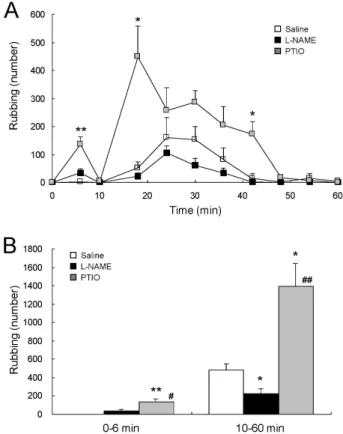
Fig. 1. Opposite effects of central NOS inhibition and NO scavenging on formalin-induced orofacial pain. Formalin-induced characteristic rubbing behaviors were reduced by intracisternal injection of L-NAME, a NOS inhibitor, in the second phase (10∼60 min), while enhanced by that of PTIO, a scavenger of NO, both in the first (0∼6 min) and the second phases (A). A histogram (B), summarizing the first and the second phases of the formalin-induced pain behaviors observed in rats, demonstrates the significant reduction in the second phase by L-NAME (n=4) and the significant enhancement both in the first and the second phases by PTIO (n=5), compared to saline (n=4). Formalin was injected into the right upper lip at time zero, and the number of rubbing behaviors was counted. **p<0.01 and *p<0.05 vs. saline, #p<0.05 and ##p<0.01 vs. L-NAME.
METHODS Animals
Male Sprague-Dawley rats weighing 270∼350 g were used for the experiments. One week before a surgical prepa- ration for catheter insertion, the rats were introduced in a room (23±1oC) and kept with water and food ad libitum in the period of experiments. All experimental procedures using animals were approved by the Institutional Care and Use Committee of School of Dentisty, Kyungpook National University, and were carried out in accordance with the ethical guidelines for the investigation of experimental pain in conscious animals of International Association for the Study of Pain.
Intracisternal implantation of catheter
Under anesthesia induced with a mixture (0.5 ml/kg; i.m.) of ketamine (100 mg/ml) and xylazine (20 mg/ml), rats were mounted on a stereotaxic frame (Model 1404, David Kopf Instruments, USA). Skin incision was done from the poste- rior side of the bregma to the occipital area. A polyethylene catheter (PE-10) was introduced into the intracisternal space, and was fixed with a screw preset in the occipital bone and self-curing resin (Dentsply, USA). The wound was sutured in layers with 4-0 nylon. After surgery, rats were intramuscularly administered with gentamycin (SamU me- dian, Korea), and housed for 5∼7 days.
Drugs
Drugs used were as follows: NG-nitro-L-arginine methyl ester hydrochloride (L-NAME), 2-(4-carboxyphenyl)-4,4,5,5- tetramethylimidazoline-1-oxyl-3-oxide (PTIO), 1H-[1,2,4]oxa- diazolo[4,3-a]quinoxalin-1-one (ODQ), 2-[1-(3-dimethylami- nopropyl)indol-3-yl]-3-(indol-3-yl)maleimide (GF109203X), and were purchased from Tocris Cookson (Ellisville, MO, USA). Drugs were dissolved as a stock in saline or 10%
dimethylsulfoxide (DMSO). Except for PTIO, other drugs are membrane-permeable.
Experimental procedure of orofacial formalin test The animals remained in the testing cage for approximately 15 min to allow behavioral accommodation. Then, the NO synthase inhibitor L-NAME (0.1 mg), the NO scavenger PTIO (30 μg), the guanylyl cyclase inhibitor ODQ (5 μg) or the PKC inhibitor GF109203X (13 μg) were pre-treated through the inserted catheter 10 minutes before formalin injection. Formalin (3%, 50 μl) was subcutaneously injected into right upper lip. Rats subjected immediately exhibited face rubbing, a characteristic behavior of formalin-induced orofacial pain. The number of face rubbing incidents was counted in 2-min blocks for 60 min. Because a quiet period of rubbing behaviors following the formalin injection is prominent at 6∼10 min from the formalin injection, we summed the counts at 0∼6 min for the first phase, and the counts at 10∼60 min for the second phase. The sums of face rubbings were submitted to one-way analysis of var- iance (ANOVA) with subsequent t-tests using a Bonferroni α correction for post-hoc analysis. The statistical signifi- cance between means of the groups at each time point was assessed by unpaired Student’s t-test. The level of statistical significance was set at p<0.05 or p<0.01. Data are repre-
sented as mean±SEM.
RESULTS
To investigate a role of NO playing in the brainstem proc- essing of formalin-induced pain, we administered several membrane-permeable or -impermeable inhibitors, blocking pathways related to NO production and signaling, into intracisternal space 10 min before the subcutaneous formalin injection into the upper lip, and then counted the number of face rubbing behaviors to assess nociceptive behaviors.
The central administration of L-NAME, the membrane- permeable NOS inhibitor, significantly reduced the second phase (10∼60 min) of formalin-induced face rubbing behaviors (Fig. 1). However, this result was not accomplished by the central administration of PTIO, the membrane- im- permeable scavenger of NO. Rather, PTIO significantly en- hanced both the first (0∼6 min) and the second phases of
Fig. 2. Reduction of formalin-induced orofacial pain by central inhibition of NO-sensitive guanylate cyclase. Formalin-induced characteristic rubbing behaviors were reduced in the second phase by intracisternal injection of ODQ, an inhibitor of NO-sensitive guanylate cyclase (A). GF109203X, a PKC inhibitor, used as a positive effect control, also reduced the second phase of formalin- induced orofacial pain behavior. A histogram (B), summarizing the first and the second phases of the formalin-induced pain behaviors observed in rats, demonstrates the tendency of reduction by ODQ (n=5) and the significant reduction by GF109203X (n=3) in the second phase, compared to that of DMSO negative control (n=3).
Formalin was injected into the right upper lip at time zero, and the number of rubbing behaviors was counted. *p<0.05 vs. DMSO,
#p<0.05 vs. ODQ.
the formalin-induced face rubbing behaviors (Fig. 1), com- pared to those in the saline control. This result strongly suggests that NO, diffused out of the NO-producing cells, prevents formalin-induced hyperalgesia.
Further we tested the membrane-permeable compound ODQ, which inhibits NO-GC, on the formalin-induced pain behaviors. In this experiment, GF109203X, the protein kinase C (PKC) inhibitor, was also applied as a positive control because PKC was known as a key mediator in the second phase of formalin-induced pain behaviors (Yashpal et al., 1995). Consequently, both the centrally administered ODQ and GF109203X significantly reduced the formalin-induced pain behaviors only in the second phase, compared to those in the DMSO control (Fig. 2). However, the pain- reducing effect of ODQ was weaker than that of GF109203X (Fig. 2).
This result indicates that NO-GC mediates the hyperalgesic action of NO.
DISCUSSION
In this study, formalin-induced orofacial pain behaviors in rats were significantly reduced by the intracisternal ad- ministration of L-NAME or ODQ, the membrane-permeable inhibitors of NOS or NO-GC, respectively, but enhanced by that of PTIO, the membrane-impermeable NO scavenger.
The results obtained here indicate the differential role of NO in the central processing of orofacial nociceptive in- formation depending on the cellular location of the NO’s downstream target, NO-GC; i.e., the location in the NO-pro- ducing cells per se or in the neighboring cells.
In the trigeminal system that is the anatomical site for the central procession of orofacial pain, NOS, the NO syn- thesizing enzyme, and GC, the downstream target of NO, have not been clearly demonstrated, as shown in the spinal dorsal horn (DH) (Schmidtko et al., 2009). In the spinal DH, histological studies have demonstrated that NOS is expressed in peptidergic primary afferents in dorsal root ganglion (DRG) and predominantly in GABAergic inter- neurons in the spinal DH (Valtschanoff et al., 1992;
Ruscheweyh et al., 2006; Schmidtko et al., 2009), while soluble GC staining is found in numerous neurons in the spinal DH (Ruscheweyh et al., 2006), including neurokinin 1 (NK1)-expressing projection neurons in lamina I (Ding and Weinberg, 2006; Schmidtko et al., 2008) and GABAergic interneurons in laminae II and III (Schmidtko et al., 2008).
Interestingly, NOS did not co-localize with Fos-positive neurons expressed in the spinal DH following noxious hind- paw stimulation (Herdegen et al., 1994). On the other hand, it has been known that NOS is expressed in Fos-positive neurons in the trigeminal system (Yeo et al., 1997; Yeo, 2002), indicating a direct intracellular modulation of orofacial no- ciception by NO in pain transmission neurons per se. In addition, the result, showing that GCs widely express throughout all the laminae of the spinal DH (Ruscheweyh et al., 2006), contemplates a co-expression of NO-GC and NOS in the Fos-positive pain transmission neurons in the trigeminal nucleus, which is in contrast with the spinal DH neurons (Ding and Weinberg, 2006). Therefore, it would be concluded in the trigeminal system that NO activates GC both within the NO-producing, pain transmission neurons and also neighboring pain transmission neurons in a para- crine fashion. The activation of NO-GC in the neighboring neurons by the diffused NO will be blocked by the mem- brane-impermeable NO scavenger PTIO.
The present result, showing the antinociceptive effects of membrane-permeable inhibitors L-NAME and ODQ (intra- cisternal injection), can be supported by other previous studies using formalin test, as well as inflammatory or neu- ropathic pain models (Meller and Gebhart, 1993; Semos and Headley, 1994; Duarte and Ferreira, 2000; Schmidtko et al., 2008). However, the hyperalgesic effect by membrane- impermeable NO scavenger PTIO has not been demon- strated. Based on the anatomical localizations of NOS and GC described in the spinal cord and also the trigeminal nucleus, NO may globally activate GCs existing in the NO-producing cells and also in the neighboring cells in the pain transmission pathways, thereby producing the prono- ciceptive effect. However, NO may activate GCs only within the NO-producing cells in the presence of PTIO, since PTIO is not able to remove NO inside of cells. Therefore, it is likely concluded that the activation of GCs in the neighboring cells by the diffused NO may have opposite effect on the trigeminal nociceptive processing, i.e., antinociceptive action.
On the other hand, in the spinal cord, intrathecal delivery of 8-bromo-cGMP, a cGMP analog, at a low concentration interestingly inhibited nociceptive behaviors in formalin tests, whereas that at a higher concentration increased the behaviors (Tegeder et al., 2002), contemplating that different NO levels by different manipulation tools can produce oppo- site processing of nociception (Sousa and Prado, 2001;
Tegeder et al., 2002). Therefore, our result showing the opposite effects on pain transmission by two ways for the inhibition of NO signal, inhibiting NO production or ex- tracellular NO diffusion, may be attributable to the differ- ent NO levels in the trigeminal system. However, it would also be feasible that pain modulation by NO and GC system in the trigeminal nucleus is diverse due to complex excitatory and inhibitory synaptic circuits.
Since a previous report demonstrated that intrathecal PKC inhibitors significantly reduced hind paw pain behaviors in the second phase of the formalin test (Yashpal et al., 1995), GF109203X, the PKC inhibitor, was used here as a positive control. Consistent with the previous report (Yash- pal et al., 1995), the inhibition of PKC with GF109203X significantly reduced the formalin-induced orofacial noci- ceptive behaviors, or even more effective than that of GC inhibition with ODQ. In addition, other previous reports in the spinal cord, showing that activation of PKC with phorbol esters increased glutamate release in the spinal cord, sensitized spinothalamic tract and other DH neurons, and decreased heat and mechanical withdrawal thresholds (Gerber et al., 1989; Lin et al., 1996; Sluka and Willis, 1997;
Palecek et al., 1999), also support the present study demon- strating the effective blockade of formalin-induced pain by PKC inhibition. On the other hand, it has to be pointed out that PKC can be an important upstream regulator of NOS because NOS is phosphorylated by various kinases, including PKC (Nakane et al., 1991; Bredt et al., 1992;
Dinerman et al., 1994). However, considering the bigger ef- fect of PKC inhibition than those of the GC or NOS in- hibitions, the route of NOS activation by PKC may be parti- ally operated. Rather, another PKC pathway independent of NOS activation would govern the formalin-induced pain in a larger portion.
In conclusion, it is shown here that formalin-induced or- ofacial pain is reduced by the trigeminal inhibitions of NO production or GC activation, whereas blocking NO diffusion enhances the orofacial pain. These data suggest that the NO modulation in the central processing of nociception would be complex due to the cellular locations of NO pro- duction, the route of diffusion and the downstream targets of NO.
ACKNOWLEDGEMENTS
This work was supported by Basic Science Research Program through the National Research Foundation of Korea (NRF) funded by the Ministry of Education, Science and Technology (No. R01-2008-000-20629-0 to D.-H. Y and No. R13-2008-009-01001-0 to D.-K. A). The authors are thankful to J.-S. Ju for technical advice.
REFERENCES
Bredt DS, Ferris CD, Snyder SH. Nitric oxide synthase regulatory sites. Phosphorylation by cyclic AMP-dependent protein kinase,
protein kinase C, and calcium/calmodulin protein kinase;
identification of flavin and calmodulin binding sites. J Biol Chem 267: 10976−10981, 1992.
Clavelou P, Dallel R, Orliaguet T, Woda A, Raboisson P. The orofacial formalin test in rats: effects of different formalin concentrations. Pain 62: 295−301, 1995.
Dinerman JL, Steiner JP, Dawson TM, Dawson V, Snyder SH.
Cyclic nucleotide dependent phosphorylation of neuronal nitric oxide synthase inhibits catalytic activity. Neuropharmacology 33: 1245−1251, 1994.
Ding JD, Weinberg RJ. Localization of soluble guanylyl cyclase in the superficial dorsal horn. J Comp Neurol 495: 668−678, 2006.
Duarte ID, Ferreira SH. L-NAME causes antinociception by stimu- lation of the arginine-NO-cGMP pathway. Mediators Inflamm 9:
25−30, 2000.
Gerber G, Kangrga I, Ryu PD, Larew JS, Randic M. Multiple effects of phorbol esters in the rat spinal dorsal horn. J Neurosci 9:
3606−3617, 1989.
Hama AT, Sagen J. Induction of spinal NADPH-diaphorase by nerve injury is attenuated by adrenal medullary transplants.
Brain Res 640: 345−351, 1994.
Herdegen T, Rudiger S, Mayer B, Bravo R, Zimmermann M.
Expression of nitric oxide synthase and colocalisation with Jun, Fos and Krox transcription factors in spinal cord neurons following noxious stimulation of the rat hindpaw. Brain Res Mol Brain Res 22: 245−258, 1994.
Knowles RG, Palacios M, Palmer RM, Moncada S. Formation of nitric oxide from L-arginine in the central nervous system: a transduction mechanism for stimulation of the soluble guanylate cyclase. Proc Natl Acad Sci U S A 86: 5159−5162, 1989.
Lin Q, Peng YB, Willis WD. Possible role of protein kinase C in the sensitization of primate spinothalamic tract neurons. J Neurosci 16: 3026−3034, 1996.
Meller ST, Gebhart GF. Nitric oxide (NO) and nociceptive processing in the spinal cord. Pain 52: 127−136, 1993.
Nakane M, Mitchell J, Forstermann U, Murad F. Phosphorylation by calcium calmodulin-dependent protein kinase II and protein kinase C modulates the activity of nitric oxide synthase. Biochem Biophys Res Commun 180: 1396−1402, 1991.
Palecek J, Paleckova V, Willis WD. The effect of phorbol esters on spinal cord amino acid concentrations and responsiveness of rats to mechanical and thermal stimuli. Pain 80: 597−605, 1999.
Ruscheweyh R, Goralczyk A, Wunderbaldinger G, Schober A, Sandkuhler J. Possible sources and sites of action of the nitric oxide involved in synaptic plasticity at spinal lamina I projection neurons. Neuroscience 141: 977−988, 2006.
Schmidtko A, Gao W, Konig P, Heine S, Motterlini R, Ruth P, Schlossmann J, Koesling D, Niederberger E, Tegeder I, Friebe A, Geisslinger G. cGMP produced by NO-sensitive guanylyl cyclase essentially contributes to inflammatory and neuropathic pain by using targets different from cGMP-dependent protein kinase I. J Neurosci 28: 8568−8576, 2008.
Schmidtko A, Tegeder I, Geisslinger G. No NO, no pain? The role of nitric oxide and cGMP in spinal pain processing. Trends Neurosci 32: 339−346, 2009.
Semos ML, Headley PM. The role of nitric oxide in spinal nociceptive reflexes in rats with neurogenic and non-neurogenic peripheral inflammation. Neuropharmacology 33: 1487−1497, 1994.
Sluka KA, Willis WD. The effects of G-protein and protein kinase inhibitors on the behavioral responses of rats to intradermal injection of capsaicin. Pain 71: 165−178, 1997.
Sousa AM, Prado WA. The dual effect of a nitric oxide donor in nociception. Brain Res 897: 9−19, 2001.
Tegeder I, Schmidtko A, Niederberger E, Ruth P, Geisslinger G.
Dual effects of spinally delivered 8-bromo-cyclic guanosine mono- phosphate (8-bromo-cGMP) in formalin-induced nociception in rats. Neurosci Lett 332: 146−150, 2002.
Valtschanoff JG, Weinberg RJ, Rustioni A, Schmidt HH. Nitric oxide synthase and GABA colocalize in lamina II of rat spinal cord. Neurosci Lett 148: 6−10, 1992.
Yashpal K, Pitcher GM, Parent A, Quirion R, Coderre TJ. Noxious
thermal and chemical stimulation induce increases in 3H- phorbol 12,13-dibutyrate binding in spinal cord dorsal horn as well as persistent pain and hyperalgesia, which is reduced by inhibition of protein kinase C. J Neurosci 15: 3263−3272, 1995.
Yeo JF. Does nitric oxide play a role in orofacial pain transmission?
Ann N Y Acad Sci 962: 151−160, 2002.
Yeo JF, Tang FR, Leong SK. Ultrastructural study of NADPH-d positive neurons in laminae I and II of the rat caudal spinal trigeminal nucleus. Int J Neurosci 91: 29−43, 1997.