• 검색 결과가 없습니다.

Effects of Storage in Different Commercial Semen Extenders on Sperm Motility, Viability and Membrane Integrity of Korean Native Boar Spermatozoa

N/A
N/A
Protected

Academic year: 2021

Share "Effects of Storage in Different Commercial Semen Extenders on Sperm Motility, Viability and Membrane Integrity of Korean Native Boar Spermatozoa"

Copied!
5
0
0

로드 중.... (전체 텍스트 보기)

전체 글

(1)

http://dx.doi.org/10.12750/JET.2013.28.4.349

Effects of Storage in Different Commercial Semen Extenders on Sperm Motility, Viability and Membrane Integrity of Korean Native Boar Spermatozoa

Soo-Jin Sa

1,†

, In-Cheul Kim

1

, Sun-Ho Choi

1

, Joon-Ki Hong

1

, Du-Wan Kim

1

, Kyu-Ho Cho

1

, Young-Hwa Kim

1

, Ki-Hwa Chung

2

and Jun-Cheol Park

1

1

Swine Science Division, National Institute of Animal Science, RDA, Cheonan 330-801, Korea

2

Gyeongnam National University of Science and Technology, Jinju 660-758, Korea

ABSTRACT

The objective of this study was to compare the effect of semen extenders on the sperm motility, viability, acrosome integrity and functional integrity of plasma membrane (HOST: hypo-osmotic swelling test) during liquid preservation of Korean Native boar semen. In this experiment, semen was diluted in Androhep plus, Beltsville Thawing Solution (BTS), Modena

TM

, Seminark and Vitasem LD. Sperm-rich fractions were collected from three Korean Native boars and sub-samples were diluted (30×10

6

spermatozoa/ml) in different semen extenders. Semen samples were stored at 17 ℃ for 96 hours. On everyday (0, 24, 48, 72, 96 h) after storage, the sperm characteristics relevant for fertility, such as sperm motility, viability, acrosome integrity and HOST positive were evaluated. The motility of spermatozoa stored in different extenders was no significantly different among other extenders (P>0.05). Also, no difference was observed among samples processed with different extenders in the percentage of sperm viability, acrosome integrity and HOST positive. All extenders maintained a high percentage (70%) of sperm motility, viability and acrosome integrity through 96 h of storage. The result of this study show that there was no significant differences among extenders in their capacity to preserve motility, viability and membrane integrity of spermatozoa from normal, fertile Korean Native boars for 96 h of liquid preservation at 17 ℃.

(Key words: semen extender, motility, viability, acrosome integrity, Korean native boar)

This work was supported by Grant No. PJ009481 from Rural Development Administration.

Correspondence : E-mail : [email protected]

INTRODUCTION

Artificial insemination of swine is widely performed around the world today. In Korea, the swine industry use artificial insemination over 90%. When compared with natural mating, artificial insemination is a very useful tool to introduce superior genes into sow herds, with a minimal risk of disease (Maes et al., 2008). In practice, artificial insemination with fresh liquid semen is performed immediately after dilution or keeping for a day at 15 ∼20℃, using a dose of 3 billion spermatozoa with a volume of 80 ∼100 ml.

Among mammalian species, boar spermatozoa are extremely sensitive towards cold shock because of their peculiar plasma membrane composition (White, 1993). A different composition of the phospholipids in the membrane of boar spermatozoa compared to bull spermatozoa, a low cholesterol/phospholipid ratio and an asymmetrical distribution of cholesterol within the membrane render boar spermatozoa very susceptible to cold

temperatures resulting in increased permeability and loss of controlled membrane processes (De Leeuw et al., 1990). Con- sequently, two factors are very important for storage of liquid boar semen: the temperature of collection and storage, and the composition of the storage medium (Johnson et al., 2000). The storage media for liquid boar semen aim to prolong sperm survival, to provide energy to the sperm cells, to buffer the pH of the suspension and to avoid the growth of bacteria (Vyt et al., 2004). Boar semen extenders can be divided into two major groups: those designed for short-term preservation (less than 1

∼3 days) and extenders for long-term semen preservation (over 4 days) (Gadea, 2003). The storage tolerance of spermatozoa depends on many factors such as semen extender, storage time, storage temperature, semen quality and dilution concentration (Haugan et al., 2007; Martin-Hidalgo et al., 2011; Paulenz et al., 2000; Waterhouse et al., 2004). Martin-Hidalgo et al.

(2013) reported that both extender and breed influence motility

characteristics of liquid-stored boar semen. Also, Sonderman

(2)

and Luebbe (2008) reported that boar breeds differed in the sustainability of motility in extended semen stored for 5 days.

There are many boar semen extenders available in Korea.

However, no study has been carried out to compare the efficacy among commercial semen extenders on the sperm characteris- tics during cold storage of Korean Native boar semen. Increa- sing concern on effective breeding program of scarce Korean Native pig raises questions in the field regarding the choice of semen extender. Consequently, the objective of this study was to examine the effect of semen extenders on the sperm motility, viability and membrane integrity during liquid preservation of Korean Native boar semen.

MATERIALS AND METHODS

1. Animals

Three mature Korean Native boars ranging from 1 to 2 years age were selected based on normal semen quality (e.g. initial motility of >80% and >85% morphologically normal sperma- tozoa) and proven fertility after artificial insemination with liquid-preserved semen. Boars were kept under uniform feeding and handling conditions in National Institute of Animal Science, Rural Development Administration, Korea.

2. Reagents and Media

All chemicals used in this study were purchased from Sigma- Aldrich Corporation (St. Louis, Mo, USA) unless otherwise stated. The five commercial semen extenders were Androhep plus (Minitube of America. INC., USA), BTS (Kruuse, Ger- many), Modena

TM

(Swine Genetics International Ltd., USA), Seminark (Noah Biotech., Korea) and Vitasem LD (Magapor S.L., Spain).

3. Semen Processing and Experimental Design

Sperm-rich fractions were collected from three Korean Native boars using the gloved-hand manual collection method. Semen was filtered to remove the gel fraction of the ejaculates. At collection, sperm-rich fraction from a single boar was split into five aliquots, immediately diluted 1:1 with Androhep plus

, BTS, Modena

TM

, Seminark and Vitasem LD pre-warmed at 37 ℃. Single AI doses (3 × 10

9

spermatozoa/100 ml) were then prepared with the same extender formerly used and stored in a semen storage unit at 17 ℃ for 96 h. Assessment of sperm characteristics was performed at 0, 24, 48, 72 and 96 h after

storage.

4. Assessment of Sperm Characteristics

Sperm motility was assessed for %motile characteristics using computer-assisted sperm analysis (CASA; Medical Supply, Korea) on each day post collection. Five µl of semen sample was placed in a pre-warmed (38 ℃) Makler counting chamber (Sefi Medical Instruments, Haifa, Israel).

The viability was measured by SYBR-14/Propidium iodide stain. Ten µl of diluted spermatozoa were mixed with 5 µl of the working solution of SYBR-14 and 10 µl of propidium iodide. After incubation at 37 ℃ for 15 min, a total of 200 sper- matozoa were assessed under fluorescence microscope at mag- nification of × 400. The nuclei of spermatozoa with intact plasma membrane stained green with SYBR-14, while those with damaged membranes stained red with propidium iodide.

Acrosome integrity was evaluated using fluorescein isothio- cyanate-labeled peanut (Arachis hypogaea) agglutinin (FITC- PNA) staining. Ten µl of Ethidiumhomodimer-1 and incubated at 37 ℃ for 15 min. Five µl of the mixture was smeared on a slide glass and fixed with 95% ethanol for 30 sec. Fifty µl Fit C-PNA (dilute Fit C-PNA with PBS 1:10 v/v) was spread over the slide and incubated in a moist chamber at 4 ℃ for 30 min. After incubation, it was rinsed with cold PBS and air dried. The percentage of acrosome-intact spermatozoa was assessed under fluorescent microscope at magnification of × 1,000. At least 200 spermatozoa were counted for each sample.

The functional integrity of the sperm plasma membrane was assessed using a short hypo-osmotic swelling test (HOST) (Cha- napiwat et al., 2009). Spermatozoa were incubated at 38 ℃ for 30 min, with 75 mOsm/kg a hypo-osmotic solution that consist of 0.368% (w/v) Na-citrate and 0.675% (w/v) fructose in di- stilled water. After this incubation, 200 µl of the semen hypo- osmotic solution was fixed in 1,000 µl of a hypo-osmotic solution plus 5% formaldehyde. At least 200 spermatozoa were counted under a phase contrast microscope at magnification of

× 400. The coiled tail (HOST positive) spermatozoa found following incubation were functional intact plasma membrane.

5. Statistics

Data were analyzed by ANOVA using the General Linear

Models procedure of the Statistical Analysis System (SAS Insti-

tute Inc., Cary, NC). When F-test results were significant in

ANOVA, individual data were further tested by Duncan’s mul-

(3)

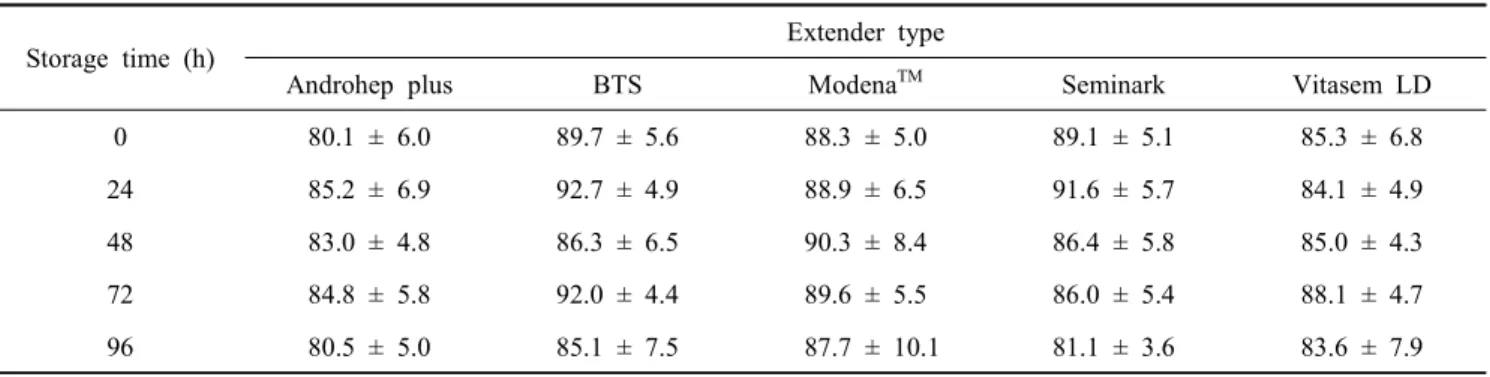
Table 1. Effect of different commercial semen extenders on sperm motility (%) of Korean Native boar semen stored for up to 96 h at 17℃

Storage time (h)

Extender type

Androhep plus BTS Modena

TM

Seminark Vitasem LD

0 80.1 ± 6.0 89.7 ± 5.6 88.3 ± 5.0 89.1 ± 5.1 85.3 ± 6.8

24 85.2 ± 6.9 92.7 ± 4.9 88.9 ± 6.5 91.6 ± 5.7 84.1 ± 4.9

48 83.0 ± 4.8 86.3 ± 6.5 90.3 ± 8.4 86.4 ± 5.8 85.0 ± 4.3

72 84.8 ± 5.8 92.0 ± 4.4 89.6 ± 5.5 86.0 ± 5.4 88.1 ± 4.7

96 80.5 ± 5.0 85.1 ± 7.5 87.7 ± 10.1 81.1 ± 3.6 83.6 ± 7.9

Value are expressed as mean ± SEM.

Table 2. Effect of different commercial semen extenders on sperm viability (%) of Korean Native boar semen stored for up to 96 h at 17℃

Storage time (h)

Extender type

Androhep plus BTS Modena

TM

Seminark Vitasem LD

0 80.0 ± 4.7 79.2 ± 4.6 78.3 ± 4.1 79.6 ± 4.3 79.9 ± 4.8

24 81.1 ± 6.3 83.9 ± 5.2 78.9 ± 7.3 79.6 ± 5.8 82.3 ± 3.6

48 75.4 ± 12.4 72.0 ± 5.5 74.8 ± 7.1 79.5 ± 6.8 78.3 ± 5.2

72 73.9 ± 7.9 76.3 ± 6.6 71.7 ± 5.9 74.8 ± 5.6 75.8 ± 4.1

96 72.9 ± 5.0 73.5 ± 7.4 72.8 ± 5.7 75.8 ± 4.1 74.2 ± 3.5

Value are expressed as mean ± SEM.

tiple-range test. Differences with values of P<0.05 were consi- dered to be statistically significant. Data are presented as mean

± standard error of the mean (SEM).

RESULTS

This study was shown the effects of semen extenders and storage duration on sperm motility, viability, acrosome integrity and HOST during liquid preservation (for 96 h at 17 ℃) of Korean Native boar semen. All extenders maintained a high level (80%) of sperm motility through 96 h of storage. There was no significant difference (P>0.05) in sperm motility among extenders (Table 1). The viability of spermatozoa was gradually decreased by increasing the duration time of storage. However, there was no significant difference in sperm viability among extenders. The percentage of alive sperm was above 70% in all extenders through 96 h of semen storage (Table 2). Also, all extenders can maintain acrosome integrity of more than 70% up to 96 h after collection (Table 3). In case of acrosome

integrity and HOST, there was no significant different with regardless to extenders type or length of storage. The percen- tage of HOST positive varied between 18 and 25% (Table 4).

DISCUSSION

In this study, we compared five different commercial semen extenders with regard to motility, viability, acrosome integrity and HOST of Korean Native boar spermatozoa during semen storage for 96 h at 17 ℃. Generally, spermatozoa are changes in motility, viability and alterations membrane integrity during long term storage in low temperature (17 ℃). These changes can be explained by the fact that sperm have a high content of unsaturated fatty acids in their membranes (Johnson et al., 1969; Park and Lynch, 1992) and they lack a significant cyto- plasmic component containing antioxidants (de Lamirande and Gagnon, 1995).

For evaluating the boar semen quality, sperm motility is an

important parameter because the movement of spermatozoa

(4)

Table 3. Effect of different commercial semen extenders on acrosome integrity (%) of spermatozoa of Korean Native boar semen stored for up to 96 h at 17℃

Storage time (h)

Extender type

Androhep plus BTS Modena

TM

Seminark Vitasem LD

0 79.1 ± 4.1 79.5 ± 3.0 76.5 ± 5.0 77.8 ± 5.5 79.7 ± 5.9

24 78.7 ± 5.9 79.7 ± 8.3 78.0 ± 3.8 78.8 ± 6.5 74.1 ± 3.9

48 80.2 ± 6.4 76.3 ± 9.2 70.5 ± 6.0 74.2 ± 7.9 76.1 ± 5.6

72 79.7 ± 7.7 78.7 ± 6.4 74.8 ± 5.8 74.5 ± 5.7 78.1 ± 4.7

96 75.7 ± 6.8 73.1 ± 7.5 76.2 ± 8.0 73.9 ± 6.9 73.1 ± 7.5

Value are expressed as mean ± SEM.

Table 4. Effect of different commercial semen extenders on HOST (%) of spermatozoa of Korean Native boar semen stored for up to 96 h at 17℃

Storage time (h)

Extender type

Androhep plus BTS Modena

TM

Seminark Vitasem LD

0 23.1 ± 9.5 19.9 ± 6.4 22.4 ± 8.9 20.4 ± 5.1 19.2 ± 10.8

24 21.8 ± 4.6 23.2 ± 6.9 21.3 ± 7.9 22.1 ± 8.7 20.4 ± 6.7

48 25.4 ± 7.8 24.5 ± 9.5 24.7 ± 8.6 18.2 ± 5.8 19.6 ± 7.3

72 24.9 ± 4.3 22.1 ± 6.7 18.6 ± 6.5 19.8 ± 5.4 22.5 ± 9.3

96 21.3 ± 5.8 19.4 ± 5.3 21.1 ± 5.4 23.8 ± 6.7 22.8 ± 8.9

Value are expressed as mean ± SEM.

indicates active metabolism, membrane integrity and fertilizing capacity (Vyt et al., 2004; Estienne et al., 2007). The mini- mum percentage of motile spermatozoa for artificial insemina- tion dose has been established to be at least of 60% because, under this threshold, lower farrowing rates can be experienced (Flowers, 1997). The results of several showed that semen extender influences sperm quality parameters during storage (De Ambrogi et al., 2006; Estienne et al., 2007; Waterhouse et al., 2004). In this study, there was no significant difference in sperm motility among five different commercial semen exten- ders (Androhep plus, BTS, Modena

TM

, Seminark and Vitasem LD). Also, the percentage of motile sperm was above 80% in all extenders for 96 h. Interestingly, even samples extended with short-term extender such as BTS was not different in sperm motility from other extenders. Consistent with our results, Laforest and Allard (1995) reported that the percentage of mo- tile spermatozoa in semen extended in short-term and long- term extenders was not different significantly by extender or day of storage. Waberski et al. (2011) reported that ther were

no significant changes in membrane integrity as assessed by flow cytometry between 1 and 3 days of storage.

On the other hand, the viability of spermatozoa was gra- dually decreased by increasing the duration time of storage.

However, there was no significant difference in sperm viability among extenders. The percentage of alive and acrosome-intact sperm was above 70% in all five semen extenders through 96 h of storage. Also, there were not marked any differences in acrosome integrity and HOST among the extenders, regardless of the storage time. Vyt et al. (2004) reported that there were no major differences in the percentage of dead cells in semen extended with BTS or long-term extenders. Huo et al. (2002) reported that there were no major differences in spermatozoa preserved in BTS or Androhep plus, when boar semen was extended and stored for 120 h post-collection. In the present study, even samples extended with short-term extender such as BTS did not show any change in sperm motility and membrane integrity after 96 h storage.

In conclusion, the present study showed that there was no

(5)

significant difference among extenders in their capacity to pre- serve motility, viability, acrosome integrity and HOST of sper- matozoa from Korean Native boars for 96 h of in vitro storage at 17 ℃. Therefore, it seems that even using a short-term ex- tender can provide good preservation of semen characteristics such as motility and membrane integrity, at least for 96 h of storage. The result of this study shows that even inexpensive extenders were reasonably effective in preserving spermatozoa quality of Korean Native boar, when diluted semen is to be used within 3 to 4 days after collection.

REFERENCES

Chanapiwat P, Kaeoket K and Tummaruk P. 2009. Effects of DHA-enriched hen egg yolk and L-systeine supplementa- tion on quality of cryopreserved boar semen. Asian J. And- rology 11: 600-608.

De Ambrogi M, Ballester J, Saravia F, Caballero I, Johanni- sson A, Walleren M, Andersson M and Rodriguez-Martinez H. 2006. Effect of storage in short- and long-term commer- cial semen extenders on the motility, plasma membrane and chromatin integrity of boar spermatozoa. Int. J. Androl. 29:

543-552.

De Lamirande E and Gagnon C. 1995. Impact of reactive oxy- gen species on spermatozoa: a balancing act between bene- ficial and detrimental effects. Hum. Reprod. Suppl. 10: 15- 21.

De Leeuw F, Colenbrander B and Verkleij A. 1990. The role membrane damage plays in cold shock and freezing injury.

Reprod. Dom. Anim. Suppl. 1: 95-104.

Estienne M, Harper A and Day J. 2007. Characteristics of sperm motility in boars diluted in different extenders and store for seven days at 18 ℃. Reprod. Biol. 7: 221-231.

Flowers WL. 1997. Management of boars for efficient semen production. J. Reprod. Fertil. 52: 67-78.

Gadea J. 2003. Review: Semen extenders used in artificial inse- mination of swine. Spanish J. Agri. Res. 1: 17-27.

Haugan T, Gaustad AH, Reksen O, Grohn YT and Hofmo PO.

2007. Fertility results of artificial inseminations performed with liquid boar semen stored in X-Cell vs BTS extender.

Reprod. Domest. Anim. 42: 94-99.

Huo LJ, Ma XH and Yang ZM. 2002. Assessment of sperm viability, mitochondrial activity, capacitation and acrosome intactness in extened boar semen during long-term storage.

Theriogenology 58: 1349-1360.

Johnson LA, Gerrits RJ and Young EP. 1969. The fatty acid composition of porcine spermatozoa phospholipids. Biol.

Reprod. 1: 330-334.

Johnson LA, Weitze KF, Fiser P and Maxwell WMC. 2000.

Storage of boar semen. Anim. Reprod. Sci. 62: 143-172.

Laforest JP and Allard D. 1995. Comparison of four extenders for long-term storage of fresh boar semen. Reprod. Dom.

Anim. 31: 275-276.

Maes D, Nauwynck H, Rijsselaere T, Mateusen B, Vyt Ph, de Kruif A and Van Soom A. 2008. AI transmitted diseases in swine: an overview. Theriogenology 70: 1337-1345.

Martin-Hidalgo D, Baron FJ, Bragado MJ, Carmona P, Robina A, Garcia-Marin LJ and Gil MC. 2011. The effect of mela- tonin on the quality of extended boar semen after long- term storage at 17 ℃. Theriogenology 75: 1550-1560.

Martin-Hidalgo D, Baron FJ, Robina A, Bragado MJ, Hurtado de Liera A, Garcia-Marin LJ and Gil MC. 2013. Inter- and Intra-breed comparative study of sperm motility and viability in Iberian and Duroc boar semen during long-term storage in MR-A and XCell extenders. Anim. Reprod. Sci. 139:

109-114.

Parks JE and Lynch DV. 1992. Lipid composition and thermo- tropic phase behavior of boar, bull, stallion and rooster sperm membranes. Cryobiology 29: 255-266.

Paulenz H, Kommisrud E and Hofmo P. 2000. Effect of long- term storage at different temperatures on the quality of liquid boar semen. Reprod. Domest. Anim. 35: 83-87.

Sonderman JP and Luebbe JJ. 2008. Semen production and fertility issues related to differences in genetic lines of boars.

Theriogenology 70: 1380-1383.

Vyt PH, Maes D, Dejonckheere E, Castryck F and Van Soom A. 2004. Comparative study on five different commercial extenders for boar semen. Reprod. Dom. Anim. 39: 8-12.

Waberski D, Henning H and Petrunkina AM. 2011. Assess- ment of storage effects in liquid preserved boar semen. Re- prod. Domest. Anim. 46: 45-48.

Waterhouse KE, De Angelis PM, Haugan T, Paulenz H, Hofmo PO and Farstad W. 2004. Effects of in vitro storage time and semen-extender on membrane quality of boar sperm assessed by flow cytometry. Theriogenology 62: 1638-1651.

White IG. 1993. Lipids and calcium uptake of sperm in rela- tion to cold shock and preservation: a review. Reprod. Fertil.

Dev. 5: 539-658.

( 접수: 2013. 11. 02/ 심사: 2013. 11. 03/ 채택: 2013. 11. 18)

수치

Table  1.  Effect  of  different  commercial  semen  extenders  on  sperm  motility  (%)  of  Korean  Native  boar  semen  stored  for  up  to  96  h  at  17℃
Table  3.  Effect  of  different  commercial  semen  extenders  on  acrosome  integrity  (%)  of  spermatozoa  of  Korean  Native  boar  semen  stored  for  up  to  96  h  at  17℃

참조

관련 문서

This study is based on the fact that demand for housing has been under the influence of change of population structure... people live in

Current study explores the effects of entrepreneurial orientation both on financial and innovative performance with 1,497 Korean small and medium-sized

This study aims to explore the effects of parenting beliefs and parenting knowledge on parenting behaviors among marriage-immigrant mothers and native-born mothers and

In order to investigate the effects of process parameters on qualities of the drilled hole quantitatively, laser drilling experiments were carried out using

In this Thesis, an empirical study on the Influence of Consumer's Preferences and Satisfaction on Purchase Intention of Korean Automobile in Vietnamese Consumers

The aim of this study was to compare the effect on bone regeneration relative to maintenance period of PTFE membrane in rabbit calcarial defects.. Eight adult

• Pyrolysis process has been shown to be able to produce high yields of liquid products which can be easily shipped and stored and then utilised in small and medium size

Conclusions : No significant corelation of the patency rate was shown in the study on the effects of local irrigation and systemic application of heparin