• 검색 결과가 없습니다.

Quantitative Analysis for Win/Loss Prediction of 'League of Legends' Utilizing the Deep Neural Network System through Big Data

N/A
N/A
Protected

Academic year: 2021

Share "Quantitative Analysis for Win/Loss Prediction of 'League of Legends' Utilizing the Deep Neural Network System through Big Data"

Copied!
9
0
0

로드 중.... (전체 텍스트 보기)

전체 글

(1)

JKSCI

Quantitative Analysis for Win/Loss Prediction of ‘League of Legends’

Utilizing the Deep Neural Network System through Big Data

1)

Si-Jae No*, Yoo-Jin Moon**, Young-Ho Hwang***

*Student, Dept. of Comp. Engr. & African Languages, Hankuk University of Foreign Studies, Gyeonggi-do, Korea

**Professor, Dept. of Mgmt. Information System, Hankuk University of Foreign Studies, Gyeonggi-do, Korea

***Professor, Division of Public Admin. & Economics, Kunsan National University, Jeonbuk, Korea

[Abstract]

In this paper, we suggest the Deep Neural Network Model System for predicting results of the match of ‘League of Legends (LOL).’ The model utilized approximately 26,000 matches of the LOL game and Keras of Tensorflow. It performed an accuracy of 93.75% without overfitting disadvantage in predicting the ‘2020 League of Legends Worlds Championship’ utilizing the real data in the middle of the game. It employed functions of Sigmoid, Relu and Logcosh, for better performance. The experiments found that the four variables largely affected the accuracy of predicting the match ---

‘Dragon Gap’, ‘Level Gap’, ‘Blue Rift Heralds’, and ‘Tower Kills Gap,’ and ordinary users can also use the model to help develop game strategies by focusing on four elements. Furthermore, the model can be applied to predicting the match of E-sports professional leagues around the world and to the useful training indicators for professional teams, contributing to vitalization of E-sports.

▸Key words: Neural network, AI, League of Legends, Deep learning, Big data

[요 약]

이 논문은 League of Legends (LOL) 게임의 승패를 예측하기 위하여 Deep Neural Network Model 시스템을 제안한다 . 이 모델은 다양한 LOL 빅데이터를 활용하여 TensorFlow 의 Keras에 의하여 설 계하였다 . 연구 방법으로 한국 서버의 챌린저 리그에서 행해진 약 26000 경기 데이터 셋을 분석하 여, 경기 도중 데이터를 수집하여 그 중에서 드래곤 처치 수, 챔피언 레벨, 정령, 타워 처치 수가 게 임 결과에 유의미한 영향을 끼치는 것을 확인하였다 . 이 모델은 Sigmoid, ReLu 와 Logcosh 함수를 사용했을 때 더 높은 정확도를 얻을 수 있었다 . 실제 LOL의 프로 게임 16경기를 예측한 결과 93.75%의 정확도를 도출했다. 게임 평균시간이 34분인 것을 고려하였을 때, 게임 중반 15분 정도에 게임의 승패를 예측할 수 있음이 증명되었다 . 본 논문에서 설계한 이 프로그램은 전 세계 E-sports

프로리그의 활성화 , 승패예측과 프로팀의 유용한 훈련지표로 활용 가능하다고 사료된다.

▸주제어: 신경망, 인공지능, 리그오브레전드, 딥러닝, 빅데이터

∙First Author: Si-Jae No, Corresponding Author: Yoo-Jin Moon

*Si-Jae No ([email protected]), Dept. of Computer Engr. & African Languages, Hankuk University of Foreign Studies **Yoo-Jin Moon ([email protected]), Dept. of Mgmt. Information System, Hankuk University of Foreign Studies ***Young-Ho Hwang ([email protected]), Division of Public Admin. & Economics, Kunsan National University

∙Received: 2021. 03. 03, Revised: 2021. 04. 22, Accepted: 2021. 04. 22.

∙This paper has extended the paper titled “Prediction of League of Legends Using the Deep Neural Network” of the Proceedings of 2021 Winter KSCI.

Copyright ⓒ 2021 The Korea Society of Computer and Information http://www.ksci.re.kr pISSN:1598-849X | eISSN:2383-9945
(2)

I. Introduction

In today’s high-stakes business environment, leading big data companies that differentiate, outperform, and adapt to customer needs faster than competitors rely on data analytics. They see how the purposeful, systematic exploitation of big data, coupled with analytics, reveals opportunities for better business outcomes. For mature organizations, data analytics technologies including artificial intelligence (AI), machine learning (ML) and neural networks etc. are helping solve even more complex business challenges [1, 2, 3, 4].

Big data analytics is often the complex process of examining big data to uncover information --- such as hidden patterns, correlations, market trends and customer preferences--- that can help organizations make informed business decisions [1, 3, 5].

On a broad scale, data analytics technologies and techniques give organizations chances to analyze data sets and gather new information. That is, business intelligence (BI) queries answer basic questions about business operations and performance. On the other hand, big data analytics is a form of advanced analytics, which involves complex applications with elements such as predictive models, statistical algorithms and what-if analysis powered by analytics systems [6, 7, 8].

Deep neural networks (DNN) are a powerful category of machine learning algorithms implemented by stacking layers of neural networks along with the depth and width of smaller architectures. DNN have recently demonstrated discriminative and representative learning capabilities over a wide range of applications in the contemporary years. Researchers in ML are expanding the horizons of deep learning by seeking their prospective applications in other diverse domains. DNN require a large amount of annotated data for training with efficient training algorithms [9, 10].

As mentioned above, artificial intelligence technology is prevalent in almost every field. The

usefulness of predictions using AI has been recognized in various fields such as medicine, education, and sports, and especially its effectiveness in games has been verified.

Representatively, the effectiveness of the game

“League of Legends (LOL)” by its prediction has been greatly revealed. LOL hosts the annual “World Championship” in a league format, and the public showed great interest in the Win/Loss result prediction. As a result, AI is likely to surpass expert predictions in the E-sports field. Moreover, it not only predicts victory or defeat, of the game but also plays as a coach of the professional teams.

The purpose of this paper is to ensure that the match prediction of the LOL can be implemented through Deep Neural Networks using open data provided by Riot Games, not by the team history record but by the personal game processing record.

This paper is organized as follows: Section 2 describes previous research and introduction of League of Legend. Section 3 describes system architecture of this research including data selection, feature selection, data normalization and the suggested deep neural network model. Section 4 provides result analysis of the research model and predictions of information utilization applications. Finally, discussions and contributions are described in Section 5.

II. Previous Studies and Preliminaries

1. Previous Research

Recently, various studies have been underway on game match prediction using artificial networks.

Previous works mainly consist of programs that make real-time match predictions of the games.

Hallym University students conducted “League of Legends Win/Loss prediction using TensorFlow”

[11], where they predicted the match’s Win/Loss by

learning from the entire game data of one user

(SKT T1’s Faker). But our research utilizes the

(3)

results of approximately 26,000 rounds of

‘Challenger’ games for all players, but not just for one player. Therefore, our research can be considered to be a general useful prediction tool in a match, since members of the team can be changed frequently. Furthermore, the prior work developed a system to predict LOL Win/Loss in real-time. However, our work focuses on making more accurate predictions by making LOL Win/Loss predictions after 15 minutes of the game, which is around half of the average playing game time in progress.

In the “2020 League of Legends World Championship”, the Win/Loss predictions of a game using AI hit 100% by the team history record [12], where it used open data provided by Riot Games by the team history record. But our research predicts the game by utilizing the personal game processing record in progress.

The system “SenpaiAI.GG” [12] also showed high results in predictions of the “2020 League of Legends World Championship.” However, our research analyzes the game skills of each team player and the results of professional team games, and utilizes them as data to predict the game’s Win/Loss. It is hard to apply individual games that encounter new users. Thus, our model aims at whoever individual easily putting his/her game data in order to enable Win/Loss predictions.

2. Introduction to ‘League of Legend’

The ‘League of Legends (LOL)’ is a Multiplayer Online Battle Arena (MOBA) game that basically forms a 5-5 team to destroy the enemy’s tower. To lead the team victory, the users must choose a champion that fits their position and control. After the start of the game, users are positioned in the appropriate position and grow to protect their

‘Nexus’, which determines the win or loss of the match, from the enemies’ attack. An important factor in the strategic team play is cooperation and growth of the team members. Each user chooses a champion they will play in the game. Champions get

stronger by earning experience to level up and gold to buy more powerful items as the game progresses. Users get rid of minions that are generated every 30 seconds to gain gold and experience to grow their champions. Therefore, if users kill more minions than the enemy, they will be able to stay ahead of their opponents in growth.

The team that is relatively ahead of growth is advantageous when the battle is triggered. At the battle, users can earn gold and experiences, destroy enemies’ towers until the enemy is revived.

It is also important to install the ward in the appropriate location to prepare for a surprise attack. In addition, the ‘Dragons’, which is created in the middle of the game, can be buffed throughout the team, and sometimes the match can be reversed because of ‘Dragons’. Additionally, if users get rid of a ‘Rift Herald’, they can destroy enemies’ towers with the support of a ‘Rift Herald’.

To summarize, users can destroy enemies’ towers and win by destroying the opponent’s ‘Nexus’, using the above factors through strategic team play.

Overall, the key factor in winning and losing the game is the choice of champions for each position, the control of each player, the cooperation of team members, the growth through opponent minions, the destroy enemy turrets, the installation of wards, and the Dragon and Rift Herald. It was difficult to secure objectivity because the characteristics of the champion vary from season to season, and the control and the teamwork differ greatly in the player’s personal ability. Therefore, our research aims to predict the outcome of the match with data such as ‘Minion Kills’, ‘Champion Kills’, ‘Wards Installation’, ‘Dragon Kills’, and ‘Rift Herald Kills’. In this regard, we hypothesized that the ‘Gold gap’ and ‘Level gap’ with the opponent team in the middle of the game would have the greatest impact on the match’s Win/Loss.

3. Architecture of the Deep Neural Networks

The Deep Neural Networks model in a math and

programming-friendly approach can be realized

using Keras and Python etc. The model focuses on

(4)

an end-to-end approach to develop supervised learning algorithms in regression and classification with practical business-centric use-cases, which is often implemented in Keras provided by TensorFlow [9].

A DNN is an artificial neural network that contains hidden multi-layers; it inherently fuses the process of feature extraction with classification into learning using the fuzzy support vector machine (FSVM) and enables the decision making [13, 14, 15, 16, 17].

III. The Proposed System Architecture

This research utilized approximately 26,000 matches of LOL game to perform feature selection of the neural network structure in order to select input variables. And then it constructed a Deep Neural Network model that predicted the Win/Loss results of LOL by entering the selected feature values processed by normalization of the input data.

Finally, we performed evaluation of the model.

1. Big Data Sources

We processed and used game APIs provided by

‘developer.riotgames’ [18]. For the reliability of the data, we processed the APIs that recorded progress of the game for about 26,000 matches of the ‘2020 Challenger Rank’ up to 10 minutes and 15 minutes from the start of the match. The dependent variable used on the dataset was ‘Blue team’s Win or Loss’. The independent variables used on the dataset were ‘Gold Acquisitions’, ‘Level Sum’,

‘Minions Kills’, ‘Ward Installations’, ‘Enemy champion Kills’, ‘Destruction of the first tower’, and ‘Dragon kills’ through processing of the feature selection.

2. Feature Selection

This research ran in a Python 3.8.5 version of the Google Colaboratory environment and used the Keras and Pandas modules in Tensorflow 2.3.0

version. To predict Win or Lose of the game, we needed the relative value. So, each independent variable was set to the difference by subtracting the Red Team data value from the Blue Team data value.

Rank Variables Weight

1 DragonGap 0.29073733

2 LevelGap 0.25727928

3 TowerKillsGap 0.19852534

4 BlueRiftHeralds 0.17530133

5 KillGap 0.09428952

6 MinionKillsGap 0.02036662

7 GoldGap 0.00089564

8 WardGap -0.00335312

9 BlueFirstTower -0.06866119

Table 1. Result of Evaluation of Variables

And then, the research decided variables that largely affected the accuracy of predicting the match. To measure the weight of each variable for the suggested model, it built a Single-Layered Neural Network with data such as ‘Gold Gap’,

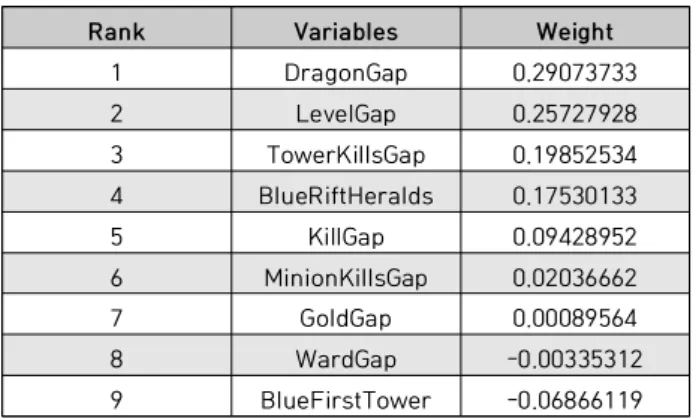
‘Level Gap’, ‘Minion Kills Gap’, ‘Kill Gap’, ‘Ward Gap’, ‘Blue First Tower’, ‘Tower Kills Gap’, ‘Dragon Gap’, and ‘Blue Rift Heralds’ in 15 minutes. For the comparison of the feature selection model, the research also built a Multi-Layered Neural Network and evaluated the result and found the same result as the Single-Layered Neural Network. For the feature selection processing, the learning rate used was 0.01, and the optimizer ‘Adam’, and the loss function ‘Mean Squared Error (MSE)’, and the Evaluation Function ‘Accuracy.’ The result of this feature selection is arranged in the descending order as illustrated in Table 1.

The measurement showed that the weights were

relatively small except for the top four elements

--- ‘Dragon Gap’, ‘Level Gap’, ‘Blue Rift Heralds’,

and ‘Tower Kills Gap.’ Three ‘Dragon Gaps’ can be

generated in 15 minutes. They play a significant

role in our match prediction system as one of the

main factors in the second half of the game. ‘Level

Gap’ works as the role in increasing the gap with

the other team within the game. So, we choose it

(5)

as one of the four factors that play a significant role in predicting the game. 'Blue Rift Heralds' is a factor that is only created once until 15 minutes after the start of the game. It affects the whole game since it widens the gap with the opponent after the mid-game. Considering the game ending when all towers are destroyed, the 'Tower Kills Gap' is a weighted factor in predicting the game's victory or defeat. All these four factors help the team to widen the gap with the other team.

Moreover, they help lead the latter half of the game to an advantage. Thus, using these four inputs to predict wins or losses will enable more accurate predictions in the game.

Thus, these four variables were set as independent variables, and whether Blue Team’s Win or not was set up as the dependent variable.

3. Preprocessing of Data Normalization

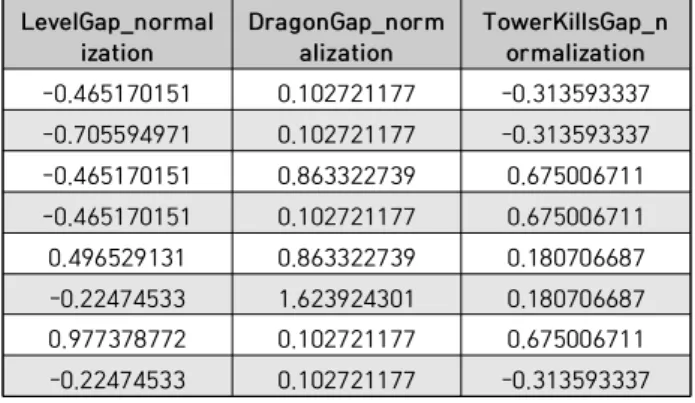
Among the four independent variables, the data normalization process was deemed necessary due to the difference between the maximum and minimum values of ‘Dragon Gap’, ‘Level Gap’, and

‘Tower Kills Gap’. In the case of ‘Blue Rift Heralds’, the minimum value was 0, and the maximum value was 1. So, we decided that it was not necessary to proceed with the normalization process for ‘Blue Rift Heralds.’

LevelGap_normal ization

DragonGap_norm alization

TowerKillsGap_n ormalization

-0.465170151 0.102721177 -0.313593337

-0.705594971 0.102721177 -0.313593337

-0.465170151 0.863322739 0.675006711

-0.465170151 0.102721177 0.675006711

0.496529131 0.863322739 0.180706687

-0.22474533 1.623924301 0.180706687

0.977378772 0.102721177 0.675006711

-0.22474533 0.102721177 -0.313593337

Table 2. Result of Data Normalization

The suggested model used ‘Gaussian Normalization’ as the normalization method [19].

‘Gaussian Normalization’ is a method of

normalizing x’ = (x – means) / standard deviation instead of the input x. Table 2 showed examples of input data with normalization.

4. The Suggested Deep Neural Network Model The research constructed the deep neural network model for prediction of the LOL match, utilizing Keras of TensorFlow [20, 21, 22, 23, 4]. It compared two sets of the game data up to 10 minutes and 15 minutes after the game had started.

The comparison showed that the test accuracy of data up to 10 minutes was about 0.7116, and the 15 minutes was about 0.8005, utilizing the training data. This result suggested that the game data up to 15 minutes were more effective than those of 10 minutes in predicting the match.

4.1 Softmax vs. Sigmoid Function for Accuracy The research experimentally compared Softmax with Sigmoid for the accuracy function setting.

Table 3 showed the result of this comparison.

Experiments showed that the accuracy difference between Softmax (0.5002) and Sigmoid (0.8005) is clear. Thus, the research model is constructed using the Sigmoid function.

Function Accuracy

Sigmoid 0.8005

Softmax 0.5002

Table 3. Result of Comparison between Softmax and Sigmoid Accuracy Function

4.2 Activation Function Comparison

Layer Accuracy

ReLU 0.7969

Softmax 0.7966

Tanh 0.7919

Table 4. Comparison of the Activation Functions

To decide the Hidden-Layer’s activation function,

the research experimentally compared ReLU and

Softmax and Tanh Function. Table 4 showed the

result of this comparison. Experiments showed that

(6)

among the three activation functions, ReLU has the highest accuracy. Thus, the research used ReLU as the activation function of the model.

4.3 Setting the Loss Function

Loss Function Accuracy Loss

MSE 0.795677542686 0.140145093202

Binary

Crossentropy 0.790585041046 0.431628733873 C a t e g o r i c a l

Crossentropy 0.7053782343864 6.005625152E-08 Logcosh 0.7908334136009 0.0657412856817 Table 5. Loss Function Comparison

To establish the Loss Function of the model, the model compared ‘MSE (Mean Square Error)’,

‘Binary Crossentropy’, ‘Categorical Crossentropy’, and ‘Logcosh’. The activation functions were all equally set to Adam, and the learning rate was set to 0.1, with the epoch set to 100. Table 5 showed the result of this comparison. We used ‘Logcosh’, which had the highest accuracy and the lowest loss value, as a loss function in our model.

4.4 Architecture of the Model

This research used a DNN model in Figure 1, consisting of four variables used for learning as input layers, two hidden layers with 64 nodes. It tried to identify how many hidden layers and nodes would make the highest prediction performance by adding 2 hidden layers and 16 nodes to the previous every time, and found that no big difference existed in performance between DNN with 2 hidden layers and 64 nodes and that with the more hidden layers and nodes. Besides, it used the ReLU function as activation functions as hidden layers. Finally, it consisted of one output layer consisting of a Sigmoid function to print Win/Loss prediction results. The optimizer used Adam, the learning rate was set to 0.003 by experiments and the epoch to 1000. The loss function was Logcosh, and the evaluation function was Accuracy.

Fig. 1. Architecture of DNN

The research selected the K-fold method for the process of progressing the learning. The final accuracy value was 0.8005 by the training data, which meant the model had an accuracy of 80%.

IV. Results of the Proposed Deep Learning Model

1. Result Analysis

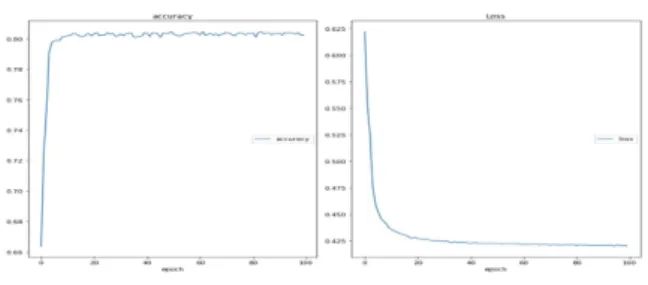
Fig. 2. Accuracy and Loss Graph of the Model

The results of the proposed deep learning neural network showed accuracy between 0.79 and 0.81.

Figure 2 indicated the values of Accuracy and Loss by the processing epochs.

2. Predictions of Information Utilization

Applications

(7)

Team Predictions Actual Results

1 Win Win

2 Loss Loss

3 Loss Loss

4 Win Win

5 Loss Loss

6 Loss Loss

7 Loss Loss

8 Win Win

9 Loss Loss

10 Loss Loss

11 Loss Loss

12 Win Win

13 Loss Win

14 Win Win

15 Loss Loss

16 Win Win

Table 6. Predictions of 2020 League of Legends Worlds Championship

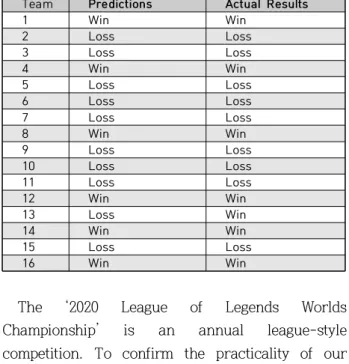
The ‘2020 League of Legends Worlds Championship’ is an annual league-style competition. To confirm the practicality of our program, the suggested model predicted 16 games of the '2020 Worlds Championship'. The model divided the test set into two, creating a validation set that further tests the final model after the first test.

The suggested model used all the data of the Challenger rank games for learning in this model.

And then, it put the 16 match data of the championship into the verification set. The functions, validation, and evaluation methods were the same as the previous model. Table 6 indicated the results of the prediction.

According to result of the execution, the test accuracy was 0.9375, making most of the match predictions successful. It meant the suggested model is useful for predicting Win or Loss of the game.

Moreover, it meant that the suggested deep learning model did overcome the overfitting disadvantage, in that its test accuracy was 0.9375 in the data of ‘2020 League of Legends Worlds Championship’ compared to 0.81 of the proposed model.

V. Conclusions

This research proposed the Deep Neural Network Model that predicted the results of matches of

‘League of Legends’. It utilized various real big data of the LOL game and Keras of Tensorflow. The model indicated an accuracy of 93.75% in predicting the '2020 League of Legends Worlds Championship' without the overfitting disadvantage.

Given that the average playing time of the ‘2020 spring season of League of Legend Champions Korea (LCK spring season)’ is 33 minutes and 37 seconds, this model can predict the game results in the middle of the game.

The research found by experiments that ordinary users can also use the model to help develop game strategies by focusing on four elements (Dragon, Level, Rift Heralds, Tower). It is also expected to utilize the model for predicting match results of similar genre games.

Theoretically, the model suggested in the research implies that it will be able to obtain better results in identification problems (i.e., precision of Win/Loss prediction at a specific timepoint, degree of open data utilization, and possibility of training index utilization of professional teams) of present various game markets if these DNN analyses are applied through big data including time series data. DNN analyses in this research promise improvements in prediction performance as compared to models from traditional machine learning.

Practically, employing suitable DNN is capable of

resolving learning high-level features with more

complexity and abstraction than shallower neural

networks, which provides the probability that these

high-level features comprise a particular object or

scene. This deep feature hierarchy enables suitable

DNNs to achieve superior performance in many

tasks. Thus, DNN analyses in the research can lead

to predict precise Win/Loss results, surpassing the

experts. It implies that the method suggested in the

research may be utilized not only as the effective

training indicators but also as the supplementary

tool of the professional LOL team coach. As well,

existing and socializing the prediction method of

the E-sports utilizing AI & DNNs can make the

public induce to be excited at the E-sports by

(8)

predicting possibility of the Win/Loss results, which contributes to vitalization of E-sports and prosperity & expansion of the base for the E-sports industry.

Moreover, the professional team can determine the most significant factors that affect the victory by measuring the weight changes. The team can practice which factors affect the victory to win the game effectively and quickly. Thus, the method will increase the winning rate of the professional team.

And, this prediction program can be applied to the match prediction method for other E-sports professional leagues and the useful training indicator for professional teams.

Limitation of the research exists in collecting game application real data for the general purpose of the game result prediction. In this research, we used data from champions or users within the top 0.02% points as learning data. Accordingly, the model may not be suitable for predicting the matches of ordinary users who are not good at playing the game.

The future work to do is as follows. First, the research should continue to divide the dataset into beginner users, ordinary users, and top users at the experiments for the general purpose of the game result prediction. With the proper dataset, we can expect to gain results that are more accurate than prior experiments. In this case, all the users of the game can use our model to predict their game personally. Second, the method provided in the research should be applied to the match prediction method for other E-sports professional leagues.

ACKNOWLEDGEMENT

This work was supported by Hankuk University of Foreign Studies Research Fund of 2020.

REFERENCES

[1] Yong Chen, Hong Chen, Anjee Gorkhali, Yang Lu, Liqian Ma, and Ling Li, “Big Data Analytics and Big Data Science: A Survey,” Journal of Management Analytics, Vol. 3, No. 1, pp.

1-42, 2016.

[2] Teradata, “Big Data Analytics - Reveal the Best Opportunities for Big Data Companies,” 2021. https://kr.teradata.com/Solutions/

Big-Data?utm_campaign=2020brand&utm_source=google&utm_

medium=paidsearch&utm_content=TERA1_GS_Brand_APAC-K R-EN_CV_NBKW_BMM&utm_creative=BigData-DataAtTheCent er|BigDataOverview&utm_term=big%20data%20science&gclid=

EAIaIQobChMIwLiR4o6C7wIV2KqWCh0TEw13EAAYASAAEgL GOvD_BwE

[3] Sangho Kim, “A Study on Relationship of BDBA (Big Data Business Analytics) System and Supply Chain Management,”

Journal of Korea Research Association of International Commerce, Vol. 19, No. 2, pp. 89-107, 2019.

[4] Hyejeong Park, Kyoungha Seok, Juyong Shim and Changha Hwang, “Deep Learning from TensorFlow,” Hanbit Academy Press, 2019.

[5] Bruce Lehrman, “Big Data’s Role in the Post-COVID Era,” Data Agility, Vol. 16, Issue 11, Sept. 2020. https://www.pipelinepub.

com.

[6] Katy Warr, “Strengthening Deep Neural Networks: Making AI Less Susceptible to Adversarial Trickery,” O'Reilly Media, 2019.

[7] Wesley Chai, Mark Labbe, and Craig Stedman, “Big Data Analytics,” 2021. https://searchbusinessanalytics.techtarget.com/

definition/big-data-analytics

[8] Jun Wu, Jian Wang, Stephen Nicholas, Elizabeth Maitland, and Qiuyan Fan, “Application of Big Data Technology for COVID-19 Prevention and Control in China: Lessons and Recommendations,”

Journal of Medical Internet Research, Vol. 22, No. 10: e21980, Oct. 2020. DOI: 10.2196/21980.

[9] Jojo Moolayil, “Learn Keras for Deep Neural Networks: A Fast-Track Approach to Modern Deep Learning with Python,”

Apress, 2019.

[10] Jen-Tzung Chien, “Source Separation and Machine Learning,”

Elsevier: Academic Press, 2019.

[11] Hon-Ki kim, Yu-Seop Kim. “League of Legends Win/Loss Prediction Using TensorFlow,” Hallym University, 2017.

[12] Senpai.gg. https://senpai.gg

[13] Honqmei Li, Jinying Huang, and Shuwei Ji, “Bearing Fault Diagnosis with a Feature Fusion Method Based on An Ensemble Convolutional Neural Network and Deep Neural Network,”

Sensors (Basel, Switzerland), Vol. 19, Issue 9, pp. 2034, 2019.

[14] N. Yuvaraj, R. Arshath Raja, N.V. Kousik, Prashant Johri, and

Mario José Diván, “Chapter15 - Analysis on the Prediction of

Central Line-Associated Bloodstream Infections (CLABSI) Using

(9)

Deep Neural Network Classification,” Computational Intelligence and Its Applications in Healthcare, Academic Press, pp. 229-244, 2020. https://doi.org/10.1016/B978-0-12-820604-1.00016-9 [15] Gilbert Lim, Wynne Hsu, Mong Li Lee, Daniel Shu Wei Ting,

and Tien Yin Wong, “Chapter 21 - Technical and Clinical Challenges of A.I. in Retinal Image Analysis,” Computational Retinal Image Analysis::Tools, Applications and Perspectives, Academic Press, pp. 445-466, 2019. https://doi.org/10.1016/B9 78-0-08-102816-2.00022-8

[16] Xiangrui Xu, Yaqin Li, and Cao Yuan, “Identity Bracelets for Deep Neural Networks,” IEEE Access, Vol. 8, pp.

102065-102074, 2020. DOI: 10.1109/ACCESS.2020.2998784 [17] Wonil Lee, Byungjai Kim, and HyunWook Park, “Quantification

of Intravoxel Incoherent Motion with Optimized B‐values Using Deep Neural Network,” Magnetic Resonance in Medicine, Feb.

2021. DOI: 10.1002/mrm.28708

[18] 2020 Challenger Rank, https://developer.riotgames

[19] Junmo Cho, “Big Data Analytics and Artificial Intelligence Starting with Python,” Infinity Books, 2020.

[20] Michael Negenevitsky, “Artificial Intelligence,” Addison-Wesley, 2011.

[21] Russell, Stuart, “Artificial Intelligence: A Modern Approach,”

Pearson Education, 2017.

[22] Ian Goodfellow, Yoshua Bengio and Aaron Courville, “Deep Learning,” MIT Express, 2016.

[23] Ingook Cheon, “Artificial Intelligence: Machine Learning and Deep Learning by Python,” Infinity Books, 2020.

Authors

Si-Jae No is a student of Hankuk University of Foreign Studies. He is studying Computer Engineering and African Languages&Cultures.

His interested research area is big data, neural network and integrated software systems.

Yoo-Jin Moon is a professor of Hankuk University of Foreign Studies. She received her PhD from Seoul National University. Her interested area is artificial intelligence, natural language processing and database system.

Young-Ho Hwang is a professor of Kunsan National University. He received his Master

& PhD from Seoul National University. His

interested area is neural network, big data

and information policy analysis etc.

수치

Table  1.  Result  of  Evaluation  of  Variables
Table  3  showed  the  result  of  this  comparison.
Figure 2 indicated the values of Accuracy and Loss  by  the  processing  epochs.
Table  6.  Predictions  of  2020  League  of  Legends  Worlds  Championship

참조

관련 문서

1 John Owen, Justification by Faith Alone, in The Works of John Owen, ed. John Bolt, trans. Scott Clark, "Do This and Live: Christ's Active Obedience as the

It is believed that people will reconsider our study -the possibility of connection between zinc and for hair loss treatment methods- and especially people would be

The data collected in the research were processed using the SPSS WIN software program, whether significant difference of Internet addiction exists or

The study derived the problems according to results of field-centered synthetic analysis on yellow croakers of fishery system currently used in Chujado, Korea

Therefore, it is hoped that appropriate education will be provided to college students majoring in design through the opening of the universal design

After listening to the opinions of firemen in field activities, we confirmed that the firepower can be secured by reducing the loss of firepower caused

Secondly, in the results of the analysis as to the influence of the Taekowndo leader's leadership on the stress of a Taekowndo player, it appeared that in

24-26 indicate the graphs showing the prediction results of the hydrogen concentration in the containment according to the elapsed time after the reactor