• 검색 결과가 없습니다.

Modified Yagi dipole Antenna for WLAN Dual-band Operation

N/A
N/A
Protected

Academic year: 2021

Share "Modified Yagi dipole Antenna for WLAN Dual-band Operation"

Copied!
6
0
0

로드 중.... (전체 텍스트 보기)

전체 글

(1)

WLAN 이중 대역 동작을 위한 수정된 야기 다이폴 안테나

박성일*ㆍ정진우**

Modified Yagi dipole Antenna for WLAN Dual-band Operation

Sung-Il Park

*

ㆍJin-Woo Jung

**

요 약

WLAN 이중 대역 동작을 위한 수정된 야기 다이폴 안테나를 제안하였다. 제안된 안테나는 오픈 슬리브 다 이폴안테나와 기생소자들로 구성되었다. 각 WLAN 동작 대역에서 오픈 슬리브의 영향, 방사 특성, 그리고 기 생소자의 영향에 관하여 분석하였다. 측정 결과 제안된 안테나의 임피던스 대역폭은 320 MHz (2.4- 2.72 GHz)와 640 MHz (5.04 - 5.68 GHz)이고 각 WLAN 대역에서의 최대 이득은 7.74 dBi와 6.93 dBi이다.

ABSTRACT

For WLAN dual-band operation, a modified Yagi dipole antenna is presented. The modified dipole antenna consists of a dipole antenna with open sleeves and parasitic elements. The parasitic elements are used for the practical application of the radiation patterns and high-gain operation at the WLAN dual band. The experimental results showed that the achieved impedance bandwidths were 320 MHz (2.4 to 2.72 GHz) and 640 MHz (5.04 to 5.68 GHz), respectively. The measured maximum gain at the two WLAN bands was 7.74 dBi and 6.93 dBi, respectively.

키워드

Yagi Antenna, Parasitic element, Dual band, WLAN 야기 안테나, 기생 소자, 이중 대역, WLAN

* 동신대학교 정보통신공학과 ([email protected])

** 교신저자 : 전남대학교 전자컴퓨터공학과 ㆍ접 수 일 : 2018. 04. 20

ㆍ수정완료일 : 2018. 05. 18 ㆍ게재확정일 : 2018. 06. 15

ㆍReceived : Apr. 20, 2018, Revised : May. 18, 2018, Accepted : Jun. 15, 2018 ㆍCorresponding Author : Jin-Woo Jung

Dept. of Electronics and Computer Engineering, Chonnam National University, Email : [email protected]

Ⅰ. Introduction

In recent years, there have been rapid developments in wireless local area network (WLAN) applications. To satisfy the 2.4 GHz band of IEEE 802.11b and the 5.2 GHz band of 802.11a WLAN standards, dual-band operation in the 2.4 GHz (24 to 2485 MHz) and 5.2 GHz (5150 to 5350 MHz) bands is demanded in practical WLAN

applications[1]. To comply with this, high performance multi-band antennas with excellent radiation characteristics are required[2]. In addition, for various applications of WLAN systems, high-gain operation of antennas is necessary.

For high-gain operation of dipole antennas, the

typical method uses Yagi geometry[3-5]. However,

in the case of the conventional Yagi dipole antenna,

by the electrical distance between a driver and

http://dx.doi.org/10.13067/JKIECS.2018.13.3.533

(2)

(a) Geometry of proposed antenna

(b) Photograph of proposed antenna Fig. 1. Geometry and photograph of proposed

antenna

director/reflector and the electrical length of a director/reflector, the radiation patterns at higher resonance frequencies are unsuitable for practical application and high-gain operation.

In this letter, a dipole antenna with open sleeves is used for the WLAN dual band. For practical application of the radiation patterns and high-gain operation at the WLAN dual band, a modified Yagi dipole antenna is proposed. The proposed Yagi dipole antenna is modified by parasitic elements.

When compared with the conventional Yagi dipole antenna, the radiation patterns at the higher WLAN band are improved by parasitic elements. Details of

the antenna design and experimental results are presented and discussed.

Ⅱ. Antenna Design and Results Figure 1 shows the geometry and a photograph of the proposed antenna. The antenna consists of five elements. Element 3, which consists of the dipole and open sleeves, is the driver. Element 1 is the reflector for the lower operating WLAN band.

Elements 2 and 4 are the reflector and the director for the higher operating WLAN band, respectively.

Element 5, which consist of a liner line and four folded branch lines, is the director for the lower and higher operating WLAN bands. The geometry values of the proposed antenna are shown in Figure 1. The width of each element is 1 mm. The antenna is fed by a coaxial cable. Thus, between each arm of the driver, there is a gap of 1.5 mm.

Each element is printed on an FR4 substrate with a relative permittivity of 4.2 and a thickness of 1.6 mm. The length and width of the FR4 substrate expanded 0.5 mm, respectively, compared with the length and width of each element. To fix the geometry, an FR4 substrate with a width of 1 mm is situated between each element.

For WLAN dual-band operation of the antenna, the radiator is designed as shown in element 3 of Figure 1. The radiator consists of a linear dipole antenna and open sleeves. When the resonance frequency of the linear dipole antenna is f

0

, the resonance frequency of the higher operating band is 3f

0

. For WLAN dual-band (2.45 GHz/5.2 GHz) operation, the higher resonance frequency should be decreased; therefore, open sleeves are used. The electrical length is decreased by the coupling effect between the linear dipole antenna and open sleeves.

The decrease in the resonance frequency is

influenced by the electrical length of the open

sleeve. For the given dimensions, the open sleeve

(3)

electrical length is too short compared with the wavelength of the lower resonance frequency and is approximately half the wavelength of the higher resonance frequency. Therefore, the higher resonance frequency is more decreased by the coupling effect than the lower resonance frequency.

As a result, the radiator operates for the WLAN dual band. In addition, the practical application of the radiation pattern at the higher resonance frequency is achieved by open sleeves. The linear dipole at the higher resonance frequency is considered as an array of three half-wavelength dipole antennas with opposite phases and spacing of half a wavelength. The normalized array factor for a linear array of three isotropic elements with spacing of half a wavelength and opposite phases has four pattern nulls with 0 < theta < 2π.

Therefore, by pattern multiplication, the total radiation patterns at the higher resonance frequency become unsuitable for practical application.

The phase of the current on the open sleeve is opposite to that of the radiating element. When considering the coupling effect between the radiating element and open sleeves, the electrical length of the open sleeve is approximately half a wavelength compared with the wavelength at the higher operating frequency. Based on the higher operating frequency, the current for radiation is canceled by the open sleeve. Therefore, the dipole antenna with open sleeves is considered as an array of two half-wavelength dipole antennas with the same phase. As a result, unnecessary pattern nulls are eliminated, and by pattern multiplication, the total radiation patterns at the higher resonance frequency become suitable for practical application.

The elements 1, 2, 4, and 5 can be considered parasitic elements. When a parasitic element is capacitive (shorter than 0.5 λ), it operates as a director. On the other hand, when a parasitic element is inductive (longer than 0.5 λ), it operates as a reflector. For high-gain operation using Yagi

geometry, the ideal electrical distance between driver and reflector/director is 0.25 λ.

For the given dimensions, the electrical length of element 1 is longer than 0.5 λ

L

and 0.5 λ

H

L

: wavelength at the lower resonance frequency, λ

H

: wavelength at the higher resonance frequency).

Therefore, element 1 operates as a reflector at both resonance frequencies.

The distance of 31 mm between the driver and element 1 is approximately 0.25 λ

L

. However, at the higher resonance frequency, the electrical distance between the driver and element 1 is more than 0.25 λ

H

. Therefore, the visible region[6] is expanded by this electrical distance. As a result, the radiation pattern at the higher resonance frequency is inappropriate for practical application.

For practical application of the radiation pattern at the higher resonance frequency, we used element 2. The electrical length of element 2 is capacitive at the lower resonance frequency and is inductive at higher resonance frequency.

Element 2 operates as a director at lower resonance frequency. Thus, the directivity at the lower resonance frequency is increased in the x direction. However, the x directional wave at the lower resonance frequency is reflected by element 1. Therefore, at the lower resonance frequency, the effect of element 2 can be ignored. Element 2 operates as a reflector at the higher resonance frequency, and the electrical distance between the driver and element 2 is approximately 0.25 λ

H

. At the higher resonance frequency, the wave is reflected by element 2; therefore, the effect of element 1 can be ignored. As a result, elements 1 and 2 can be considered the reflector for dual band.

When considering the electrical length and the

distance between the driver and element 4, element

4 is the director for the higher resonance

frequency. Also, based at the lower resonance

frequency, element 4 is capacitive. Thus, element 4

can be considered a director at the lower resonance

(4)

Fig. 2. Radiation patterns for the conventional and proposed Yagi geometry

frequency. However, the electrical length is too short compared with the wavelength of the lower resonance frequency. Therefore, the radiation patterns at the lower resonance frequency are not greatly influenced by element 4.

Element 5 operates as a director for both resonance frequencies. For the parasitic element to operate as a director, it should be capacitive based on each resonance frequency.

The electrical length of element 5 without the folded branch lines is capacitive for the lower resonance frequency and is inductive for the higher resonance frequency.

When the resonance frequency of element 5 without folded branch lines is f

05

, the harmonic resonance frequency is 3f

05

. When the harmonic resonance frequency of element 5 is decreased under the higher WLAN resonance frequency, then element 5 is capacitive for the higher resonance

frequency. To decrease the harmonic resonance frequency of element 5, we used the folded branch lines. When the branch lines are situated at a suitable position, which is 0.5 λ

H

from open point, the harmonic resonance frequency is decreased[7].

Therefore, by four folded branch lines, element 5 can be capacitive for the higher resonance frequency. As a result, element 5 operates as a director at both resonance frequencies.

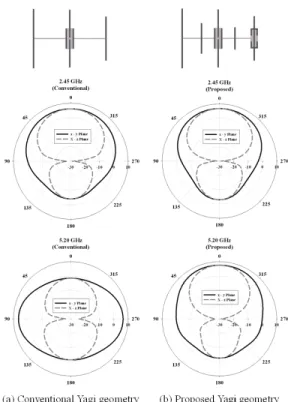
The effect of the parasitic elements in the proposed antenna can be confirmed by comparison with conventional Yagi geometry. Figure 2 shows the radiation patterns for the conventional and proposed Yagi geometry. The conventional Yagi geometry is the proposed antenna without element 2, element 4, and the folded branch lines.

At the lower resonance frequency (2.45 GHz), element 2 is a director. However, the wave, which has directivity in the x direction, is reflected by element 1, and elements 4 and 5 are directors.

Therefore, the radiation patterns are similar to those of conventional Yagi geometry.

At the higher resonance frequency (5.2 GHz), in the case of the conventional Yagi geometry, element 1 operates as a reflector. However, the electrical distance between the driver and element 1 leads to a problem of the radiation pattern, and element 5 without folded branch lines operates as a reflector. Therefore, the radiation patterns are inappropriate for practical application in high-gain operation. In the case of the proposed Yagi geometry, element 2 operates as a reflector. Thus, the effect of element 1 is ignored, and elements 4 and 5 operate as directors. Therefore, the radiation patterns are improved by the proposed Yagi geometry.

As a result, the radiation patterns are suitable for practical application in high-gain operation as shown in Figure 2.

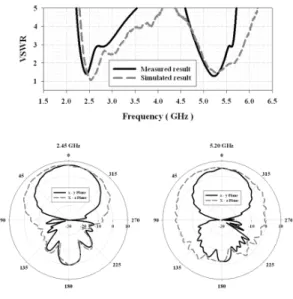
Figure 3 shows the simulated and measured

VSWR for the given dimensions. The simulated

impedance bandwidths (defined by 2:1 VSWR) were

(5)

Fig. 3. Measurement results

200 MHz (2.34 to 2.54 GHz) and 420 MHz (5.01 to 5.43 GHz), respectively. The measured impedance bandwidths were 320 MHz (2.4 to 2.72 GHz) and 640 MHz (5.04 to 5.68 GHz), respectively. In addition, the radiation characteristics of the proposed antenna were measured at 2.45 GHz and 5.2 GHz as shown in Figure 3. The lower WLAN band (2.4 to 2.485 GHz) has a measured maximum gain of 7.74 dBi, and that of the higher WLAN band (5.15~5.35 GHz) is 6.93 dBi. Good agreement between the measured and simulated result was observed. In addition, because element 5 operates as a director at both resonance frequencies, by increasing number of element 5, the directivity of the proposed antenna can be further increased. When element 5 is situated two more (with distance of 31 mm), the measured maximum gain at the two WLAN bands were 8.3 dBi and 7.48 dBi, respectively.

Ⅲ. Conclusions

For the practical application of radiation patterns and high-gain operation at the WLAN dual band, a modified Yagi dipole antenna was proposed and

investigated. For WLAN dual-band operation, a dipole antenna with open sleeves is used. In comparison with the conventional Yagi dipole antenna, the proposed antenna is modified by parasitic elements, which are linear lines and a linear line with folded branch lines. For practical application and high-gain operation at the WLAN dual band of a dipole antenna, the effect of parasitic elements was analyzed in terms of radiation characteristics. With parasitic elements, the proposed antenna is suitable for practical application and high-gain operation at the WLAN dual band. The obtained impedance bandwidths (defined by 2:1 VSWR) were 320 MHz (2.4 to 2.72 GHz) and 640 MHz (5.04 to 5.68 GHz), respectively.

The measured maximum gain was 7.74 dBi, and 6.93 dBi, respectively, at each WLAN band.

References

[1] H. Chen, J. Chen, P. Cheng, and Y. Lim,

“Feed for dual-band printed dipole antenna,”

Electronics Letters, vol. 40, no. 21, 2004, pp.

1320-1322.

[2] R. Raj, M. Joseph, C. Aanandan, K.

Vasudevan, and P. Mohanan, “A new compact microstrip-fed dual-band coplanar antenna for WLAN applications,” IEEE transactions on antennas and propagation, vol.

54, no. 12, 2006, pp.3755-3762.

[3] W. Deal, N. Kaneda, J. Sor, Y. Qian, and T.

Itoh, “A new quasi-Yagi antenna for planar active antenna arrays,” IEEE Transactions on Microwave Theory and Techniques, vol. 48, no.

6, 2000, pp. 910-918.

[4] John P. Gianvittorio and Yahya Rahmat-Samii,

“Fractal Yagi antennas: Design, Simulation, and Fabrication,” Microwave and Optical Technology Letters, vol. 41, no. 5, 2004, pp.375-380.

[5] X. Yang, B. Wang, S. Xiao, and K. Man,

(6)

“Frequency and pattern reconfigurable Yagi patch antenna,” Microwave and Optical Technology Letters, vol. 50, no. 3, 2007, pp.716-719.

[6] Constantine, A. Balanis, Antenna Theory Analysis and Design, New York: Wiley, 1997.

[7] J. Jung, H. Lee, and Y. Lim, “Compact monopole antenna for dual ISM bands (2.4 and 5.8 GHz) operation,” Microwave and Optical Technology Letters, vol. 51, no. 9, 2009, pp.2227-2229.

[8] C. You, B. Song, and I. Hwang, "Research Regarding Filter Composition and Motor control for Yagi-Antenna Remote Tracking System," J. of the Korea Institute of Electronic Communication Sciences, vol. 11, no. 11, 2016, pp.1039-1046.

[9] J. Yoon, "A Design and Implementation of Dual-band Monopole Antenna with two arc-shaped line for WLAN application," J. of the Korea Institute of Electronic Communication Sciences, vol. 12, no. 6, 2017, pp.1049-1056.

[10] O. Kim, "Design of Dual-band Microstrip Antenna for wireless Communication Applications," The Korea Institute of Electronic Communication Sciences, vol. 7, no.6, 2012, pp.1275-1279.

저자 소개

박성일(Sung-Il Park) 2002년 동신대학교 정보통신공학과 (공학사)

2004년 동신대학교 대학원 정보통 신공학과 졸업(공학석사)

2010년 전남대학교 대학원 전자정보통신공학과 졸업 (공학박사)

2014년 ~ 현재 동신대학교 정보통신공학과 조교수

※ 관심분야 : 전자회로설계, RF 부품설계, 이동통신 안테나 설계

정진우(Jin-Woo Jung) 2005년 전남대학교 정보통신공학과 졸업(공학사)

2007년 전남대학교 대학원 전자정 보통신공학과 졸업(공학석사) 2011년 전남대학교 대학원 전자컴퓨터공학과 졸업 (공학박사)

2012년 ~ 2017년 국방과학연구소 선임연구원 2017년 ~ 2018년 1월 국립전파연구원 공업연구사

※ 관심분야 : 안테나, 위상배열안테나, 적응형 빔

형성 알고리즘

수치

Fig.  2.  Radiation  patterns  for  the  conventional  and  proposed  Yagi  geometry
Fig.  3.  Measurement  results

참조

관련 문서

 Magnesium and other metals in of the periodic table have two elections in their outermost s band.  Highly conductive due to the overlapping of p band and s band at

1 John Owen, Justification by Faith Alone, in The Works of John Owen, ed. John Bolt, trans. Scott Clark, &#34;Do This and Live: Christ's Active Obedience as the

- Example) Suppose that a new product or facility is proposed and that the criterion for success is a 10 percent rate of return on the investment for a 5-year life of the

• At the higher operational frequencies encountered in practical applications, the circuit must be modified to take into account capacitive coupling between the device

This research is to conduct comparative analysis on the rain intensity of expected rainfall depth of the research-use X-band dual-polarimetric radar with that of actually

Purpose: To evaluate the radiographic and clinical results of patellar comminuted fractures using modified tension band wiring. Materials and Methods: Thirty

4.3 Simulation results of the proposed dual output converter for increasing of voltage command during operation (a) Boost Voltage (b) Buck Voltage (c)

Induced dipole – induced dipole (dispersion force) Instantaneous dipole-induced dipole (London force) Instantaneous dipole induced dipole (London force).. • 1 eV : energy