Printed in the Republic of Korea
http://dx.doi.Org/10.5012/jkcs.2015.59.4.308
Impact of Teachers’ Overcoming Experience of Threshold Concepts in Chemistry on Pedagogical Content Knowledge (PCK) Development
Eun Jung Park
Sookmyung Women's University, Seoul 140-742, Korea.虹E-mail: [email protected] (Received October 17, 2
이
4; Accepted June 5, 2015)ABSTRACT. As a follow-up study to identify references for threshold concepts in science, 20 high school chemistry teachers were interviewed. Seven concepts were identified as threshold concepts. The data revealed that teachers overcome the thresholds while they are teaching as well as learning during their school years. This explains that the mastery experience of threshold concepts involve not only the process of creating subject matter knowledge of a learner but also the reflection on or preparation for teaching. Hence, the current study proposes that a strong relationship exists between the mastery experience of threshold concepts and the development of teachers’ pedagogical content knowledge (PCK). In this regard, findings from this study will provide valuable information to understand the nature of threshold concepts and suggests the value of mastery experience of threshold concepts in terms of PCK development.
Key words: Threshold concepts, Pedagogical content knowledge, Integrative feature
INTRODUCTION
Despite remarkable advances in science and technol
ogy, many students have confided that they find scientific concepts difficult, and often think of science as an alien language in which they cannot communicate meaning
fully. This led the author of the current study to search for potential threshold concepts in the field of science. Accord
ing to Meyer and Land,1 a threshold concept is a portal or gateway that can be reached through “a transformed way of understanding, or interpreting, or viewing something, without which the learner cannot progress.” Threshold concepts may be similar to core concepts in each subject area, but they can be more complex due to the nature of transformative, integrated, bounded, irreversible, and trouble
some aspects of the concept. In other words, understanding a threshold concept, or overcoming the threshold barrier, requires a learner to have a holistic understanding of the concept and related theories (characterized as “transforma
tive^ and “integrated”)as unforgettable knowledge (char
acterized as “irreversible”). Moreover, since threshold concepts are troublesome concepts, they challenge the learner.
Based upon the phenomenographic perspective of defining
“a way of thinking,” Davies2mentions difficulties in pin
ning down thoughts and the features differentiating them.
With respect to the difficulty of research, Davies3 suggests two different approaches, revealing variations in the learning experiences associated with threshold concepts. First, profes
sionals with expertise and learning experience in the field
can develop the list of threshold concepts through common agreement.4 Alternatively, student responses describing conceptual understanding and learning can be scrutinized by researchers to identify candidate threshold experiences.5
-
7 In general, threshold concepts in a specific field provide clues to understand student learning, and can be good references for instructional practice.
In order to build a reference list of threshold concepts in science, high school chemistry teachers and students were studied. For the purposes of this report, only data from teachers will be discussed. Chemistry teachers suggested several potential threshold concepts in high school chem
istry, as well as how they perceive that these concepts affect teaching and learning chemistry. Based on the teachers’
responses, we explored mastery experiences around these threshold concepts, as well as their influence on teaching.
Data show that teachers overcome the thresholds while they are teaching as well as learning during their own schooling.
This is the uniqueness of teachers’ overcoming experience of threshold concepts. Hence, we consider teachers1 mastery experiences with regards to threshold concepts as not only part of the process of building subject matter knowledge (SMK) in learners, but also as important for inducing reflection on or preparation for teaching.8This calls to mind
“the synthetic or synergistic impact of knowledge-in or knowledge-on action” on pedagogical content knowledge (PCK).9,10 Accordingly, the current study investigates the strong relationship between mastery (or awareness) expe
riences of threshold concepts and the development of
-308-
teachers’ PCK. By examining teachers who were begin
ning to build their content expertise,11 Shulman and col
leagues searched for a way to explain knowledge required for the teaching occupation. To do this, they paid special attention to teachers’ transitions from expert students to novice teachers as they gained content knowledge. Their probe initially identified three types of teachers’ knowledge:
content knowledge (SMK), PCK, and curricular knowledge (contextual knowledge). Among them, Shulman12 consid
ered PCK a representative knowledge, characterizing the teacher as a professional. Shulman further explained that PCK is developed from the interaction of particular kinds of content knowledge and pedagogical strategies. In later studies, types of teachers’ knowledge and sub-categories of PCK were further studied and classified in a variety of ways.10,13,14 For example, in the introduction of “Exam
ining pedagogical content knowledge,” Gess-Newsome15 defined PCK as an integrated mixture or transformed compound of three constructs: subject-matter knowledge, pedagogical knowledge, and contextual knowledge. How
ever, Grossman16 classified knowledge into the four different domains of SMK, general pedagogical knowledge, knowl
edge on the context, and PCK. Although the classification of related knowledge types differed according to researchers’
perspectives on prerequisites, domains, or sub-compo
nents, many studies have opted for the following defini
tion of the crucial elements ofPCK: (1) knowledge of student understanding, (2) knowledge of subject matter, (3) knowl
edge of instructional strategies, and (4) knowledge of cur
riculum.17
-
21 Starting from an inquiry tracing teachers’knowledge and the transition process in teaching, studies revealed the value of PCK as a useful tool in the design of teacher education programs and as a measure of teacher evaluation.22
-
26As mentioned previously, several studies including the current study27,28have reported that teachers more often have mastery experience while working as teachers than during their own schooling. This made us recall Shulman’s earlier inquiry on the transition from expert students to novice teachers. Related to this, the importance of “learning through experience” was clarified at the beginning of the book (chapter one) “Understanding and developing science teachers’ pedagogical content knowledge.” Studies on PCK have often compared the SMK of experts and teachers, in order to analyze the characteristics of PCK. In the process, several studies highlighted the value of SMK for PCK.14,29
-
31 Conversely, Johnson and Ahtee32 doubted the consequential relationship between the two. They instead argued about the quality, not the quantity of teachers’ SMK. Likewise,considerable differences between PCK and related SMK were explored in Onno De Jong etal.'s study.33However, there were no specific details about the quality and difference of the two, which indicates that despite frequently raised questions, there are not many studies investigating direct relationships between the two. In this respect, the current study investigates how PCK and SMK are related. Teachers’
experiences of overcoming thresholds in learning and teaching are expected to be clues that provide further clarity about the quality of SMK and PCK, and how they are different from each other. To that end, we first investigated the com
mon ground of PCK and threshold concepts (TC); the impacts of experiences of overcoming threshold concepts (TCs) on teaching were then examined in detail. Through interviews with high school chemistry teachers, this study identified threshold concepts in chemistry, and their educational implica
tions, especially their usefulness and applicability for designing curriculum and instruction. From our analysis, the importance of teachers’ experiences of overcoming threshold con
cepts in their subject areas will be discussed in light of the development of PCK in teacher professionals.
METHOD
Data setting and participants
In order to identify threshold concepts in chemistry, data were collected from teachers who had majored in chemistry or chemistry education. They had completed the required chemistry and education courses that qualified them for government-authorized teacher certificates. Twenty chemis
try teachers from several high schools located in various areas of South Korea participated in this study. First, the teachers responded to a questionnaire that aimed at iden
tifying threshold concepts and explaining their learning and teaching experiences related to the concepts. Second, they were invited to a follow-up interview designed to elicit details about their responses on the questionnaire.
The interviewees differed in their amount of teaching experience, location, education, and gender. Nine male and eleven female teachers participated in the interview.
Seven teachers held a master’s degree in science educa
tion. Six teachers held a master’s degree in chemistry, among whom two had a doctorate in the field. Nine teach
ers had worked in the profession for ten years or less, and the rest had more than ten years of experience.
Instrument and data analysis
The teachers were asked to write responses on an open- ended questionnaire; they were then interviewed to add
Figure 1. Distribution of teachersbyexperience and education.
details to each response. They suggested potential thresh
old concepts in high school level chemistry on the ques
tionnaire. The questionnaire was administered around the third week of the fall semester. During the following months (October through December), interviews were conducted to verify the teachers5 suggestions as threshold concepts.
The 11-item questionnaire was e-mailed to all teachers.
The first four items (1~4) were prepared to gather background information categorizing teachers by gender, school loca
tion, education, and years of teaching experience. The rest of the questionnaire items asked about the teachers5 thoughts and experiences in terms of threshold concepts (see Appen
dix A). Considering the differences between “important,”
''difficult," and "threshold” concepts as suggested by Park &
Light34, items 5, 6, 7, and 8 asked teachers to describe their thoughts and experiences about the first two (important and difficult) concepts in chemistry. On item 9, the teach
ers were asked to identify concepts considered "threshold" in learning chemistry, and item 10 then asked for their reflec
tion on the experience of overcoming threshold concepts.
As well as revealing potential threshold concepts in chemistry, the analyses of items 9 and 10 revealed how teachers under
stood the scientific meaning of each concept, which itself may be a source of difficulty inherent in learning the concepts.
Conversely, item 11 was prepared to examine the relationship between understanding threshold concepts and teaching.
11. When you are teaching threshold concepts, if you have the experience of overcoming the threshold barrier, how do you teach? Is there any difference with teaching other concepts?
The follow-up interviews took approximately 40 to 60 minutes to elicit details about the teachers5 responses on the questionnaire. They also provided reasonable evi
dence supporting selected threshold concepts. Key fea
tures of threshold concepts were cited to describe teachers5 criteria for the selection. At the end, the interview included one more item asking about the value of applying threshold concepts to the development of instruction and curriculum materials (see Appendix B). All responses were catego
rized qualitatively, and the frequencies of identified cat
egories were measured. Data analysis of findings from the questionnaire responses was used to develop initial categories for each item, and the initial categories were further elaborated along with the interview data analysis. The current study is primarily based on the analysis of the interview responses.
In interviews in particular, since teachers provided multiple responses to a question and the numbers of responses varied, the frequency of each category is not included in this paper;
responses were instead classified by descriptive analysis.
For the analysis of teachers5 written or verbal responses, three researchers with a background in science and edu
cation (two Masters of Science, one PhD in science education with Chemistry master 5s) participated. For each item, researchers individually analyzed the teachers5 responses and constructed a list of categories characterizing them.
Through in-depth discussion, common codes appropriately representing all teachers5 responses were developed. In order to measure reliability among raters, the three researchers randomly selected and separately coded five teachers5 responses (written responses to the questionnaire + interview transcripts). Codes from the three raters agreed with 86.4 percent correspondence. Two of the three researchers assessed all 20 teachers' responses using the common codes and achieved an agreement of 95.3 percent. The third researcher was consulted to resolve conflicting ratings.
RESEARCH FINDINGS
Thresh이d concepts in chemistry
Based on the learning and teaching experiences reported
Journal of the Korean Chemical Society
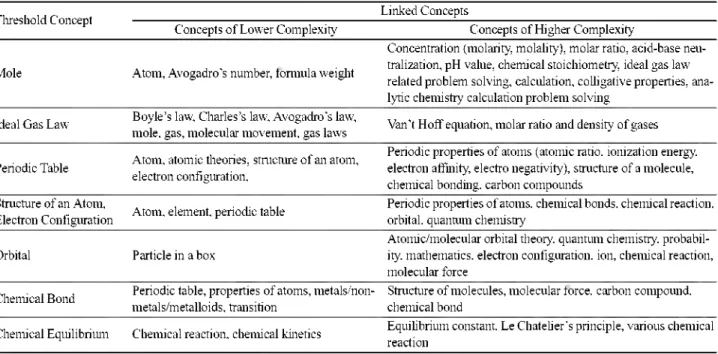
Table 1. Threshold and related concepts identified by high school chemistry teachers
Threshold Concept LinkedConcepts
Concepts of Lower Complexity Concepts of Higher Complexity
Mole Atom, Avogadro’s number, formula weight
Concentration (molarity, molality), molar ratio, acid-baseneu tralization, pH value,chemical stoichiometry, idealgas law related problemsolving, calculation, colligativeproperties, ana
lyticchemistry calculation problem solving Ideal GasLaw Boyle’s law, Charles’slaw, Avogadro’s law,
mole,gas, molecular movement, gas laws Vn’t Hoff equation,molar ratioand densityof gases
Periodic Table Atom,atomic theories, structureof an atom, electronconfiguration,
Periodic propertiesof atoms(atomic ratio, ionizationenergy, electron affinity,electro negativity), structureof amolecule, chemical bonding, carboncompounds
Structure ofan Atom,
Electron Configuration Atom, element, periodic table Periodic properties of atoms,chemical bonds, chemical reaction, orbital,quantum chemistry
Orbital Particle ina box
Atomic/molecularorbitaltheory, quantum chemistry,probabil ity, mathematics, electronconfiguration, ion, chemical reaction, molecular force
Chemical Bond Periodictable,properties ofatoms, metals/non- metals/metalloids,transition
Structure ofmolecules, molecular force,carboncompound, chemical bond
Chemical Equilibrium Chemicalreaction,chemical kinetics Equilibrium constant, Le Chatelier’s principle, various chemical reaction
by 20 high school chemistry teachers, the current study identified seven threshold concepts in high school level chemistry, shown in Table 1 above. Related or linked con
cepts to the threshold concepts are also listed in the table.
When the teachers were asked about the integrated or transformative features of selected concepts, they addressed the related concepts to describe conceptual changes in their learning experience. Teachers listed these concepts after considering curriculum guides, textbooks, and their own lessons. Some were concepts that needed to be learned in advance and others were learned at higher levels (grades).
Because the teachers were able to see all of them as one or realize the hidden thread connecting them, the critical ones were referred to as threshold concepts. This well describes the integrated feature of a threshold concept, which, as it is a crucial concept, connects other concepts. Many teachers in this study first picked the “periodic table” as a threshold concept in chemistry, followed by “orbitals” and “structure of an atom.” In particular, as integrated concepts in lower or higher complexity links, the four concepts: periodic table, orbitals, structure of an atom, and chemical bonds, are intensely associated with each other.
Some teachers did not find any concepts at the high school chemistry level to be particularly difficult or trou
blesome. However, although it was not that difficult for them to pass school examinations and to gain qualifica
tions as chemistry teachers, these teachers admitted that they did have “a-ha” experiences when they learned or
taught certain concepts in high school or elsewhere. More
over, there still remained areas or barriers in which some teachers had not experienced transformations in under
standing. For example, the concepts of electricity, entropy, and the physical/scientific meaning of mathematical rep
resentation in quantum chemistry are on teachers’ list of difficult concepts. This needs to be further studied by comparing teachers’ understanding with responses from expert scientists who have mastered and made the corre
sponding conceptual transformations. Then we may have more threshold concepts. Although “atoms” and “chem
ical bonds” were cited most as important concepts, many teachers stated that the scholastic ability test for college admissions is another key factor determining the impor
tance of concepts. Therefore, their responses were mainly related to how to solve the problems. This reveals how teacher responses in the three categories are different. In this regard, the prior study34 can be referenced.
Types of experience
The identification of threshold concepts is based upon teachers’ mastery experiences and by conceptual transforma
tions. Described as an “a-ha!” moment by several teach
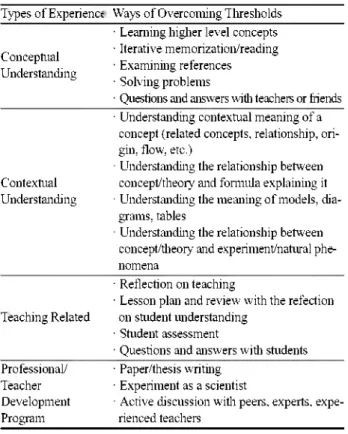
ers, the experience of overcoming the troublesomeness of threshold concepts is unique and is accompanied by a transformed way of thinking. Interview data analysis shows that chemistry teachers achieved such moments of aware
ness in various ways. Table 2 lists how or when the chem-
Table 2. Moments of awarenessand ways of achieving them Types ofExperience Ways of Overcoming Thresholds
Conceptual Understanding
• Learning higherlevel concepts
• Iterative memorization/reading
• Examining references
• Solving problems
• Questions and answers wi^teachers or friends
Contextual Understanding
• Understanding contextual meaning of a concept (related concepts,relationship, ori gin, flow,etc.)
• Understandingtherelationship between concept/theory and formulaexplaining it
• Understandingthemeaning ofmodels, dia grams, tables
• Understandingtherelationship between concept/theoryandexperiment/naturalphe nomena
Teaching Related
• Reflectionon teaching
• Lesson plan and review with the refection on student understanding
• Student assessment
• Questionsand answers withstudents Professional/
Teacher Development Program
• Paper/thesis writing
• Experiment asa scientist
• Active discussion withpeers, experts,expe
riencedteachers
istry teachers had their moments of awareness.
Learning in itself is development and progress. Learn
ers build knowledge through the process of learning; how
ever, conceptual understanding of threshold concepts goes beyond the cumulative build-up of knowledge. Thus, in the case of mastering threshold concepts, the process of learning provides opportunity for learners to form con
ceptual understandings and then experience transforma
tions in their thinking. Teachers in this study understood some concepts immediately; others they found initially difficult to comprehend, but gradually, they deviated from
“liminal status”35 to comprehending them conceptually.
As summarized in Table 2, some teachers comprehended a threshold concept while learning higher-level concepts in the subject, examining reference materials, or solving related problems. Other teachers attained conceptual understanding and transformation through the iterative processes of memorization, reading, and frequent consul
tation with their colleagues. Teachers also cited participation in higher education or degree programs as opportunities to enrich these experiences of overcoming knowledge blocks.
Although the meaning of comprehension can be subjec
tive, most teachers had mastered concepts such as “mole and periodic table” in high school chemistry class. Depend
ing on the concepts, the teachers’ experiences of their aware
ness varied. Five teachers said that they had learned the concepts meaningfully and made conceptual transforma
tions during their college studies. In addition, two addressed the importance of inquiry experiences in the laboratory and thesis processes, including writing, which usually happened in graduate school. This is well explained in the excerpt below:
Teacher KJ: I was O.K. I mean I was a high achieving student in high school. I was highly ranked in my grade as well as in science. My knowledge of science was good enough to pass all the tests given by the school and even good enough for the college entrance exam. It didn't matter how I com
pletely understood the concept or not; I think I had a fair understanding for high school level science. However when I look over my past years, I think my understanding in high school was pretty superficial. For example, in regard to the concept of orbital, I understood the meaning of probabil
ity and its mathematical representation from college sci
ence courses. From studies related to the coursework, I linked prior knowledge that existed as fragments to a whole, and I think that gave me another transformative moment compared to my previous understanding in high school, together with integrating parts.
This opportunity for higher education can be extended to professional development programs such as workshops, seminars, conferences, and teachers’ social activities. Third, teachers mentioned that they had “a-ha” moments while teaching or preparing lessons. Teaching entails student reac
tions. In this regard, the teachers in this study raised one similar question from their earlier teaching experiences:
“Why don’t my students understand this concept?” Alter
natively, “Why is this concept difficult for them?” From that moment on, the teachers sought ways to help students under
stand, or to reduce the difficulties of learning science. In order to prepare lessons, teachers had to re-structure their knowledge into an easily achievable form appropriate for students’ ability levels. Through the processes of reflec
tion and re-construction, many teachers in this study experi
enced a transformative understanding of threshold concepts.
Teacher IY: While I was preparing lessons and thinking of answers to student queshons, in particular about how to teach, how to deliver, and which way may be the best, I was able to comprehend the meaning offormulas and con
cepts that were simply memorized and used for problem solving previously. I then seemed to be enlightened by this holistic understanding. I think that “to know” and “to be aware of” are different. I think I became aware of the con
cepts through teaching or preparing for teaching. That was the "a-ha” moment that I vividly remember.
The importance of contextual understanding was also
Journal of the Korean Chemical Society
presented as a critical component of mastering the thresh
old concepts. Seven chemistry teachers mentioned that understanding of the threshold concepts in a transforma
tive way was accompanied or achieved by understanding the flow, contextual structure, or relatedness of concepts in the subject. The integrated nature of threshold concepts was valued by recognizing them not only as single con
cepts but also concepts integrating contextual informa
tion and related concepts. According to the teachers, they experienced "a-ha” moments when they figured out the relationships between related concepts, models and enti
ties, parts and the whole, experimental data and theoret
ical background, real-life experiences and theoretical descriptions, mathematical representations and scientific meanings, and formulas and explanations. One teacher, LJ, explained that drawing a “big picture” provides insight, mapping the integrated aspect of science as well as achieving conceptual understanding. Furthermore, two teachers (LJ & KJ) explained being able to see the link or connectivity of concepts in chemistry itself as the threshold in learning science.
Influence of overcoming the difficulty of threshold concepts
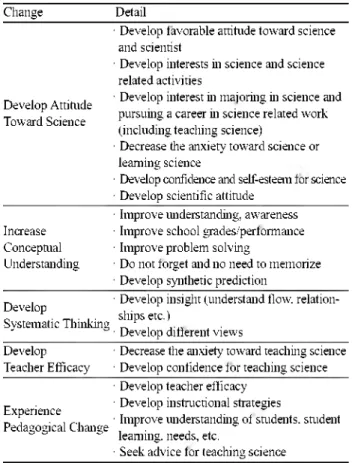
The experiences of overcoming threshold concepts helped chemistry teachers make changes in a number of ways.
Table 3 summarizes teachers’ responses. As for Table 2, Table 3 lists the categories containing the most responses, rather than indicating the frequency of each response.
First, because understanding threshold concepts is trans
formative, integrated, and irreversible in nature, teachers were able to understand better, think systematically, and thus, internalize the concepts as knowledge that would be hard to forget. Second, the experience of overcoming threshold barriers improved their efficacy as teachers. The mastery experience of understanding threshold concepts helped teachers to abate their fears of teaching chemistry and to gain confidence in their abilities to make students learn. Third, teachers admitted to having attitude changes towards science through these experiences of awareness. Specifically, they developed intellectual curiosity for chemis
try, interest in chemistry, and favorable attitude towards chemists. Consequently, these positive changes motivated the teachers to major in chemistry-related disciplines and even to build their careers as chemistry teachers. By lov
ing chemistry, they decreased their anxiety towards it and improved their self-esteem for learning chemistry and science in general. Fourth, the teachers made significant changes in their methods of teaching threshold concepts. The experi
ences of awareness affected teachers’ teaching as well as
Table 3. Theinfluence of experiencesof mastering threshold con
cepts on teachers
Change Detail
Develop Attitude Toward Science
• Develop favorableattitudetoward science and scientist
• Develop interests in science and science related activities
• Develop interestinmajoring in scienceand pursuing a careerin science related work (including teachingscience)
• Decreasethe anxiety toward science or learningscience
• Develop confidence andself-esteem for science
• Develop scientificattitude
Increase Conceptual Understanding
• Improve understanding, awareness
• Improve school grades/performance
• Improve problem solving
• Donotforget and noneedtomemorize
• Develop synthetic prediction Develop
Systematic Thinking
• Develop insight(understand flow, relation
shipsetc.)
• Develop different views Develop
Teacher Efficacy
• Decreasethe anxietytoward teaching science
• Develop confidence for teaching science
Experience Pedagogical Change
• Develop teacher efficacy
• Develop instructional strategies
• Improve understandingof students, student learning, needs, etc.
• Seek advice for teaching science
their learning. This pedagogical change is discussed in more detail below.
Pedagogical change as a result of understanding threshold concepts
As pointed out previously, understanding threshold concepts and the experience of this awareness helped the teachers in this study to develop efficacy and confidence for teaching the concepts. However, their confidence was not limited to the threshold concepts. Due to the inte
grated characteristics of threshold concepts, the teachers stated that they had the confidence to explain threshold concepts and its contextual knowledge. With this pre
paredness, several teachers admitted that they found it easier to explain the concepts. For example, teacher JK replied as follows.
After understanding this, after experiencing the "a-ha”
moment, I think I don’t have fear to teach the concept and related theories. To put it simply, I think I don’t even need to prepare a lesson plan particularly for the concept. I mean, because I know it well, like I’m saturated enough with the concept, I can answer all student questions related to
it. Depending on the students in my class and their level of understanding, I can easily adjust my lessons; in other words, I can explain it simply, or I can teach it in more detail.
The excerpt reveals a crucial effect of embodied subject matter knowledge on pedagogical change or development.
Relating to the embodiment of the threshold concept, data show various changes in teachers’ pedagogy.
First, teachers who had the mastery experience of threshold concepts tried to re-design the science curriculum struc
tured by the Korean National Science Education Standards.
Because of the importance of the annual college entrance exam conducted by the Korean government, most high school science curricula follow the National Science Stan
dards. For this reason, it is not easy to change the science curriculum based on national standards (scope of contents and orders), particularly in the secondary level public school system. Nevertheless, the teachers in this study described that they had made slight changes by regulating the depth and order of some threshold concepts in the existing school science curriculum.
The periodic table is an example. It was supposed to be taught in a sub-chapter “Metal and property of metals” of the introductory level high school chemistry (11
山
grade, Chemistry I). Lessons about the structure of an atom and atomic theories were covered in 12thgrade Chemistry II.To reduce the gap or to enable the students to understand better, some teachers made curricular adjustments. For the topic “periodic table,” some teachers gave a brief intro
duction of atomic structure before teaching the property of metals, and others taught the periodic table to 12thgrade students after completing the structure of an atom chapter.
Second, many teachers adopted various instructional aids such as models, video clips, and visual/audial/tactile materials. In general, students have difficulty understand
ing abstract concepts in chemistry. Most of the threshold concepts identified in this study, particularly orbitals, equilib
rium, bonds, electricity, etc., fall into the category of abstract.
Many teachers who participated in the interviews expressed concern about the abstract nature of these concepts and their students’ related learning difficulties. Although teach
ers did not describe specific examples for certain concepts, they believed in the positive effect of these instructional materials on student understanding.
Third, based on the same reason for which they used instructional aids, teachers employed a variety of teaching methods. In order to embody and promote understanding of the abstract concepts, they made frequent use of analogies, metaphors, comparisons, and examples. In such cases, some teachers incorporated their own experiences or familiar
real-world phenomena/products into the various meth
ods. Because they had experienced “a-ha” moments and conceptual transformations, they tended to emphasize les
sons including threshold concepts compared to other top
ics. Furthermore, teachers developed various questions designed to reveal student understanding and lead students to think or reflect for themselves. Through this thoughtful process, students could identify differences between their understanding and the textbook contents. As this meta- cognitive thinking helped teachers to overcome concep
tual barriers, teachers guided students to see or meet the difficulty of the threshold concepts and encouraged them to overcome these thresholds.
Fourth, teachers’ own experiences helped them to bet
ter understand student learning difficulties, predict the obstacles interfering with student learning, and plan ahead to fix these gaps or to put stepping stones between student knowledge and the science curriculum goals. Their own student-level understandings again affected their teaching and interaction with students. Teacher LJ admitted that, by looking back on his own experience, he could easily spot alternative conceptions held by students. In PS’s case, stu
dents were encouraged to participate in science lessons actively and were pushed to ponder methods and solu
tions to solve problems for themselves. Through this pro
cess, the teachers could communicate with students more often and build meaningful rapports with them. Like PS, SH asked students to seek various approaches other than those in the textbooks to understand the concepts. In order to stimulate student learning and increase student confi
dence in science learning, LH initially provided questions that were simple and easy enough for most of the students to solve, and then she gradually raised the level of her lessons.
Fifth, as teachers experienced “a-ha” moments by under
standing links between concepts, theory and experiments, formulas and scientific phenomena, theory and real-life experiences, and concepts and contextual information, they directed students to see the systematic structure of knowl
edge in each subject. In this vein, instruction was designed to reveal relatedness, connectivity, and the developmental flow of concepts in chapters or subjects. For an example of using formulas, SH usually used a science formula as a tool for encouraging student confidence through solving problems or a tool for summarizing complex description of phenomena in a simplified form.
When I was studying science in high school, I had a tip
using scientific formulas as a tool to summarize theories. I think the formula is a simplified version of a theory. There
fore, it usually helped me to see lots of information such as
Journal of the Korean Chemical Society
potential variables and their relationships, etc. Moreover, I can predict controlling factors of a phenomena or results by changing conditions of variables. For example, the ideal gas law can be written as PV = nRT Instead of mem
orizing all theories (Boyle ’ law, Charles s law, Gay-Luy- sak's Law, andAvogadro s principle) separately, I can tell all of them with the one formula. By describing scientific phenomena as a formula and extracting related theories from a simplified formula, the two processes helped me a lot to learn science, and I wanted to teach this approach to my students, especially for the threshold concepts such as ideal gas law and periodic tables. In addition, understand
ing the scientific meaning offormulas helps students to solve problems better, and this can encourage them in learning science.
To this end, concept maps and flow charts were pointed out as the most frequently used methods in their teaching.
Sixth, expected struggles of students while learning threshold concepts led the teachers to be acquainted with each other. Although teachers had mastered the threshold concepts, such concepts are usually difficult to teach as well as to learn. To improve student understanding, the teachers often asked for advice from other teachers and discussed instructional methods that would best fit their students. By sharing various experiences and instructional methods, the teachers had opportunities for indirect experience and could widen the repertoire of approaches they could take in their science classes.
CONCLUSION AND DISCUSSION
A useful tool for understanding the meaning and nature of threshold concepts in science
Concepts in this study (Table 1) were identified by the features of threshold concepts. Although they were selected based on the personal experience of teachers, the defining features of threshold concepts, such as transformative, integrated, bounded, irreversible, and troublesome, became criteria limiting the diversity of the proposed concepts. In line with the given five criteria, the 20 experienced chem
istry teachers selected seven concepts as threshold con
cepts in high school chemistry. In fact, the concepts of atomic structure, orbital, periodic table, and chemical bonds are conceptually inter-related. Considering this, the number of threshold concepts is not as diverse as the number of teachers and their experiences. This suggests that the cri
teria above are not only a good reference for describing the nature of concepts but also a good tool for objectifying the subjective experience. As explained, a threshold con
cept is not necessarily a key concept in the subject. How
ever, some threshold concepts such as atomic structure and periodic table are fundamental concepts in the field of chemistry and have a historical significance in science because of their transformative and integrated nature. In this regard, features of an identified concept provide infor
mation describing its scientific meaning and distinctive nature in science. This demonstrates the potential value of threshold concepts for science education.
In regard to significant features, the data from this study first reveal the importance of the integrated nature of each concept in chemistry. When many teachers understood the links between concepts at different levels, concepts and contexts, parts and wholes, theories and experiments, for
mulas and conceptual meanings, problem solving and the
ories, phenomena and concepts, models and concepts, etc., they had "a-ha” moments; that is, they experienced irre
versible transformations, or “awarenesses,” by understand
ing the interrelated structure of these concepts as a whole or system. This is considered higher order thinking in sev
eral studies.36
-
38In particular, this holistic and systematic approach helped the teachers to form rational understandings and make scientific predictions about the concept and related phenomena. Therefore, in the development of chem
istry curriculum and instruction, encouraging students to perceive the integrated structure of concepts should be taken into account. Second, because the data from this study are provided by teachers, some threshold concepts might be difficult at student levels of understanding. Nonetheless, considering that the teachers’ awarenesses were obtained through learning science as students and teaching science to students, the difficulty of each concept allows us to pre
dict the learning difficulties faced by students.5 The var
ious methods the teachers used to overcome thresholds (for themselves or their students) and their mastery expe
riences are good resources for them or teachers in general, to prepare lessons on related concepts.
The influence of teachers’ experiences of overcom
ing threshold concepts on the development of PCK With respect to overcoming thresholds, many teachers (10 out of 20) cited relevant experience in teaching; that is, while preparing for classroom instruction or through/
after interactions with students in class, teachers were able to overcome their own difficulties in understanding thresh
old concepts. Although it may be complicated to map the exact mechanism linking the experience of overcoming threshold concepts and PCK development, what is clear from this study is that there is a relationship between the two.
As suggested in Park and Oliver’s study,10 PCK devel
opment is closely associated with the understanding and reflection of teachers within a given context. Through the hexagonal model of PCK for science teaching, they listed six components of PCK: teacher efficacy, orientation to teach
ing science, knowledge of assessment of science learning, knowledge of instructional strategies for teaching science, knowledge of science curriculum, and knowledge of students ’ understanding in science. In general, teachers’ responses about teaching threshold concepts showed similar patterns to those found in this prior study in terms ofPCK development.
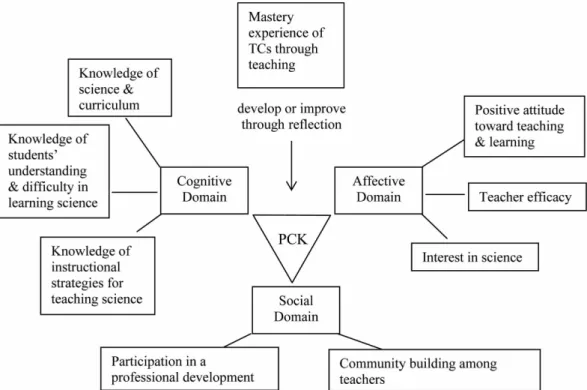
However, some components were particularly noticeable due to the ''a-ha” experience of threshold concepts. Fig. 2 below explains how the mastery experience affected knowl
edge development (both SMK and PCK). To better explain teachers’ responses, this study grouped them into three knowl
edge domains-cognitive, affective, and social domains of knowledge.
As can be seen in Fig. 2a, subject matter knowledge obtained through the mastery experience includes factors required to develop PCK as well. Related to this, Fig. 2 shows that there are some overlaps between the two expe
riences (teachers’ mastery experience through teaching vs.
learning). This reveals similarities and differences between expert learners’ SMK and experienced teachers’ PCK well.
Fig. 2b shows that teachers gain knowledge about students (their understanding, difficulty in learning science, etc.) and instructional strategies after teaching experiences. Teachers’
knowledge in the cognitive domain is more comprehensive compared to that of expert learners. Details about these differences will be further discussed in a follow-up paper, by comparing interviews from expert scientists and science
• Conceptual understanding
•Contextual understanding
•Positive attitude toward science
•Positive attitudetoward leaming/teaching/doing science
can be developed into> PCK
a) Subject matter knowledge (SMK) development by understanding threshold concepts (TCs)
b) Pedagogical content knowledge development (PCK) by understanding threshold concepts (TCs)
Figure 2. Theinfluenceof understanding thresholdconcepts onthe knowledge development of teachers.
Journal of the Korean Chemical Society
teachers (in progress). As stated in teachers’ responses, teach
ers’ awareness ("a-ha” experiences) through teaching or interactions with students had great influences on PCK development. Furthermore, affective domains ofknowledge seem to be strengthened while teaching. Perhaps the "a-ha”
experience itself improved teachers’ attitudes to the sub
ject matter considerably (positive attitude toward science teaching/learning, teacher efficacy, interest in science), while advances in the cognitive domain inspired teachers to reflect thoughtfully on their teaching, content, and their own students. Although some were easy concepts for teach
ers to learn as expert students, the mastery experience helped teachers to better understand the nature and scientific meaning of threshold concepts in science. This suggests that they were aware of the transformative and integrated aspect (at least) of the threshold concepts. In interviews, many teachers discussed the importance of understanding the integrated feature of concepts, which in turn, worked as a meaning
ful guide to better understanding student learning, and to reflecting on their teaching. In addition to affecting the cognitive domain, "a-ha” experiences improved other domains.
This synergistic link between the cognitive and affective domains seems to accompany teachers’ knowledge devel
opment in the social domain. The term "reflection in- or on-action”39 well explains what the teachers who participated in this study did after/through their awareness of thresh
old concepts for/with their students.
In this regard, we can review many studies that ques
tioned the role or effectiveness of subject matter knowledge to teaching science.40
-
44 As a distinct knowledge base or a part of PCK, subject matter knowledge (chemistry content knowledge in this study) is an important component for teaching, which was well stated by explaining PCK as subject-, content- or domain-specific knowledge type in Ged- dis’ study.45 However, having a degree in a subject area does not guarantee that teachers are professional in their teaching.46
-
49 In particular, the inefficiency of superficial learning or rote-memorization for problem solving has been pointed out in many learning studies. It reminds us of the importance of overcoming thresholds or gaining aware
ness of subject matter rather than simply accumulating knowledge through the degree program. In this sense, "a-ha”
experiences are potential keys by which students learn sci
ence meaningfully; these experiences may therefore work as good instructional tips for teachers. Again, the features of threshold experiences can be good criteria for evaluate teachers’ knowledge (SMK and PCK). In addition, teaching experiences themselves were factors stimulating teachers to overcome thresholds in their subjects. Findings from
this study have implications for teacher education pro
grams. For both pre-service teachers and in-service teachers, this study, including the research in progress (1. targeting stu
dents and expert scientists, 2. different subjects in science), will provide valuable information for understand the trou
blesome nature of threshold concepts, student learning, and teaching/learning tips from teachers and experts.
Acknowledgment. This work was supported by the National Research Foundation of Korea Grant funded by the Korean Government(NRF-2012S1A5A8024386).
REFERENCES
1. Meyer, J.; Land, R. (2003). Threshold concepts and trou
blesome knowledge: Linkages to ways of thinking and practicing within the disciplines. ETL project Occasional Report. University of Edinburgh.
docsZETLreport4.pdf.
http://www.etl.tla.ed.ac.uk/
2. Davies, P. Threshold concepts: how can we recognize them? In Overcoming barriers to student understanding:
Threshold concepts and troublesome knowledge; Meyer, J.
H. F., Land, R. Eds.; Routledge, 2006; p 70.
3. Davies, P. Threshold concepts: how can we recognize them?
Proceedings presented at the EARLI Conference. http://
etcworkingpaper1.pdf, 2003.
web.staffs.ac.uk/schools/business/iepr/etc/WorkingPapers/
4. EcEdWeb Economic concepts students should know, available
at (accessed 19,
February, 2013), 2003.
http://ecedweb.unomaha.edu/home.cfm
5. Park, E.; Light, G. International Journal of Science Edu
cation 2009, 31, 233.
6. Cheek, K. A. Why is geologic time troublesome knowl
edge? In Threshold concepts and transformational Learning, Meyer, J. H. F.; Land, R.; Baillie, C. Eds.; Sense Publishers, The Netherlands, 2010; p 117.
7. McCartney, R.; Eckerdal, A.; Mostrom, J. E.; Sanders, K.;
Thomas, L.; Zander, C. Computing students learning comput
ing informally. In Proceedings of the 10th Koli Calling International Conference on Computing Education Research, 2010; p 43. ACM.
8. Schneider, R. M.; Plasman, K. Review of Educational Research, 2011, 81, 530.
9. Fraut, M. Developing professional knowledge and competence.;
Falmer Press, London, 1994; p 35.
10. Park, S.; Oliver, J. S. Research in Science Education, 2007, 38, 261.
11. Shulman, L. S. Educational Researcher, 1986, 15, 4.
12. Shulman, L. S. Harvard Educational Review, 1987, 57, 1.
13. Haidar, A. H. Journal of Research in Science Teaching, 1997, 34, 181.
14. Van Driel, J. H.; Verloop, N.; de Vbs, W. Journal of Research in Science Teaching, 1998, 35, 673.