논토양 중 자운영 환원에 의한 질소의 동태 구명
이창훈*ㆍ정기열1ㆍ김선태2
농촌진흥청 국립농업과학원 토양비료과, 1농촌진흥청 식량과학원 기능성작물부, 2부산대학교 작물생명과학과
Behavior of Nitrogen Released from Chinese Milk Vetch in Paddy Soil by Using Stable 15 N Trace
Chang Hoon Lee*, Ki Youl Jung
1, and Sun Tae Kim
2Soil and Fertilizer Management Division, NAAS, RDA, Suwon 441-707, South Korea
1
Functional Cereal Crop Research Division, National Institute of Crop Science, RDA, 1085, Naey-dong, Miryang, South Korea
2
Department of Plant Bioscience, Pusan National University, Miryang 627-706, Korea
Green manure cultivation affects soil productivity and nutrient conservation in paddy soil at winter season.
This study was to evaluate nitrogen behavior released from chinese milk vetch (CMV) as green manure by using stable
15N trace during rice cultivation. The CMV used in the experiment was 29.9 of C/N ratio and 14.1 g N kg
-1(
15N 0.388 atom % excess) and was applied at rates of 10 and 30 Mg ha
-1in pot of 1/2000a size. Rice growth and N uptake increased with higher levels of CMV application at harvesting stage. Among total N uptake, 14.6 and 26.8 % of nitrogen was released respectively from the two different rates of CMV application.
Stable
15N recovery by rice biomass was 60%, 54% to the
15N input, respectively, of CMV application, which decreased in order of grain, root, and straw of rice biomass. Total N content in the soil after rice harvest was 1.9 and 2.1 g N kg
-1, respectively, with increasing N input by the different rates of CMV application and the rate of
15N recovery derived from CMV in the soil was 3.8 and 4.8 %, respectively. N input by CMV application induced rice growth and productivity during rice cultivation. However, it might need proper managements to reduce N loss because about 36-41 % of nitrogen was lost from N input by CMV application.
Key words: Green manure, Chinese milk vetch,
15N recovery, Rice접수 : 2012. 11. 13 수리 : 2012. 12. 6
*연락저자 : Phone: +82312900335 E-mail: [email protected]
서 언
집약적인 작물 재배는 토양유기물 및 양분불균형을 초래 하여 토양특성을 악화로 작무의 생산성이 감소될 수 있다 (Cassman and Pingali, 1995; Reddy and Krishnaiah, 1999).
녹비작물은 경작지에서 직접 재배가 가능하고 녹비작물 자 체를 비료 및 유기물 공급원으로 사용이 될 수 있다. 녹비작 물은 휴한기 재배가 가능하여 유기물 증진 및 질소공급효과 가 알려져 있어 (Kuo et al., 1997; Choi et al., 2010), 최근 에는 녹비작물은 작물생산을 위한 화학비료 대체 및 절감수 단으로 이용성이 점차 확대되고 있다 (Hartwing and Ammon, 2002).
녹비작물의 질소공급은 환원시기와 시용량, 녹비의 화학 적 조성, 토양특성에 영향을 받지만, 녹비작물의 탄질율에 따라 질소공급이 달라진다. 탄질율이 8:1-15:1를 나타내는 두과 녹비작물은 토양 중 질소함량과 작물 수량을 증대시키
며 (Sainju et al., 1999), 화본과 녹비 작물은 상대적으로 탄질비 (30:1-60:1)가 높기 때문에 미생물의 질소부동화로 작물의 질소이용율이 감소가 발생된다 (Wagger, 1989). Ashraf et al. (2004)는 녹비작물의 환원에 따른 후작물의 질소이용 율은 약 19-50%으로 녹비작물에 따라 차이를 보인다고 보 고하였다. 이러한 녹비환원에 따른 작물의 질소이용율 차이 는 무기화 및 질소 유출 과정을 통해 발생될 수 있다 (Asagi and Ueno, 2009). 토양 중 질소는 암모니아 휘산, 용탈, 탈 질 등 질소손실이 발생되며, 토양 pH와 수분, 온도 등이 질 소 유출에 영향을 일으키는 인자로 알려져 있다 (Fenn and Hossner, 1985; Sommer and Ersboll, 1996; Vlek and Craswell, 1979). 토양 질소의 작물흡수와 유실은 작물의 생산성과 농 업생태계에 중요하기 때문에 녹비작물 유래 질소동태에 합 리적인 평가가 이루어져 한다.
녹비작물 중 두과의 자운영 (Astragalus sinicus L.)은 겨 울철 남부지방의 논토양에 적응력이 높으며, 생물학적 질소 고정이 높기 때문에 벼 생산을 위한 질소공급원이 될 수 있 다 (Jeong et al., 1995; Cho et al., 2003). 남부지방에서 동 절기 자운영 생산량은 약 20 ~ 30 ton ha-1이며, 자운영은
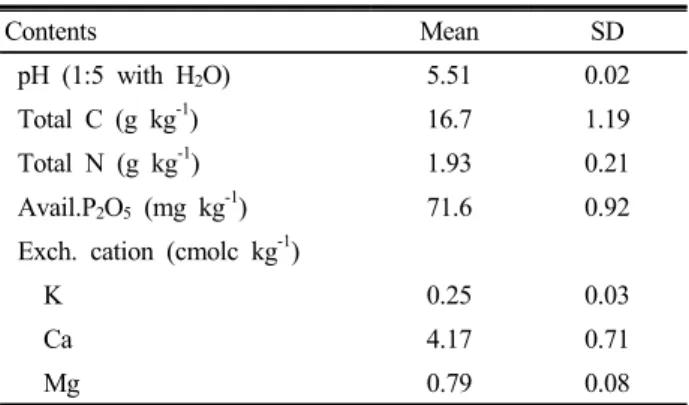
Table 1. Chemical properties of paddy soil before this experiment.
Contents Mean SD
pH (1:5 with H2O) 5.51 0.02
Total C (g kg-1) 16.7 1.19
Total N (g kg-1) 1.93 0.21
Avail.P2O5 (mg kg-1) 71.6 0.92 Exch. cation (cmolc kg-1)
K 0.25 0.03
Ca 4.17 0.71
Mg 0.79 0.08
질소를 2 ~ 3% 함유하고 (Jeong et al., 1996), 낮은 리그닌 함량 (Yusue, 1991), 그리고 낮은 C/N율 때문에 토양 중에 서 분해가 빠르며, 미생물의 질소부동화가 낮은 것으로 알 려져 있다 (Singh et al.,1999). 그러나 녹비작물인 자운영 의 질소공급효과는 작물의 흡수와 토양특성과 연계되어 있 기 때문에 직접적인 평가가 쉽지 않다. 최근 중질소동위원 소 (15N)를 활용하여 토양 중 질소의 동태에 대한 연구가 이 루어지고 있으며 (Bergstrom and Kirchmann, 2004; Harris et al., 1994; Jackson, 2000; 1988; Seo et al., 2006:
Wivstad, 1999), 질소이용율과 유실을 추정하는 유용한 방 법이 되고 있다. 본 연구는 토양에서 자운영의 질소 동태를 평가하고자 중질소동위원소를 함유한 자운영을 논토양의 담수조건에 투입하여 벼의 질소이용율과 유실을 포트시험 을 통해 조사하였다.
재료 및 방법
자운영 월동직후 포장에서 월동한 어린 자운영을 채취 하여 60×40cm 크기의 pot로 이식하고 뿌리가 활착한 다음
15N Urea (10.0 atom%)를 0.5% 농도 조제하여 1주일 간격으 로 개화기까지 엽면 살포하였다. 결실기에 수확한 자운영은 전질소 함량 (T-N)이 14.1 g kg-1, 탄질율은 29.9, 수분함량 은 68%이었고, 중질소 (15N) 함량은 0.38 atom % excess로 조사되었다.
벼 재배 포트시험 결실기 자운영의 질소동태 평가는 2008년 6월에 기능성작물부내 온실에서 3수준 4반복의 완 전임의배치법으로 1/2000a 와그너포트에서 실시하였다. 결 실기 자운영 처리수준은 생체량 기준으로 0, 10, 30 Mg ha-1을 시용하였고, 자운영 처리구의 수확기 정조수량을 화 학비료구 (N-P2O5-K2O=90-45-57 kg ha-1)와 비교하였다.
와그너 포트에 토양 충전은 자운영을 토양과 잘 혼합한 후 에 토양깊이 0-15 cm와 용적밀도 1.2 g cm-3로 충전하였 고, 토양 깊이 15-25cm는 용적밀도를 1.4 g cm-3으로 토양 을 충전하였다. 포트시험에 사용한 시험전 토양의 특성은 Table 1과 같이 pH 5.5, 전질소 함량은 1.93 g kg-1, 탄질율 은 8.66 이었다. 화학비료구 (NPK)는 질소 50%, 인산전량, 가리 70%를 기비로, 분얼기에 질소 20%만, 유수형성기에 질소와 가리를 각각 30% 추비하였다. 벼 품종은 일미벼로 담수 3일 후 포트당 3 주 이앙하였으며, 2008년 10월 5일에 벼를 수확하였다.
중질소 분석 벼 건물량은 정조, 볏짚, 뿌리로 각각 분리 하여 70℃ 건조기에서 48 시간동안 건조하였다. 수량구성 요소는 농촌진흥청 표준재배법에 준하여 조사하였다 (NAAS, 2000). 토양내 15N 함량을 조사하기 위해 벼 수확전 0-15 cm 깊이의 토양을 100 cc core로 채취하여 용적밀도를 측정
하였다. 수확기 식물체와 토양은 ball-mill로 곱게 분쇄 후 안정동위원소 질량분석기 (ISo-prime EA, micromass, UK) 로 전질소 함량과 15N atom %를 측정하였다.
토양 분석 수확기 토양은 풍건 후에 2 mm체로 토양시 료를 조제하였다. 각 처리구의 pH는 시료와 증류수를 1:5 wt/v 진탕하여 pH meter로 측정하였다. 유효인산은 Lancaster 법, 치환성 양이온은 1 M ammonium acetate (pH 7.0)로 침 출하여 ICP로 K, Ca, Mg 함량을 분석하였고, 전탄소 (T-C) 와 전질소 (T-N)함량은 건조시료를 막대사발에서 곱게 갈 은 후, 원소분석기를 이용하여 정량하였다 (NIAST, 2000).
Microbial biomass N (MBN)은 chloroform fumigation 법으 로 (Vance et al., 1988), 진공 데시케이터 내에서 건토기준 10 g 습토를 CHCl3으로 25℃에서 24시간동안 훈증 처리하 여 0.5M K2SO4 용액으로 추출하여 microbial biomass N의 정량에 이용하였다. 그리고 훈증하지 않은 습토를 위화 같 은 침출액으로 침출하여 TOC-TN (Shimazu, Japan)분석기 로 T-N 함량을 측정하였다. Microbial biomass N 함량은 fumication과 non-fumigation 차이에 1.85를 곱하여 구하 였다 (Jenkinson et al., 1988; Wu et al., 1990). 가용성 암 모니아태 질소는 2M KCl로 침출하여 킬달법으로 측정하였 다 (NIAST, 1998).
중질소 동위원소 계산 수확후 벼와 토양내 자운영 중 질소 (15N) 함량은 다음과 같이 계산하였다.
NDFF = 총질소 흡수량 × Ndff
이때, N derived from fertilizer (NDFF)은 식물체 (토양) 에 흡수된 자운영 15N 함량이며, N derived from fertilizer (Ndff)는 시비된 자운영 15N 비율로서 (시료 15N atom% - 0.366)/(시비질소 15N atom%-0.366)으로 구하였다. 또한 식물체에 흡수된 토양 질소는 벼의 총질소함량과 NDFF 차 이로 구하였다. 자운영 중질소 (15N)의 회수율은 결실기 자
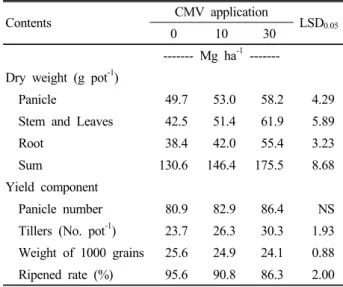
Table 2. Dry weight and grain yield components of rice at harvest stage.
Contents CMV application
LSD0.05
0 10 30
--- Mg ha-1 --- Dry weight (g pot-1)
Panicle 49.7 53.0 58.2 4.29
Stem and Leaves 42.5 51.4 61.9 5.89
Root 38.4 42.0 55.4 3.23
Sum 130.6 146.4 175.5 8.68
Yield component
Panicle number 80.9 82.9 86.4 NS
Tillers (No. pot-1) 23.7 26.3 30.3 1.93 Weight of 1000 grains 25.6 24.9 24.1 0.88 Ripened rate (%) 95.6 90.8 86.3 2.00 NS: not significance.
Fig. 1. Grain yields of rice as affected by application of chinese milk vetch (** denotes significance at 1.0%).
운영을 통해 시용된 총질소량에 대한 NDFF의 백분율로 계 산하였다.
통계처리 모든 분석치는 SAS를 이용하여 완전임의배 치법으로 일원변량분석을 실시한 후에 최소유의차 (LSD0.05) 로 처리간 평균을 비교하였다 (Little and Hills 1978).
결과 및 고찰
벼 수량 및 자운영 N 흡수량 논토양에 자운영 시용 은 벼의 정조, 볏짚, 뿌리의 건물량을 유의적 (P<0.001)으로 증가시켰다 (Table 2). 자운영 무시용구의 정조수량은 47.1 g pot-1이었고, 자운영 10, 30 Mg ha-1 시용된 처리구는 정 조수량이 각각 49.7과 53.6 g pot-1이었다 (Fig. 1). N자운영 시용량 증가는 낱알수와 경수는 향상되었고, 천립중과 등숙 율은 감소되었다. NPK와 자운영 처리구의 정조수량을 비교
하였는데, 자운영 30 Mg ha-1 처리구의 정조수량은 NPK (52.1 g pot-1)에 비해 3% 증수되었으나, 통계적인 유의차는 없었다.
자운영 시용은 수확기 벼의 질소흡수에 영향을 주었다 (Table 3). 자운영 무시용구의 총 질소흡수량은 860 mg pot-1 으로 각 부위별 질소흡수량은 정조, 볏짚, 뿌리가 각 각 418, 196, 246 mg pot-1 이었다. 논토양에서 자운영 유래 된 질소에 대한 벼의 질소 이용율은 30-40%으로 알려져 있 으며, 벼가 동화한 총 질소 중 약 60-70%는 토양이나 관개 수를 통해 흡수된다 (Gillian et al., 1985; Murayama, 1979).
자운영을 10과 30 Mg ha-1 환원함에 따라 벼에 흡수된 자운 영 유래의 질소흡수량은 각각 140과 337 mg pot-1으로, 자 운영 질소의 총량에 각각 14.6과 26.8%를 차지하였으나, 벼 의 토양질소 흡수율은 자운영의 투입량 증가에 의해 감소되 었다.
논토양에서 벼의 생체량은 뿌리의 근권 확대 및 질소의 공급에 의해서 발생될 수 있으나 (Jenkinson et al., 1985), 토양 중 질소 부동화는 벼의 뿌리생장을 저해할 수 있다 (Asagi and Ueno, 2009). 본 시험에서 자운영 투입은 벼 뿌 리 및 질소흡수량은 증가되었고, 30 Mg ha-1의 자운영 시용 된 처리구가 가장 높은 결과를 보였는데, 이는 토양에 투입 된 자운영의 무기화가 잘 이루졌으며, 벼에 대한 질소공급 이 원활하다는 것을 보여주고 있다. 따라서 Fig. 1에 나타난 바와 같이 NPK 수량을 기준으로, 결실기 자운영의 30 Mg ha-1을 논토양에 투입을 통하여 벼의 질소추천시비량을 대 체하는 효과가 있었다.
토양내 자운영 15
N 질소
수확기 토양내 전탄소 (T-C) 와 전질소 (T-N) 함량뿐만 아니라 microbial biomass N (MBN)과 NH4-N 함량은 자운영 투입량이 높아짐에 따라 증 가하였으나 (Table 4), 토양 pH는 처리간 뚜렷한 차이가 없 었다. 무시용구는 T-C와 T-N함량은 시험전 토양 (각각 1.67과 1.93 g kg-1)에 비하여 다소 감소되었다. 자운영구의 T-C와 T-N함량은 자운영 투입에 의해 증가하였고, 이중 수확기 논토양에 자운영으로 유래된 질소는 자운영 10과 30 Mg ha-1 투입으로 토양 잔존 질소를 8.2과 35.8 m pot-1으 로 증가하였다.토양에 신선한 유기물이 투입되면 미생물은 탄소를 에너 지원으로, 질소를 세포구성에 이용하기 위하여 분해한다.
이때 유기물 분해속도는 투입되는 유기물의 탄질률에 따라 결정된다 (Sainju et al., 1999; Wagger, 1989). Table 4와 같이, 자운영 투입은 토양내 T-N 함량와 NH4-N, microbial biomass N (MBN)을 증가시켰 (p<0.01), 특히 MBN 함량은 NH4-N에 비해 전질소에 대한 비율은 상대적으로 높았다.
토양 유기물과 미생물 개체수과의 관계는 정의상관관계를 나타내는데 (Bonde et al., 1988), 자운영 투입은 Microbial
Table 3. Uptake of nitrogen derived from Chinese milk vetch (CMV) and soil by rice plant at harvest stage·
Contents CMV application
LSD0.05
0 10 30
--- Mg ha-1 ---
Total N uptake (mg pot-1) 860 954 1245 121.1
N derived from CMV (mg pot-1)
Panicle - 74 (50.4) 157 (47.1) 13.6
Stem and leaves - 29 (20.3) 79 (23.5) 18.5
Root - 41 (29.3) 98 (29.4) 15.2
Sum - 140 337 21.9
N derived soil (mg pot-1)
Panicle 418 (48.5) 281 (45.3) 293 (45.2) 74.9
Stem and leaves 196 (22.8) 213 (26.0) 229 (25.1) 34.0
Root 246 (28.7) 235 (28.7) 270 (29.7) 21.6
Sum 860 817 912 103.8
N distribution in rice (%)
CMV 0 14.6 26.8 0.92
Soil N 100 85.4 73.2 0.92
Table 4. Chemical properties and N content derived from Chinese milk vetch (CMV) in paddy soil at harvest stage.
Contents CMV application
LSD0.05
0 10 30
--- Mg ha-1 --- pH (1:5 with H2O) 5.8 5.6 5.7 NS Total C (g kg-1) 16.0 16.7 17.3 0.45 Soil N
Total N (g kg-1) 1.83 1.97 2.17 0.26 NH4+-N (mg pot-1) 5.46 9.74 11.37 2.39 MBN (mg kg-1) 14.0 23.8 31.1 5.67 MBN/Total N (%) 0.76 1.21 1.44 0.24 CMV (mg pot-1) - 8.2 35.8 3.32 MBN: microbial biomass N, NS: not significance.
Fig. 2. Recovery rate of N derived from chinese milk vetch in paddy soil at harvest stage (* and ** denote significance at 5.0% and 1.0%, respectively).
biomass에 활성에 따라 벼 재배기간 중 자운영 분해와 무기 화, 그리고 토양질소의 저장에 영향을 미치는 것으로 판단 된다.
자운영 15
N의 회수율
벼와 토양의 자운영 유래된 중 질소 (15N)의 회수율은 자운영 투입량에 따라 차이를 보였 다 (Fig. 2). 자운영 10과 30 Mg ha-1투입에 따라 벼의 15N 회수율은 각각 63.9와 50.8%으로 감소되었고, 토양 중 15N 회수율은 각각 3.7과 5.1%으로 증가되었다. 자운영으로 유 래된 15N의 미회수율 각각 32.4와 44.1%으로 각각 71 와 289 mg pot-1이 질소 유실이 있었다.토양 질소는 암모니아 휘산, NO3-N 용탈, N2O 탈질에 의해 유실된다. 담수조건에서 질소는 온도와 pH에 의해 암 모니아 휘산으로 질소유실이 되며, 논토양에 시비된 질소의 약 30-40%가 암모니아 휘산에 의해서 유실된다 (Vlerk and Craswell, 1979). 일반적으로 벼 생육기간에 표면수의 pH는 7-8이며, 미생물 개체수와 활성이 pH 증가에 의해서 촉진 된다 (Tate, 2000). 따라서 Fig. 2와 같이 대부분의 자운영 질소유실은 자운영의 무기화와 암모니아 휘산에 의해 발생 된 것으로 해석된다. 그러나 물관리에 의해 벼 근권 산화 (oxidation)력은 NO3 용탈 및 N2O 탈질을 촉진 할 수 있기 때문에 (Bosse and Frenzel, 1997; Tsuruta et al., 1997), 자 운영의 투입시 논토양의 물관리가 필요할 것으로 판단된다.
적 요
담수조건으로 토양질소동태에 대한 결실기 자운영의 투 입효과를 포트시험을 통해 평가하였다. 자운영의 투입에 따 라 벼의 자운영유래 질소 이용율은 약 51-64%으로 자운영 의 투입량이 높을수록 감소하였다. 수확기 토양의 자운영 질소는 약 3-5%가 저장되었고, 자운영 유래 질소의 손실은 각각 32.4와 44.1%를 차지하였다. 벼 수량 대비 자운영 30 Mg ha-1 시용은 질소추천시비량을 전량 대체할 수 있었다.
사 사
본 연구는 농촌진흥청 국립농업과학원 농업과학기술 연 구개발사업 (과제번호:PJ008596)의 지원에 의해 이루어진 것임
인 용 문 헌
Asagi, N. and H. Ueno. 2009. Nitrogen dynamics in paddy soil applied with various 15N-labelled green manures. Plant Soil. 322:251-262.
Ashraf, M., T. Mahmood, F. Azam, and R.M. Qureshi. 2004.
Comparative effects of applying leguminous and nonle- guminous green manures and inorganic N on biomass yield and nitrogen uptake in flooded rice (Oryza sativa L.). Biol.
Fertil. Soils 40:147-152.
Bergstrom, L. and H.Z. Kirchmann. 2004. Leaching and crop uptake of nitrogen from nitrogen-15-labeled green manures and ammonium nitrate. J. Environ. Qual. 33:1786-1792.
Bonde, T.A., J. Schnurer, and T. Rosswall. 1988. Microbial biomass as a fraction of potentially mineralizable nitrogen in soils from longterm field experiments. Soil Biol.
Biochem. 20:447-452.
Bosse, U. and P. Frenzel. 1997. Activity and distribution of methane-oxidizing bacteria in flooded rice soil microcosms and in rice plants (Oryza sativa). Appl. Environ. Microbiol.
63:1199-1207.
Cassman, K.G. and P.L. Pingali. 1995. Extrapolating trends from long-term experiments to farmer’s fields: the case of irrigated rice systems in Asia. In: Barnett, V., Payne, R.
(Eds.), Agricultural Sustainability: Economic, Environmental and Olsen S. R. and Statistical Considerations. John Wiley
& Sons, New York, pp. 63-84.
Cho, Y.S., T. Mineta, and K. Hidaka. 2003. Nitrogen fixation and utilization for green manure of common wild legume narrowleaf vetch (Vicia angustifolia L.). Jarq-Japan Agr.
Res. Quart. 37:45-51.
Choi, B.S., J.A. Jung, M.K. Oh, S.H. Jeon, H.G. Goh, Y.S.
Ok, and J.K. Sung. 2010. Effects of Green Manure Crops on Improvement of Chemical and Biological Properties in Soil. Korean J. Soil Sci. Fert. 43(5): 650-658.
Fenn, L.B. and L.R. Hossner. 1985. Ammonia volatilization from ammonium froming nitrogen fertilizer. Adv. Soil Sci.
1:123-169.
Gilliam, J.W., T.J. Logan, and F.E. Broadbent, 1985. In:
England, O.P. (Ed.), Fertilizer Technology and Use. Soil Sci. Soc. Am. Inc., Madison, WI, USA, pp. 561-588.
Hartwig, N.L. and H.U. Ammon. 2002. Cover crop and living mulches. Weed Sci. 50:688-699.
Harris, G.H., O.B. Hesterman, E.A. Paul, S.E. Peters, and R.R. Janke. 1994. Fate of Legume and fertilizer nitrogen-15 in a long-term cropping systems experiment. Agron. J.
86:910-915.
Jenkinson, D.S., R.H. Fox, and J.H. Rayner. 1985.
Interractions between fertilizer nitrogen and soil nitrogen—
the so-called ‘priming’ effect. J. Soil. Sci. 36:425-444.
Jackson, L.E. 2000. Fates and losses of Nitrogen from a nitrogen-15-labeled cover crop in an intensively managed vegetable system. Soil Sci. Am. J. 64:1404-1412.
Jenkinson, D.S. 1988 The determination of microbial biomass carbon and nitrogen in soil. In Advances in Nitrogen Cycling in Agricultural Ecosystems(J. R. Wilson, Ed.), p.
368-386. Commonwealth Agricultural Bureau International, Wallingford.
Jeong, J.H., S.Y. Choi, B.W. Shin, and J.D. So. 1996. Effect of milk vetch (Astragalus sinicus L.) cultivation on reduction of fertilizer application rate in paddy soil. RDA J.
Agric. Sci. 38:299-303.
Jeong, I.H., J.D. So, G.S. Rhee, and H.J. Kim. 1995. Soil improvement and rice yield productivity by milk vetch (Astragalus sinicus L.) in paddy soil. RDA. J. Agr. Scci.
37:255-258.
Kuo, S., U.M. Sainju, and E.J. Jellum. 1997. Winter cover crop effects on soil organic carbon and carbohydrate. Soil Sci. Soc. Am. J. 61:145-152.
Little, T.M. and J.J. Hills. 1978. Agricultural experi- mentation. design and analysis. John Wiley. Chichester.
Miyahara, M. 1988. Studies ecology and control of Barnyardgrass (Echinochloa oryzicola Vasing.) and other annual weeds in paddy fields. Korean J. Weed Sci. 8:
103-113.
NAAS. 2010. Fertilizer application recommendations for crop plants, National Academy of Agricultural Science, RDA, Suwon, Korea.
NIAST. 1988. Methods of soil chemical analysis. National Institute of Agricultural Science and Technology, Suwon, Korea (in Korean).
NIAST. 2000. Methods of soil chemical analysis. Natioanl Institue of Agricultural Science and Technology, RDA, Suwon, Korea.
Reddy, M.N. and K. Krishnaiah. 1999. Current status of crop response to fertilisers in different agro-climatic regions experience of the all India coordinated rice improvement project. Fertil. News 44:113-126.
Sainju, U.M., B.P. Singh, S. Rahman, and V.R. Reddy. 1999.
Soil nitrate-nitrogen under tomato following tillage, cover cropping, and nitrogen fertilization. J. Environ. Qual.
28:1837-1844.
Seo, J.H., J.J. Meisinger, and H.J. Lee. 2006. Recovery of nitrogen-15-labeled hairy vetch and fertilizer applied to corn. Agron. J. 98:245-254.
Singh, S., J.S. Singh, and A.K. Kashyap. 1999. Methane flux from irrigated rice fields in relation to crop growth and N-fertilization. Soil Biol. Biochem. 31:1219-1228.
Sommer, S.G. and A.K. Ersboll. 1996. Effect of air flow rate, lime amendments and chemical soil properties on the volatilization of ammonia from fertilizers applied to sandy soils. Boil. Fert. Soils 21:53-60.
Tate, R.L. 2000. Soil Microbiology, second ed. Wiley, New York, NY.
Tsuruta, H., K. Kanda, and T. Hirose. 1997. Nitrous oxide emission from a rice paddy field in Japan. Nutr. Cycl.
Agroecosys. 49:51-58.
Wagger, M.G. 1989. Time of desiccation effects on plant composition and subsequent nitrogen release from several winter annual cover crops. Agron. J. 81:236-241.
Wivstad, M. 1999. Nitrogen mineralization and crop uptake of N from decomposing 15N labeled red clover and yellow sweetclover plant fractions of different age. Plant Soil.
208:21-31.
Wu. J., R.G. Joergensen, B. Pommererning, R. Chaussod, and P.C. Brookes. 1990. Measurement of soil microbial biomass C by fumigation-extraction- an automated procedure. Soil Biol. Biochem. 22:1167-1169.
Vance, E.D., P.C. Brookes, and D.S. Jenkinsen. 1987. An extraction method for measuring soil microbial biomass C.
Soil Biol. Biochem. 19:697-702.
Vlek, P.L.G. and E.T. Craswell. 1979. Effect of N source and management on ammonia volatilization losses from flooded rice systems. Soil Sci. Soc. Am. J. 43: 352-358.
Yasue, T. 1991. The change of cultivation and utilization of Chinese milk vetch (Astralagus sinicus L.), and the effect of fertilizer and soil fertility on paddy field as a green manure.
Jpn. J. Crop Sci. 60:583-592.