—235—
INTRODUCTION
The cutlassfishes (family Trichiuridae), which comprise 3 subfamilies and 10 genera with 39 species, are distrib- uted in tropical and temperate seas worldwide (Nelson, 2006). Characters of this family include very elongate and strongly compressed body, lower jaw protruding than upper jaw, fang-like teeth on both jaws, and dorsal fin extremely long with spines and soft rays (Nelson, 2006).
Among 39 trichiurid fish species, 13 species in 8 genera have been reported from Japan (Nakabo, 2013) and 5 species in 5 genera from Korea up to the present (Kim et al., 2012).
The crested hairtail (Tentoriceps cristatus), which was collected from the Red Sea, originally reported as a new species, Trichiurus cistatus, by Klunzinger (1884). Then, this species is now known to distribute in Indo-West Pacific ocean including East China Sea, Japan, Philip- pines and North Australia (Eschmeyer, 2013). Recently, one specimen of T. cristatus was caught from the bottom trawl in the coastal waters of Jeju Island on 30 November 2013. Here, we describe the morphological characters of T. cristatus as an addition to the list of Korean fishes.
MATERIALS AND METHODS
After a partial tissue was isolated from the specimen of T. cristatus to extract genomic DNA, the specimen was fixed in 10% formalin and then preserved in 70%
ethanol. Counts and measurements followed the method of Hubbs and Lagler (1964). The present specimen was deposited at Fish Genetic and Breeding Lab., Jeju Nation- al University (JNU), Korea.
Molecular identification of the specimen was conduct- ed by using the DNA sequences (651 bp) of mitochondr- ial cytochrome c oxydase subunit I (COI). Genomic DNA extraction and PCR were performed according to Tzeng and Chiu (2012). The DNA sequence of the COI gene obtained from the present specimen were compared to that of T. cristatus (JN990844) deposited at the National Center for Biological Information databases (NCBI). The genetic distance between them was calculated using the program MEGA 5 (Tamura et al., 2011).
Genus Tentoriceps Whitley, 1948 (New Korean name: Tu-gu-gal-chi-sok) Tentoriceps Whitley, 1948: 94 (type species: Trichiurus
cistatus Klunzinger, 1884).
Caudal fin absent and pelvic fin modified into a scale-like process. Pectoral fin is not reaching lateral line due to its short and anal fin starts below 47th to 50th soft dor- sal fin ray. And only one species of the genus Tentori-
First Record of the Crested Hairtail, Tentoriceps cristatus (Perciformes: Trichiuridae) from Korea
By Maeng Jin Kim, Jun-Cheol Ko and Choon Bok Song1,*
Subtropical Fisheries Research Center, National Fisheries Research and Development Institute, Jeju 690-192, Korea
1Department of Aquatic Biomedical Sciences, Jeju National University, Jeju 690-756, Korea
ABSTRACT One specimen (619.0 mm in standard length) of Tentoriceps cristatus, belonging to the family Trichiuridae, was newly collected in the coastal waters of Jeju Island by the bottom trawl. This species was characterized by the following morphological traits: round dorsal profile of head (vs. straight for the similar species, Eupleurogrammus muticus); pelvic fin locating below the 12th dorsal fin ray (vs.
15th~~17th); V, 131 dorsal fin rays; 11 pectoral fin rays; 1 pelvic fin ray changed to be a scale-like pro- cess; II anal fin rays (second one is changed to be a scale-like process). We suggest the Korean names,
“Tu-gu-gal-chi-sok” and “Tu-gu-gal-chi” for the genus and species, respectively.
Key words : First record, crested hairtail, Tentoriceps cristatus, Trichiuridae, Jeju Island
*Corresponding author: Choon Bok Song Tel: 82-64-754-3471 Fax: 82-64-756-3493, E-mail: [email protected]
KOREAN JOURNAL OF ICHTHYOLOGY, Vol. 26, No. 3, 235-238, September 2014 ISSN: 1225-8598 (Print), 2288-3371 (Online)
Received: July 25, 2014 Revised: August 5, 2014 Accepted: September 17, 2014
http://www.fishkorea.or.kr
ceps has been recognized worldwide so far (Nakamura and Parin, 1993; Nakabo, 2013).
Tentoriceps cristatus (Klunzinger, 1884) (New Korean name: Tu-gu-gal-chi)
(Fig. 1; Table 1)
Trichiurus cristatus Klunzinger, 1884: 120 (type locality:
Kosseir, Red Sea coast of Egypt).
Tentoriceps cristatus Nakamura, 1984: 228 (Japan); Moh- sin and Ambak, 1996: 527 (Malaysia); Randall and Lim, 2000: 643 (South China sea); Hutchins, 2001:
(Australia).
Material examined. JNU-1174, one specimen, 619.0 mm in SL, bottom trawl, off Jeju Island, 33�20′51′′N, 127�37′18′′E, 30 November 2013.
Description. Table 1 lists the measurements of the mor- phological traits of the specimen. Measurements as a percentage of SL are as follows: head length 9.1; body depth 4.3; predorsal fin length 5.8; prepectoral fin length 8.1; prepelvic fin length 11.8; preanus length 33.4; snout length 3.7; eye diameter 1.4; upper jaw 4.2; interorbital length 1.0. Measurements as a percentage of head length:
snout length 40.6; eye diameter 15.0; upper jaw 45.8;
interorbital length 11.1.
Body extremely elongate, tapering to a point, com- pressed and covered by scaleless; dorsal profile of head steeply convex, curved from tip of mouth to origin of dorsal fin; head small; ineterorbital space convex; eye somewhat large and situating at middle part of head; nos- trils positioning in front of eye; mouth large, slightly oblique, end of upper jaw extending below posterior part of eye, lower jaw more projecting than upper jaw, 3 pairs
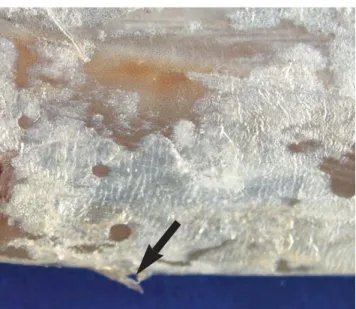
of fangs at tip of upper jaw, 9 small canines on lateral side of upper jaw; 2 pairs of fang in anterior part of lower jaw, 10 small teeth on lateral side of lower jaw; vomer toothless; margin of subopercle convex; dorsal fin single and starts above behind of preopercle, extending to near end of body; pectoral fin small, rounded and not reach- ing lateral line; pelvic fin inserting below 12th dorsal fin with a small scale-like spine (Fig. 2); origin of anal fin starts below about 48th dorsal fin ray, first anal fin is very short and second one is scale-like spine; anus locating in front of anal fin base; caudal fin absent.
Color when fresh. Body uniformly silver white; head
236 Maeng Jin Kim, Jun-Cheol Ko and Choon Bok Song
Table 1.Comparison of morphological characters of Tentoriceps cristatus
Morphological characters Present study Klunzinger (1884) Senta (1975)
Number of specimens 1 9 50
Total length (mm) 619.0 ?~418.5 283.0~633.0
Counts
Dorsal fin rays V, 131 120 (?) V, 126~144
Anal fin rays II - II, 82~91
Pectoral fin rays 11 - -
Pelvic fin rays I I I
Gill rackers 3++9 - 2~6++7~11
Vertebrae 49++112==161 - 45~48++105~117==152~164
Fig. 1.Tentoriceps cristatus, JNU-1174. 619.0 mm SL, Jeju Island, Korea.
Fig. 2.The arrow indicates a scale-like process of the pelvic fin.
and interorbital region dark; tip of both jaws black; dor- sal fin base and its terminal part black; pectoral and pelvic fin white.
Color after preservation. Coloration in 70% alcohol is very similar to that of fresh specimen.
Distribution. Known from Indo-West Pacific ocean:
Red Sea, Mozambique Channel to northern and southeast- ern Australia, Tasman Sea, Philippines, South China Sea, East China Sea, southern Japan (Nakamura and Parin, 1993; Eschmeyer, 2013) and Korea (present study).
Remarks. The morphological characteristics of the present specimen agreed well with those of Tentoriceps cristatus by having the interorbital convex, pectoral fin short and not reaching at lateral line, pelvic fin present but changed to a scale-like process and caudal fin absent (Senta, 1975; Nakamura and Parin, 1993; Nakabo, 2002).
Also, the meristic characters of the present specimen were compared with those of T. cristatus previously reported by other researcher (Table 1) although several taxonomi- cally important meristic characters of type specimen were not examined by Klunzinger (1884). The result indicated they appeared to be well matched with each other except the number of vertebrae before anus (49 in the present study vs. 45~48 in Sentra, 1975). Such an exception is likely to be due to intra-specific variation in the number of vertebrae before anus. Another thing we want to men- tion is that the anal fin rays of the present specimen were not countable because its anal fin completely buried in the skin, which is also reported in Nakamura and Parin (1993). In addition, we adopted molecular identification method based on COI DNA sequences to make sure of the accurate species identification. The result indicated that COI sequence of present specimen was almost iden- tical (99.7%) to that of T. cistatus from NCBI (data not shown). On the other hand, among 5 trichiurid fish spe- cies occurred in Korean waters, T. cristatus is morpho- logically similar in its body shape to Eupleurogrammus muticus. However, the former can be distinguished from the latter by dorsal profile of head (round vs. straight for E. muticus) and position of pelvic fin (below 9th~12th dorsal fin ray vs. 15th~17th for E. muticus) (Nakamura and Parin, 1993; Nakabo, 2002). When the Korean name for T. cistatus was given, we used “Tu-gu-gal-chi” which was previously suggested by Yamada et al. (2009) with- out a real specimen collected from Korean waters.
ACKNOWLEDGMENTS
This work was funded by a grant from the National Fisheries Research and Development Institute (RP-2014 -FR-019).
REFERENCES
Eschmeyer, W.N. (ed.). 2013. Catalog of fishes electronic version. available from: http//research.calacademy.
org/ichthyology/catalog/fishcatmain.asp.
Hubbs, C.L. and K.F. Lagler. 1964. Fishes of the Great Lake Region. Bull. Granbrook Inst. Sci., 26: 19-27.
Hutchins, J.B. 2001. Checklist of the fishes of Western Aus- tralia. Records of the Western Australian Museum Supplement, No. 63: 9-50.
Kim, M.J., J.H. Choi, T.Y. Oh, J.Y. Kim and D.W. Lee. 2012.
First record of the cutlass fishes, Benthodesmus tenuis (Perciformes: Trichiuride) from Korea. Korean J.
Ichthyol., 24: 302-305.
Klunzinger, C.B. 1884. Die Fische des Rothen Meeres. E.
Schweizerbart’sche Verlagshanding (E. Koch), Stutt- gart, ix++1-133.
Mohshin, A.K.M. and M.A. Ambak. 1996. Marine fishes and fisheries of Malaysia and neighbouring countries.
University of Pertanian Malaysia Press, Serdang, Malaysia, 744pp.
Nakabo, T. 2002. Trichiuridae. In: Nakabo, T. (ed.), Fishes of Japan with pictorial keys to the species, English edition. Tokai Univ. Press, Tokyo, pp. 1342-1345.
Nakabo, T. 2013. Trichiuridae. In: Nakabo, T. (ed.), Fishes of Japan with pictorial keys to the species, 3rd edition.
Tokai Univ. Press, Tokyo, pp. 1644-1647.
Nakamura, I. 1984. Family Trichiuridae. In: Masuda, H., K.
Amaoka, C. Araga, T. Uyeno and T. Yoshino (eds.), The fishes of the Japanese Archipelago. Tokai Univ.
Press, Tokyo, p. 109.
Nakamura, I. and N.V. Parin. 1993. FAO species catalog.
Snake mackerels and cutlassfishes of the world (fam- ilies Gempylidae and Trichiuridae). Rome, 125: 136.
Nelson, J.S. 2006. Fishes of the world. 4th edition, John Wiley and Sons, Inc., Hoboken, New Jersey, 601pp.
Randall, J.E. and K.K.P. Lim. 2000. A checklist of the fishes of the South China Sea. Raffles Bull. Zool. Suppl., 8:
569-667.
Senta, T. 1975. Redescription of trichiurid fish, Tentoriceps cristatus (Klunzinger) and its occurrence in South China Sea and the straits of Malacca. Japan. J. Ichthy- ol., 21: 175-182.
Tamura, K., D. Peterson, N. Peterson, G. Stecher, M. Nei and S. Kumar. 2011. MEGA5: Molecular evolutionary genetics analysis using maximum likelihood, evolu- tionary distance, and maximum parsimony methods.
Mol. Bio. Evol., 28: 2731-2739.
Tzeng, C.H. and T.S. Chiu. 2012. DNA barcode-based iden- tification of commercially caught cutlassfishes (Fam- First Record of Tentoriceps cristatus from Korea 237
ily: Trichiuridae) with a phylogenetic assessment.
127-128: 176-181.
Whitley, G.P. 1948. Studies in ichthyology, no 13. Rec. Aust.
Mus., 22: 70-94.
Yamada, U., M. Tokimura, K. Hoshino, S. Deng, Y. Zheng,
S. Li, Y.S. Kim and J.K. Kim. 2009. Names and illus- trations of Fishes from the East China sea and the Yellow Sea. - Japan Chinese Korean -. Overseas Fishery Cooperation Foundation of Japan, Tokyo, 784pp.
238 Maeng Jin Kim, Jun-Cheol Ko and Choon Bok Song
한국산 갈치과 어류 1 미기록종, Tentoriceps cristatus
김맹진∙고준철∙송춘복1
국립수산과학원 아열대수산연구센터, 1제주대학교 해양의생명과학부
요 약 :갈치과에 속하는 Tentoriceps cristatus 1개체(표준체장 619.0 mm)가 제주도 주변해역에서 저층트롤로 처음으로 채집되었다. 이종은 머리의 외곽이 둥근 점(유사종 분장어는 직선을 이룸), 배지느러미는 등지느러미 12 번째 기조 밑에 위치하는 점(유사종 분장어는 15~17번째 기조 밑에 위치), 등지느러미 기조수가 V, 131개, 가슴 지느러미 기조수가 11개, 배지느러미가 비늘형태로 변형된 점, 그리고 뒷지느러미의 극조수가 2개(2번째 극조는 비늘모양으로 변형됨)인 점이 특징이다. 본 종의 속명과 종명은 “투구갈치속”과 “투구갈치”로 각각 명명하였다.
찾아보기 낱말 :미기록종, 갈치과, 투구갈치, 제주도