Safflower (Carthamus tinctorius) is cultivated herbaceous annual plant of the family Asteraceae. Safflower has been widely cultivated in Korea, India, China, Egypt, Southern Europe, North America, and Australia (Lee, 1980). Safflower seeds contain α-linoleic acid, which used as cooking oil and clinically for the treatment of cataclasis, osteoporosis and rheumatoid arthritis in Korea (Kang et al., 1999; Kim, 1992; Lee et al., 2002). In addition, its flower has been utilized for folk medicine as an analgesic, antithrombotic and antihyperten- sive crude drug, as well as natural dye and food colorants (Han, 1988).
It has been reported that main pathogens on safflower are Alternaria alternata (leaf spot), Botrytis cinerea (gray mold), Colletotrichum acutatum (Anthracnose), Fusarium oxysporum (Fusarium wilt), Phytophthora cactorum (Phytophthora root
rot), Puccinia carthami (rust), Sclerotium rolfsii (collar rot), and Sphaerotheca fuliginea (powdery mildew) worldwide (Farr and Rossman, 2016). Recently, we observed wilt symptoms on saf- flower grown in green house in Jeonju, Korea, thus leading to identify the causal agent of the wilt disease in this study.
Isolation of the pathogen. Several wilted safflower were observed in May, 2015 in Jeonju, Korea. The symptoms ap- peared as brown discoloration of leaves on the lower part of stem (Fig. 1A). The infected plants were wilted with sudden dropping of leaves (Fig. 1B). Severely infected plants were covered by whitish fungal mass (arrow) (Fig. 1C). Small pieces of stem from the diseased plant were sterilized with 75% eth- anol and 1% sodium hypochlorite for 30 seconds followed by 2 times washing with sterile distilled water. They were placed onto water agar and incubated at 25
oC. After 2 days, hyphal tips of the emerging fungus were transferred onto potato dextrose agar (PDA; Difco, Sparks, MD, USA) medium to pure
©The Korean Society of Plant Pathology
cc
This is an open access article distributed under the terms of the Creative Commons Attribution Non-Commercial License (http://creativecommons.org/
licenses/by-nc/4.0/), which permits unrestricted non-commercial use, distribution, and reproduction in any medium, provided the original work is properly cited.
Open Access
Res. Plant Dis. 22(2): 111-115 (2016)
http://dx.doi.org/10.5423/RPD.2016.22.2.111
First Report of Fusarium Wilt Caused by Fusarium proliferatum on Safflower
*Corresponding author Tel: +82-63-238-4931 Fax: +82-63-238-4859 E-mail: [email protected]
Sang Gyu Kim, Ho-Cheol Ko, On-Sook Hur, Binod Prasad Luitel, Ju-Hee Rhee, Mun-Sup Yoon, Hyung-Jin Baek, Kyoung-Yul Ryu, and Jung Sook Sung*
National Agrobiodiversity Center, National Institute of Agricultural Sciences, Rural Development Administration, Jeonju 54874, Korea
Received March 29, 2016 Revised June 1, 2016 Accepted June 7, 2016
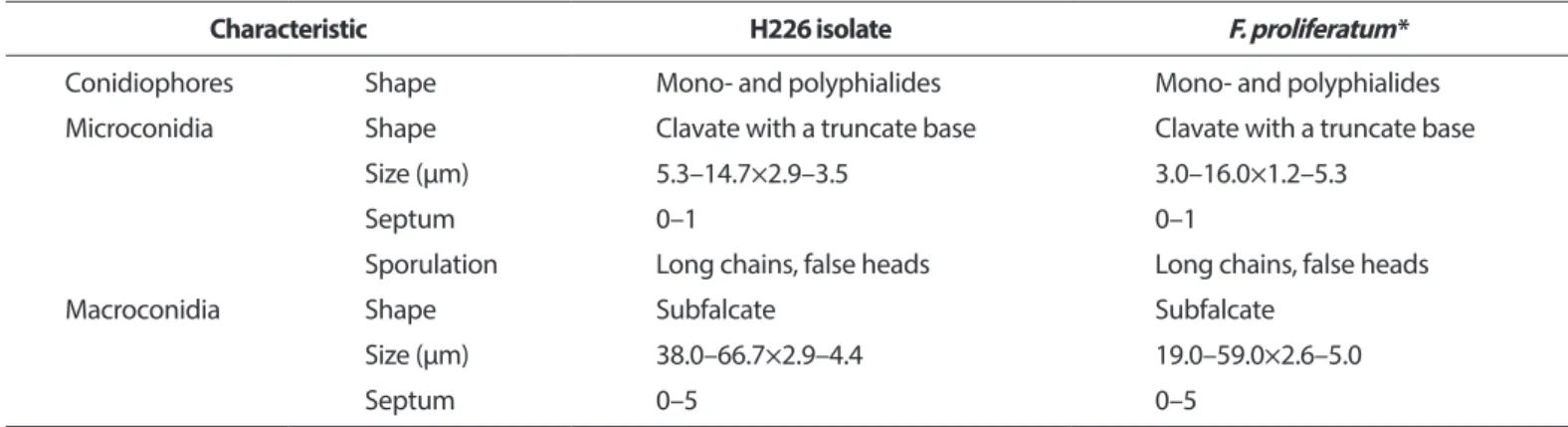
Wilt disease appeared the first in greenhouse-grown safflower (Carthamus tinctorius) in Jeonju, Korea. With the advancement of the disease, the infected plants were withered and died. In order to investigate the causal organism of this symptom disease, fungus was isolated from the infected plants and cultured on potato dextrose agar medium. The fungus showed the white or orange colony color with aerial mycelium. Macroconidia were from falcate to straight, usually 3–5 septate with 38.0–66.7×
2.9–4.4 µm. The fungus was inoculated to a new safflower plant and caused the same wilt. With morphological characters and pathogenicity results, sequence analyses (internal transcribed spacer ribosomal DNA and translation elongation factor 1α) suggested that, the isolated fungus is Fusarium proliferatum. This is the first report of Fusarium wilt disease caused by F. proliferatum on safflower in Korea.
Keywords: Carthamus tinctorius, Fusarium proliferatum, Fusarium wilt, Pathogenicity, Safflower
Research in Plant Disease pISSN 1598-2262, eISSN 2233-9191 www.online-rpd.org
식물병연구