Method of Curriculum System Design and Documentation Including General Education, MSC, and Engineering Design at Chosun University
Hyun-sun Go*․ Gil-moon Park**,†
**Innovation Center for Engineering Education, Chosun University, Korea
**Department of Mechanical Engineering, Chosun University, Korea
ABSTRACT
The curriculum system and documentation for advanced general education, MSC (Mathematics, Basic Science, Computer Science), and engineering-design courses have been developed to improve the education of advanced undergraduate students in engineering and technology at Chosun University. In this paper, to obtain improved quality of engineering courses, we systemized the education of engineering and technology, which could be designed as the education satisfying students and provide awards for high-quality performance, through efficient management of education courses and establishment of basic and professional courses. In addition, by applying evaluation to the engineering courses and using the model of continuous quality improvement, we could achieve a high-quality education system for the engineering and technology courses.
Keywords: Engineering Design, Method of Curriculum System, Documentation including
I. Introduction
1)Engineering education accreditation emphasizes both
‘performance-based’ and ‘demand-oriented’ education. The performance-based education needs to set goals at the beginning and reflect on the results for continuous im- provement in the quality, or CQI, of education. For this, closed-loop and quality assurance are needed in educational procedures and methods. It indicates that it needs ob- jectives, reasonable, periodical and documented measures, evaluation and reflection on the results to improve quality.
That is, educational goals that meet the properties of educational institutes should be developed and documented, and to achieve the goals set, organized curriculum and an administrative system to deal with them should also be established. Such educational systems should have a consistent self-assessment system through which programs can be improved. And programs should provide a series of organized curriculum that help students achieve edu- cational goals and achievements. The documented curriculum should be available to the public so that all the students
Received 30 August, 2011; Revised 5 December, 2011 Accepted 7 December, 2011
† Corresponding Author: [email protected]
can use them for development of their academic plans.
The standards for the curriculum have the following three points:
1) Curriculum should have a completion system in which antecedent, following, and parallel relations among subjects are specified instead of just a simple arrangement 2) A system to assure the order of completing subjects should be prepared which was designed to assure students can have organized knowledge as they complete their curriculum.
It should contribute to academic achievements as all the students are advised from their advisors at the point of course application and complete them in an organized way
II. Examples of Organized Subject Completion Assurance and Documentation
1. Required Completion
The educational elements required for engineering edu- cation accreditation are categorized into three: general education involved in programs, MSC and majors. Students
require more than 18 credits of general education, more than 30 of MSC, and more than 60 of major. However, design process requires more than 18 credits. Chosun University documents academic regulations to meet the accreditation standards.
Table 1 Article No. 12 of Academic Regulation of Chosun University
Divisions (departments) that implement engineering education accreditation in accordance with Section 7, Article 12 (management of curriculum) of Academic Affair Regulations can manage more than 18 credits of general education and more than 30 credits of MSC.
2. Curriculum Organization (Directions for 2009 Engineering Education Accreditation Curriculum)
The curriculum must be continuously improved to enable students to attain program outcomes and educational ob- jective upon graduation. The program must be provided an integrated curriculum consistent with program edu- cational objectives. Students should be required more than 18 credits of general education, more than 30 of MSC, and more than 60 credits of major courses. However, Engineering Design Courses are required more than 18 credits.
① The curriculum for major programs should be organized with courses that reflect the suggestions from program members(students and professors) and industries to achieve educational goals and academic performance of major programs. Therefore, the courses shall be organized and have a system of continuous quality improvement (CQI)
② For students to develop academic plans for course completion, “Major Program Curriculum Flow Chart”
should be open in public and a completion assurance system shall be developed for completion of courses in accordance with accreditation standards of the Accreditation Board of Engineering Education of Korea (ABEEK). The curriculum should be organized in con- sideration of antecedent, following and parallel relations among courses.
③ Curriculum shall be organized with more than 18 credits of introductory design (creative engineering design),
introductory design (creative engineering design) for freshman, element design for sophomore and junior students and Capstone Design 1 & 2 for Senior students
(Related Regulation –Article No. 7 of Engineering Edu- cation Innovation Center Management Regulations)
Table 2 Directions for general education, MSC, and Capstone Design
■ general education shall require more than 18 credits to achieve the educational goals and results of each major program in the pool of courses designated (Table1-1).
■ MSC shall require more than 30 credits of MSC required to achieve educational goals and results of each major program in the pools of courses designated(Table 1-2). However, computer science courses shall be less than 6 credits. (except computer engineering).
■ Capstone design shall require more than 18 credits of courses required for organized completion of introductory design (creative engineering design), element design, and Capstone Design1 and 2.
3. Documentation
A. Documentation of Course Application
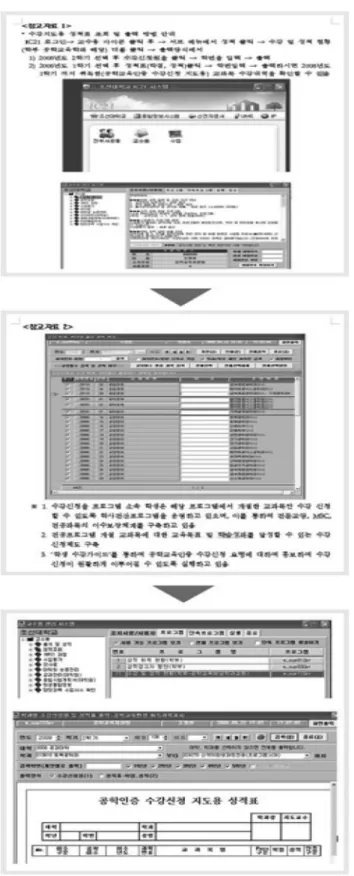
① We provide a computer system for academic affairs for students who want to submit an application for only the courses provided in each program through which completion assurance system of general education, MSC and major programs are managed
② We develop a course application system to achieve educational goals of the courses provided in each major program and academic achievements
③ We promote how to apply courses of engineering education accreditation through ‘Course Guide’ for better course application.
B. Documentation of Lesson Plan, Curriculum Portfolio and CQI
① In cases when the organization of “2009 Curriculum Organization Chart” violates the regulations, it shall not be input to the academic affairs program.
② When professors, who teach general education and MSC, neglect the organization of their curriculum portfolio, major programs can report neglect of instructors to managing departments and incentives for the portfolio
Fig. 1 Course Application Procedure
Table 3 Article No. 28 of Academic Regulations of Chosun University (How to apply for courses)
Students who belong to divisions (departments) which implement engineering education accreditation in accordance with Article No.
28 of the Academic Regulations shall apply courses for the online accreditation system based on instructions from advisors according to curriculum completion system required for the accreditation and submit the list of courses applied to the chief professor of divisions (departments) via confirmation from their advisors.
Table 4 Contract for Part-time Instructors of Chosun University
Part-time instructors who teach engineering students in accordance with Section 4, Article 3 of the contract of part-time teachers shall develop the curriculum portfolio required by each department.
For this, an allowance of 200,000 won a semester shall be provided to the instructors.
③ To develop the curriculum portfolio and CQI reports that reflect the educational goals and academic ac- hievements required for general education and MSC, duties shall be listed on contracts of part-time instructors and an incentive of 200,000 won a semester shall be given to them.
④ As introduction of liberal arts and MSC is managed by full-time instructors of other colleges or departments in consideration of the conditions of this university, the results of accreditation activities shall be reflected in their performance evaluation to enhance quality of engineering education accreditation.
4. Reflection for Educational Improvement
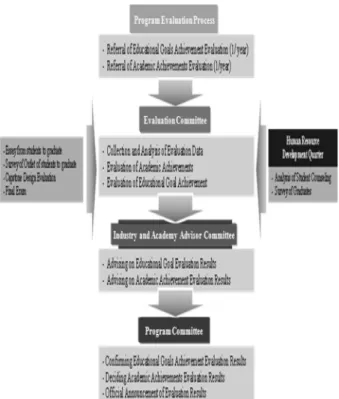
To assess academic achievements in each program, we improved rubrics and methods of assessment and gave academic assessment to students to graduate. Then we analysed the results and collected basic data for im- provement. Based on the results of the improvement, we revised management regulations for each program for evaluation tools and rubrics and the revision procedure was displayed on the home-page of Chosun University after a discussion between department heads of the college of engineering and we received approval from the president.
Fig. 2 Mechanical Engineering Program Evaluation Process
Fig. 3 program Educational Outcomes
III. Conclusion
Chosun University has organized and institutionalized general education, MSC, and engineering design and de- veloped a system for quality enhancement of continuing education involved in “performance-based education” and
“demand-oriented education” for engineering education
documented educational goals that meet the properties of educational institutes and developed an organized curri- culum to achieve the goals. And we have had administrative systems to deal with them and managed a consistent self-assessment system. It is sure that our engineering education has had enhanced the quality of engineering education and created an education system with international equivalence.
This study was supported by research fund from Chosun University, 2009.
References
1. Accreditation Board for Engineering Education of Korea,
“Engineering certification standards(KEC 2005)”.
2. Chosun University, Engineering Education Self-Assessment Report 2010.
3. Woongsup Kim(2011). A Formative Assessment Based Capstone Design Course for Improving Program Learning Outcomes. Joural of Engineering Education Research, 13(1):
62-69.
4. Sung-Ku Cho, Eue-Su Lee, Yong-Han Lee, Myoung-Chun Lee, Se-Kyoung Youm(2008). Activation Strategy of Engineering Interdisciplinary Design through Abroad Case.
Joural of Engineering Education Research, 11(1): 117-125.
5. Cha Sung Woon, Kim Dae-eun, Lee Soo-hong, Lee Kyung Soo and Kim Minsoo(2007). Engineering Design Education based on Three Essential Design Technology Factors.
Joural of Engineering Education Research, 10(4): 5-16.
Hyun-sun Go
Associate Researcher, Innovation Center for Engineering Education, Chosun University
Ph.D. in Mechanical Eng. Chosun Univ. in 2010 Phone: 82-62-230-7903
Fax: 82-62-230-7642 E-mail: [email protected]
Gil-moon Park
Professor, Mechanical Engineering Dept., College of Engineering, Chosun University Ph.D. in Mechanical Eng. Korea Univ. in 1987 Phone: 82-62-230-7640
APPENDIEX 1 Process and Documentation of Engineering Design Curriculum System
Organzation Process Contents Documentation
(Related Regulation, Appendix)
Required Courses for General Education
▪ Section 7, Article 12 of Academic Affairs Regulation (Curriculum Management)
- Divisions (Departments) that implement engineering education accreditation in accordance with Section 7, Article 12 (management of curriculum) of Academic Affairs Regulations can manage more than 18 credits of General Education and more than 30 credits of MSC.
▪ Academic Affairs Regulations
Ð
General Education Curriculum
▪ Directions for the 2009 Engineering Education Accreditation Curriculum
1) The General Education program requires more than 18 credits to achieve the educational goals and results of each major program in the pool of courses designated (Table1-1).
2) General Education (Example of Mechanical Engineering Program) Law & Contemporary
Society Thinking and Writing College English English
Conversation1
Environment and Pollution
Management and Engineers English
Conversation2
Report Writing &
Presentation
▪ Directions for 2009 Engineering Education Accreditation Curriculum
▪ 2009 Mechanical Engineering Program List
▪ General Education Flow Chart in the Mechanical Engineering Program
Ð
Documentation of Course Appplication (Course Guide and Instruction)
▪ Section 1, Article 28 of Academic Affairs Regulations (Course Application)
- Students who belong to Divisions (Departments) which implement engineering education accreditation in accordance with Article No. 28 of the Academic Regulations shall apply courses for the online accreditation system based on instructions from advisors according to curriculum completion system required for the accreditation and submit the list of courses applied to the Chairman of Divisions (Departments) via confirmation from their advisors.
▪ Course Guide (Completion Requirements)
- Engineering Education Accreditation Completion Requirements (p.64)
▪ Academic Affair Regulations
▪ Course Guide Book
▪ Application Form(student)
▪ Course Approval(professor)
Ð
Documentation of syllabus, Course Portfolio,
and CQI
▪ Full-time Instructors
1) Course Portfolio: points of research activities 2) Student Counselling: service points
3) Major program self-evaluation report: points of research activities
▪ Part-time Instructors
- Section4, Article 3 of Part-time Instructor Contract . Part-time instructors who teach engineering students in
accordance with Section 4, Article 3 of the contract of part-time instructors shall develop the Course portfolio required by each Department. For this, an allowance of 200,000 won a semester shall be provided to the instructors.
▪ Part-time Instructor Contract
▪ Research Activities Regulations
▪ Lesson Plan Sample
▪ CQI Sample
Ð
Statistics and Analysis of Course Application General Education W/S
▪ General Education WORKSHOP
1) Efficient Development of lesson plans, Course portfolio, and CQI 2) Improvement in educational goals and academic achievements
evaluation
3) Improvement in how to teach General Education
▪ Liberal Arts WORKSHOP Data
▪ Analysis Data of Contribution of Liberal Arts to PO
Ð
Feedback for Educational Improvement
▪ CQI of Each Major Program
▪ Engineering Education Policy CQI By Innovation Center of Engineering Education
▪ CQI Sample of Major Programs
▪ CQI Sample of Engineering Education Policy
APPENDIEX 2 Process and Documentations of MSC Curriculum System
Organization Process Contents Documentation
(Related Regulation, Appendix)
Required Courses for MSC
▪ Section7, Article 12 of Academic Affairs Regulations(Curriculum Management)
- Division (Departments) that implement engineering education accreditation in accordance with the accreditation standards of ABEEK can manage more than 18 credits of General Education and more than 30 credits of MSC.
▪ Academic Affairs Regulations
Ð
Curriculum Organization
▪ Directions for 2009 Engineering Education Accreditation Curriculum 1) MSC shall require more than 30 credits of MSC required to
achieve educational goals and results of each major program in the pool of courses designated (Table1-2). However, computer science courses shall be less than 6 credits(except computer engineering).
2) MSC Courses (Example of Mechanical Engineering Program)
code completion code Course
Math
MSC required Calculus
MSC required Linear algebra MSC required Engineering Math 1 MSC required Engineering Math 2 MSC required Numerical Analysis
Basic Science
MSC required General Physics 1 MSC required Physics Laboratory 1 MSC required Physics Laboratory 2 MSC required General Physics Laboratory 2 MSC required General Chemistry MSC required Chemistry Lab Computer
Science
MSC required Programming Language & LAB1 MSC required Programming Language & LAB2
▪ Directions for 2009 Engineering Education Accreditation Curriculum
▪ 2009 Mechanical Engineering Program Curriculum
▪ MSC of Mechanical Engineering Program
Ð
Documentation of Course Application (Course Guide and Advising)
▪ Section 1, Article 28 of Academic Affairs Regulations (Method of Course Application)
- Students who belong to Divisions (Departments) which implement engineering education accreditation in accordance with Article No. 28 of the Academic Affairs Regulations shall apply courses for the online accreditation system based on instructions from advisors according to curriculum completion system required for the accreditation and submit the list of courses applied to the Chairman of Divisions (Departments) via confirmation from their advisors.
▪ Course Guide (Curriculum Completion Requirements) - Engineering Accreditation Completion Requirements(p.64)
▪ Academic Affairs Regulations
▪ Course Guide Book
▪ Application Form for students
▪ Course Approval for professors
Ð
Documentation of syllabus, Course Portfolio,
and CQI
▪ Full-time Instructors
1) Course Portfolio: __ points of research activities 2) Student Counselling: __ of service points
3) Major program self-evaluation report: __points of research activities
▪ Part-time Instructors
- Section 4, Article 3 of Part-time Instructor Contract . Part-time instructors who teach engineering students in
accordance with Section 4, Article 3 of the contract of part-time instructors shall develop the Course portfolio required by each Department. For this, an allowance of 200,000 won a semester shall be provided to the instructors.
▪ Part-time Instructor Contract
▪ Regulations on Research Activities
▪ Lesson Plan Sample
▪ CQI Sample
Ð
Course Application Statistics and Analysis MSC Instructors W/S
▪ MSC Instructor WORKSHOP
1) Efficient Development of lesson plans, curriculum portfolio, and 2) Improvement in educational goals and academic achievements CQI
evaluation
3) Improvement in methods of teaching MSC
▪ MSC Instructors WORKSHOP Data Collection
▪ Analysis Data of Contribution of MSC to PO
Ð
Feedback for Educational ▪ CQI of Each Major Program ▪ Major Program CQI Sample
APPENDIEX 3 Process and Documentation of Engineering Design Curriculum System
Organzation Process Contents Documentation
(Related Regulation, Appendix)
Required Courses for Engineering Design
▪ Article 7 on Engineering Education Innovation Center Management Regulations
- Curriculum shall be organized with more than 18 credits of introductory design (creative engineering design), engineering design, and Capstone design as required: introductory design (creative engineering design) for freshman, element design for sophomore and junior students and Capstone Design 1&2 for Senior students (Related Regulation –Article No. 7 of Engineering Education Innovation Center Management Regulations)
▪ Engineering Education Innovation Center Management Regulations
Ð
Organization of Engineering Design Curriculum
▪ Directions for 2009 Engineering Education Accreditation Curriculum 1) Engineering Design shall require more than 18 credits of courses required for organized completion of introductory design (creative engineering design), element design, and Capstone Design 1 and 2.
2) Engineering Design Courses (example of mechanical engineering program)
Code course title design code
Required Capstone Design Introductory Design Required Fluid System Design Element Design Required Mechatronics Design Element Design Required Mechanical Design 2 Element Design Required Thermal System Design Element Design Required CAPSTONE DESIGN 1 Capstone Design Required CAPSTONE DESIGN 2 Capstone Design
▪ Directions for 2009 Engineering Education Accreditation Curriculum
▪ 2009 Mechanical Engineering Program Curriculum
▪ Engineering Design Curriculum Flow Chart of Mechanical Engineering Program
Ð
Documentation of Course Application (Course Guide and Instruction)
▪ Section1, Article 28 of Academic Affairs Regulations (Course Application)
- Students who belong to Divisions (Departments) which implement engineering education accreditation in accordance with Article No. 28 of the Academic Affairs Regulations shall apply courses for the online accreditation system based on instructions from advisors according to curriculum completion system required for the accreditation and submit the list of courses applied to the Chairman of Divisions (Departments) via confirmation from their advisors.
▪ Course Guide (Curriculum Completion Requirements) - Engineering Education Accreditation Course Completion
Requirements(p.64)
▪ Full-time Instructors
1) Course Portfolio: __ points of research activities 2) Student Counselling: __ points of student counselling 3) Major program self-evaluation report: __ points of research
activity
▪ Part-time Instructors
- Section4, Article 3 of Part-time Instructor Contract . Part-time instructors who teach engineering students in
accordance with Section 4, Article 3 of the contract of part-time instructors shall develop the Course portfolio required by each Department. For this, an allowance of 200,000 won a semester shall be provided to the instructors.
▪ Academic Affairs Regulations
▪ Course Guide Book
▪ Application Form for student
▪ Course Approval for professor
Ð
Documentation of Syllabus, Course Portfolio,
and CQI
▪ Syllabus of Engineering Design shall include design project plans, directions, and design evaluation sheets.
▪ Part-time Instructor Contract
▪ Regulations on Research Activities
▪ Syllabus Sample
▪ CQI Sample
▪ Management Directions for Department Rules([Capstone Design])
Ð
Course Application Statistics and Analysis Engineering Design Instructors
W/S
▪ Engineering Design instructors WORKSHOP
1) Efficient Development of Syllabus, Course portfolio, and CQI 2) Improvement in educational goals and academic achievements
evaluation
3) Improvement in methods of teaching engineering design
▪ Engineering Design Professors WORKSHOP Data
▪ Analytical Data of Contribution of Major Program to PO Ð
Feedback for Educational Improvement
▪ CQI Development of Each Major Program
▪ CQI Development of Engineering Education Policy by Innovation Center of Engineering Education
▪ CQI Sample of Major Programs
▪ CQI Sample of Engineering Education Policy