식물병연구
Res. Plant Dis. 17(3) : 399−401 (2011)
Research in Plant Disease
© The Korean Society of Plant Pathology
Sclerotium rolfsii에 의한 초석잠 흰비단병
권진혁*·강동완·이성태·최옥희1·신순선2
경상남도농업기술원, 1경상대학교 응용생물학과, 2중국 하남농업대학교
Stem Rot of Stachys sieboldii Caused by Sclerotium rolfsii in Korea
Jin-Hyeuk Kwon*, Dong-Wan Kang, Seong-Tae Lee, Okhee Choi1 and Shun-Shan Shen2 Gyeongsangnam-do Agricultural Research and Extension Services, Jinju 660-360, Korea
1Department of Applied Biology, Gyeongsang National University, Jinju 660-701, Korea
2College of Plant Protection, Henan Agricultural University, Zhengzhou 450002, China (Received on September 16, 2011; Revised on November 1, 2011; Accepted on November 3, 2011)
Stem rot of Stachys sieboldii occurred sporadically in the farmer's fields at Shindeung-myeon, Sancheong- gun, Gyeongnam province in Korea. The infected leaves and stems are water-soaked, rotted, wilted and finally leads to the death of the whole plants. The sclerotia, 1−3 mm, white to brown, globoid, were formed on lesions and the surface of soil line. The optimum temperature for mycelial growth and sclerotia formation was 30oC on potato dextrose agar. The typical clamp connections were observed in the hyphae of the fungus. On the basis of mycological characteristics and pathogenicity to host plants, this fungus was identified as Sclerotium rolfsii Saccardo. This is the first report of stem rot on S. sieboldii caused by S. rolfsii in Korea.
Keywords : Sclerotium rolfsii, Stachys sieboldii, Stem rot 초석잠(Stachys sieboldii Miq.)은 꿀풀과(Labiatae)에 속 하는 다년생 초본식물로서 습윤한 곳이나 물가에 잘 자 라고 감위, 심통, 자양강장 등에 이용되며 덩이줄기는 식 용으로 이용한다(Kim, 1998).
경상남도 산청군 신등면 농가포장에 재배중인 초석잠 이 서서히 시들어 말라 죽는 이상증상이 발생하여 농가 로부터 임상진단 의뢰를 받았다. 포장에서 병든 식물체를 관찰한 결과 초석잠의 줄기 부위에 흰색의 곰팡이와 갈 색의 작은 둥근 균핵이 관찰되었다. 병든 식물체를 채집 하여 병원균을 순수 분리하고 균학적 특징을 조사한 결 과 Sclerotium sp.에 의한 초석잠 흰비단병으로 의심되었다.
지금까지 우리나라에서 초석잠에 발생하는 병해는 Botrytis cinerea에 의한 잿빛곰팡이병 1종이 보고(Kwon 등, 2006) 되어 있을 뿐 흰비단병에 대한 발생은 보고된 바 없었다 (The Korean Society of Plant Pathology, 2009). 따라서 본 연구에서 초석잠에 발생한 흰비단병의 병징, 병원균의 균
학적 특징 및 병원성 조사결과를 보고한다.
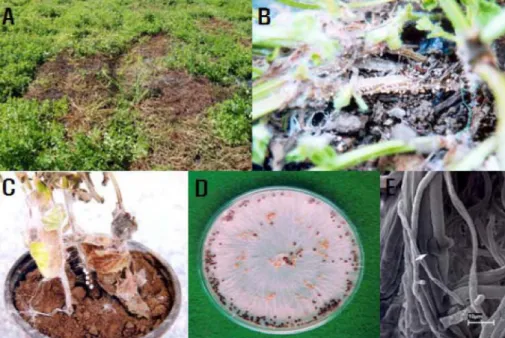
병징. 초석잠의 줄기에 발생하며 병든 부위는 수침상으 로 물러지고 썩으면서 식물체 전체 생육이 불량하여 서 서히 시들어 말라 죽는다(Fig. 1A). 병든 식물체의 줄기 와 잎에 흰색의 곰팡이가 생기고 갈색의 작은 둥근 균핵 을 형성하였다(Fig. 1B).
발생환경. 2011년 6월 하순 경상남도 산청군 신등면 농 가포장에 재배중인 초석잠에서 흰비단병이 군데군데 발 생하여 시들어 말라 죽었다. 생육 초기에는 초석잠 줄기 가 위로 곧게 자라 통풍과 채광이 좋을 경우 흰비단병 발 생이 적었지만, 생육중기 이후 식물체가 성장함에 따라 군락 내 온도와 습도가 알맞게 유지되고 채광이 좋지 않 는 상태에서 지제부위의 줄기에 발생하여 피해를 주는 것 으로 관찰되었다.
균학적 특성. 초석잠에서 발생한 흰비단병의 병원균을 분리하기 위하여 병든 식물체를 채집하여 건전부와 병든 부위의 줄기 경계 부분에 5 × 5 mm 크기로 30개 자른 다 음 1% 차아염소산나트륨(NaOCl) 용액으로 1분간 표면소 독한 후 멸균수에 3회 세척을 하였다. 클린벤치 안에서 물기를 제거한 후 일회용 페트리디쉬 안에 넣고서 다시
*Corresponding author
Phone) +82-055-771-6423, Fax) +82-055-771-6419 E-mail) [email protected]
http://dx.doi.org/10.5423/RPD.2011.17.3.399 Note Open Access
400 권진혁·강동완·이성태·최옥희·신순선
24시간 보관하였다. 감자한천배지(PDA) 위에 옮겨 30oC 항온기내에서 4일간 배양한 후 자라 나온 균사를 다시 PDA배지 위에 옮겨 12일 배양하여 병원균의 균학적 특 성을 조사하였다(Table 1).
PDA배지 위에서 균총은 흰색의 균사가 솜털처럼 자라 며 균핵 시원체가 형성되고 배양시간이 길어짐에 따라 갈 색의 작은 둥근 균핵을 많이 형성하였다(Fig. 1D). 균핵 의 표면은 광택이 있고 크기는 1−3 mm 이였다. 균사생 육 및 균핵 형성 적온은 30oC였다. 6일간 배양한 균총을 가지고 균사특유의 clamp connection 형태를 관찰하였으 며(Fig. 1E) 균사의 폭은 4−9 µm이었다.
병원성 검정. 초석잠에 대한 병원성을 검정하기 위하여 2011년 7월 중순에 경남 함양군 안의면 경남농업기술원 약초연구팀에서 이색비닐폿트(10 × 7 × 9 cm)에 재배중인
건전한 식물체 6포기를 가지고 병원성을 검정하였다. 접 종원은 6월 상순에 토양 3 kg을 가는 체(2.0 mm)로 거른 다음 121oC 고압살균기에 30분 살균한 다음 꺼내어 같은 방법으로 5일 간격 3회 살균하였다. 감자한천배지에 7일 간 배양한 후 배지로부터 균총 30개를 수거하여 플라스 틱 통(56 × 35 × 13 cm)에 넣고 살균한 토양 3 kg과 섞은 다음 손으로 골고루 잘 마쇄하였다. 온실에서 20일간 잘 건조시키면서 잘게 마쇄한 후 온실 내 보관하였다. 접종 전 포트 내 토양이 건조하지 않게 하기 위해 포트 당 물 50 ml씩 주고서 만들어 놓은 전염원을 50 g씩 접종한 후 실험실에 격리 재배하여 발병을 유도하였다. 접종 3일후 초석잠의 줄기와 잎이 수침상으로 물러지고 부패되어지 면서 시들어져 말라 죽었다. 흰색의 균사와 갈색의 작은 둥근 균핵을 형성하여 흰비단병 특유의 병징이 나타났다 Fig. 1. Symptoms of stem rot of Stachys sieboldii and mycological characteristics of the pathogenic fungus, Sclerotium rolfsii. (A) The infected plant eventually died in the field; (B) The typical symptom of stem rot of S. sieboldii with the severely infected and cracked stems and leaves; (C) Symptoms induced by artificial inoculation; (D) Mycelial mats and sclerotia produced on PDA after 12 days of incubation; (E) Scanning electron microscopy of clamp connections (arrow).
Table 1. Comparison of mycological characteristics of the present isolate obtained from Stachys sieboldii and Sclerotium rolfsii Characteristics Present isolate S. rolfsiia
Colony color white white
Hypha size (µm) 4−9 4.5−9
clamp connection present present
Sclerotium shape globoid spherical
size (mm) 1−3 1−2
color white to brown brown
aDescribed by Mordue (1974).
Sclerotium rolfsii에 의한 초석잠 흰비단병 401 (Fig. 1C).
이상과 같이 초석잠에서 분리한 병원균의 균학적 특성 을 조사한 결과, Mordue(1974)가 보고한 S. rolfsii와 일치 하였으며, 최근에 Kwon(2010a)이 보고한 해바라기 흰비 단병, Kwon(2010b)이 보고한 마늘 흰비단병, Kwon 등 (2011)이 보고한 은방울꽃 흰비단병의 병징과 균학적 특 징이 일치하였다. 따라서 이러한 연구 결과를 가지고 이 병을 S. rolfsii Saccardo에 의한 초석잠 흰비단병으로 명 명하고자 한다.
요 약
경남 산청군 신등면 농가포장에 재배중인 초석잠에서 Sclerotium rolfsii에 의한 흰비단병이 발생되었다. 병징은 줄기와 잎이 수침상으로 물러지고 썩으면서 서서히 시들 어 말라 죽었다. 병반부와 지제부의 토양 표면에 흰색의 곰팡이가 발생하고 갈색의 작은 둥근 균핵을 많이 형성 하였다. 균핵의 크기는 1−3 mm이며 균사의 폭은 4−9 µm 였다. 균사특유의 clamp connection이 관찰되었다. 균사생 육과 균핵형성 적온은 30oC이었다. 이와 같이 초석잠에 서 발생한 병징과 병원균의 균학적 특징을 근거로 하여 이 병을 S. rolfsii Saccardo에 의한 초석잠 흰비단병으로 명명하고자 제안한다.
Acknowledgement
This work was carried out with the support ofCooperative Research Program for Agriculture Science
& Technology Development (Project No. PJ007345), Rural Development Administration, Korea.
References
Kim, J. C. 1998. Chinese medical dictionary. Jungdam. 5930 pp.
(In Korean)
Kwon, J. H. 2010a. Occurrence of stem rot of sunflower (Helianthus annuus) caused by Sclerotium rolfsii. Res. Plant Dis. 16: 323−325. (In Korean)
Kwon, J. H. 2010b. Stem rot of garlic (Allium sativum) caused by Sclerotium rolfsii. Mycobiology 38: 156−158.
Kwon, J. H., Jin, Y. M., Bae, S. M., Jeong, E. H., Ryu, J. S. and Kim, M. K. 2006. Occurrence of gray mold of Stachys sieboldii caused by Botrytis cinerea. Kor. J. Mycol. 34: 122−
124. (In Korean)
Kwon, J. H., Lee, H. S., Kang, D. W. and Kwack, Y. B. 2011.
Stem rot of Convallaria keiskei caused by Sclerotium rolfsii.
Kor. J. Mycol. 39: 145−147. (In Korean)
Mordue, J. E. M. 1974. Sclerotium rolfsii. CMI descriptions of pathogenic fungi and bacteria. No. 410. Commonwealth Mycological Institute, Kew, Surrey, England.
The Korean Society of Plant Pathology. 2009. List of plant diseases in Korea, 5th ed. 853 pp. (In Korean)