• 검색 결과가 없습니다.

A Study of an Efficient ZigBee Address Assignment Scheme for Home Area Networks of Smart Grid

N/A
N/A
Protected

Academic year: 2021

Share "A Study of an Efficient ZigBee Address Assignment Scheme for Home Area Networks of Smart Grid"

Copied!
11
0
0

로드 중.... (전체 텍스트 보기)

전체 글

(1)

Journal of Korea Multimedia Society Vol. 16, No. 5, May 2013(pp. 566-576) http://dx.doi.org/10.9717/kmms.2013.16.5.566

A Study of an Efficient ZigBee Address Assignment Scheme for Home Area Networks of Smart Grid

Dongmin Choi

, Ilyong Chung

††

ABSTRACT

In Home Area Network (HAN) of the smart grid, Power Line Communication (PLC) technology and ZigBee communication technology can be used in the communication among the Advanced Metering Infrastructure (AMI) devices. However, according to performance evaluation results of the PLC technol- ogy, we find that using the PLC technology is unsuitable for the remote meter reading service. It is worth noting that some parts of the PLC are converted to the ZigBee communication technology in Jeju, Korea. Compared with PLC, ZigBee has no restriction of the place, where the equipments can be freely set up, due to the advantage of radio communication. However, number of usable devices will impact the network performance which is depended on the address assignment. In addition, due to the restriction of transmission range among devices, it is difficult to apply the ZigBee address assignment method to the practical circumstance. In this paper, we examine the previous ZigBee address assignment schemes and the corresponding routing algorithms, and propose a novel address assignment scheme compared with the existing methods, the performance of the proposed one is improved. In particular, evaluation results show that the proposed scheme reduces the average number of hop count, the transfer time and the processing time.

Key words: zigbee address, home network, smart grid

※ Corresponding Author : Ilyong Chung, Address : Dept. of Computer Engineering, Chosun University, 375 Seosuk-dong, Dong-gu, Gwangju 501-759, South Korea, TEL : +82-62-230-7712, FAX : +82-62-230-7754, E-mail

: [email protected]

Receipt date : Dec. 20, 2012, Revision date : Feb. 28, 2013 Approval date : Mar. 26, 2013

††

Department of Computer Science, Chosun University (E-mail: [email protected])

††
Department of Computer Science, Chosun University

※ This work was supported by the research fund from Chosun University, 2012. An earlier version of this paper [14] was presented at the conference of Korean institute of smart media, Jeju University, April 19-20, 2012.

1. INTRODUCTION

Smart grid is the next-generation power grid where the power supplier and consumer exchanges the information with bidirectional on a real-time basis and optimizes the energy efficiency [1]. When we consider the countryside where people are liv- ing in sparse area, Power Line Communication (PLC) technology has a problem to support fre-

quent multiplex signal of Advanced Metering Infrastructure (AMI) devices because of line speed limitation and line quality limitation. Thus, for maintain the link quality additional devices are required. In the case of ZigBee communication technology[2], has no restriction of the place, where the equipments can be freely set up and communicate each other within wireless communi- cation coverage without support of additional de- vices, due to the advantage of radio communication. Thus, many researchers proposed the applications [3-7] based on the basic ZigBee communication scheme. However, the number of usable devices, will impact the network perform- ance which is depended on the address assignment [8-11]. In addition, due to the restriction of trans- mission range among devices, it is difficult to apply the ZigBee address assignment method to the practical circumstance.

The rest of this paper is organized as follows.

(2)

Section 2 introduces some address assignment schemes based on ZigBee tree network. Section 3 explains our scheme in detail, and Section 4 eval- uates the performance of the proposed scheme in terms of average number of hop count, transfer time, and processing time. Finally, we conclude the paper in Section 5.

2. RELATED WORK

2.1 Distribute Address Assignment & Tree Routing Algorithm

The devices of ZigBee network are assigned their own network addresses by the distributed ad- dress assignment method (BAAM). Suppose that, the maximum number of child nodes is 

, the maximum number of child routers is 

, and the depth of the network is 

. We may compute the children’s address pool for each node according to the algorithm. Note that   is used to derive the starting address of its children’s address pool.

  for the coordinator or a router in depth  is defined as:

  

  

 

  

   

  

 

 

· 

   

 if 

 



(1) In addition, the parent node with depth d assigns 16bit address to the nodes who want to establish the connection with the parent node by equation (2) below.

 

 

   ×  (2)

Where 

denotes the address assigned to the new node, 

  

denotes the address of the parent node and denotes the number of routers of the parent node.

As we know, tree routing is a simple scheme in which data can be delivered to the parent node or child node. When a node receives data, it checks the destination information. If the destination in- formation does not match, the node checks its child

nodes addresses in order to match the destination information until meet the end point by equation (3).

  



      (3) Where  denotes address of node itself and 



denotes destination address. If 



satisfies above condition, the packet is delivered to the next ad- dress calculated by equation (4), where 

denotes the address of the node where the packet will be delivered.

 

   ⌊

 



    

⌋×   (4)

2.2 Orphan node & networks expansion limitation problem

Fig. 1 shows an example of the orphan node problem in ZigBee distribute address assignment.

Node  tries to join the network as a child node of node 7 or 10. However, node 7 cannot assign the address since the number of child node has be- come 5 already. Note that the maximum number of child node is 5. In addition, Node 10 cannot has a child node either, since the maximum depth of the tree topology is 2. Therefore, node  becomes orphan node.

In this case, when the connection of the node is concentrated on the partial domain of the tree, due to the restriction of the topology, even if the address field remains, the orphan node is generated.

It is easily concluded that the maximum number of node participating in the network is 65,536 in the ZigBee network since the address uses 16 bits.

In addition, if this network is expanded to the max- imum length by using distribute address assign- ment scheme, the maximum depth becomes 15.

We assume that the maximum communication

distance of the node is 30 . Hence, the limitation

of connectable distance is 450 . This limitation

problem makes the application difficult. Therefore,

this scheme is difficult to apply to the smart grid

network environment.

(3)

568 JOURNAL OF KOREA MULTIMEDIA SOCIETY, VOL. 16, NO. 5, MAY 2013

Fig. 1. Orphan problem  

  

  

 

Fig. 2. Network layer frame format 2.3 Coordinate based address assignment

method

In order to resolve the problem of the limitation

of the connectable distance of the distribute ad-

dress assignment, coordinate based address as-

signment method (CBAAM) was proposed in [12,

(4)

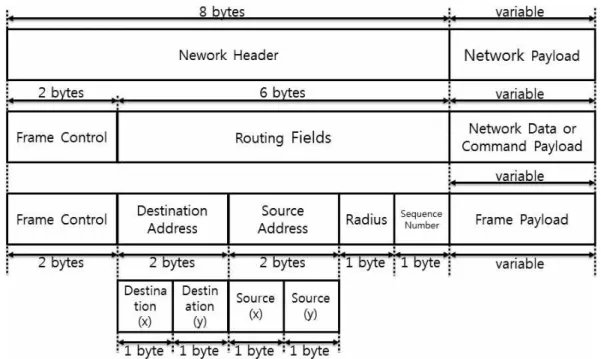
13]. As shown in Fig. 2, CBAAM improves the ad- dress space of the double-byte allocated to the destination and source addresses in the frame for- mat of ZigBee network layer which can use the

 and -axis of the node.

By utilizing two dimension coordinates, CBAAM assigns addresses to nodes. 8-bit is allocated to and -axis and these address field is used as the address of the node.

According to the research results, this method shows the number of hop count and operation speed is more efficient in comparison with the DAAM. Moreover, if the maximum communication distance of the node is assumed as 30 , the max- imum connectable distance is suitable for the wide area network where the distance can reach to 7.6

 .

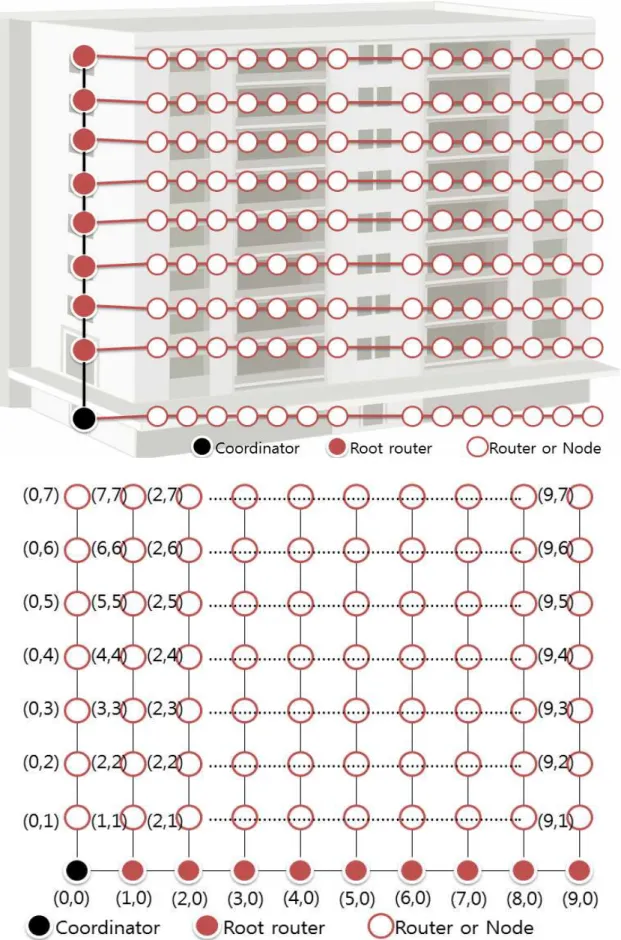
Fig. 3 shows a building or apartment environ- ment of HAN. In this case, ZigBee network devices are able to obtain their own ids by the combination of the , -coordinates. Parent nodes, such as a coordinator and root routers, connect with their child nodes directly or indirectly by their following

 s. This scheme assigns - coordinates ad- dresses (1 to 255, 1 to 255) to nodes sequentially.

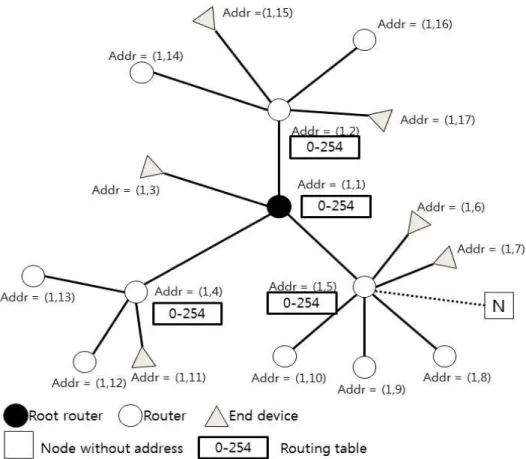
When direct connection of the node is impossible for a root router, a router can be additionally con- nected with the root router as a child node. In this case, the root router and routers know all the re- maining addresses.

In order to assign addresses to the freshly added nodes, the root router and routers have to maintain the address table. In the worst case, the root router and routers should manage 255 nodes addresses, which are shown in Fig. 4.

3. PROPOSED SCHEME

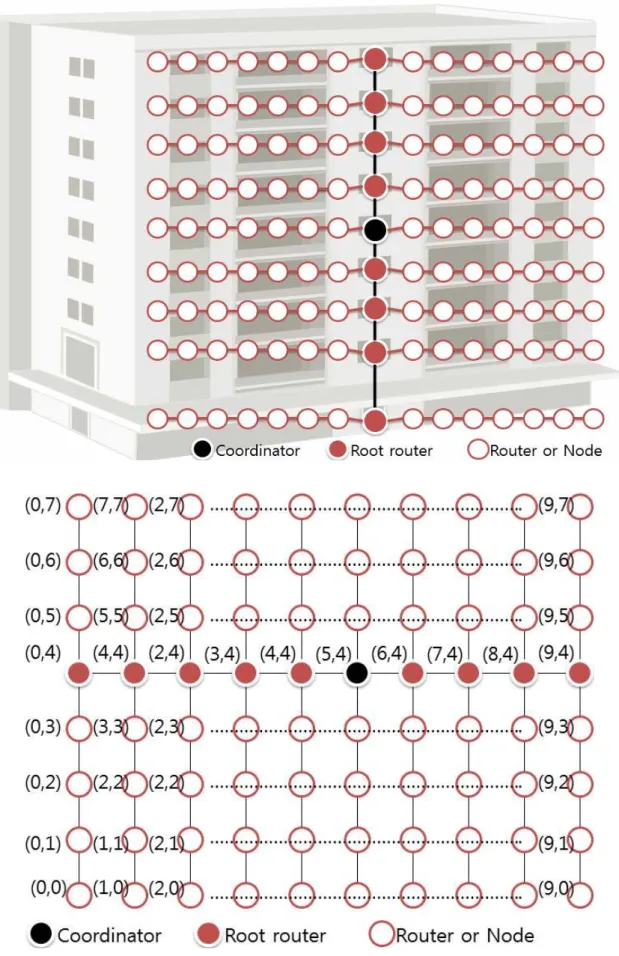
In order to improve routing efficiency, transfer speed and network congestion, the proposed scheme modifies the coordinate-based address as- signment method. Fig. 5 depicts our address as-

signment scheme in detail, which can be applied to the building or apartment structure.

Different from the previous scheme, proposed method predefines the location of the coordinator and root routers in the intermediate area of the network. For example, the network address is as- signed to the nodes from to  , then 

indicates the coordinator, and  or  in- dicates root routers. Address  can be expressed using the binary number   . Based on this value, a big or small address is assigned to the child node by turns. In our scheme, thus, the num- ber of hop count of the packet transmission is shortened than that of the previous method. In ad- dition, the capacity of the routing table is also shortened.

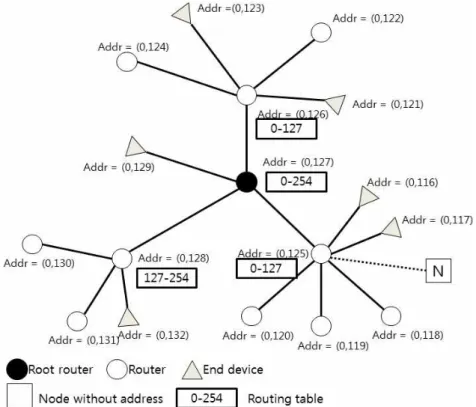
As in Fig. 6, in order to assign addresses to freshly added nodes, the root router and routers have to maintain the address table. In the worst case, however, the root router and routers manage 127 nodes addresses and this address capacity is only 50% compared with that of the existing scheme. We explain the differences with the CBAAM in below.

•Root router has the address of  or

 . And a router connected to the root router is assigned the small or big number of address based on the address of the relevant root router.

•A node requesting the connection to a router is sequentially assigned address from to 

when the router address is smaller than  . And address is bigger than  , address is assigned from  to  .

The later procedure is identical with the sequen- tial address assignment.

As shown in Fig. 6, node  can be assigned ad- dress from to  since the router address is less than  . Thus, the address space assigned to the node is from  . Therefore, the node is assigned

 .

The existing coordinate based address assign-

ment scheme indicates that routing is possible

(5)

Fig. 3. Example of connected node in HAN and address assignment.

570 JOURNAL OF KOREA MULTIMEDIA SOCIETY, VOL. 16, NO. 5, MAY 2013

(6)

Fig. 4. Example of router and node address assignment.

through the comparison of or coordinates of the destination address. Thus, coordinate based scheme was  bits for address comparison, while the distribute address assignment scheme was 

bits. As shown in Fig. 7, the proposed scheme is possible that route search through only 1 bit ad- dress comparison. It is a dramatic improvement.

Route search through the comparison of first  bit can be explained by the following example.

Address  can be expressed using the binary number   , and if the address is bigger than

 , the binary expression is   . As depicted in Fig. 7, routers and the coordinator formation is a straight line which divide the area of the network into two parts. Thus, when the coordinates of source and destination node are in the different part of the network separately, the route search be- comes possible with the comparison of first  bit about 50% of the path. Therefore, it is easily con- cluded that our scheme is more efficient. Fig. 7

shows that the example of coordinate comparison of the existing scheme and the proposed scheme.

4. PERFORMANCE EVALUATION

In this section, we present experimental results of address assignment scheme in terms of the average number of hop count, packet transfer time and network processing time by using MATLAB software. For fair evaluation, we evaluated the performance in the same manner of previous schemes. In this evaluation, we assumed the node transmission range is 50m.

4.1 Comparison of average hop count

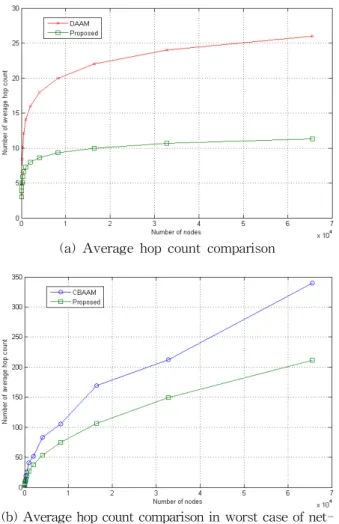
In the mobile network, the number of hop count indicates that the routing cost. We measured the average hop count for our scheme to show the routing efficiency.

As shown in Fig. 8(a), the number of hop count

(7)

Fig. 5. Address assignment and applied example of the proposed scheme.

572 JOURNAL OF KOREA MULTIMEDIA SOCIETY, VOL. 16, NO. 5, MAY 2013

(8)

Fig. 6. Example of router and node address assignment.

Fig. 7. Comparison of coordinates base and proposed scheme.

(9)

574 JOURNAL OF KOREA MULTIMEDIA SOCIETY, VOL. 16, NO. 5, MAY 2013

(a) Average hop count comparison

(b) Average hop count comparison in worst case of net- work connection

(c) Average hop count comparison from coordinator in worst case of network connection

Fig. 8. Comparison result of coordinates base and proposed scheme.

Fig. 9. Comparison result of packet transfer time.

of the coordinate based schemes is shorter than that of DAAM. Because of using the same coor- dinate based address assignment scheme, the per- formance of CBAAM and our scheme are same.

In the case of all network devices are becoming routers, DAAM and CBAAM show unexpected re- sult as shown in Fig. 8(b), and (c). However, our proposed scheme performs well.

4.2 Comparison of packet transfer time

As shown in Fig. 9, our scheme shows the same result of the CBAAM. However, when we consider the bit comparison, the result is changed.

4.3 Network processing time comparison

We compared the in-network packet processing time for the network performance evaluation.

According to Fig. 10(a), the proposed scheme per- forms better than existing schemes. However, in the worst case of the network connection shown in Fig. 10(b), and (c), our scheme our scheme per- forms well. Due to the 1-bit comparison, in our scheme a router can easily find a path and then deliver the packet to the destination with low cost.

5. CONCLUSION

We propose a method to improve the coordinate base address assignment scheme. According to the experimental results, the network processing time is improved compared with the existing schemes.

In addition, the size of address table maintained by

a router reduced by 50%. In order to determine the

(10)

(a) Average network processing time comparison

(b) Average network processing time comparison in worst case of network connection

(c) Average network processing time comparison from coordinator in worst case of network connection Fig. 10. Comparison result of network processing

time.

route, a router refers to the routing table. This re- search shows that the route search of the bit unit can improve the network processing speed

considerably.

REFERENCES

[ 1 ] U.S. Department of Commerce, NIST Frame- work and Roadmap for Smart Grid Interop- erability Standards Release 1.0 (Draft) , 2009.

[ 2 ] ZigBee Alliance, ZigBee Specification , ZigBee document 053474r17, 2008.

[ 3 ] Doohyun Kim and Sung Ho Cho,” An Efficient Search Algorithm for Shorten Routing Path in ZigBee Networks,” The Journal of Korea Information and Communication Society , Vol.

34, No. 12, pp. 1535-1541, 2009.

[ 4 ] Hyo Hyun Choi, ”An Transmission Time Allocation Scheme in ZigBee Network,”

Journal of the Korea Society of Computer and Information , Vol. 16, No.4, pp. 121-128, 2011.

[ 5 ] Khusvinder Gill, Shuang-Hua Yang, Fang Yao, and Xin Lu, “A ZigBee-Based Home Automation System,” IEEE Transactions on Consumer Electronics , Vol. 55, No. 2, pp. 422- 430, 2009.

[ 6 ] Jinsoo Han, Chang-Sic Choi, and Ilwoo Lee,

“More Efficient Home Energy Management System Based on ZigBee Communication and Infrared Remote Controls,” IEEE Transactions on Consumer Electronics , Vol. 57, No. 1, pp.

85-89, 2011.

[ 7 ] Seok-Cheol Lee, Shin Il Jeong, and Chang- Soo Kim, “Design and Development of Monitoring System for Subway Station based on USN,” Journal of Korea Multimedia Society , Vol. 12, No. 11, pp. 1629-1639, 2009.

[ 8 ] Meng-Shiuan Pan, Hua-Wei Fang, Yung-Chih Liu, and Yu-Chee Tseng, “Address Assignment and Routing Schemes for ZigBee-Based Long-Thin Wireless Sensor Networks,” IEEE Vehicular Technology Conference , pp. 173- 177, 2008.

[ 9 ] Jongjun Park, Hoon Jeong, Soyoung Hwang,

and Seong-Soon Joo, “A Hierarchical Cluster

(11)

576 JOURNAL OF KOREA MULTIMEDIA SOCIETY, VOL. 16, NO. 5, MAY 2013

Tree Based Address Assignment Method for Large and Scalable Wireless Sensor Net- works,” The Journal of Korea Information and Communication Society , Vol. 34, No. 12, pp. 1514-1523, 2009.

[10] Fujun Ye and Ruifang Pan, “A Crosscut Tree Routing Scheme for Preemptive Distributed Address Assignment Mechanism,” Interna- tional Conference on Consumer Electronics, Communications and Networks , pp. 3808- 3812, 2011.

[11] Zhi Ren, Pengxiang Li, and Jun Fang,

“Segmentation-Based On-Demand Scalable Address Assignment for ZigBee Networks,”

IEEE Vehicular Technology Conference , pp.

1-5, 2011.

[12] Jaehyun Kim, Soojung Hur, Yongwan Park, Wonsek Kang, and Dongha Lee, “Effective address assignment method in hierarchical structure of Zigbee network,” Journal of the Institute of Electronics Engineers of Korea , Vol. 44, No. 10, pp. 20-28, 2007.

[13] Yang-Hyun Cho, Song-Bin Lim, and Gyung- Mok Kim, “An Efficient Addressing Scheme Using (x, y) Coordinates in Environments of Smart Grid,” Journal of the Korea Society of Computer and Information , Vol. 17, No. 1, pp.

61-69, 2012.

[14] Dongmin Choi, Jian Shen, and Ilyong Chung,

“A Study of ZigBee Address Assignment Scheme in Smart Grid Environment,” Spring Conference of Korean Institute of Smart Media , pp. 57-59, 2012.

Dongmin Choi

He received his B.E. degree from the Kyunghee University in 2003 and M.S. and Ph.D. de- grees in computer Science from Chosun University in 2007 and 2011, respectively. He is work- ing as a researcher in Computer Science at Chosun University. His research interests are in information security, sensor network systems, mobile ad-hoc systems, smart grid home network sys- tems and internet ethics.

Ilyong Chung

He received the B.E. degree from Hanyang University, Seoul, Korea, in 1983 and the M.S. and Ph.D. degrees in Computer Science from City University of New York, in 1987 and 1991, respectively.

From 1991 to 1994, he was a senior technical staff of

Electronic and Telecommunication Research Institute

(ETRI), Dajeon, Korea. Since 1994, he has been a

Professor in Department of Computer Science,

Gwangju, Korea. His research interests are in com-

puter networking, security systems and coding theory.

수치

Fig. 2. Network layer frame format2.3Coordinatebasedaddressassignment
Fig. 3. Example of connected node in HAN and address assignment.
Fig. 4. Example of router and node address assignment.
Fig. 5. Address assignment and applied example of the proposed scheme.
+3

참조

관련 문서

In this study, using concept mapping of a variety of learning techniques in the area of science, especially biology, has a positive effect on learning

Full name, resident registration number (In case of foreign students: alien registration number or passport number), address, phone number, cell phone number,

Incheon is also developing smart tourist city contents, selected for the first time among the cities in Korea, in the whole area of the open port area by April 2021

• A legal assignment for the circuit, is an assignment of values to the labeled wires where the output value of each multiplication gate is indeed the product of the

For confirmation of results of direct real-time melting curve analysis, we also performed an in-house JAK2 V617F ASP and a BsaXI-treated nested PCR-direct

In wireless sensor networks (WSNs), a transport protocol plays an important role of reliable transmission and congestion control.. The efficient design of

After first field tests, we expect electric passenger drones or eVTOL aircraft (short for electric vertical take-off and landing) to start providing commercial mobility

1 John Owen, Justification by Faith Alone, in The Works of John Owen, ed. John Bolt, trans. Scott Clark, "Do This and Live: Christ's Active Obedience as the