청정에너지기술
Development of Monolithic Catalyst System with Co-Ru-Zr for CO 2 (dry) Reforming of Methane : Enhanced Coke Tolerance
Hyojin Kim
1,2, Young-Woo You
1, Iljeong Heo
1, Tae-Sun Chang
1, Ji Sook Hong
1, Ki Bong Lee
2, and Jeong Kwon Suh
1,*
1
Korea Research Institute of Chemical Technology 141 Gajeong-ro, Yuseong-gu, Daejeon, 34114, Korea
2
Korea University
145 Anam-ro, Seongbuk-gu, Seoul, 02841, Korea
(Received for review January 18, 2017; Revision received April 11, 2017; Accepted April 11, 2017)
Abstract
To verify the viability of Co, Ru and Zr-based catalyst for CO
2(dry) reforming reaction, catalysts were fabricated using cordierite, silicon carbide and rota monolithic substrates, and they were compared with the conventional Co-Ru-Zr/SiO
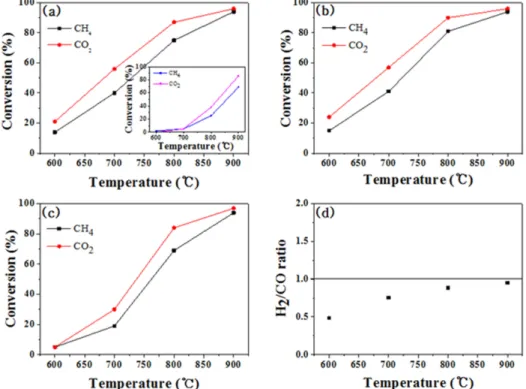
2catalyst in terms of performance and durability. Cordierite monolith was showed high activity with the least amount of active component. In addition, when Cordierite monolith was coated with Co-Ru-Zr in various ways, most excellent performance was showed at a precursor solution coating method. In particular, when 0.9 wt% Co-Ru-Zr/Cordierite was used for reaction, it was observed that 95% CO
2conversion was maintained for 300 h at 900 ℃.
Keywords : CO
2reforming, Cobalt-ruthenium-zirconium, Monolith catalysts, Coking, Catalyst durability
* To whom correspondence should be addressed.
E-mail: [email protected]; Tel: +82-42-860-7334; Fax: +82-42-860-7533 doi: 10.7464/ksct.2017.23.3.314 pISSN 1598-9712 eISSN 2288-0690
This is an Open-Access article distributed under the terms of the Creative Commons Attribution Non-Commercial License (http://creativecommons.org/licences/
by-nc/3.0) which permits unrestricted non-commercial use, distribution, and reproduction in any medium, provided the original work is properly cited.
1. Introduction
As global warming resulting from greenhouse gas emission has emerged as a serious environmental issue, carbon capture and utilization (CCU) technology is drawing attention as a so- lution to capture and utilize CO
2emission [1-3]. CO
2(dry) reforming of Methane (CDR or DRM in short) is the repre- sentative CCU technology that uses two primary greenhouse gases (CO
2and CH
4) as raw materials to produce synthetic gas which provides a platform substance for a variety of chemical products downstream. In particular, CDR reaction features H
2: CO generation ratio close to 1:1, more effective in synthesizing hydrocarbon, aldehyde, acetic acid, etc. than steam reforming (SM) or partial oxidation (PO) reaction [4,5].
In CDR reactions, transition metal based catalyst, i.e. Ni/
Al
2O
3, or platinum group metal (PGM) catalyst containing Ru, Rh, Pd, Pt, etc. is primarily used [6]. Among them, the PGM catalyst shows high activity as well as excellent anti-coking performance, but its scarcity and low cost-competitiveness limits its value in application for commercial processes [7]. Therefore,
many have studied Ni group catalysts that show similar perfor- mance to that of the PGM catalyst at low cost[8-12]. However, it was reported that although Ni catalyst showed high activity in CDR reaction, it also revealed serious carbon deposition [12-14].
Recently, it was reported that cobalt catalyst improved re- sistance to carbon deposition and showed excellent performance at low temperature [15,16]. It was reported that cobalt-added catalyst improved resistance to carbon deposition when com- pared with catalysts containing only nickel, contributing to the suppression of catalytic deactivation [17]. To optimize cobalt- based catalyst, Hou and Yashima studied the impacts of calcina- tions temperature, Co content, and reduction conditions on ca- talytic activity and carbon generation [18]. They reported that in Co/α-Al
2O
3, Co surface, reforming activity, and coke-forming speed depended heavily on the calcinations temperature and reduction conditions of catalyst. Promoters added to cobalt- based catalyst were also studied. Ruckenstein and Trépanier reported that when a small amount of Ru was added to Co, it promoted dispersion of Co
3O
4and suppressed oxidation of
314
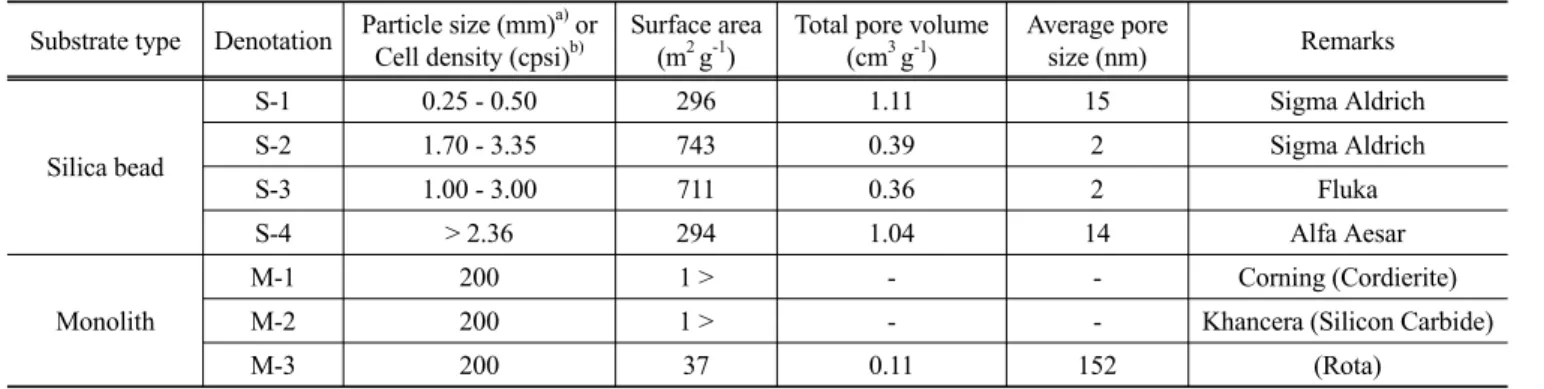
Table 1. Characteristics of silica bead type and monolith substrate Substrate type Denotation Particle size (mm)
a)or
Cell density (cpsi)
b)Surface area (m
2g
-1)
Total pore volume (cm
3g
-1)
Average pore
size (nm) Remarks
Silica bead
S-1 0.25 - 0.50 296 1.11 15 Sigma Aldrich
S-2 1.70 - 3.35 743 0.39 2 Sigma Aldrich
S-3 1.00 - 3.00 711 0.36 2 Fluka
S-4 > 2.36 294 1.04 14 Alfa Aesar
Monolith
M-1 200 1 > - - Corning (Cordierite)
M-2 200 1 > - - Khancera (Silicon Carbide)
M-3 200 37 0.11 152 (Rota)
a)
Particle size (mm) for bead type substrate,
b)Cell density (cpsi) for monolithic substrate.
cobalt and carbon deposition of active site, thus improving ac- tivity and carbon resistance [19,20]. In addition, it is known that given its high thermal stability, Zr can contribute to catalytic durability, and precursors such as ZrCl
2O containing chloride affect the dispersion and crystal size of cobalt active substance during calcinations or reduction of catalyst [21]. Based on this study, Lee, et al. manufactured Co-Ru-Zr/SiO
2(“CRZ/S” here in after) and found that it maintained excellent durability in prolonged CO
2reforming reaction (500 h, 700 ℃) [22].
CO
2and CH
4(raw materials for CO
2(dry) reforming reac- tion) are generally converted at high temperature at or above 700 ℃ since they are chemically very stable [23]. Therefore, to maximize CO
2reduction, it is necessary to develop a catalyst that can allow for stable operation of catalyst react or under high-flux reaction conditions, support high thermal stability without pressure decline. Moreover, as carbon deposition com- promises catalytic performance and blocks reaction flow due to destruction of catalyst, it is essential to resolve such issues if the technology proposed herein is to be accomplished.
Hence, we coated the catalyst with Co-Ru-Zr using Cordierite, Silicon Carbide (SiC) and Rota monoliths as substrates that are free from pressure decline, featuring excellent thermal/mechanical strength and finding extensive applications in environmental catalysts including automotive catalysts, and evaluated CO
2reforming performance and durability. Various catalyst coating methods were reviewed to optimize the monolithic catalyst, and, in particular, Co-Ru-Zr coating content was varied to study its impact on catalyst activation and carbon deposition.
2. Experimental 2.1. Catalyst preparation
Table 1 summarizes the physical properties and data of 4 silica beads (S-1, S-2, S-3, S-4) and 3 monolithic substrates (Cordierite (M-1), Silicon Carbide (M-2), Rota (M-3)) used in this study. In addition, for precursors used in fabricating Co-
Ru-Zr catalyst, cobalt (II) nitrate hexahydrate (Co(NO
3)
2․6H
2O, SamchunChem, 97%), ruthenium (III) nitrosyl nitrate (Ru(NO) (NO
3)
3, StreamChem, 99%) and zirconium (IV) chloride oxide octahydrate (ZrCl
2O․8H
2O, Junsei, 99%) were used and dis- solved in distilled water to mix Co, Ru, and Zr in the ratio of 74.3%, 0.7%, and 25% respectively.
CoRuZr/SiO
2catalysts (CRZ/S-1,CRZ/S-2,CRZ/S-3,CRZ/S-4) using silica bead as substrates were manufactured by impregna- tion method [22]. Namely, precursor solution where the sum of Co, Ru, and Zr and silica bead were mixed in the mass ratio of 1:4 was mixed with silica bead and evaporated in a rotary evaporator at 50 mbar and 45 ℃ for 12 h. Subsequently, as -prepared specimen was completely dried up at 110 ℃ for 24 h. The catalysts were calcinated under stagnant air in muffle furnace at 400 ℃ for 6 h, with temperature raised at the rate of 2 ℃ min
-1.
All monolithic catalysts were manufactured by dipping method.
Monolithic substrates were dipped in CRZ precursor solution
and dried with air blown to keep catalytic substance from plug-
ging the channel. This process was repeated until the monolithic
substrates were coated with desired amount of catalytic subst-
ance. In addition, to evaluate performance in reference to the
size of monolith, small and big Cordierite monolithic substrates
were prepared respectively. The small monolithic substrates
were fabricated to be a cylinder that was 10 mm in diameter,
20 mm in height, and 1.57 mL in capacity where as the big
monolithic substrates were fabricated to be 25 mm in diameter,
50 mm in height, and 24.53 mL in capacity of it inside an
inconel reactor. In addition, to understand the impact of binder,
CRZ precursor was dissolved in silica sol or alumina sol and
catalyst was manufactured by repeating the same process as
above with Cordierite monolithic substrates. Silica sol and alumina
sol were used in 1:1 molar ratio to zirconia. Note that the absolute
mass of Co, Ru, and Zr catalytic substances excluding the con-
tent of added binder was maintained to be the same as the mono-
lithic catalyst manufactured without addition of binder. Table 2
Table 2. Information of CRZ based catalysts Substrate
type Denotation Content of CRZ
(wt%)
a)Remarks
Silica bead
CRZ/S-1 17.7 Low surface area
CRZ/S-2 - High surface area
CRZ/S-3 4 High surface area
CRZ/S-4 18 Low surface area
Monolith
CRZ/M-1
0.68 0.94 1.6 (1.2/0.01/0.39)
b)2.7
CRZ/M-1 prepared with various content of CRZ
CRZ/M-2 -
CRZ/M-3 -
CRZS(sol)/
M-1 - CRZ/M-1 prepared
with Alumina sol and Silica sol CRZA(sol)/
M-1 -
( - ) : not measured
a)