• 검색 결과가 없습니다.

Impact of High-Normal Blood Pressure Measured in Emergency Room on Adverse Cardiac Events in Acute Myocardial Infarction

N/A
N/A
Protected

Academic year: 2021

Share "Impact of High-Normal Blood Pressure Measured in Emergency Room on Adverse Cardiac Events in Acute Myocardial Infarction"

Copied!
7
0
0

로드 중.... (전체 텍스트 보기)

전체 글

(1)

Korean Circulation Journal

Introduction

Individuals with prehypertensive blood pressure (BP) have an in- creased risk of developing cardiovascular disease relative to those with optimal levels.

1)

The Seventh Report of the Joint National

Print ISSN 1738-5520 • On-line ISSN 1738-5555

Impact of High-Normal Blood Pressure Measured in Emergency Room on Adverse Cardiac Events in Acute Myocardial Infarction

Nam Sik Yoon, MD 1 , Myung Ho Jeong, MD 1 , Youngkeun Ahn, MD 1 , Jong Hyun Kim, MD 2 , Shung Chull Chae, MD 3 , Young Jo Kim, MD 4 , Seung Ho Hur, MD 5 , In Whan Seong, MD 6 , Taek Jong Hong, MD 7 , Donghoon Choi, MD 8 , Myeong Chan Cho, MD 9 , Chong Jin Kim, MD 10 , Ki Bae Seung, MD 11 , Wook Sung Chung, MD 11 , Yang Soo Jang, MD 8 , Jeong Gwan Cho, MD 1 , Seung Jung Park, MD 12 , and Other Korea Acute Myocardial Infarction Registry Investigators

1

The Heart Center of Chonnam National University Hospital, Gwangju,

2

The Cardiovascular Center, Hanseo Hospital, Busan,

3

Department of Internal Medicine, Kyungpook National University Hospital, Daegu,

4

Department of Internal Medicine, Yeungnam University Hospital, Daegu,

5

Department of Internal Medicine, Keimyung University Dongsan Medical Center, Daegu,

6

Department of Internal Medicine, Chungnam National University Hospital, Daejeon,

7

Department of Internal Medicine, Pusan National University Hospital, Busan,

8

Department of Internal Medicine, Yonsei University Severans Hospital, Seoul,

9

Department of Internal Medicine, Chungbuk National University Hospital, Cheongju,

10

Department of Internal Medicine, Kyunghee University College of Medicine, Seoul,

11

Department of Internal Medicine, The Catholic University of Korea Hospital, Seoul,

12
Department of Internal Medicine, Asan Medical Center, University of Ulsan College of Medicine, Seoul, Korea

Background and Objectives: Prehypertension according to JNC7 is common and is associated with increased vascular mortality. The importance of management in high-normal blood pressure (BP) is underemphasized.

Subjects and Methods: We analyzed major adverse cardiac events (MACEs) in the Korea Acute Myocardial Infarction Registry in normal BP (group I) and high-normal BP (group II) patients.

Results: Among 14871 patients, 159 (61±12.3 years, 122 males) satisfied the study indication. Six-month and one-year clinical follow-up rate was 88.9% and 85.8%, respectively. Group I had 78 patients (60.9±12.4 years). Group II had 81 patients (61.6±12.5 years). Demo- graphics of patients were not different between groups. Treatment strategy was not different. Initial Thrombolysis in Myocardial Infarc- tion flow grade 0 was less frequent in group II (n=32, 47.1%) than in group I (n=16, 21.9%) (p=0.001). Successful intervention rate was not different between group II (93.8%) and group I (97.1%) (p=0.590). Six-month MACE occurred in 3 patients in group I (4.4%) and 10 in group II (15.6%) (p=0.031). Compared with normal BP, the odds ratio for patients with high-normal BP was 1.147 (p=0.045, 95% confidence inter- val 1.011-1.402) for 6-month MACE.

Conclusion: Even though high-normal BP patients had a better baseline clinical status, the prognosis was poorer than patients with nor- mal BP. Therapeutic BP target goal for the patients with acute myocardial infarction should be <140/90 mm Hg, which is recommended in JNC7. (Korean Circ J 2012;42:304-310)

KEY WORDS: Blood pressure; Prognosis.

Received: June 16, 2011 / Revision Received: September 1, 2011 / Accepted: November 7, 2011

Correspondence: Myung Ho Jeong, MD, The Heart Research Center of Chonnam National University Hospital, 42 Jebong-ro, Dong-gu, Gwangju 501- 757, Korea

Tel: 82-62-220-6243, Fax: 82-62-228-7174, E-mail: [email protected]

• The authors have no financial conflicts of interest.

This is an Open Access article distributed under the terms of the Creative Commons Attribution Non-Commercial License (http://creativecommons.org/licenses/

by-nc/3.0) which permits unrestricted non-commercial use, distribution, and reproduction in any medium, provided the original work is properly cited.

Committee on Prevention, Detection, Evaluation, and Treatment of

High BP (JNC 7) defined a new entity termed “prehypertension” to

reflect the growing evidence that systolic BP (SBP) values between

120 and 139 mm Hg and diastolic BP (DBP) values between 80 and

89 mm Hg are associated with an increased cardiovascular risk.

2)

(2)

The European Guidelines,

3)

however, divide this population into two groups: those with SBP between 120 and 129 mm Hg or DBP between 80 and 84 mm Hg are classified as normal, whereas those with SBP between 130 and 139 mm Hg or DBP between 85 and 89 mm Hg are classified as high-normal. Although the association of cardio- vascular risk with elevated BP is well-accepted,

4)

only a few studies have addressed the risks of major adverse cardiac events (MACEs) for the population with acute myocardial infarction (AMI) in the high-normal range. The importance of management in “high-nor- mal BP” according to definition of European Society of Hyperten- sion (ESH) and the European Society of Cardiology (ESC) seems to be underemphasized. We presently investigated the impact of high-normal BP on adverse cardiac events in the patients with AMI from the Korea Acute Myocardial Infarction Registry (KAMIR).

Subjects and Methods

Methods

Korea Acute Myocardial Infarction Registry is a Korean, prospec- tive, open, observational, multicenter, on-line registry of AMI with support from the Korean Society of Cardiology since November 2005. The 50 participating hospitals are capable of primary percu- taneous coronary intervention (PCI). Details of the KAMIR have been published.

5)

AMI was diagnosed by characteristic clinical pre- sentation, serial changes on electrocardiogram suggesting infarc- tion, and increase in cardiac enzymes.

6)

ST-segment elevation myo- cardial infarction (STEMI) was defined by new ST elevation in ≥2 contiguous leads, measuring >0.2 mV in leads V 1-3, or 0.1 mV in all other leads.

Demographic and clinical characteristics including age, gender, cardiovascular risk factors (hypertension, diabetes mellitus, hyper- lipidemia, smoking status, and family history of coronary heart dise- ase) and co-morbidities were identified. Hypertension was defined as previously diagnosed by a physician and/or receiving medication to lower BP. Hyperlipidemia was defined as previously diagnosed by a physician and/or receiving lipid-lowering drugs. Family history of coronary heart disease was defined as coronary heart disease in first-degree male relative <55 years old or coronary heart disease in first-degree female relative <65 years old. Height, weight, and body mass index (BMI) were measured at admission. Initial vital signs were measured and Killip class was evaluated at admission. Elec- trocardiogram was recorded and analyzed in all patients by attend- ing physicians and/or cardiologists. Blood samplings for baseline laboratory tests except lipid measurement were collected at ad- mission or before PCI. Overnight fasting blood was also sampled for lipid levels. The left ventricular ejection fraction was determined by two-dimensional echocardiography during the index hospitalization.

In-hospital complications and their management were also recorded.

Initial treatment strategy for patients with STEMI could include PCI, thrombolysis, or conservative treatment at the discretion of the attending physician. Primary PCI was defined as emergency PCI performed within 12 hours after admission or PCI in patients with continuing symptoms or cardiogenic shock, even after 12 hours.

For patients with non-STEMI, initial treatment strategy could in- clude early invasive PCI or conservative treatment based on cur- rent guidelines, at the discretion of the attending physician. Early invasive PCI was defined as emergency PCI that was performed within 48 hours in patients with non-STEMI with remaining symp- toms. Glycoprotein IIb/IIIa receptor blockers, thrombectomy devic- es, predilatation balloons, and stents during index PCI were used at the decision of the interventional cardiologists. Epicardial coronary blood flow in the infarct-related artery before and after stent im- plantation was graded according to the classification used in the Thrombolysis in Myocardial Infarction (TIMI) trials. Successful PCI was defined as a residual stenosis <50% in diameter with final TIMI grade 3 flow. Furthermore, prescription of optimal evidence- based medications was encouraged in all indicated patients who had no contraindications to guideline-recommended drugs during index hospitalization or after discharge.

Patient population and end point

From November 2005 to May 2009, 14871 patients with a final di- agnosis of AMI were enrolled in KAMIR. Of these patients, to avoid effects of autonomic nerve system, patients without history of hy- pertension, present angina, present dyspnea, present bradycardia, and tachycardia were analyzed in this study. BP was measured with a practical manual for usual emergency rooms. Usually, these were single-measured values. There was no limitation of hypotension and the lowest SBP among them was 120 mm Hg. Present angina and dyspnea were defined according to patients subjective symp- toms upon arrival at the emergency department. Bradycardia was defined as <60 beats/min. Tachycardia was defined as >100 beats/min.

Among the 14871 patients, 159 patients (61±12.3 years, 122 ma-

les) satisfied the study inclusion criteria. We analyzed MACEs in-

cluding death, recurrent myocardial infarction, revascularization

including repeat PCI (target lesion or target vessel revasculariza-

tion, or non-target vessel revascularization), and coronary artery

bypass grafting in patients with normal BP (group I, n=78) and high-

normal BP (group II, n=81) according to ESH 2007 definition.

3)

Cardi-

ac death was defined as death from pump failure, arrhythmia, or me-

chanical complications including ventricular septal rupture and

free wall rupture. Follow-up data were obtained by reviewing medi-

cal records and/or telephone interview with patients. All data were

entered into an electronic web-based case-report form.

(3)

Statistical analyses

Continuous variables were presented as the mean value±SD, com- parisons were conducted by 2-tailed Student’s t-test. Discrete vari- ables were presented as percentages and relative frequencies and comparisons were conducted by chi-square statistics or Fisher’s exact test as appropriate. Logistic regression analysis was perform- ed to identify the independent predictors of MACEs with a 95%

confidence interval (CI). The Kaplan-Meier method was used to es- timate the risk of MACEs up to about 360 days, stratified by normal or high-normal BP. The Statistical Package for the Social Sciences (SPSS) for Windows, version 15.0 (SPSS Inc., Chicago, IL, USA) was used for all analyses. The level of significance for this study was 0.05.

Results

Among 14871 patients, 159 patients (61±12.3 years, 122 males) satisfied the study incision criteria. Group I had 78 patients (60.9±

12.4 years). Group II had 81 patients (61.6±12.5 years). BP of group I was 120±1.6/77±6.3 mm Hg. BP of group II was 130±2.0/82±7.7 mm Hg. BP of group II was higher (p<0.001). However, at discharge, there was no statistical difference of BP (group I=116±10.7/73±

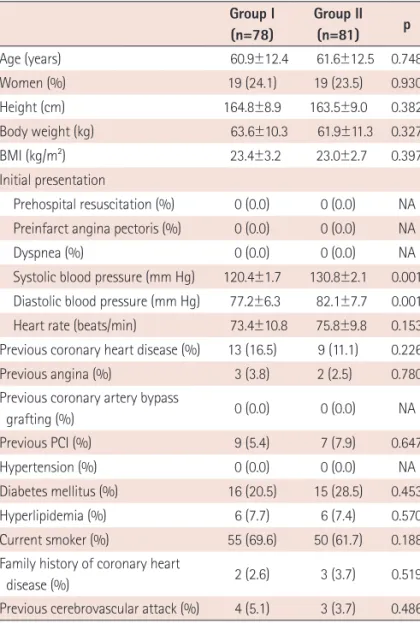
7.9 mm Hg, group II=113±20.1/75±9.2 mm Hg, p=0.389). Baseline clinical characteristics and initial presentation of patients are listed in Table 1. There were no significant differences in demographics, initial presentation, and vital signs.

Past medical histories were not different (Table 1). The preval- ence of diabetes, dyslipidemia, smoking history, familial history, and BMI were not different between groups. STEMI was 43.6% of group I and 44.6% of group II.

Baseline laboratory characteristics are listed in Table 2. Left ven- tricular ejection fraction, levels of peak creatine kinase-Mo full term myocardial bind, serum creatinine, high-sensitivity C-reactive pro- tein, and N-terminal pro-B-type natriuretic peptide did not differ- ent. The level of total cholesterol was not different, but the level of high density lipoprotein-cholesterol was higher in group II (43.1±

12.7 mg/dL vs. 47.8±13.9 mg/dL, respectively; p=0.032).

Initial treatment strategy and discharge medications were not different (Table 3).

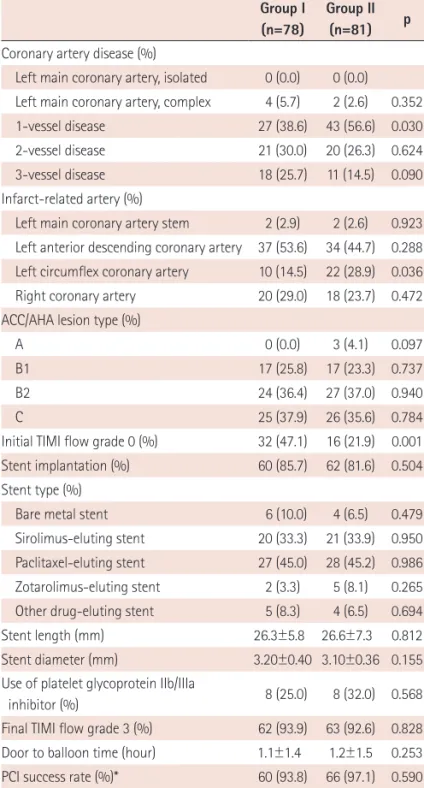
The angiographic and procedural data are shown in Table 4. Left main coronary artery disease and three-vessel disease were not different between groups. There were no significant differences between groups in number of left anterior descending coronary artery. There were no significant differences between groups in le- Table 1. Baseline clinical characteristics and past medical history

Group I (n=78)

Group II

(n=81) p

Age (years) 60.9±12.4 61.6±12.5 0.748

Women (%) 19 (24.1) 19 (23.5) 0.930

Height (cm) 164.8±8.9 163.5±9.0 0.382

Body weight (kg) 63.6±10.3 61.9±11.3 0.327

BMI (kg/m

2

) 23.4±3.2 23.0±2.7 0.397

Initial presentation

  Prehospital resuscitation (%) 0 (0.0) 0 (0.0) NA   Preinfarct angina pectoris (%) 0 (0.0) 0 (0.0) NA

  Dyspnea (%) 0 (0.0) 0 (0.0) NA

  Systolic blood pressure (mm Hg) 120.4±1.7 130.8±2.1 0.001   Diastolic blood pressure (mm Hg) 77.2±6.3 82.1±7.7 0.001   Heart rate (beats/min) 73.4±10.8 75.8±9.8 0.153 Previous coronary heart disease (%) 13 (16.5) 9 (11.1) 0.226

Previous angina (%) 3 (3.8) 2 (2.5) 0.780

Previous coronary artery bypass

grafting (%) 0 (0.0) 0 (0.0) NA

Previous PCI (%) 9 (5.4) 7 (7.9) 0.647

Hypertension (%) 0 (0.0) 0 (0.0) NA

Diabetes mellitus (%) 16 (20.5) 15 (28.5) 0.453

Hyperlipidemia (%) 6 (7.7) 6 (7.4) 0.570

Current smoker (%) 55 (69.6) 50 (61.7) 0.188

Family history of coronary heart

disease (%) 2 (2.6) 3 (3.7) 0.519

Previous cerebrovascular attack (%) 4 (5.1) 3 (3.7) 0.486 Data expressed as mean±SE or number of patients (percentage). BMI: body mass index, PCI: percutaneous coronary intervention, SE: standard error, NA: not available

Table 2. Baseline laboratory characteristics Group I (n=78)

Group II

(n=81) p

Left ventricular ejection fraction 53.9±10.6 54.8±12.0 0.626 Peak creatine kinase-Mo full

term MB (ng/mL) 83.6±118.2 93.7±137.8 0.625

Peak cardiac troponin I (ng/mL) 34.1±42.3 39.6±62.7 0.547

Glucose (mg/dL) 149.3±75.6 152.2±61.1 0.797

Serum creatinine (mg/dL) 1.3±2.3 1.1±1.3 0.586

Total cholesterol (mg/dL) 178.0±49.3 188.5±48.6 0.184 Triglyceride (mg/dL) 115.7±66.1 127.8±74.7 0.294 High density lipoprotein-

cholesterol (mg/dL) 43.1±12.7 47.8±13.9 0.032

Low density lipoprotein-

cholesterol (mg/dL) 118.4±37.2 123.0±43.2 0.490 High-sensitivity C-reactive

protein (mg/dL) 1.9±2.8 2.9±9.9 0.446

N-terminal pro-B-type

natriuretic peptide (pg/mL) 994.3±1592.6 1040.7±1562.6 0.878

Data expressed as mean±SE or number of patients (percentage). SE: stan-

dard error

(4)

sion types of American College of Cardiology/American Heart As- sociation criteria. Initial TIMI flow grade was better in group II. Final TIMI flow grade was not different. The deployed stent profile, such as type, length, and diameter were not different between groups.

Door to balloon time was not different. PCI success rate was not different.

In-hospital death occurred in 0 (0.0%) vs. one (1.3%) patient (p=

0.319). One-month composite MACE occurred in zero (0.0%) vs.

seven (10.3%) patients (p=0.006) (Table 5). The latter seven includ- ed three (4.4%) cardiac deaths, two (2.9%) repeat PCIs, and two (2.9%) coronary artery bypass grafts. Six-month clinical follow-up rate were 88.9%. Thirteen (9.9%) developed MACE 6 months after the index treatment. Six-month composite MACE occurred in three (4.4%) vs. 10 (15.6%) patients (p=0.031) (Table 6). The former three (4.4%) were repeat PCIs.

The later 10 included three (4.7%) cardiac deaths, five (7.8%) re- peat PCIs, and two (3.1%) coronary artery bypass grafts. One-year clinical follow-up rate were 85.8%. Seventeen (13.6%) developed MACE 1 year after the index treatment. The former six included one (1.5%) cardiac death, four (6.0%) repeat PCIs, and one (1.5%) coronary artery bypass graft. The later 11 included 3 (5.2%) cardiac deaths, six (10.3%) repeat PCIs, and two (3.4%) coronary artery by- pass grafts. Cumulative MACEs-free survival was better in group I

than in group II (p=0.049) (Fig. 1).

Compared with group I, the odds ratio for group II was 1.181 (p=

0.045, 95% CI, 1.011-1.402) for 6-month composite MACEs (Table 7).

In multivariate logistic regression analysis, SBP was independent of age, gender, diabetes mellitus, familial history of coronary heart disease, N-terminal pro-B-type natriuretic peptide, and left main stem disease, as a predictor of MACEs at 6 months after AMI. How- ever, group II did not have statistical significance to predict 12- Table 3. Treatment strategies in patients with normal and high-normal

blood pressure

Group I (n=78)

Group II

(n=81) p

ST segment elevation MI (%) (n=32) (n=33) 0.546

  Primary PCI 21 (65.6) 18 (54.5)

  Facilitated PCI 1 (3.1) 4 (12.1)

  Thrombolytic therapy 6 (18.8) 6 (18.2)   Conservative treatment 4 (12.5) 5 (15.2)

Non-ST-elevation MI (%) (n=38) (n=41) 0.424

  Early invasive therapy 28 (73.7) 32 (78.0)   Early conservative therapy 10 (26.3) 9 (22.0) Discharge medication (%)

  Aspirin 76 (98.7) 73 (97.3) 0.490

  Clopidogrel 71 (92.2) 68 (90.7) 0.480

ß blockers 60 (77.9) 55 (73.3) 0.319

ACE

inhibitors or angiotensin II receptor blockers

66 (85.7) 64 (85.3) 0.565

Lipid-lowering drugs 51 (66.2) 54 (72.0) 0.277

  Nitrates 45 (58.4) 38 (50.7) 0.212

  Calcium channel blockers 3 (3.9) 7 (9.3) 0.153 MI: myocardial infarction, PCI: percutaneous coronary intervention, ACE:

angiotensin-converting enzyme

Table 4. Angiographic and procedural data in each group Group I (n=78)

Group II (n=81) p Coronary artery disease (%)

  Left main coronary artery, isolated 0 (0.0) 0 (0.0)   Left main coronary artery, complex 4 (5.7) 2 (2.6) 0.352

  1-vessel disease 27 (38.6) 43 (56.6) 0.030

  2-vessel disease 21 (30.0) 20 (26.3) 0.624

  3-vessel disease 18 (25.7) 11 (14.5) 0.090

Infarct-related artery (%)

  Left main coronary artery stem 2 (2.9) 2 (2.6) 0.923   Left anterior descending coronary artery 37 (53.6) 34 (44.7) 0.288   Left circumflex coronary artery 10 (14.5) 22 (28.9) 0.036   Right coronary artery 20 (29.0) 18 (23.7) 0.472 ACC/AHA lesion type (%)

  A 0 (0.0) 3 (4.1) 0.097

  B1 17 (25.8) 17 (23.3) 0.737

  B2 24 (36.4) 27 (37.0) 0.940

  C 25 (37.9) 26 (35.6) 0.784

Initial TIMI flow grade 0 (%) 32 (47.1) 16 (21.9) 0.001 Stent implantation (%) 60 (85.7) 62 (81.6) 0.504 Stent type (%)

  Bare metal stent 6 (10.0) 4 (6.5) 0.479

Sirolimus-eluting stent 20 (33.3) 21 (33.9) 0.950   Paclitaxel-eluting stent 27 (45.0) 28 (45.2) 0.986 Zotarolimus-eluting stent 2 (3.3) 5 (8.1) 0.265   Other drug-eluting stent 5 (8.3) 4 (6.5) 0.694

Stent length (mm) 26.3±5.8 26.6±7.3 0.812

Stent diameter (mm) 3.20±0.40 3.10±0.36 0.155

Use of platelet glycoprotein IIb/IIIa

inhibitor (%) 8 (25.0) 8 (32.0) 0.568

Final TIMI flow grade 3 (%) 62 (93.9) 63 (92.6) 0.828

Door to balloon time (hour) 1.1±1.4 1.2±1.5 0.253

PCI success rate (%)* 60 (93.8) 66 (97.1) 0.590

Data expressed as mean±SE or number of patients (percentage). *Success-

ful PCI was defined as a residual stenosis <50% in diameter with final TIMI

grade 3 flow. ACC/AHA: American College of Cardiology/American heart

association, TIMI: Thrombolysis in Myocardial Infarction, PCI: percutaneous

coronary intervention, SE: standard error

(5)

month composite MACE.

Discussion

We analyzed MACEs after AMI in patients with normal BP and high-normal BP. Baseline status was very similar in both groups.

Treatment strategy and medication was not different between gr- oups. The patients with high-normal BP had more MACEs and poor survival 6 months after index treatment.

The United States is facing a serious challenge in the prevention and management of prehypertension and hypertension. People’s awareness and control of hypertension remain poor.

7)

High-normal BP is common and is associated with increased vascular mortality.

The results of a multiple ethnic groups investigation has demon- strated that high-normal BP is a risk factor for incidence of coronary heart disease in both men and women.

8)

In a Japanese cohort study, high-normal BP was revealed to be a risk factor for the incidence of stroke and MI in the general urban men population.

4)

The extent to which it increases risk of cardiac death, recurrent MI, repeat PCI,

and coronary artery bypass grafting after treatments of AMI is not clear. Some investigators reported that pre-hypertension appeared to be associated with an increased risk of MI and coronary artery disease but not stroke.

9)

Some study reported that at 6-month fol- low-up, age- and gender-adjusted odds ratios for adverse events were equivalent in hypertensives and normotensives after an initial acute coronary syndrome.

10)

The authors explained this interesting result with the fact that treatment for the patients with hyperten- sion was better tailored. In our study, there were no differences in treatment strategy and discharge medications.

The main finding of this study was that the patients with high- normal BP, which was measured in the emergency room, have poor prognosis 6 months after index treatment. Interestingly, this study had a very well-conditioned baseline state comparable with pro- spective studies. Among the dozens of baseline parameters, only high density lipoprotein-cholesterol level was not statistically equal.

Thus, this study does not need to be adjusted to reduce confound- Table 5. Clinical outcomes during follow-up: in-hospital death and one

month MACE

Group I (n=74)

Group II

(n=76) p

In-hospital death (%) 0 (0.0) 1 (1.3) 0.319

One month MACE (5.0%) (%) (n=70) (n=68)

  Any MACE 0 (0.0) 7 (10.3) 0.006

  Cardiac death 0 (0.0) 3 (4.4) 0.076

  Non-cardiac death 0 (0.0) 0 (0.0) NA

All cause death 0 (0.0) 3 (4.4) 0.076

  Recurrent MI 0 (0.0) 0 (0.0) NA

  Repeat PCI 0 (0.0) 2 (2.9) 0.148

  Coronary artery bypass grafting 0 (0.0) 2 (2.9) 0.148 MI: myocardial infarction, PCI: percutaneous coronary intervention, MACE:

major adverse cardiac event, NA: not available

Table 6. Clinical outcomes during follow-up: six-month MACE Six-month MACEs (9.8%) Group I

(n=68)

Group II

(n=64) p

Any MACE (%) 3 (4.4) 10 (15.6) 0.031

Cardiac death (%) 0 (0.0) 3 (4.7) 0.071

Noncardiac death (%) 0 (0.0) 0 (0.0) NA

All cause death (%) 0 (0.0) 3 (4.7) 0.071

Recurrent MI (%) 0 (0.0) 0 (0.0) NA

Repeat PCI (%) 3 (4.4) 5 (7.8) 0.413

Coronary artery bypass

grafting (%) 0 (0.0) 2 (3.1) 0.142

MI: myocardial infarction, PCI: percutaneous coronary intervention, MACE:

major adverse cardiac events, NA: not available

Table 7. Multivariate logistic regression analysis for predicting six-month major adverse cardiac events

Variable OR (95% CI) p

Age 1.019 (0.954-1.088) 0.575

Female gender 3.898 (0.388-39.198) 0.248

Systolic blood pressure 1.181 (1.011-1.402) 0.045 Low density lipoprotein-cholesterol 0.975 (0.950-1.020) 0.056 Initial TIMI flow grade 1.419 (0.739-2.726) 0.293 N-terminal pro-B-type natriuretic

peptide 0.332 (0.096-1.145) 0.102

Left main stem disease 1.631 (0.184-31.859) 0.353 TIMI: Thrombolysis in Myocardial Infarction, CI: confidence interval, OR:

odds tadio

Fig. 1. Cumulative major adverse cardiac events (MACE) free survival in group I (solid black line, normal blood pressure) and group II (dotted black line, high-normal blood pressure) using Kaplan-Meier analysis.

1.0

0.8

0.6

0.4

0.2

0.0

Follow-up days

Cu m ul at iv e M AC E fr ee s ur vi va l

0 100 200 300 400 p=0.049

Group I

Group II

(6)

ing variables. Even though group II had generally better known prognostic factors, such as higher high density lipoprotein-choles- terol, more single vessel diseases, and higher TIMI flow grade, group II had poor 6-month MACEs and poor survival curve. It shows that high-normal BP affects on prognosis more than lipid profile and an- giographic findings. In other words, it shows that more delicate BP control is needed to prevent MACEs after AMI.

Antecedent hypertension interacts with age, neurohumoral activ- ation, and early ventricular remodeling to confer greater risk of he- art failure after MI.

11)

High-normal BP has also been associated with increased risk of carotid atherosclerosis.

12)

We think our results can be explained with the conclusion that the patients with tightly controlled BP have less progression of atheroma than the patients without tightly controlled BP. Sipahi et al.

13)

compared the effects of normal, pre-hypertensive, and hypertensive BP levels on progres- sion of coronary astherosclerosis. In that report, those with hyper- tensive BP levels displayed an increase in atheroma volume on an arterial segment, those with pre-hypertensive BP levels had an in- termediate outcome, and those with normal BP levels had a trend for atheroma regression. Patients who improved from a pre-hyper- tensive BP level at baseline to normal BP levels during the study had significantly less progression of atheroma than patients who re- mained pre-hypertensive. That study suggested that in patients with coronary artery disease, the optimal BP goal may be substan- tially lower than 140/90 mm Hg as BP levels may have a negative cor- relation with atheroma progression.

13)

We suggest that benefits can be obtained by controlling high-normal BP more tightly in patients with coronary artery diseases.

Medications including beta blockers, ACE inhibitors, and angio- tensin converting enzyme inhibitors are needed for better progno- sis after AMI. In some studies, administration of amlodipine to pati- ents with coronary artery disease and normal BP resulted in reduc- ed adverse cardiovascular events. Directionally similar, but smaller and not significant, treatment effects were observed with enala- pril. For amlodipine, intravascular ultrasound showed evidence of slowing of atherosclerosis progression.

14)

In our study, treatment strategy and medication was not different between groups.

In patients with hypertension and diabetes or renal disease, the BP goal is <130/80 mm Hg according to JNC7.

2)

The target BP goal is <130/80 mm Hg in diabetics and in high or very high risk pati- ents according to the ESC and ESH 2007 guidelines.

3)

What should we do for high risk patients without definite hypertension, in case of prehypertension according to JNC7 and normal or high-normal hypertension according to ESC/ESH 2007, especially after AMI?

Even though high-normal BP patients had better baseline clinical situation, follow-up MACE was poorer in the KAMIR patients than in patients with normal BP. This seems to confirm the importance

of BP control in high-normal BP patients. The therapeutic BP target goal for the high-normal BP patients with AMI should be <140/90 mm Hg, which is recommended in JNC7 and should be as low as 130/80 mm Hg according to the ESC and ESH 2007 guidelines, even though the patients do not have definite hypertension.

Even though this study population was relatively small, the pa- tients characteristics were very similar to the total KAMIR popula- tion, which is revealed by similar MACEs rate to total population.

15)

Total 6-month MACEs rate was 8.0% and our 6-month MACEs rate was 9.8%. When one-month MACEs were excluded, there was no difference of 6-month and 1-year MACEs. These findings are com- patible with a previous report about KAMIR.

15)

According to that report, initial in-hospital instabilities such as shock and angiogra- phic severity were responsible for 6-month MACEs. In other words, one-month MACEs affect 6-month MACEs. Also, baseline charac- teristics between the groups were similar enough to require no adjustment. Thus, those characteristics could overcome study limi- tation such as small study population number. Finally, we believe that high normal BP, which was measured in the emergency room, could predict 6-month MACEs dependently of 1-month MACE.

Our study has several other limitations. The study was based on a single measurement of BP, which may lead to a mis-classification of BP levels. It is more appropriate to compare BP management during follow-up to reduce bias related to BP measurement. Actu- ally, we had compared BP at discharge. There was no difference between groups, perhaps as a result of a similar effort to control MI using angiotensin converting enzyme inhibitors or angiotensin receptor blockers, calcium channel blockers, and beta blockers, as several options. Even though there was no difference of BP after ma- nagement, the prognosis was different. So, it may be valuable to evaluate initial BP in the emergency room. To avoid effects of au- tonomic nerve system, we enrolled patients without present angi- na, present dyspnea, present bradycardia, or tachycardia. Thus, we could have small number of population. So, those filters in patient selection might cause selection-bias in analysis. One-year clinical follow-up rate was 85.8% in this study.

Conclusively, although high-normal BP patients had better base- line clinical situation, follow-up MACEs were poorer in KAMIR than patients with normal BP. It shows that high-normal BP has adverse impacts on cardiac events in AMI. Therefore, strict BP controls are needed to prevent adverse cardiac events after AMI.

Acknowledgments

This study was supported by a grant of the Korea Healthcare Tech-

nology R&D project (A084869), Ministry for Health, Welfare and Fami-

ly Affairs, Republic of Korea.

(7)

KAMIR Investigators: Myung-Ho Jeong, MD, Youngkeun Ahn, MD, Myeong-Chan Cho, MD, Young-Jo Kim, MD, Chong-Jin Kim, MD, Bon-Kwon Koo, MD, Byung-Ok Kim, MD, Chong-Yun Rhim, MD, Dong-Hoon Choi, MD, Dong-Kyu Jin, MD, Doo-Il Kim, MD, Hyeon-Cheol Gwon, MD, In-Ho Chae, MD, In-Whan Seong, MD, Jae-Young Rhew, MD, Jang-Ho Bae, MD, Jei-Keon Chae, MD, Jeong-Gwan Cho, MD, Jin-Man Cho, MD, Jin-Yong Hwang, MD, Jong-Hyun Kim, MD, Jong-Seon Park, MD, Jung-Han Yoon, MD, Ju- Young Yang, MD, Kee-Sik Kim, MD, Keum-Soo Park, MD, Ki-Bae Seung, MD, Kyoo-Rok Han, MD, Kyoung-Tae Jeong, MD, Moo- Hyun Kim, MD, Myoung-Yong Lee, MD, Nae-Hee Lee, MD, Seok- Kyu Oh, MD, Seong-Wook Park, MD, Seong-Woon Rha, MD, Seung- Ho Hur, MD, Seung-Jae Joo, MD, Seung-Jea Tahk, MD, Seung-Jung Park, MD, Shung-Chull Chae, MD, Soo-Joong Kim, MD, Tae-Hoon Ahn, MD, Taek-Jong Hong, MD, Yang-Soo Jang, MD, Young-Youp Koh, MD, and Wook-Sung Chung, MD.

References

1. Kshirsagar AV, Carpenter M, Bang H, Wyatt SB, Colindres RE. Blood pressure usually considered normal is associated with an elevated risk of cardiovascular disease. Am J Med 2006;119:133-41.

2. Chobanian AV, Bakris GL, Black HR, et al. The seventh report of the Jo- int National Committee on Prevention, Detection, Evaluation, and Tr- eatment of High Blood Pressure: the JNC 7 report. JAMA 2003;289:

2560-72.

3. Mancia G, De Backer G, Dominiczak A, et al. 2007 guidelines for the management of arterial hypertension: the Task Force for the Manage- ment of Arterial Hypertension of the European Society of Hyperten- sion (ESH) and of the European Society of Cardiology (ESC). Eur Heart J 2007;28:1462-536.

4. Kokubo Y, Kamide K, Okamura T, et al. Impact of high-normal blood pressure on the risk of cardiovascular disease in a Japanese urban co-

hort: the Suita Study. Hypertension 2008;52:652-9.

5. Lee SR, Jeong MH, Ahn YK, et al. Clinical safety of drug-eluting stents in the Korea acute myocardial infarction registry. Circ J 2008;72:392-8.

6. French JK, White HD. Clinical implications of the new definition of myocardial infarction. Heart 2004;90:99-106.

7. Wang Y, Wang QJ. The prevalence of prehypertension and hyperten- sion among US adults according to the new joint national committee guidelines: new challenges of the old problem. Arch Intern Med 2004;

164:2126-34.

8. Vasan RS, Larson MG, Leip EP, et al. Impact of high-normal blood pres- sure on the risk of cardiovascular disease. N Engl J Med 2001;345:

1291-7.

9. Qureshi AI, Suri MF, Kirmani JF, Divani AA, Mohammad Y. Is prehyper- tension a risk factor for cardiovascular diseases? Stroke 2005;36:

1859-63.

10. Majahalme SK, Smith DE, Cooper JV, et al. Comparison of patients with acute coronary syndrome with and without systemic hyperten- sion. Am J Cardiol 2003;92:258-63.

11. Richards AM, Nicholls MG, Troughton RW, et al. Antecedent hyper- tension and heart failure after myocardial infarction. J Am Coll Cardi- ol 2002;39:1182-8.

12. Lonati L, Cuspidi C, Sampieri L, et al. Ultrasonographic evaluation of cardiac and vascular changes in young borderline hypertensives. Car- diology 1993;83:298-303.

13. Sipahi I, Tuzcu EM, Schoenhagen P, et al. Effects of normal, pre-hyper- tensive, and hypertensive blood pressure levels on progression of coronary atherosclerosis. J Am Coll Cardiol 2006;48:833-8.

14. Nissen SE, Tuzcu EM, Libby P, et al. Effect of antihypertensive agents on cardiovascular events in patients with coronary disease and nor- mal blood pressure: the CAMELOT Study: a randomized controlled trial. JAMA 2004;292:2217-25.

15. Lee JH, Park HS, Chae SC, et al. Predictors of six-month major adverse

cardiac events in 30-day survivors after acute myocardial infarction

(from the Korea Acute Myocardial Infarction Registry). Am J Cardiol

2009;104:182-9.

수치

Table 2. Baseline laboratory characteristics Group I (n=78)
Table 4. Angiographic and procedural data in each group Group I  (n=78)
Table 6. Clinical outcomes during follow-up: six-month MACE Six-month MACEs (9.8%) Group I

참조

관련 문서

Therefore, cTnT is a recommended biomarker for use in the detection of myocardial infarction (MI) and in acute coronary syndromes.[8] Indeed, several authors

Purpose: We investigated the impact of treatment on electroencephalogram (EEG) findings, and determined efficacy of antiepileptic drugs according to EEG findings

The positive change pattern of CK-MB according to time on acute myocardiac infarction patient.. The positive change pattern of troponin-T according to time on

Approved clinical use of bone marrow stem cells for myocardial infarction treatment... Cardiac

One of the useful program that sought to target the elementary analysis and the impact on improving physical activity in after-school sports in New

The result indicated that gymnasts need to undergo injury prevention education depending on the types of events, affiliations, gender and careers, and that

As a result of the study, gas membrane module was selected based on the survey of nitrogen charging capacity and using flow rate in the high-pressure

Toward safer prescribing: evaluation of a prospective drug utilization review system on inappropriate prescriptions, prescribing patterns, and adverse drug events and related