·Original article·
The effect of lowering target oxygen saturation on retinopathy of prematurity in neonatal respiratory distress syndrome
Youhyun Lee 1 , Sanglak Lee 2 , Yu Cheol Kim 1
1
Department of Ophthalmology, Dongsan Medical Center, Keimyung University School of Medicine, Daegu 700712, Republic of Korea
2
Department of Pediatrics, Dongsan Medical Center, Keimyung University School of Medicine, Daegu 700712, Republic of Korea
Correspondence to: Yu Cheol Kim. Department of Ophthalmology, Dongsan Medical Center, Keimyung University School of Medicine, Daegu 700712, Republic of Korea. eyedr@ dsmc. or. kr
Received: 2015-02-03摇 摇 Accepted: 2016-09-07
降低早产儿视网膜病变的氧饱和度对新生儿呼 吸窘迫综合征的影响
Youhyun Lee
1, Sanglak Lee
2, Yu Cheol Kim
1(作者单位:700712 韩国大邱启明大学医学院东山医院
1眼科;
2
儿科)
通讯作者:Yu Cheol Kim. 韩国大邱启明大学医学院东山医院眼 科. eyedr@ dsmc. or. kr
摘要
目的 :研究降低早产儿视网膜病变(ROP)的氧饱和度及其
危险因素对呼吸窘迫综合症 (RDS)的影响。
方法 :回顾性分析 2009 -01 / 2012 -12 期间确诊为呼吸窘
迫综合症的早产儿 (N= 252) 的医疗记录。 根据氧饱和度
范围将患者分为高饱和度组 (90% ~ 97% ; n = 116) 和低 饱和度组 (85% ~ 93% , n = 136)。 并对早产儿视网膜病 变的严重程度及其相关参数进行评估。
结果:早产儿视网膜病变的发生率,激光治疗的需求和进
展性早产儿视网膜病变比例两组无显著差异 ,但低饱和度
组存活率较高 (P = 0. 005)。 早产儿患者在恒温箱内多护
理 1d 患视网膜病变几率减少 1. 041 倍(OR = 1. 041;95%
CI = 1. 003 ~ 2. 275; P = 0. 002),而 5min 内 Apgar 评分每 多 1 分患病可能性降低 24. 7% ( OR = 0. 753; 95% CI = 0郾 152 ~ 0. 965; P = 0. 033)。
结论 :85% ~ 93% 的氧饱和度可提高早产儿存活率,且不
影响早产儿视网膜病变伴随呼吸窘迫综合症的发生 。 相
关风险因素与恒温箱内护理的持续时间和 5min 内 Apgar
评分的情况有关。
关键词 :Apgar 评分;新生儿呼吸窘迫综合症;氧;早产儿视
网膜病变 ;存活率
引用: Lee YH, Lee SL, Kim YC. 降低早产儿视网膜病变的氧饱 和度对新生儿呼吸窘迫综合征的影响. 国际眼科杂志 2016;16 (11):1992-1996
Abstract
誗
AIM: To determine the effect of lowered target oxygen saturation levels on and identify risk factors of retinopathy of prematurity ( ROP ) in neonatal respiratory distress syndrome (RDS).
誗
METHODS: Medical records of consecutive preterm infants (N = 252) diagnosed with RDS between Jan. 2009 and Dec. 2012 were retrospectively reviewed. The patients were divided into higher - saturation (90 - 97%; n = 116) and lower-saturation (85-93%; n= 136) groups according to their target oxygen saturation ranges. ROP severity was assessed and relevant systemic parameters were evaluated.
誗
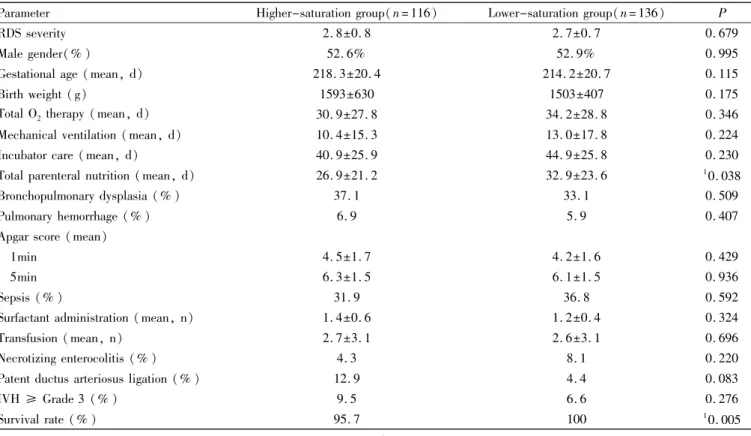
RESULTS: Incidence of ROP, need for laser ablation, and proportion of aggressive posterior ROP were not significantly different between the groups, but the lower- saturation group had a better survival rate ( P = 0. 005).
Patients who spent an additional day in incubator care had a 1. 041 times greater chance of developing ROP ( odds ratio = 1. 041; 95% CI = 1. 003-2. 275; P = 0. 002), whereas a one- point increase in the 5min Apgar score reduced the possibility by 24. 7% (odds ratio = 0. 753; 95% CI = 0. 152 - 0郾 965; P= 0. 033).
誗
CONCLUSION: Target oxygen saturation levels of 85%
to 93% may improve survival without affecting ROP development in infants with RDS. The relevant risk factors are duration of incubator care and 5-min Apgar score.
誗