Copyright © 2021 The Korean Society of Plastic and Reconstructive Surgeons
This is an Open Access article distributed under the terms of the Creative Commons Attribution Non-Commercial License (https://creativecommons.org/
licenses/by-nc/4.0/) which permits unrestricted non-commercial use, distribution, and reproduction in any medium, provided the original work is properly cited. www.e-aps.org
INTRODUCTION
Chronic wounds can develop in response to arterial and venous insufficiency, diabetes, pressure, and radiation [1]. Radiation in- jury disrupts all phases of the wound-healing process. In the ear- ly stages of radiation injury, erythema, dry desquamation, and hyperpigmentation occur, and in the later stages, tissue fibrosis
and blood vessel damage delay healing, causing wounds to be- come chronic [2].
Chronic wounds are generally difficult to manage using tradi- tional wound management. Cell therapy is an effective method for managing intractable wounds, and several studies have inves- tigated the effects of adipose-derived stem cell (ASC)-mediated wound healing [3,4]. However, the use of ASCs for cell therapy
Freeze-dried bovine amniotic membrane as a cell delivery scaffold in a porcine model of radiation- induced chronic wounds
Daemyung Oh 1 , Daegu Son 1 , Jinhee Kim 2 , Sun-Young Kwon 3
Departments of 1 Plastic and Reconstructive Surgery, 2 Radiation Oncology, and 3 Pathology, Keimyung University School of Medicine, Daegu, Korea
Background Locoregional stem cell delivery is very important for increasing the efficiency of cell therapy. Amnisite BA (Amnisite) is a freeze-dried amniotic membrane harvested from bo- vine placenta. The objective of this study was to investigate the retention of cells of the stro- mal vascular fraction (SVF) on Amnisite and to determine the effects of cell-loaded Amnisite in a porcine radiation-induced chronic wound model.
Methods Initially, experiments were conducted to find the most suitable hydration and in- cubation conditions for the attachment of SVF cells extracted from pig fat to Amnisite. Be- fore seeding, SVFs were labeled with PKH67. The SVF cell-loaded Amnisite (group S), Amnisite only (group A), and polyurethane foam (group C) were applied to treat radiation-induced chronic wounds in a porcine model. Biopsy was performed at 10, 14, and 21 days post-opera- tion for histological analysis.
Results Retaining the SVF on Amnisite required 30 minutes for hydration and 1 hour for in- cubation. A PKH67 fluorescence study showed that Amnisite successfully delivered the SVF to the wounds. In histological analysis, group S showed increased re-epithelialization and revas- cularization with decreased inflammation at 10 days post-operation.
Conclusions SVFs had acceptable adherence on hydrated Amnisite, with successful cell de- livery to a radiation-induced chronic wound model.
Keywords Amniotic membrane / Cell therapy / Tissue scaffold / Wound healing / Experimen- tal animal model
Correspondence: Daegu Son Department of Plastic and Reconstructive Surgery, Keimyung University School of Medicine, 1095 Dalgubeol-daero, Dalseo-gu, Daegu 42601, Korea
Tel: +82-53-258-7817 Fax: +82-53-258-4590 E-mail: [email protected]
This article was presented at the 7th R&R Forum on April 20, 2017, in Daejeon, Korea.
Received: June 3, 2020 • Revised: April 6, 2021 • Accepted: April 28, 2021
pISSN: 2234-6163 • eISSN: 2234-6171 • https://doi.org/10.5999/aps.2020.00997 • Arch Plast Surg 2021;48:448-456
Original Article
requires cell expansion in vitro, which is time-consuming and in- creases the risk of contamination and differentiation [5]. In contrast, the stromal vascular fraction (SVF), a collection of non-expanded heterogeneous cells (mesenchymal stem cells, hematopoietic stem cells, immune cells, fibroblasts, endothelial cells, etc.) derived from enzymatically digested adipose tissue, is easy to isolate and free of ethical concerns. Several studies have demonstrated the potential of SVF as a therapy to improve wounds [6,7].
When SVFs are simply delivered to a wound in solution, rapid diffusion into extracellular fluids results in low cell retention. Ji- ang et al. [8] loaded SVFs into a three-dimensional collagen scaffold, applied it to a diabetic wound, and reported drastically increased retention and wound healing. In addition, human acellular dermal matrix, hydrogel, chitosan, and porcine small intestinal submucosa matrix have been used as carriers to deliver ASCs [9-12].
Amniotic membranes have long been used in the treatment of burns and have been recently used for tissue engineering due to their structural and biological properties [13]. Amnisite BA (Bi- oland, Cheonan, Korea) is an acellular bovine amniotic mem- brane that is stored at room temperature in a freeze-dried state.
Storing Amnisite in a freeze-dried state confers stability, longev- ity, and ease of use while being equivalent in action to that of fresh amniotic membrane [14].
The purpose of this study was to develop a process to retain SVF on Amnisite as a scaffold and to confirm the delivery of SVF to wounds. We also investigated the effects of SVF with Amnisite on radiation-induced chronic wounds in a porcine model.
METHODS
One 7-month-old female pig weighing 30 kg, in good health and without skin disease, was obtained from Minipig; Medi Ki- netics Pyeongtaek, Korea and used for this study. This pig was given standardized feed once daily. It was housed in an isolated room maintained at 24°C with 65% humidity. The Institutional Animal Care and Use Committee approved all experimental procedures (IACUC No. KM-2015-46).
Cellular experiments
Isolation of porcine SVF
At 5 days after the operation, which is described below, adipose tissue was harvested from a 6-cm-long× 4-cm-wide paraspinous cutaneous flap that was elevated in areas that were not irradiat- ed. Adipose tissue samples were trimmed and transferred to sterile 50 mL conical tubes that contained 25 mL of phosphate-
buffered saline (PBS). These adipose tissue samples were washed twice with PBS and minced using scissors. The minced adipose tissue had a final volume of roughly 20 mL. The minced adipose tissue samples were subsequently digested with 0.075%
collagenase type I (Worthington Biochemical Corp, Lakewood, NJ, USA) in PBS at 37°C for 1 hour under steady moderate agi- tation. Then, culture medium containing low-glucose Dulbec- co’s modified Eagle’s medium (DMEM) and 10% fetal bovine serum (FBS) was added to stop enzymatic activity. Centrifuga- tion was performed, after which the supernatant was discarded and the pellet was resuspended and filtered through a 100-μm cell strainer to remove tissue debris. The suspension was re-cen- trifuged at 1,500 rpm for 5 minutes and resuspended in low-glu- cose DMEM supplemented with 10% FBS, seeded into 100 Ø culture dishes, and incubated at 37°C with 5% CO 2 for 2 days.
Retention of SVFs on Amnisite BA
The authors asked the manufacturer to produce Amnisite with- out a slit and used it in the experiment.
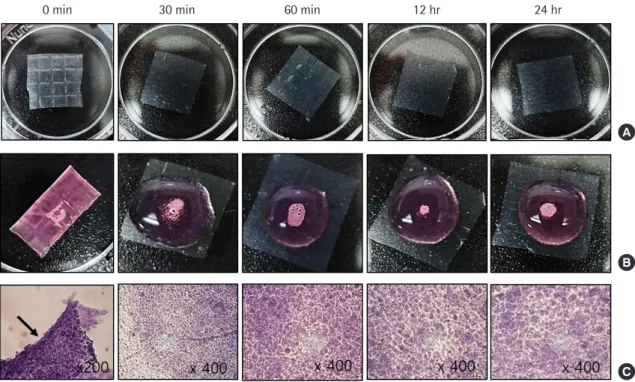
In order to prevent the curling effect that the Amnisite mem- brane typically exhibits during hydration, PBS was used. To find an efficient hydration time (the shortest time necessary to pre- vent curling), SVFs (1× 10 6 /cm 2 ) were seeded on each of four hydrated Amnisite membranes (1× 1 cm 2 ) for 30 minutes, 1 hour, 12 hours, and 24 hours in a dish filled with PBS and then incubated at 37°C with 5% CO 2 for 24 hours. Each membrane was then stained with crystal violet and observed using an opti- cal microscope to confirm cell attachment.
To determine the ideal incubation time, SVFs were seeded on Amnisite using the method described above. The membranes were incubated at 37°C with 5% CO 2 for 1, 3, 6, 12, and 24 hours. The success of cell attachment and the bond strength be- tween Amnisite and the SVF were then compared. The ideal in- cubation time was defined as the time necessary to form a bond strength resilient to just drops of PBS but broken by hydrostatic positive pressure using a pipette. We observed cell attachment using an optical microscope after crystal violet staining.
The success of delivery to the wound and the viability of en-
grafted cells were evaluated in vivo. Before seeding, SVFs were
labeled with PKH67 (PKH67-GL; Sigma-Aldrich, St. Louis,
MO, USA). PKH67 labeling was performed in single-cell sus-
pensions containing 0.6–1× 10 7 SVFs that had been washed
once in serum-free DMEM. The staining procedure followed
the manufacturers’ instructions. To summarize, PKH was added
and the cells were mixed by constant inversion of the tube for
5 minutes. Unbound PKH67 molecules were then blocked with
100% FBS (1:1). The suspension was then centrifuged for
5 minutes at 1,600 × g. The supernatant was carefully aspirated
and cells were resuspended in the culture medium for seeding onto Amnisite.
Animal experiment
Delivery of irradiation and wound creation
A radiation-induced chronic wound model was established fol- lowing protocols described in previous studies [15,16]. The pig received a single dose of 18 Gy with a 6 MeV electron beam per 18×8 cm area. Three radiation areas (total radiation area: 432 cm 2 ) were selected on the paraspinal dorsal skin surface of the pig: two were located on the left side of the spine and one was located on the right side of the spine. These areas were selected to ensure sufficient non-radiated tissue around each wound for the areas to stay independent of each other while avoiding the spread of infection and skin necrosis. Over 90% of the prescribed irradiation dose was limited to a maximum depth of 2 cm.
After 5 weeks of irradiation, a skin defect wound model was designed as follows: First, tiletamine/zolazepam (Zoletil; Vir- bac, Carros, France) was injected intramuscularly for sedation.
Then, xylazine hydrochloride (Rompun; Bayer Animal Health, Monheim, Germany) was injected intravenously for induction.
After shaving the hair, a 4 cm 2 square excisional wound site was marked with an oil ink pen on the irradiated zone. The site was 2 cm away from the boundary. A total of six wounds were made.
Each wound was positioned 6 cm apart from the other wounds.
The excision tissues included the skin and the superficial fat lay- er. The deep fat layer was not included to prevent the spread of infection via the muscular fascia (Fig. 1).
Preliminary animal experiment
A foam dressing (Therasorb, Wonbiogen Co. Ltd., Gumi, Ko- rea) was maintained on the excisional wounds until practical ex-
periments. At 7 days post-operation, the wounds were randomly divided into three groups: group S (SVF with Amnisite, n=2), group A (Amnisite group, n=2), and group C (control group, Therasorb, n=2) (Fig. 2). In group S, 1×10 6 /cm 2 SVF suspend- ed in Amnisite was applied to the wounds, which were then cov- ered with Vaseline gauze and polyurethane foam. In group A, Amnisite was applied to wounds dressed with the same method used for those in group S. In group C, only polyurethane foam was applied to wounds. The body of the pig was then covered with a snug-fitting non-adherent tube gauze dressing (Tubifast;
Mölnlycke Health Care, Gothenburg, Sweden), which was tai- lored into a vest to further protect wounds.
Measurement of wound contraction
To compare the rate of wound contraction ([original wound size (at 7 days post-operation)–wound size measured at that time/original wound size] × 100) among the three wound groups, photographs of the wound region were obtained with a digital camera every time dressings were changed. These photo- graphs were analyzed using ImageJ software (National Institutes of Health, Bethesda, MD, USA). All photographs were taken with a sterilized paper ruler that was used for calibration, stan- dardization, and subsequent quantitative analysis.
Histological analysis
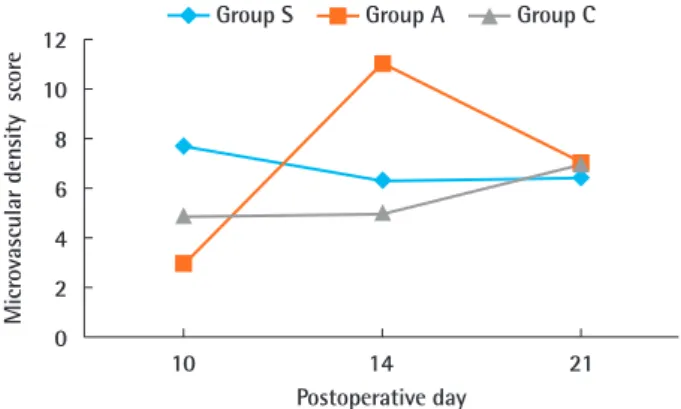
Biopsies were taken sequentially from each of three sides of the square at 10, 14, and 21 days post-operation. The specimens were full-thickness incisional biopsy specimens (including skin, superficial and deep subcutaneous tissue, and granulation tissue)
Fig. 1. Wound creation. (A) Diagram of the porcine radiation-in- duced chronic wound model. (B) Gross findings after creation of chronic wounds.
Fig. 2. Diagram showing locations of dressing application areas. S1, S2: stromal vascular fraction with amniotic membrane (AM) appli- cation; A1, A2: AM application; C1, C2: control group, Therasorb ap- plication.
8 cm
8 cm
Wound, 4×4 cm2 sized
Wound, 4×4 cm
2sized
Radiation area Dose 18 Gy