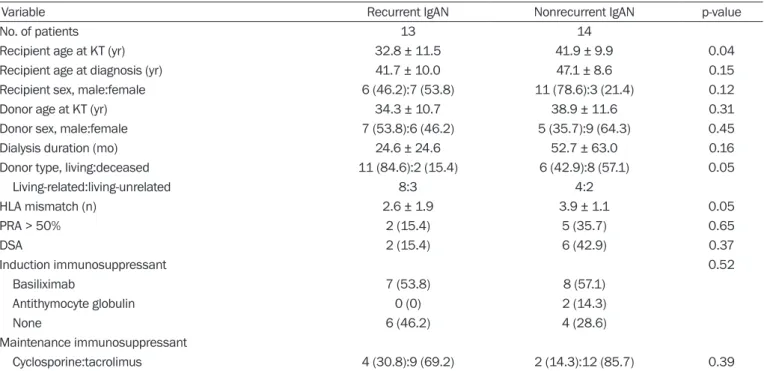
Background: Recurrent glomerulonephritis (GN) is a common cause of allograft loss in kidney transplantation (KT), the most frequent of which is immunoglobulin A (IgA) nephropathy (IgAN). Galactose-deficient IgA1 (Gd-IgA1) plays a major role in the pathophysiology of IgAN, but the association between Gd-IgA1 and recurrent IgAN in kidney transplant recipients (KTRs) is uncertain. We aimed to evalu- ate the efficacy of Gd-IgA1 for prediction of recurrent IgAN and graft and patient survival according to Gd-IgA1 level.
Methods: We enrolled 27 KTRs who underwent allograft biopsy between 2009 and 2016 and measured the serum Gd-IgA1 level of each KTR. We divided the patients into two groups: nonrecurrent IgAN (patients with IgAN prior to KT who were not diagnosed with re- current IgAN) and recurrent IgAN (patients with IgAN prior to KT who were diagnosed with recurrent IgAN).
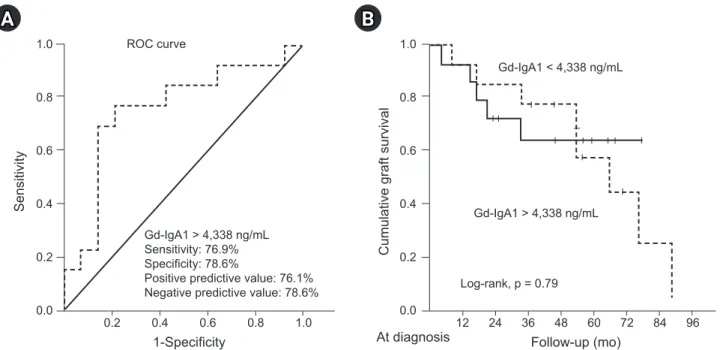
Results: The mean serum Gd-IgA1 level was significantly higher in the recurrent IgAN group than in the nonrecurrent IgAN group (6,419 ± 3,675 ng/mL vs. 3,381 ± 2,844 ng/mL, p = 0.02). The cutoff value of serum Gd-IgA1 in receiver operating characteristic curve analysis was 4,338 ng/mL (area under the curve, 0.76; 95% confidence interval [CI], 0.57–0.95, p = 0.02). Serum Gd-IgA1 lev- el was an independent factor for recurrent IgAN (odds ratio, 17.60; 95% CI, 1.33–233.03, p = 0.03). There was no significant differ- ence in graft or patient survival between the two groups.
Conclusion: Serum Gd-IgA1 can be used as a diagnostic biomarker for recurrent IgAN in KT.
Keywords: Glomerulonephritis, Graft survival, Immunoglobulin A, Kidney transplantation, Survival Kidney Res Clin Pract 2021;40(2):317-324
pISSN: 2211-9132 • eISSN: 2211-9140 https://doi.org/10.23876/j.krcp.20.183
Clinical significance of serum galactose-deficient immunoglobulin A1 for detection of recurrent
immunoglobulin A nephropathy in kidney transplant recipients
Woo Yeong Park
1,2,3, Yaerim Kim
1,2, Jin Hyuk Paek
1,2, Kyubok Jin
1,2, Seungyeup Han
1,21
Division of Nephrology, Department of Internal Medicine, Keimyung University School of Medicine, Daegu, Republic of Korea
2
Keimyung University Kidney Institute, Daegu, Republic of Korea
3