Introduction
In the past, the first-line chemotherapy for non-small cell lung cancer (NSCLC) included a platinum-based doublet regimen
1-3. In recent decades, there has been great progress in the treatment of lung cancer. In particular, molecular-targeted agents, including epidermal growth factor receptor (EGFR) tyrosine kinase inhibitors (TKI) or anaplastic lymphoma kinase inhibitors, have been reported to show significantly improved survival and reduced toxicity
4. For the advanced non-squamous NSCLC, pemetrexed and cisplatin followed by maintenance pemetrexed regimen have shown good clinical efficacy. Furthermore, immune checkpoint inhibitors Copyright © 2019
The Korean Academy of Tuberculosis and Respiratory Diseases.
The Clinical Efficacy and Safety of Four- Weekly Docetaxel as First-Line Therapy in Elderly Lung Cancer Patients with Squamous Cell Carcinoma
Jong Hyun Choi, M.D.
1, Juwhan Choi, M.D.
1, Sang Mi Chung, M.D.
1, Jee Youn Oh, M.D., Ph.D.
1, Young Seok Lee, M.D., Ph.D.
1, Kyung Hoon Min, M.D., Ph.D.
1, Gyu Young Hur, M.D., Ph.D.
1, Jae Jeong Shim, M.D., Ph.D.
1, Kyung Ho Kang, M.D., Ph.D.
1, Hyun Kyung Lee, M.D., Ph.D.
2and Sung Yong Lee, M.D., Ph.D.
11
Department of Internal Medicine, Korea University Guro Hospital, Seoul,
2Department of Internal Medicine, Inje University Busan Paik Hospital, Busan, Korea
Background: Docetaxel is one of the standard treatments for advanced non-small cell lung cancer. Docetaxel is usually administered in a 3-week schedule, but there is significant toxicity. In this phase II clinical study, we investigated the efficacy and safety of a 4-weekly schedule of docetaxel monotherapy, as first-line chemotherapy for advanced squamous cell carcinoma in elderly lung cancer patients.
Methods: Patients with stage IIIB/ IV lung squamous-cell carcinoma age 70 or older, that had not undergone cytotoxic chemotherapy were enrolled. Patients received docetaxel 25 mg/m
2on days 1, 8, and 15, every 4 weeks. Primary endpoint was the objective response rate (ORR). Secondary endpoints were progression-free survival (PFS), overall survival (OS), and toxicity profiles.
Results: A total of 19 patients were enrolled. Among 19 patients, 17 were for evaluated efficacy and safety. In the intent- to-treat population, ORR and disease control rate (DCR) were 11.8% and 47.1%, respectively. In the response evaluable population, ORR was 16.7% and DCR was 66.7%. Median PFS and OS were 3.1 months and 3.3 months, respectively.
There were three adverse grade 3/4 events. Grade 1 neutropenia was reported in one patient.
Conclusion: Our data failed to demonstrate efficacy of a 4-weekly docetaxel regimen, in elderly patients with a poor performance status. However, incidence of side effects, including neutropenia, was lower than with a 3-week docetaxel regimen, as previously reported.
Keywords: Carcinoma, Non-Small-Cell Lung; Chemotherapy; Docetaxel; Treatment Outcome; Safety; Therapeutics;
Aged; Lung Neoplasms; Carcinoma, Squamous Cell
Address for correspondence: Sung Yong Lee, M.D., Ph.D.
Department of Internal Medicine, Korea University Guro Hospital, 148 Gurodong-ro, Guro-gu, Seoul 08308, Korea
Phone: 82-2-2626-3030, Fax: 82-2-2626-1166 E-mail: [email protected]
Received: May. 30, 2018 Revised: Sep. 15, 2018 Accepted: Oct. 12, 2018 Published online: Dec. 20, 2018
cc It is identical to the Creative Commons Attribution Non-Commercial License (http://creativecommons.org/licenses/by-nc/4.0/).
targeting programmed death-1 or programmed death ligand 1 (PD-L1) have been associated with a greater survival rate in patients with high expression of PD-L1
5-7. However, these agents can only be used in selected patients with a driving gene mutation or high PD-L1 expression. Therefore, patients without driving mutations or low PD-L1 expression still need standard cytotoxic chemotherapy, and in particular, elderly patients are often unable to undergo chemotherapy because of their comorbidities and the concern of frequently occurred chemotherapy related serious adverse events.
Docetaxel has been shown to be efficacious as a mono- therapy in both chemo-naïve and resistant NSCLC
8-10and is approved on a 3-week schedule at a dose of 75 mg/m
2. How- ever, severe and frequent myelosuppression was observed on the 3-week schedule. In phase 1 clinical trials, 100 mg/m
2was administered at 3-week intervals, and grade 3–4 neutropenia was present in more than 90% of participants
11. In addition, among the clinical trials conducted in Japan, neutropenia has been reported
12in more than 80% of patients even when ad- ministered at a dose of 60 mg/m
2.
In a previous clinical trial of NSCLC patients treated with docetaxel on weekly schedules, severe toxicity profiles of neutropenia and febrile neutropenia were improved while re- taining the antitumor effect compared with those of a 3-week schedule
13,14. Based on these results, we evaluated the efficacy and safety of docetaxel alone in 4-weekly schedules as first- line therapy in elderly patients with squamous cell lung carci- noma.
Materials and Methods
This study was an open-label, single-arm phase II trial. The primary endpoint was the objective response rate (ORR). Sec- ondary endpoints included progression-free survival (PFS), overall survival (OS), and safety profiles.
1. Study design and participants
Chemotherapy-naïve patients aged 70 years or older with measurable, histologically confirmed advanced squamous cell NSCLC classified as clinical stage IIIB or IV (American Joint Committee on Cancer seventh edition) and with an Eastern Cooperative Oncology Group performance status (ECOG PS) of 1–2 were enrolled in the study.
In addition, patients were required to satisfy the following criteria: absolute neutrophil count ≥1,500/mm
3, platelet count of ≥100,000/mm
3, serum total bilirubin level of ≤1.25 times the upper limit of the normal range, serum levels of aspartate aminotransferase and alanine aminotransferase ≤3.0 times the upper limit of the normal range of each institution (if there were liver metastasis, ≤5.0 times the upper limit of the normal range), serum levels of alkaline phosphatase ≤2.5 times the
upper limit of the normal range (if there were liver metastasis,
≤5.0 times the upper limit of the normal range), serum cre- atinine levels of <1.5 mg/dL, and estimated life expectancy exceeding 3 months.
Patients with other coexisting malignancies, symptomatic brain metastasis, peripheral neuropathy of grade 2 or higher, clinically significant heart disease (e.g., congestive heart failure uncontrolled with medication, symptomatic coronary artery disease, or arrhythmia) or myocardial infarction within 12 months were not enrolled. In addition, patients who received radiotherapy or administered another test drug within 4 weeks of the start of the study were excluded.
All enrolled patients provided written informed consent and the institutional review boards of Korea University Guro Hospital (IRB No. 2011GR0230) and Busan Paik Hospital (IRB No. 10-211) approved the study.
2. Treatment schedule
Patients enrolled in the study received 25 mg/m
2docetaxel over 1 hour on days 1, 8, and 15, every 4 weeks. Patients were premedicated with dexamethasone and antihistamine to pre- vent anaphylactic reactions and emesis.
3. Response evaluation and safety assessment
Chest computed tomography was performed every 2 cycles (8 weeks) and when clinical disease progression was suspected. Responses were evaluated as complete remission (CR), partial remission (PR), stable disease (SD), and progres- sive disease (PD) according to Response Evaluation Criteria in Solid Tumor version 1.1
15. The relative dose intensity (RDI) is the ratio of delivered to the planned dose intensity. An RDI of 100% indicates that the drug was administered at the dose planned per protocol, without delay and without cancella- tions.
The safety profile, including monitoring of adverse events (AEs), vital signs, hematology, routine chemistry, and uri- nalysis, was evaluated. AE severity was graded based on the National Cancer Institute Common Terminology Criteria (NCI CTC) for Adverse Events version 3.0.
4. Statistical analysis
The ORR was calculated by the sum of the CR and PR rates
and is presented with the 95% confidence interval (CI). The
disease control rate (DCR) was defined as the sum of the CR,
PR, and SD rates. PFS was defined as the time from the start
of treatment to the point at which PD was confirmed or to the
time of death. Patients whose disease had not progressed at
the final analysis were censored on the last tumor evaluation
date. OS was defined as the time from the start of treatment
to the time of death. Follow-up was performed for up to 6
months after the end of treatment for the surviving patients.
Survival analyses were estimated using the Kaplan‒Meier method. Safety analyses summarized AEs using NCI CTC ver- sion 3.0 during the entire treatment period.
Results
1. Patient characteristics
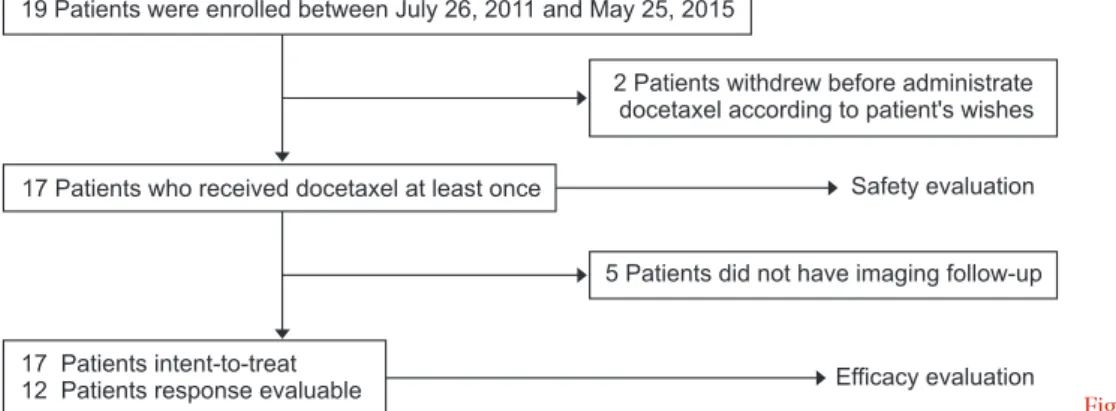
Nineteen patients were enrolled in the study from two can- cer centers in South Korea between July 26, 2011 and May 25, 2015 (Figure 1). Two patients chose to withdraw from the study before they receive docetaxel; therefore, we evaluated ef- ficacy and safety in 17 patients. Patient baseline demographics and clinical characteristics are shown in Table 1. The median age of the patients was 78 years (range, 71–86 years) and 16 patients (94.1%) were men; six patients (35.3%) had stage IIIB and 11 (64.7%) had stage IV disease; 24% had an ECOG PS of 2. The majority of patients had a history of smoking (94.1%).
The median forced expiratory volume in 1 second was 1.65 L (range, 0.80–2.6 L).
2. Efficacy
In the intent-to-treat population, ORR and the DCR were 11.8 and 47.1%, respectively. For the response evaluable population, response evaluation was performed in 12 pa- tients because five did not have imaging follow-up. The ORR was 16.7%. No patients achieved a CR and two achieved a PR (16.7%). SD was seen in six patients (50%) and PD in four (33.3%) (Table 2). The DCR was 66.7%. The duration of re- sponse for patients who achieved a PR was 3.8 months. The median number of cycles was 2 (range, 1–6). The mean rela- tive dose intensity is 54.1±30.1% (mean±standard deviation).
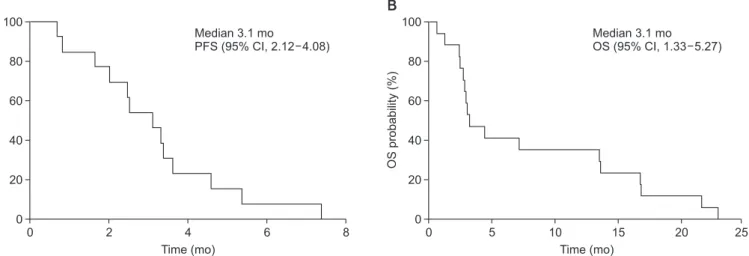
The median PFS was 3.1 months (95% CI, 2.12–4.08) and the median OS was 3.3 months (95% CI, 1.33–5.27) (Figure 2). The largest percentage changes in the sum of the longest diameters of the target lesions compared with baseline are
shown in Figure 3.
3. Safety
Of the 17 patients who received docetaxel at any one time, five did not have any AEs. Of the 10 patients who received more than 2 cycles, two did not have any AEs. The overall inci- dence of grade ≥3 AEs was 17.6% (3 of 17 patients). Grade ≥3 AEs occurred in three patients and included diarrhea (2/17) and dizziness (1/17) (Table 3). Among them, dose reductions
19 Patients were enrolled between July 26, 2011 and May 25, 2015
17 Patients who received docetaxel at least once
5 Patients did not have imaging follow-up
17 Patients intent-to-treat 12 Patients response evaluable
2 Patients withdrew before administrate docetaxel according to patient's wishes
Safety evaluation
Efficacy evaluation
Figure 1. Follow-up of the study patients.
Table 1. Baseline characteristics of patients with lung squamous cell carcinoma
Characteristic Value (n=17)
Age, yr 78 (71 – 86)
Sex
Male 16 (94.1)
Female 1 (5.9)
Stage
IIIB 6 (35.3)
IV 11 (64.7)
Performance status
0-1 13 (76.5)
2 4 (23.5)
Smoking history
Never 1 (5.9)
Former 11 (64.7)
Current 5 (29.4)
Amounts, pack year 52.5 (8 – 100)
FEV
1, L 1.65 (0.8 – 2.6)
BSA, m
21.6 (1.36 – 1.93)
Values are presented as median (range) or number (%).
FEV
1: forced expiratory volume in 1 second; BSA: body surface
area.
of docetaxel were required in only one patient and the other two withdrew from the study. Neutropenia was reported in only one patient and was grade 1. Fatal events occurred in three cases but were determined to be unlikely to be related to the study drug. Two patients who achieved SD died due to progression of interstitial lung disease diagnosed before the administration of docetaxel. One patient discontinued treat- ment because of deterioration in their general condition dur- ing the second cycle and died 30 days after the last docetaxel administration.
Discussion
According to a recent report, lung cancer is the leading cause of cancer-related death worldwide in both sexes
16. Ap- proximately 75% of lung cancers have non-small cell histol- ogy, and most of these are locally advanced stage III or meta-
static stage IV when diagnosed
5. More than half of confirmed advanced NSCLC patients are over 65 years old because they often do not have specific symptoms at an earlier stage
17. However, well-known large randomized clinical trials have excluded elderly patients and those with a poor PS; therefore, the limited evidence-based data are inadequate to provide proper management for these patients
18.
For NSCLC patients, platinum-based doublet regimens are basic first-line chemotherapy but are often difficult to use due to toxicity in some elder patient with poor PS. Oral EGFR-TKIs have improved OS and PFS in patients with known EGFR- sensitizing mutations in NSCLC over chemotherapy in sev- eral clinical studies
4. However, mutations in the EGFR gene have been shown to be most prominent in the Asia-Pacific adenocarcinoma subgroup
19. Therefore, patients with non- adenocarcinoma have a relatively limited range of chemo- therapeutic options.
Docetaxel is one of the standard chemotherapeutic agents
A
PFSprobability(%)
0 6 8
Time (mo) 4 2
Median 3.1 mo
PFS (95% CI, 2.12 4.08)
0 100
80
60
40
20
B
OSprobability(%)
0 15 25
Time (mo) 10
5
Median 3.1 mo OS (95% CI, 1.33 5.27)
0 100
80
60
40
20
20
Figure 2. Survival analyses. (A) Kaplan-Meier progression-free survival (PFS) curve. (B) Kaplan-Meier overall survival (OS) curve. CI: confi- dence interval.
Table 2. Best objective response
Response ITT (n=17) RE (n=12)
CR 0 (0) 0 (0)
PR 2 (11.8) 2 (16.7)
SD 6 (35.3) 6 (50.0)
PD 4 (23.5) 4 (33.3)
NE 5 (29.4) 0 (0)
Overall response rate, % 11.8 16.7
Disease control rate, % 47.1 66.7
Values are presented as number (%) unless otherwise indicated.
ITT: intent-to-treat; RE: response evaluable population; CR: com- plete remission; PR: partial remission; SD: stable disease; PD: pro- gressive disease; NE: not evaluable.
Figure 3. Best change in measurable lesion size from baseline for 12 patients with evaluable indicator lesions: waterfall plot. PD: pro- gressive disease; SD: stable disease; PR: partial remission.
Maximumchangesfrombaseline(%)
60 40
20
0
20
40
PD SD PR