Tuberc Respir Dis 2013;74:163-168
CopyrightⒸ2013. The Korean Academy of Tuberculosis and Respiratory Diseases. All rights reserved.
Incidence and Risk Factors of Contrast-Induced Nephropathy after Bronchial Arteriography or Bronchial Artery Embolization
June Seok Song, M.D.1, Sa Il Kim, M.D.2, Woongjun Kim, M.D.1, Dong Won Park, M.D.1, Hyun Jung Kwak, M.D.1, Ji-Yong Moon, M.D.1, Sang-Heon Kim, M.D.1, Tae Hyung Kim, M.D.1, Jang Won Sohn, M.D.1, Dong Ho Shin, M.D.1, Sung Soo Park, M.D.1, Ho Joo Yoon, M.D., Ph.D.1
1Department of Internal Medicine, Hanyang University College of Medicine, Seoul, 2Department of Internal Medicine, HanMaEum Medical Center, Changwon, Korea
Background: In uncontrolled hemoptysis patient, bronchial arteriography and bronchial artery embolization (BAE) is a important procedure in diagnosis and treatment. The aim of this study is to assess the incidence of contrast-induced nephropathy and the risk factors of contrast-induced nephropathy (CIN) after bronchial arteriography and BAE.
Methods: We retrospectively reviewed the medical records of the patients who underwent bronchial arteriography and BAE in two university hospitals from January 2003 to December 2011. CIN was defined as rise of serum creatinine more than 25% of baseline value or 0.5 mg/dL at between 48 hours and 96 hours after bronchial arteriography and BAE. We excluded patients who already had severe renal insufficiency (serum creatinine≥4.0) or had been receiving dialysis.
Results: Of the total 100 screened patients, 88 patients met the enrollment criteria. CIN developed in 7 patients (8.0%). The mean duration between the exposure and development of CIN was 2.35±0.81 days. By using multivariate analysis, serum albumin level was found to be significantly associated with the development of CIN (p=0.0219).
Conclusion: These findings suggest that the incidence of CIN was higher than expected and patients with hypoalbuminemia should be monitored more carefully to prevent the development of CIN after bronchial arteriography and BAE.
Key Words: Contrast Media; Acute Kidney Injury; Bronchial Arteries; Embolization, Therapeutic
Address for correspondence: Ho Joo Yoon, M.D., Ph.D.
Department of Internal Medicine, Hanyang University College of Medicine, 222 Wangsimni-ro, Seongdong-gu, Seoul 133-791, Korea
Phone: 82-2-2290-8349, Fax: 82-2-2298-9183 E-mail: [email protected]
Received: Oct. 10, 2012 Revised: Dec. 4, 2012 Accepted: Apr. 24, 2013
CCIt is identical to the Creative Commons Attribution Non-Commercial License (http://creativecommons.org/licenses/by-nc/3.0/).
Introduction
Since Osborne et al. first used contrast media to get a picture of urinary tract in 1960s, the substance has been widely used for diagnosis and treatment
1. As diag- nostic and intervention methods increasingly employed
contrast agents, the incidence of kidney diseases caused by the substance has risen. Contrast media is the third leading cause of iatrogenic acute renal failure occurred in hospital
2. The incidence rate of contrast-induced nephropathy was estimated at 0.6% to 2.3%. However, the rate jumped to 20-30% in patients with chronic kid- ney disease
3, diabetes, congestive heart failure and eld- erly people
1,4-7.
Hemoptysis refers to the bleeding occurring in lung parenchyma
8. The bronchial artery is the major source of bleeding in nearly 90% of cases
9. Hemoptysis is an emergency condition. Patients with massive hemoptysis need urgent procedures such as bronchial artery emboli- zation or lung lobectomy.
Effects of contrast media on kidney functions have
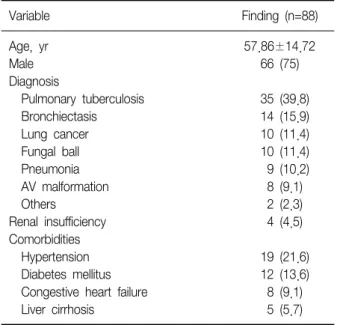
Table 1. Characteristics of subjects
Variable Finding (n=88)
Age, yr 57.86±14.72
Male 66 (75)
Diagnosis
Pulmonary tuberculosis 35 (39.8)
Bronchiectasis 14 (15.9)
Lung cancer 10 (11.4)
Fungal ball 10 (11.4)
Pneumonia 9 (10.2)
AV malformation 8 (9.1)
Others 2 (2.3)
Renal insufficiency 4 (4.5)
Comorbidities
Hypertension 19 (21.6)
Diabetes mellitus 12 (13.6)
Congestive heart failure 8 (9.1)
Liver cirrhosis 5 (5.7)
Values are presented as number (%).
AV: arteriovenous.
been addressed in studies at home and abroad. But no study discussed the incidence and risk factors of kidney disorders as effects of contrast agent used for bronchial arteriography and embolization. Bronchial arteriography and embolization are urgently performed for patients with acute hemoptysis in emergency situation. And sal- ine and N-acetylcysteine pretreatments are skipped in such an emergency situation. Based on this fact, an in- vestigation into the association between the incidence and risk factors of kidney disorders and bronchial arte- riography and embolization using contrast agents would provide useful information required to predict prognosis of patients. Authors retrospectively analyzed medical re- cords of patients who underwent bronchial arteriog- raphy or bronchial artery embolization retrospectively.
The aim of this study was to identify the incidence rate and risk factors of contrast-induced nephropathy.
Materials and Methods
Medical records of patients who underwent bronchial arteriography or bronchial artery embolization at Hanyang University Hospital and Hanyang University Guri Hospital from January 2003 through December 2011 were analyzed retrospectively. Of patients who un- derwent either bronchial arteriography or bronchial ar- tery embolization during the period, those who had no records for preopeative or postoperative creatinine level were excluded. Those had preoperative creatinine level of 4.0 mg/dL or higher and those who had undergone dialysis were also excluded. Among 100 concerned pa- tients, 12 were excluded because of the above men- tioned reasons. Medical records of 88 patients were re- viewed for the present study.
Contrast-induced nephropathy is defined as a 0.5 mg/dL or higher (or a 25% or above) increase in crea- tinine between 48 and 96 hours after either bronchial arteriography or bronchial artery embolization from the baseline creatinine value
10. Hypotension is defined by systolic blood pressure below 90 mm Hg or diastolic blood pressure below 60 mm Hg. Renal failure is de- fined as creatinine level exceeding the normal limit of
1.4 mg/dL used in the hospital.
As factors affecting contrast-induced nephropathy, age, sex, reuse of contrast agent in 3 days, test results (creatinine level, hematocrit and its change and serum albumin), bronchial artery embolization, dose of con- trast agent, medications being taken, preopeative hypo- tension and concurrent illness were identified through review of the literature
11,12. The association between each variable and contrast-induced nephropathy was investigated. Student-t tests or chi-square tests were per- formed for univariate analysis and multivariate logistic regression for bivariate analysis using SAS version 9.2 (SAS Institute Inc., Cary, NC, USA). p-values of less than 0.05 are considered significant. This study was ap- proved by Clinical Trial Review Board of Hanyang University Hospital.
Results
1. Incidence rate of contrast-induced nephropathy The average age of 88 patients was 57.8±14.72 years. Of 88 patients, 66 (75.0%) patients were men.
Among admission diagnoses, tuberculosis was the most
Figure 1. Study design and enrolled subjects. Cr: crea- tinin; CIN: contrast-induced nephropathy.
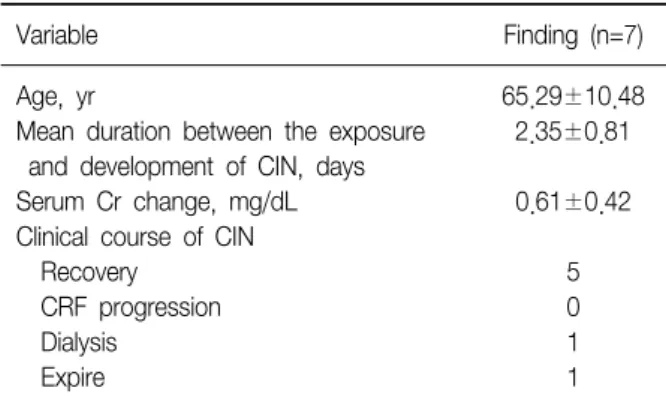
Table 2. Clinical characteristics and course of 7 patients with CIN
Variable Finding (n=7)
Age, yr 65.29±10.48
Mean duration between the exposure 2.35±0.81 and development of CIN, days
Serum Cr change, mg/dL 0.61±0.42
Clinical course of CIN
Recovery 5
CRF progression 0
Dialysis 1
Expire 1
CIN: contrast-induced nephropathy; Cr: creatinin; CRF: chronic renal failure.
highest with 35 (39.8%) patients. Of those diagnosed as tuberculosis, 23 (65.7%) patients had active tuber- culosis. Active tuberculosis was determined by com- puted tomography (CT) finding or positive sputum smear results or sputum incubation test results. Other concurrent illness included hypertension, diabetes, renal failure, and cirrhosis (Table 1). Of 88 patients, 7 (8.0%) patients developed contrast-induced nephropathy after bronchial arteriography or embolization (Figure 1).
Visipaque (Iodixanol, 290 mOsm/kg) was used as con- trast agent for 63 patients and ultravist (Iopromide, 770 mOsm/kg) for 25 patients.
2. Clinical characteristics and progress
The mean age was 65.29±10.48 years in seven pa- tients who developed contrast-induced nephropathy, which was confirmed mean 2.35 days after bronchial arteriography or embolization. An average creatinine change was 0.61 mg/dL. Of 7 patients with contrast-in- duced nephropathy, 5 recovered to the baseline crea- tinine level, one underwent dialysis and one died (Table 2).
3. Risk factors of contrast-induced nephropathy The mean age was 65.29±10.48 years and 57.22±
14.91 years, respectively, in patients with contrast-in- duced nephropathy and patients without nephropathy.
Creatinine level, hematocrit and hematocrit change and
serum albumin were also compared for the two groups.
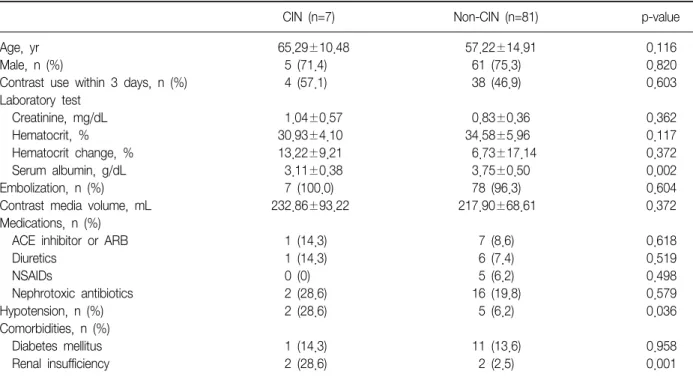
Serum albumin was 3.11±0.38 g/dL and 3.75±0.50 g/dL, respectively, in the both groups. Univariate analy- sis (p=0.002) confirmed effects of low albumin on con- trast-induced nephropathy. The entire group with con- trast-induced nephropathy received bronchial artery em- bolization while 78 (96.3%) had the same procedure in the group without nephropathy. The dose of contrast agent was 242.86±93.22 mL and 217.90±68.61 mL, re- spectively, in the both groups. The difference was not significant between the groups (p=0.372). Contrast me- dia dosage is known to be associated with the incidence of kidney disorders, according to earlier studies
13. Medications being taken included angiotensin-con- verting enzyme inhibitor or angiotensin receptor blocker (p=0.618), diuretic (p=0.519) and nonsteroidal antiin- flammatory drug (p=0.498). However, no significant dif- ferences were observed between the two groups. Of 88 patients, 18 took nephrotoxic antibiotics, including ami- noglycoside (n=16) and trimethoprim-sulfamethoxazole (n=2), before procedure. Effects of nephrotoxic anti- biotics were not significant in the both groups (p=
0.579). Hypotension was observed in two patients (28.6%) of the contrast-induced nephropathy group and five patients (6.2%) in the group without nephropathy.
The difference was significant (p=0.036). Effects of renal
failure were also significant between the two groups as
2 patients (28.6%) had renal failure in the group with
Table 3. Factors associated with CIN by using univariate analysis
CIN (n=7) Non-CIN (n=81) p-value
Age, yr 65.29±10.48 57.22±14.91 0.116
Male, n (%) 5 (71.4) 61 (75.3) 0.820
Contrast use within 3 days, n (%) 4 (57.1) 38 (46.9) 0.603
Laboratory test
Creatinine, mg/dL 1.04±0.57 0.83±0.36 0.362
Hematocrit, % 30.93±4.10 34.58±5.96 0.117
Hematocrit change, % 13.22±9.21 6.73±17.14 0.372
Serum albumin, g/dL 3.11±0.38 3.75±0.50 0.002
Embolization, n (%) 7 (100.0) 78 (96.3) 0.604
Contrast media volume, mL 232.86±93.22 217.90±68.61 0.372
Medications, n (%)
ACE inhibitor or ARB 1 (14.3) 7 (8.6) 0.618
Diuretics 1 (14.3) 6 (7.4) 0.519
NSAIDs 0 (0) 5 (6.2) 0.498
Nephrotoxic antibiotics 2 (28.6) 16 (19.8) 0.579
Hypotension, n (%) 2 (28.6) 5 (6.2) 0.036
Comorbidities, n (%)
Diabetes mellitus 1 (14.3) 11 (13.6) 0.958
Renal insufficiency 2 (28.6) 2 (2.5) 0.001
CIN: contrast-induced nephropathy; ACE: angiotensin converting enzyme; ARB: angiotensin receptor blocker; NSAIDs: non-steroida anti-inflammatory drugs.
Table 4. Factors associated with CIN by using multivariate analysis
OR 95% CI p-value
Serum albumin 0.144 0.03–0.76 0.0219
Hypotension 2.171 0.20–23.54 0.5239
Renal insufficiency 4.571 0.36–58.04 0.2412 CIN: contrast-induced nephropathy; OR: odds ratio; CI: con- fidence interval.