• 검색 결과가 없습니다.

Evaluation of Physical and Mechanical Properties of Non-certificated Laminated Veneer Lumber (LVL) Circulated in Domestic Lumber Market

N/A
N/A
Protected

Academic year: 2021

Share "Evaluation of Physical and Mechanical Properties of Non-certificated Laminated Veneer Lumber (LVL) Circulated in Domestic Lumber Market"

Copied!
8
0
0

로드 중.... (전체 텍스트 보기)

전체 글

(1)

*1 Received on June 22, 2011; accepted on September 19, 2011

*2 Department of Forest Resources, Daegu University, Kyongsan 712-714, Korea

Corresponding author : Sei-Chang Oh (e-mail: [email protected])

Evaluation of Physical and Mechanical Properties of Non-certificated Laminated Veneer Lumber (LVL)

Circulated in Domestic Lumber Market* 1

Sei-Chang Oh*

2†

ABSTRACT

The selected physical and mechanical properties of non-certificated LVL circulated in domestic lumber market were investigated and compared to relevant standards. The tested LVL passed the moisture content and the soaking delamination rate limit as per domestic (KS) and Japanese standard (JAS). The evaluated mechanical properties were flatwise/edgewise bending strength, modulus of elasticity (MOE), horizontal shear and compressive strength. The 30 mm-thick LVL showed significantly higher bending strength than that of the 25 mm-thick LVL. The modulus of elasticity (MOE) showed same tendency in the results of bending strength. The edgewise bending strength and MOE were higher than that of flatwise bending strength and MOE. The horizontal shear strength values were also showed similar results to bending strength values. The tested results were compared each other and each products were graded according to JAS 701 grade specification. The failure mode of LVL in bending test showed the similar failure mode of solidwood that failed in a simple tension manner (splintery tension). The glue line failure was severe in 25 mm-thick specimens due to concentration of shear stress in layer discontinuity containing small voids and starved glue lines. In horizontal shear strength test, failure mode of LVL showed the typical horizontal shear failure. Compressive specimens failed with fiber crushing in company with apparent de- lamination that splitted along the length of the specimens. From the results, the complete bonding between lamination and consistency in thin veneer layer were considered as a critical factor in the mechanical prop- erties of LVL. Moreover, the standard test procedure and specification for non-certificated LVL should be required to check the performance of uncertificated materials.

Keywords : laminated veneer lumber (LVL), bending strength, MOE, horizontal shear, JAS, KS

1. INTRODUCTION

Laminated veneer lumber (LVL) is a compo- site of wood veneer sheet elements manufac- tured from one or more species, either sepa-

rately or mixed, with wood fibres primarily ori-

ented along the length of the member (ISO,

2010). It has been developed as an alternative

material to solid wood products used in wood

frame construction. Typically, veneers with high

(2)

Table 1. Configuration of LVL tested in this study Nominal thickness

(mm) Number of ply Species Product type Dimension (mm)

25 21 Birch lumber 25 × 25 × 2,400

30 25 Japanese Larch panel 30 × 1,220 × 2,440

grades are placed on the face and back, inex- pensive or low-grade veneers are in the inner plies. So, it can reduce the processing costs and effectively utilize the low grade materials like thinnings, second and third growth timber with small diameters. Generally, LVL is used as headers and beams, chords for trusses, flanges in prefabricated I-joist, and scaffold planks. It is also used as columns, shear wall framing studs and even structural members in upholstered fur- niture frames (Williamson, 2002). Moreover, it is used as nonstructural elements like window frames, interior materials, and stair treads, etc.

Currently, LVL is imported from North America for structural materials used in wood frame con- struction and this product is certificated from corresponding agency. Meanwhile, any infor- mation on the properties of imported laminated veneer lumber from other countries and circu- lated in domestic market are still very limited.

This products are non-certificated materials and has some potential problems applying to the in- tended uses, lead to cause possible the consum- er's distrust to the products. So some critical in- formation is needed to evaluate the physical and mechanical properties of this product and com- pare each other. Also, it is needed to align the testing standard and quality certification.

In Korea, some species reaches the moderate diameter for making veneers for plywood and LVL, rather than lumber products. This leads to the development of value added products like structural composite materials including LVL, and the basic information is also needed for comparing competitive products.

In this study, the physical and mechanical

properties of non-certificated imported lami- nated veneer lumber were investigated and the results were compared with its corresponding standards.

2. MATERIALS and METHODS

Laminated veneer lumber (LVL) was ob- tained from commercial suppliers in Incheon, Korea. Nominal thickness of LVL were 25 mm, 30 mm respectively and LVL with the thickness of 30 mm were the panel type product with the dimension of 1,220 mm × 2,440 mm. LVL with the thickness of 25 mm was sized product with the length of 2,400 mm. These species were Japanese Larch in 30 mm product and Birch in 25 mm products as shown in Table 1.

Specimens were cut from each billet and pan- els according to ISO/FDIS 22390, ASTM D 5456 and JAS 701 standards for conducting the tests for the evaluation of physical and mechan- ical properties of LVL. The testing programs are shown in Table 2. Before the tests, the specimens were stored in a humidity chamber at 20°C and 65% relative humidity until equili- brium moisture content of 12% was reached.

The static bending to edgewise/flatwise strength and stiffness, compression strength parallel to the grain, and horizontal shear strength related to flatwise bending tests (short span bending) were conducted according to the standard de- scribed earlier. In static bending test, ten bend- ing samples were selected in each billet and loaded at third point loading along 420 mm span by 100 kN universal testing machine.

After each sample was broken, the moisture

(3)

Table 2. Strength test programs in this study

Materials Static bending Compression

parallel to the grain Horizontal shear

Flatwise Edgewise

25 mm LVL yes yes yes yes

30 mm LVL yes yes yes yes

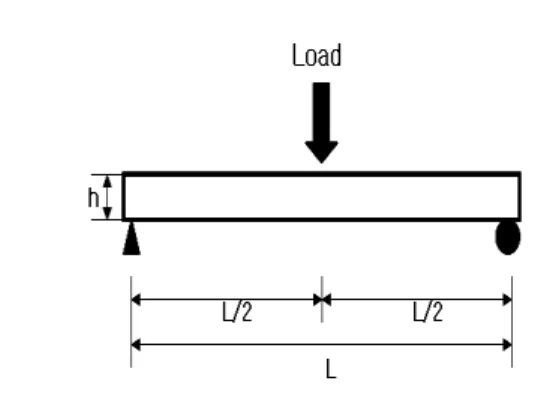
Fig. 1. The horizontal shear strength test (short span bending) method according to JAS 701 (L;

span, h; depth, L = 4 h).

content (MC) and specific gravity (SG) speci- mens were cut from the undamaged part of each sample. The compression strength parallel to the grain, and horizontal shear strength re- lated to flatwise bending tests were conducted in accordance with ISO/FDIS 22390 standards and JAS 701 (Fig. 1), respectively. The soaking delamination rate were determined according to KSF 2160 in soaking 24 hrs followed by drying under the 60 ± 3°C condition in drying oven.

Calculation equations for each strength test were as follows.

   





   



     





    



where b = sample width (mm) h = sample depth (mm) p

max

= maximum strength (N) p

prop

= load to propotional limit (N) y = deflection to propotional limit (mm) A = cross section area (mm

2

)

3. RESULTS and DISCUSSION

3.1. Physical Properties

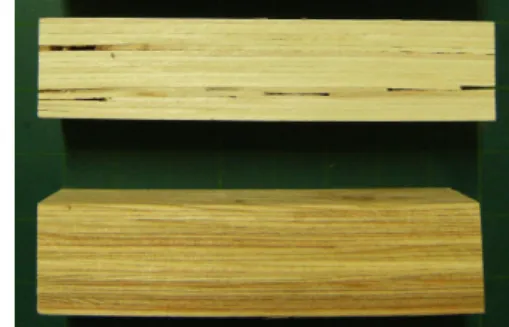
Table 3 summarizes the mean values and the standard deviation of the MC and density of the tested specimens. As shown in Table 3, the density values of birch LVL were lower than those of Japanese larch LVL. As the density of LVL made from the Japanese larch, 0.79, is higher than that of solid Japanese larch wood, 0.60 (Rijsdijk and Laming, 1994). This results came from the adding the adhesive and com- paction within and between the lamination dur- ing the hot pressing. Sulaiman, etc. (2009) also reported that there was an increase in density of LVL made from oil palm compared to solid oil palm. But the density of LVL made from birch, 0.50, were lower than that of solid birch, not less than 0.55 (Woodhandbook, 1999). This is due to the non-compact layer structure contain- ing a lot of voids between lamination, and lead to higher standard deviation and unconsisteny in each lamination as shown in Fig. 3. From the results, not only the density of raw materials but also the layer structure is considered as im- portant factors affecting to the density of LVL.

All the tested LVL samples passed the mois-

(4)

Table 4. Test results of soaking delamination rate of LVL

Materials Delamination rate (%) Test results

25 mm LVL 3 passed

30 mm LVL 0 passed

* KSF 3119; 10% or less (sum of delamination length in both side of cross section devided by sum of glue line length in both side of cross section).

Table 3. Mean and standard deviation of MC and density of tested specimens

Materials Density (g/cm

3

)

Moisture Content (%) Average Test results 25 mm LVL 0.50 (0.19) 11.53 (0.87) passed 30 mm LVL 0.79 (0.02) 9.10 (0.18) passed

*1) Values in parenthesis are standard deviation.

*2) JAS 701; 14% or less.

Table 5. Test results of strength test of LVL

Materials

Bending strength

(N/mm

2

) Compressive

strength (N/mm

2

)

Horizontal shear strength (N/mm

2

)

Flatwise Edgewise

MOR MOE MOR MOE

25 mm 49.5

(19.4)

9248.3 (175.5)

55.9 (8.3)

9931.0 (91.8)

42.3 (3.4)

4.59 (0.54)

30 mm 104.1

(7.4)

12863.9 (364.6)

114.5 (5.8)

14184.2 (423.8)

72.4 (4.6)

9.56 (0.57)

* Values in parenthesis are standard deviation.

ture content limit as per Japanese standard (JAS 701) to 14%. In the soaking delamination rate test, the test results showed good results in soaking 24 hrs followed by drying under the 60

± 3°C condition in drying oven (Table 4). There was no visible delamination in 30 mm-thick LVL samples and all the tested LVL passed the soaking delamination rate limit as per domestic standard (KS F 3119) to 10%. In spite of the results, 25 mm-thick LVL made from birch de- mands more attention to use under wet service condition due to the potential swelling by the moisture inclusion to voids and poor layer structure.

3.2. Mechanical Properties

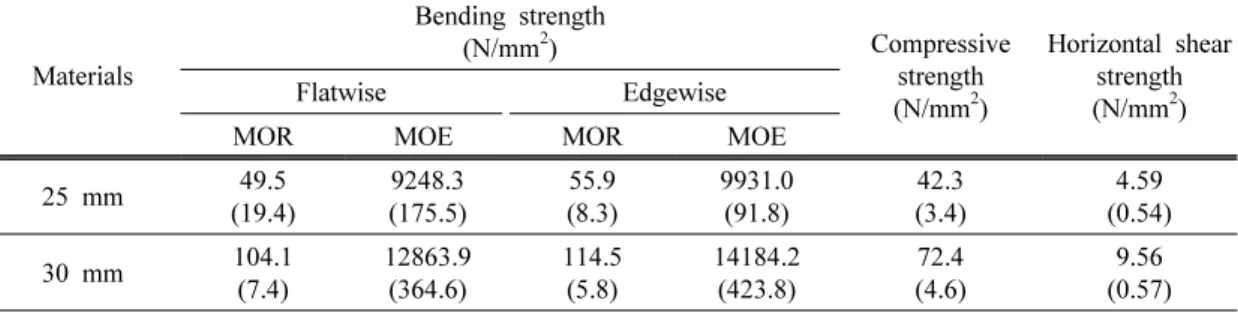
The average and the standard deviation of bending strength (MOR) and modulus of elas- ticity (MOE) of LVL are given in Table 5.

From the test results, the 30 mm-thick LVL

showed significantly higher bending strength than that of 25 mm-thick LVL, and this is con- sidered due to higher density of 30 mm-thick LVL. Quite number of thin veneer was lami- nated in 30 mm-thick LVL lead to higher den- sity and such to higher bending strength. Especially the higher standard deviation of MOR and MOE in 25 mm-thick LVL was considered to be originated from poor quality control in mak- ing LVL. In domestic market, the 25 mm-thick LVL is considered to be used as non-structural materials rather than structural application.

The highest modulus of elasticity (MOE) was

found in 30 mm-thick LVL and 25 mm-thick

has the second highest value. In comparing to

JAS 701 standard, MOR of 30 mm-thick LVL

was over the limit value to any grade and MOE

was to be considered as 120E grade in flatwise

and 140E grade in edgewise bending. Also,

MOR of 25 mm-thick LVL was passed 120E

grade in flatwise and 140E grade of this standard.

(5)

Fig. 2. Relationship of flatwise and edgewise bending strength of tested LVL.

Fig. 3. Layer structure of the LVL (from the top; 25 mm, 30 mm- thick LVL, respectively).

MOE of 25 mm-thick LVL was to be consid- ered as 90E grade in flatwise and edgewise bending. So it found to be 120E grade in 30 mm thick LVL and 90E grade in 25 mm- thick LVL according to MOE grade specification.

The standard deviations of MOR and MOE in 30 mm-thick LVL were significantly lower than that of 25 mm-thick LVL. It was come from the poor layer structure as shown in Fig.

3, because 25 mm-thick LVL contained severe defects like starved joint and missing layer structure. If the bending design value is needed in 25 mm-thick LVL, more considerations should be required due to mateiral’s nonuniformity with wide variation of the properties between materials.

The edgewise bending strength and MOE were higher than that of flatwise bending strength and MOE in 25 mm and 30 mm-thick LVL specimens. Their relations are shown in Fig. 2.

Burdurlu etc. (2007) reported that the bending strength and MOE parallel to the glue line is somewhat higher than that of perpendicular to the grain, but the difference was is not con- sistent according to ply organization. In this study, the bending strength and MOE parallel to the glue line (edgewise) is higher than that of perpendicular to the grain (flatwise) and showed

good relationship between flatwise and edge- wise bending strength data.

In compression test, 30 mm-thick LVL showed significantly higher compressive strength than that of 25 mm-thick LVL. This results also come from the difference of raw materials which has different density and the cursory layer structure in 25 mm-thick LVL as shown in Fig. 3. The 25 mm-thick LVL contains several voids and starved joint due to inconsistency in each layer, and these defects lead to the lower compression strength values. The compact layer structure was found in 30 mm-thick LVL and this lead to higher compressive strength.

The horizontal shear strength values were al- so showed similar results to bending strength values and this is also due to the difference in the density of LVL. The standard deviation of 25 mm-thick LVL specimens was somewhat higher than 30 mm-thick LVL specimens and this is also to the uneven interlayer structure.

In comparing to JAS 701 standard, horizontal shear strength of 30 mm-thick LVL was over the maximum limit value in this standard and showed highest grade, 65V-55H. 25 mm-thick LVL was to be considered as 45V-38H, the sec- ond lowest grade in this standard.

The failure mode of LVL in bending test

showed the similar failure mode in solid wood

that test specimens failed in a simple tension

(6)

(a)

(b)

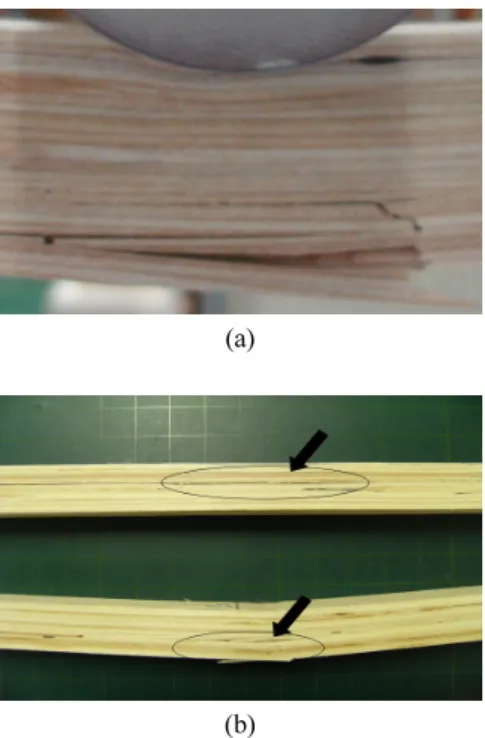
Fig. 4. Failure mode of tested LVL in bending test (a; splintering tension and along the glue line, b; horizontal shear failure (upper), splin- tering tension and horizontal shear failure (under)).

(a)

(b)

Fig. 5. Failure mode of tested LVL in horizontal shear test (a; shear failure near the neutral plane, b; shear failure in weakness region containing defects).

manner. First, the failure occured in tension side of specimens as a splintering tension mode and then the failure was progressed along the glue line in which was the weakest region among the glue lines as shown in Fig. 4(a). The glue line failure was severe in 25 mm-thick specimens due to concentration of shear stress in layer dis- continuity containing small voids and starved glue lines as shown in Fig. 4(b). Bodig and Jayne (1982) reported that species containing internal check and shakes which can act as planes of weakness for shear failure. The de- fects like voids and starved joints also can act as planes of weakness and the same results were found in this study.

In horizontal shear strength test, failure mode of LVL showed the typical horizontal shear fail-

ure, in other words, shear failure near the neu- tral plane occured as shown in Fig. 5(a). Among the specimens, the 25 mm-thick LVL samples showed significant shear failure in weakness re- gion containing defects rather than in neutral plane as shown in Fig. 5(b). This lead to the more inclined to this type of failure and lower strength values.

Compression specimens failed with fiber crush- ing with apparent delamination as shown in Fig.

6(a). Splitting along the length of the specimens due to the delamination was particularly sig- nificant in 25 mm-thick LVL samples and this is a results of weakness like internal void and poor layer structure as shown in Fig. 6(b).

Combined compression and splitting occurred in

parts of 30 mm-thick LVL samples. From the

results, the bonding strength between lamination

(7)

(a)

(b)

Fig. 6. Failure mode of tested LVL in compression test (a; crushing with apparent delamination in 30 mm-thick LVL, b; severe delamination in 25 mm-thick LVL).

and uniform thin veneer layer structure were considered as critical factors in evaluating strength properties of LVL.

4. CONCLUSION

The physical and mechanical properties of LVL available, but non-certificated products in domestic market were investigated and com- pared each other. All the tested LVL passed the moisture content limit as per domestic standard (KS) and Japanese standard (JAS). Also, all the tested samples passed the soaking delamination rate limit as per domestic standard and Japanese standard.

The bending strength and MOE of 25 mm- thick and 30 mm-thick LVL were compared each other and the differences were come from

the difference of raw materials’ density and de- gree of compaction in layer structure of lam- ination.

Also, 25 mm-thick and 30 mm-thick LVL were graded per JAS 701 standard, and special consideration is needed to set design value of 25 mm thick LVL due to it’s high standard de- viation in strength properties. The horizontal shear strength values were also evaluated and graded per JAS 701 standard.

The failure modes of LVL in bending, hori- zontal shear and compression test were com- pared each other and major cause of failure were investigated. From the results, the bonding strength between lamination or thin veneer layer was considered as a critical factor in evaluating strength properties of LVL.

Finally, the domestic standard test procedure and specification for non-certificated LVL shoud be required to check the performance of un- certificated materials.

ACKNOWLEDGEMENT

This research was supported by the Daegu University Research Grant 2010.

REFERENCES

1. American Society for Testing and Materials. 1999.

Standard specification for evaluation of staruc- tural composite lumber products. ASTM D 5456.

PA.

2. Bodig, J. and B. A. Jayne. 1982. Mechanics of wood and wood composites. Van Norstrand Reinhold Co.

3. Burdurlu, E., M. Kilic, A. C. Ilce, and O.

Uzunkavak. 2007. The effects of ply organization and loading direction on bending strength and modulus of elasticity in laminated veneer lumber (LVL) obtained from beech (Fagus orientalis L.) and lombardy poplar (Populus nigra L.).

Construction and Building Materials 21(2007):

(8)

1720 ∼1725.

4. International Standard Organization. 2010. Timber structures - Laminated veneer lumber - Structural properties. ISO/FDIS 22390, ISO.

5. Japan Agricultural Standard. 2008. Standard spec- ification of structural laminated veneer lumber.

JAS 701.

6. Korean Agency for Technology and Standard.

2008. Determination of resistance to soaking de- lamination for adhesive-bonded wood products.

KS F 2160.

7. Korean Agency for Technology and Standard.

2005. Nonstructural laminated veneer lumber. KS F 3119.

8. Rijsdijk, J. F. and P. B. Laming. 1994. Physical and related properties of 145 timbers. Kluer Academic Publishers. Dordrecht, Netherlands.

9. Sulaiman, O., N. Salim, R. Hashim, L. H. M.

Yusof, W. Razak, N. Y. M. Yunus, W. S.

Hashim, and M. H. Azmy. 2009. Evaluation on the suitability of some adhesive for laminated ve- neer lumber. Materials and Design 30: 3572 ∼ 3580.

10. Forest Products Lab. 1999. Woodhandbook. USDA Forest Serv., Forest Products Lab., Madison, WI.

11. Williamson, T. G. 2002. APA Engineered wood

handbook. Mcgrow Hill Co.

수치

Table 1. Configuration of LVL tested in this study Nominal thickness
Fig. 1. The horizontal shear strength test (short span bending) method according to JAS 701 (L;
Table 5. Test results of strength test of LVL
Fig. 2. Relationship of flatwise and edgewise bending strength of tested LVL.
+3

참조

관련 문서

The objective of this study is to analyze the shear bond strength of orthodontic buttons according to light tip distance and optic fiber diameter when an extended optic

In this way, it is possible to shorten the time of accident restoration and maintenance by minimizing the expression error of the high-strength facial

For changes in physical fitness, the physical fitness group showed a statistically significant difference in muscle strength, endurance, flexibility,

In the change of physical strength, The exercise group showed statistically significant differences in muscle strength(right), muscle strength(left),

From the results of Micro Vickers hardness test, Ti- 40Hf alloy showed significantly increasing of hardness and tensile strength than others in the case of

The purpose of this study is to analyze basic physical strength so that youth Taekwondo Poomsae players in middle school and high school can

Various studies have been performed to improve properties of material, electrical and mechanical properties of railway train according to the increase of the speed in the

In order to compare physical strength before and after the experiment, measured physical strength is agility (side step), cardiopulmonary endurance