Phenoxy, Phenylthio 및 Benzyloxy-기가 치환된 Quinolone 유도체들의 항트리파노소마 활성에 대한 3D-QSAR 분석
명평근·강나나·김상진*·성낙도**,#
충남대학교 약학대학 약학과, *대전보건대학교 화장품과학과,
**충남대학교 농업생명과학대학 응용생물화학과
(Received April 29, 2010; Revised June 26, 2010; Accepted June 26, 2010)
3D-QSAR Analysis on the Antitrypanosomal Activity of Phenoxy, Phenylthio or Benzyloxy Group Substituted Quinolone Analogues
Pyung-Keun Myung, Na-Na Kang, Sang-Jin Kim* and Nack-Do Sung**,#
Department of Pharmacy, College of Pharmacy, Chungnam National University, Daejeon 305-764, Korea
*Department of Cosmetic Science, Daejeon Health Sciences College, Daejeon 300-711, Korea
**Department of Applied Biological Chemistry, College of Agriculture & Life Science, Chungnam National University, Daejeon 305-764, Korea
Abstract — Three dimensional quantitative-structure relationships (3D-QSARs) models between structures of phenoxy, phenylthio or benzyloxy substituted quinolone analogues and their antitrypanosomal activity against Chagas disease (Try- panosoma cruzi) were derived and discussed quantitatively using comparative molecular field analysis (CoMFA) and com- parative molecular similarity indices analysis (CoMSIA) methods. The optimized CoMFA 1 model (q2=0.528 and r2=0.964) showed the best statistical results. According to the optimized CoMFA 1 model, the antitrypanosomal activities were depen- dent on the steric (60.0%) and electrostatic (36.2%) factors of quinolone derivatives. From the contour maps, it is predicted that the activity will be increased when sterically favored groups were located in R4 and R5 position and sterically disfavored groups were located in R2 position. Also, the positively charged groups on R2 would be able to increase the antitrypanosomal activities.
Keywords □ antitrypanosomal activity, Chagas disease, CoMFA, 3D-QSAR, quinolone analogues
수면병(Chagas병)은 남부와 중앙아메리카에서 성행하는 열대 성 질병으로1,2)편모가 있는 원생동물(Flagellate protozoan)에 속 하는 Trypanosoma cruzi라는 병원체에 의해 발병되어3,4)현재 이 질병에 의해 약 16~18만 명이 고통을 받고 있을 뿐 아니라,5-7) 1년에 5만명 이상이 사망하는 것으로 보고되고 있다.8)수면병은 급성과 만성의 두 가지로 나뉘는데 급성의 경우에 감염된 환자 들은 증후군이 없이 감염되는 경우도 있으며9)특히, 영아에게 치 명적인 것으로 나타난다.10)만성의 경우에는 환자의 약 30%정 도가 Chagas 심장병으로 발생하며 심한 경우에는 돌연사 한다 는 보고도 있다.11)이러한 Chagas병의 증상은 기생충 균주, 숙
주에 감염되는 Trypanosoma cruzi의 수와 숙주의 면역력 그리고 감염되는데 걸리는 시간과 그에 따른 숙주의 영양정도와 재감염 가능성과 같은 많은 요소에 따라 전파되는 것으로 추정된다.12)
감염된 환자의 수가 많음에도 불구하고 이 병을 완치할 수 있 는 효과적인 약은 없으나,3) Chagas병의 최근 형태에 기초하여 개 발된 이용 가능한 약품으로는 nitrofurane의 화합물인 Nifurtimox (Nfx)와 nitroimidazole 화합물인 Benznidazole(Bz) 등이 있다. 이 약품들은 1970년대 초기에 확인된 것으로 급성 단계의 Chagas 병 환자의 60% 이상이 치료된 것으로 나타났으나 만성 단계의 경우에는 식욕부진, 체중 감소, 구토, 우울증, 불면증 등의 심한 부작용을 가지는 것으로 밝혀졌다.13,14)최근에는 이들 약품의 부 작용과 Trypanosoma cruzi에 저항현상의 원인을 관찰하기 위한 대안으로 megazol이 실험단계에 있다.15)뿐만 아니라, Chagas병 의 치료를 위하여 2000년대 초기부터 Trypanosoma cruzi protein
#본 논문에 관한 문의는 저자에게로 (전화) 042-821-6737 (팩스) 042-821-6731 (E-mail) [email protected]
종설
farnesyl-transferase(PFT)를 표적으로 삼아 Chagas병에 저항하 는 약품인 tipifarnib가 연구되기 시작하여 그 부작용 등을 이해 하기 위한 연구가 지금까지도 계속되고 있다.16,17)
Quinolone은 항말라리아 약품인 chloroquine의 합성 부산물로 부터 nalidixic acid,18)및 1-ethyl-1,4-dihydro-7-methy-1,8-naphthyl- idine-3-carboxylic acid를 발견하면서 시작되었다.19) Quinolone 은 8개의 부분으로 구성된 헤테로 고리 방향족 화합물로 질소와 케톤기, 그리고 카르복실기를 포함하는 구조이며20)비뇨기 계통 전염병, 세포성 전염병, 호흡기 계통 전염병, 뼈 관절 전염병, 티 푸스 성 열병, 성행위 감염증, 전립선염, 급성 기관지염 등을 포 함하는 다양한 전염병의 치료와 예방을 위하여 의학과 수의학에 서 널리 사용된 항생물질과 구조적으로 연관된 화합물로 알려져
있다.21,22) 1980년대에는 antibacterial 활성 범위가 개선된
nalidixic acid에 fluorine을 첨가하여 fluoroquinolone이라 불리는 화합물을 합성하였다.23)그 중 많은 fluoroquinolone이 특허를 받 았으며,24) pefloxacin, enoxacin, fleroxacin 및 ciprofloxacin 등을 포함하는 몇몇은 수요에까지 이르러 오늘날까지도 사용되고 있 으며 이와 관련된 약들이 개발 중이다.25)
본 연구에서는 quinolone 유도체들이 Chagas병을 유발하는 트 리파노소마를 저해한다는 사실에 근거하여23) phenoxy, phenylthio 또는 benzyloxy기가 다양하게 치환된 quinolone 유도체들(1-20) 의 트리파노소마에 대한 저해 활성과의 관계를 3D-QSAR (CoMFA 및 CoMSIA)26,27)방법으로 분석하고 주로 CoMFA 결 과에 대하여 검토하였다.
재료 및 방법
분자 모델링
Phenoxy, phenylthio 또는 benzyloxy기로 치환된 quinolone 유도체들(1-20)의 치환기(R1-R5) 변화에 따른 Trypanosoma cruzi
에 대한 트리파노소마 저해 활성값은 문헌값23)들을 활용하였다.
3D-QSAR 분석은 Sybyl 분자 모델링 소프트웨어(Ver. 8.1)를 사 용하였다. 부가변수로서 분자의 계산된 소수성(ClogP)값을 포함 한 조건에서 3D-QSAR 모델의 유도과정과 조건은 전보28)와 유 사하였다. 3D-QSAR 분석을 실행하기 위하여 기질 분자의 공통 부분(R=H)을 분자틀로 정하였다. 최적화 에너지 값이 가장 낮 은 안정한 분자의 3차원 형태는 simulated annealing 방법을 이 용하여29)탐색하였으며 3차원 공간에 atom based fit(AF) 및 field fit(FF) 방법으로 정렬을 시도하고 한 예로, atom based fit(AF) 정렬을 Fig. 1에 나타내었다.
부분최소 자승(PLS) 계산
3차원 공간상에 정렬된 화합물들의 3D-구조적 특징과 생물활 성 간의 상관성을 부분 최소 자승(PLS)법30)으로 계산하였다. 최 적의 성분수를 결정하기 위하여 교차확인 방법으로 3D-QSAR 모델을 유도하는데 이용하였다. 교차확인 된 예측성은 r2cv.값(또 는 q2)으로 표현되며 화합물이 하나씩 data set에서 제거되는 leave-one-out(LOO) 방법을 이용하였고 비교차 확인과정으로 상 관성에 관한 r2ncv.값을 scaling(CoMFA standard & column filtering: 2.0 kcal/mol) 조건으로 실행시켜 구하였다. 따라서 모 델의 r2ncv.값이 0.90 이상, 그리고 q2값이 0.5 이상의 값이 얻어 졌을 경우에 한하여 유도된 모델이 안정성과 합리적인 예측성을 갖는 것으로 판단한다. 이때 성분수가 증가하게 되면 q2값이 커 지게 되기 때문에 data point의 over fitting을 피하기 위하여 가 능한 적은 수(3-5)의 성분(component)이 적절하다. 또한, CoMFA 모델에 포함된 구조와 활성 사이의 정보들을 시각적으로 분석하 기 위하여 활성이 가장 큰 화합물(14)의 구조상(R1=C2H5, R2= COOH, R3=F, R4=R5=PhCH2O)에 CoMFA장의 등고도 (contour map)를 favor : disfavor의 비율이 80 : 20으로 각각 표시 하였다.
결과 및 고찰
항트리파노소마 활성
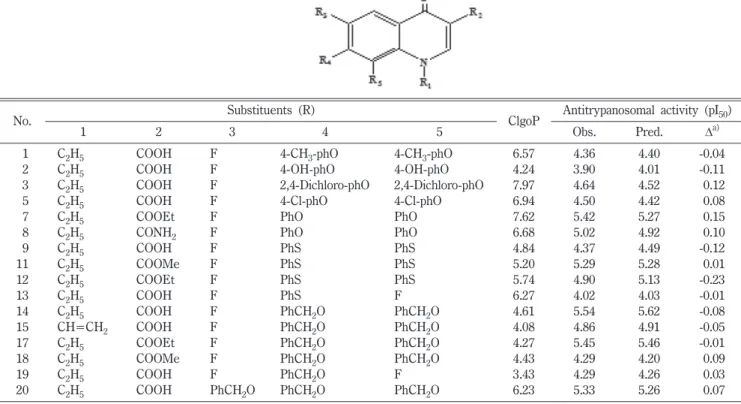
Table I에는 training set 화합물들에 대한 quinolone 유도체들 (1-20)의 계산된 소수성 상수(ClogP)와 관측된 항트리파노소마 활성값(Obs.pI50)(이하 "활성값"으로 략함)과 최적화된 CoMFA 1 모델로부터 예측된 활성값(Pred.pI50), 그리고 이들 두 값의 차이 값(Δ)을 각각 정리하였다. 이들 data set은 규모가 작고 또한, pI50 range가 작아서 3D-QSAR을 분석하기에는 적합하지 않았으나 자료가 희소한 quinolone 유도체들의 항트리파노소마 활성에 대 한 것이어서 3D-QSAR 분석이 시도되었다. 따라서 모델의 예측 성보다는 training set(n=16)를 대상으로 상관성이 큰 모델을 유 도하여 항트리파노소마 활성에 미치는 치환기들의 영향을 정량 Fig. 1 − Alignment of the potential energy minimized quinolone
structures according to a least-squares atom based fit.
적으로 탐색하고자 하였다. 그러므로 예측성을 가늠하는 test set(n=4)이 제한적으로 설정될 수 밖에 없었다. 그리고 생체내 에서 quinolone 유도체들의 흡수이행에 영향을 미치는 소수성 상 수(ClogP)는 비교적 높은 편(3.43~7.97)이었고 활성값과의 상관 성은 매우 낮은 편이었다. 또한, benzyloxy-치환체(14)의 활성값 (pI50=5.54)이 가장 크고 phenoxy-치환체(2)의 활성값(pI50=3.90) 이 가장 작았으며 이들의 차이값은 ΔObs.pI50=1.64이었다.
CoMFA 모델
두 가지 정렬방법(AF 및 FF)에 따라 조성의 수가 3인 조건에 서 grid(Å)의 값을 2.0~2.5 사이로 변화시킨 결과로부터 유도된 CoMFA 및 CoMSIA 모델들의 통계값을 Table II에 모두 나타내
었으나 그 중에서 가장 양호한 최적화된 모델은 CoMFA 1 모델 이었다(r2cv.(q2)=0.528 및 r2ncv.=0.964). Table III에는 각 모델들 의 특성장에 대한 상대적인 기여비율(%)과 training set(Table I) 및 test set(Table IV) 화합물들의 오차(Ave. 및 PRESS)를 정리 하였다. 그리고 전반적으로 training set의 오차값이 test set 보 다 작은 값을 나타내므로 모든 3D-QSAR 모델은 test set에 기 초한 예측성보다 training set에 근거한 상관성이 우세한 모델이 었다. 특히, 최적화된 CoMFA 1 모델의 예측성을 판단하기 위하 여 test set 화합물들에 대한 활성값들을 정리하였고 기여비율 (%)은 입체장(S) 60.0%, 정전기장(E) 36.2% 및 소수성장(Hy) 3.8%로 입체장이 가장 큰 비율을 나타내었다. 앞서, 소수성과 활 성값과의 상관성이 극히 낮은 편이었다는 사실은 소수성장(Hy) Table I − Calculated hydrophobicity of quinolones and their observed antitry-panosomal activity against Chagas disease (Trypanosoma cruzi),
and predicted activity by optimized CoMFA 1 model for training set
No. Substituents (R)
ClgoP Antitrypanosomal activity (pI50)
1 2 3 4 5 Obs. Pred. Δa)
01 C2H5 COOH F 4-CH3-phO 4-CH3-phO 6.57 4.36 4.40 -0.04
02 C2H5 COOH F 4-OH-phO 4-OH-phO 4.24 3.90 4.01 -0.11
03 C2H5 COOH F 2,4-Dichloro-phO 2,4-Dichloro-phO 7.97 4.64 4.52 -0.12
05 C2H5 COOH F 4-Cl-phO 4-Cl-phO 6.94 4.50 4.42 -0.08
07 C2H5 COOEt F PhO PhO 7.62 5.42 5.27 -0.15
08 C2H5 CONH2 F PhO PhO 6.68 5.02 4.92 -0.10
09 C2H5 COOH F PhS PhS 4.84 4.37 4.49 -0.12
11 C2H5 COOMe F PhS PhS 5.20 5.29 5.28 -0.01
12 C2H5 COOEt F PhS PhS 5.74 4.90 5.13 -0.23
13 C2H5 COOH F PhS F 6.27 4.02 4.03 -0.01
14 C2H5 COOH F PhCH2O PhCH2O 4.61 5.54 5.62 -0.08
15 CH=CH2 COOH F PhCH2O PhCH2O 4.08 4.86 4.91 -0.05
17 C2H5 COOEt F PhCH2O PhCH2O 4.27 5.45 5.46 -0.01
18 C2H5 COOMe F PhCH2O PhCH2O 4.43 4.29 4.20 -0.09
19 C2H5 COOH F PhCH2O F 3.43 4.29 4.26 -0.03
20 C2H5 COOH PhCH2O PhCH2O PhCH2O 6.23 5.33 5.26 -0.07
Note: Phenoxy (1-8), phenylthio (9-13) and benzyloxy (14-20) substituted quinolone analogues, a)different between observed and predicted value.
Table II − Summary of the statistical parameters of 3D-QSAR models under two alignments
Model no. Alignments PLS analyses
Grid (Å) Components r2cv.a) r2ncv.b) SEncv.c) F
CoMFA 1d) AF 2.0 3 0.528 0.964 0.115 105.682
CoMFA 2 FF 2.5 3 0.531 0.897 0.193 34.860
CoMSIA 1 AF (α=0.3) 2.0 3 0.650 0.928 0.161 51.699
CoMSIA 2 FF (α=0.3) 2.5 3 0.654 0.915 0.176 42.831
Notes: F=fraction of explained versus unexplained variance, attenuation factor=α, a)cross-validated r2, b)non-cross-validated r2,
c)standard error estimate, d)optimized model.
의 기여가 매우 낮았음을(3.8%) 잘 반영하고 있다. 그리고 Fig.
2에는 관측된 활성값(Obs.pI50)과 CoMFA 1 모델에 의한 예측된 활성값(Pred.pI50) 사이의 관계(Pred.pI50=0.963Obs.pI50+0.174, n=16, s=0.104, F=370.637, r2=0.964 및 q2=0.956)를 나타내 었다. 오차의 결과와 그래프로부터 최적화된 CoMFA 1 모델은 상관성이 양호하나 예측성이 낮은 경향을 보였다.
CoMSIA 모델
CoMSIA 모델들은 5개 특성장(입체장, 정전기장, 소수성장, H-
결합 주게장 및 H-결합 받게장), 두 정렬(AF 및 FF), 조성수(1- 4), grid(1.0~4.0 Å)의 조합 및 attenuation factor(α)=0.3인 조건 에서 유도되었으며(Table II) 가장 양호한 모델은 CoMSIA 1 모 델(r2cv.(q2)=0.650 및 r2ncv.=0.928) 이었다. 이 경우, 분자 내 원 자들과 probe atom들 사이의 거리에 의존적인 α값과 예측성 r2cv.
(또는 q2)의 관계로부터 조성수가 3이고 α=0.3일때 가장 높은 r2cv.(q2)값을 나타내었다. 따라서 이 CoMSIA 1 모델은 CoMFA 1 모델에 비하여 F 값이 현저하게 낮았을 뿐 아니라, 상관성도 낮았지만 예측성은 다소 높았다. Table III에는 모델들의 특성장 에 대한 기여비율(%)과 오차(Ave. 및 PRESS)를 정리하였다.
CoMFA 모델들의 경우와 같이 CoMSIA 모델도 test set에 기초 한 예측성보다 training set에 근거한 상관성이 우세하였다.
CoMSIA 1 모델의 기여비율(%)은 입체장(S) 35.6%, 소수성장 (Hy) 48.1% H-결합 받게장(HA)이 16.3%로 소수성장이 가장 큰 기여도를 나타내지만, 입체장과 소수성장이 비슷하였으며 H-결 합 받게장이 가장 작은 비율을 나타내었다. 그러나 전체적으로 CoMSIA 모델보다 통계값이 양호한 CoMFA 1 모델이 최적화 모 델이었으므로 등고도는 CoMFA 1 모델의 정보에 관련한 자료만 을 제시하였다.
CoMFA 등고도 분석
CoMFA에서는 3차원 공간상에 일정한 간격으로 놓여있는 격 자 원자의 입체장과 정전기장으로 표현되지만, 필요에 따라 부 가변수로서 계산된 소수성(ClogP)을 포함시킨 소수성장 등, 3종 의 특성장을 나타낸다.26)따라서 CoMFA의 입체장은 CoMSIA 에서 입체장 및 소수성장으로, 그리고 CoMFA의 정전기장은 Table III − Relative field contribution ratio (%) for antitrypanosomal activity and error (Ave. & PRESS) of training set and test set by 3D-QSAR
models
Model no. Field contribution (%) Training set Test set
S E Hy HD HA Ave. PRESS Ave. PRESS
CoMFA 1a) 60.0 36.2 03.8 - - 0.080 0.157 0.350 0.642
CoMFA 2 80.4 17.9 01.7 - - 0.128 0.445 0.298 0.510
CoMSIA 1 35.6 - 48.1 - 16.3 0.116 0.309 0.320 0.530
CoMSIA 2 21.5 - 26.7 44.7 07.0 0.105 0.355 0.323 0.584
Notes: S=steric, E=electrostatic, Hy=hydrophobic, HD=H-bond donor field, HA=H-bond acceptor field, Ave.=average residual, PRESS=predictive residual sum of squares, a)optimized model.
Table IV − Calculated hydrophobicity of quinolones and their observed antitrypano- somal activity against Chagas disease (Trypanosoma cruzi), and predicted activity by optimized CoMFA 1 model for test set
No. Substituents (R)
ClogP Antitrypanosomal activity (pI50)
1 2 3 4 5 Obs. Pred. Δa)
04 C2H5 COOH F 4-F-phO 4-F-phO 6.62 4.90 4.32 -0.58
06 C2H5 COOH F 4-CH3-phO 4-CH3-phO 8.08 3.96 4.41 -0.45
10 Cy-Pr COOH F PhS PhS 5.58 4.42 4.39 -0.03
16 C2H5 COOMe F PhCH2O PhCH2O 4.10 5.08 5.40 -0.32
a)Different between observed and predicted activities.
Fig. 2 − Relationships between observed antitrypanosomal activities (Obs.pI50) of quinolones and predicted antitrypanosomal activities (Pred.pI50)by the optimized CoMFA 1 model (Atombased fit). (training set; Pred.pI50=0.963Obs.pI50+ 0.174, n=16, s=0.104, F=370.637, r2=0.964 & q2=0.956).
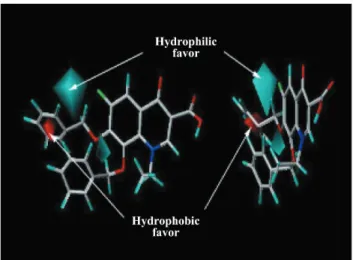
CoMSIA에서 정전기장, H-결합주게장 및 H-결합받게장으로 각 각 분할되어 CoMSIA에서는 5종의 특성장으로 표현된다.27)여 기에서는 3D-QSAR 모델 중, CoMFA 1 모델이 CoMSIA 모델 들보다 압도적으로 양호한 최적화된 모델이기 때문에(Table II) 별도로 CoMSIA 등고도를 논의할 필요가 없다. 그러므로 최적화 된 CoMFA 1 모델의 특성장에 관한 기여도를 시각적으로 분석 하기 위하여 가장 큰 활성을 나타낸 화합물(14)의 구조상에 등 고도를 나타내었다. 기여비율(%)이 가장 큰 입체장과 정전기장 에 관한 등고도(Fig. 3)에서 R4-와 R5-치환기는 넓은 외곽부분과 R1-치환기는 입체적으로 클수록(green) 활성을 증가할 것이라는 분자의 성질을 나타냈다. 반면에 R1,R2-및 R4, R5-치환기는 좁 은 영역에서 입체적으로 작은(yellow) 치환기가 도입될수록 활성
을 증가시킬 것으로 설명되었다. 또한, R2-치환기에는 양전하을 나타내는 치환기가 활성에 기여할(blue) 것으로 예측되었다. 기 여비율(%)이 가장 작은 소수성장에 관한 등고도(Fig. 4)에서는 R3, R4-치환기에 친수성이 큰(cyan) 치환기가 그리고 R3-치환기 먼 부분의 작은 영역에 소수성 치환기가 활성을 증가시킬 것으 로 예상되었다. 이와 같은 분석결과로부터 등고도 상 특성장을 만족하는 quinolone 유도체들이 항트리파노소마 활성을 현저하 게 증가시킬 것으로 판단된다.
결 론
Phenoxy, phenylthio 또는 benzyloxy기가 치환된 quinolone 유도체(1-20)들의 정량적인 구조와 수면병원균(Trypanosoma cruzi)에 대한 항트리파노소마 활성간의 3D-QSAR 모델을 CoMFA 및 CoMSIA 방법으로 유도하고 정량적으로 검토하였다. 그 결과, benzyl-oxy-치환체(14)의 활성값(pI50=5.54)이 가장 크고 phenoxy- 치환체(2)의 활성값(pI50=3.90)이 가장 작았다. 3D-QSAR 모델 중, 최적화된 CoMFA 1 모델(q2=0.528 및 r2=0.964)이 가장 양 호한 통계값을 나타내었으며 활성에 대한 기여비율(%)은 입체장 이 60.0%로 가장 큰 기여도를 나타내었고 정전기장은 36.2%이 었다. 가장 큰 활성을 나타낸 화합물(14)의 구조상에 나타낸 입 체장에 관한 등고도에서 R4-와 R5-치환기는 입체적으로 크고 R2- 치환기는 입체적으로 작아야하며 또한, R2-치환기는 양전하를 띄 는 치환체이어야 항트리파노소마 활성이 증가할 것으로 예측되었다.
감사의 말씀
이 논문은 2010년도 정부(교육과학기술부)의 재원으로 한국연 구재단의 지원을 받아 수행된 연구임(No. 2010-0001351).
참고문헌
1) Rodrigues, C., Batista, A. A., Aucelio, R. Q., Teixeira, L. R., Visentin, L. D. C. and Beraldo, H. : Spectral and electro- chemical studies of ruthenium (II) complexes with N4-methyl- 4-nitrobenzaldehyde and N4-methyl-4-nitrobenzophenone thiose- micarbazone: Potential anti-trypanosomal agents. Polyhedron 27, 3061 (2008).
2) Mezencev, R., Galizzi, M., Kutschy, P. and Docampo, R. : Trypanosoma cruzi: Antiproliferative effect of indole phyto- alexins on intracellular amastigotes in vitro. Exp. Parasitol.
122, 66 (2009).
3) Demir, O. and Roitberg, A. E. : Modulation of catalytic function by differential plasticity of the active site: case study of Trypanosoma cruzi trans-sialidase and Trypanosoma rangeli sialidase. Biochem. 48, 3398 (2009).
Fig. 4 − CoMFA-HINT contour maps (Left: front view & Right: side view) for hydrophobic field (stdev*coeff) by the optimized CoMFA 1 model (hydrophobic favor: 80%, hydrophilic favor: 20%).
Fig. 3 − The steric and electrostatic contour maps (stdev*coeff) by the optimized CoMFA 1 model (favor: 80% & disfavor:
20%).
4) Rodigues, P. R., Lane, J. E., Carter, C. E., Bogitsh, B. J., Singh, P. K., Zimmerman, L. J., Molenda, J. J. and Jones, M. M. : Chelating agent inhibition of Trypanosoma cruzi epimastigotes in vitro. J. Inorganic Biochem. 60, 277 (1995).
5) Choe, Y. C., Brinen, L. S., Price, M. S., Engel, J. C., Lange, M., Grisostomi, C., Weston, S. G., Pallai, P. V., Cheng, H., Hardy, L. W., Hartsough, D. S., McMakin, M., Tilton, R. F., Baldinod, C. M. and Craika, C. S. : Development of α-keto-based inhibitors of cruzain, a cysteine protease implicated in Chagas disease. Bioorganic Med. Chem. 13, 2141 (2005).
6) Caetano, L. C., Braza, V., Filipin, M. D. V., Santello, F. H., Caetano, L. N., Toldo, M. P. A., Caldeira, J. C. and Jr. Prado, J. C. D. : Effects of repetitive stress during the acute phase of Trypanosoma cruzi infection on chronic Chagas disease in rats.
Stress 12, 144 (2009).
7) Otero, L., Vieites, M., Boiani, L., Denicola, A., Rigol, C., Opazo, L., Olea-Azar, C., Maya, J. D., Morello, A., Krauth-siegel, R. L., Piro, O. E., Castellano, E., Gonzalez, M., Gambino, D. and Cerecetto, H. : Novel antitrypanosomal agents based on palladium nitrofurylthiosemicarbazone complexes: DNA and redox metabolism as potential therapeutic targets. J. Med.
Chem. 49, 3322 (2006).
8) Otero, L., Aguirre, G., Boiani, L., Denicola, A., Rigol, C., Olea-Azar, C., Maya, J. D., Morello, A., Gonzalez, M., Gambino, D. and Cerecetto, H. : Nitrofurylsemicarbazone rhenium and ruthenium complexes as anti-trypanosomal agents. E. J. Med. Chem. 41, 1231 (2006).
9) Oliveira, E. C., Stefani, M. M. A., Campos, D. E., Andrade, A. L. S. S., Silva, S. A., Rassi, A. and Luquetti, A. O. : Trypanosoma cruzi stocks isolated from acute Chagas disease patients lead to lethal murine infection. Transactions of the Royal Society of Tropical Medicine and Hygiene 91, 25 (1997).
10) Ricardo, P. F., Maria del carmen, S. G., Carlos, G. A., Monteo'n, V. M., Reyes, P. A. and Rosales-encina, J. L. : Humoral nitric oxide levels and antibody immune response of symptomatic and indeterminate chagas disease patients to commercial and autochthonous Trypanosoma cruzi antigen. Am. J. Trop. Med.
Hyg. 58, 715 (1998).
11) Juan, M. B., Mar'ia, S. P., H'ector, W. R., Alicia, R. F., Julio, E. E., Ricardo, E. F. and Patricia, P. O. : Treatment with benznidazole or thioridazine in the chronic phase of experimental Chagas disease improves cardiopathy. Int. J.
Parasitol. 29, 733 (2007).
12) Juan, M. B., He'ctor, W. R., Alicia, R. F. and Julio, E. E. : Trypanosoma cruzi reinfections in mice determine the severity of cardiac damage. Int. J. Parasitol. 32, 889 (2002).
13) Castro, J. A., Montalto de Mecca, M. and Bartel, L. C. : Toxic side effects of drugs used to treat Chagas disease (American trypanosomiasis). Hum. Exp. Toxicol. 25, 471 (2006).
14) Silva, J. J. N., Pavanelli, W. R., Gutierrez, S. F. R., Lima, F. C. A., Silva, A. B. F., Silva, J. S. and Franco, D. W. : Complexation of the anti-Trypanosoma cruzi drug benznidazole improves solubility and efficacy. J. Med. Chem. 51, 4104 (2008).
15) Poli, P., Michele, A. M., Annamaria, B., Renato, A. M., Cristina, N. A., Solange, S. Carlo, R. and Tania Maria, A. D. Z. : Cytotoxic and genotoxic effects of megazol, an anti-Chagas disease drug, assessed by different short-term tests. Biochem. 64, 1617 (2002).
16) Oliver, H., Michael, H. G., Christophe, L. M. J. V. and Frederick, S. B. : The protein farnesyltransferase inhibitor tipifarnib as a new lead for the development of drugs against chagas disease. J. Med. Chem. 48, 5415 (2005).
17) James, M. K., Christophe, L. M. J. V., Mandana, K., Galina, I. L., Michael, H. G. and Frederick, S. B. : Rational modification of a candidate cancer drug for use against chagas disease. J.
Med. Chem. 52, 1639 (2009).
18) Shimoda, K. : Mechanisms of quinolone phototoxicity. Toxicology Letters 102-103, 369 (1998).
19) Lesher, G. Y., Froelich, E. J., Gruet, M. D., Bailey, J. H. and Brundage, R. P. : 1,8-Naphthyridine derivatives. A new class of chemotherapeutic agents. J. Med. Chem. 5, 1063 (1962).
20) Herna'ndez-Arteseros, J. A., Barbosa., J., Compano, R. and Prat, M. D. : Analysis of quinolone residues in edible animal products. J. Chromatography A. 945, 1 (2002).
21) Zafra-Gmez, A., Garballo, A., Ballesteros, O., Navaln, A. and Garca-Ayuso, L. E. : Simultaneous determination of quinolone antibacterials in bovine milk by liquid chromatography - mass spectrometry. Biomed. Chromatogr. 22, 1186 (2008).
22) Iztok, T. : The interactions of metal ions with quinolone antibacterial agents. Coordination Chem. 232, 27 (2002).
23) Xiang, M., Weicheng, Z. and Reto, B. : Synthesis, in vitro antitrypanosomal and antibacterial activity of phenoxy, phenylthio or benzyloxy substituted quinolones. Bio. Med.
Chem. 19, 986 (2009).
24) Belal, F., Al-Majed, A. A. and Al-Obaid, A. M. : Methods of analysis of 4-quinolone antibacterials. Talanta 50, 765 (1999).
25) Appelbaum, P. C. and Hunter, P. A. : The fluoroquinolone antibacterials: past, present and future perspectives. I. J.
Antimicrobial Agents 16, 5 (2000).
26) Cramer, R. D. III, Patterson, D. E. and Bunce, J. D. : Comparative molecular field analysis (CoMFA), 1. Effect of shape on the binding of steroid to carrier proteins. J. Am.
Chem. Soc. 110, 5959 (1988).
27) Klebe, G., Abraham, U. and Mietzner, T. : Molecular similarity indexes in a comparativeanalysis (comsia) of drug molecules to correlate and predict their biological-activity. J. Med. Chem. 37, 4130 (1994).
28) Soung, M. K., Lee, Y. J. and Sung, N. D. : 3D-QSARs of
herbicidal 2-N-phenylisoindolin-1-one analogues as a new class of potent inhibitors of protox. Bull. Kor. Chem. Soc. 30, 613 (2009).
29) Vasan, A. and Komaragiri, S. R. : Comparative analysis of simulated annealing, simulated quenching and genetic algorithms for optimal reservoir operation. Applied Soft Computing 9, 274
(2009)
30) Wold, S., Johansson, E. and Cocchi, M. : PLS-partial least squares projections to latent structures, in 3D-QSAR in Drug Design: Theory, Methods and Applications (ed. H. Kubinyi), ESCOM, Leiden, pp. 523-550 (1993).