VOL.24 NO.4 : 105-113 (2011)
한의학 관련 무작위배정비교임상연구의 비뚤림 위험 평가
1 경희대학교 한의과대학 한방부인과학교실, 2 한국보건의료연구원
3 세명대학교 한의과대학 내과학교실, 4 경희대학교 한의과대학 비계내과학교실
5 경희대학교 한의과대학 심계내과학교실
이윤재 1,2 , 장보형 2 , 고호연 3 , 현민경 2 , 박선영 3 , 이창훈 1 , 김진성 4 , 조기호 5
ABSTRACT
The Assessment of Risk of Bias on Randomised Controlled Trials of Oriental Medicine in Korea
Yoon-Jae Lee 1,2 , Bo-Hyoung Jang 2 , Ho-Yeon Go 3 , Min-Kyung Hyun 2 , Sun-Young Park 3 , Chang-Hoon Lee 1 , Jin-Sung Kim 4 , Ki-Ho Cho 5
1 Dept. of Oriental Gynecology, College of Oriental medicine, Kyung-Hee University
2 National evidence-based healthcare collaborating agency
3 Dept. of Internal medicine, Hospital of Oriental Medicine, Se-Myung University
4 Dept. of Gastroenterology, Hospital of Oriental Medicine, Kyung-Hee University
5 Dept. of Cardiovascular and Neurologic Diseases(Stroke Center), College of Oriental Medicine, Kyung-Hee University
Objectives: To examine the current status of clinical research in oriental medicine, and to assess ‘risk of bias’(ROB) of randomized clinical trials(RCTs) in oriental medicine in Korea.
Methods: Special committee for EBM, KOMS(Korean Oriental Medicine Society) reviewed 17 journals related to oriental medicine in Korea (from the first issue to May 2010), the Cochrane Central Register of Controlled Trials (The Cochrane Library Issue 2, 2010), and PubMed (1966 to May 2010). Then we selected eligible RCTs in terms of oriental medicine, and assessed ‘risk of bias’.
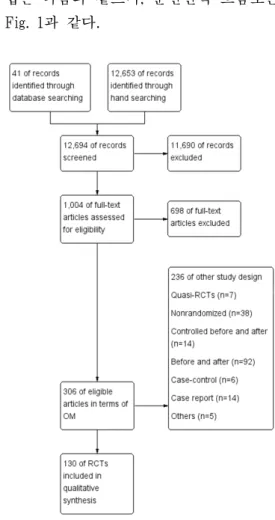
Results: We reviewed 12,653 articles from the 17 journals, and 41 articles from CENTRAL and PubMed. After non-clinical articles were excluded, 1,004 articles were left. Among them, the number of eligible studies in terms of oriental medicine was 306. In these eligible studies, 130 were RCTs. Of RCTs, 69 were on acupuncture, 25 on herbal medicine. The proportion of ‘unclear’ is high in the criteria of ‘Allocation concealment’, ‘Blinding of participants and personnel’, ‘Blinding of outcome assessment’
and ‘Other bias’. On the other hand, ‘low’ has high in the criteria of ‘Incomplete outcome data’ and ‘Selective reporting’.
Conclusions: Risk of bias on oriental medicine is unclear in terms of ‘allocation concealment’ and ‘blinding’. For high-quality research in oriental medicine, further research should be needed on randomization and blinding in the RCTs.
Key Words: Risk of bias, RCT, Oriental Medicine
10)
“이 연구는 경희대학교 한의과대학원의
2010학년도 1차 우수연구논문 장학금으로 지원받아 연구되었음"
교신저자(조기호) : 서울시 회기동 1번지 경희의료원 한방병원 2내과학교실 전화 : 02-958-9129 팩스: 02-958-9132 이메일 : [email protected]