Journal of Institute of Control, Robotics and Systems (2014) 20(3):235-244 http://dx.doi.org/10.5302/J.ICROS.2014.14.9011 ISSN:1976-5622 eISSN:2233-4335
이동 구간 제어기의 최근 기술 동향
Recent Trends in Receding Horizon Control
권 욱 현*, 한 수 희
(Wook Hyun Kwon
1,*and Soohee Han
2)
1Department of Information and Communication Engineering, DGIST
2Department of Electrical Engineering, Konkuk University
Abstract: This article introduces recent trends in RHC (Receding Horizon Control), also known as MPC (Model Predictive
Control), that has been well recognized in industry and academy as a systematic approach for optimal design and constraint management. Constrained and robust RHCs will be briefly reviewed with milestone results. Among the diverse developments and achievements of RHCs, implementation issues will be focused on, together with the latest applications. In particular, this article introduces results on how to solve a finite horizon open-loop optimal control problem in an efficient way, together with code generation for real-time execution and easy implementation. Instead of traditional applications such as refineries and petrochemical plants, this article highlights some selected emerging applications, such as energy management systems and mechatronics, that have resulted from state-of-the-art high performance computing power and advanced numerical schemes.
Keywords: RHC (Receding Horizon Control), MPC (Model Predictive Control), constraint handling, robust, computation,
implementation
Copyright© ICROS 2014
I. 서론
이동 구간 제어기(RHC: Receding Horizon Control)는 모 델 예측 제어기(MPC: Model Predictive Control)라는 이름으 로 오래 동안 화학공정 등에서 매우 폭넓게 활용되어 왔다.
특히, 구속조건을 고려하면서, 모델을 바탕으로 예측하며 제어기를 설계하였기 때문에, 모델(model)과 예측(prediction) 의 두 단어가 강조되어 MPC라는 이름이 흔히 쓰이게 되었 다. 초기의 IO (Input & Output) 모델을 일반적인 상태 공간 모델로 변환하면 MPC는 구속조건을 갖는 최적제어 문제가 된다. 최적 제어는 MPC와 별개로 이 전부터 많이 연구해 온 이론적 결과로 이것을 따로 MPC라고 부르지는 않았다.
최적 제어는 고정된 유한 구간 혹은 무한 구간의 문제를 오프라인으로 다루는 것에 비해, MPC는 실시간으로 시간 이 흐름에 따라 구간을 이동시키는데, 이것은 최적 제어와 대비되는 특징으로 이동 구간(receding horizon)이라고 표현 할 수 있다. 따라서 RHC가 MPC보다 훨씬 더 개념과 의미 가 잘 표현된 이름이라고 할 수도 있다. 비록 RHC가 MPC 보다 많이 사용되는 용어는 아니어도, 이런 이유 때문에 지 금도 계속 어느 정도의 선호는 유지하고 있다[77]. 이 논문 에서는 MPC 대신 RHC 용어를 사용하도록 한다.
RHC는 현재의 상태를 초기 값으로 유한 구간 최적 제어 문제를 풀어서 구한 해로부터 얻어진다. 유한 구간에서 얻 어진 최적의 제어 입력 값 중에 첫 번째 것만 실행되고, 다 음 샘플링 시간에는 다시 동일한 방법으로 유한 구간 최적
* Corresponding Author
Manuscript received January 24, 2014 / accepted February 3, 2014 권욱현: DGIST 정보통신융합공학전공 석좌교수, 서울대학교 전기 · 정보공학부 명예교수([email protected])
한수희: 건국대학교 전기공학과([email protected])
제어 문제를 풀어 제어 입력을 구하게 된다. 미리 결정된 형태의 기존 제어기와 달리 RHC는 매 순간 예측을 통해 최적의 해를 찾기 때문에 여러 가지 장점을 갖는다.
RHC는 무한 구간의 최적 제어보다 계산량이 훨씬 적 다. 특히, 제한 조건이 있는 경우의 무한 구간 최적 제어 문제는 매우 어렵고, 실시간에 구하기도 쉽지 않다. 최적 제어에 기반을 두기 때문에 RHC는 모델에 기반 하지 않 는 간단한 형태의 제어기에 비해 추종 성능이 월등하다.
이러한 우수한 추종 성능에 의해 화학공정과 같은 산업체 에서 RHC를 사실상 표준처럼 오래 전부터 활용하고 있다.
RHC는 유한 구간 최적 제어 문제를 풀기 때문에 유한 구 간에서의 정보만을 요구한다. 이러한 특징 때문에 RHC는 입력과 상태에 대한 제약 조건을 다루는 데도 매우 용이 하다. 더구나, RHC는 유한 구간의 최적 제어를 다루면서 도 간단한 조건만 만족하면 무한 구간에서의 안정성을 확 보한다. 쉬운 선형시스템 뿐만 아니라, 비선형과 하이브리 드 시스템 등 복잡한 시스템에서도 RHC는 비교적 잘 적 용이 된다.
지금까지 RHC의 이론 및 응용에 대한 광범위한 연구가 이루어져 왔고, 꾸준히 기존의 결과를 정리하고 소개하는 논문[1-18]과 저서[19-38]들이 발표되어 왔다. [1,2]에는 전반 적인 RHC의 이론과 응용이 정리되어 있고, 이 후에는 분야 별로 비선형[3,7], 산업용[4,10], 강건성[5,12] RHC등을 중점 적으로 다루고 있다. [8]에서는 제약조건을 다루는 RHC를 중심으로 안정도와 최적성을 집중적으로 다루었다. 특히 [16]에서는 2010년까지의 RHC 결과들을 잘 정리하였다. 10 년 단위로 산업응용, 이론적 정립, 다양한 응용으로 분류하 여 각 세대의 연구 방향과 결과물을 잘 소개하고 있다.
RHC 관련 저서들도 초기에 일반적인 이론[19,20]을 다루거
236 Wook Hyun Kwon and Soohee Han
나, 비선형 시스템[21,23,29,32], 제약 조건[22,25], 강건성[31]
에 초점을 두어 다루었다. 최근에는 전력전자 분야 등과 같 은 응용[34]과 실시간 계산[33,38] 등의 구현을 다루는 저서 들이 등장하고 있다.
이 논문은 제약 조건과 강건성을 지니는 RHC에 대해 간 략히 중요 결과들을 정리해보고, 최근 많이 연구되고 있는 계산 및 구현 문제를 중점적으로 다룬다. 매 샘플링 시간마 다 유한 구한 최적 제어 문제를 풀어야 하므로 RHC는 실 시간 응용을 위해 빠른 계산이 가능한 알고리즘이 요구된 다. 또한 이러한 알고리즘들이 여러 가지 시스템에서 다양 한 응용이 가능하도록 구현도 용이해야할 필요가 있다. 최 근에는 제어 입력의 빠른 계산을 위해 상태공간을 분할하 여 각 영역에 대하여 제어기를 미리 설계하는 방법과 수치 해석적인 반복 풀이 법등이 연구되고 있다. 용이한 구현을 위해 RHC의 자동 코드 생성과 같은 연구개발도 진행되고 있다. 이러한 노력으로 RHC의 계산 속도와 개발에 소요되 는 시간이 획기적으로 개선되어 고속 샘플링이 필요하고 구현이 복잡한 메카트로닉스 분야 등의 응용까지도 가능해 졌다. 그 동안 RHC는 다양한 분야에서 활용이 되어 왔고, 기존 여러 문헌에서도 많이 소개가 되어왔기 때문에, 이 논 문에서는 최근 RHC가 많이 활용되고 있는 에너지, 전력전 자, 메카트로닉스 분야들의 사례들을 중점적으로 살펴본다.
스마트 그리드와 같이 에너지 효용성을 극대화시키려는 노 력으로 발전, 저장, 소비들을 효율적으로 제어하려는 시도 에서 RHC의 역할도 소개하도록 한다.
이 논문은 다음과 같이 구성되어 있다. II 장에서는 제약 조건을 고려한 RHC에 대한 결과와 중요 논문을 정리한다.
III 장에서는 강건한 RHC를 다룬다. IV 장에서는 최근 연 구가 활발하게 이루어지고 있는 RHC의 계산 및 구현 문제 를 다룬 결과들을 소개한다. V 장에서는 에너지, 전력전자, 메카트로닉스 분야에서의 RHC 활용을 소개한다. VI 장에 서는 결론을 맺는다.
II. 제약조건을 고려한 이동 구간 제어기
다음과 같은 시스템을 고려하자.
(1)
여기에서 ⋅와 ⋅는 각각 상태변수와 입력변수를 나타내고, 으로 원점이 평형점을 이루며, 상태변 수와 입력변수는 아래와 같은 제약조건을 만족해야 한다.
∈
∈
(2)
여기에서
와
는 보통 convex 하고, compact 한 집합으 로 주어진다. 제어 목적은 (2)를 만족하면서 상태변수를 평 형점인 원점으로 이동시키는 것이다. 추종 제어인 경우도 적절한 변환을 통해 이런 식으로 제어목적을 설정할 수 있 다. 가격함수는 다음과 같다.
(3)
여기에서 와
은 각각 현재 시각과 구간 크기를 의미하 며, 는 다음과 같이 구간
에서의 제어변수 를 모아놓은 배열이다.
⋯
(4) 가격함수 (3)의 종단 상태변수
에 대해서는 보통 다음과 같이 제약조건이 주어질 수 있다.
∈
(5)
여기에서
도 (2)의
와
같이 보통 convex 하고, compact 한 집합으로 주어진다. 가격함수 (3)을 최소로 하 는 최적 제어입력과 이 제어입력을 대입한 결과는 다음과 같다.
⋯
(6) RHC는 (6)의
가 포함하는 원소 중 첫 번째인
를 적용하고, 다음 시간 에서는 구간
을 구간
로 이동하여 동일한 방법으로 제어 입력을 구한다. 이런 식으로 계속 반복된다.
안정성을 보장하는 RHC를 위해 다음과 같은 몇 가지 방 법들이 제안되었다.
1. 종단 등호 제약 조건 사용
가장 오래 전에 제안된 방법으로 종단 상태변수
에 대한 제약 조건 (5)의
와 가격함수가 다음과 같이 주어진다.
≡ (7) (7)과 같은 제약 조건은 선형시스템인 경우 쉽게 처리될 수 도 있다. 전체 가격함수 (3)의 종단 상태 부분만 가중치를
∞로 둠으로써 보다 쉽게 구할 수도 있다.
2. 종단 가격함수 사용
먼저 소개한 종단 등호 제약조건보다는 좀 더 약화된 조 건으로 가격 함수 (3)의
를 활용하는 방법이 있다.
를 적절히 잘 선택하면
≤ (8) 와 같이 최적 가격함수의 값이 시간이 지남에 따라 단조롭 게 감소하는 성질을 갖는다. 특히 선형시스템의 경우 아래 와 같이 종단 상태에 대한 이차 가격함수를 보통 고려한다.
(9) 여기에서
는 가중치 행렬로 설계 변수이다. 시스템 (1)에 서
이고, 가격함수 (3)에서
인 경우, 파라미터(
,
,
,
)와 가격함수의 가중치 함
수
만으로 이루어지는 다음과 같은 행렬 부등식이 어떤
행렬
에 대해 해를 갖기만 하면 (8)과 같은 최적 가격함
수의 단조 감소성을 만족하고, 안정성이 보장된다[27,39].
Recent Trends in Receding Horizon Control 237
≥
(10) 이 행렬부등식은 선형행렬부등식(linear matrix inequality:
LMI)으로 표시되어 수치 해석적으로 쉽게 계산된다. (9)에 서
∞
로 두면 종단 가격함수의 사용은 종단 등호 제약 조건
과 등가이다. (
,
)가 안정화 가 능하면 충분히 큰
(
≥
, 충분히 큰 )에 대해 부 등식 (10)은 항상 만족된다.
3. 종단 부등호 제약 조건 사용
종단 상태변수에 대한 제약 조건 (5)의
를 적절히 설 정함으로써 안정성을 획득할 수 있다.
는 보통 부등호로 표시되고,
내부에서는 간단한 형태의 상태 피드백 제어 기만을 사용하여 제약조건을 만족하면서 안정화가 가능하 도록 한다. 유한 시간 내에 상태변수가
내부로 들어오 면 간단한 형태의 상태 피드백 제어기로 전환하여 전체적 으로 안정성을 보장하는 제어기를 설계한다. 이런 식의 제 어방법을 dual mode 라고 부른다.
4. 종단 가격함수와 종단 부등호 제약조건 사용
최근의 RHC가 채택하고 있는 방법으로 종단 가격함수와 종단 부등호 제약조건을 같이 사용한다. 만약 (9)와 같은 종단 상태에 대한 가격함수를 고려한다면,
가 변수로 매 번 종단 가격함수 조건(단조 감소성 조건)과 더불어 아래의 집합이 종단 부등호 제약조건을 만족하도록 다시 구해진다.
≤ (11) 여기서 는 매 샘플링 시간마다 정해지는 변수이다. 종단 부등호 조건은
를 한 번 만 구하여 고정시키는 반면 위 의 방법은 성능을 고려하여 매번
를 구한다.
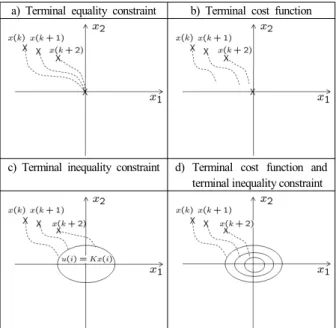
지금까지 설명한 4가지 경우에 대한 안정성 조건을 그림 1에 그래프를 사용하여 개념적으로 표현하였다.
a) Terminal equality constraint b) Terminal cost function
c) Terminal inequality constraint d) Terminal cost function and terminal inequality constraint
그림 1. 안정성을 보장하는 이동 구간 제어기의 설계에 대한 개 념적인 그림들.
Fig. 1. Conceptual figures for stabilizing design of RHCs.
일반적인 상태 공간 시스템에서 제약 조건을 다루는 RHC 관련 결과는 [8]과 그 안의 참고문헌에서 찾아볼 수 있으며, 최근의 MPC 연구는 위에서 설명한 안정성 조건을 Markovian jump 시스템[43], Sampled-data 시스템[45], 입력 채널 제약 시스템[46], 하이브리드 시스템[100] 등으로 다양 하게 확장하고 있다. 입력 및 상태 시간 지연 시스템의 RHC 경우도 종단 등호 제약조건 [47]과 종단 가격함수 [48,49]를 사용하여 가격함수의 단조성을 보일 수 있다.
III. 강건한 이동 구간 제어기
모델에 불확실성이 있을 경우에는 강건한 RHC를 설계해 야 한다. 즉, 불확실성이 가장 최악의 시나리오로 실현되었 다고 가정하고 설계해야 한다. 이 장에서는 다음과 같이 불 확실성이 포함된 시스템을 고려한다.
(12) 여기에서
⋅⋅와
⋅는 다음을 만족한다.
(13)
∞이고,
, 은 불확실성 정도를 의미한다.
가 허용되는
들을 포함한 집합이라고 하면, 강건한 RHC는 기본적으로 다음과 같은 min-max 문제를 다룬다.
min
∈max
∈
(14) 여기서 는 불확실성이고, 는 허용된 불확실성의 집합 이다. (14)에서 가격함수
는 다음과 같이 표 시된다.
(15)
여기서 놈은 1, 2, ∞ 놈이 가능하며, 각각 [19,50,51]에 서 다루어지고 있다.
선형시스템인 경우 제약 조건을 다루는 RHC 문제가 LMI로 표현되어 쉽게 해결이 되었는데, 강건한 RHC도 LMI를 사용하여 풀기위한 많은 연구가 진행되었다. [52,53]
에서는 다각형 모양의 불확실성에 대해 강건한 RHC 설계 문제를 LMI로 표현하였고, [54]에서는 종단 가격함수와 부 등호(타원 모양) 제약 조건을 제시하여 큰 성능의 손실 없 이 계산상의 효율을 높였다. [55]에서는 오프라인 계산을 통해 덜 보수적인 제어기를 설계하여 성능의 개선을 이루 었다. [56]에서는 놈 제한이 있는 불확실성을 다루는 경우 에 대한 LMI 표현을 제안하였다.
위에서 소개한 결과는 주로 가격함수 (15)에서
⋅ ≡ 에 해당하는, 즉 기준신호가 고정되는 정치제어
문제(regulation problem)를 다루었다. [57]에서는 [58]의 결과
를 확장하여 기준신호가 시간에 따라 변하는 추종제어에
대한 견실한 RHC를 제안하였다. [59]에서는 시간에 따라
변하는 불확실 성분을 예측하고, 적분기를 통해 외란을 제
238 권 욱 현, 한 수 희
거하여 추종 오차를 0으로 하는 설계방법을 제안하였다.
[60]에서는 강건한 RHC가 실시간에 사용되도록 오프라인으 로 미리 계산해놓는 방법을 제안하여, 빠른 시스템에서도 잘 적용됨을 보였다.
강건한 RHC가 잡음 등을 다루면, 가격함수 (15)가 결정 이 가능한(deterministic) 값이 아니라, 확률(stochastic) 변수를 포함한 기댓값으로 계산이 되는 매우 복잡한 문제가 된다.
[61]에서는 확률적인 강건한 RHC 문제를 비선형 프로그램 으로 변환하고, 이차 프로그래밍(quadratic programming) 방 법을 반복적으로 사용하여 계산하는 방법을 제안하였다.
[62]에서는 확률적인 불확실성을 고려하였고, convex 최적 화 방법을 사용하였다. [66]에서는 임의 추출된 불확실성에 대한 설계를 통해 불확실성과 외란에 대한 확률론적 정보 를 고려하였다. [63]에서는 확률적인 문제를 다루지는 않지 만, 미지의 시스템에서 추종오차가 0인 강건한 RHC 설계방 법을 convex hull로 이루어진 불확실성하에서 convex 최적 화를 사용하여 제안하였다. 이 연구에서는 dual mode 제어 기를 위해 불변 영역(invariant region)을 소개했는데, [64]에 서는 이 결과를 확장하여 최대 불변 영역을 구하는 방법을 제안하였다.
IV. 이동 구간 제어기의 계산 및 구현 이슈
서론에서 이미 언급했듯이, RHC는 매 샘플링 시간마다 유한 구간의 최적 제어 문제를 풀어야 하므로 계산상의 부 담이 크다. 따라서 최근 RHC의 계산을 효과적으로 수행하 는 방법에 대한 연구가 많이 진행되고 있다.
온 라인 계산 효율을 높이기 위해, [69-74]에서 RHC를 선형 제어기와 같은 명시적인(explicit) 형태로 미리 오프라 인으로 계산해놓는 명시적 RHC(explicit RHC)를 제안하였 다. 다각형 모양의 각 영역에서 RHC의 상태 피드백 이득과 DC 보상 항을 미리 구하여 lookup 테이블을 구성하고, 실 행 시에는 각 영역에 해당하는 제어기를 수행한다. 이런 식 으로 수행되는 명시적 RHC를 계산하기 위해서는 문자 변 수를 다룰 수 있는 multi parametric linar/quadratic programming이라는 수치해석적인 도구가 필요한데, 이에 대 한 소개를 여러 문헌에서 볼 수 있다[105].
명시적 RHC는 시스템의 차수(order)가 작고, 이동 구간 크기가 적당하며, 간단한 제약조건만 있는 시스템의 경우에 매우 효율적으로 활용될 수 있고, PID 제어기와 같이 구현 도 매우 용이하다. 이유는 이럴 경우 각 제어기가 설계되는 영역의 수가 적당해지기 때문이다. 하지만 다루는 시스템과 제약 조건이 복잡해지면, 명시적 RHC의 복잡도는 매우 커지 게 된다. 또한 명시적 RHC는 시불변 시스템의 경우에만 의 미가 있고, 시변인 경우에는 적용하기 적당하지 않다. 매 순 간 RHC의 해를 명시적으로 구하는 것은 계산 부담이 크기 때문이다. 따라서 약간의 최적성을 손해 보는 대신 이런 명 시적 RHC의 계산 부담을 덜고자 하는 많은 연구가 진행되 었다[106]. 특히, 가격함수에 대한 최적성과 영역의 단순화 간의 효과적인 조율을 많이 다루고 있다. 영역의 수를 줄이 거나, 단순화할수록 계산은 간단해지나, 최적성은 손해를 보기 때문에 둘 사이의 관계를 정량화하는 것은 중요하다.
위에 설명한 명시적 RHC는 불확실성이 있는 시스템으로 확장하여 강건한 RHC를 설계하는데도 활용될 수 있다.
[65,72].
명시적 RHC 이후 좀 더 차원(order) 높은 문제를 풀고자, 오프라인으로 미리 구해놓는 방법이외에 계산 자체를 온라 인으로 신속하게 수행하는 방법이 제안되었다. 선형시스템 과 이차 가격함수를 고려하면, RHC 문제는 전형적인 QP (Quadratic Programming)로 표현되는데, 효율적인 풀이로 active set 방법[103], interior-point 방법[75], Newton 방법 [104] 등이 제안되었다. 온라인 active set 방법을 사용한 MPC는 active set이 매 순간 그렇게 많이 변하지 않는다는 실용적인 가정을 하고, 이 전의 QP 해를 참고하여 실시간 계산이 가능하도록 하였다[103]. [104]에서는 MPC문제에 나 타나는 QP를 구분적(piecewise) 선형 시스템과 가격함수로 다시 표현하여 구분적 smooth Newton method를 적용하였 다. [75]는 행렬의 특수한 구조를 활용하여 계산의 복잡도 를 줄이고, 계산량이 이동 구간의 크기에 세제곱 형태가 아 니라 선형적으로 비례하도록 interior-point 방법을 사용하여 계산하였다. 또한 입력을 구간의 일정 부분에서 일정하다고 가정하여 변수를 줄이는 move blocking 방법, 이전 단계의 결과를 바탕으로 예측하여 초기화를 수행하는 warm-starting 방법, 제어기의 성능에 영향을 미치지 않는 범위에서 QP 풀이의 early termination과 같은 방법을 사용하면 suboptimal 해와 예측을 통하여 전체적인 성능을 저해하지 않으면서 계산 속도를 획기적으로 개선할 수 있었다.
최근에는 RHC의 계산 속도를 높이기 위해 fast gradient- projection 방법을 사용하려는 시도가 있다[35,101]. 초기에는 입력 제약 조건만 다룰 수 있거나, 박스 형태의 단순한 입 력 및 상태 제약 조건만 다룰 수 있었는데, [76]에서는 dual gradient-projection 알고리즘을 사용하여 입력과 상태에 대한 일반적인 다각형 제약 조건이 있는 경우를 다루었다.
RHC의 실제 적용을 위해 계산 방법을 개선하는 것 이외 에 구현을 용이하게 하는 방법도 많이 연구되고 있다. [81]
에서는 RHC 설계를 위해서 설계 파라미터를 효율적으로 조절(tuning)하는 방법을 소개하였다. RHC는 PID 제어기와 같이 간단한 구조의 제어기가 아니기 때문에 숙련된 코딩 작업이 요구되어, 코드를 자동 생성하는 도구들도 많이 개 발되었다. 특히 코드 생성은 이론적인 연구 자체이외에 현 장에서 이론적인 지식이 없는 사람들에게도 RHC에 대한 접근성을 높인다는데 큰 의미가 있다. [77]에서는 선형 시 스템을 다루었는데, 이차 프로그래밍 코드가 고급언어[41]
를 사용하여 다양한 플랫폼에 이식하기 용이하도록 자동 생성된다. [78-80]에서는 비선형 시스템에 대한 RHC의 코드 가 자동 생성되는 도구를 제공한다. 특히 [77]에서는 대부 분의 시스템이 제약된 상황에서 선형 시스템으로 모델링 가능하고, 비선형 시스템도 선형화 과정을 거쳐 선형시스템 으로 표현이 가능하므로 선형 시스템에 대한 코드 생성 기 능이 중요함을 언급하였다.
V. 응용
RHC는 앞서 말한 MPC, GPC (Generalized Predictive
이동 구간 제어기의 최근 기술 동향 239
Control), DMC (Dynamic Matrix Control), MAC (Model Algorithmic Control)등으로 불리면서, 오래 전부터 정제, 석 유화학, 펄프, 고분자 등 화학공정 산업에 성공적으로 잘 활용되고 있다. 이런 고전적인 응용에 대해서는 많은 문헌 에서 이미 많이 소개되었기 때문에 이 논문에서는 최근의 RHC 응용에 초점을 맞추기로 한다.
근래 들어 전 세계적으로 환경 및 에너지 문제가 대두되 면서, 에너지 관리 시스템(EMS: Energy Management Systems), 에너지 저장 시스템(ESS: Energy Strage System), 신재생 에너지 등의 키워드가 많이 등장하고 있다. RHC도 이런 에너지 분야에 대한 새로운 응용을 발굴하며, 연구가 진행되고 있다.
특히 신재생 에너지원인 풍력 및 태양광과 에너지 저장 장치(ESS: Energy Storage System)를 결합한 최적의 운용 전 략을 구하는데 RHC가 유용하게 활용되고 있다. ESS를 언 제 얼마나 충전과 방전을 할 것인지를 혼합정수계획법 (MILP: Mixed Integer Quadratic Programming)을 사용하여 매 샘플링 시간에 최적화를 수행한다[82-89]. 특히, 신재생 에 너지 중 풍력은 예측하기 매우 힘든 에너지원으로 원자력 이나 화석 연료와 같이 미리 계획하기가 용이하지 않아, 생 산되는 에너지 량에 비해 실제 활용은 매우 미미하다. 비싼 건설비를 고려하면 충분히 활용해야겠지만, 계통의 안정성 을 위해 많은 도입을 하지 못한다. 이런 예측하기 힘든 풍 력 에너지를 ESS와 연동함으로써 추후에 사용할 수 있는 데, 실시간 전기 가격의 변동, 여러 가지 부가 서비스(주파 수 조절 등) 참여 등을 고려하여 사용자에게 가장 큰 이득 을 제공하는 ESS의 충방전 알고리즘을 RHC 방법으로 구할 수 있다[82-84]. 최근에 분산전원(distributed generation), 마이 크로 그리드(micro grid) 등 에너지 공급 및 소비 관점에서 효율적인 시스템을 구축하는 데도 RHC가 효과적으로 활용 될 수 있음을 보여주고 있다[85,89].
또한 빌딩 등 옥내에서 열관리 또는 전기 에너지 관리를 통한 효율적인 에너지 소모를 위해서도 RHC를 활용하고 있다[90,91]. 집 안의 전기 기기 운용에 작동 시간을 정하 고, 작동 순서를 정하는 RHC를 활용하면 경제적인 에너지 사용을 할 수 있고[90], 좀 규모가 큰 빌딩에서도 신재생 에너지와 위에서 언급한 ESS를 활용해서 효과적인 열관리 와 에너지 관리를 수행할 수 있다[91]. 전기자동차의 경우 도 효과적인 충전을 위해서 RHC 방법을 사용하기도 한다 [107].
위와 같이 상위 계층(컨텐츠, 서비스)에서 효율적인 운영 을 위해 RHC를 활용하고, 하위 계층(물리적인 시스템)에서 도 실제 구현하는 하드웨어 장치에 RHC를 응용하려는 시 도가 꾸준히 늘고 있다. 특히 전력변환장치로 쓰이는 컨버 터에 기존에 쓰이는 PID 제어기를 대체하여 더욱 정확한 제어가 되도록 하는 연구가 진행되고 있다[92,93]. 최근에는 이 분야의 응용에 관한 책도 출판되었다[34]. [116]에서는 펄스폭변조(PWM)를 고려하지 않고, 안정성 분석도 안 되어 있지만, 아주 간단한 구조의 컨버터용 RHC가 제안되었다.
[117,118]에서는 컨버터용 비선형 MPC와 명시적 MPC가 각 각 소개되어 있다.
에너지의 발생, 저장, 및 수요 등에 대한 정교한 모델을 위해 많은 연구가 진행되고 있기 때문에, 모델에 기반한 RHC의 활용은 더욱 더 활발해질 전망이다. 이 논문에는 소 개하지 않았지만, 제어 관련 학회 등에서 많은 에너지관련 논문들이 발표되고 있고, 다수의 에너지 관련 세션들이 구 성되고 있는데, RHC 라는 이름을 직접 사용하지 않더라도, RHC의 기본 개념들이 많이 활용되고 있다.
위에 소개한 에너지 관련 응용뿐 아니라, 최근에는 AC 전동기 제어[94,114,115], 교통 흐름 제어[95], 고전적인 전 력 계통 제어[96], 로봇 제어[97], 하이브리드 전력원 제어 [98,99]등에도 RHC의 응용 관련 연구들이 활발하다. 최근 컴퓨팅 속도가 획기적으로 개선됨에 따라, 동작속도가 매우 빠른 메카트로닉스 분야에도 RHC의 적용이 시도되고 있는 데, 아래와 같은 응용 사례들이 있다.
- 압전형 시스템(piezoactuated system) [108]
- 진동제어(vibration control) [109]
- 픽업 배치 장치(pick-and-place machine) [110]
- 자석형 구동기(magnetic actuator) [111]
- 초음속 모터(ultrasonic motor) [112]
- 내연 기관의 하이브리드 구동기 [113]
이 외에도 최근 RHC를 활용한 다양한 응용결과들이 많지 만, 지면 제한으로 전부 소개하지 못함을 이해하기 바란다.
VI. 결론
RHC는 모델에 기반한 최적 제어를 현실에서 효율적으로 적용할 수 있는 방법이다. 비교적 정확한 모델이 주어지고, 원하는 성능과 현실적인 제약조건이 정량적인 가격함수와 수학적인 제약조건으로만 표현된다면 어떤 응용도 가능하다.
각각의 분야에서 다양한 시스템들을 대상으로 모사 실험 을 위해 모델링을 하고 있고, 컴퓨팅의 기술이 발전하여 많 은 양의 계산을 짧은 시간에 수행할 수 있어 RHC의 미래 는 매우 밝다고 할 수 있다.
RHC는 모델과 미래의 데이터(기준 신호, 파라미터 등)에 바탕을 두기 때문에 이 들의 정확도가 매우 중요한데, 최근 에는 과거 데이터를 기반으로 주로 확률적으로(stochastic) 주 어지는 사례가 많아 앞으로는 확률적인 RHC가 많이 연구될 것으로 보인다. 에너지, 환경, 경제 등 인간의 삶과 관련된 분야에 RHC가 적용되면서, 정성적인 요소에 대한 확률적인 정량화 과정이 필요하고, 그에 대응하는 확률적인 RHC가 개발될 것으로 전망된다. 또한 최근의 big data 기술과 cloud computing 기술로 우리 생활의 다양한 면이 계층적으로 모 델링되고, 상호간의 접근성도 증가되어, 효율적으로 계획하 고 운용하는 기회가 더욱 더 많아질 전망인데, RHC가 많은 분야에서 중요한 역할을 할 것으로 생각한다. 최근에 RHC 앞에 decentralized 또는 distributed와 같은 단어가 붙는 사례 가 많아진 것도 눈 여겨 볼 필요가 있는데, 이것은 복잡한 시스템에서의 RHC 응용도 가능해졌음을 의미한다.
RHC 또는 같은 개념인 MPC에 대한 연구를 막 시작하
거나, 본인의 시스템에 RHC를 적용해보고 싶은 독자들에게
이 논문이 조금이라도 도움이 되길 바란다.
240 Wook Hyun Kwon and Soohee Han
REFERENCES
[1] C. E. Garcia, D. M. Prett, and M. Morari, “Model pre- dictive control: Theory and practice - A survey,”
Automatica, vol. 25, no. 3, pp. 335-348, May 1989.
[2] W. Kwon, “Advances in predictive control : theory and application,” Proc. of Asian Control Conference '94, 1994.
[3] J. B. Rawlings, E. S. Meadows, and K. R. Muske,
“Nonlinear model predictive control: A tutorial and sur- vey,” Proc. of ADCHEM '94, 1994.
[4] S. J. Qin and T. A. Badgwell, “An overview of in- dustrial model predictive control technology,” AIChE Symposium Series, 1997.
[5] A. Bemporad and M. Morari, “Robust model predictive control: A survey,” Robustness in identification and control: Lecture Notes in Control and Information Sciences, Springer, vol. 245, pp. 207-226, 1999.
[6] M. Morari and J. H. Lee, “Model predictive control:
past, present, and future,” Computer & Chemical Engineering, vol. 23, no. 4-5, pp. 667-682, May 1999.
[7] S. J. Qin and T. A. Badgwell, “An overview of non- linear model predictive control applications,” Nonlinear Model Predictive Control: Progress in Systems and Control Theory, Springer, vol. 26, pp. 369-392, 2000.
[8] D. Q. Mayne, J. B. Rawlings, C. V. Rao, and P. O.
M. Scokaert, “Constrained model predictive control:
Stability and optimality,” Automatica, vol. 36, no. 6, pp. 789-814, Jun. 2000.
[9] J. B. Rawlings, “Tutorial overview of model predictive control,” IEEE Control Systems Magazine, vol. 20, no.
3, pp. 38-52, Jun. 2000.
[10] S. J. Qin and T. A. Badgwell, “A survey of industrial model predictive control technology,” Control Engineering Practice, vol. 11, no. 7, pp. 733-764, Jul.
2003.
[11] W. H. Kwon, S. H. Han, and C. K. Ahn, “Advances in nonlinear model predictive control: A survey on sta- bility and optimality,” International Journal of Control, Automation, and Systems, vol. 2, no. 1, pp. 15-22, Mar. 2004.
[12] A. A. Jalali and V. Nadimi, “A survey on robust mod- el predictive control from 1999-2006,”
CIMCA-IAWTIC'06, pp. 207-212, Nov. 2006.
[13] A. Alessio and A. Bemporad, “A Survey on Explicit Model Predictive Control,” Nonlinear model predictive control: Lecture Notes in Control and Information Sciences, Springer, vol. 384, pp. 345-369, 2009.
[14] R. Scattolini, “Architectures for distributed and hier- archical Model Predictive Control - A review,” Journal of Process Control, vol. 19, no. 5, pp. 723-731, May 2009.
[15] J. L. Garriga and M. Soroush, “Model predictive con- trol tuning methods: A review,” Ind. Eng. Chem. Res., vol. 49, no. 8, pp. 3505-3515, 2010.
[16] J. H. Lee, “Model predictive control: Review of the three decades of development,” International Journal of Control, Automation and Systems, vol. 9, no. 3, pp.
415-424, Jun. 2011.
[17] “Model Predictive Control,” Special issue of Journal of Control Science and Engineering, 2012.
[18] A. Afram and F. Janabi-Sharifi, “Theory and applica- tions of HVAC control systems - A review of model predictive control (MPC),” Building and Environment, vol. 72, no. 2, pp. 343-355, Feb. 2014.
[19] D. W. Clarke, Advances in Model-Based Predictive Control, Oxford Univ. Press, 1994.
[20] M. Morari, C. E. García, J. H. Lee, and D. M. Prett, Model Predictive Control, Prentice-Hall, Upper Saddle River, NJ, 1994.
[21] F. Allgöwer and A. Zheng, Nonlinear Model Predictive Control, Birkhauser Verlag, Basel, 2000.
[22] J. Maciejowski, Predictive Control with Constraints, Prentice Hall, 2000.
[23] B. Kouvaritakis and M. Cannon, Nonlinear Predictive Control: Theory and Practice, IET, London, 2001.
[24] J. A. Rossiter, Model-based Predictive Control: A Practical Approach, CRC Press, Florida, 2003.
[25] F. Borrelli, Constrained Optimal Control of Linear &
Hybrid Systems (Lecture Notes in Control &
Information Sciences, Vol. 290), Springer Verlag, Berlin, 2003.
[26] E. F. Camacho and C. Bordons, Model Predictive Control, Springer, Berlin, 2004.
[27] W. H. Kwon and S. Han, Receding Horizon Control, Springer-Verlag, New York, 2005.
[28] L. Wang, Model Predictive Control System Design and Implementation Using MATLAB, Springer Verlag, Berlin, 2009.
[29] L. Magni, D. M. Raimondo, and F. Allgöwer, Nonlinear Model Predictive Control: Towards New Challenging Applications, Springer Verlag, Berlin, 2009.
[30] J. B. Rawlings and D. Q. Mayne, Model Predictive Control Theory and Design, Nob Hill Pub, San Francisco, 2009.
[31] M. Cychowski, Robust Model Predictive Control:
Complexity and Optimality, VDM Verlag, 2009.
[32] L. Grüne and J. Pannek, Nonlinear Model Predictive Control: Theory and Algorithms, Springer Verlag, London, 2011.
[33] A. Grancharova and T. A. Johansen, Explicit Nonlinear
Model Predictive Control: Theory and Applications,
Springer Verlag, London, 2012.
Recent Trends in Receding Horizon Control 241
[34] J. Rodriguez and P. Cortes, Predictive Control of Power Converters and Electrical Drives, A John Wiley
& Sons. Ltd, 2012.
[35] J. M. Maestre and R. R. Negenborn, Distributed Model Predictive Control Made Easy, Springer Verlag, London, 2013.
[36] M. Alamir, A Pragmatic Story of Model Predictive Control: Self-Contained Algorithms and Case-Studies Easy, CreateSpace Independent Publishing Platform, 2013.
[37] E. F. Camacho and Carlos Bordons, Model Predictive Control in the Process Industry, Springer Verlag, London, 2013.
[38] M. Lawrynczuk, Computationally Efficient Model Predictive Control Algorithms: A Neural Network Approach, Springer Verlag, London, 2014.
[39] W. H. Kwon and K. B. Kim, “On stabilizing receding horizon controls for linear continuous time-invariant systems,” IEEE Trans. Automatic Control, vol. 45, no.
7, pp. 1329-1334, Jul. 2000.
[40] S. Richter, C. Jones, and M. Morari, “Real-time in- put-constrained MPC using fast gradient methods,”
Proc. of 48-th IEEE Conference on Decision and Control, 2009.
[41] J. E. Mattingley and S. Boyd, “CVXGEN: A code generator for embedded convex optimization [Online]”
Available: http://standard.edu/boyd/pa- pers/code_gen_impl.h tml
[42] H. Chen and F. Allgower, “A quasi-infinite horizon nonlinear model predictive control scheme with guaran- teed stability,” Automatica, vol. 34, no. 10, pp.
1205-1217, Oct. 1998.
[43] J. Lu, D. Li, and Y. Xi, “Constrained model predictive control synthesis for uncertain discrete-time Markovian jump linear systems,” IET Control Theory &
Applications, vol. 7, no. 5, pp. 707-719, Oct. 2013.
[44] X. Du, Y. Xi, and S. Li, “An efficient constrained model predictive control algorithm based on approx- imate computation,” Journal of Systems Engineering and Electronics, vol. 13, no. 1, pp. 42-47, Oct. 2002.
[45] P. Sopasakis, P. Patrinos, and H. Sarimveis, “MPC for sampled-data linear systems: guaranteeing constraint sat- isfaction in continuous-time,” To Appear in IEEE Trans. Automatic Control.
[46] M. G. Cea and G. C. Goodwin, “Stabilization of sys- tems over bit-rate-constrained networked control archi- tectures,” IEEE Trans. Industrial Informatics, vol. 9, no. 1, pp. 357-364, Jan. 2013.
[47] W. Kwon and A. Pearson, “Feedback stabilization of linear systems with delayed control,” IEEE Trans.
Automatic Control, vol. 25, no. 2, pp. 266-269, Apr.
1980.
[48] W. H. Kwon, Y. S. Lee, and S. H. Han, “General re- ceding horizon control for linear time-delay systems,”
Automatica, vol. 40, no. 9, pp. 1603-1611, 2004.
[49] J. H. Park, H. W. Yoo, S. H. Han, and W. H. Kwon,
“Receding horizon controls for input-delayed systems,”
IEEE Trans. Automatic Control, vol. 53, no. 7, pp.
1746-1752, Aug. 2008.
[50] M. S. Bazaraa and C. M. Shetty, Nonlinear Programming, Wiley, 1979.
[51] P. J. Campo and M. Morari, “Robust model predictive control,” Proc. of American Control Conference, 1987.
[52] F. A. Cuzzola, J. C. Geromel, and M. Morari, “An im- proved approach for constrained robust model predictive control,” Automatica, vol. 38, pp. 1183-1189, 2002.
[53] W. J. Mao, “Robust stabilization of uncertain time-varying discrete systems and comments on “an im- proved approach for constrained robust model predictive control,” Automatica, vol. 39, pp. 1109-1112, 2003.
[54] Z. Wan and M. V. Kothare, “An efficient off-line for- mulation for robust model predictive control using line- ar matrix inequalities,” Automatica, vol. 39, pp.
837-846, 2003.
[55] L. Feng, J. Wang, and E. Poh, “Off-line formulation of robust model predictive control based on several Lyapunov functions,” Proc. of 8-th International Conference on Control, Automation, Robotics and Vision, 2004.
[56] A. Casavola, D. Famularo, and G. Franze, “Robust constrained predictive control of uncertain norm-bound- ed linear systems,” Automatica, vol. 40, pp. 1865-1876, 2004.
[57] M. A. Rodrigues and D. Odloak, “MPC for stable line- ar systems with model uncertainty,” Automatica, vol.
39, pp. 569-583, 2003.
[58] J. B. Rawling and K. R. Muske, “The stability of con- strained multivariable receding horizon control,” IEEE Trans. Automatic Control, vol. 38, pp. 1512-1516, 1993.
[59] Y. Wang and J. B. Rawlings, “A new robust model predictive control method I: Theory and computation,”
J. Proc. Contr., vol. 14, pp. 231-247, 2004.
[60] D. Munoz la pena, D. R. Ramirez, E. F. Camacho, and T. Alamo, “Application of an explicit min-max MPC to a scaled laboratory process,” Control Engineering Practice, vol. 13, pp. 1463-1471, 2005.
[61] P. Li, M. Wendt, and G. Wozny, “Robust model pre- dictive control under chance constraints,” Computers and Chemical Engineering, vol. 24, pp. 829-834, 2000.
[62] A. Abate and L. E. Ghaoui, “Robust model predictive
control through adjustable variables: an application to
242 권 욱 현, 한 수 희
path planning,” Proc. of 43-th IEEE Conference on Decision and Control, 2004.
[63] G. Pannocchia, “Robust offset-free model predictive control,” Proc. of IFAC 2002 World Congress, 2002.
[64] M. Cannon and B. Kouvaritakis, “Optimizing prediction dynamics for robust MPC,” IEEE Trans. Automatic Control, vol. 50, no. 11, pp. 1892-1897, Nov. 2005.
[65] D. Munoz de la Pena, A. Bemporad, and C. Filippi,
“Robust explicit MPC based on approximate multi-para- metric convex programming,” Proc. of 43-th IEEE Conference on Decision and Control, 2004.
[66] G. C. Calafiore and L. Fagiano, “Robust Model pre- dictive control via scenario optimization,” IEEE Trans.
Automatic Control, vol. 58, no. 1, pp. 219-224, Jan.
2013.
[67] M. V. Kothare, V. Balakrishnan, and M. Morari,
“Robust constrained model predictive control using line- ar matrix inequalities,” Automatica, vol. 32, no. 10, pp.
1361-1379, Oct. 1996.
[68] A. Gautam, Y.-C. Chu, and Y. C. Soh, “Robust
∞receding horizon control for a class of coordinated con- trol problems involving dynamically decoupled sub- systems,” IEEE Trans. Automatic Control, vol. 59, no.
1, pp. 134-149, Jan. 2014.
[69] A. Bemporad, M. Morari, V. Dua, and E. N.
Pistikopoulos, “The explicit linear quadratic regulator for constrained systems,” Automatica, vol. 38, no. 1, pp. 3-20, Jan. 2002.
[70] P. Tondel, T. A. Johansen, and A. Bemporad, “An al- gorithm for multi-parametric quadratic programming and explicit MFC solutions,” Proc. of 40-th IEEE Conference on Decision and Control, 2001.
[71] H. J. Ferreau, H. G. Bock, and M. Diehl, “An online active set strategy to overcome the limitation of ex- plicit MPC,” Int. J. Robust Nonlinear Control, vol. 18, no. 8, pp. 816-830, 2008.
[72] K. I. Kouramas, C. Panos, N. P. Faísca, and E. N.
Pistikopoulos, “An algorithm for robust explicit/multi- parametric model predictive control,” Automatica, vol.
49, no. 2, pp. 381-389, Feb. 2013.
[73] K. I. Kouramas, N. P. Faísca, C. Panos, and E. N.
Pistikopoulos, “Explicit/multi-parametric model pre- dictive control (MPC) of linear discrete-time systems by dynamic and multi-parametric programming,”
Automatica, vol. 47, no. 8, pp. 1638-389, Feb. 2013.
[74] H. Khajuria and E. N. Pistikopoulos, “Dynamic model- ing and explicit/multi-parametric MPC control of pres- sure swing adsorption systems,” Journal of Process Control, vol. 21, no. 1, pp. 151-163, Jan. 2011.
[75] Y. Wang and S. Boyd, “Fast model predictive control using online optimization,” IEEE Trans. Control
Systems Technology, vol. 18, no. 2, pp. 267-278, Mar.
2010.
[76] P. Patrinos and A. Bemporad, “An accelerated dual gradient-projection algorithm for embedded linear model predictive control,” IEEE Trans. Automatic Control, vol.
59, no. 1, pp. 18-33, Jan. 2014.
[77] J. Mattingley, Y. Wang, and S. Boyd, “Receding hori- zon control,” IEEE Control Systems Magazine, vol. 31, no. 3, pp. 52-65, Jun. 2011.
[78] T. Ohtsuka and A. Kodama, “Automatic code gen- eration system for nonlinear receding horizon control,”
Trans. Soc. Instrum. Contr. Eng., vol. 38, no. 7, pp.
617-623, Jul. 2002.
[79] T. Ohtsuka, “A continuation/GMRES method for fast computation of nonlinear receding horizon control,”
Automatica, vol. 40, no. 4, pp. 563-574, Apr. 2004.
[80] B. Houska and H. J. Ferreau, “ACADO toolkit:
Automatic control and dynamic optimization,” http://
www.acadotoolkit.org., 2008.
[81] S. Di Cairano and A. Bemporad, “Model predictive control tuning by control matching,” IEEE Trans.
Automatic Control, vol. 55, no. 1, pp. 185-190, 2010.
[82] W. Qi, J. Liu, and P. D. Christofides, “Distributed su- pervisory predictive control of distributed wind and so- lar energy systems,” IEEE Trans. Control Systems Technology, vol. 21, no. 2, pp. 504-512, Mar. 2013.
[83] J. Han, S. K. Solanki, and J. Solanki, “Coordinated predictive control of a wind/battery Microgrid system,”
IEEE Journal of Emerging and Selected Topics in Power Electronics, vol. 1, no. 4, pp. 296-305, Dec.
2013.
[84] A. Khatamianfar, M. Khalid, A. V. Savkin, and V. G.
Agelidis, “Improving wind farm dispatch in the austral- ian electricity market with battery energy storage using model predictive control,” IEEE Transactions on Sustainable Energy, vol. 4, no. 3, pp. 745-755, Jul.
2013.
[85] W. Qi, J. Liu, and P. D. Christofides, “A distributed control framework for smart grid development:
Energy/water system optimal operation and electric grid integration,” Journal of Process Control, vol. 21, pp.
1504-1516, 2011.
[86] M. Khalid and A. V. Savkin, “Minimization and con- trol of battery energy storage for wind power smooth- ing: Aggregated, distributed and semi-distributed stor- age,” Renewable Energy, vol. 64, pp. 105-112, 2014.
[87] M. Khalid and A. V. Savkin, “A model predictive con- trol approach to the problem of wind power smoothing with controlled battery storage,” Renewable Energy, vol.
35, pp. 1520-1526, 2010.
[88] M. Khalid and A. V. Savkin, “An optimal operation of
이동 구간 제어기의 최근 기술 동향 243
wind energy storage system for frequency control based on model predictive control,” Renewable Energy, vol.
48, pp. 127-132, 2012.
[89] A. Parisio, E. Rikos, G. Tzamalis, and L. Glielmo,
“Use of model predictive control for experimental mi- crogrid optimization,” Applied Energy, vol. 115, pp.
37-46, 2014.
[90] C. Chen, J. Wang, Y. Heo, and S. Kishore,
“MPC-based appliance scheduling for residential build- ing energy management controller,” IEEE Transactions on Smart Grid, vol. 4, no. 3, pp. 1401-1410, Sep.
2013.
[91] H. Dagdougui, R. Minciardi, A. Ouammi, M. Robba, and R. Sacile, “Modelling and optimization of a hybrid system for the energy supply of a Green building,”
Energy Conversion and Management, vol. 64, pp.
351-363, 2012.
[92] V. Yaramasu, M. Rivera, M. Narimani, M. B. Wu, and J. Rodriguez, “Model predictive approach for a simple and effective load voltage control of four-leg inverter with an output LC filter,” To appear in IEEE Trans.
Industrial Electronics.
[93] P. Karamanakos, T. Geyer, and S. Manias, “Direct voltage control of DC-DC boost converters using enu- meration-based model predictive control,” IEEE Trans.
Power Electronics, vol. 29, no. 2, pp. 968-978, Feb.
2014.
[94] A. Damiano, G. Gatto, I. Marongiu, A. Perfetto, and A. Serpi, “Operating constraints management of a sur- face- mounted pm synchronous machine by means of an fpga-based model predictive control algorithm,”
IEEE Trans. Industrial Informatics, vol. 10, no. 1, pp.
243-255, Jan. 2014.
[95] M. A. S. Kamal, J. Imura, T. Hayakawa, A. Ohata, and K. Aihara, “Smart driving of a vehicle using mod- el predictive control for improving traffic flow,” To ap- pear in IEEE Trans. Intelligent Transportation Systems.
[96] A. J. del Real, A. Arce, and C. Bordons, “An in- tegrated framework for distributed model predictive control of large-scale power networks,” IEEE Trans.
Industrial Informatics, vol. 10, no. 1, pp. 197-209, Jan.
2014.
[97] J. C. L. Barreto S., A. G. S. Conceicao, C. E. T.
Dorea, L. Martinez, and E. R. de Pieri, “Design and implementation of model-predictive control with friction compensation on an omnidirectional mobile robot,” To Appear in IEEE/ASME Trans. Mechatronics.
[98] B. Hredzak, V. G. Agelidis, and M. Jang, “A model predictive control system for a hybrid battery- ultra- capacitor power source,” IEEE Trans. Power Electronics, vol. 29, no. 3, pp. 1469-1479, Mar. 2014.
[99] J. Torreglosa, P. Garcia, L. M. Fernandez, and F.
Jurado, “Predictive control for the energy management of a fuel-cell-battery-supercapacitor tramway,” IEEE Trans. Industrial Informatics, vol. 10, no. 1, pp.
276-285, Jan. 2014.
[100] M. Lazar, W. P. M. H. Heemels, S. Weiland, and A.
Bemporad, “Stabilizing model predictive control of hy- brid systems,” IEEE Trans. Automatic Control, vol. 51, no. 11, pp. 1813-1818, Nov. 2006.
[101] L. Magni and R. Scattolini, “Stabilizing decentralized model predictive control of nonlinear systems,”
Automatica, vol. 42, no. 7, pp. 1231-1236, Jul. 2006.
[102] S. Richter, C. Jones, and M. Morari, “Computational complexity certification for real-time MPC with input constraints based on the fast gradient method,” IEEE Trans. Automatic Control, vol. 57, no. 6, pp.
1391-1403, Jun. 2012.
[103] H. Ferreau, H. Bock, and M. Diehl, “An online active set strategy to overcome the limitations of explicit MPC,” Int. J. Robust Nonlin. Control, vol. 18, no. 8, pp. 816-830, 2008.
[104] P. Patrinos, P. Sopasakis, and H. Sarimveis, “A global piecewise smooth Newton method for fast large-scale model predictive control,” Automatica, vol. 47, no. 9, pp. 2016-2022, 2011.
[105] E. N. Pistikopoulos, M. C. Georgiadis, and V. Dua, Multi-Parametric Programming, Wiley-VCH, 2007.
[106] C. Jones and M. Morari, “Polytopic approximation of explicit model predictive controllers,” IEEE Trans.
Automatic Control, vol. 55, no. 11, pp. 2542-2553, Nov. 2010.
[107] A. D. Giorgio, F. Liberati, and S. Canale, “Electric ve- hicles charging control in a smart grid: A model pre- dictive control approach,” Control Engineering Practice, vol. 22, pp. 147-162, Jan. 2014.
[108] C.-Y. Lin and Y.-C. Liu, “Precision Tracking Control and Constraint Handling of Mechatronic Servo Systems Using Model Predictive Control,” IEEE/ASME Transactions on Mechatronics, vol. 17, no 4, pp.
593-605, Aug. 2012.
[109] G. Takacs and B. Rohal-llkiv, Applications of Model Predictive Vibration Control, Springer Verlag, London, 2012.
[110] L. Van den Broeck, M. Diehl, and J. Swevers, “Time optimal MPC for mechatronic applications,” Proc. of 48-th IEEE Conference on Decision and Control, 2009.
[111] S. D. Cairano, A. Bemporad, I. V. Kolmanovsky, and
D. Hrovat, “Model predictive control of magnetically
actuated mass spring dampers for automotive applica-
tions,” International Journal of Controls, vol. 80, no
11, pp. 1701-1716, Nov. 2007.
244 Wook Hyun Kwon and Soohee Han