• 검색 결과가 없습니다.

A Study on Strategic Orientation and the performance of IT Startup : The Mediating Effect of Network

N/A
N/A
Protected

Academic year: 2021

Share "A Study on Strategic Orientation and the performance of IT Startup : The Mediating Effect of Network"

Copied!
15
0
0

로드 중.... (전체 텍스트 보기)

전체 글

(1)

1. Introduction

The heightening competition in the global market and rapid changes in the management environment

due to the increase in technological complexity put numerous startups on the verge of failure. Although many firms are adhering to traditional operations

A Study on Strategic Orientation and the performance of IT Startup : The Mediating Effect of Network

Yunsoo Shim 1 , Jounghae Seo 2*

1

Graduate Student, School of Business Administration, Kyungpook National University

2

Professor, School of Business Administration, Kyungpook National University

IT스타트업의 전략적 지향성과 성과에 관한 연구 :네트워크 매개효과

심연수

1

, 서정해

2*

1

경북대학교 경영학부 박사과정,

2

경북대학교 경영학부 교수

Abstract This study aims at examining the effect of strategic orientation on IT startup performance and analyzing the mediating effect of network in the relationship. The study was conducted on the three dimensions that make up strategic orientation: technological orientation, customer orientation, competitive orientation on firm performance, and the understanding of the role of the network. Empirical research on 94 IT startups as residents of startup support institutions was conducted. The suitability of the research model was evaluated with PLS-SEM. As a result of the empirical analysis, customer orientation and competitive orientation was verified to have a positive effect on network, while Technological orientation was confirmed to have no positive effect. and network mediated the relationship between customer orientation and competitive orientation, while Technological orientation was confirmed to have no positive effect. The results of this study provide startup practitioners with strategic direction and the importance of network establishment and utilization.

Key Words : Strategic Orientation, Technological Orientation, Customer Orientation, Competitive Orientation, Startup Performance.

요 약 본 연구는 국내 IT스타트업의 성과에 미치는 전략적 지향성에대해 알아보고, 그 관계에서 네트워크의

매개효과를 분석하는데 목적이 있다. 전략적 지향성을 구성하는 세 가지 차원인 기술지향성, 고객지향성, 경쟁 지향성 각각이 성과에 미치는 영향 관계 및 네트워크의 역할 파악에 대한 연구를 수행하였다. 스타트업 지원기 관 등에 입주하고 있는 94개 IT기업을 대상으로 실증연구를 완료하였으며, 연구 모형의 적합성을 평가하기 위 해 PLS기반 구조방정식 모델을 사용하였다. 실증분석 결과 고객지향성과 경쟁지향성은 성과와 네트워크 모두 에 긍정적인 영향을 미치는 것으로 확인되었으며, 기술지향성은 성과와 네트워크 모두 긍정적 영향을 미치지 않는 것을 확인했다. 또한 고객 지향성과 경쟁지향성은 기업성과와의 관계에서 네트워크가 매개역할을 하는 것 을 확인하였지만, 기술지향성과 기업성과의 관계에서 네트워크는 매개역할을 하지 못하는 것으로 확인되었다.

본 연구의 결과는 스타트업 실무자들에게 전략적 방향과 네트워크 구축 및 활용의 중요성을 시사하고 있다.

키워드 : 전략적 지향성, 기술 지향성, 고객 지향성, 경쟁자 지향성, 스타트업 성과

*
Corresponding Author : Jounghae Seo([email protected]) Received January 29, 2020

Accepted February 20, 2020

Revised February 18, 2020

Published February 29, 2020

(2)

and management methods, but in modern times, extreme uncertainty is actually causing many to fail.

In other words, applying traditional ways of management brings failures. IT startups with relatively insufficient resources are more in need of the transition to a method of pursuing innovativeness in addition to traditional operations and management centering on efficiency to maintain a competitive advantage. Startup must have strategic orientation because it can only focus on the startup's internal capabilities, such as cost reduction and technology development. When strategic orientation is applied to an organization, it establishes strategies for creating sustainable values, while the organization constituents effectively handle the information to reach a decision [1]. In literature on strategic orientation, it was studied in various constructed. Ho et al.(2016) focused on market orientation, technological orientation, relational orientation and entrepreneurial orientation, Aloulou (2019) focused on technological orientation, market orientation and entrepreneurial orientation, Schweiger et al.(2019) focused on entrepreneurship, learning orientation, and Marketing Orientation, and Chung and Lee(2019) focused on technological orientation and market orientation. Since IT startup is based on technology, technological orientation will be relatively important. In addition, If the customer fails to identify the core desires that they want, the firm will have to set up and target various markets, which will result in waste of resources. Firms should use limited resources efficiently, and customer orientation can help them use their resources efficiently and contribute to improving performance. Also, The management environment and technological development are rapidly changing.

At a time when the product’s life cycle is also being shortened, an entity must collect, archive and analyze competitor information and information from within and outside the market for quick and accurate decision making as the market changes.

Competitive orientation would give firms a competitive edge by providing them with ways to respond to markets and competitors. Therefore, among the various lower dimensions that strategic orientation, this study want to see technological orientation, customer orientation, and competitive orientation. Furthermore, IT startups can share technology and knowledge via network in order to overcome limited resources, and, based on the network interaction, they can increase far more market opportunities [2]. The earlier in the phase of business, the more important for the company to secure networks that can be connected to diverse groups. Such networks for obtaining information have a significant influence on firm performance [3].

Despite the importance, Korean study on the strategic orientation of IT startups is significantly lacking. In particular, the past study has been focused on combining strategic orientation with entrepreneurial orientation and marketing orientation.

However, unlike the past strategic orientation studies, first, the relationship between the customer orientation and the competition orientation, which constitutes the technology orientation and market orientation, which is relatively important for technology-based IT startups, is analyzed. So, strategic orientation is examined in depth by classifying into three elements as its sub-factor. In addition, this study is differentiated from past study because this study comprehensively analyzes the influence of network influence in addition to conducting the empirical study on Korean IT startups, which have not been dealt with. Therefore, The results of this study expect to be used as an index to provide founders with the strategic direction and the importance of network construction and utilization.

2. Literature Review 2.1 Strategic Orientation

Strategic orientation is a unique approach of

(3)

enabling the provision of direction for strategic choices to achieve a higher firm performance and to create excellent customer values by achieving sustainable competitive advantage [4-6], in addition to being an important element of securing competitiveness of a venture company [7]. In contrast to larger enterprises, small-firm or venture like startups lack strategic thinking due to their shorter span of operational lives [8].

Strategic orientation refers to the process, customs, and decision-making process that derive the growth of a firm [9]. Strategic orientation means a consistent set of guidelines and modalities for firm decision-making, which are used for policy and procedure establishment and resource allocation [10]. It can be defined as the strategic direction of creative behaviors of a firm that helps it to achieve excellent management performance [4-5] while influencing the marketing and strategy-making activities of a firm [11-12]. In this study, strategic orientation is classified into technological orientation, customer orientation, and competitive orientation according to the classification by [5] and [13].

2.1.1 Technological Orientation

Technological orientation is a firm capability trying to continuously secure technological background used for new products [14]. It means the ability to develop innovative technology and utilizing innovative technology by integrating it into product development or marketing process [15].

Technological orientation is an organizational culture where companies adopt innovative technologies to secure a sustainable competitive advantage in the market by securing superior technology than competitors and strive to settle the technologies within the organization. In addition, it includes using cutting-edge technologies in new product development, increasing the speed of the integration of new technologies, and pursuing new technology development and new product idea generation. Also,

it achieves a technological advantage that cannot be easily copied by competitors and provides companies the potential for gaining greater competitive advantage [16]. Firms need a strong technological orientation in order to increase their technological capabilities and investment in development for creating innovations of superiority over their competitors. In markets where demand is relatively uncertain, technological orientation must be strengthened to achieve firm performance [5].

2.1.2 Customer Orientation

Customer orientation refers to the ability of

integrating identified customer needs into product

development and marketing process [5] and the

tendency of an organization that continuously

produces and supplies products that generates or

increases good quality of products by constantly

and sufficiently identifying customer needs [4],

thereby prioritizing customer satisfaction as the

most important purpose for implementation

marketing activities in the market. Customer

orientation includes valuable information generation

about customers and competitors, the ability of a

company in disseminating information and turning it

into useful information, and the coordination of the

resources amongst departments to create the best

customer value [7]. and customer orientation can

improve a company's ability to produce higher

performance [17], identify customer needs, and

realize customer satisfaction more effectively than

its competitors. Based on customer orientation,

information about customers and competitors is

collected, the information is distributed and spread

within the organization, and customer value is

created by creating necessary behaviors effectively

for purchaser value while responses to competitors

are made via cross-departmental collaboration based

on information. In the case of startups, they have a

quicker decision-making process than large firms

while being relatively limited in profit generation

(4)

based on customer-oriented activities due to the lack of systematic decision-making systems.

Customer-oriented strategies cause an organization to define its action path while deriving more rapid decision making [18]. Thus, in order to increase competitiveness and achieve performance goals, startups must strengthen customer orientation.

2.1.3 Competitive Orientation

Competitive orientation is the tendency of a firm that analyzes and responds to recognized behaviors of competitors [4] as a process for making appropriate decisions by firm management in response to the changes of competitors [4]. It also means the capability of integrating the information on competitors into the marketing process and product development process [5]. At the same time, the term refers to identifying the short-term advantages and disadvantages of potential and current competitors of a company while understanding their long-term strategy and capability [4,9]. Competition is not to neutralize competitors by using various tools but rather responding quickly by delivering competitor information to an organization by anticipating or identifying the behaviors and trends of competitors [7]. Accordingly, for the commercial success of startups, which are relatively young firms, competitive orientation must be strengthened.

2.2 Network

In initial technology startups, intraorganizational social capital, a resource that enables smooth interaction between CEOs and employees, and interorganizational social capital, a set of resources arising from the structure of transactions with stakeholders outside the organization, are important factors for the performance of technology startups [20].

Networks improve the timeliness and quality of contents by increasing the accessibility of

constituents of the organization on the necessary knowledge and information [21] and promotes the sharing and exchange of resources, thereby supporting the generation of new knowledge [22]. In addition, based on interactions, it strengthens the cohesion and sense of responsibility of constituents of the organization, influencing firm performance [23]. Also, A network of technology-based startups improves firm performance by encouraging active participation in business-related relationships and peer groups [24]. As such, IT startups with a wide network can identify new opportunities in response to rapid technological changes and develop products or services with marketability.

3. Research Design

3.1 Strategic Orientation and Performance It is not surprising that the concept of strategy has been linked to performance outcomes. The literature on strategy and firm performance studied that successful firms invest time in developing proactive strategies, while unsuccessful firms are reactive in their strategic orientation [25].

Technologically oriented firms strongly pursue research and development, actively secure new technology, and use cutting-edge technology in new product development [5]. As a company has a higher level of technological orientation, it pursues technological superiority, introduces new technology into products, and secure the flexibility and superiority of the market, thereby enabling innovative product development [26]. The technological orientation emphasizes the acquisition and application of sophisticated technologies in business operations and production facilities [27].

Thus, Companies pursuing technological orientation mean the focused use of innovative technologies, products and support for technology development.

Thus, firms that pursue technological orientation

produce innovative products in the market, thereby

increasing the competitiveness of their firms and

(5)

influencing their management performance [28]. In order to overcome limited resources and conditions, IT startups should promote R&D investment of the company in order to secure a differentiated competitive advantage over its existing market competitors within a short period of time and strengthen technology innovation activities, which will lead to the creation of new values, enabling the company to obtain potential innovativeness.

Customer-oriented companies strive to develop superior products or services that competitors fail to provide based on sufficient understanding and analysis of capability and strategy of competitors [29]. By analyzing customers, a company establishes strategies that can fulfill the current needs of customers, which enables technology innovation that can satisfy customers. This leads to new product creation, which results in achievements. As such, customer orientation is a factor that enables the creation of a company’s competitive advantage, which leads to achievements by securing the competitive advantage of a product or service in the market [30] Several studies have found that customer orientation has a positive influence on firm performance [31-34].

Companies with competitive orientation need to understand the capability, strategy, advantages, and disadvantages of current and potential competitors [4]. In the process where successful and innovative entrepreneurs checking the characteristics of products provided by competitors, they determine the concept of their new products [30]. In other words, while keeping an eye on the competitors’

products and their characteristics, the entrepreneurs develop a superior product or specific services. In existing studies, competitive orientation was found to have a positive effect on firm performance [7, 12, 34, 35]. Accordingly, in this study, the following hypotheses were set for strategic orientation and performance of startups.

H1: There is a positive relationship between strategic orientation and firm performance.

1-1: There is a positive relationship between technological orientation and firm performance.

1-2: There is a positive relationship between customer orientation and firm performance.

1-3: There is a positive relationship between competitive orientation and firm performance.

3.2 Strategic Orientation and Network A company with a high level of technological orientation establishes technological solutions by using technological knowledge in order to answer and satisfy new needs of users [5] and combines and distributes diverse resources and technological resources including technology innovation capability in order to secure and use cutting-edge technology [16]. As technological orientation is sustained, network is more diversified and the interaction with existing networks is vitalized, which leads to strengthening the connection.

A company with a high level of customer orientation actively conducts activities for finding and responding to customer demand and needs. The customer needs identified as such are reflected on marketing activities and product development [5]

and can strengthen the scope and strength of networks in the process of establishing strategy and measures for customer satisfaction. A company with a higher level of competitive orientation can create results such as innovative products based on the efforts of continuously monitoring the internal and external knowledge and information of a firm with open mindedness [36] Accordingly, in this study, the following hypotheses were set for strategic orientation and network.

H2: There is a positive relationship between strategic orientation and network.

2-1. There is a positive relationship between

technological orientation and network.

(6)

2-2. There is a positive relationship between customer orientation and network.

2-3. There is a positive relationship between competitive orientation and network.

3.3 Mediate effect of Network

Through networks, the accessibility to necessary information and knowledge for acquiring new technology is increased. Also, by enabling newer and more diversified opportunity creation based on official and unofficial interaction and communication among constituents, technological orientation can influence the technology innovation performance via networks. In addition, the bond formed with customers via customer orientation allows an effective response to changes tailored to each customer and the market by allowing the company to have the response process including production and service according to the changes in customer preference [37]. Network function can improve the performance of new product development through improving the relationships with internal stakeholders of a firm in the process of new product development [3]. Thus, based on customer orientation, it is important to use it effectively and to establish a network to access external information. By analyzing the secured information via competitive orientation based on networks and disseminating the information for the entire firm, and by spreading the information among departments, the inter-department cooperation is strengthened. This will hinder unnecessary development and enable swift market response.

Network function creates a virtuous circle by creating new knowledge that can respond to the uncertain environment, which is learned by constituents of an organization and thereby increasing the performance, and by influencing the innovation performance based on the increased new product quality [38]. In sum, IT startups can maximize the positive functions of strategic

orientation by successfully mobilizing support by stakeholders and managing the diversity of internal relationships of the firm through network. The effective network increases the survival capability of a firm and has a significant influence on the ability for innovative performance and achievement [39].

Accordingly, this study has set the following hypotheses on each factor of technological orientation, customer orientation, and competitive orientation as sub-factors of strategy orientation, as well as on mediate effect of network.

H3: Network will mediate the relationship between strategic orientation and firm performance.

3-1. Network will mediate the relationship between technological orientation and firm performance.

3-2. Network will mediate the relationship between customer orientation and firm performance.

3-3. Network will mediate the relationship between competitive orientation and firm performance.

3.4 Research Modeling

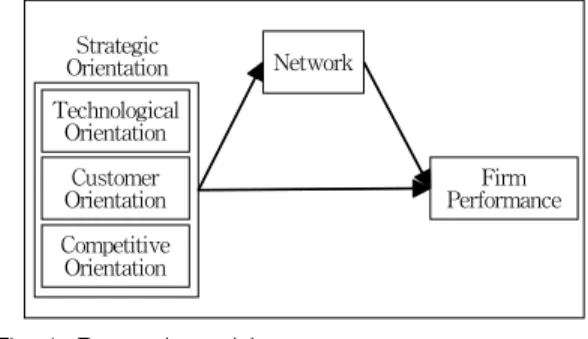
The summary of the above hypothesis shows that the research model is shown in (Fig. 1).

Technological Orientation

Customer Orientation Competitive Orientation

Performance Firm Network

Strategic Orientation

Fig. 1. Research model

3.5 Research Modeling Process

In this study, first, the direct impact of strategic

orientation on startup performance is confirmed

respectively by classifying it into three dimensions

(7)

of technological orientation, customer orientation, and competitive orientation. Then, this study aims at confirming the mediating effect of network that can increase the effects of the three dimensions. In order to verify the suitability of the research model, this study utilizes a structural equation model to confirm the reliability and validity, followed by an evaluation of the significance of the hypothesis via path analysis.

3.6 Sample

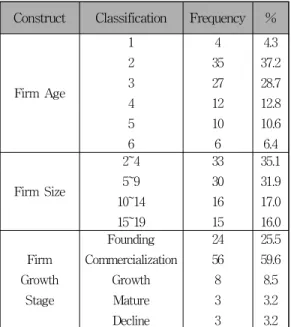
By obtaining the firm information of a total of 746 companies via matching the list of Korean startup support organizations with the data on the startup portal site, the survey was conducted for about 2 months from July 2019. In addition, the purpose and contents of the study were explained via e-mail or calls, in addition to personal visits were made as needed to collect the responses. Of the total 158 firms that responded to the survey, the final 94 companies were selected as the empirical analysis sample after excluding companies that have been existed for more than 7 years.

Table 1. Characteristics of Sample Startups (N = 94)

3.7 Measures

In order to identify the direct effects of strategic orientation on firm performance and the mediating effect of network, variables are measured based on relevant studies, and all variables used in the empirical analysis are measured by the Likert 5-point scale.

3.7.1 Strategic Orientation

Strategic orientation was measured as 3 independent concepts [5]. technological orientation was measured with 4 items, and as a single-dimension scale in reference to the study by [40]. Customer orientation was measured in a total of 4 items by referring to the research by [4] and [41]. Competitive orientation, in reference to [12], was measured using 4 items including the importance of competitors’ behaviors and continuous benchmarking, major decision making for competitors’ behaviors, immediate response to competitors’ behaviors, and deriving main business goals from competitors’ behaviors and strategies.

3.7.2 Network

In reference to [42] and [39], network was measured with 4 items including network combination and connection strength, and the strength and frequency of contact related to work/non-work.

3.7.3 Performance of Startup

For strategic orientation performance, diverse types of dependent variables are being used other than financial performance and innovation performance, and perceived performance is measured in many studies [42-44].

This study, in reference to the studies by [45]

and [46], composed 4 items of market share, sales, return on investment, and production efficiency within 3 years compared to the competitors, and the startup performance was measured by combining Construct Classification Frequency %

Firm Age

1 2 3 4 5 6

4 35 27 12 10 6

4.3 37.2 28.7 12.8 10.6 6.4

Firm Size

2~4 5~9 10~14 15~19

33 30 16 15

35.1 31.9 17.0 16.0

Firm Growth

Stage

Founding Commercialization

Growth Mature Decline

24 56 8 3 3

25.5

59.6

8.5

3.2

3.2

(8)

perceived financial performance and perceived non-financial performance. Cognitive measurement can overcome the shortcomings of financial performance measurement because they identify financial performance based on managers’

professional knowledge and experience on the field [47].

3.7.4 Control Variable

In order to control the influence on firm performance of the firm size, firm age, and growth-stage via the resources and firm structure of a startup, the 3 items were used as control variables [48].

Table 2. Construct Measurement

4. Analysis and Results

For statistical analysis, the Partial Least Squares-based(PLS) structural equation model(SEM) was utilized, PLS-SEM can particularly be used in the area of social sciences, strategic management and marketing as it is a multivariate analysis method. Moreover, PLS-SEM has no limitations on the interaction technique, as compared with other covariance techniques [49]. and, for the hypotheses verification, path analysis was used after evaluating the suitability of the measurement model and structural model with the SmartPLS 3.0 program, which works well even in small samples.

4.1 Assessing Measurement Model

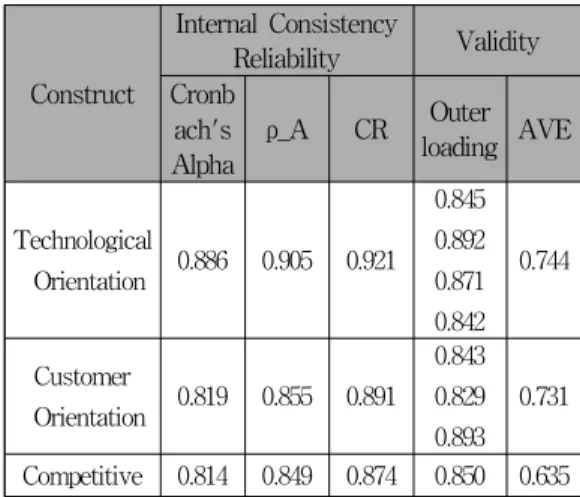
For the evaluation of the measurement model of PLS-SEM, the internal consistency reliability, convergent validity, and discriminant validity were evaluated [50], of which results are summarized in Table 3. The internal consistency reliability was found to satisfy both Cronbach's α and the composite reliability at the conformance criterion of 0.6 or higher as well as and rho_A (ρ_A) with the conformance criteria of 0.7 or higher. Also, the outer loading relevance was found to satisfy the conformance criteria of 0.7 or higher as well as the AVE value of 0.5 or higher [51-52].

Table 3. Construct reliability and validity Construct

Internal Consistency

Reliability Validity Cronb

ach's Alpha

ρ _A CR Outer loading AVE

Technological

Orientation 0.886 0.905 0.921 0.845 0.892 0.871 0.842

0.744

Customer

Orientation 0.819 0.855 0.891 0.843 0.829 0.893

0.731

Competitive 0.814 0.849 0.874 0.850 0.635

Construct Measurement refera

nce

Strat egic Orie ntati on

Techno logical

Rapid acceptance of technological innovation based on research results

[5,40]

Acceptance of innovative new product ideas

Use of innovative new product Use sophisticated technology to develop new products

Custom er

Decision-making based on customer satisfaction

[4,41]

Goal setting based on customer satisfaction

Customer satisfaction with products Customer satisfaction with service

Compet itive

Continuous benchmarking

[12]

Major decisions making from competitor's Activities

Immediate response to competitors Derivation of major business goals from competitors

Network

Strength of contact related to work

[4.41]

Strength of contact related to non-work Frequency of contact related to work Frequency of contact related to non-work

Firm performance

Increased market share over the past three years

Sales growth [46]

Improving profitability in terms of investment

productivity improvement Cont

r o l vari able

Firm age Natural Log(Years passed from establishment year to measurement year)

[44,48]

Firm size Natural Log(Number of employees) Firm Growth

stage

Convert to dummy variable

(Founding=1,Commercialization/Growth/Mat

ure/Decline=2)

(9)

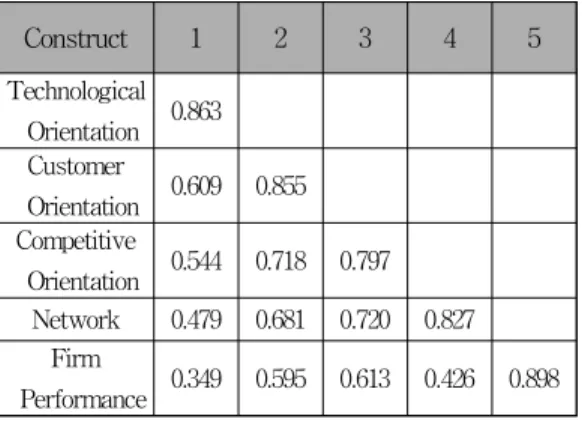
In addition, Discriminant validity is acceptable based on the rule that the correlation between any two distinct constructs is lower than the square root of the AVE from these constructs. As a result of the comparison of the correlation between each AVE square root and variables to evaluate the discriminant validity, as shown in Table 4, the AVE square root value of each variable represented in the diagonal was found to be larger than the highest value among the correlations between the variables [51]. As such, the above results confirmed that both the reliability and validity of the measurement model were secured.

Table 4. Discriminant validity(Fornell-Larcker Criterion)

4.2 Assessing Structural Model

The PLS-SEM performs a bootstrapping procedure in order to verify the significance of the coefficients. The t-value is calculated by a repetitive regression process that restores and

extracts a large number of bootstrap samples, based on which the significance and suitability of the path coefficient can be evaluated [53]. Bootstrap resampling is recommended 5,000 times to estimate the correct value [54-55]. therefore, 5,000 Bootstrap Resampling samples were set with 94 raw data.

Then, after calculating the t-value, the results of the verification results of the statistical significance of the hypotheses are presented in Table 5. The hypotheses verification results supported H1-2 and H1-3, which stated that customer orientation and competitive orientation among strategic orientation will have a positive effect on firm performance, at the p-value of 0.01, 0.05. In addition, H2-2 and H2-3, which assumed that customer orientation and competitive orientation among strategic orientation will have a positive effect on network at the p-value of 0.05, 0.01. In the case hypotheses that assumed that network will mediate the relationship between strategy orientation and firm performance, only for customer orientation under H3-2 and competitive orientation under H3-3, network was found to have a mediating effect at the p-value of 0.05, 0.01, while all hypotheses related to technological orientation were found not to have any significant effect. Among the control variables, firm size and firm growth stage will have a significant effect on firm performance, at the p-value of 0.05, but firm age was confirmed not to have a significant effect in this study.

Table 5. Path coefficients and t-value Orientation

0.848 0.751 0.732

Network 0.845 0.853 0.896 0.814 0.903 0.822 0.764

0.684

Firm

Performance 0.921 0.948 0.944 0.888 0.908 0.934 0.861

0.807

Construct 1 2 3 4 5

Technological Orientation 0.863 Customer

Orientation 0.609 0.855 Competitive

Orientation 0.544 0.718 0.797 Network 0.479 0.681 0.720 0.827

Firm

Performance 0.349 0.595 0.613 0.426 0.898

Hypothesis β T

value P value

H1

Technological Orientation → Firm

Performance -0.063 0.649 0.517 Customer Orientation →

Firm Performance 0.324 2.527 0.012

*

Competitive Orientation

→ Firm Performance 0.448 3.692 0.000

**

H2 Technological

Orientation → Network 0.024 0.225 0.822

(10)

5. Discussion and Conclusions This study conducted an empirical analysis of the mediating effect of a respective network by classifying strategy orientation into its three sub-factors of technological orientation, customer orientation, and competitive orientation in order to carry out in-depth research on the influence of the factors on firm performance of Korean IT startups.

This study tried to establish a logical system through empirical analysis on whether each network plays a role of mediation in these relationships, and this is the contribution of this paper. Based on the above studies, the conclusions and discussion points of this study are as follows. first, Of the strategic orientations of IT startups, customer orientation and competitive orientation was found to have positive effect on firm performance, but technological orientation was found to have no positive effect on firm performance. second, Of the strategic orientations of IT startups, customer orientation and competitive orientation was found to have positive effect on Network, but technological orientation was

found to have no positive effect on Network. Third, it was confirmed that network mediated the relationship between customer orientation and competitive orientation with firm performance of IT startups. but it wasn't confirmed that network mediated the relationship between technological orientation and firm performance.

Despite the fact that technological superiority unique to a firm is critical in the IT startup industry for securing competitive advantage, the research result showing no significance in the relationship between technological orientation and network can be interpreted with the unique characteristics of a startup. In the case of companies in existing markets or over mid-sized relatively need new technologically oriented strategies because it is important for them to release new products based on sufficiently accumulated and secured knowledge and technological capability. That is why network activities are required, However, in the case of startups, due to their relatively lack of resources, excessive technology development strategies for relatively new and good products launches can waste resources and put the company at risk of business failure. On the other hands, in the case of customer orientation and competitiveness orientation, more diverse analysis of competitors and customers or communication in order to achieve firm performance can activate the cooperation amongst constituents of an organization and thereby increase the performance of a startup while reducing the risk of failure. This can be determined as caused by startups being more focused on creating firm culture as a business at its initial stage. In addition, the network also showed the results of mediating performance in the case of customer orientation or competitive orientation, suggesting the strategic direction and the importance of network construction and utilization to enhance competitiveness for startup practitioners. Based on these results, it Customer Orientation →

Network 0.326 2.464 0.014

*

Competitive Orientation

→ Network 0.473 3.081 0.002

**

H3

Technological Orientation → Network

→ Firm Performance

0.023 0.219 0.827

Customer Orientation → Network → Firm

Performance

0.327 2.505 0.012

*

Competitive Orientation

→ Network → Firm Performance

0.473 3.156 0.002

**

Con trol Vari able

Firm age → Firm

Performance -0.083 1.002 0.483 Firm size → Firm

Performance 0.225 2.210 0.027

*

Firm growth stage →

Firm Performance -0.177 2.203 0.028

*

*p<0.05, **p<0.01

(11)

suggests that it is possible to continue to have confidence in competitors between startups and to make deals with and maintain relationships with competitors by securing opportunities for joint development of new products and market exploration among firms. Therefore, startup practitioners should be able to preempt the market through in-depth analysis of customers and competitive rather than excessive technological-oriented strategies.

In addition, this study theoretically extends the study of strategic orientation. In the past strategic orientation study, strategic orientation study has been studied by integrating customer orientation and competitive orientation into one concept that constitutes market orientation. However, this study revealed that each has different influences, including technology orientation. Also, In practice, technology-intensive IT startups make positive effect customer orientation and competitive orientation among strategic orientation. This result will lead to the improvement of firm performance only if the firm leads the strategy not only to meet the current customer needs but also to meet the potential needs of future customers. Finally, by identifying the partial mediation effect of the network in relation to strategic orientation and firm performance, the strategy of external network is needed to improve firm's performance in the case of startups with weak resource bases. It is hoped that this will expand the discussion of the importance of networks.

This study is limited in the following ways.

First, the theoretical basis was insufficient due to the lack of existing studies with comprehensive research on strategic orientation and network of startups. In addition, because there was a limited number of startups that produce performance and achievement and because this study focused on only IT startups, the samples for statistical analysis was somewhat limited. Thus, future studies should carry out research on other industries as well. In addition,

in measure firm performance, quantitative indices on financial statements such as ROI and ROA should be used in addition to subjective firm performance indices. In addition, network research should be extended to scope, strength and degree of trust.

Lastly, diverse considerations on a variety of business management activities and mechanisms that mediate the relationship between strategy orientation and firm performance is necessary.

Accordingly, future studies should examine whether other mediating factors can mediate the relationship in addition to the network. In addition, the study of future strategic orientation requires independent research on each of the more diverse various levels.

REFERENCES

[1] Li, T., & Calantone, R. J. (1998). The impact of market knowledge competence on new product advantage: conceptualization and empirical examination. Journal of marketing, 62 (4), 13-29.

DOI: 10.1177/002224299806200402

[2] Singh, R. P., Hills, G. E., Lumpkin, G. T., &

Hybels, R. C. (1999, August). The entrepreneurial opportunity recognition process:

Examining the role of self-perceived alertness and social networks. In Academy of Management Proceedings (Vol. 1999, No. 1, pp.

G1-G6). Briarcliff Manor, NY 10510: Academy of Management.

DOI: 10.5465/apbpp.1999.27600505

[3] Stam, W., Arzlanian, S., & Elfring, T. (2014).

Social capital of entrepreneurs and small firm performance: A meta-analysis of contextual and methodological moderators. Journal of business venturing, 29 (1), 152-173.

DOI: 10.1016/j.jbusvent.2013.01.002

[4] Narver, J. C., & Slater, S. F. (1990). The effect of a market orientation on business profitability.

Journal of marketing, 54 (4), 20-35.

DOI: 10.1177/002224299005400403

[5] Gatignon, H., & Xuereb, J. M. (1997). Strategic

(12)

orientation of the firm and new product performance.

Journal of marketing research, 34 (1), 77-90.

DOI: 10.1177/002224379703400107

[6] Grinstein, A. (2008). The effect of market orientation and its components on innovation consequences: a meta-analysis. Journal of the Academy of Marketing Science, 36 (2), 166-173.

[7] Day, G. S. (1994). The capabilities of market-driven organizations. Journal of marketing, 58 (4), 37-52.

DOI: 10.1177/002224299405800404

[8] Haider, A. A., Zafar, A., Khalid, A., Majid, A., Abdullah, M. A., & Sarwar, M. B. (2017).

Marketing Management. Head, B , 22.

[9] Lumpkin, G. T., & Dess, G. G. (1996). Clarifying the entrepreneurial orientation construct and linking it to performance. Academy of management Review, 21 (1), 135-172.

DOI: 10.5465/amr.1996.9602161568

[10] Hambrick, D. C. (1984). Taxonomic approaches to studying strategy: Some conceptual and methodological issues. Journal of Management, 10 (1), 27-41.

DOI: 10.1177/014920638401000104

[11] Manu, F. A., & Sriram, V. (1996). Innovation, marketing strategy, environment, and performance. Journal of business Research, 35 (1), 79-91.

DOI: 10.1016/0148-2963(95)00056-9

[12] Noble, C. H., Sinha, R. K., & Kumar, A. (2002).

Market orientation and alternative strategic orientations: a longitudinal assessment of performance implications. Journal of marketing, 66 (4), 25-39.

DOI: 10.1509/jmkg.66.4.25.18513

[13] J.Y. Kim, & J.H. Han. (2010). The Impact of CEO's Strategic Orientation on Ventures' Performance. Korea Assocation of Business Education, 60 , 75-91.

[14] Cooper, R. G. (1984). The strategy-‐

performance link in product innovation. R&D Management, 14 (4), 247-259.

DOI: 10.1111/j.1467-9310.1984.tb00521.x

[15] Voss, G. B., & Voss, Z. G. (2000). Strategic orientation and firm performance in an artistic environment. Journal of marketing, 64 (1), 67-83.

DOI: 10.1509/jmkg.64.1.67.17993

[16] Jeong, I., Pae, J. H., & Zhou, D. (2006).

Antecedents and consequences of the strategic orientations in new product development: The case of Chinese manufacturers. Industrial Marketing Management, 35 (3), 348-358.

DOI: 10.1016/j.indmarman.2005.06.010

[17] He, Xinming, Keith D. Brouthers and IgorFilatotchev(2018), Market Orientation and Export Performance: The Moderation of Channel and Institutional Distance, International Marketing Review, 35 (2), 258-279.

[18] Sexton, D. L., & Van Auken, P. M. (1982).

Prevalence of strategic planning in small business. Journal of Small Business Management (pre-1986), 20 (000003), 20.

[19] Baker, W. E., & Sinkula, J. M. (1999). The synergistic effect of market orientation and learning orientation on organizational performance. Journal of the academy of marketing science, 27 (4), 411-427.

DOI: 10.1177/0092070399274002

[20] Korea Business Incubation Association(2017), basic of Technology start-up , 1-152.

[21] Kwon, S. W., & Adler, P. S. (2014). Social capital: Maturation of a field of research.

Academy of management review, 39 (4), 412-422.

DOI: 10.5465/amr.2014.0210

[22] Nahapiet, J., & Ghoshal, S. (1998). Social capital, intellectual capital, and the organizational advantage. Academy of management review, 23 (2), 242-266.

DOI: 10.5465/amr.1998.533225

[23] Coleman, J. S. (1988). Social capital in the creation of human capital. American journal of sociology, 94 , S95-S120.

DOI: 10.1086/228943

(13)

[24] Yun, H. Bo., Kim, J. S., Lee, I. H. (2018), The Effects of Enterprise Characteristics in Technology-based Startups on Business Performance, Journal of the Korean Entrepreneurship Socieity, 13 , 118-144.

[25] Boohene, R. (2018). Entrepreneurial orientation, strategic orientation and performance of small family firms in the Kumasi Metropolis.

Academy of Entrepreneurship Journal.

[26] Talke, K., Salomo, S., & Kock, A. (2011). Top management team diversity and strategic innovation orientation: The relationship and consequences for innovativeness and performance. Journal of Product Innovation Management, 28 (6), 819-832.

DOI: 10.1111/j.1540-5885.2011.00851.x

[27] Mandal, S. (2018), “Exploring the influence of big data analytics management capabilities on sustainable tourism supply chain performance:

the moderating role of technology orientation”, Journal of Travel & Tourism Marketing, 35 (8), 1104-1118

DOI: 10.1080/10548408.2018.1476302

[28] Park, J. M. (2016). A Study on the Effects of Market and Technological Orientation of Companies upon Technological Cooperation and Management Performance. Management &

Information Systems Review, 35 (2), 205-220.

[29] Morgan, N. A., Vorhies, D. W., & Mason, C. H.

(2009). Market orientation, marketing capabilities, and firm performance. Strategic management journal, 30 (8), 909-920.

DOI: 10.1002/smj.764

[30] Cooper, R. G., & Kleinschmidt, E. J. (1995).

Benchmarking the firm's critical success factors in new product development. Journal of Product Innovation Management: An International Publication of the Product Development &

Management Association, 12 (5), 374-391.

DOI: 10.1111/1540-5885.1250374

[31] Jaworski, B. J., & Kohli, A. K. (1993). Market orientation: antecedents and consequences.

Journal of marketing, 57 (3), 53-70.

DOI: 10.1177/002224299305700304

[32] Salavou, H., Baltas, G., & Lioukas, S. (2004).

Organisational innovation in SMEs: the importance of strategic orientation and competitive structure. European journal of marketing, 38 (9-10), 1091-1112.

DOI: 10.1108/03090560410548889

[33] Li, Y., Zhao, Y., Tan, J. and Liu, Y. (2008), Moderating effects of entrepreneurial orientation on market orientation-performance linkage:

evidence from chinese small firms, Journal of Small Business Management, 46 (1), 113-133.

DOI: 10.1111/j.1540-627X.2007.00235.x

[34] S.Y. Heo, S.D. Kim, & M.S. Lee. (2018), A Study on the Effects of the Entrepreneurship of Venture Firms on Strategic Orientation and Business Performance, Journal of channel and retailing 23 (3), 25-51.

[35] Jung, C. H., Jung, D. H.(2014), The Effects of Strategic Orientations on Company Performance and the Moderating Role of Entrepreneurship in Small-Medium Sized and Ventures Manufacturing Firms, Journal of the korea contents assocation, 14 (7), 468-479.

[36] Cohen, W. M., & Levinthal, D. A. (1990).

Absorptive capacity: A new perspective on learning and innovation. Administrative science quarterly, 35 (1), 128-152.

DOI: 10.2307/2393553

[37] Slater, S. F., & Narver, J. C. (1998). Customer led and market‐oriented: let's not confuse the two.

Strategic management journal, 19 (10), 1001-1006.

DOI:10.1002/(SICI)1097-0266(199810)19:10<1001::

AID-SMJ996>3.0.CO;2-4

[38] Song, M., Podoynitsyna, K., Van Der Bij, H., &

Halman, J. I. (2008). Success factors in new ventures: A meta‐analysis. Journal of product innovation management, 25 (1), 7-27.

[39] Tsai, W., & Ghoshal, S. (1998). Social capital

and value creation: The role of intrafirm

networks. Academy of management Journal,

41 (4), 464-476. DOI: 10.5465/257085

(14)

[40] Zhou, K. Z., Yim, C. K., & Tse, D. K. (2005).

The effects of strategic orientations on technology-and market-based breakthrough innovations. Journal of marketing, 69 (2), 42-60.

DOI: 10.1509/jmkg.69.2.42.60756

[41] Kohli, A. K., Jaworski, B. J., & Kumar, A.

(1993). MARKOR: a measure of market orientation. Journal of Marketing research, 30 (4), 467-477. DOI: 10.1177/002224379303000406 [42] De Clercq, D., Thongpapanl, N., & Dimov, D.

(2009). When good conflict gets better and bad conflict becomes worse: The role of social capital in the conflict–innovation relationship.

Journal of the Academy of Marketing Science, 37 (3), 283-297. DOI: 10.1007/s11747-008-0122-0 [43] Wiklund, J., & Shepherd, D. (2003). Knowledge

based resources, entrepreneurial orientation, and the performance of small and medium‐sized businesses. Strategic management journal, 24 (13), 1307-1314. DOI: 10.1002/smj.360 [44] Stam, W., & Elfring, T. (2008). Entrepreneurial

orientation and new venture performance: The moderating role of intra-and extraindustry social capital. Academy of management journal, 51 (1), 97-111. DOI: 10.5465/amj.2008.30744031 [45] D.H. Lee.(2012), The Effects of Strategic

Orientations on Innovation Performance and the Mediating Role of Entrepreneurial Orientation, Korean Assocation of Industrial Business Administration, 27 , 279-302. DOI:

10.1509/jmkg.69.2.42.60756

[46] Hult, G. T. M., & Ketchen Jr, D. J. (2001).

Does market orientation matter?: A test of the relationship between positional advantage and performance. Strategic management journal, 22 (9), 899-906. DOI: 10.1002/smj.197

[47] Cembrero, D., & Sáenz, J. (2018). Performance outcomes of interaction, balance, and alignment between exploration and exploitation in the technological innovation domain. International Journal of Business Innovation and Research, 15 (1), 14-33.

[48] Chang, S. D. (2006). Survival of Venture Firms:

The Role of Human and Social Capitals.

Korean Management Review, 35 (4), 1131-1155.

[49] Lowry, P. B., & Gaskin, J. (2014). Partial least squares (PLS) structural equation modeling (SEM) for building and testing behavioral causal theory: When to choose it and how to use it. IEEE transactions on professional communication, 57 (2), 123-146.

DOI: 10.1109/TPC.2014.2312452

[50] G. Li, & S.T. Park. (2012). A Study on the Effect of Social Media on Country Image and Purchasing Intention: Focused on Chinese Consumers. Journal of Digital Convergence, 10 (4), 119-128.

DOI: 10.14400/JDPM.2012.10.4.119

[51] Fornell, C., & Larcker, D. F. (1981). Evaluating structural equation models with unobservable variables and measurement error. Journal of marketing research, 18 (1), 39-50.

DOI: 10.1177/002224378101800104

[52] Hair, J. F., Ringle, C. M., & Sarstedt, M.

(2011). PLS-SEM: Indeed a silver bullet.

Journal of Marketing theory and Practice, 19 (2), 139-152.

DOI: 10.2753/MTP1069-6679190202

[53] Tenenhaus, M., Vinzi, V. E., Chatelin, Y. M., &

Lauro, C. (2005). PLS path modeling. Computational statistics & data analysis, 48 (1), 159-205.

[54] Bae, B. R. (2015). Analyses of moderating and mediating effects with SPSS/Amos/LISREL/

SmartPLS. Seoul: Chungram Publishing.

[55] Hair Jr, J. F., Hult, G. T. M., Ringle, C., &

Sarstedt, M. (2016). A primer on partial least squares structural equation modeling (PLS-SEM). Sage publications .

[56] Ho, J., Plewa, C. and Lu, V.N. (2016),

“Examining strategic orientation complementarity using multiple regression analysis and fuzzy set QCA”, Journal of Business Research, 69( 6), 2199-2205.

DOI: 10.1016/j.jbusres.2015.12.030

(15)

[57] Aloulou, W. J. (2019). Impacts of strategic orientations on new product development and firm performances. European Journal of Innovation Management, 22 (2), 257-280.

[58] Sarstedt, M., Ringle, C. M., Smith, D., Reams, R.,

& Hair Jr, J. F. (2014). Partial least squares structural equation modeling (PLS-SEM): A useful tool for family business researchers. Journal of Family Business Strategy, 5 (1), 105-115.

DOI: 10.1016/j.jfbs.2014.01.002

[59] D.S. Chung, & H.O. Lee. (2019), Strategic Orientation of SMEs and Exploration and Exploitation Perspective of Open Innovation And Business, The Journal of Business and Economics, 35 (2), 159-184.

심연수(Yunsoo Shim) [정회원]

․ Aug, 2016 : Kyungpook National University, Master of Business Administration (MBA)

․ March, 2017 ~ Present : Graduate Student, School of Business Administration at Kyungpook National University

․ Research Interests : Management Of Technology, Business Strategy, R&D Strategy

․ E-Mail : [email protected]

서정해(Jounghae Seo) [정회원]

․ Feb, 1997 : Hitotsubashi University, Strategic Management Department (Ph.D)

․ Feb, 1997 ~ Present : Professor, School of Business

Administration at Kyungpook National University

․ Research Interests : Management, Industrial cluster, Business Strategy, R&D Strategy

․ E-Mail : [email protected]

수치

Fig. 1. Research model
Table 1. Characteristics of Sample Startups (N = 94)
Table 3. Construct reliability and validity Construct Internal ConsistencyReliability ValidityCronb ach's Alpha ρ _A CR Outer loading AVE Technological Orientation 0.886 0.905 0.921 0.8450.8920.871 0.842 0.744 Customer Orientation 0.819 0.855 0.891 0.8430.
Table 5. Path coefficients and t-valueOrientation0.8480.7510.732Network0.8450.8530.8960.8140.9030.8220.7640.684FirmPerformance0.9210.9480.9440.8880.9080.9340.8610.807Construct12345TechnologicalOrientation0.863CustomerOrientation0.6090.855Competitive Orient

참조

관련 문서

This study examines the effect of previous work experience on the long-lived venture firm called 'Good Quality startup'. The research explores entrepreneurs of

As a result of the study, it was confirmed that only human resource competency had a positive(+) effect on the intercompany cooperation method of IT SMEs,

This study aims to examine the impacts of mentoring functions of corporate field teachers on the transfer of training of learning workers through the

And the mediating effect of organizational ambidexterity between strong &amp; balanced organizational culture and organizational performance and the moderating

Objectives: This study aimed to investigate the relationship between job stress and turnover intention of employed opticians and to investigate the mediating effect of burnout

The purpose of this study is to verify whether The mediating effects of planned happenstance skills on the relationship between perceived social support

A A A A Study Study Study Study Analysis Analysis Analysis Analysis of of of of the the the the J. Bach, a representative composer in Baroque period. Composed

The purpose of this research was to identify the mediating effect of unconditional self-acceptance and the moderated mediating effect of emotional