서 론
개서대(Cynoglossus robustus)는 참서대과(Cynogloss-
idae)에 속하는 어종으로 우리나라의 서해와 남해 연안,
남중국해, 황해 및 일본 남부 연안의 수심 20~85 m의 펄질에 분포하는 저서성 어류이다(Chyung, 1977). 개서 대는 참서대과에 속하는 110종 중의 한 종으로서(Nel- son, 1994) 한국에는 4속 10종이 서식하며, 그 외의 분포 해역으로는 중국에 3속 28종과 일본에 4속 17종이 서 식한다(Jordan and Metz, 1913; Mori, 1952; Cheng and Zheng, 1987; Kim and Choi, 1994). 개서대의 성숙 크기 는 26~27 cm로 산란시기는 6~7월이며, 최대 전장은 약 40 cm이다(Ochiai, 1966; Masuda et al., 1988).
개서대는 경제적으로 가치가 높은 어종 중의 하나이며 특히 우리나라의 서해와 남해 지역에서 선호도가 매우 높 다.
참서대과 어류의 형태와 생태학적 연구는 비교적 많이 발표된 바 있으나(Ochiai, 1966; Ramanathan et al., 1980;
Cheng and Zheng, 1987; Kim and Choi, 1994; Terwilliger and Munroe, 1999; Aceves et al., 1999), 개서대의 식성에 관하여 자세히 연구된 보고는 없다.
형태와 생태가 유사한 참서대과 어류들이 선호하는 먹 이생물은 종에 따라서 다소 차이를 보였다(Kuthalingam, 1957; Ochiai, 1966; Ramanathan et al., 1980; Yamada et al., 1986; Baeck et al., 2002; Baeck, 2003). 환경요인의 변화에 따라 환경생물들의 현존량과 종조성이 다르기 때 문에 저서 어류는 환경요인의 변화의 변화에 따라서 먹이 생물이 달라진다(Ochiai, 1966; Lim, 1972; Kwon and
─
─ 341 ──
여수 주변 해역에서 채집된
개서대(Cynoglossus robustus)의 식성
백 근 욱∙허 성 회*
부경대학교 해양학과
Feeding Habits of Robust Tonguefish, Cynoglossus robustus Collected in the Coastal Waters of Yosu, Korea
Gun Wook Baeck and Sung-Hoi Huh*
Department of Oceanography, Pukyong National University, Busan 608-737, Korea
We examined the stomach contents of 244 Cynoglossus robustus collected monthly in the coastal waters of Yosu from January to December, 2001. Lengths of collected fishes ranged from 11.4 to 42.4 cmTL. Of the 244 individuals examined, the stomachs of 52 specimens (21.3%) were empty. The main prey items of C. robustus were amphipods, bivalves, polychae- tes, crabs, shrimps and gastropods. They showed ontogenetic changes in feeding habits. Indivi- duals of small size (10~15 cmTL) fed mainly on small prey organisms such as amphipods and small polychaetes. However, larger shrimps, crabs, polychaetes and bivalves were consumed with increasing fish size.
Key words : Cynoglossus robustus, feeding habits, Yosu.
*Corresponding author: [email protected]
Park, 1973, 1981; Kim, 1982; Inaba, 1988; Cha et al., 1999; Cha et al., 2001). 본 연구는 여수 연안에 풍부하게 서식하고 있는 개서대의 위내용물 분석을 통하여 주 먹이 생물, 성장에 따른 먹이생물 변화양상 등에 관하여 조사하 여 여수연안 어류 군집생태를 이해하기 위한 생태학적인 기초자료를 제공하고자 한다.
재료 및 방법
본 연구에 사용된 개서대의 시료는 2001년 1월부터 12월까지 매월1회 여수 연안 해역에서 저인망을 이용하 여 채집하였다(Fig. 1).
채집된 시료는 현장에서 10% 중성포르말린에 보관하 여 실험실로 운반하였다. 실험실에서 각 개체의 입 크 기(mouth width)와 체장은 0.1 cm 단위까지, 체중은 0.1 g 단위까지 측정하였으며, 위 부분을 분리한 뒤 위내용 물을 분석하였다. 위내용물 중 출현하는 먹이생물은 Na- mibe and Kosuge (1967), Takeda (1982), Nishimura (1995), Yamaji (1996), Cha et al. (2001)을 이용하여 동정 하였다.
먹이생물은 종류별로 개체수를 계수하였고, 먹이생물 의 크기를 mm 단위까지 측정하였다. 그 후 종류별로 건 조기에 넣고 80�C에서 24시간 건조시킨뒤, 전자저울을 이용하여 건조중량을 0.1 mg 단위까지 측정하였다.
위내용물의 분석 결과는 각 먹이생물에 대한 출현빈 도(frequency of occurrence), 먹이생물의 개체수비 및 건 조중량비로 나타내었다.
섭이된 먹이생물의 상대중요성지수(index of relative importance, IRI)는 Pinkas et al. (1971)의 식을 이용하 여 구하였다.
IRI = (N±W)×F
여기서, N은 먹이생물 총 개체수에 대한 백분율이며, W는 먹이생물 총 건조중량에 대한 백분율이고, F는 각 먹이생물의 출현빈도이다.
또한 각 먹이생물의 상대중요성지수를 백분율로 환산 하여 상대중요성지수비(% IRI)를 구하였다.
결과 및 고찰
1. 위내용물 조성
본 연구에 사용된 개서대의 개체수는 총 244개체였으 며, 이들의 전장(total length)은 11.4~42.4 cm 범위였다 (Fig. 2).
위내용물 분석에 사용된 총 244개체의 개서대 중에서 위속에 내용물이 전혀 없었던 개체는 52개체로서21.3%
를 차지하였다.
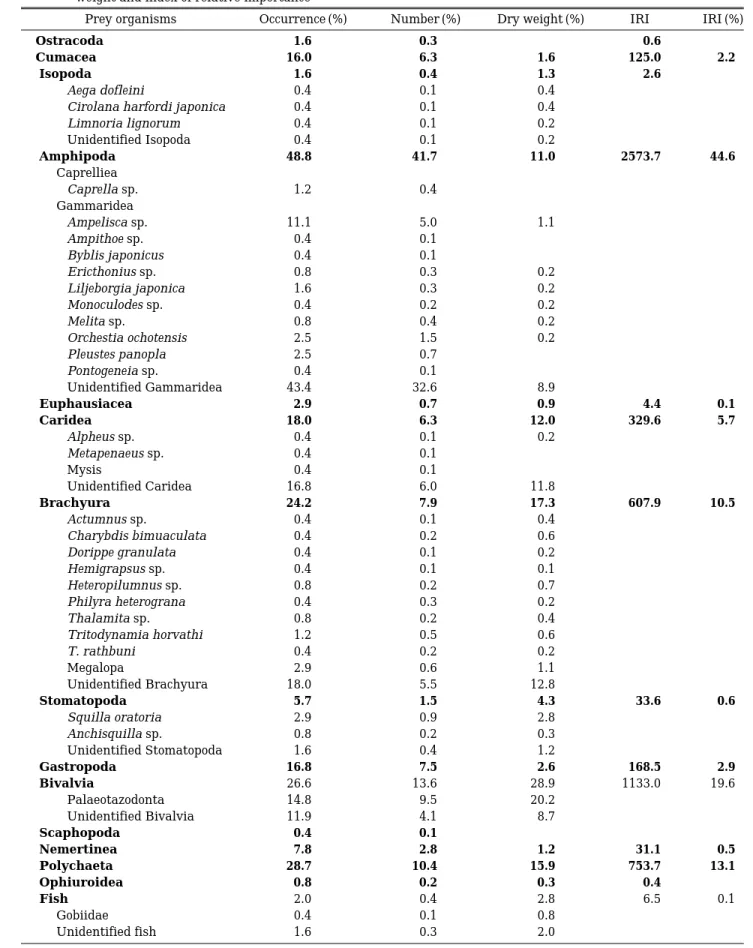
먹이를 섭이한 192개체의 위내용물 분석 결과는 Table 1과 같다. 개서대의 주 먹이생물은 상대중요성지수 비가 10% 이상을 보인 단각류(Amphipoda), 이매패류 (Bivalvia), 갯지렁이류(Polychaeta), 게류(Brachyura)였 다. 이 중에서 가장 중요한 먹이생물은 단각류로 나타났 다. 단각류는 48.8%의 출현빈도를 보였으며, 총 먹이생 물 개체수의 41.7%를 차지하였다. 그리고 전체 건조중 량의11.0%를 차지하였으며, 상대중요성지수비는 44.6%
였다.
단각류 다음으로 중요한 먹이생물은 이매패류, 갯지렁 이류, 게류 순으로 나타났다. 이매패류는 26.6%의 출현빈 도, 13.6%의 개체수비, 28.9%의 건조중량비를 보였으며, 상대중요성지수비는 19.6%였다. 갯지렁이류는 28.7%의 출현빈도, 10.4%의 개체수비, 15.9%의 건조중량비를 보 였으며, 상대중요성지수비는 13.1%였다. 게류는24.2%의 출현빈도, 7.9%의 개체수비, 17.3%의 건조중량비를 보였 으며, 상대중요성지수비는10.5%였다.
새우류(Caridea), 복족류(Gastropoda), 쿠마류(Cuma- cea)는 상대중요성지수비가 2% 이상의 값을 보여 주 먹 이생물군 다음으로 중요한 먹이생물군으로 나타났다. 그 외에 갯가재류(Stomatopoda),유형동물(Nemertinea), 어 류(Pisces), 난바다곤쟁이류(Euphausiacea), 등각류(Iso- poda), 패충류(Ostracoda), 거미불가사리류(Ophiuroi- dea) 등이 위내용물 중에서 발견되었는데, 그 양은 많지 않았다.
따라서 개서대는 단각류, 이매패류, 갯지렁이류, 게류, 새우류, 복족류를 주 먹이생물로 하는 저서섭식 육식성 Fig. 1. Location of the sampling area.
35�N Yosu
130�E East Sea
Japan Korea
Yellow Sea
Table 1. Percent composition of the stomach contents of Cynoglossus robustus by frequency of occurrence, number, dry weight and index of relative importance
Prey organisms Occurrence (%) Number (%) Dry weight (%) IRI IRI (%)
Ostracoda 1.6 0.3 ± 0.6 ±
Cumacea 16.0 6.3 1.6 125.0 2.2
Isopoda 1.6 0.4 1.3 2.6 ±
Aega dofleini 0.4 0.1 0.4
Cirolana harfordi japonica 0.4 0.1 0.4
Limnoria lignorum 0.4 0.1 0.2
Unidentified Isopoda 0.4 0.1 0.2
Amphipoda 48.8 41.7 11.0 2573.7 44.6
Caprelliea
Caprella sp. 1.2 0.4 ±
Gammaridea
Ampelisca sp. 11.1 5.0 1.1
Ampithoe sp. 0.4 0.1 ±
Byblis japonicus 0.4 0.1 ±
Ericthonius sp. 0.8 0.3 0.2
Liljeborgia japonica 1.6 0.3 0.2
Monoculodes sp. 0.4 0.2 0.2
Melita sp. 0.8 0.4 0.2
Orchestia ochotensis 2.5 1.5 0.2
Pleustes panopla 2.5 0.7 ±
Pontogeneia sp. 0.4 0.1 ±
Unidentified Gammaridea 43.4 32.6 8.9
Euphausiacea 2.9 0.7 0.9 4.4 0.1
Caridea 18.0 6.3 12.0 329.6 5.7
Alpheus sp. 0.4 0.1 0.2
Metapenaeus sp. 0.4 0.1 ±
Mysis 0.4 0.1 ±
Unidentified Caridea 16.8 6.0 11.8
Brachyura 24.2 7.9 17.3 607.9 10.5
Actumnus sp. 0.4 0.1 0.4
Charybdis bimuaculata 0.4 0.2 0.6
Dorippe granulata 0.4 0.1 0.2
Hemigrapsus sp. 0.4 0.1 0.1
Heteropilumnus sp. 0.8 0.2 0.7
Philyra heterograna 0.4 0.3 0.2
Thalamita sp. 0.8 0.2 0.4
Tritodynamia horvathi 1.2 0.5 0.6
T. rathbuni 0.4 0.2 0.2
Megalopa 2.9 0.6 1.1
Unidentified Brachyura 18.0 5.5 12.8
Stomatopoda 5.7 1.5 4.3 33.6 0.6
Squilla oratoria 2.9 0.9 2.8
Anchisquilla sp. 0.8 0.2 0.3
Unidentified Stomatopoda 1.6 0.4 1.2
Gastropoda 16.8 7.5 2.6 168.5 2.9
Bivalvia 26.6 13.6 28.9 1133.0 19.6
Palaeotazodonta 14.8 9.5 20.2
Unidentified Bivalvia 11.9 4.1 8.7
Scaphopoda 0.4 0.1 ± ± ±
Nemertinea 7.8 2.8 1.2 31.1 0.5
Polychaeta 28.7 10.4 15.9 753.7 13.1
Ophiuroidea 0.8 0.2 0.3 0.4 ±
Fish 2.0 0.4 2.8 6.5 0.1
Gobiidae 0.4 0.1 0.8
Unidentified fish 1.6 0.3 2.0
± : less than 0.1%
어종(bottom feeding carnivore)이다.
참서대과 어종들은 선호하는 먹이생물에 따라 크게4가 지로 나누어지는데,Cynoglossus semifasciatus, C. arel, C.
lida는 갯지렁이류를 가장 선호하였으며(Seshappa and Bhimachar, 1955; Rajaguru, 1992), C. abbreviatus는 거 미불가사리류(Baeck, 2003)를, C. joyneri는 갑각류와 이 매패류를,그리고 C. itinus, C. interruptus, C. nigropin- natus, C. trigrammus, C. macrolepidotus, C. rubustus,
C. lingua등 많은 참서대과 어류가 갑각류를 주 먹이생
물로 하였다(Kuthalingam, 1957; Ochiai, 1966; Ra- manathan et al., 1980; Yamada et al., 1986; Baeck et al., 2002, Baeck, 2003). 서식환경과 생활방식이 유사한 가자 미과 어류 역시 갑각류를 선호하는 어종이 많은 것으로 알려져 있다(Yamada et al., 1986; Huh and Baeck, 2003).
여수 주변 해역에서 채집된 참서대과 어류에 속하는 참 서대는 가장 선호하는 먹이생물이 단각류와 이매패류의 치패로 개서대의 주 먹이생물과 매우 유사하였다(Baeck et al., 2002). 이와같이 참서대와 개서대의 주 먹이생물 이 유사한 것은 서식 해역이 같아서 노출된 환경먹이생 물의 종조성이 동일하기 때문이며, 또한 이들은 동일 속 에 포함되는 어종들로 턱의 구조, 입의 형태와 크기가 유사하기 때문이다.
이상에서 나타난 바와 같이 동일 해역에 서식하는 참 서대와 개서대는 선호하는 먹이생물이 유사하기 때문에 그들 사이에 먹이경쟁에서 살아남기 위한 생존전략을 가졌을 것이라 판단된다.
2. 성장에 따른 먹이 조성의 변화
본 연구에서 채집된 개서대를 전장 기준 5 cm 간격으 로 크기군을 나누어 먹이생물의 조성 변화를 조사하였 다(Fig. 3).
가장 작은 크기군인 전장 10~15 cm에서는 단각류가 전체 위내용물 건조중량의86.1%를 차지하여 가장 중요 한 먹이생물이었으며, 갯지렁이류는 건조중량비의 8.3%
를 차지하였다. 전장15~20 cm 크기의 개서대가 연구기 간 중 채집되지 않아 이 크기군의 먹이조성을 조사할 수 없었다.
전장 20~25 cm 크기군에서는 10~15 cm 크기군에서 높은 건조중량비를 보였던 단각류가16.2%로 크게 감소 한 반면 이매패류의 점유율은 34.1%를 차지하여 가장 중요한 먹이생물이 되었다. 그리고 갯지렁이류는 17.1%
로 점유율이 증가하였으며, 게류는 15.4%, 새우류는 1.8%를 차지하였다.
전장 25~30 cm 크기군에서는 이매패류의 점유율이
32.1%를 나타내어 여전히 가장 중요한 먹이생물이었다.
다음으로 게류와 갯지렁이류는 전체 위내용물 건조중량 의 14.3%와 13.5%를 차지하였다. 한편 단각류는 계속 감소하여 12.9%의 점유율을 보였으며, 새우류의 점유율 은7.7%로 증가하였다.
전장 30~35 cm 크기군에서는 단각류의 점유율이
Fig. 3. Ontogenetic changes in diet of Cynoglossus robu- stus by % dry weight.
Fig. 2. Size distribution of Cynoglossus robustus collected in the coastal waters off Yosu, Korea in 2001.
20 30 40
Fish size (cmTL)
N = 244
Percentage frequency(%)
20
15
10
5
0
Others Polychaeta Brachyura Caridea Bivalvia Amphipoda
10~15 20~25 25~30 30~35 35~43 Fish size (cmTL)
Percentage of stomach content
100%
50%
0%
7.2%를 차지하였고, 새우류는 증가하여 17.2%를 차지하 였다. 반면 이매패류는 점유율이 24.2%로 감소하였다.
가장 큰 전장 35~43 cm의 크기군에서는 단각류의 점 유율이 1.1%까지 감소하였으며, 이매패류 또한 6.1%로 크게 감소하였다. 반면 전장 20~25 cm의 크기군에서부 터 점진적으로 증가하던 새우류의 점유율은 36.8%로 크 게 증가하여 가장 중요한 먹이생물로 나타났다. 갯지렁이 류와 게류 또한 각각 28.9%와 25.6%로 높은 점유율을 보였다.
이상의 결과를 근거로 개서대의 성장에 따른 먹이생 물 변화를 유추해 보면, 전장 10 cm 이하의 작은 크기의 개서대가 금번 조사에서 채집되지 않아 초기 성장기에서 의 먹이생물을 정확히 알 수 없었지만, 참서대과에 속하는 어종의 자치어기에는 주 먹이생물이 요각류인 것으로 알 려져 있다(Suzuki and Kuwahara, 1983; Kuwahara and Munekiyo, 1985; Choi et al., 1995). 전장 10 cm 이하의 개서대가 채집되지 않아 먹이 전환이 일어난 크기를 알 수 없으나, 부유생활을 마치고 저서생활을 시작할 무렵 에 요각류에서 단각류로의 1차 먹이전환이 일어난 것으 로 추정된다.
전장10 cm에서 15 cm까지는 단각류를 주 먹이생물로 선호하다가 전장 20 cm 이상부터는 이매패류로의 2차 먹이전환이 일어나고, 35 cm 이상의 크기에서는 새우류 와 게류로의3차 먹이전환이 나타났다.
본 조사 결과와 마찬가지로 대부분의 어종들은 성장을 하면서 먹이생물을 전환한다(Gaughan and Potter, 1997;
Huh and Baeck, 2000; Kovacic, 2001). 개서대와 같은 속 에 속하는 참서대는 치어기 이후에 단각류에서 이매패류 로 먹이를 전환하였지만(Baeck et al., 2002), 개서대는 단 각류에서 이매패류로 먹이 전환을 하였다가 그 후에 다 시 이매패류에서 새우류와 게류로 먹이전환을 한번 더 하 였다.
참서대과 어종들은 성장하면서 먹이전환을 하는데, 먹 이생물에 따라 크게 5개의 그룹으로 나누어진다. 첫 번 째가 어린시기에 요각류를 선호하다가 성어기에는 갯지 렁이류로 먹이전환하는 Cynoglossus semifasciatus, C.
arel, C. lida등의 그룹(Seshappa and Bhimachar, 1955;
Rajaguru, 1992), 두 번째가 요각류 →거미불가사리류로 먹이전환하는 C. abbreviatus등의 그룹(Baeck, 2003), 세 번째로 요각류 →단각류와 이매패류로 먹이전환을 하 는 C. joyneri등의 그룹(Baeck et al., 2002), 네 번째로 요각류 →새우류와 게류로 먹이전환하는 대부분의 참서대 과 어류 그룹(Kuthalingam, 1957; Ochiai, 1966; Ramana- than et al., 1980; Yamada et al., 1986; Baeck et al., 2002, Baeck, 2003), 다섯번째로 요각류 →단각류와 이매패류 →
새우류와 게류로 전환하는 개서대 등의 그룹이다. 개서대는 성장에 따라 먹이생물의 크기가 변화하였다 (Fig. 4). 가장 작은 크기군인 전장10~20 cm의 경우 먹 이생물의 평균크기는 0.4 cm였으며 개서대의 평균 입 크기는 0.7 cm였다. 이시기에는 단각류와 소형 갯지렁이 류를 주로 섭이하였다. 개서대의 크기가 증가함에 따라 입 크기와 먹이생물의 크기는 점진적으로 증가하였는데, 전장 20~25 cm 크기군에서는 0.6 cm의 먹이생물 평균 크기를 나타내었으며, 평균 입 크기는 0.9 cm였다. 이 시 기부터 다양한 크기의 먹이생물을 섭이하기 시작하였으며 소형 먹이생물에 속하는 단각류의 점유율이 급격히 낮아 지고 크기가 비교적 큰 이매패류, 갯지렁이류, 게류를 주 로 섭이하였다. 전장 35~43 cm의 크기군에서는 먹이생 물의 평균 크기가 2.1 cm였으며, 평균 입 크기는 1.7 cm 였다. 이 시기에는 큰 크기의 새우류, 갯지렁이류, 게류를 섭이하였으며, 반면에 소형 먹이생물인 단각류는 거의 섭 이하지 않았다.
이처럼 개서대가 성장하면서 먹이생물이 달라지는 것은 성장하면서 입 크기가 커지는 때문이다. 일반적으로 어류 의 입 크기와 먹이생물은 밀접한 관련이 있다. 작은 크기 의 입을 가진 베도라치(Pholis nebulosa), 실고기(Syn- gnathus schlegeli), 주둥치(Leiognathus nuchalis), 날개 망둑(Favonigobius gymnauchen), 줄망둑(Acentrogobius pflaumii) 용가자미(Hippoglossoides pinetorum) 등의 어 종들은 성장하면 단각류, 새우류, 게류 등의 갑각류와 갯 지렁이류를 선호하며(Huh and Kwak, 1997a,b,c; Huh and Kwak, 1998a, b; Huh and Baeck, 2003), 큰 크기의 Fig. 4. Ontogenetic changes in sizes of prey organisms and fish mouths in Cynoglossus robustus (solid tri- angle and circle denote mean sizes of fish mouth and prey organisms, respectively. Dotted and solid lines show the ranges in size of fish mouths and size of prey organisms, respectively).
Size of prey organisms(cm)
16 14 12 10 8 6 4 2 0
10~15 20~25 25~30 30~35 35~43 Fish size (cmTL)
Size of fish mouth(cm)
2.5
2
1
1.5
0.5
0
입을 가진 가시망둑(Pseudoblennius cottoides)과 황아 귀(Lophius litulon) 등의 어종들(Huh and Kwak, 1998c;
Baeck and Huh, 2003)은 먹이생물로 어류를 선호한다.
적 요
개서대의 식성을 조사하기 위해 여수 주변해역에서 저인망을 이용하여 2001년 1월부터 12월까지 매월 채 집된 개서대의 위내용물을 분석하였다. 개서대의 가장 중요한 먹이생물은 단각류(Amphipoda), 이매패류(Bival- via), 갯지렁이류(Polychaeta), 게류(Brachyura)였다. 그 리고 새우류(Macurura), 복족류(Gastropoda), 쿠마류
(Cumacea)가 주 먹이생물군 다음으로 중요한 먹이생물
군이었다. 그 외에 갯가재류(Stomatopoda), 유형동물 (Nemertinea), 어류(Pisces), 난바다곤쟁이류(Euphau- siacea), 등각류(Isopoda), 패충류(Ostracoda), 거미불가 사리류(Ophiuroidea) 등이 위내용물 중에서 발견되었는 데, 그 양은 많지 않았다.
개서대는 성장함에 따라 먹이생물의 전환이 명확히 나 타났는데, 전장 10~15 cm의 크기에서는 단각류를 주로 잡아 먹었으나 전장이 증가하면서 단각류가 위내용물 중 차지하는 비율은 점차 감소한 반면, 이매패류가 차지하는 비율은 점차 증가하여 전장 20~35 cm까지는 소형 이매 패류가 가장 중요한 먹이생물로 나타났다. 전장 35 cm 이 상의 크기에서는 새우류와 갯지렁이류 그리고 게류가 가장 중요한 먹이생물이었다.
인 용 문 헌
Aceves, M.G., E.A. Gonzalez and R.J. Saldierna. 1999.
Larval development of Symhpurus williamsi (Cynoglos- sidae: Pleuronectiformes) from the Gulf of California.
Fish. Bull., 97 : 738~745.
Baeck, G.W. 2003. Comparative fisheries ecology on three tonguefish species, genus Cynoglossus, from the Yosu coast, Korea and the Seto Inland Sea, Japan. Ph.D.
Thesis, Hiroshima Univ., 129 pp.
Baeck, G.W. and S.H. Huh. 2003. Feeding habits of juve- nile Lophius litulon in the coastal waters of Kori, Korea.
J. Kor. Fish. Soc., 36(6) : 695~699. (in Korean)
Baeck, G.W., S.H. Huh and H. Hashimoto. 2002. Feeding habits of tonguefish, Cynoglossus joyneri collected in the coastal waters off Yosu, Korea. Kor. J. Ichthyol., 14(3) : 234~239. (in Korean)
Cha, B.Y., B.Q. Hong, H.S. Jo and H.S. Sohn. 1999. Spe-
cies composition of shrimp collected by shrimp trawl in coastal waters of Sacheon. Bull. Nat’1. Fish. Res. Dev.
Inst. Korea, 56 : 45~53. (in Korean)
Cha, H.K., J.U. Lee, C.S. Park, C.I. Baik, S.Y. Hong, J.H.
Park, D.W. Lee, Y.M. Choi, K.S. Hwang, Z.G. Kim, K.H.
Choi, H.S. Sohn, M.H. Sohn, D.H. Kim and J.H. Choi.
2001. Shrimps of the Korean Waters. Hanguel Graphics Press, Pusan, 188 pp. (in Korean)
Cheng, Q. and B. Zheng. 1987. Systematic Synopsis of Chinese Fishes. Sci. Beijing, China, 509~513.
Choi, Y., I.S. Kim, B.S. Yu., U.Y. Jong and J.Y. Park. 1995.
Biology of Cynoglossus joyneri Günther in the west coastal water, Korea. Kor. J. Ichthyol., 7(1) : 56~63. (in Korean)
Chyung, M.K. 1977. The Fishes of Korea. Ilji-sa, Seoul, 727 pp. (in Korean)
Gaughan, D.J. and L.C. Potter. 1997. Analysis of diet and feeding strategies within an assemblage of estuarine larval fish and an objective assessment of dietary niche overlap. Fish. Bull., 95 : 722~731.
Huh, S.H. and G.W. Baeck. 2000. Feeding habits of blotc- hed eelpout, Zoarces gilli collected in the coastal waters off Gadeok-do, Korea. Kor. J. Ichthyol., 12(1) : 54~61.
(in Korean)
Huh, S.H. and S.N. Kwak. 1997a. Feeding habits of Pholis nebulosa. Kor. J. Ichthyol., 9(1) : 22~29. (in Korean) Huh, S.H. and S.N. Kwak. 1997b. Feeding habits of
Syngnathus schlegeli in the eelgrass, Zostera marina bed in Kwangyang Bay. J. Kor. Fish. Soc., 30(5) : 896~ 902. (in Korean)
Huh, S.H. and S.N. Kwak. 1997c. Feeding habits of Leiog- nathus nuchalis in the eelgrass, Zostera marina bed in Kwangyang Bay. Korean J. Ichthyol., 9(2) : 221~227. (in Korean)
Huh, S.H. and S.N. Kwak. 1998a. Feeding habits of Favo- nigobius gymnauchen in the eelgrass Zostera marina bed in Kwangyang Bay. J. Kor. Fish. Soc., 31(3) : 372~ 379. (in Korean)
Huh, S.H. and S.N. Kwak. 1998b. Feeding habits of Acen- trogobius pflaumii in the eelgrass Zostera marina bed in Kwangyang Bay. Kor. J. Ichthyol., 10(1) : 24~31. (in Korean)
Huh, S.H. and S.N. Kwak. 1998c. Feeding habits of Pseu- doblennius cottoides in the eelgrass Zostera marina bed in Kwangyang Bay. J. Kor. Fish. Soc., 31(1) : 37~44.
(in Korean)
Inaba, A. 1988. Fauna and Flora of the Seto Inland Sea, Second Edition II. Mukaishima Marine Biological Station. Hiroshima Univ. Press, Hiroshima. 475 pp. (in Japanese)
Jordan, D.S. and C.W Metz. 1913. A catalogue of the fishes known from the waters of Korea. Mem. Can. Mus., 9(1) : 1~65.
Kim, B.K. 1982. The variation coefficient of water tempera- ture and salinity in the southern sea of Korea. J. Korean Soc. Ocean., 17(2) : 74~82. (in Korean)
Kim, I.S. and Y. Choi. 1994. A taxonomic revision of the family Cynoglossidae (Pisces, Pleuronectiformes) from Korea. Bull. Kor. Fish. Soc., 27(6) : 803~812. (in Korean) Kovacic, M. 2001. The biology of Roule’s goby in the Kvar-
ner area, northern Adriatic Sea. J. Fish. Biol., 59 : 759~ 809.
Kuthalingam, M.D.K. 1957. Life history and feeding habits of Cynoglossus lingua (Ham. Buch.). J. Zool. Soc. India., 9(2) : 208~215.
Kuwahara, A. and M. Munekiyo. 1985. Food habits of ribbon fish in the western Wakasa Bay. Bull. Japanese Soc. Sci.
Fish., 51(6) : 913~919.
Kwon, N.Y. and S.J. Park. 1973. On the bottom sediments of the southern coasts of Korea. Bull. Nat’l. Fish. Res.
Dev. Inst. Korea, 10 : 39~52. (in Korean)
Lim, G.B. 1972. On the study of monthly variation of sur- face water temperature and its annual mean condition in the coast of Korea. Bull. Nat’l. Fish. Res. Dev. Inst.
Korea, 9 : 29~45. (in Korean)
Lim, G.B. 1981. Oceanographic conditions in the southern waters of Korea, and characteristics of fishing grounds of Pacific mackerel. Bull. Nat’l. Fish. Re. Dev. Inst.
Korea, 27 : 7~24. (in Korean)
Masuda, H., K. Amaoka, C. Araga, T. Uyeno and T. Yoshino.
1988. The Fishes of the Japanese Archipelago. Tokyo Univ. Press, Tokyo. 356 pp.
Mori, T. 1952. Checklist of the fishes of Korea. Mem Hyogo Univ. Agr., 1(3) : 1~228.
Namibe, T. and S. Kosuge. 1967. Common Shells of Japan in Color. Hoikusha Press, Osaka. 223 pp. (in Japanese) Nelson, J.S. 1994. Fishes of the World, 3rd., John Wiley
and Sons, New York, 442 pp.
Nishimura, S. 1995. Guide to Seashore Animals of Japan with Color Pictures and Keys. Hoikusha Press, Osaka.
663 pp. (in Japanese)
Ochiai, A. 1966. Study about Biology and Morphology of Cynoglossidae in Japan. Misaki Marine Biological Station, Tokyo Univ. Press, Tokyo. 97 pp. (in Japanese) Pinkas, L., M.S. Oliphant and I.L.K Iverson. 1971. Food
habits of albacore, bluefin tuna and bonito in California waters. Fish. Bull., 152 : 1~105.
Rajaguru, A. 1992. Biology of two co-occurring tongue- fishes, Cynoglossus arel and C. lida (Pleuronectiformes:
Cynoglossidae), from Indian waters. Fish. Bull., 90 : 328~367.
Ramanathan, N., P. Vijaya., V. Ramaiyan and R. Natarajan.
1980. On the biology of the large scaled tongue sole Cyno- glossus macrolepidotus (Bleeker). Indian J. Fish., 24 : 83~89.
Seshappa, G. and B.S. Bhimachar. 1955. Studies on the fishery and biology of the malabar sole, Cynoglossus semifasciatus. Indian J. Fish., 1 : 145~162.
Suzuki, S. and A. Kuwahara. 1983. Relationships between feeding habits of fish larvae and their food organisms in the western Wakasa Bay. Bull. Japanese Soc. Sci.
Fish., 49(10) : 1507~1513.
Takeda, M. 1982. Keys to Japanese and Foreign Crusta- ceans. Hokuryukan Press, Tokyo. 284 pp. (in Japanese) Terwilliger, M.R. and T.A. Munroe. 1999. Age, growth,
longevity, and mortality of blackcheek tonguefish, Sym- phurus plagiusa (Cynoglossidae: Pleuronectiformes), in Chesapeake Bay, Virginia. Fish. Bull., 97 : 340~361.
Yamada, U., M. Tagawa, S. Kishida and K. Honjo. 1986.
Fishes of the East China Sea and the Yellow Sea. Sei- kai Regional Fisheries Research Laboratory, Kochi. 501 pp. (in Japanese)
Yamaji, I. 1996. Illustrations of the Marine Plankton of Japan. Hoikusha Press, Osaka, 538 pp. (in Japanese)
Received : August 20, 2004 Accepted : December 1, 2004