A New Record of Myurella nebulosa (Terebridae: Gastropoda) from Korea
Daewui Jung1, Sang-Hwa Lee1, Yeongjae Choe1 and Joong-Ki Park2
1Program in Cell Biology and Genetics, College of Medicine, Chungbuk National University, Cheongju 361-763, Korea
2Division of EcoScience, Ewha Womans University, Seoul 120-750, Korea
ABSTRACT
We report a new record of Myurella nebulosa (Sowerby, 1825) collected by SCUBA diving from sandy bottom of subtidal zone in Jeju Island in Korea. The specimen of M. nebulosa is distinguished from its congeners by having slightly plump shell, high spire, distinctive subsutural band, deep axial ribs, numerous and shallow spiral ribs, ivory in color. In this report, we provided a brief morphological description and photographs of M. nebulosa. An unrooted phylogenetic tree for mitochondrial cox1 sequences using NJ analysis found Korean M. nebulosa sample was clustered with its conspecific sequences, but clearly separated from M. columellaris that is not easy to distinguishable based on external shell morphology alone.
Keywords: Terebridae, Myurella nebulosa, mtDNA cox1, Korea
INTRODUCTION
The family Terebridae, commonly known as auger shells, is a group of predatory marine gastropods. This group is characterized by elongated and pointed shell with a relatively short anterior canal in the aperture.
They are found in the sandy bottom from the intertidal zone to deep sea of tropical and subtropical waters (Bratcher and Cernohorsky, 1987). Some terebrid species use teretoxin (neuropeptide) secreted from a specialized venom apparatus to suppress their prey (Puillandre and Holford, 2010; Castelin et al., 2012).
To date, 21 species from eight genera in the family Terebridae have been recorded in Korea (Yoo, 1976;
Choe, 1992; Choe et al., 1997; Lee and Min, 2002; Min et al., 2004; see Appendix 1). During the survey of
marine mollusks in Korea, a specimen of Myurella nebulosa (Sowerby, 1825) was collected from Jeju Island in Korea. In this paper, we provide a detailed description and photographs of the shell morphology and comparison of mitochondrial cytochrome oxidase subunit I (cox1) sequences with some other congeneric species.
MATERIALS AND METHODS
The specimen was collected from Jeju Island in Korea by SCUBA diving on April in 2008 and preserved in 95% ethanol, and morphologically observed under a stereoscopic microscope (Leica M205C, Wetzlar, Germany). The sample of animal was identified by the authors, and followed the taxonomic classification of Bouchet and Rocroi (2005). The external features of the shell were photographed with a Nikon D200 DSLR camera (Nikon, Tokyo, Japan).
The specimen examined in this study was deposited in the National Institute of Biological Resources (NIBR), Incheon, Korea (KOSPIV0000218894).
For molecular study, genomic DNA was extracted from mantle tissue using the DNeasy Blood & Tissue Kit (Qiagen, Valencia, USA) according to the manufacturer’s instructions. The mitochondrial cox1 Received: June 7, 2015; Revised: June 22, 2015;
Accepted: June 29, 2015
Corresponding author : Joong-Ki Park
Tel: +82 (2) 3277-5948 e-mail: [email protected] 1225-3480/24579
This is an Open Access article distributed under the terms of the Creative Commons Attribution Non-Commercial License with permits unrestricted non-commercial use, distribution, and reproducibility in any medium, provided the original work is properly cited.
[단보, Short communication]
gene fragment was PCR-amplified using LCO1490 and HCO2198 primer set (Folmer et al., 1994). PCR amplifications were conducted using TaKaRa Ex Taq™
(Takara Bio, Shiga, Japan) in 50 μl containing 31.75 μl of distilled water, 5 μl 10X Ex Taq™ buffer, 4 μl each 10 pM primer set, 0.25 μl of TaKaRa Ex Taq™, and 5 μl template DNA with the following conditions:
1 cycle of initial denaturation at 94 ℃ for 30s, followed by 35 cycles of denaturation at 98 ℃ for 10s, annealing at 47 ℃ for 30s, elongation at 72 ℃ for 1 min, and a final extension at 72 ℃ for 10 min. The amplified PCR product was purified using Expin™ Gel SV Kit (GeneAll Biotechnology, Seoul, Korea), and sequencing reaction was conducted using ABI PRISM 3700 DNA Analyzer (Applied Biosystems, Foster City, USA). The cox1 sequence obtained from the specimen was deposited in GenBank (Accession number:
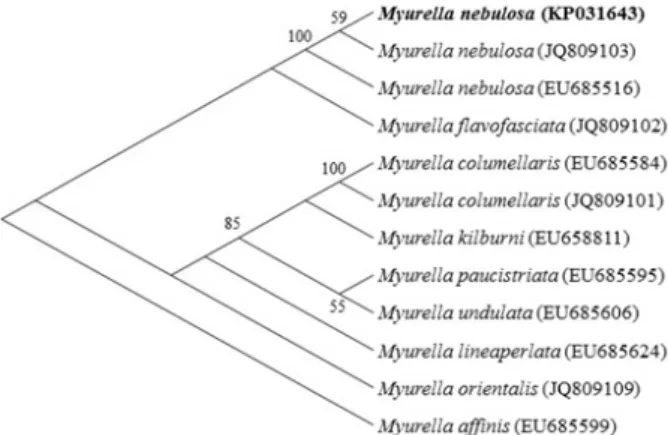
KP031643), and aligned with 9 species of genus Myurella using CLUSTAL W program (Thompson et al., 1994). Genetic distances among Myurella species were calculated using Kimura’s 2 parameter model (Kimura, 1980) and an unrooted phylogenetic tree was produced using neighbor joining (NJ) method (Saitou and Nei, 1987) with MEGA 6.06 software (Tamura et al., 2013).
RESULTS
Systematic accounts
Phylum Mollusca Linnaeus, 1758 연체동물문 Class Gastropoda Cuvier, 1795 복족강 Order Neogastropoda Wenz, 1938 신복족목 Family Terebridae Mörch, 1852 송곳고둥과
1*Genus Myurella Hinds, 1844 흰띠송곳고둥속 (신칭)
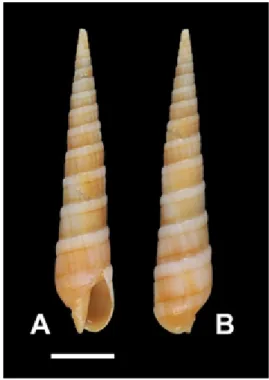
2*Myurella nebulosa (Sowerby, 1825) (Fig. 1)
2*굵은흰띠나선송곳고둥 (신칭)
Terebra nebulosa Sowerby, 1825: 76, xxv; Hirase, 1917:
4, Pl. 2, fig. 10, Pl. 4, fig. 55; Hinton, 1972: 48, Pl. 24, fig. 16; Bratcher and Cernohorsky, 1987: 83, Pl. 19, fig.
68, color pl. D, fig. 18; Wilson, 1994: 227, Pl. 51, fig.
10a, b.
Decorihastula nebulosa: Okutani, 2000: 676-677, Pl.
337, fig. 51.
Terebra (Decorihastula) nebulosa: Cernohorsky and
Jennings, 1966: 47, Pl. 5, fig. 27.
Myurella nebulosa: Poppe, 2008: 810, Pl. 700, fig. 9-11;
Kantor et al., 2012: 665, fig. 1, table 1, 3.
Material examined. Korea: 1 individual, Jeju Island, Seogwipo-si, Bomok-dong, Supseom, 24 April 2008.
Measurement. Shell height 49 mm; shell width 9 mm.
Description. Shell elongate with slightly plump, white and ivory with a little gloss in color. Whorls 15 in number with deep sutures. Apex worn-off. Spire very high, approximately 3/4 of shell height. Subsutural band creamy white in color, defined by subsutural groove, beginning on 4th whorl, with deep quadrated sculptures by axial ribs. Axial ribs distinct on spire, becomes unclear on body whorl. Spiral ribs narrow, numerous, faint to upward. Outline of body whorl slightly convex. Aperture elongated ovate with short, almost straight, opened siphonal canal, pale brown in color.
Distribution. Korea, Japan, China, Vietnam, Philippines, Australia, Fiji Island, Polynesia, Hawaii, South Africa.
Habitat. From intertidal zone to sub-tidal zone. Sandy or mud bottom.
Fig. 1. Myurella nebulosa (Sowerby, 1825). A.
Ventral view; B. Dorsal view. Scale bar=10 mm.
Remarks. Identification of Myurella nebulosa is often confused with Myurella columellaris due to their similar external shell morphology. The shell of M.
nebulosa is slightly plumped and less glossed than M.
columellaris (Okutani, 2000), but these difference are not clear, and it is not easy to precisely differentiate these two species based on external shell morphology alone. In this study, we determined nucleotide sequence of mitochondrial cox1 gene fragment and compared it with some other congeneric species.
Sequence comparison revealed 17.0-18.0% divergence between M. nebulosa and M. columellaris. An unrooted phylogenetic tree from NJ analysis (Fig. 2) found Korean M. nebulosa sequence (KP031643) was clustered with sequences obtained from Mozambican (JQ809103) and Filipino samples (EU685516) of the same species with 100% bootstrap values, but clearly separated from M. columellaris (EU685584 and JQ809101).
ACKNOWLEDGEMENTS
This work was supported by the Ministry of Oceans and Fisheries (Marine Mollusk Resource Bank of Korea; MMRBK) and a grant from the National Institute of Biological Resources (NIBR), funded by the Ministry of Environment (MOE) of the Republic of
Korea (NIBR No. 2014-02-001).
REFERENCES
Bouchet, P. and Rocroi, J.R. (2005) Classification and nomenclator of gastropod families. Malacologia, 47:
1-397.
Bratcher, T. and Cernohorsky, W.O. (1987) Living terebras of the world: a monograph of the recent Terebridae of the world. pp. 1-240. American Malacologists Inc., Melbourne.
Castelin, M., Puillandre, N., Kantor, Y.I., Modica, M.V., Terryn, Y., Cruaud, C., Bouchet, P., and Holford, M.
(2012) Macroevolution of venom apparatus innovations in auger snails (Gastropoda; Conoidea;
Terebridae). Molecular Phylogenetics and Evolution, 64: 21-44.
Cernohorsky, W.O. and Jennings, A. (1966) The Terebridae of Fiji (Mollusca: Gastropoda). The Veliger, 9: 37-66.
Choe, B. (1992) Illustrated encyclopedia of fauna and flora of Korea. Vol. 33. Mollusca (Ⅱ), pp. 1-860, Ministry of Education, Seoul. [in Korean]
Choe, B.L., Je, J.G. and Lee, T.H. (1997) Classification and description of Conoidea (Gastropoda:
Neogastropoda) from Korean waters. Korean Journal of Systematic Zoology, 13: 103-140. [in Korean]
Folmer, O., Black, M., Hoeh, W., Lutz, R. and Vrijenhoek, R. (1994) DNA primers for amplification of mitochondrial cytochrome c oxidase subunit I from diverse metazoan invertebrates. Molecular Marine Biology and Biotechnology, 3: 294-229.
Hinton, A.G. (1972) Shells of New Guinea and the Central Indo-Pacific. pp. 1-92, Robert Brown and Associates Pty. Ltd., Port Moresby.
Hirase, Y. (1917) Terebridae of the Japanese empire, pp.
1-50. The Hirase Conchological Museum, Kyoto.
Kantor, Y.I., Fedosov, A.E. and Marin, I.V. (2012) An unusually high abundance and diversity of the Terebridae (Gastropoda: Conoidea) in Nha Trang Bay, Vietnam. Zoological Studies, 51: 663-670.
Kimura, M. (1980) A simple method for estimating evolutionary rates of base substitutions through comparative studies of nucleotide sequences. Journal of Molecular Evolution, 16: 111-120.
Lee, J.S. and Min, D.K. (2002) A catalogue of molluscan fauna in Korea. The Korean Journal of Malacology, 18: 93-217.
Min, D.K., Lee, J.S., Koh, D.B. and Je, J.G. (2004) Mollusks in Korea. pp. 1-566, Hanguel Graphics, Busan. [in Korean]
Okutani, T. (2000) Marine mollusks in Japan. pp.
1-1173, Tokai University Press, Tokyo. [in Japanese and English]
Poppe, G.T. (2008) Philippine marine mollusks. Vol. 2, Gastropoda Part 2. pp. 1-848, ConchBooks, Hackenheim.
Fig. 2. Unrooted phylogenetic tree for mtDNA cox1 sequences of some selected terebrid species. Bootstrap values of ≥ 50% are indicated on the branches and GenBank accession numbers are shown in parentheses after species names. The cox1 sequence from Korean sample is indicated in bold.
Puillander, N. and Holford, M. (2010) The Terebridae and teretoxins: Combining phylogeny and anatomy for concerted discovery of bioactive compounds. BMC Chemical Biology, 10: 7.
Saitou, N. and Nei, M. (1987) The neighbor-joining method: A new method for reconstructing phylogenetic trees. Molecular Biology and Evolution, 4: 406-425.
Sowerby, G.B. (1825) A catalogue of the shells contained in the collection of the late Earl of Tankerville:
arranged according to the Lamarckian conchological system: together with an appendix containing descriptions of many new species. pp. I-xxxiv, E.J.
Stirling, London.
Tamura, K., Stecher, G., Peterson, D., Filipski, A. and
Kumar, S. (2013) MEGA6: molecular evolutionary genetics analysis version 6.0. Molecular Biology and Evolution, 30: 2725-2729.
Thompson, J.D., Higgins, D.G. and Gibson, T.J. (1994) CLUSTAL W: improving the sensitivity of progressive multiple sequence alignment through sequence weighting, position-specific gap penalties and weight matrix choice. Nucleic Acids Research, 22: 4673-4680.
Wilson, B. (1994) Australian marine shells. Vol. 2, prosobranch gastropods, part two (neogastropods), pp.
1-370, Odyssey Publishing, Kallaroo.
Yoo, J.S. (1976) Korean shells in color, pp. 1-196, Iljisa, Seoul. [in Korean]
Appendix 1. Species list of the family Terebridae in Korea.
Family Terebridae Mörch, 1852 송곳고둥과
Genus Cinguloterebra Oyama, 1961 고리송곳고둥속 (신칭) Cinguloterebra anilis (Röding, 1798) 노랑고리송곳고둥 Cinguloterebra lima (Deshayes, 1857) 미남송곳고둥 Genus Duplicaria Dall, 1908 빈송곳고둥속
Duplicaria albozonata (Smith, 1875) 흰띠송곳고둥 Duplicaria dussumierii (Kiener, 1860) 빈송곳고둥 Duplicaria evoluta (Deshayes, 1859) 속재송곳고둥 Duplicaria hiradoensis (Pilsbry, 1921) 나사송곳고둥 Duplicaria koreana (Yoo, 1976) 고운무늬송곳고둥
Duplicaria latisulcata (Yokoyama, 1922) 곧은줄흰줄송곳고둥 Duplicaria recticostata (Yokoyama, 1920) 곧은줄송곳고둥 Genus Euterebra Cotton & Godfrey, 1932 띠죽순송곳고둥속 (신칭)
Euterebra taylori (Reeve, 1860) 검은보라송곳고둥 Genus Granuliterebra Oyama, 1961 구슬송곳고둥속 (신칭)
Granuliterebra bathyrhaphe (Smith, 1875) 구슬송곳고둥 Genus Hastula Adams & Adams, 1853 죽순송곳고둥속
Hastula celidonota (Melvill & Sykes, 1898) 꼬마송곳고둥 Hastula hectica (Linnaeus, 1758) 민첩송곳고둥
Hastula matheroniana (Deshayes, 1859) 흰띠적갈색점죽순고둥 Hastula rufopunctata (Smith, 1877) 죽순고둥
Hastula strigilata (Linnaeus, 1758) 점줄송곳고둥 Hastulopsis melanacme (Smith, 1873) 가는송곳고둥 Genus Myurella Hinds, 1844 흰띠송곳고둥속 (신칭)
Myurella nebulosa (Sowerby, 1825) 굵은흰띠나선송곳고둥(신칭) Genus Strioterebrum Sacco, 1891 갈색띠송곳고둥속 (신칭)
Strioterebrum japonicum (Smith, 1873) 갈색띠송곳고둥 Genus Terebra Bruguière, 1789 송곳고둥속
Terebra amanda Hinds, 1844 대마디송곳고둥 Terebra spectabilis Hinds, 1844 송곳고둥
Genus Triplostephanus Dall, 1908 줄칼송곳고둥속 (신칭) Triplostephanus fenestratus (Hinds, 1844) 줄칼송곳고둥