https://doi.org/10.7840/kics.2017.42.1.1
영오차 확률 기반 알고리즘의 입력 정력 정규화
김 종 일°, 김 남 용*
Input Power Normalization of Zero-Error Probability based Algorithms
Chong-il Kim°, Namyong Kim*
요 약
충격성 잡음 환경에서 최대 영확률 (MZEP) 알고리듬은 최소자승오차 (MSE) 기반의 알고리듬 보다 우수한 성 능을 지닌다. 그리고 알고리듬 자체에 내재한 크기 조절 입력 (MCI)가 MZEP 알고리듬을 충격성 잡음으로부터 알고리듬을 안정되게 유지하는 역할을 하는 것으로 알려져 있다. 이 논문에서는 MCI 입력의 평균전력으로 MZEP 알고리듬의 스텝 사이즈를 정규화하는 방식을 제안하였다. 충격파 발생률이 0.03인 충격성 잡음하의 시뮬레이션에 서 정상상태 MSE 성능 비교에서 기존 MZEP에 비해 제안한 방식이 약 2dB 정도 향상된 특성을 보인다.
Key Words : Normalization, Step size, Zero-error probability, Impulsive noise, Magnitude controlled
ABSTRACT
The maximum zero error probability (MZEP) algorithm outperforms MSE (mean squared error)-based algorithms in impulsive noise environment. The magnitude controlled input (MCI) which is inherent in that algorithm is known to plays the role in keeping the algorithm undisturbed from impulsive noise. In this paper, a new approach to normalize the step size of the MZEP with average power of the MCI is proposed. In the simulation under impulsive noise with the impulse incident rate of 0.03, the performance enhancement in steady state MSE of the proposed algorithm, compared to the MZEP, is shown to be by about 2 dB.
° First and Corresponding Author : Catholic Kwandong University, [email protected], 정회원
* Kangwon National Univ., [email protected], 종신회원
논문번호:KICS2016-06-124, Received June 12, 2016; Revised September 25, 2016; Accepted September 25, 2016
Ⅰ. Introduction
In supervised signal processing such as in most equalization applications, the least mean square (LMS) algorithm is widely used for its simplicity and effectiveness[1]. One of the problems of the LMS algorithm is the step size parameter fixed at every iteration time. The fixed step size requires information of the statistics of the input signal such as signal input power and amplitude that affect its performance[2]. As an extension of the LMS
algorithm, the normalized least mean square algorithm (NLMS) where its step size is proportional to the inverse of the dot product of the input vector with itself has been proven to have more enhanced performance[3,4].
As an information theory based criterion, unlike the MSE criterion, the zero-error probability (ZEP) and its related algorithms outperform MSE-based algorithms and yield superior and stable convergence in impulsive noise environment[5]. The nonlinear version of MZEP has been proposed for underwater
communication channels and known to compensate successfully for ISI without error propagation[6]. Also for practical implementation a recursive gradient estimation method has been proposed for the MZEP algorithm to reduce its computational complexity significantly[7]. In the recent study[8], it has been revealed that the ZEP criterion has equivalent optimum solution of MSE criterion and the magnitude controlled input (MCI) of MZEP algorithm plays the role of keeping the optimum solution undisturbed from impulsive noise.
Though the role of MCI in the MZEP algorithm under impulsive noise has been introduced, any application of the MCI to performance enhancement has not been carried out. In this paper, based on the NLMS approach, a normalized step size for the MZEP is investigated where the normalized step size is proportional to the inverse of the dot product of the MCI with itself. And then, through simulation under impulsive noise with different rates of impulse occurrence, it will be shown that the normalized step size employing the information of MCI can enhance the performance of MZEP significantly.
Ⅱ. MSE Criterion and LMS algorithm
In communication systems, a symbol point d at k symbol time k is transmitted through the wireless channel H(z)=
∑
hiz−i and noise nk is added to the channel output. Then the received signal xk is composed of the channel output and noise nk ask i k i
k hd n
x =
∑
− + (1)Assuming that the equalizer has the TDL (tapped delay line) structure with weights, Wk=[w0,k,w1,k,..,
T k
wL−1, ] and input buffer Xk=[xk,xk−1,...,xk−L+1]T, the equalizer output yk attime k becomes
k T k
yk=W X . Then the error e and the MSE k
criterion PMSE is defined in [3] as.
k T k k k k
k d y d
e = − = −W X (2)
] [ k2
MSE Ee
P = (3)
The expectation or mean operation E in(3) can [⋅] mitigate the influence of the Gaussian noise. But in case of impulsive noise, a single large impulse can dominate the mean operation so that the averaging operation may not be effective to defeat the impulsive noise.
As a practical algorithm developed based on the MSE criterion, the LMS (least mean square) is to use the instant error power e instead of k2 E[ek2][3]. With the instant gradient ∂ek2 ∂W and a step sizeμ, the LMS algorithm can be expressed as
W
W ∂
−
= ∂
∂
∂ek2 2ek (dk yk)
=−2ekXk=−2(dk−XkWkT)Xk
(4)
W W
W ∂
⋅∂
−
+ =
2
1 k
k k
μ e =Wk+2μ⋅e Xk k
(5)
By letting the gradient ∂e2k ∂W in (3) be zero, the optimum weight WLMSo can be obtained.
k T k
k o k
LMS
d X X
W = X (6)
Ⅲ. Normalized LMS algorithm
One of the problems of the LMS algorithm is the step size parameter μ fixed at every iteration time.
The fixed step size requires information of the statistics of the input signal such as signal input power and amplitude that affect its performance[2]. The step size μNLMS in the normalized least mean square algorithm (NLMS) as an extension of the LMS algorithm is defined in [3] as proportional to the inverse of the dot product of the input vector with itself.
2
1 1
k k T k
NLMS =X X = X
μ (7)
The denominator k k 2 T
kX X
X = is also equivalent to the sum of the expected energies of the input samples, ∑−
= −
1 0
2 L m
m
xk
. With an additional parameter μ∧ for freedom of adaptation, the NLMS algorithm can be expressed as
k k NLMS k
k W eX
W+1= +μ ⋅ (8)
∑
−= −
∧
∧ =
= 1
0 2 L 2
m m k k
NLMS
x μ μ μ
X (9)
The NLMS algorithm shows far greater stability with unknown signals and considered to be effective in real time adaptive systems[4].
Since the averaging operation is not effective to defeat the impulsive noise, the LMS and NLMS algorithms employing instant error power e without k2
averaging operation may cause surefire instability in impulsive noise environment.
Ⅳ. ZEP Criterion and Magnitude Controlled Input
The criterion of zero-error probability PZEPthat has been developed for impulsive noise environment is defined as in (10) by the kernel density estimation method[8,9].
∑
− +=
−
=
=
= k
N k i
i E
ZEP G e
e N f P
1
) 0 1 (
) 0
( σ (10)
The Gaussian kernel Gσ(e) is exp(2 ) 2
1
2 2
π σ σ
−e
with a kernel size and error samples }
,..., ,..., ,
{ek ek−1 ei ek−N+1 (sample size N ) as described in the work[5].
For maximization of ZEP (MZEP) that forces error samples to be concentrated on zero, the steepest descent method with the step-size μMZEP that
controls the system stability is employed. The resulting MZEP algorithm as in [5] is
∑
− +=
+ = + k ⋅
N k i
A i i MZEP
k
k e
N 1
1 2
1 X
W
W μ σ (11)
where the magnitude-controlled input (MCI), X is kA
defined in [8] as
k k A
k G e X
X = σ( )⋅ (12)
Since the Gaussian kernel Gσ(ek) is a function of an exponential decay with the error power e , large 2k
error power due largely to strong impulses involved within the input X is mitigated through k Gσ(ek). This indicates that the MCI, XAk through the magnitude control process Gσ(ek)⋅Xk in (12) can prevent system instability that might be induced by large input values contaminated with impulsive noise[8].
On the other hand, the gradient in (11),
∑
− +=
⋅
∂ =
∂ k
N k i
A i i
ZEP e
N P
2 1
1 X
W σ can be written as
∑
− +=
⋅
−
∂ =
∂ k
N k i
A i i T i k
ZEP d
N P
2 (1 )
1 X W X
W σ (13)
Letting the gradient (13) be zero, we obtain the optimum weight WMZEPo for MZEP algorithm as
∑
∑
+
−
= +
−
= =k
N k i
T i A i k
N k i
A i k o
MZEP
d
1 1
X X
X
W (14)
In the work[8], it has been proven that the statistical average of the optimum weights of MZEP and LMS are equal in the steady state that most error samples are assumed to be at around zero.
That is,
] [ MZEPo
E W =E W[ LMSo ] (15)
While MZEP based on ZEP criterion and LMS based on MSE have the same optimum solution, the
behavior of steady state weight under impulsive noise situations have been shown to be significantly different in the work[8]. The trace of the steady state weight for MZEP algorithm has stayed in the value of WZEPo thanks to MCI X , whereas that of LMS kA
algorithm being afflicted directly by large impulses has fluctuated wildly.
Ⅴ. Power Estimation of MCI for Normalized Step Size
Similar to the NLMS where the step size is normalized by the averaged power of the current input samples as presented in Section 3, we propose the data-dependent step size which is normalized by the average of the expected energies of the current MCI XMCIm,k for greater stability with unknown signals and robustness against impulsive noise as well.
∑
=∑
− ++
−
=
+ = + k ⋅
N k i
A i k i
N k i
A i MZEP k
k e
x N
N 1
2 1 1 2
1
1 X
W
W σ
μ
(16)
where i i
A
i G e x
x = σ( ) is from (12).
Noticing the fact that averaging operation may not be effective to defeat the impulsive noise as explained in Section 3, we may observe that the denominator of (16) may be sensitive to impulsive noise. To avoid this kind of situation, we propose to track the averaged energy E(k) recursively as
) 2
1 ( ) 1 ( )
(k E k xkA
E =β⋅ − + −β ⋅ (17)
The equations (17) can be expressed as a z-transformed system A(z) with its input xkA2
andoutput E(k).
β β
− −
= z
z z
A( ) (1 ) (18)
The time constant of the single-pole low-pass filter A(z) is controlled by the parameter β
) 1 0
( <β < . Then the normalized MZEP (NMZEP) algorithm with a constant μNMZEP becomes
∑
− +=
+ = + k ⋅
N k i
A i NMZEP i
k
k e
k
E 1
1 W ( ) X
W μ
(19)
Ⅵ. Results and Discussion
In this section, it will be investigated how the NMZEP equipped with MCI behave under different impulsive noise situations. The impulsive noise n k
in (1) is composed of the background Gaussian noise with its variance σGN2 and impulses. The amplitude distribution of impulses is a Gaussian with variance σIN2 and the impulses are generated according to a Poisson process with its incident rate ε[9].
2 ] 2 exp[
) 1
( 2
2 GN k GN
k N
n n
f σ π σ
ε −
= −
)] (
exp[2 ) (
2 2 2
2 2
2 GN IN
k IN
GN
n σ σ σ
σ π
ε
+
− + +
(20)
We take the same simulation environment as in [8] except that impulse noise models have different incident rates, ε=0.01 depicted as a sample in Fig.
1 and ε=0.03 in Fig. 4, respectively. The random symbol point d k from the set
{d1=−3,d2=−1,d3=1,d4=3} is transmitted
through the multipath channel
2 1 0.304 903
. 0 304 . 0 )
(z = + z− + z−
H [10]. The TDL
equalizer has 11 weights (L=11). The sample size N, the kernel size σ for the MZEP and NMZEP is 20 and 0.7, respectively. The step-size μMZEP,
NMZEP
μ and μLMS are 0.004, 0.008 and 0.0002, respectively. The forgetting factor β and the initial
2 0A
x for NMZEP are set to be 0.9 and 1.0, respectively.
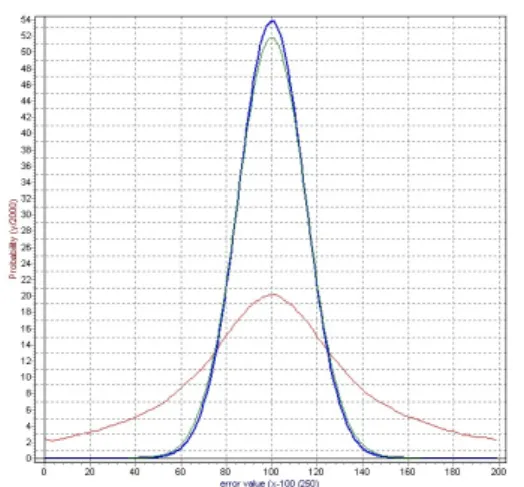
We observe in Fig. 2 that due to the large impulse noise spikes shown in Fig. 1, the LMS fails to converge below -20 dB even for the small step-size. On the other hand, the MZEP type
Fig. 3. Error distribution for the impulsive noise with ε
=0.01 (red: LMS, green: MZEP, blue: NMZEP).
Fig. 4. Impulsive noise with ε= 0.03.
Fig. 5. MSE learning curves for the impulsive noise with ε=0.03 (red: LMS, green: MZEP, blue: NMZEP).
Fig. 1. Impulsive noise sample with ε=0.01.
Fig. 2. MSE learning curves for the impulsive noise with ε=0.01 (red: LMS, green: MZEP, blue: NMZEP).
algorithms converge well. Compared to the MZEP, the curve of the proposed NMZEP algorithm reaches lower steady state MSE than the MZEP showing about 1 dB enhancement. In the Fig. 3, this performance difference can be noticed in the aspect of error probability density.
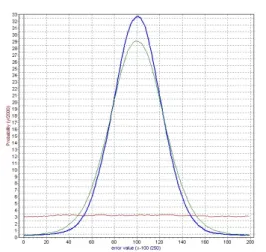
On the other hand, in the situation of the impulsive noise with ε=0.03 as in Fig. 4, the performance difference between NMZEP and MZEP is clearer as in Fig. 5 and 6. The difference of steady state MSE for the MZEP and NMZEP algorithms is about 2 dB. In the comparison of error probability density, the performance difference can be observed more clearly.
From the results of MSE learning curves and
error distribution, we find that the normalized step size with the information of MCI Xm,MCIk can serve
Fig. 6. Error distribution for the impulsive noise with ε
=0.03 (red: LMS, green: MZEP, blue: NMZEP).
MZEP based algorithms to produce performance enhancement significantly. And the MCI contributes more to performance enhancement in the NMZEP algorithm as the impulsive noise is severer.
Ⅶ. Conclusion
The MZEP algorithm outperforms MSE-based algorithms in impulsive noise environment and the magnitude controlled input, MCI inherent in that algorithm, plays the role in keeping the algorithm undisturbed from impulsive noise. In this paper, a normalization approach to the step size of the MZEP based on the MCI has been proposed. From the simulation results, it can be concluded that the normalized step size employing the information of MCI can enhance the performance of MZEP significantly.
References
[1] Y. Cho, H. Yu, B. Kim, J. Cho, J. Kim, J.
Lee, and H. Park, “Proposal of optimum equalizer hardware architecture for cable modem and analysis of various LMS algorithms,” J. KICS, vol. 27, pp. 150-159, Feb. 2002.
[2] L. Bharani and P. Radhika, “FPGA implementation of optimal step size NLMS algorithm and its performance analysis,”
IJRET, vol. 2, pp. 885-890, Jul. 2013.
[3] S. Haykin, Adaptive filter theory, 4th Ed., PrenticeHall, Upper Saddle River, 2001.
[4] R. Chinaboina, D. Ramkiran, H. Khan, M.
Usha, B. Madhav, K. Srinivas, and G. Ganesh,
“Adaptive algorithms for acoustic echo cancellation in speech processing,” IJRRAS, vol. 7, pp. 38-42, Apr. 2011.
[5] N. Kim, K. Jung, and L. Yang, “Maximization of zero-error probability for adaptive channel equalization,” J. Commun. Networks(JCN), vol. 12, pp. 459-465, Oct. 2010.
[6] N. Kim, “Decision feedback equalizer based on maximization of zero-error probability,” J.
KICS, vol. 36, pp. 516-521, Aug. 2011.
[7] N. Kim, “Efficient adaptive algorithms based on zero-error probability maximization,” J.
KICS, vol. 39A, pp. 237-243, May 2014.
[8] N. Kim and G. Lee, “Optimum conditions of adaptive equalizers based on zero-error probability,” J. KICS, vol. 40, pp. 1865-1870, Oct. 2015.
[9] I. Santamaria, P. Pokharel, and J. Principe,
“Generalized correlation function: definition, properties, and application to blind equalization,” IEEE Trans. Sign. Process., vol.
54, pp. 2187-2197, Jun. 2006.
[10] J. Proakis, Digital Communications, 2nd Ed., McGraw-Hill, 1989.
김 종 일 (Chong-il Kim)
1987년 : 서강대학교 전자공학과 공학사
1989년 : 연세대학교 전자공학과 공학석사
1993년 : 연세대학교 전자공학과 공학박사
1993년~현재 : 가톨릭관동대학 교 전자공학과 교수.
관심분야 : 이동통신, STC, TCM, OFDM, CDMA, 주파수 합성기 등
김 남 용 (Namyong Kim)
1986년 2월:연세대학교 전자 공학과 졸업
1988년 2월:연세대학교 전자 공학과 석사
1991년 8월 : 연세대학교 전자 공학과 박사
1992년 8월~1998년 2월:관동 대학교 전자통신공학과 부교수
1998년 3월~현재 : 강원대학교 공학대학 전자정보통 신공학부 교수
<관심분야> Adaptive equalization.