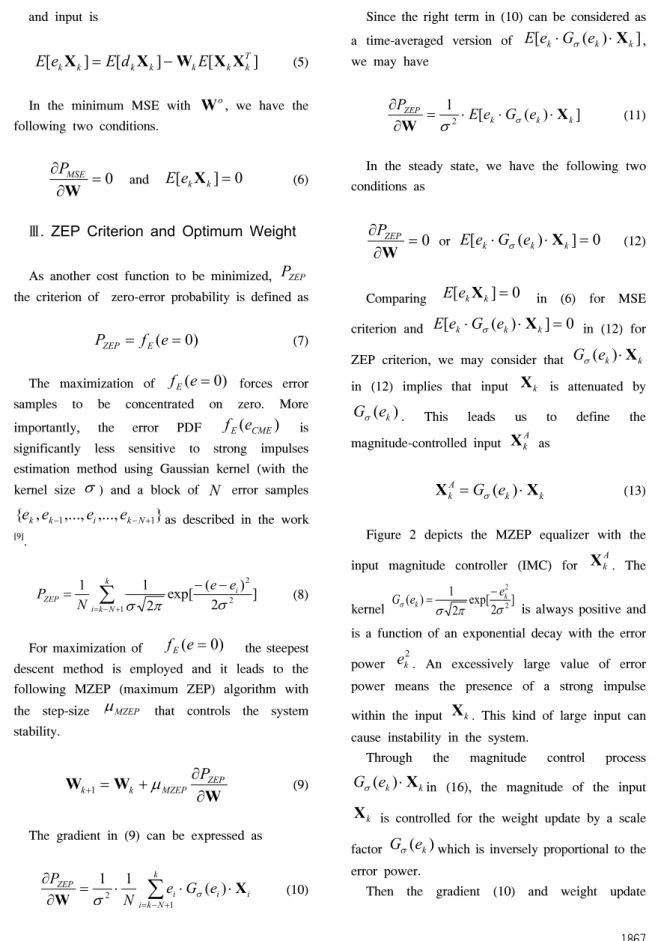
http://dx.doi.org/10.7840/kics.2015.40.10.1865
영확률에 기반한 적응 이퀄라이져의 최적조건
김 남 용°, 이 규 영*
Optimum Conditions of Adaptive Equalizers Based on Zero-Error Probability
Namyong Kim°, Gyoo-Yeong Lee*
요 약
신호처리에서 영확률을 성능기준으로 하는 적응 알고리듬들은 충격성 잡음 환경에서 우수한 성능과 안정된 수 렴을 보인다. 이 논문에서는 MSE 성능기준과 비교분석을 통해 영확률 성능기준이 MSE와 동일한 최적해를 가진 다는 것을 증명한다. 또한 이 연구를 통해, 영확률 기반 알고리듬의 크기 조정된 입력이 충격성 잡음으로부터 최 적해가 방해 받지 않도록 유지해주는 역할을 하고 있음을 보인다.
Key Words : zero-error, probability, impulsive noise, optimum weight, magnitude controlled, equalizer
ABSTRACT
In signal processing, the zero-error probability (ZEP) criterion and related algorithm (MZEP) outperforms MSE-based algorithms and yields superior and stable convergence in impulsive noise environment. In this paper, the analysis of the relationship with MSE criterion proves that ZEP criterion has equivalent optimum solution of MSE criterion. Also this work reveals that the magnitude controlled input of MZEP algorithm plays the role in keeping the optimum solution undisturbed from impulsive noise.
° First and Corresponding Author : Division of Electronic, Information and Commun. Eng., Kangwon National Univ., [email protected], 정회원
* Division of Electronic, Information and Commun. Eng., Kangwon National Univ.
논문번호:KICS2015-08-268, Received August 27, 2015; Revised October 20, 2015; Accepted October 20, 2015
Ⅰ. Introduction
Besides the harsh problems such as multipath propagation and severe fading in wireless network communication environment, impulsive noise from a variety of sources affects the links[1-3]. Many signal processing algorithms designed on the basis of MSE criterion may fail when impulsive noise is present[4]. As an alternative to the MSE, the zero-error probability (ZEP) criterion has been introduced in [5]. By maximization of ZEP (MZEP) and steepest descent method, the MZEP algorithm has been
developed for communication systems with impulsive noise and channel distortions. For application for underwater communication channels, the nonlinear MZEP has been proposed to compensate for ISI without error propagation[6].
One drawback of MZEP in which weights are calculated based on block processing method is a heavy computational burden. In the work in [7] a method utilizing the current gradient in estimation of the next gradient has been proposed and shown that its computational complexity can be significantly reduced.
Fig. 1. Base-band communication system model
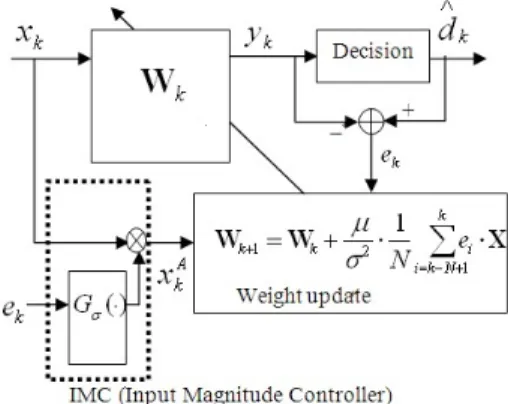
Fig. 2. ZEP-based equalizer with IMC (Input Magnitude Controller)
Though the ZEP based adaptive algorithms have improved so as to be better suited to practical situations and problems, any analysis of its optimum solutions and their behavior has not been carried out.
In this paper, through the analysis of its optimum weight behavior being compared with the MSE criterion, we will uncover some properties and factors that play the role in robustness against impulsive noise.
Ⅱ. System Model and MSE Criterion
In communication systems, a symbol point is transmitted and distorted through the wireless channel, and noise
n
k is added to the channel output as depicted in baseband model in Fig. 1. The multipath channelH (z )
can be expressed asi i
z h z
H ( ) = ∑ − in z-transform. With the noise
being added to the distorted channel output, the
equalizer input becomes as x
k = ∑ h
id
k−i+ n
k[8].
When we assume that the equalizer structure is TDL
(tapped delay line) with L weights, the output y
k at
timekcan be expressed as k T k
y
k= W X
with the input Xk =[xk,xk−1,...,xk−j,...,xk−L+1]T and weightT k L k j k k
k=[w0, ,w1, ,..,w,,...,w−1, ]
W .
The difference between the transmitted symbol point
d
k and the outputy
k is defined as errore
kas in (1). Then the MSE criterion
P
MSE is defined as the expectation of error power[8].k T k k k k
k
d y d
e = − = − W X
(1)] [
k2MSE
E e
P =
(2)Instead of taking (2), minimization of the instant power of system error
e
k with respect to weight is employed as a cost function which is efficient for implementation in the well-known LMS algorithm.While the influence of the Gaussian noise can be mitigated owing to the expectation or mean operation
E [⋅ ]
in (2), impulsive noise may defeat the averaging operation since a single large impulse can dominate the mean operation. Therefore impulsive noise can lead algorithms based on the MSE criterion to become unstable. This indicates that the instant error powere
k2 without being averaged may cause worse instability in the system.The gradient of the MSE criterion becomes
] [ 2 ] [
2
k Tk k k kMSE
E E d
P X X W X
W = −
∂
∂
(3)Letting the gradient be zero, we obtain the optimum weight vector for MSE criterion as
] [
] [
T k k
k o k
MSE
E
d E
X X
W = X
(4)On the other hand, the correlation between error
and input is
] [ ]
[ ]
[ e
k kE d
k k kE
k TkE X = X − W X X
(5)In the minimum MSE with
W
o, we have the following two conditions.= 0
∂
∂ W P
MSEand
E [ e
kX
k] = 0
(6)Ⅲ. ZEP Criterion and Optimum Weight
As another cost function to be minimized,
P
ZEPthe criterion of zero-error probability is defined as
) 0 ( =
= f e
P
ZEP E (7)The maximization of
f
E( e = 0 )
forces error samples to be concentrated on zero. More importantly, the error PDFf
E( e
CME)
issignificantly less sensitive to strong impulses estimation method using Gaussian kernel (with the kernel size
σ
) and a block of N error samples} ,..., ,..., ,
{ e
ke
k−1e
ie
k−N+1 as described in the work[9].
∑
− +=
−
= k −
N k i
i ZEP
e e P N
1 2
2
2 ] ) exp[ (
2 1 1
π σ
σ (8)
For maximization of
f
E( e = 0 )
the steepest descent method is employed and it leads to the following MZEP (maximum ZEP) algorithm with the step-sizeμ
MZEP that controls the system stability.W W
W ∂
+ ∂
+
=
ZEPMZEP k
k
μ P
1 (9)
The gradient in (9) can be expressed as
∑
− +=
⋅
⋅
⋅
∂ =
∂ k
N k i
i i i
ZEP e G e
N P
1
2 1 ( )
1 X
W
σ
σ (10)Since the right term in (10) can be considered as a time-averaged version of
E [ e
k⋅ G
σ( e
k) ⋅ X
k]
,we may have
] ) ( 1 [
2 k k k
ZEP Ee G e
P X
W = ⋅ ⋅ ⋅
∂
∂
σ
σ (11)In the steady state, we have the following two conditions as
= 0
∂
∂ W P
ZEPor
E [ e
k⋅ G
σ( e
k) ⋅ X
k] = 0
(12)Comparing
E [ e
kX
k] = 0
in (6) for MSE criterion andE [ e
k⋅ G
σ( e
k) ⋅ X
k] = 0
in (12) for ZEP criterion, we may consider thatG
σ( e
k) ⋅ X
kin (12) implies that input
X
k is attenuated by) ( e
kG
σ . This leads us to define themagnitude-controlled input
X
kA ask k A
k
G e X
X =
σ( ) ⋅
(13)Figure 2 depicts the MZEP equalizer with the input magnitude controller (IMC) for
X
kA. Thekernel ]
exp[2 2 ) 1
( 22
σ π
σ k σ k
e e
G = −
is always positive and is a function of an exponential decay with the error power
e
k2. An excessively large value of error power means the presence of a strong impulse within the inputX
k. This kind of large input can cause instability in the system.Through the magnitude control process
k
e
kG
σ( ) ⋅ X
in (16), the magnitude of the inputX
k is controlled for the weight update by a scale factorG
σ( e
k)
which is inversely proportional to the error power.Then the gradient (10) and weight update
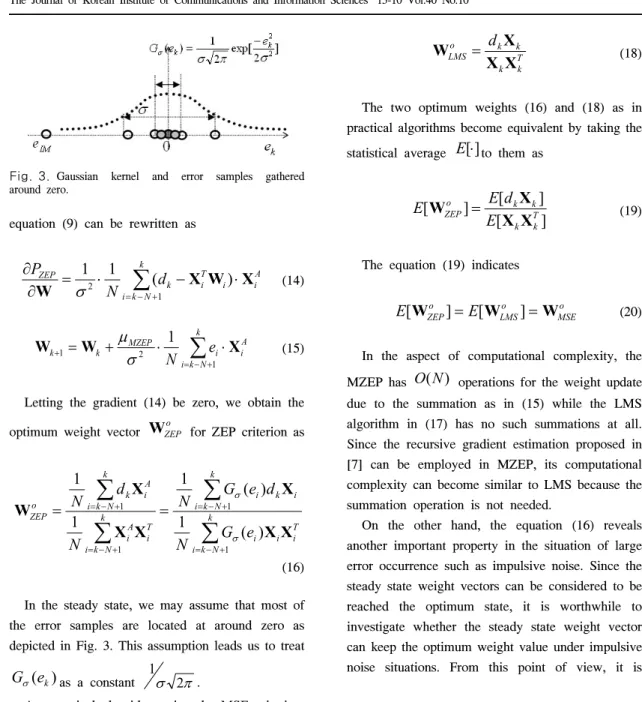
Fig. 3. Gaussian kernel and error samples gathered around zero.
0 2000 4000 6000 8000 10000
-15 -10 -5 0 5 10 15 20
Number of samples
volt
Fig. 4. Impulsive noise for the examination of weight behavior in the steady state (after convergence).
equation (9) can be rewritten as
∑
− +=
⋅
−
⋅
∂ =
∂
kN k i
A i i T i
ZEP
d
kN P
2
1 (
1)
1 X W X
W σ
(14)∑
− +=
+
= + ⋅
k⋅
N k i
A i MZEP i
k
k
e
N
11 2
1 X
W
W σ
μ
(15)Letting the gradient (14) be zero, we obtain the optimum weight vector
W
ZEPo for ZEP criterion as∑
∑
∑
∑
+
−
= +
−
=
+
−
= +
−
=
=
=
kN k i
T i i i k
N k i
i k i k
N k i
T i A i k
N k i
A i k o
ZEP
e N G
d e N G
N N d
1 1
1 1
) 1 (
) 1 (
1 1
X X
X X
X X W
σ σ
(16) In the steady state, we may assume that most of the error samples are located at around zero as depicted in Fig. 3. This assumption leads us to treat
) ( e
kG
σ as a constant 1σ 2π .As a typical algorithm using the MSE criterion, LMS (least mean square) is to minimize the instant error power
e
k2 insteadE [ e
k2]
for practical reasons[8]. Then the gradient of LMS becomes
k k
k
e
e X
W 2
2
−
∂ =
∂
(17)Letting (17) be zero, we obtain the optimum weight vector
T k k
k o k
LMS
d X X
W = X
(18)The two optimum weights (16) and (18) as in practical algorithms become equivalent by taking the statistical average
E [⋅ ]
to them as] [
] ] [
[
Tk k
k o k
ZEP
E
d E E
X X
W = X
(19)The equation (19) indicates
o MSE o
LMS o
ZEP
E
E [ W ] = [ W ] = W
(20)In the aspect of computational complexity, the MZEP has O(N) operations for the weight update due to the summation as in (15) while the LMS algorithm in (17) has no such summations at all.
Since the recursive gradient estimation proposed in [7] can be employed in MZEP, its computational complexity can become similar to LMS because the summation operation is not needed.
On the other hand, the equation (16) reveals another important property in the situation of large error occurrence such as impulsive noise. Since the steady state weight vectors can be considered to be reached the optimum state, it is worthwhile to investigate whether the steady state weight vector can keep the optimum weight value under impulsive noise situations. From this point of view, it is
0 2000 4000 6000 8000 10000 -0.5
0.0 0.5 1.0 1.5
weight value
Number of samples w4-LMS w4-ZEP w5-LMS w5-ZEP
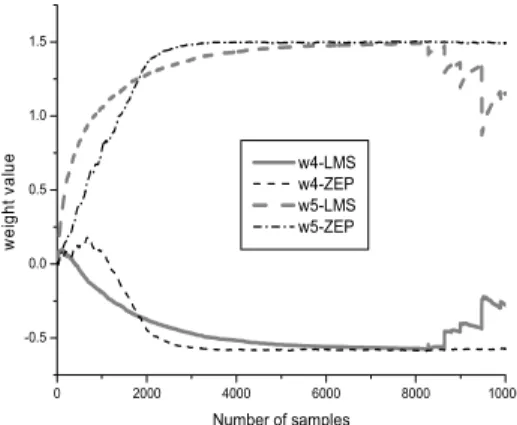
Fig. 5. Behavior of weight values in steady state under impulsive noise.
reasonable to see that
W
ZEPSteadyState can stay in the value ofW
ZEPo thanks to magnitude-controlling) ( e
kG
σ and time-average process∑
+
−
= k
N k
Ni 1
1
, whereas the steady state weight of LMS can be fluctuated since a single large impulse can afflict (17) directly. These properties are examined by observing the behavior of steady state weight vectors under impulsive noise situations in the following section.
Ⅳ. Simulation Results and Discussion
In this section, it will be investigated how the steady state weight vectors behave under impulsive noise situations. We use the same signal processing environment as in [7] except that impulse noise is applied after convergence, that is, in the steady state.
The symbol point set to be transmitted is
{
d1=−3,d2=−1,d3=1,d4=3}
. The random symbol pointd
k at time k is transmitted through the multipath channel H(z)=0.304+0.903z−1+0.304z−2. Then the additive Gaussian white noise (AWGN) is added to the channel output. The impulse noise add ed after convergence (from k = 8000) is generated according to the work [4] withσ
22= 50 . 001
andincident rate
ε
=0.01. The variance of the background AWGN is 0.001 and the distributionfunction of overall noise
n
k is (21) and is depicted in Fig. 4.2 ] 2 exp[
] 1 exp[2 ) 2
( 2
1 2
1 2 2 2
2 σ π σ
ε σ
π σ
ε k k
k N
n n n
f = − + − − (21)
This channel–distorted and noise-added signal is used as an input
x
kto the TDL equalizer with L=11.The sample size N for the MZEP algorithm is 20, the kernel size σ is 0.8. The convergence step-sizes are μMZEP= 0.004 for MZEP algorithm and μLMS= 0.001for LMS algorithm. All the parameter values are chosen to produce the lowest steady state MSE in this simulation.
Figure 4 shows that the AWGN is present throughout the sample time and the impulses added after k = 8000. The trace of
w
4,k andw
5,k (theother tap weights are not included just for the page-limit) in Fig. 5. It is observed that the steady state weight of LMS algorithm shows abrupt changes at the exact time of each impulse occurrence by the amount being proportional to its impulse intensity. In the weight traces of MZEP, each tap weight presents no fluctuations under the strong impulses. This result shows that the dominant role in the robustness against impulsive noise is the IMC.
Ⅴ. Conclusion
The MZEP algorithm outperforms MSE-based algorithms in supervised signal processing in most equalization applications. Particularly in impulsive noise environment, its performance is superior. In this paper, through analysis of the relationship with MSE-based optimum solution and behavior of optimum weight, it has been proven that the optimum solution of ZEP criterion is equivalent to the one of MSE criterion. This work has also revealed that the magnitude controlled input of MZEP plays the role in keeping the optimum solution undisturbed from impulsive noise.
Investigation of the detailed characteristics of the magnitude controlled input in future study is
demanded to lead the ZEP-related adaptive algorithms to finding more enhanced methods and their application fields.
References
[1] S. Unawong, S. Miyamoto, and N. Morinaga,
“A novel receiver design for DS-CDMA systems under impulsive radio noise environments,” IEICE Trans. Commun., vol.
E82-B, pp. 936-943, Jun. 1999.
[2] K. Blackard, T. Rappaport, and C. Bostian,
“Measurements and models of radio frequency impulsive noise for indoor wireless communications,” IEEE J. Sel. Areas in Commun., vol. 11, pp. 991-1001, 1993.
[3] H. Sedarat and K. Fisher, “Multicarrier communication in presence of biased-Gaussian noise sources,” Signal Processing, vol. 88, pp.
1627-1635, Jul. 2008.
[4] I. Santamaria, P. Pokharel, and J. Principe,
“Generalized correlation function: Definition, properties, and application to blind equalization,” IEEE Trans. Signal Processing, vol. 54, pp. 2187-2197, 2006.
[5] N. Kim, K. Jung, and L. Yang, “Maximization of zero-error probability for adaptive channel equalization,” J. Commun. Networks(JCN), vol. 12, pp. 459-465, Oct. 2010.
[6] N. Kim, “Decision feedback equalizer based on maximization of zero-error probability,” J.
KICS, vol. 36, pp. 516-521, Aug. 2011.
[7] N. Kim, “Efficient adaptive algorithms based on zero-error probability maximization,” J.
KICS, vol. 39A, pp. 237-243, May 2014.
[8] S. Haykin, Adaptive Filter Theory, PrenticeHall, Upper Saddle River, 4th Ed., 2001.
[9] E. Parzen, “On the estimation of a probability density function and the mode,” Ann. Math.
Stat. vol. 33, p. 1065, 1962.
김 남 용 (Namyong Kim)
1986년 2월:연세대학교 전자 공학과 졸업
1988년 2월:연세대학교 전자 공학과 석사
1991년 8월 : 연세대학교 전자 공학과 박사
1992년 8월~1998년 2월:관동 대학교 전자통신공학과 부교수
1998년 3월~현재 : 강원대학교 공학대학 전자정보통 신공학부 교수
<관심분야> Adaptive equalization.
이 규 영 (Gyoo-Yeong Lee)
1996년 3월~현재 : 강원대학교 공학대학 전자정보통 신공학부 교수