한국정보통신학회논문지 Vol. 24, No. 1: 50~56, Jan. 2020
복잡한 환경에서 MTCNN 모델 기반 얼굴 검출 알고리즘 개선 연구
부옥매1·김민영2·장종욱3*
Research and Optimization of Face Detection Algorithm Based on MTCNN Model in Complex Environment
Yumei Fu1 · Minyoung Kim2 · Jong-wook Jang3*
1Graduate Student, Department of Computer Engineering, Dong-Eui University, Busan, 47227 Korea
2Researcher, Research Institute of ICT Fusion and Convergence, Dong-Eui University, Busan, 47227 Korea
3*Professor, Department of Computer Engineering, Dong-Eui University, Busan, 47227 Korea
요 약
현재 심층 신경망 이론 및 응용 연구의 빠른 개발로 얼굴 인식의 효과가 향상되고 있다. 그러나 심층 신경망 계산 의 복잡성과 탐지 환경의 복잡성으로 인해 얼굴을 빠르고 정확하게 감지하는 방법이 주요 문제가 된다. 이 논문은 FDDB, LFW 및 FaceScrub 공개 데이터 세트를 훈련 표본을 사용하는 단순한 MTCNN 모델을 기반으로 둔다.
MTCNN 모델을 분류하고 소개하면서 학습 훈련 속도를 높이고 성능을 향상하는 방법을 모색합니다. 본 논문에서는 다이내믹 이미지 피라미드 기술을 이용하여 기존 이미지 Pyramid 기술을 대체하여 샘플을 분할하고 MTCNN 모델 의 OHEM을 훈련에서 제거하여 훈련 속도를 향상시켰다.
ABSTRACT
With the rapid development of deep neural network theory and application research, the effect of face detection has been improved. However, due to the complexity of deep neural network calculation and the high complexity of the detection environment, how to detect face quickly and accurately becomes the main problem. This paper is based on the relatively simple model of the MTCNN model, using FDDB (Face Detection Dataset and Benchmark Homepage), LFW (Field Label Face) and FaceScrub public datasets as training samples. At the same time of sorting out and introducing MTCNN(Multi-Task Cascaded Convolutional Neural Network) model, it explores how to improve training speed and Increase performance at the same time. In this paper, the dynamic image pyramid technology is used to replace the traditional image pyramid technology to segment samples, and OHEM (the online hard example mine) function in MTCNN model is deleted in training, so as to improve the training speed.
키워드 : 얼굴 감지, 특정 추출 , 이미지 전처리 , MTCNN, OHEM
Keywords : Face Detection, Feature extraction, Image Preprocessing, MTCNN, OHEM
Received 30 September 2019, Revised 2 October 2019, Accepted 17 October 2019
* Corresponding Author Jong-wook Jang(E-mail:[email protected], Tel:+82-51-890-1709) Professor, Department of Computer Engineering, Dong-eui University, Busan, 47227 Korea
Open Access http://doi.org/10.6109/jkiice.2020.24.1.50 print ISSN: 2234-4772 online ISSN: 2288-4165
This is an Open Access article distributed under the terms of the Creative Commons Attribution Non-Commercial License(http://creativecommons.org/li-censes/
Ⅰ. Introduction
In Face, detection is mainly used to detect and locate the face in the picture, return high-precision face frame coordinates, face feature point coordinates and number of faces. With the rapid development of convolutional neural network technology, the application scene of face detection has gradually evolved from indoor to outdoor, from a single limited scene to square, station, subway entrance and other scenes. Face detection methods based on deep learning often need a complex pre-training model, such as VGG16 and RESNET56, etc. These models usually have high computational complexity, which seriously affects the efficiency of a reasoning process. However, the MTCNN (multi-task cascaded convolutional neural network) model uses three convolutional neural networks with low complexity to complete the task of face detection[1].
Ⅱ. Related research
2.1. Training Sample Datasets
In the process of training a deep convolution neural network algorithm, a large number of training data are needed, and the selection of data is very important. In this paper, FDDB, LFW, and FaceScrub datasets are used for collation[2-4]. The dataset contains 4000 images of the test set and the training set. The training data set contains two types of images. The first type is an image containing a human face, and the second type is an image without a human face. which contains images that no one appears, and all the images are in JPG format.
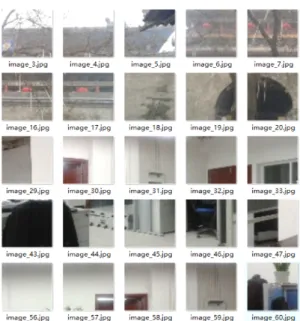
Fig. 1 and Fig. 2 show that the size, shape, and color of the image in the training sample of containing a human face are different, and there are varying degrees of noise. In the process of training the model, which can be used to distinguish a face from non-face, so as to get a more accurate model. In addition, this training chooses the experimental tool of the Tensorflow Deep Learning Framework and uses GPU to calculate large matrices and
high bit vectors, thus greatly shortening the operation.
Fig. 1 Sample containing facial information
Fig. 2 Sample without face information
2.2. Image Preprocessing
Before training the face detection model, it is necessary to pre-process the face image, increase the stability of the face detection model to the interference of noise and angle transformation, enhance the experimental data set, and use different linear transformation to enhance each image.
Random horizontal flip is 40 degrees, horizontal and
vertical migration is 0.2, random scaling is 0.2, and filling the blank areas in the transformation process according to the nearest pixels makes the deep convolution neural network with many parameters avoid falling into over-fitting. Finally, the image is normalized, the RGB channel is subtracted by 127.5 for each pixel value and then divided by 128 to normalize the pixel value to {-1, 1}. Thus, the generalization ability of a convolutional neural network is greatly improved.
Fig. 3 Image preprocessing
Fig. 3 shows, since images of different sizes are needed in the model, the dynamic image pyramid method is adopted in this paper[5]. In the dynamics image pyramid generation process, only the last zoom result is scaled instead of scaling the full image. Thus obtaining the required dimensions of Proposal Network, Refined Network and Output Network in MTCNN (Multi-task convolutional neural network) model.
2.3. MTCNN model
MTCNN model consists of three stages. it adopt the idea of candidate frame and classifier to perform fast and efficient face detection.
Fig. 4 Proposal Network
Fig. 4 shows, The first stage is a proposal network.
after the image data enters the Proposal network, it first undergoes 3 convolutions layers and 1 max pool layer operation, and the original 12 * 12 * 3 image data
becomes a 1 * 1 * 32 feature image. through 32 of feature images 1 * 1, 2 of feature images 1 * 1 can be generated for face classification; 4 feature images of 1 * 1 can be generated for regression frame judgment; 10 feature images of 1 * 1 can be generated for facial landmark localization.
Through face classification, bounding box regression, and face landmark positioning, face judgment and preliminary recommendations for face regions are performed. This data is input to Refined network for further processing.
Fig. 5 Refined network
Fig. 5 shows, First adjust the input image size to 24 * 24 * 3, and then send the image data to the Refine Network. This network uses 3 convolutions, 2 softmax pools layer to obtain 3 * 3 * 64 feature images, and then uses a fully connected layer to generate 128 vectors.
Through 128 vectors in the full connection layer, 2 vectors can be generated for face classification; 4 vectors can be generated for regression box judgment; 10 vectors can be generated for face contour point judgment. Because refine network receives the data transmitted by p-net, through further operation of refine network, a large number of poor candidate boxes in p-net are filtered out. Finally, the prediction results are further optimized for the selected bounding box regression and NMS(non-maximum suppression). This data is input to Output Network for further processing[6].
Fig. 6 Output Network
Fig. 6 shows, First adjust the input image size to 48 *
48 * 3, and then send the image data to the output network. This network uses 4 convolutions layer and 3 softmax pools layer to obtain 3 * 3 * 128 feature vectors, and then uses the fully connected layer Generated 256 vectors. Through the 256 vectors of the fully connected layer, 2 vectors are generated for face classification, 4 vectors are used for regression frame judgment, and 10 vectors are used for judgment of face contour points.
The output network is also a large fully-connected layer of 256 vectors, which retains more image features, then performs face recognition, bounding boxes regression and facial landmark localization, and finally outputs the upper left corner coordinates of the face region The five characteristic points are coordinated.
2.4. Key Techonlogy
The three subtasks of MTCNN model are face or non-face classifiers, bounding box regression and landmark position.
First, since the face classification belongs to a cross entropy cost function, the distribution similarity between the real distribution and the trained value can be measured. When the gradient descent method is used, the problem of the drop in the learning rate of the mean square loss function can be avoided. the equation for obtaining whether a picture has a human face by cross entropy cost is as in(1)[7].
det detlog det log (1) Where Prepresents the probability that the sample is a face, and the value of Pi is obtained in the CNN network.
Yi indicates that the face data of the tag has a value of 0 or 1, 0 means non-human face, and 1 means face.
The bounding box regression uses a linear function whose loss function uses a regression loss function calculated by Euclidean distance. It's calculation is very simple, and the feature properties are unchanged after different representation domain transformations. the equation for obtaining the bounding box regression by Euclidean distance is as in(2)[8].
∥ ∥
(2)
The above formula shows, Among them, box gets the return target from CNN, box is a thinking vector.
Facial landmark localization uses the same loss function as the bounding box regression to find the minimum distance, which improves the accuracy of the model. the equation for obtaining the Facial landmark localization by Euclidean distance is as in(3) [9].
and ∥and and∥
(3)
NMS is the suppression of elements that are not maximum, which can be understood as local maximum search. Local representation of a neighborhood has two variable parameters: one is the dimension of the neighborhood, the other is the size of the neighborhood.
Fig. 7 Flowchart for non-maximum suppression in MTCNN model
Fig. 7 shows, In face detection, the region selected by the search algorithm is extracted by feature, and then the classification confidence is obtained by feature input classifier. Because of the overlap between the selected area and other selected areas, non-maximum suppression method is needed to select the region predicted to be the highest face score in the neighborhood for further detection, so as to reduce the computational complexity.
The equation for obtaining Suppress redundant bounding boxes by Intersection over union is as in(4).
∩╱∪ (4)
Where IoU represents the overlap of two frames, SA∩
B represents the overlap (intersection) of the fractional drunk window and the test window, and SAUB represents the union of the two windows. If the calculated value of IoU is greater than 0.65, it is a positive sample, if it is greater than 0.4 and less than 0.65, it is a partial sample, and if it is less than 0.4, it is a negative sample.
Fig. 8 Dropout layer
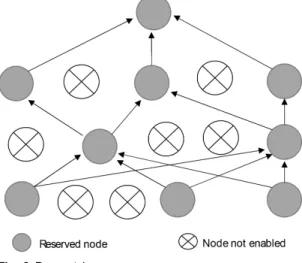
Fig.8 shows, in order to prevent over-fitting, Dropout's regularization method is used in the model to limit the parameters and optimize the network. in training, each neuron unit is reserved with probability p (dropout discarding rate is 1-p), and the Current output is set to 0[9]. When the training is completed, the parameters of each neuron using the dropout layer are multiplied by probability p, temporarily referring to those discarded neurons restoring their previous values in the next training process, and some neurons are randomly selected again, Repeat this process. In the training phase of the neural network, the forward propagation randomly deletes halve nodes, so that improve work efficiency.
Ⅲ. Experimental Effect
This experiment mainly runs in the window system environment, using GPU training datasets, the main use of tensorflow2.0 framework, based on mtcnn model for face detection.
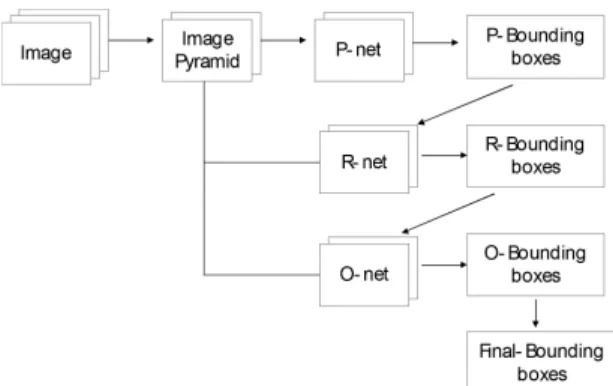
Firstly, the obtained images are zoomed in different scales, and an image pyramid is constructed to detect the face images of different sizes.
Secondly, the zoomed image is transferred to P-Net layer respectively. The network structure mainly obtains the regression vector of bounding box and candidate window of face region.
Thirdly,the output data from the P-Net layer is transferred to the R-Net layer. The network structure still removes highly coincident areas through boundary box regression and NMS. However, due to the difference between the network structure and the P-Net network structure, a full connection layer is added, so it will achieve better inhibition;
Finally, the result of rnet output is transferred to the O-Net layer. Compared with the R-Net layer, the layer adds a layer of roll base layer, so the processing of face details is more precise. Its function is the same as the R-Net layer. However, because the layer has more supervision on the face area, the block diagram with face features can be output finally.
In the training process, the image pyramid generation process takes the most time, and the subsequent generation of multiple images will be sent to the back-end for calculation, so this paper according to the model back-end output suitable minsize value and image matching, can directly reduce the number of image zooming in the pre-processing stage, and in the image pyramid generation process, only the last zooming results are zoomed again. Secondly, delete the function of "online hard example mining" and do not select the first 70% samples for back propagate during training.
And use dropout's regulation method to disable some parameters, thereby increasing the training speed.
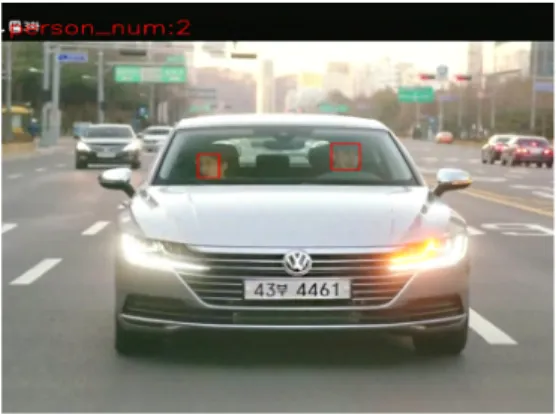
Fig. 9 Test Results
From the results shown in Fig. 9, we can understand that MTCNN model has a good effect on facial contour clearly visible, the change of figure posture in the image, the size of the head image, and the illumination is not clear. However, the effect of occlusion of the five senses is not good.
Ⅳ. Conclusion
This paper aims at improving the accuracy of face detection by image preprocessing combined with MTCNN model under the unrestricted environment of light, posture and color interference. The training data sets increase the diversity and recognition degree of samples through image preprocessing technology, which lays a foundation for better face Detection of models.
The three cascaded convolution neural networks in MTCNN model are used to refine the candidate regions and to obtain the final detection results. Because MTCNN model uses image pyramid, border regression, non-maximum suppression and other technologies, it avoids the huge performance consumption brought by traditional ideas such as sliding window and classifier, and improves the accuracy. However, it is still impossible to recognize faces that are too occluded by objects. Next, I will try to integrate MTCNN mode with Deep Convolutional Neural Network mode to solve the problem that occlusion can’t be detected in face
detection. It will be helpful for further research and application of deep convolution neural network technology in face detection in the future.
ACKNOWLEDGEMENT
The research was supported by the BB21+
project in 2019.
REFERENCES
[ 1 ] H.Gan, C.Q, “Research on Face Recognition Algorithm Based on MT-CNN,” Industrial control computer journal, vol. 31, no. 11, pp. 119-122, May. 2018.
[ 2 ] UMass Vision.Face Detection Data Set and Benchmark Home [Internet]. Available : http://vis-www.cs.umass.edu/fddb/.
[ 3 ] UMass Vision. Labeled Faces in the Wild [Internet].
Available : http://vis-www.cs.umass.edu/lfw/.
[ 4 ] vesion interaction group. FaceScrub [Internet]. Available : http://vintage.winklerbros.net/facescrub.html.
[ 5 ] J.Y.Wu, and S.Q.Chen, “An Face Detection Algorithm Base on Improved MTCNN,” Software Guide journal, no. 09, pp.
23-26, Nov. 2019.
[ 6 ] W.Q.Zhao, H.Yan, and X.Q.Shao, “Object detection based on inproved non-maximum suppression algorithm,” Journal of Image and Graphics, no. 11, pp. 1676-1685, Nov. 2018.
[ 7 ] D.Zhao, Q.C.Tang, and Z.B.Yu, “A Solution to Multi- Objective Optimization Problem with Improved Cross Entropy Optimization,” Journal of XI'AN Jiao Tong University, vol. 53, no. 3, pp. 66-74, Mar. 2019.
[ 8 ] Z.Y.Tang, F.R.Meng, and Z.X.Wang, “Fast face recognition with regularized least square via sparse representation,”
Journal of Application Research of Computers, vol. 33, no.
9, pp. 2831-2836, Sep. 2016.
[ 9 ] X.J.Fan, S.B.Xuan, and T.Feng, “Behavior Recognition Based on Dropout Convolutional Neural Network,” Journal of GuangXi University for nationalities, vol. 23, no. 1, pp.
76-78, Feb. 2017.
부옥매(Yumei Fu)
現, 동의대학교 컴퓨터공학과 대학원 석사과정
※관심분야 : 머신러닝, 딥러닝
김민영(Minyoung Kim)
동의대학교 컴퓨터공학과 공학석사 現, 동의대학교 ICT융복합연구소 연구원
※관심분야 : LPWA 통신, 자동차네트워크, 블록체인, 딥러닝
장종욱(Jong-wook Jang)
부산대학교 컴퓨터공학과 공학박사 한국전자통신연구소 연구원 現, 동의대학교 컴퓨터공학과 교수
※관심분야 : 유무선통신시스템, 자동차네트워크, 블록체인, 딥러닝