DOI: https://doi.org/10.14579/MEMBRANE_JOURNAL.2017.27.4.313
1. 서 론
1)
대부분의 올레핀은 에테인, 프로페인, 나프타, 기체 오일의 증류 크래킹으로 제조가 되고 있다[1-2]. 이러한 제조 방법은 올레핀을 효율 높게 분리하지 못하는 것으 로 알려져 있기 때문에 올레핀/파라핀을 분리하기 위한 더 효과적인 방법들로 에너지를 절약하고자 하는 방법 들이 널리 연구되고 있다. 이러한 많은 올레핀 제조 방 법에서, 분리막 기술들은 비효율적인 분리 방법을 대체 할 수 있는 기술로 알려지고 있다[3-7]. 특히 촉진수송 분리막은 크래킹이나 수많은 단계를 거치는 증류방법
의 대안적인 방법이 될 수 있는 것으로 관심을 받고 있 다[8]. 촉진수송의 특징은 선택도와 투과도가 특정한 운 반체에 의해서 모두 증가할 수 있다는 점이다[9-12].
특히, AgNO3, AgBF4과 같은 염들과 poly(ethylene oxide)(PEO), poly(dimethyl siloxane)(PDMS), poly(2- ethyl-2-oxazoline)(POZ), poly(N-vinyl pyrrolidone)(PVP) 와 같은 고분자를 포함하는 촉진 수송 분리막은 올레핀 /파라핀 혼합물 분리를 할 때 우수한 분리 성능을 보여 준다고 보고되었다[13-21].
뿐만 아니라, PEO/AgBF4 혹은 POZ/AgBF4 같은 고 분자 막에 Al(NO3)3의 도입은 Ag+ ion의 환원을 억제
†
Corresponding author(e-mail: [email protected], http://orcid.org/0000-0001-7211-4064)
올레핀/파라핀 분리를 위한 poly(ethylene oxide)/AgBF
4/Al(NO
3)
3/Ag
2O 복합체 분리막
정 수 영⋅강 상 욱†
상명대학교 자연과학대학 화학과
(2017년 7월 27일 접수, 2017년 8월 15일 수정, 2017년 8월 16일 채택)
Poly(ethylene oxide)/AgBF
4/Al(NO
3)
3/Ag
2O Composite Membrane for Olefin/Paraffin Separation
Sooyoung Jeong and Sang Wook Kang
†Department of Chemistry, Sangmyung University, Seoul 03016, Republic of Korea (Received July 27, 2017, Revised August 15, 2017, Accepted August 16, 2017)
요 약: 올레핀/파라핀 분리를 위해 Poly(ethylene oxide)(PEO)/AgBF
4/Al(NO
3)
3/Ag
2O 복합막이 제조되었으며, Ag
2O가 도 입되었을 때, 복합체 분리막의 초기성능은 선택도 13.7과 투과도 21.7 GPU로 관찰되었다. PEO/AgBF
4/Al(NO
3)
3분리막의 성 능(선택도 13와 투과도 7.5 GPU)에 비해서 초기성능이 증가한 이유는 Ag
2O의 첨가로 인한 Ag ion의 활성도 증가로 생각되 었다. 하지만 시간에 따른 성능저하 현상이 관찰되었는데 이는 고분자 matrix인 PEO 때문인 것으로 생각되었다. PEO 고분자 는 Ag
2O 입자를 안정화 시킬 수 없기 때문에 용매가 증발하면서 Ag
2O 입자끼리 뭉치게 되고, Ag
2O가 barrier 역할을 하게 돼서 시간이 지나면 투과도가 감소하는 것으로 분석되었다.
Abstract: For the separation of olefins/paraffins, poly(ethylene oxide)(PEO)/AgBF
4/Al(NO
3)
3/Ag
2O composite membranes were prepared. When Ag
2O was introduced, the initial selectivity and permeance of composite membranes were observed to be 13.7 and 21.7 GPU, respectively. The increase in performance compared to the initial performance of PEO/AgBF
4/Al(NO
3)
3membrane (selectivity 13 and permeance 7.5 GPU) was thought to be due to the increase of Ag ion activity due to the addition of Ag
2O. However, performance degradation over time was observed, which was thought to be due to the polymer matrix PEO. Since the PEO polymer could not stabilize the Ag
2O particles, the Ag
2O particles becmae aggregated together as the solvent evaporates, and Ag
2O acts as a barrier. As a result, the permeance decreases over time.
Keywords: olefin, membrane, Ag
2O, PEO
함으로써 장시간 내구성을 보여줄 수 있다고 보고되었다 [10]. 실제로 POZ/AgBF4/Al(NO3)3과 PEO/AgBF4/Al(NO3)3
분리막의 분리 성능은 각각 14일, 10일 동안 유지되었 는데, 이것은 은 이온의 안정함을 의미한다. 이러한 장 시간 내구성은 은 이온들과 질산염 이온들 사이의 상호 작용과 BF4-와 Al3+의 상호작용으로부터 나타나는 것으 로 보고되었다[22-26].
하지만 PVP/AgBF4/Al(NO3)3 복합막은 장시간의 안 정성을 보여주지만, 비교적 낮은 분리성능을 보였주었 다. 따라서 기존 연구에서는 분리성능을 높이기 위해 Ag2O 나노입자를 PVP/AgBF4/Al(NO3)3 복합막에 첨가 하는 연구가 진행되었다. Ag이온과 Ag2O의 산소의 상 호작용은 Ag ion이 olefin carrier로서 활성이 높아지기 때문에 성능이 증가하는 것으로 보고되었다[27].
이번 연구에서 우리 연구팀은 PEO의 경우 chain flexibility가 높아 기존 PVP 보다 투과도가 더 높아질 것으로 예상하여, PEO/AgBF4/Al(NO3)3막에 Ag2O을 사 용함으로써 분리 성능을 증가시키고자 하였다.
2. 실험방법
2.1. 재료 및 시약
실험에 사용한 고분자는 poly(ethylene oxide)(PEO, Mw 900,000 g/mol)이고, silver tetrafluoroborate (AgBF4, purity 98%)와 Aluminium nitrate nonahydrate (Al(NO3)3
⋅9H2O, 98% purity), silver (I) oxide (Ag2O, 99% pu- rity) 모두 Sigma-Aldrich사에서 구입하였다. 고분자 분 리막을 만들기 위해 polysulfone (Toray Chemical Korea Inc.) 지지체를 사용하였다. 구입한 시약들은 모 두 별도의 정제 과정 없이 그대로 사용하였다.
2.2. 분리막 제조
silver(I) oxide를 물에 sonication으로 5분 동안 분산 시킨 후에, PEO 고분자를 20%의 비율로 Ag2O가 첨가 된 물 용액에 첨가했다. 그리고 나서 올레핀 운반체로 서 AgBF4를 용액에 첨가했다. 그 용액을 1시간 동안 상온에서 저어주었다. PEO/AgBF4/Al(NO3)3/Ag2O의 몰 비율은 1 : 0.7 : 0.015 : 0.009의 가장 좋은 성능이 나오 는 비율로 고정시켰다. 마지막으로, 용액을 RK Control Coater (Model 202, Control Coater RK Print-Coat Instruments Ltd., UK)을 사용하여 polysulfone 지지체 (Toray chemical, Tnc, Korea)에 코팅시켰다. 코팅된 막
을 24시간 동안 진공오븐에서 실온으로 건조시켰다.
2.3. 기체 투과 실험
프로판과 프로필렌(50 : 50 vol%)의 가스 혼합물을 PEO/AgBF4/Al(NO3)3/Ag2O막에 투과시켰다. Gas chro- matography (GC)를 사용하여 선택도를 측정하였고, bubble flow meter를 사용하여 투과도를 측정하였다.
가스 혼합물의 흐름은 각각 Mass flow meter (MFM)와 Regulated by mass flow controller (MFC)을 사용하여 확인하고 조절하였다. 가스 투과도의 단위는 GPU (1 GPU = 1 × 10⁻⁶ cm3 (STP)/(cm2s cmHg)로 나타냈다.
3. 결과 및 고찰
3.1. SEM 분석
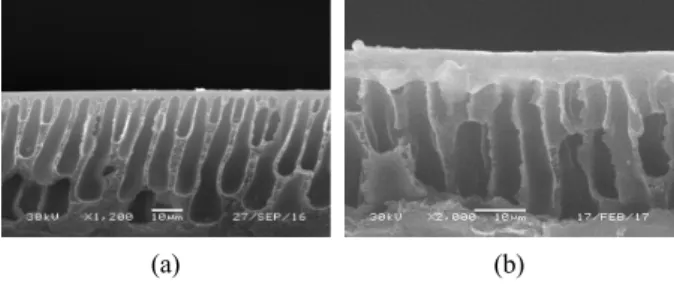
Fig. 1(a)는 polysulfone 지지체의 구조를 나타내고, Fig. 1(b)는 PEO/AgBF4/Al(NO3)3/Ag2O막이 코팅된 SEM 사진이다. 선택성을 보이는 active layer의 두께는 약 5.9 µm로 확인되었다. 첨가된 Ag2O는 PEO 전해질 막에 고루 분산된 것으로 확인되었고, 용액은 균일하게 고분자 지지체의 표면 위에 균일하게 코팅된 것으로 관 찰되었다.
3.2. 프로필렌/프로판 혼합 가스에 대한 분리막의 성능
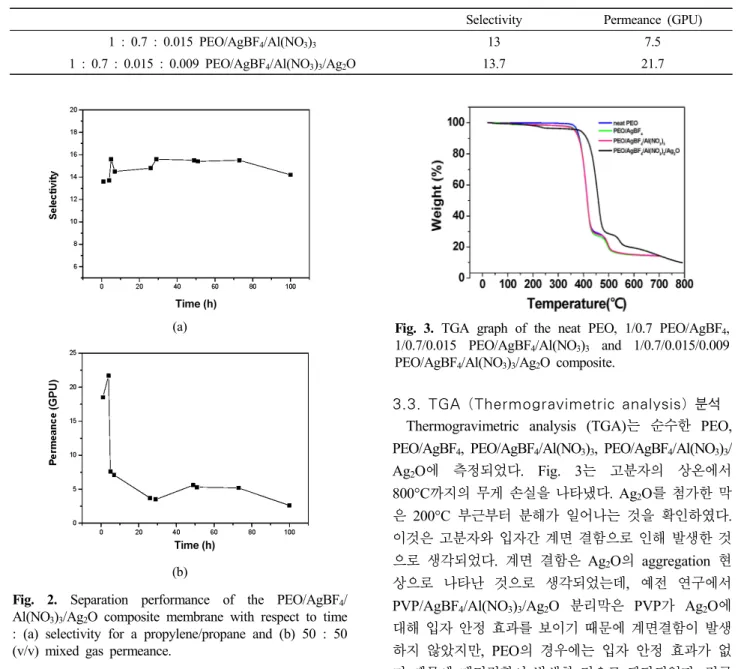
Table 1은 프로필렌/프로판 혼합 가스에 대한 분리막 의 투과도와 선택도의 성능을 나타냈다[28]. Ag2O를 첨 가하였을 때 초기 4시간 동안에서의 분리 성능은 선택 도 13.7과 투과도 21.7 GPU로서 Ag2O가 첨가되지 않 은 분리막(성능 : 선택도 13과 투과도 7.5GPU)보다 성 능이 높게 측정되었다. 하지만 Fig. 2는 긴 시간이 지났 을 때 성능이 유지되지 않는 것으로 관찰되었다. Ag2O(a) (b)
Fig. 1. Scanning Electron Microscopy (SEM) images of
(a) neat polysulfone support and (b) PEO/AgBF
4/Al(NO
3)
3/
Ag
2O membrane coated on polysulfone support.
와 silver ion 간 서로 상호작용 하기 때문에 초기 선택 도와 투과도 성능이 높게 관찰되고, 장시간 테스트에서 도 선택도는 높게 유지가 되는 것은 증대된 Ag+ ion의 activity가 유지되고 있다는 것을 의미하였다. 하지만 투 과도는 4시간 이후로 급격하게 감소하게 되는데, 이것 은 건조 후에도 분리막 내에 남아있는 용매가 증발할 때 Ag2O 입자끼리 뭉침이 일어나게 되고, 이 뭉쳐진 Ag2O 입자들이 barrier 역할을 하게 되어, 결국 투과도 가 감소하는 것으로 생각되었다.
3.3. TGA (Thermogravimetric analysis) 분석
Thermogravimetric analysis (TGA)는 순수한 PEO, PEO/AgBF4, PEO/AgBF4/Al(NO3)3, PEO/AgBF4/Al(NO3)3/ Ag2O에 측정되었다. Fig. 3는 고분자의 상온에서 800°C까지의 무게 손실을 나타냈다. Ag2O를 첨가한 막 은 200°C 부근부터 분해가 일어나는 것을 확인하였다.이것은 고분자와 입자간 계면 결함으로 인해 발생한 것 으로 생각되었다. 계면 결함은 Ag2O의 aggregation 현 상으로 나타난 것으로 생각되었는데, 예전 연구에서 PVP/AgBF4/Al(NO3)3/Ag2O 분리막은 PVP가 Ag2O에 대해 입자 안정 효과를 보이기 때문에 계면결함이 발생 하지 않았지만, PEO의 경우에는 입자 안정 효과가 없 기 때문에 계면결함이 발생한 것으로 판단되었다. 결국 이러한 현상으로 인해 Ag2O가 첨가된 막의 열적 안정 도가 감소하게 되었다.
3.4. Raman 분석
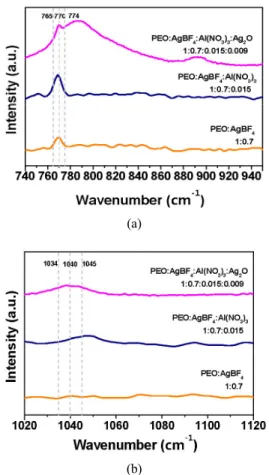
PEO/AgBF4/Al(NO3)3/Ag2O 복합체에서 Ag2O과 다 른 이온들 간의 상호작용을 Raman spectroscopy로 분 석하였다. Fig. 4(a)는 BF4- stretching bands부분의 Raman spectra를 보여준다. 765, 770, 774 cm-1에서의 BF4-
stretching bands는 각각 free ions, ion pairs, ion ag-
Selectivity Permeance (GPU)
1 : 0.7 : 0.015 PEO/AgBF4/Al(NO3)3 13 7.5
1 : 0.7 : 0.015 : 0.009 PEO/AgBF4/Al(NO3)3/Ag2O 13.7 21.7
Table 1. Mixed Gas (propylene/propane) Permeance and Selectivity of the PEO/AgBF
4/Al(NO
3)
3and PEO/AgBF
4/ Al(NO
3)
3/Ag
2O Composite Membranes
(a)
(b)
Fig. 2. Separation performance of the PEO/AgBF
4/ Al(NO
3)
3/Ag
2O composite membrane with respect to time : (a) selectivity for a propylene/propane and (b) 50 : 50 (v/v) mixed gas permeance.
Fig. 3. TGA graph of the neat PEO, 1/0.7 PEO/AgBF
4,
1/0.7/0.015 PEO/AgBF
4/Al(NO
3)
3and 1/0.7/0.015/0.009
PEO/AgBF
4/Al(NO
3)
3/Ag
2O composite.
gregates를 가리킨다. PEO/AgBF4/Al(NO3)3의 main peak 는 769 cm-1로 BF4-가 주로 ion pairs로 존재하는 것을 의미한다. PEO/AgBF4/Al(NO3)3/Ag2O 혼합물에서는 774 cm-1쪽으로 그래프가 이동한 것으로 보아 ion pairs와 ion aggregates 상태로 존재한다는 것을 보여주었다.
Fig. 4(b)는 NO3- stretching bands의 Raman spectra를 나타낸다. NO3-의 free ions, ion pairs, ion aggregates에 대한 peak은 각각 1034, 1040, 1045 cm-1에서 관찰된 다. PEO/AgBF4/Al(NO3)3/Ag2O막의 main peak은 1038 cm-1에서 나타나므로, NO3-가 free ions과 ion pairs로 존재함을 확인할 수 있었다.
이러한 결과들은 Al(NO3)3와 AgBF4의 상호작용이 감소하는 것을 의미한다. PEO가 Ag2O의 안정제 역할 을 하지 못하기 때문에 Ag2O끼리 뭉치게 되고, 시간이 지날수록 상분리 과정이 일어나게 된다. 따라서 상분리 과정에서 Ag2O와 Al(NO3)3가 동시에 PEO와 AgBF4로
부터 떨어지게 된다. 결국 BF4-는 상대적으로 ion ag- gregates 상태로 되고, NO3-는 free ions 상태로 존재하 게 된다. 이로 인해 Ag+의 안정도는 떨어져서 시간이 지나면 성능이 감소하게 될 가능성이 높아지게 된다.
4. 결 론
기존의 PVP/AgBF4/Al(NO3)3/Ag2O막의 성능이 좋았 던 것을 참고하여, 투과도를 높이기 위해 permeable한 특성을 갖는 PEO를 사용하여 실험을 진행하였다. 그 결과 PEO/AgBF4/Al(NO3)3/Ag2O막의 성능이 선택도 13.7와 투과도 21.7 GPU로 일시적으로 증가되었다.
SEM, TGA, Raman 분석으로 고분자와 Ag2O 사이의 coordination 특징을 살펴보았다. 일시적인 투과도의 증 가는 silver ion과 Ag2O 입자의 상호작용으로 인해 일 어난 것으로 생각되었다. 하지만 시간이 지남에 따라 투과도 성능이 감소하게 되는데, 이것은 PEO가 Ag2O 의 안정제로서 작용하지 못하였기 때문인 것으로 생각 되었다. 이는 남은 용매가 증발하면서 Ag2O는 뭉치게 되고, Ag2O가 뭉친 것들이 barrier 역할을 하여 투과도 가 감소한 것으로 판단되며, 이러한 결과로부터 poly- mer matrix가 매우 중요한 인자라는 것을 알 수 있다.
Amide 구조를 갖고 있는 PVP의 경우는 Ag2O 입자를 안정화 시켜주어서 용매가 날아가도 성능이 유지되었 다. 하지만 ether 구조를 갖는 PEO는 입자 안정제 역할 을 하지 못하게 된다. 이러한 결과들로부터 고분자/은 염/알루미늄염 전해질 분리막의 성능을 향상시키기 위 한 첨가제로서 나노입자를 사용할 경우 amide 그룹을 가진 polymer가 matrix로 사용되어야 한다는 결론을 도 출하였다.
감 사
본 연구는 2016년도 상명대학교 교내연구비를 지원 받아 수행하였음.
Reference
1. R. B. Eldridge, “Olefin/paraffin separation technol- ogy: Are view”, Ind. Eng. Chem. Res., 32, 2208 (1993).
(a)
(b)
Fig. 4. Raman spectra of (a) BF
4-and (b) NO
3-ions in the
1/0.7/0.015/0.009 PEO/AgBF
4/Al(NO
3)
3/Ag
2O, 1/0.7/0.015
PEO/AgBF
4/Al(NO
3)
3and 1/0.7 PEO/AgBF
4solution.
2. D. J. Safarik and R. B. Eldridge, “Olefin/paraffin separations by reactive absorption: A review”, Ind.
Eng. Chem. Res., 37, 2571 (1998).
3. T. C. Merkel, R. Blanc, I. Ciobanu, B. Firat, A.
Suwarlim, and J. Zeid, “Silver salt facilitated trans- port membranes for olefin/paraffin separations:
Carrier instability and a novel regeneration meth- od”, J. Membr. Sci., 447, 177 (2013).
4. M. Askari and T. S. Chung, “Natural gas purifica- tion and olefin/paraffin separation using thermal cross-linkable co-polyimide/ZIF-8 mixed matrix membranes”, J. Membr. Sci., 444, 173 (2013).
5. K. S. Liaoa, S. Japipa, J. Y. Laib, and T. S.
Chung, “Boron-embedded hydrolyzed PIM-1 car- bon membranes for synergistic ethylene/ethane pu- rification”, J. Membr. Sci., 534, 92 (2017).
6. M. Fallanza, A. Ortiz, D. Gorri, and I. Ortiz,
“Polymer-ionic liquid composite membranes for propane/propylene separation by facilitated trans- port”, J. Membr. Sci., 444, 164 (2013).
7. R. J. Swaidan, X. Ma, and I. Pinnau,
“Spirobisindane-based polyimide as efficient pre- cursor of thermally-rearranged and carbon molec- ular sieve membranes for enhanced propylene/pro- pane separation”, J. Membr. Sci., 520, 983 (2016).
8. D. F. Sanders, Z. P. Smith, R. Guo, L. M.
Robenson, and J. E. McGrath, “Energy-efficient polymeric gas separation membranes for a sustain- able future: A review”, Polymer, 54, 4729 (2013).
9. Y. S. Kang, S. W. Kang, H. Kim, J. H. Kim, J.
Won, C. K. Kim, and K. Char, “Interaction with olefins of the partially polarized surface of silver nanoparticles activated by p-benzoquinone and its implications for facilitated olefin transport”, AdV.
Mater., 19, 475 (2007).
10. S. W. Kang, K. Char, and Y. S. Kang, “Novel ap- plication of partially positively charged silver nanoparticles for facilitated transport in olefin/par- affin separation membranes”, Chem. Mater., 20, 1308 (2008).
11. Y. S. Park, J. Won, and Y. S. Kang, “Facilitated transport of olefin through solid PAAm and
PAAm-graft composite membranes with silver ions”, J. Membr. Sci., 183, 163 (2001).
12. I. Pinnau, L. G. Tory, and C. Casillas, “Olefin separation membrane and process”, US Patent, 5,670,051 (1997).
13. J. H. Kim, Y. S. Kang, and J. Won, “Silver poly- mer electrolyte membranes for facilitated olefin transport: carrier properties, transport mechanism and separation performance”, Macromol. Res., 12, 145 (2004).
14. I. Pinnau and L. G. Toy, “Solid polymer electro- lyte composite membranes for olefin/paraffin sepa- ration”, J. Membr. Sci., 184, 39 (2001).
15. S. U. Hong, J. Y. Kim, and Y. S. Kang, “Effect of feed pressure on facilitated olefin transport through solid polymer electrolyte membranes”,
Polym. Adv. Technol., 12, 177 (2001).
16. J. H. Kim, B. R. Min, H. S. Kim, J. Won, and Y.
S. Kang, “Facilitated transport of ethylene across polymermembranes containing silver salt: effect of HBF4 on the photoreduction of silver ions”, J.
Membr. Sci., 212, 283 (2003).
17. S. W. Kang, J. H. Kim, K. S. Oh, J. Won, K.
Char, H. S. Kim, and Y. S. Kang, “Highly stabi- lized silver polymer electrolytes and their applica- tion to facilitated olefin transport membranes”, J.
Membr. Sci., 236, 163 (2004).
18. J. H. Kim, B. R. Min, C. K. Kim, J. Won, and Y.
S. Kang, “New insights into the coordination mode of silver ions dissolved in poly(2-ethyl-2-oxazoline) and its relation to facilitated olefin transport”,
Macromolecules, 35, 5250 (2002).
19. Y. Yoon, J. Won, and Y. S. Kang, “Polymer elec- trolyte membranes containing silver ion for facili- tated olefin transport”, Macromolecules, 33, 3185 (2000).
20. J. H. Kim, B. R. Min, J. Won, and Y. S. Kang,
“Anomalous temperature dependence of facilitated propylene transport in silver polymer electrolyte membranes”, J. Membr. Sci., 227, 197 (2003).
21. S. W. Kang and Y. S. Kang, “Silver nanoparticles stabilized by crosslinked poly(vinyl pyrrolidone)and
its application for facilitated olefin transport”, J.
Colloid Interf. Sci., 353, 83 (2011).
22. D. S. Song, Y. S. Kang, and S. W. Kang, “Highly permeable and stabilized olefin transport mem- branes based on a Poly(ethylene oxide) Matrix and Al(NO3)3”, J. Membr. Sci., 474, 273 (2015).
23. S. W. Kang, J. H. Kim, J. Won, and Y. S. Kang,
“Suppression of silver ion reduction by Al(NO3)3
complex and its application to highly stabilized olefin transport membranes” J. Membr. Sci., 445, 156 (2013).
24. K. W. Yoon and S. W. Kang, “Preparation of Polyvinylpyrrolidone/AgBF4/Al(NO3)3 Electrolyte Membranes for Facilitated Gas Transport”, Membr.
J., 26, 38 (2016).
25. Y. S. Park, Y. S. Kang, and S. W. Kang,
“Cost-effective facilitated olefin transport mem-
branes consisting of polymer/AgCF3SO3/Al(NO3)3
with long-term stability”, J. Membr. Sci., 495, 61 (2015).
26. Y. S. Park, S. Chun, Y. S. Kang, and S. W. Kang,
“Durable poly(vinyl alcohol)/AgBF4/Al(NO3)3 com- plex membrane with high permeance for propy- lene/propane separation”, Sep. Purif. Technol., 174, 39 (2017).
27. S. Jeong and S. W. Kang, “Effect of Ag2O nano- particles on long-term stable polymer/AgBF4/ Al(NO3)3 complex membranes for olefin/paraffin separation”, Chem. Eng. J., 327, 500 (2017).
28. K. W. Yoon, Y. S. Kang, and S. W. Kang,
“Activated Ag ions and enhanced gas transport by incorporation of KIT-6 for facilitated olefin trans- port membranes”, J. Membr. Sci., 513, 95 (2016).