• 검색 결과가 없습니다.

Evaluation of Food Habits, Nutrient Intake, and Dietary Variety in Female College Students

N/A
N/A
Protected

Academic year: 2021

Share "Evaluation of Food Habits, Nutrient Intake, and Dietary Variety in Female College Students"

Copied!
5
0
0

로드 중.... (전체 텍스트 보기)

전체 글

(1)

http://www.culinary.re.kr

INTRODUCTION

Healthy nutrition should be an integral part of daily life that contributes to the physiological, mental and social wellbeing of individuals(WHO, 1995). A healthy diet means that the amount and variety of foods is adequate to provide the body with all the nutrients required in adequate proportions. No single nutrient is inherently good or bad, but the proportion in which it is provided by the diet is important. In other words, no single food is enough, except for breast milk for newborns, and a variety of foods are needed in the diet. The frequency with which they are part of the diet is what makes the diet healthy or unhealthy. Food and eating are important and powerful expressions of cultural and social identity(Racette SB et al., 2005). Food provides the nutrients nee- ded to form and maintain body tissues(protein, iron and calcium), energy for physical activity and metabolism(fat and carbohydrate) and nutrients for regulating body processes(vitamins and minerals).

Studies support the theory that good nutrition contributes to improving the wellbeing of children and their potential learning ability, therefore contributing to better school performance(Pollit E, 1990). Epidemiologic studies show that lifestyle habits, such as food intake during young adulthood, may have long-term health implications and the food intake of young adults is not as nutritionally sound as desired(Kimm SY et al., 2000). The eating

behaviours and food choice of university students are determined by an interaction of various different factors(Jas P, 1998). The first are biological factors such as changing energy demands, weight change. The second one is sociocultural factors like availability, price of food. The third is cultural factors. There are also psy- chological factors such as freedom from parental control and the need to keep up with changes in the world in which they find themselves(Sanlier N & Unusan N, 2007). College students are in the stage of adolescence moving towards adulthood and also in the period of active physical and mental growth, in which the nutritional condition greatly influences the health of lifetime (Splette PL & Story M, 1997; Choi SN et al., 2002). However, college students have had higher frequency of eating out(Oh HS & Min SH, 2001) and irregular dietary life due to rapid changes of daily life(Seymour et al.,1997). Also, college students have little interest in health(Lee MS & Woo MK, 1999) and do not establish proper values on the importance of dietary life(Lee MS & Woo MK, 2003);

thus, they are showing many health related problems such as increased meal skipping rates and snack-eating, increased drinking and smoking, and improper weight reduction(Kim WK & Lee KA, 1998). Some studies on dietary habits(Lee YN & Choi HM, 1994) and actual conditions on nutrient intakes(You JS et al.,1994) have been reported in Korea.

Therefore, this study was performed to investigate the actual

Evaluation of Food Habits, Nutrient Intake, and Dietary Variety in Female College Students

Min Jeong Kang 1 and Jung Yun Kim 2,¶

1 Dept. of Food & Nutrition, Yeonsung University, Anyang 430-841, Korea

2 Dept. of Food & Nutrition, Seojeong College, Yangju 482-777, Korea

ABSTRACT: This study was intended to investigate food habits, dietary variety and the effects of nutrient intake of female college students. Food habits such as regularity of meal time, repast of breakfast, lunch, and supper, and duration of meal were assessed via a self reporting questionnaire, 24 hrs recall method for nutrient intake was obtained from 155 female college students in Yangju-si.

Dietary variety was assessed by dietary diversity score(DDS). The mean height and weight of the subjects were 161.25±3.52 cm and 52.26±4.52 kg, respectively. The dietary habits of female college students was generally inadequate. In the survey of dietary habits, the ratio of skipping breakfast 3~6 days a week in total subjects was 87.09%, showing a rather higher ratio of skipping breakfast. In the evaluation of nutrient intakes by DDS, subjects who had higher DDS had significantly higher nutrient intakes of energy, protein, carbohydrate, fiber, calcium, phosphate, iron, vitamin A, vitamin C, and cholesterol(p<0.05). There was a great difference in nutrient intakes, suggesting the risk of nutritional imbalance. These findings suggest that nutritional education based on female college students' eating variety and dietary habits(regularity of meal time, skipping breakfast and night snacks per week, and duration of meal) may be required to improve dietary variety. it is considered that the improvement in dietary habits will contribute to the improvement of nutrition.

Keywords: Dietary Habits, Nutrient Intakes, Dietary Diversity Score

§ Corresponding Author: Jung Yun Kim, Dept. of Food & Nutrition, Seojeong College, Yangju-si 482-777, Korea. Tel. +82-10-6362-4771, Fax. +82-31-859-6907, E-mail: [email protected]

Received: 28 August, 2014, Revised: 7 October, 2014, Accepted: 20 October, 2014.

(2)

condition of overall dietary life through the survey on dietary habits and nutrient intakes in some college students, and to obtain basic data for the nutritional improvement and the proper es- tablishment of dietary habits in college students through the analysis on the influence of dietary habits on nutrient intakes.

SUBJECTS AND METHODS Subjects

The subjects of this study were 155 respondents of a survey carried out on students attending a college in Yangju-si, South Korea to investigate the eating habits and dietary intake female students. The survey was performed between March 5 and May 30 of 2013.

General Characteristics and Dietary Habits

Subjects were asked to provide information on age, height and weight, body mass index(BMI) was calculated using a weight (kg)/height(m 2 ) equation. Subjects were answered questions on their dietary habits and attitudes such as meal regularity, fre- quency of skipping breakfast, night snacking frequency, duration of meal.

Dietary Diversity Score(DDS) and Nutrients Intake

Nutrient intakes A dietary record on one regular meal using 3 days 24-hour recall method was directly recorded by study subject.

Nutrient intakes and ratios were calculated by using Can-pro 3.0 Professional(The Korean Nutrition Society). Food group was di- vided into five groups, such as grains, vegetables, meat(eggs, including fish, beans), fruit, milk and dairy food groups. DDS was calculated when the minimum amount of each food consumed, and did the sum. A point obtain when the food intake was more than the minimum amount. Minimum amount of each group is 60 g grain group, 30 g of meat group(liquid form 60 g), 30 g of fruit group(liquid form 60 g), 30 g of vegetable group(liquid form 60 g), 60 g of milk and Dairy group(15 g of solid milk products).

Statistical Analysis

Study data was analyzed by using SPSS(version 14.0). The fre- quency and % ratio for each questionnaire were calculated and mean and standard deviation were calculated. The significance among variables was verified by using t-test.

RESULTS AND DISCUSSION General Characteristics

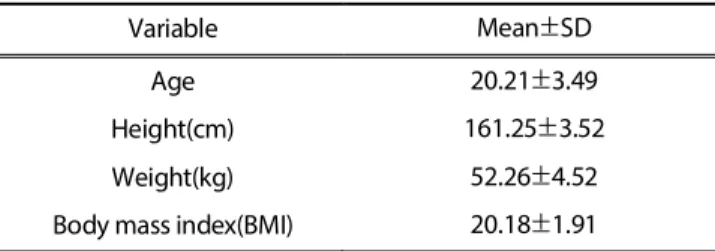
General characteristics of subjects are shown in Table 1. The average age of the subjects was 20.21±3.49 years old. The average height and weight and BMI of subjects were 161.25±3.52 cm, 52.26±4.52 kg, 20.18±1.91 kg/m 2 , respectively. The average BMI of subjects in this research shows a slightly was slightly less than the Korean Nutrition Society’ average BMI of 22 kg/m 2 for people over 20 years of age in 2005.

Dietary Habits

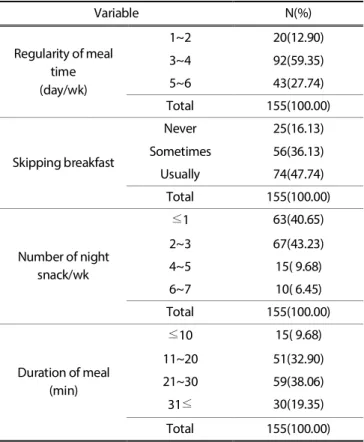
Table 2 shows the results of dietary habits, such as regularity of meal time, skipping breakfast, night snack and duration of meal by

Table 1. General characteristics of subjects

Variable Mean±SD

Age 20.21±3.49

Height(cm) 161.25±3.52

Weight(kg) 52.26±4.52

Body mass index(BMI) 20.18±1.91

subjects. The questions about what days on a regular meal time per week was 5 to 6(27.74%), 3 to 4(59.35%), less than two days (12.90%). In response to the 87.09% of subjects for more than three days a week, and this was found to be irregular. College student of Busan in the study of Ko MS(2007), meal time was shown to very regular(12.8%), regular(25.5%), regular or irregular(23.4%), irregular (38.3%). However the results show a response rate of slightly irregular(53.3%), always regular(15.2%), always irregular(31.4%) at the age of 20 in survey research of Dietary factors related to meal time(Jung IK, 2005), these results were similar to the findings of this study. College life is different from high school, it is considered that there are many difficulties in the regular dietary factors, such as part-time jobs, class time not considered personal eating and some free time. However, care should be taken to prevent this, since such eating can break the body’ nutritional balance, thus causing obesity or various geriatric diseases.

The response to the frequency of skipping breakfast was 47.74%

for usually and 36.13% for sometimes showing a higher rate of skipping breakfast, and the response to the number of night snack was 9.68% for 4~5 days a week and 43.23% for 2~3 days a week.

The result of duration of meal was 21~30 minutes, that was most common(38.06%), followed 11~20 minutes(32.90%), more than 31 minutes(19.35%), 10 minutes or less(9.68%), and most of the sub- jects were consumed 11 to 30 minutes for meals with 70.96%

response rate.

Healthy dietary patterns are associated with healthy lifestyle factors such as being more physically active(Brodney S et al., 2001;

and Sjoberg A et al., 2003) and regular consumption of main meals including breakfast(Sjoberg A et al., 2003). Adults who skip break- fast are at higher risk for weight gain and are more likely to have less healthy behaviors such as increased snacking, sedentary lifestyle, smoking and high BMI(Keski-Rahkonen A et al., 2003). It is considered important that young adult have regular daily meals with special attention to breakfast, which is often referred to as the most important meal of the day(Nicklas TA et al., 1993). The pre- sent study is in agreement with Sakamaki A et al. (2005) who reported that the majority of Japanese university students(81.0 %) ate three meals but were also more likely to skip breakfast.

However in Korea 58.9 % of university students ate twice a day and the most frequently skipped meal was breakfast. The present findings are also in agreement with Baric S et al.(2003), who also found breakfast to be the most frequently skipped meal in Croa- tian university students. As for survey skipping breakfast of college students followed gluttony and overeating because of irregular meals and late dinners(Lee HB & Yu YS 1995; Lee HS et al., 1998).

Also overeating of dinner is thought to cause loss of appetite. Both

the importance of breakfast and acquirable education of dietary

technology may be essential to health. Thus, there will be needed

importance of breakfast, education of regular life and a new cook

development to replace breakfast.

(3)

Table 2. Food habits of subjects

Variable N(%)

Regularity of meal time (day/wk)

1~2 20(12.90)

3~4 92(59.35)

5~6 43(27.74)

Total 155(100.00)

Skipping breakfast

Never 25(16.13)

Sometimes 56(36.13)

Usually 74(47.74)

Total 155(100.00)

Number of night snack/wk

≤1 63(40.65)

2~3 67(43.23)

4~5 15( 9.68)

6~7 10( 6.45)

Total 155(100.00)

Duration of meal (min)

≤10 15( 9.68)

11~20 51(32.90)

21~30 59(38.06)

31≤ 30(19.35)

Total 155(100.00)

Table 3. Dietary diversity score(DDS) and of subjects

N(%) Mean±S.D.

DDS

1~2 0 0

3~4 102(65.81) 3.62±0.50

5~6 53(34.19) 5.12±0.33

Total 155(100.00) 4.29±0.87

Nutrients Intake by Dietary Diversity Score(DDS)

The results of DDS were shown Table 3. DDS of the day was 4.29±0.87, 65.81% for 3~4 score and 34.19% for 5~6 score. The subjects were divided according to the DDS, and nutrient intake were analyzed by DDS(Table 4). Subjects with higher DDS(5~6) had significantly higher intake of nutrients such as energy, protein, carbohydrate, fiber, calcium, phosphate, iron, vitamin A, vitamin C, and cholesterol than those with lower DDS(3~4)(p<0.05). Average daily calories intake levels were insufficient of the EER(Estimated Energy Requirement) provided by the KDRIs(dietary reference Intakes for Koreans). In protein intake, subjects were found to be taking in adequate amounts, with 125.05% of RI(Recommended Intake) levels. Because of the overall nutrient intakes were in- sufficient, and especially the intake of calcium, iron, zinc, vitamin A, vitamin B 1 , vitamin B 2 , niacin, vitamin C and folic acid intake were lower than RI. The intake ratio of carbohydrates, protein, and fat was 56:16:28 for DDS 5~6 and 57:15:28 for DDS 3~4. Average daily cholesterol intake levels were 335.73 mg for DDS 5~6 and 305.15 mg for DDS 3~4, displaying significantly higher intake levels at DDS 5~6 than the DDS 3~4. Average daily nutrition intake levels were lower in subjects compared to the KDRIs, these results seem

to be related to the poor dietary habits such as skipping breakfast and irregular meal time. The excessive intake of carbohydrates can lead to considerably reduced intake of protein and fat. However, in this study, carbohydrate intake was lower ratio and fat intake was higher. Hence, in order to prevent chronic diseases, carbohydrates, fat, and protein should be consumed in an adequate ratio. In the daily mineral intake analysis, Ca intake was 58.98% and pho- sphorus intake was 111.26% of the RI level for Koreans in the same age groups, while the intake ratio of Ca and P was 1:2, showing higher intakes of P. While P-intake increased compared to the recommended intake ratio of 1:1 in the Korean Recommended Dietary Allowance(2005), the Ca and P ratio was recently found to be irrelevant to adults. But for women, Ca intake levels can influence bodily output in women after menopause and senescent osteoporosis, so increasing Ca intake in those years can help prevent osteoporosis(National Research Council, 1997). Fe intake was 71.86% of RI level, with lower percentages. This showed a close correlation with the results of studies on intake levels of iron- source foods - such as meats, fish and shellfish. Shim JE et al.(2001) reported that Fe intake for university students was 14.7 mg, while Hyun WJ et al.(2003) reported iron intake for female university students was 10 mg. According to the two studies, Koreans’ Fe intakes from meals ranged between 9.1~14.7 mg. Women should eat sufficient amounts of iron-rich foods, since iron is essential to women’s health considering their physiological characteristics - iron is lost during menstruation, required by the fetus during pregnancy, and required by the body in order to increase tissue- and stored iron-levels. Results of the daily vitamin intake analyses displayed vitamin A, vitamin B 1 , vitamin B 2 , niacin, vitamin C and folic acid levels lower than the RI levels, 93.65%, 95.61%, 81.87%, 92.47%, 49.07%, and 41.87%, respectively. Thiamin was lower in the heavier groups, respectively. Thiamin deficiency accompanies cardiovascular symptoms such as appetite and weight-loss, hyper- sensitiveness, myasthenia, and cardiomegaly. Sufficient intake- levels should be maintained, since serious deficiency leads to beriberi, a disorder in the nervous and cardiovascular system. Vita- min C deficiency reduces Fe absorption, so Fe deficiency is also seen to be related to vitamin C. Therefore, vitamin C sources, fresh vegetables and fruits, should be eaten in sufficient amounts, while new dishes that reduce cooking time, maintain acidity, and can be stored for long periods should be developed, considering the fact that fruits and vegetables easily oxidize, and vitamin C is easily destroyed in the preparation and cooking processes.

CONCLUSIONS

This study was performed to investigate the dietary habits, diversity of food intakes and nutrient intakes of some female college students in Yangju-si. A survey questionnaire on general characteristics and dietary habits, and daily intake using 24-hour recall method of 3 days were recorded by 155 female college students. Nutrient intakes and ratios were calculated using Can- pro 2.0, from which % of RDA(Recommended dietary allowances).

The average height and weight and BMI of subjects were 161.25

±3.52 cm, 52.26±4.52 kg, 20.18±1.91, respectively. The average

(4)

BMI of subjects in this research shows a slightly was slightly less than the Korean Nutrition Society’ average BMI of 22kg/m 2 for people over 20 years of age in 2005. In response to the 87.09% of subjects for more than three days a week, and this was found to be irregular. The response to the frequency of skipping breakfast was 47.74% for usually and 36.13% for sometimes showing a higher rate of skipping breakfast, and the response to the number of night snack was 9.68% for 4~5 days a week and 43.23% for 2~3 days a week. Subjects with higher DDS(5~6) had significantly higher intake of nutrients such as energy, protein, carbohydrate, fiber, calcium, phosphate, iron, vitamin A, vitamin C, and cho- lesterol than those with lower DDS(3~4)(p<0.05). Average daily nutrition intake levels were lower in subjects compared to the KDRIs, these results seem to be related to the poor dietary habits such as skipping breakfast and irregular meal time. In conclusion, Based on the above results, it was confirmed that the improve- ment of dietary habits could improve nutritional condition. These findings suggest that nutritional education based on female college students' eating variety and dietary habits(regularity of meal time, skipping breakfast and night snacks per week, and duration of meal) may be required to improve dietary variety. it is considered that the improvement in dietary habits will contribute to the improvement of nutrition. Therefore, it is considered that the effect of improved nutrition in college students will be ex- pected through the improvement in dietary habits.

REFERENCES

Baric, S., Salzburger, W., & Sturmbauer, C. (2003). Phylogeography and evolution of the Tanganyikan cichlid genus Tropheus ba- sed upon mitochondrial DNA sequences. J. Mol. Evol., 56:54- 68.

Brodney, S., McPherson, S., Carpenter, R. A., Welten, D., & Blair, S. N.

(2001). Nutrient intake of physically fit and unfit men and women. Med. Sci. Sports Exerc., 33:459-467.

Choi, S. N., Cung, N. Y., & Yun, M. E. (2002). A study on the food habits and the dietary behaviors of university students in Seoul.

Korean J. Diet. Culture, 17(1), 57-63.

Hyun, W. J. (2001). The relationship between obesity, lifestyle, and dietary intake and serum lipid level in male university students.

Korean J. Comm. Nutr., 6:162-171.

Jas, P. (1998). Aspects of food choice behaviour in adolescents. Nutr.

Food Sci., 3:163-165.

Jung, I. K. (2005). A study on the nutrient intakes and factors related to dietary behavior of women by age groups in Incheon. Ko- rean J. Comm. Nutr., 10:46-58.

Keski-Rahkonen, A., Kaprio, J., Rissanen, A., Virkkunen, M., & Rose, R.

J. (2003). Breakfast skipping and health-compromising beha- viors in adolescents and adults. Eur. J. Clin. Nutr., 57:842-853.

Kim, W. K., & Lee, K. A. (1998). Effect of food behaviors on nutrients and food intake in college students. J. Korean Soc. Food Sci. Nutr., Table 4. Nutrients intake by dietary diversity score(DDS) of subjects

Variable DDS=3~4

(n=102)

DDS=5~6

(n=53) Mean±S.D.

Energy(kcal) 1,351.42±250.31 * 1,731.72±216.74 1,543.71±393.18

Protein(g) 59.29±46.31 * 69.74±16.07 62.53±28.14

Fat(g) 51.86±14.18 53.26±8.70 52.69±15.55

Carbohydrate(g) 226.67±44.77 * 248.15±62.47 230.45±54.18

Fiber(g) 11.59±6.80 * 14.01±5.46 13.07±4.41

Ca(mg) 385.38±154.64 * 416.83±166.21 383.21±154.65

P(mg) 722.78±210.18 * 956.31±231.25 798.77±230.42

Fe(mg) 8.28±3.29 * 11.16±3.90 10.08±3.24

Na(mg) 3,064.13±913.65 3,624.31±1401.54 3,322.68±1,182.44

K(mg) 1,635.42±573.59 1,938.05±629.54 1,775.25±403.54

Zn(mg) 6.47±2.16 7.29±2.22 6.85±2.23

Vitamin A(μg RE) 571.91±278.23 * 778.45±558.87 667.24±437.35

Vitamin B 1 (mg) 0.99±0.31 1.11±0.35 1.05±0.45

Vitamin B 2 (mg) 0.89±0.27 1.08±0.38 0.98±0.39

Vitamin B 6 (mg) 1.40±0.51 1.67±0.47 1.53±0.52

Niacin(mg) 12.65±4.28 13.28±6.24 12.94±6.22

Vitamin C(mg) 42.54±18.93 * 59.68±27.03 49.07±23.75

Folic acid(μg) 165.44±65.22 169.31±70.28 167.47±66.86

Vitamin E(mg) 12.87±5.88 12.95±6.60 12.89±5.67

Cholesterol(mg) 305.15±112.53 * 335.73±102.36 318.47±105.34

(5)

27(6), 1285-1296.

Kimm, S. Y., Glynn, N. W., Kriska, A. M., Fitzgerald, S. L., Aaron, D. J., Similo, S. L., McMahon, R. P., & Barton, B. A. (2000). Longitudinal changes in physical activity in a biracial cohort during ado- lescence. Med. Sci. Sports Exerc., 32:1445-1454.

Ko, M. S. (2007). The comparison in daily intake of nutrients and dietary habits of college students in Busan. Korean J. Comm.

Nutr., 12:259-271.

Korean Nutrition Society (2005). Dietary Reference Intakes for Ko- reans. Hanareum Printing, Seoul. Republic of Korea.

Lee, H. B., & Yu, Y. S. (1995). A study on lunch meal practice of the college students in Seoul area. Korean J. Diet. Culture, 10:147- 154.

Lee, H. S., Lee, J. A., & Paik, J. J. (1998). A study of food habits, phy- sical status and related of college students in Chuncheon. Ko- rean J. Comm. Nutr., 3:34-43.

Lee, M. S., & Woo, M. K. (1999). Changes in food habit, nutritional knowledge and nutrition attitude of university students during nutrition course. Kor. J. Nutr., 32:735-745.

Lee, M. S., & Woo, M. K. (2003). Differences in the dietary and heal- threlated habits and quality of diet in university living in Dae- jeon. Korean J. Comm. Nutr., 8(1), 33-40.

Lee, Y. N., & Choi, H. M. (1994). A study on the relationship between body mass index and the food habits of college students. Ko- rean J. Diet. Culture, 9(1), 1-10.

Nicklas, T. A. (2003). Calcium intake trends and health consequ- ences from childhood through adulthood. J. Am. Coll. Nutr., 22:

340-356.

National Reserch Council (1997). Dietary Reference Intakes for Cal- cium, Phosphorus, Magnesium, Vitamin D, and Fluoride. National Academy Press. Washington, DC. USA.

Oh, H. S., & Min, S. H. (2001). A study on dietary attitudes of college

students in Wonju area. Korean J. Diet. Culture, 16(3), 215-224.

Pollit, E. (1990). Malnutrition and Infection in the Classroom. UNESCO, Paris.

Racette, S. B., Deusinger, S. S., Strube, M. J., Highstein, G. R., &

Deusinger, R. H. (2005). Weight changes, exercise, and dietary patterns during freshman and sophomore years of college. J.

Am. Coll. Health, 53:245-251.

Sakamaki, R., Amamoto, R., Mochida, Y., Shinfuku, N., & Toyama, K.

(2005). A comparative study of food habits and body shape perception of university students . Japan and Korea Nutr. J., 4:31.

Sanlier, N., & Unusan, N. (2007). Dietary habits and body compo- sition of Turkish university student. Pakistan J. Nutr., 6(4), 332- 338.

Seymour, M., Hoerr, S. L., & Huang, Y. (1997). Inappropriate dieting behaviors and related lifestyle factors in young adults : Are college students different? J. Nutr. Edu., 2(1), 21-26.

Shim, J. E., Paik, H. Y., Moon, H. K., & Kim, Y. O. (2001). Comparative analysis and evaluation of dietary intakes of Koreans by age.

Groups: (1) Nutrient intakes. Kor. J. Nutr., 34:554-567.

Slette, P. L., & Story, M. (1997). Child nutrition: Objectives for the decade. J. Am. Diet. Assoc., 91:665-668.

Sjoberg, A., Hallberg, L., Hoglund, D., & Hulthen, L. (2003). Meal pa- ttern, food choice, nutrient intake and lifestyle factors in the goteborg adolescence study. Eur. J. Clin. Nutr., 57:1569-1578.

You, J. S., Chang, K. J., & Byun, K. W. (1994). A study on nutrient ontake of college students. Korean Home Eco. Assoc., 32(4), 209- 216.

World Health Organization (WHO) (1995). Physical Status: The Use

and Interpretation of Anthropometry: Report of a WHO Expert

Committee. Geneva. World Health Organization; WHO Technical

Report Series 854.

수치

Table 2 shows the results of dietary habits, such as regularity of  meal time, skipping breakfast, night snack and duration of meal by
Table 2. Food habits of subjects  Variable  N(%)  Regularity of meal  time  (day/wk)  1~2  20(12.90) 3~4 92(59.35) 5~6 43(27.74)  Total  155(100.00)  Skipping breakfast  Never  25(16.13) Sometimes 56(36.13)  Usually  74(47.74)  Total  155(100.00)  Number o

참조

관련 문서

Using selected engine performance simulation results as input to the intake faces of the nozzles and ejector CFD simulation to determine pressure loss, temperature levels and

Objective : This study is to identify factors related to performance of hand washing in daily life for emergency Medical Technology students.. Methods : The study subjects

Four volumes of the text are used as a core text to instruct third and fourth year elementary school students in the rudiments of Korean language related to daily

A study on the relationship between body mass index and the food habits of college students. Keilins respiratory chain concept and its

The analysis was done on the school section that needs to be improved first and is the most basic out of the different issued related to the high school equalization such

This study aims to analyse the relations between stress and eating habits of adolescents as it was assumed that adolescents need lots of nutrients and eating habits

Second, the lower the academic achievement of middle school students, the more likely they were to participate in e-sports and addicted to games, whereas

□ The least-upper-bound property (sometimes called completeness or supremum property) is a fundamental property of the real number system. The least-upper-bound