Print ISSN: 2288-4637 / Online ISSN 2288-4645 doi:10.13106/jafeb.2020.vol7.no9.621
The Impact of Human Resource Management Activities on the Compatibility and Work Results
Duc Trung NGUYEN1, Van Dung HA2, Truong Thanh Nhan DANG3
Received: June 29, 2020 Revised: July 12, 2020 Accepted: August 10, 2020
Abstract
This research focuses on determining the impact of human resource management activities on the compatibility and work results of employees of Ho Chi Minh Stock Exchange (HOSE) listed companies. The paper includes five parts: introduction, literature review, research methodology, research results, and conclusion and policy implications. The data are collected from the survey of 350 listed companies in HOSE, in which 315 survey notes filled with sufficient information are used for analysis. The paper employs both qualitative method and quantitative method. Group discussion of 10 experts is for qualitative research. Quantitative method performs analysis of Statistics, Cronbach’s Alpha, EFA analysis, CFA analysis and SEM model. The results of the research clearly indicate that human resource management (HRM) activities are measured through improving the ability, improving the motivation and improving the opportunity. While compatibility is measured through suitability, connection and sacrifice; whereby HRM activities of ability improvement have a positive effect on the job suitability and connection; HRM activities of motivation improvement have a positive effect on the job suitability, connection and sacrifice; and HRM activities of opportunity improvement have a positive effect on the job suitability, sacrifice and connection; Finally, the job suitability, sacrifice and connection positively affect the work results of employees.
Keywords: Resource, Work Result, Improvement, Connection, Suitability JEL Classification Code: C31, J53, M12
organization. (Callea et al., 2016; Villajos et al., 2019;
Nguyen, 2020).
However, in the context of current economic development, the fierce competition has led to the consequences of moving human resources between units and sectors. In fact, units and sectors with good incomes and ideal working environment will increasingly attract and retain quality staff to serve the work and increase work results. This seriously affects the quality of staff as well as the work results of other units (Tian et al., 2016, Swalhi et al., 2017). In this context, it is essential to learn, research, analyze and evaluate the factors of human resource management activities affecting the work result.
Human resource management activities are considered as the basis and foundation to help better compatibility at work because the policies and supports from the unit for employees are expressed through human resource management activities, thereby promoting better work results (Tian et al., 2016). And now there are many domestic and foreign studies that are constantly being exploited and implemented, units in different sectors and fields also need to do this to increase the work result of their employees.
1. Introduction
Human resources are the key factors that make profits for the organization, they ensure all creative resources in the organization. People are still an important factor besides the equipment, assets to serve the development of the organization, because without people, it is impossible to operate those resources to bring the best results for the
1 First Author. Banking University Ho Chi Minh City, Vietnam.
Email: [email protected]
2 Corresponding Author. Institute for Banking Science and Technology Research, Banking University of Ho Chi Minh City, Vietnam [Postal Address: 39 Ham Nghi Street, District 1, Ho Chi Minh City, 70000, Vietnam] Email: [email protected]
3 Faculty of Business Administration, Banking University of Ho Chi Minh City, Vietnam. Email: [email protected]
© Copyright: The Author(s)
This is an Open Access article distributed under the terms of the Creative Commons Attribution Non-Commercial License (https://creativecommons.org/licenses/by-nc/4.0/) which permits unrestricted non-commercial use, distribution, and reproduction in any medium, provided the original work is properly cited.
Based on that foundation, the objective of this research is to identify and measure the impact of human resource management activities on the compatibility and work results of companies listed on HOSE. Based on the results, the research proposes administrative implications to improve the work result of those companies.
2. Theoretical Basis
2.1. Human Resource Management (HRM) Activities
The term of HRM is a strategic, integrated and coherent approach to the employment of staff in organizations. For Boxall et al. (2007), it is about managing the work and the people in the desired direction. Som (2008) described HRM as a carefully designed combination of works that aim to improve organizational efficiency and, thus, achieve better performance. Many researchers identified HRM in different ways. Researchers have given various names for human resource management activities such as “best practices” or
“high performance” (Huselid, 2005; Villajos et al., 2019),
“sophisticated” (Golhar & Deshpande, 1997; Hornsby &
Kuratko, 2000; Goss et al., 2004) or “professional” (Gnan
& Songini, 2003).
Human resource management activities are claimed to initiate positive exchange relationships especially when managers are able to provide evidence of consideration and attention to the individual needs of workers (Tian et al., 2016; Ong & Koh, 2018). Delery and Doty (2006) conceptualized human resource management activities as a set of consistent internal policies and methods established and applied to ensure the organization’s human resources in order to contribute to achieving its goals. Swalhi et al. (2017) described human resource management activities as a set of separate, but interrelated activities, functions and processes directed at attracting, developing and maintaining “human resources” of an organization.
For this research, human resource management activities are understood as consistent internal policies and methods established and applied to ensure the organization’s human resources contribute to achieving the organization’s goals, coming up with solutions for developing human resources and human resource management activities to help improve the ability, opportunity and motivation of employees. HRM activities of ability improvement are HRM activities that include recruitment, selection, training and development practices; human resource management activities that enhance the ability play a key role in determining the suitability of the work and the organization (Tian et al., 2016); HRM activities of opportunity improvement, according to Jiang et al. (2012), are human resource
management activities that create opportunities to carry out activities related to work design, team utilization, employee engagement, complaints and the process of handling complaints and sharing information widely and HRM activities of motivation improvement are activities designed to encourage employees to devote their efforts to the work, including those related to performance evaluation, compensation, work security and incentives for work (Tian et al., 2016).
2.2. Job Compatibility
The initial concept of job compatibility includes organization compatibility and community compatibility, all of that is expressed through three components: suitability, sacrifice, and connection. Suitability is defined as an employee’s awareness of compatibility or comfort with an organization; the better the suitability is, the more likely the employee will feel professional and attached to their employer (Mitchell et al., 2001); Sacrifices characterized by physical or psychological benefits can be lost by leaving current work (Mitchell et al., 2001; Aboul-Ela, 2017).
Therefore, financial losses (e.g., high salaries or attractive benefits) and psychological losses (e.g., loss of support from the organization) are important measures of sacrifice in the work of employees. Connections are formal or informal connections between a person and organizations or others (Mitchell et al., 2001). The more connections that tie an employee to others in the same organization, the more he or she becomes attached to work and the organization, reluctant to leave the organization.
Therefore, it can be understood that the job compatibility refers to how employees feel comfortable with the organization, are attached to their employer/ leaders, and are connected with their colleagues (Jiang et al., 2012). In studies that mention job compatibility, most scholars agreed that job compatibility consists of three independent components:
suitability, sacrifice, and connection.
2.3. Work Results
The employee’s work result shows that the employee’s
financial or non-financial results are directly linked to the
organization’s results and success (Nguyen et al., 2019). At
the same time, in order to improve employee’s work results,
it is necessary to focus on promoting employee engagement
(Tian et al., 2016). Research by Christian et al. (2011), Leiter
and Bakker (2010) also showed that the presence of high
level of employee engagement helps improve work results,
through the performance of civic organization’s duties and
behaviors, productivity, discretionary efforts, emotional
commitment, and ongoing commitment.
The work results are the direct and indirect contributions of employees to the work to achieve the organization’s goals.
A more recent definition by Swalhi et al. (2017) stated that work results are the total expected value that individuals perform on their assigned work. It is important to note that work results are difficult to track by a single indicator and instead, it closely resembles an underlying structure, evaluated and measured by many different factors (Callea et al., 2016).
2.4. Research Hypotheses
2.4.1. The Relationship between Compatibility and Work Results
Although job compatibility has been studied primarily as work that affects the revenue of organizations, there are also many studies showing that it can also have an impact on work results and civic behavior (Burton et al., 2010; Lev
& Koslowsky, 2012). In two aspects of job compatibility, research showed that compatibility with the organization is a better predictor of work results than compatibility with the community (Sekiguchi et al., 2008). It is argued that people with high organizational cohesion tend to be motivated to achieve higher work results (Tian et al., 2016). Sekiguchi et al. (2008) and Villajos et al. (2019) argued that employees engage with projects and relate to each other at work who feel appropriate to their work and can apply their skills (i.e., suitability) and believe that they will lose valuable things if they leave their work (that is, sacrifice), so they must try to perform their work and duties well. Harris et al. (2011), and Wheeler et al. (2012) argued that job compatibility involves factors of suitability, sacrifice, and connection that promote work results through the benefits that result from the work (for example, better access to advice and job support). The factors of suitability, sacrifice and connection almost have a positive impact on the work results (Feldman, 2013; Aboul- Ela, 2017). Therefore, the author proposes the following hypothesis:
H1. Suitability (a), Sacrifice (b) and Connection (c) in the organization have a positive effect on Work results.
2.4.2. The Relationship between Human Resource Management Activities and Compatibility
Empirical studies have shown that HRM activities have a positive impact on employees’ commitment and satisfaction, resulting in better work results (Kehoe & Wright, 2013); and improve revenue results (Kehoe & Wright, 2013), improve productivity and financial efficiency (Callea et al., 2016).
Recent assessments suggest that the close combination
of HRM activities is likely to support the performance of any individual better, and it has a positive impact on job compatibility, which improves job fit, sacrifice, and connection (Kehoe & Wright, 2013). Studies and assessments of HRM activities also show the positive contribution of HRM activities to the increase of job suitability, sacrifice and connection (Jiang et al., 2012).
HRM activities help improve the motivation to increase employees’ efforts and perseverance, as well as improve the opportunity to empower employees to use their skills and motivation to achieve the organization’s goals, teamwork, engagement in decision making and information sharing (Gardner et al., 2011; Ong et al., 2019). Job compatibility can be developed through HRM activities, and many studies have examined the impact of HRM activities on job compatibility (Bambacas & Kulik, 2013). Bergiel et al. (2009) found that job compatibility was an intermediary factor in promoting HRM activities for improving the work results. Bambacas and Kulik (2013) found that job compatibility is an intermediary factor between employees’ perceptions of HRM activities (employee development, performance assessment, rewards) and revenue issues.
As regards HRM activities of ability improvement, HRM activities include recruitment, selection, training and development practices; human resource management activities of ability improvement play a key role in determining the suitability with the job and organization.
However, because training and development leads to an increase in employees’ cognitive benefits at work, HRM activities have a positive impact on job compatibility.
HRM activities of ability improvement are a stepping stone to improving the job suitability, sacrifice and connection because the increase in training and development activities contributes significantly to improved employees’ positive thoughts and engagement with the organization (Tian et al., 2016). Therefore, the author proposes the following hypothesis:
H2. HRM activities of ability improvement have a positive effect on the job suitability, sacrifice and connection.
HRM activities of motivation improvement are activities
designed to encourage employees to devote themselves to
their work, including those related to performance assessment,
compensation, job security and incentives (Kehoe & Wright,
2013; Tian et al., 2016). Ensuring safe and rewarding job that
enhances the suitability for all employees at the place where
they are staying and their sense of job sacrifice is the main
task in HRM activities of motivation improvement (Tian
et al., 2016). In many cases, the assessment of work results is
based on many relationships (colleagues, subordinates) and
many other impact factors (Tian et al., 2016). Motivations
in HRM activities are seen as the basis for improving the job suitability, sacrifice and connection (Kehoe & Wright, 2013; Tian et al., 2016). Therefore, the author proposes the following hypothesis:
H3. HRM activities of motivation improvement have a positive effect on the job suitability, sacrifice and connection.
HRM activities of opportunity improvement, according to Jiang et al. (2012), are human resource management activities that create opportunities to carry out activities related to work design, team utilization, participation of employees, complaints, and the process of handling complaints and sharing information widely. Job characteristics such as autonomy and diverse skills that provide flexibility and discretion allow a person to achieve a greater suitability in knowledge, skills, abilities, and other personal attributes (Tian et al., 2016, Swalhi et al., 2017). Teamwork and employee engagement are likely to strengthen relationships with others in the workplace (connection), while the tradeoff between current functions and tasks and opportunities in the future is something that must be considered upon the assessment of HRM activities (sacrifice) (Callea et al., 2016, Swalhi et al., 2017, Ha, 2020). Therefore, the author proposes the following hypothesis:
H4. HRM activities of opportunity improvement have a positive effect on the job suitability, sacrifice and connection.
3. Research Methods
Here are the two methods used:
- Qualitative method: The author conducts discussions
with 10 experts to collect ideas about adjusting or adding scales to the research context.
- Quantitative method: It is used to analyze survey data
from 315 companies listed on the HOSE. Survey forms are sent via post and the author calls to remind the companies.
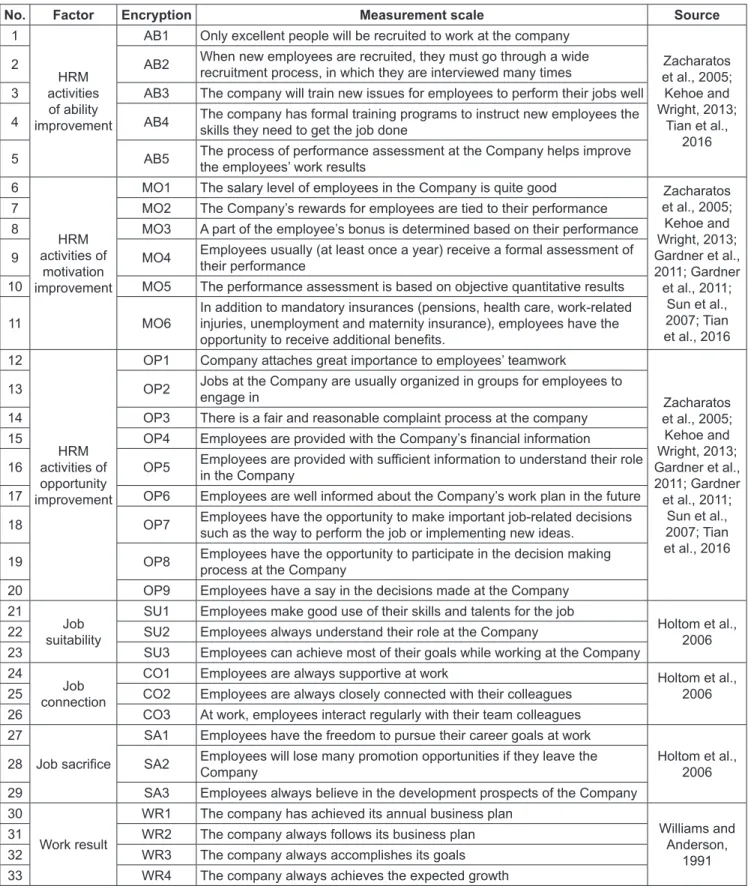
Basic analytical techniques (Statistics, Cronbach’s Alpha, EFA, CFA, and SEM) are conducted by SPSS 20 and AMOS 20 software to demonstrate the impact of human resource management activities on the compatibility and work result of companies listed on HOSE (see Table 1).
It is necessary to investigate the samples whose number must be five times the number of variables (Hoang & Chu, 2008). Therefore, the minimum sample size of this study is 165 samples, corresponding to 33 variables. However, to ensure high representativeness, the paper surveys 350 samples, which produced 315 valid observations. Out of 315 subjects surveyed, there were 112 women, accounting for 35.6%, and 203 men, accounting for 64.4%; Deputy director positions accounted for the highest proportion, with 58.1%;
The age group is mainly above 30 years old at the proportion of 85.4% and the seniority is mostly over 5 years with 90.8%.
4. Research Results
Cronbach’s Alpha analysis results show that the variables have the corrected item total correlation greater than 0.3 (except for variables/scales of AB5, MO2, OP7, OP8, OP9) and Cronbach’s Alpha indexes were greater than 0.7.
28 variables belonging to factors AB (HRM activities of ability improvement), MO (HRM activities of motivation improvement), OP (HRM activities of opportunity improvement), SU (Job suitability), CO (Job connection), SA (Job sacrifice), and WR (Work result)) are included in the Exploratory Factor Analysis (EFA). EFA analysis results show that KMO = 0.760 > 0.5 and the Chi-Square statistic of Bartlett’s test is valued 7,590.922 with Sig. = 0,000 << 0.05.
Therefore, all variables are satisfactory to include in the model analysis (see Table 2).
The eigenvalue is 1.247 greater than 1 and stops at the third line with the total variance extracted is 72.456%
greater than 50%. This value is quite high with 72.456% of data variability explained by three factors. At the same time, all factor loads are greater than 0.5 and arranged in seven separate groups of factors. These are groups of factors AB, MO, OP, SU, CO, SA, and WR.
The results of CFA analysis show that the convergence concepts and data ensure the requirements for model analysis, because, CFA analysis results show that the value of Chi- square/df = 2.252 is less than 5, GFI = 0.861 > 0.8, TLI = 0.937 > 0.9, CFI = 0.945 > 0.9 and RMSEA = 0.063 < 0.1. At the same time, standardized results of CFA show the factor weights are greater than 0.5. Thus, with CFA analysis results, the main factors are included in the analysis, which are: AB, MO, OP, SU, CO, SA, and WR.
Along with that, the factors ensure reliability when included in the analysis, because the variance extracted is greater than 0.7 and composite reliability is higher than 0.5.
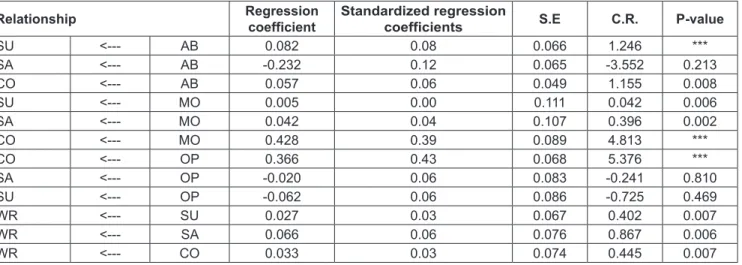
The values reach discriminant value, which is shown by the correlation of the significant factors at 5%. The results of the Structural Equation Model SEM are suitable. This is reflected in such indicators as: Chi-square/df value = 2,251 < 5, GFI
= 0.859 > 0.8, TLI = 0.937 > 0.9, CFI = 0.945 > 0.9 and RMSEA = 0.063 < 0.1 (see Table 3).
At the same time, based on P-value values, the statistically significant relationship of the factors is shown, namely:
- HRM activities of ability improvement are statistically significant in influencing job suitability and job connection because P-value values are 0,000 and 0.008, less than 5%.
HRM activities of motivation improvement are statistically
significant in influencing job suitability, job connection and
job sacrifice because P-value values are 0.006; 0,000 and
0.002. And HRM activities of opportunity improvement are
statistically significant in influencing job connection because
the P-Value value is 0,000.
Table 1: Measurement scales for the factors
No. Factor Encryption Measurement scale Source
1
activities HRM of ability improvement
AB1 Only excellent people will be recruited to work at the company
Zacharatos et al., 2005;
Kehoe and Wright, 2013;
Tian et al., 2016 2 AB2 When new employees are recruited, they must go through a wide
recruitment process, in which they are interviewed many times
3 AB3 The company will train new issues for employees to perform their jobs well 4 AB4 The company has formal training programs to instruct new employees the
skills they need to get the job done
5 AB5 The process of performance assessment at the Company helps improve the employees’ work results
6
activities of HRM motivation improvement
MO1 The salary level of employees in the Company is quite good Zacharatos et al., 2005;
Kehoe and Wright, 2013;
Gardner et al., 2011; Gardner et al., 2011;
Sun et al., 2007; Tian et al., 2016 7 MO2 The Company’s rewards for employees are tied to their performance
8 MO3 A part of the employee’s bonus is determined based on their performance 9 MO4 Employees usually (at least once a year) receive a formal assessment of
their performance
10 MO5 The performance assessment is based on objective quantitative results 11 MO6 In addition to mandatory insurances (pensions, health care, work-related
injuries, unemployment and maternity insurance), employees have the opportunity to receive additional benefits.
12
activities of HRM opportunity improvement
OP1 Company attaches great importance to employees’ teamwork
Zacharatos et al., 2005;
Kehoe and Wright, 2013;
Gardner et al., 2011; Gardner et al., 2011;
Sun et al., 2007; Tian et al., 2016 13 OP2 Jobs at the Company are usually organized in groups for employees to
engage in
14 OP3 There is a fair and reasonable complaint process at the company 15 OP4 Employees are provided with the Company’s financial information
16 OP5 Employees are provided with sufficient information to understand their role in the Company
17 OP6 Employees are well informed about the Company’s work plan in the future 18 OP7 Employees have the opportunity to make important job-related decisions
such as the way to perform the job or implementing new ideas.
19 OP8 Employees have the opportunity to participate in the decision making process at the Company
20 OP9 Employees have a say in the decisions made at the Company
21 Job
suitability
SU1 Employees make good use of their skills and talents for the job
Holtom et al., 22 SU2 Employees always understand their role at the Company 2006
23 SU3 Employees can achieve most of their goals while working at the Company
24 Job
connection
CO1 Employees are always supportive at work Holtom et al.,
2006 25 CO2 Employees are always closely connected with their colleagues
26 CO3 At work, employees interact regularly with their team colleagues 27
Job sacrifice
SA1 Employees have the freedom to pursue their career goals at work
Holtom et al., 28 SA2 Employees will lose many promotion opportunities if they leave the 2006
Company
29 SA3 Employees always believe in the development prospects of the Company 30
Work result
WR1 The company has achieved its annual business plan
Williams and Anderson,
1991
31 WR2 The company always follows its business plan
32 WR3 The company always accomplishes its goals
33 WR4 The company always achieves the expected growth
Table 2: Rotated Component Matrix
Component
1 2 3 4 5 6 7
OP3 0.942
OP6 0.939
OP1 0.873
OP4 0.859
OP2 0.799
OP5 0.794
MO5 0.990
MO1 0.985
MO6 0.645
MO3 0.587
MO4 0.556
WR3 0.896
WR2 0.827
WR4 0.812
WR1 0.752
AB3 0.877
AB2 0.809
AB4 0.795
AB1 0.759
SU3 0.899
SU2 0.891
SU1 0.842
CO3 0.887
CO2 0.885
CO1 0.604
SA2 0.848
SA1 0.841
SA3 0.733
Eigenvalues 7.177 3.274 2.699 2.248 1.920 1.722 1.247
% of Variance 25.633 11.695 9.639 8.028 6.858 6.151 4.453
Cumulative % 25.633 37.328 46.967 54.995 61.852 68.003 72.456
Table 3: Results from SEM model
Relationship Regression
coefficient Standardized regression
coefficients S.E C.R. P-value
SU <--- AB 0.082 0.08 0.066 1.246 ***
SA <--- AB -0.232 0.12 0.065 -3.552 0.213
CO <--- AB 0.057 0.06 0.049 1.155 0.008
SU <--- MO 0.005 0.00 0.111 0.042 0.006
SA <--- MO 0.042 0.04 0.107 0.396 0.002
CO <--- MO 0.428 0.39 0.089 4.813 ***
CO <--- OP 0.366 0.43 0.068 5.376 ***
SA <--- OP -0.020 0.06 0.083 -0.241 0.810
SU <--- OP -0.062 0.06 0.086 -0.725 0.469
WR <--- SU 0.027 0.03 0.067 0.402 0.007
WR <--- SA 0.066 0.06 0.076 0.867 0.006
WR <--- CO 0.033 0.03 0.074 0.445 0.007
- Job suitability, job sacrifice and job connection are statistically significant in influencing job performance because the P-value values are 0.007; 0.006 and 0.007.
- Meanwhile, HRM activities of ability improvement are statistically significant in influencing job sacrifice because the P-value value is 0.213, greater than 5%. And HRM activities of opportunity improvement are not statistically significant in influencing job sacrifice and job suitability because P-value values are 0.810 and 0.469, which are higher than 5%.
Along with that, the regression coefficients are greater than zero, showing a positive relationship between factors, namely:
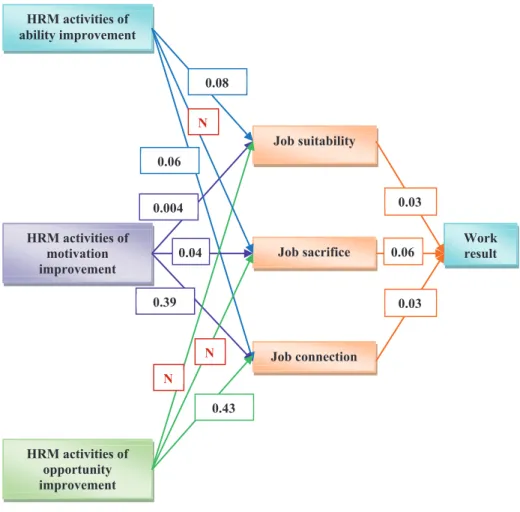
HRM activities of ability improvement have a positive impact on job suitability and job connection with impact factors of 0.08 and 0.06; so, when HRM activities of ability improvement are better (increase by 1 time), the job suitability and job connection will increase by 0.08 times and 0.06 times respectively. HRM activities of motivation improvement have a positive impact on job suitability, job
connection and job sacrifice with impact factors of 0.004;
0.39 and 0.04; so, when HRM activities of motivation improvement are better (increase by 1 time), the job suitability, job connection and job sacrifice will increase by 0.004 times; 0.39 times and 0.04 times. HRM activities of opportunity improvement have a positive impact on job connection with an impact factor of 0.43; so, when HRM activities of opportunity improvement are better (increase by 1 time), the job connection will increase by 0.43 times.
And job suitability, job sacrifice and job connection have a positive impact on work results with impact factors of 0.03; 0.06 and 0.03; so, when the job suitability, job sacrifice and job connection are respectively better (increase by 1 time), the work results will increase by 0.03 times;
0.06 times and 0.03 times. Thus, after performing analysis of linear SEM structure model, the research showed the impact of human resource management activities on the compatibility and work result of companies listed on HOSE (see Figure 1).
N: No effects
HRM activities of ability improvement
HRM activities of motivation improvement
HRM activities of opportunity improvement
Job suitability
Job sacrifice
Job connection
Work result 0.03
0.06 0.03 0.08
0.04 0.39
0.43 N
N 0.06
N 0.004
Figure 1: The results from SEM
5. Conclusion and Policy Implications 5.1. Conclusion
This research focuses on determining the impact of human resource management activities on the compatibility and work results of companies listed on HOSE. The results of the research clearly indicate that human resource management (HRM) activities are measured through improving the ability, improving the motivation and improving the opportunity, while compatibility is measured through suitability, connection and sacrifice. HRM activities of ability improvement have a positive impact on the job suitability and connection; HRM activities of motivation improvement have a positive impact on the job suitability, connection and sacrifice; and HRM activities of opportunity improvement have a positive impact on the job suitability, sacrifice and connection. Finally, the job suitability, sacrifice and connection positively affect the work result.
5.2. Policy Recommendations
The paper proposes the following policy implications to improve the work results of the companies listed on the HOSE:
Companies should improve the job compatibility through activities. Companies should always create conditions for employees to use their skills and talents well at work;
as well as show employees the benefits of working at the company; enhance the propaganda activities on the goals and orientations of the company for employees to know, thereby helping employees understand and set out the direction to achieve their specific work goals. Moreover, the companies need to show their employees the short-term and long-term working plans of the company and associate them to the development and growth of scale and sales. It is especially important to promote the employees’ working attitude, clearly defining the employees’ roles, responsibilities and obligations so that they are well aware of their job positions, thereby showing their key role in the company.
Companies enhance human resource management activities. Companies need to have recruitment and training plans and training programs, which are suitable to the current situation and needs. It requires the development of specific criteria in evaluating work performance and assessing work results that must ensure the timeliness. Salaries, bonuses and allowances must be delivered on time and granted according to the capacity and working ability of each employee.
References
Aboul-Ela, G. M. (2017). Reflections on Workplace Compassion and Job Performance. Journal of Human Values, 23(3), 234-243.
Bambacas, M., & Kulik, C. T. (2013). Job embeddedness in china:
how HR practices impact turnover intentions. The International Journal of Human Resource Management, 24(10), 1933-1952.
Bergiel, E. B., Nguyen, V. Q., Clenney, B. F., & Taylor, G. S. (2009).
Human resource practices, job embeddedness and intention to quit. Management Research News, 32(3), 205-219.
Boxall, P., Purcell, J., & Wright, P. (2007). Human Resource Management: scope, analysis and significance. In: P. Boxall, J.
Purcell, & P. Wright (Eds.), The Oxford Handbook of Human Resource Management. Oxford, UK: Oxford University Press.
Burton, J. P., Holtom, B. C., Sablynski, C. J., Mitchell, T. R., & Lee, T. W. (2010). The buffering effects of job embeddedness on negative shocks. Journal of Vocational Behavior, 76(1), 42-51.
Callea, A., Urbini, F., & Chirumbolo, A. (2016). The mediating role of organizational identification in the relationship between qualitative job insecurity, OCB and job performance. Journal of Management Development, 35(6), 735-746.
Christian, M. S., Garza, A. S., & Slaughter, J. E. (2011). Work engagement: a quantitative review and test of its relations with and contextual performance. Personnel Psychology, 64(1), 89-136.
Delery, J. E., & Doty, H. D. (2006). Modes of Theorizing in Strategic Human Resource Management: Tests of Universalistic, Contingency, and Configurational Performance predictions.
Academy of Management Journal, 39(4), 802-835.
Feldman, S. (2013). Cognitive Consistency: Motivational Antecedents and Behavioral Consequents. New York, NY:
Academic Press.
Gardner, T. M., Wright, P. M., & Moynihan, L. M. (2011). The impact of motivation, empowerment, and skill-enhancing practices on aggregate voluntary turnover: the mediating effect of collective affective commitment. Personnel Psychology, 64(2), 315-350.
Gnan, L., & Songini, L. (2003). The Professionalization of Family Firms: The Role of Agency Cost Control Mechanisms. FBN Proceedings (pp.141-172). Milan, Italy.
Golhar, D., & Deshpande, S. P. (1997). HMR Practices of Large and Small Canadian Manufacturing Firms. Journal of Small Business Management, 35(3), 30-38.
Goss, D., Adam-Smith, D., & Gilbert, A. (2004). Small Firms and HRM: Exceptions that Prove the Rule? Journal of Small Business and Enterprise Development. 1(2), 2-8.
Ha, V. D. (2020). The Impacts of Empowerment on the Teamwork Performance: Evidence from Commercial Banks in Vietnam.
Journal of Asian Finance, Economics, and Business, 7(4), 267-273. https://doi.org/10.13106/jafeb.2020.vol7.no4.267 Harris, K. J., Wheeler, A. R., & Kacmar, K. M. (2011). The mediating
role of organizational job embeddedness in the LMX-outcomes relationships. The Leadership Quarterly, 22(2), 271-281.
Hoang, T., & Chu, N. M. N. (2008). Textbook of Data Analysis with SPSS Episodes 1 & 2. Ho Chi Minh City, Vietnam: Hong Duc Publishing. [Vietnamese]
Holtom, B., Mitchell, T., & Lee, T. (2006). Less is more: validation of a short form of the job embeddedness measure and theoretical extensions. Annual meeting of the Academy of Management Conference, Atlanta, GA.
Hornsby, J. S., & Kuratko, D. K. (2000). Human Resource Management in Small Business: Critical Issues for the 1990s.
Journal of Small Business Management, 28 (3), 9-18.
Huselid, M. A. (2005). The Impact of Human Resource Management Practices on Turnover, Productivity and Corporate Financial Performance. Academy of Management Journal, 38, 635-670.
Jiang, K., Lepak, D. P., Hu, J., & Baer, J. C. (2012). How does human resource management influence organizational outcomes?
A meta-analytic investigation of mediating mechanisms, Academy of Management Journal. 55(6), 1264-1294.
Kehoe, R. R., & Wright, P. M. (2013). The impact of high performance human resource practices on employees’ attitudes and behaviors. Journal of Management, 39(2), 366-391.
Leiter, M. P., & Bakker, A. B. (2010). Work engagement:
introduction. In: Bakker, A.B. and Leiter, M. P. (Eds.). Work engagement: A Handbook of Essential Theory and Research.
Hove, UK: Psychology Press.
Lev, S., & Koslowsky, M. (2012). On-the-job embeddedness as a mediator between conscientiousness and school teachers’
contextual performance. European Journal of Work and Organizational Psychology, 21(1), 57-83.
Mitchell, T. R., Holtom, B. C., Lee, T. W., Sablynski, C. J., &
Erez, M. (2001). Why people stay: using job embeddedness to predict voluntary turnover. Academy of Management Journal, 44(6), 1102-1121.
Nguyen, M. H., Nguyen, C., Ngo, T. T., & Nguyen, L. V. (2019).
The Effects of Job Crafting on Work Engagement and Work Performance: A Study of Vietnamese Commercial Banks.
Journal of Asian Finance, Economics, and Business, 6(2), 189-201. https://doi.org/10.13106/jafeb.2019.vol6.no2.189 Nguyen, T. H. (2020). Impact of Leader-Member Relationship
Quality on Job Satisfaction, Innovation and Operational Performance: A Case in Vietnam. Journal of Asian Finance, Economics, and Business, 7(6), 449-456. https://doi.
org/10.13106/jafeb.2020.vol7.no6.449
Ong, C. H., & Koh, R. J. (2018). The Influence of Human Resources Management Practices on Employee Performance in the Manufacturing Sector in Malaysia. International Journal of Human Resources Studies, 8(2), 129-147.
Ong, C. H., Maria, A. H., Lim, L. P., Tan, O. K., & Goh, C. F.
(2019). The relationship between human resource management practices and job performance in the courier service industry.
International Journal of Academic Research in Business &
Social Sciences, 9(3), 64-79.
Sekiguchi, T., Burton, J. P., & Sablynski, C. J. (2008). The role of job embeddedness on employee performance: the interactive effects with leader-member exchange and organization-based self-esteem. Personnel Psychology, 61(4), 761-792.
Som, A. (2008). Innovative human resource management and corporate performance in the context of economic liberalization in India. The International Journal of Human Resource Management, 19(7), 1278-1297.
Sun, L. Y., Aryee, S., & Law, K. S. (2007). High-performance human resource practices, citizenship behavior, and organizational performance: a relational perspective. The Academy of Management Journal, 50(3), 558-577.
Swalhi, A., Zgoulli, S., & Hofaidhllaoui, M. (2017). The influence of organizational justice on job performance: The mediating effect of affective commitment. Journal of Management Development, 36(4), 542-559.
Tian, A. W., Cordery, J., & Gamble, J. (2016). Staying and performing: How human resource management practices increase job embeddedness and performance. Personnel Review, 45(5), 947-968.
Villajos, E., Tordera, N. & Peiró, J. M. (2019). Human resource practice, eudaimonic well-being, and creative performance:
The mediating role of idiosyncratic deals for sustainable human resource management. Sustainability, 11, 1-20. doi:10.3390/
su11246933.
Zacharatos, A., Barling, J., & Iverson, R. D. (2005). High- performance work systems and occupational safety. Journal of Applied Psychology, 90(1), 77-93.
Wheeler, A. R., Harris, K. J., & Sablynski, C. J. (2012). How do employees invest abundant resources? The mediating role of work effort in the job-embeddedness/job-performance relationship. Journal of Applied Social Psychology, 42(1), 244-266.
Williams, L. J., & Anderson, S. E. (1991). Job satisfaction and organizational commitment as predictors of organizational citizenship behavior and in-role behaviors. Journal of Management, 17(1), 601-617.