• 검색 결과가 없습니다.

Intra-Organizational Factors Affecting Business Performance: An Empirical Study in Vietnam

N/A
N/A
Protected

Academic year: 2021

Share "Intra-Organizational Factors Affecting Business Performance: An Empirical Study in Vietnam"

Copied!
10
0
0

로드 중.... (전체 텍스트 보기)

전체 글

(1)

Print ISSN: 2288-4637 / Online ISSN 2288-4645 doi:10.13106/jafeb.2021.vol8.no10.0119

Intra-Organizational Factors Affecting Business Performance:

An Empirical Study in Vietnam

Khuong Ngoc MAI

1

, Thao Thi Thanh NGUYEN

2

, Phuong Ngoc Duy NGUYEN

3

, Khoa Tien TRAN

4

Received: June 15, 2021 Revised: August 29, 2021 Accepted: September 06, 2021

Abstract

In the era of industry 4.0 with the robust digital transformation, especially under the trigger of the Covid-19 pandemic, the process of transforming businesses to achieve the desired business performance depends much on the mindset transformation of each member of the organization, beginning with the thoughts of leadership and stakeholders. This study will evaluate the relationship between leadership’s strategic reasoning perspectives on employee engagement or commitment and the company’s reputation, thereby directly or indirectly affecting organizational performance. The study examines data from 382 companies out of 500 samples in typical industries in Vietnam using the exploratory factor analysis (EFA) and partial least squares structural equation modeling (PLS-SEM) techniques. The results show that holistic thinking is closely related to employee retention and corporate reputation, thereby increasing the business outcomes of the organization, whereas there was no evidence to support analytical thinking in this study. As a consequence, transforming the business to achieve the desired business performance is heavily reliant on changing the mindset of each member of the organization, beginning with the top leaders and influencers of the business. This will assist Vietnamese leaders in gaining a comprehensive understanding of corporate governance and controlling the relationships between organizational constructs.

Keywords: Rational Reasoning Perspective, Creative Reasoning Perspective, Business Performance, Employee Commitment, Company Reputation

JEL Classification Code: M10, M12, M14

each other, and even the local and global cultures. Nobody denies the impacts of this revolution. It transforms the very basics of our social lives into a new normal. Living in the world of unpredictable changes and continuous innovation, besides struggling with reinventing their business models, companies keep improving their business results - not just sales and return on investment (ROI) but also their reputation by carefully investigating the effects of many antecedents.

Among those various factors influencing the firm’s outcomes, leadership prospects, employee commitment, and company reputations are considered highly interrelated, especially in developing countries like Vietnam.

The strategist’s mind determines how the organization operates and achieves its vision, mission, and specific goals, objectives, and strategic direction. Many management theory scholars have observed that the contrary of intuition and analysis cause stress for top managers (Boland &

Pondy, 1983; Langley, 1989; Langley et al., 1995). There is widespread agreement that executives must implement both analytic and intuitive thinking, even if they are opposed to

1

First Author. Vice Dean, School of Business, International University, Ho Chi Minh City, Vietnam. Email: [email protected]

2

Corresponding Author. Ph.D. Candidate, School of Business, International University, Ho Chi Minh City, Vietnam [Postal Address:

45, 6D Street, Trung Son Residence Area, Binh Hung Ward, Binh Chanh District, Ho Chi Minh City, 700000, Vietnam]

Email: [email protected]

3

Lecturer, School of Business, International University, Ho Chi Minh City, Vietnam. Email: [email protected]

4

Rector, School of Business, International University, Ho Chi Minh City, Vietnam. Email: [email protected]

© Copyright: The Author(s)

This is an Open Access article distributed under the terms of the Creative Commons Attribution Non-Commercial License (https://creativecommons.org/licenses/by-nc/4.0/) which permits unrestricted non-commercial use, distribution, and reproduction in any medium, provided the original work is properly cited.
1. Introduction

The explosion of advanced technologies accompanied by

globalization is driving a revolution that evolves the ways

people work, produce goods, deliver service, interact with

(2)

it, while some researchers argue strongly for formal analysis (Isenberg, 1984; Schoemaker & Russo, 1993).

Employees are also seen as one of the most essential stakeholders in a business and a vital component of its performance, both as a goal and as a contributor to its progress. As competition in the global market increases, managers should be aware of the most effective strategies for improving results and adapting them to their organizations (Ellis, 2010). Human resources management must be improved and stimulated to improve the social climate, employee retention, job satisfaction, and productivity, as well as people’s engagement with their jobs and organizations.

However, there exists a gap between employee’s comprehension and execution of the leader’s strategic direction of the company. This affects employee commitment to the company which, in turn, could directly or indirectly affect the firm competencies. Last but not the least, corporate reputation is regarded as the business differentiation signal and its competitive advantage in the market. And the connection between reputation and corporate performance can be argued as a two-way relation (López & Iglesias, 2010;

Park et al., 2014).

This study focuses on studying the impact of reasoning perspectives on company reputation, and employee commitment that directly or indirectly influences the business performance of companies in Vietnam, by using SEM analysis.

2. Literature Review and Hypotheses

Successful company outcomes necessitate a diverse set of organizational and managerial skills that take advantage of market opportunities. It is critical for all company leaders and stakeholders to gain a better understanding of the factors influencing the successful development of business performance. Many previous studies have highlighted the critical roles of strategic reasoning perspectives, company reputation, and employee commitment in improving business performance. Corporate reputation is one of the most important instruments in growth strategies for entering new markets, increasing current market share, and providing the company with a competitive advantage. It does, in many ways, motivate future employees to apply for jobs and present employees to stay with and work for the companies.

2.1. Strategist Reasoning Perspectives

This study concentrates on the aspects of strategic thinking (SC), known as preconceived perspectives held by executives when facing strategy issues. SC has become one of the major streams for strategic management theory and empirical research in recent years (Ohmae, 1991;

Huff, 1990) Intuitive and analytical thinking are the two

most typical sorts of strategist perspectives. When people use their intuition, their latent information from the past directs their reasoning (Behling & Eckel, 1991). Intuitive thinking is a type of informal and holistic thinking that is said to lead to more creative organization. Informal thought refers to thinking that is mostly unconscious and is based on assumptions, variables, and causal links that people who do think are unable to openly recognize. The term “holistic”

is a thinker who maintains a more integrated perspective on reality, instead of trying to dissect phenomena in their components.

Logical thinking, on the other hand, is a disciplined and meticulous thinking approach based on formal rules, data, facts, and processes. When using logic, each step in a discussion follows the previous ones and is founded on sound disciplines.

Hence, a logical thinker will only reach a conclusion if it is supported by a strong chain of reasoning. The strategists can avoid the construction of a false model of reality, by analyzing empirical data and by precisely testing the assumptions that build a common cognitive map (Meyer, 2017).

In general, leadership reasoning perspectives, regard- less of creative or analytical perspectives, are thought to determine the strategic direction that leads to a firm’s outcomes in both direct and indirect ways. In explaining strategy and, therefore, competitive advantages for enterprises, the strategic cognition perspective attributed causal relevance to cognitive processes and structures.

According to Nadkarni and Narayanan (2007b), the company’s strategy used to be described in cognitive terminology to explain business performance at the organizational level (Nadkarni & Narayanan, 2007a).

However, top management team and organizational-level cognition may be included in the CEO’s thinking in smaller organizations, such as startups or those in which the CEO wields significant and centralized power (Staw, 1991). As a result, power style and company size should be considered in the analysis of firm-level strategic choice Narayanan et al. (2011) reported that SC included three kinds of outputs:

process results which means the quality, speed and risk of decision making, strategic actions indicating outside or inside oriented actions, such as competitive movements, resource allocation and the numbers of action or delays, and economic results such as profitability, revenue growth, and stock market response. Therefore, it is implied that SC has a direct and indirect effect on organizational reputation and performance.

2.2. Company Reputation

Corporate reputation has been defined by (López,

2006) as the most valuable intangible resource that

companies possess. Firm reputation draws increasing

attention among both researchers and practitioners, so the

number of published articles in this area keeps increasing

(3)

continuously. Besides, in the study of Ertug and Castellucci (2013), reputation was regarded as an intangible asset where an entity’s publicly present image and quality are “based on past quality evidence”. Corporate reputation is the overall estimation in which an organization is held by its internal and external stakeholders based on its past actions and prob- ability of its future behavior (Fombrun & Van Riel, 2003).

A company’s reputation is a source of competitive advantage and a signal of differentiation in the market.

Organizational reputation can influence a company’s ability to generate long-term competitive advantages and increase its intrinsic value. The relationship between corporate reputation and performance has been discussed by some authors to be a mutual relationship (Lo ́pez & Iglesias, 2010;

Park et al., 2014).

2.3. Employee Commitment

While research into a company’s reputation has risen in recent decades, research into the perspective of employees is still limited, and it is still mostly focused on human resource management and organizational practices. The company’s owners and managers pay a lot of attention to their employees, one of the most important internal stakeholders. Employee awareness of the firm reputation directly affects their sense of self-confidence, emotional commitment, job satisfaction, and perception of reputation itself (Helm, 2011).

According to Paais and Pattiruhu (2020), job satisfaction is strongly influenced by motivation, leadership, and culture variables, whereas employee performance variables are mainly affected by motivation, leadership, culture, and job satisfaction. Moreover, the reputation of the employer is important not only to allure but also to retain skilled people (Dögl & Holtbrügge, 2014). Besides, Tangngigasu et al.

(2020) proved that CSR and organizational justice provide a reliable and positive domino effect in increasing the role and consequences of employee trust and firm reputation.

Another research conducted by Almeida and Coelho (2018) examined how reputation affects the commitment of employees which helps to improve individual performance.

This study demonstrates the challenges that organizations face in achieving the right balance between profit and service to the community through responsible attitudes and practices.

Furthermore, an Indonesian study shows evidence of direct relationships between work motivation and leadership, and work satisfaction and employee performance (Pancasila et al., 2020).

2.4. Business Performance

For the strategy researcher, the goal of strategic management is to increase business performance. More

formally, the importance of corporate performance in stra- tegic management can be discussed in three respects: theore- tically, empirically, and theoretically (Cameron & Whetten, 1983). Most strategic management theories underline either implicitly or explicitly performance, as performance is a time test of any strategic approach (Schendel & Hofer, 1979). Empirically, most strategic studies use the business performance structure to examine a range of strategic content and process questions (Ginsberg & Venkatraman, 1985).

The managerial relevance of business performance is clear in many prescriptions for improving performance (Nash, 1983). The increased volume of research and organization’s transitions on corporate turnarounds (Hofer, 1980) shows interest in corporate performance, adaptation, and survival.

As frequently measured in marketing strategy research, firm performance has been operationalized as sales growth, profit, cash flow, and shareholder value (Deshpande et al., 1998). Malhotra and Miller (1998) defined “business per- formance as the interaction of actions taken in response to competitive forces that allow the business to adapt to the external environment, thereby integrating competence and usefulness”. According to Spanish research (Susana et al., 2005), high-performance human resource or employee practices improve organizational learning, which in turn improves business performance. As previously stated, many scholars believe that there is a connection between corporate reputation and business performance.

2.5. Vietnam Situation

Vietnam has made remarkable progress over the last 40 years. Given its deep integration with the global economy, the Vietnamese economic system has been impacted by the ongoing COVID-19 pandemic, but has demonstrated impressive resilience. In 2020, GDP increased by 2.9 percent. It was one of the few countries in the globe that continued to rise even as its economy slowed and its recovery was threatened. Vietnam’s economy is expected to grow 6.6 percent in 2021, owing to COVID-19 infection control, strong performance by export-oriented manufacturing, and a robust recovery in domestic demand.

Vietnamese businesses started to diversify and branch

out into new business models to weather the COVID-19

storm and maintain cash flow. According to Thanh Nien

newspaper, in a survey conducted by the Vietnam Young

Entrepreneurs Association (VYEA), 35 percent of enterprises

said they could only exist for three months if the Covid-19

pandemic continues. Meanwhile, 38 percent said they could

survive for six months, 13 percent for a year, and 14 percent

for more than a year. The survey, which took place from

March 17 to 26, 2021, included businesses in major cities

such as Binh Duong, Hanoi, Ho Chi Minh City, Lang Son,

and Quang Ninh, among others, with 93 percent focusing on

(4)

the domestic market. The survey drew 348 responses from businesses.

As a result, discussing how to improve organizational performance at this turning time is critical for Vietnamese firms. In this changing era, technology innovation and digital transformation force businesses to confront many challenges and opportunities, so how to maintain the business and improve performance is a serious issue for most enterprises.

2.6. Hypotheses

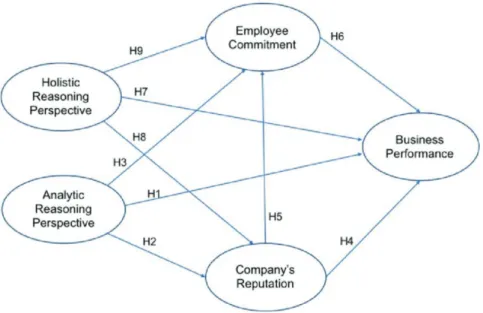
Many antecedents can affect the business performance, from tangible factors such as financial or budget performance to dominant intangible ones which are strategist mindset perspectives, organizational learning and innovation, competitive advantages, employee commitment, corporate reputation, and so on. In the scope of this study, we would like to investigate whether a rational and holistic reasoning perspective affects employee commitment and business performance, with the company reputation acting as a mediator in the relationships. Figure 1 demonstrates the proposed conceptual model and hypotheses.

Each structure has its own set of measurable variables, which are divided into internal and external variables.

External (environmental) and internal (organizational) factors both have direct and indirect effects on business performance. The effects of analytical and holistic reasoning perspectives on employee commitment, company reputation, and business performance are among the internal variables

studied in this article. As a result of the empirical research and hypothesis theory, we proposed the following:

H1: The analytical reasoning perspective is somehow related to business performance.

H2: Analytical reasoning perspective is related to company reputation.

H3: Analytical reasoning perspective is related to employee commitment.

H4: The perception of a company’s reputation is directly related to business performance.

H5: The perception of a company’s reputation is positively related to employee commitment.

H6: Employee commitment is positively related to business performance positively.

H7: A holistic reasoning perspective is directly associated with improved business performance.

H8: A holistic reasoning perspective is strongly related to a company’s reputation.

H9: A holistic reasoning perspective is related to higher levels of employee commitment.

3. Research Methodology 3.1. Measurement of Constructs

A 40-item questionnaire is divided into two sections:

the first includes demographic questions about the partici- pants, and the second is designed to measure all of the analyzed constructs. Gender, the highest level of education,

Figure 1: Hypothesis Model

(5)

position, company type, and industry are all examples of demographic information. The study items were derived from those used in previous studies to ensure content validity.

Rational/Analytical Reasoning Perspective (ARP) Great managers mainly rely on their analytical abilities to comprehend their company’s strategic issues. Developing strategies necessitates logical reasoning. Managers must be extremely rational when developing strategies. Strategies should be founded on facts, not feelings. Without thorough market research, it is risky to take audacious strategic action. The best strategists are analytical rather than creative (Meyer, 2017).

Generative/Holistic Reasoning Perspective (HRP) Successful managers strongly depend on their intuitive abilities to understand strategic problems. Developing strategies necessitates a high level of creativity. The strategy should be inspired by creativity and supported by analysis.

The most effective strategists are more imaginative than analytical. Original ideas are more vital than inanimate facts in formulating a strategy. Being inventive is more important than being analytical when strategizing (Meyer, 2017).

Business Performance (BP)

Dabas (2011) defined business performance as a phenomenon defined by positive values as perceived by managers. To compare business performance to competitors, sales growth, market share growth, return on investment (ROI), and net profit margin growth must be measured. As a result, some questions in our questionnaire would be raised, especially about market share, sales growth, effort and time invested by the company, ability to access credit easily when needed, return on equity, and performance comparison (Saeidi et al., 2015).

Employee commitment (EC)

Employees believe in the organization’s goals and values and have a strong desire to remain a member of the organization, which managers can observe and evaluate.

The employee appears to be “emotionally attached” to the company. Employees see organizational problems as their own. Employees are deeply concerned about the organization’s fate. Employee attachment, whether employees see company problems as their own, their involvement in the company’s long-term strategic development activities, and their desire and love to work for the company are some of the last observed variables in the questionnaire (Shore et al., 1995).

Corporate reputation (CR)

CR is a measure of a company’s credibility, trust, dependability, and responsibility (El-Garaihy, Mobarak, &

Albahussai, 2014).

Corporates that produce high-quality products, use appropriate publicity, conduct business with a focus on social and environmental responsibility, and fulfill their obligations to stakeholders can gain a competitive advantage. Reliability, a reputable image in the market, honesty in business, and a better reputation in recent years are some of the variables observed in the questionnaire.

3.2. Data Collection and Sample Size

The survey technique was utilized in the research and was distributed to enterprises in Ho Chi Minh City and some provinces in southern Vietnam in both hard copy and electronically (e-mail). Due to their convenience for respondents and effectiveness in distant communication, these techniques were chosen. The 5-point Likert scale type of questions was applied in the questionnaire. Data collection was collected within two months. To collect data, a total of 500 questionnaires were distributed and 382 were returned which represents a 76.4% response rate.

According to statistics, the majority of the respondents were males (62.6%), and managers/heads of departments of the company (39.3%). Company owners comprised 23% of informants while C-level directors (CEO, deputy directors, etc) accounted for 23.8%, and the remaining are management board assistants.

In addition, from the data collected from different companies, more than half (56%) are private companies, 34.6% are state companies, 9.2% are FDI companies, and 0.3 % for remaining, in which 55.2% are in the industry of trade and service, 25.9% of production, 8.6% of real estate, and 10.2% for others.

3.3. Statistical Methodology

Many business researchers use structural equation

modeling (SEM) to investigate complex relationships

between latent constructs such as business performance,

company reputation, employee commitment, leadership

perspectives, and other cohesion. Its ability to evaluate

complex measurement models and structural paths

involving a plethora of variables and construct levels has

allowed researchers to investigate complex and intricate

relationships that were previously difficult to untangle and

examine. Partial least squares-SEM (PLS-SEM), which uses

an identical sample, was chosen in this study to investigate

the causal influence between investigated constructs. The

first step, as usual, was to analyze the measurement model,

and the second was to evaluate the relationships between

the structures of the underlying constructs. The current

study attempted to measure the reliability and validity of the

measurements before identifying these existing relationships

within the model using this special statistical technique.

(6)

To evaluate the reliability in this study, the researchers have used Composite Reliability (CR), Average Variance Extracted (AVE), and Cronbach’s coefficient alpha (α) which should be higher than 0.70. Validity refers to what characteristic the test measures and how well the test measures those characteristics. Validity refers to how accurately a method measures what it is intended to measure.

If research has high validity that means it produces results that correspond to real properties, characteristics, and variations in the physical or social world. It is split into two parts: convergent and discriminatory validity. The convergent validity using AVE and factor loadings values were measured in this study.

For ethic assurance, the study justification was explained to the interviewees. All data in connection with the research was kept strictly confidential by the researchers. Participants have also been informed that the data will not be distributed and sold to third parties and for academic and research purposes only. In addition, the literature sources used in the study have been accurately recognized.

4. Results

4.1. Measurement Model Results

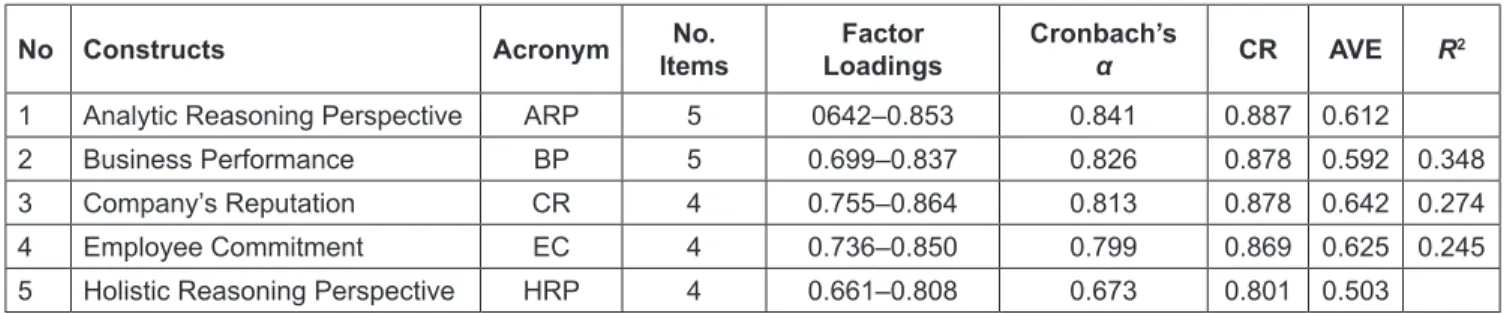
Single dimensionality was determined using EFA to determine factor loadings, and the results are shown in Table 1, with all items displaying significantly high values, greater than 0.50. EFAs are used if the researchers

are not sure of the dimensionality of a scaled model or to identify the smallest number of factors associated with observed variables. As the extraction method, the Principal component analysis (PCA) is used in this study, and the Varimax rotation is used because the data was considered orthogonal. Other rotations could be used if factors are considered unrelated.

Before putting the proposed model to the test, it is necessary to confirm the measurement model’s dependability and validity. Three criteria should be met for the convergent validity of the model. First, all loading indicators should exceed 0.60, then composite reliability (CR) coefficients have to exceed 0.70, and the average variance extracted (AVE) for each construct has to exceed 0.50. (Fornell &

Larcker, 1981; Hair et al., 1998). Cronbach’s alpha was used to determine reliability. All of the constructs in the study had Cronbach’s alpha values greater than the recommended value of 0.70. (Hair et al., 2010).

Table 1 displays Cronbach’s coefficient values ranging from 0.673 to 0.841, with only HRP falling short of expectation. Investigated constructs’ internal consistency requires CR values greater than 0.70, and more preferably > 0.80, and in this case, all values exceed the recommended value. AVE of HRP is considerably lower than other constructs, but still above the acceptance level of 0.50.

Fornell and Larcker (1981) proposed that the square root of a latent variable’s AVE should be greater than the correlations between the remaining latent variables when evaluating discriminant validity. As shown in Table 2, the Table 1: Measurement Model Evaluation

No Constructs Acronym No.

Items Factor

Loadings Cronbach’s

α CR AVE R

2

1 Analytic Reasoning Perspective ARP 5 0642–0.853 0.841 0.887 0.612

2 Business Performance BP 5 0.699–0.837 0.826 0.878 0.592 0.348

3 Company’s Reputation CR 4 0.755–0.864 0.813 0.878 0.642 0.274

4 Employee Commitment EC 4 0.736–0.850 0.799 0.869 0.625 0.245

5 Holistic Reasoning Perspective HRP 4 0.661–0.808 0.673 0.801 0.503

Table 2: Discriminant Validity Coefficients

No Constructs Acronym ARP BP CR EC HRP

1 Analytic Reasoning Perspective ARP 0.782

2 Business Performance BP 0.354 0.769

3 Company’s Reputation CR 0.496 0.481 0.801

4 Employee Commitment EC 0.301 0.492 0.470 0.790

5 Holistic Reasoning Perspective HRP 0.358 0.340 0.333 0.297 0.709

(7)

model has discriminant validity the square root of each construct’s AVE is higher than its correlation with another construct. Moreover, all indicators’ Cronbach’s alpha values should exceed the recommended value of 0.70, and all study measurement items except HRP, listed in Table 2, are greater than 0.70. As a result, overall measurement items have sufficient reliability.

4.2. Structural Model Results

The statistical significance of the corresponding path coefficients was determined to test the study hypotheses.

Except for those related to process view and the effect of cross-functional integration on business performance, all hypotheses were supported at a level of 0.05 (see Table 3

and Figure 2). In addition to estimating the R

2

magnitude, Stone (1974) and Geisser (1975) developed a predictive relevance evaluation measure that was used to determine model fit. As a result, the model’s ability to estimate clear indicators of underlying constructs can be assessed.

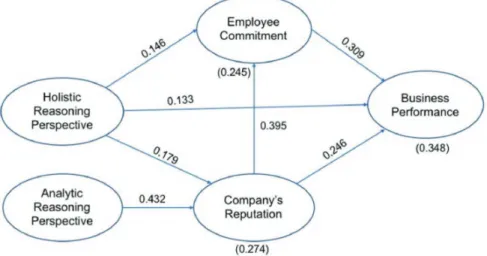
The model accounted for 34.8 percent of the variance in business performance.

To test the structural model, non-parametric bootstrapping was used with nearly 2,000 replications. The structural model resulting from the PLS analysis is shown in Table 3.

Except for two, all of the paths were significant (H1, H3). As a result, H2, H4, H5, H6, H7, H8, and H9 were supported, but H1 and H3 were not. The p-values less than 0.05 were used to assess the strength of the effect of the determinants on business performance.

Table 3: Path Coefficient and Hypothesis Testing

Hypothesis Relationship Path Coefficient T Statistics (O/STDEV) P Values Decision

H1 ARP → BP 0.091 1.604 0.109 Not supported

H2 ARP → CR 0.432 8.697 0.000 Supported

H3 ARP → EC 0.052 0.831 0.406 Not supported

H4 CR → BP 0.246 4.020 0.000 Supported

H5 CR → EC 0.395 5.347 0.000 Supported

H6 EC → BP 0.310 6.030 0.000 Supported

H7 HRP → BP 0.133 2.831 0.005 Supported

H8 HRP → CR 0.179 4.164 0.000 Supported

H9 HRP → EC 0.145 2.422 0.016 Supported

Figure 2: The Refined Hypothesis Model

(8)

5. Discussion and Implications

There is no doubt that the leadership reasoning perspective is a significant determinant of employee commitment, company reputation, and business performance. Leadership mindset shapes organizational culture and directly affects employees’ attachment to the organization, thereby affecting business performance. Leaders are responsible for boosting employee morale through communication and their promotion path. The term “company” refers only to a legal entity with desks and computers. Nobody quits because of the company itself. The decision usually comes from the motivation, the working environment, the support, the training, the vision, and the direction of the leaders they follow. In the leadership role, leaders must be able to see the problem to guide their staff. Then, when they are

“managed”, the next stage is to influence and inspire them.

However, in the case of Vietnamese companies in the survey, holistic or innovative thinking is directly related to business performance and indirectly to employee commitment as well as the company’s reputation. This is consistent with existing Eastern culture, which is more sensitive to feelings than to logic. That explains why there was no evidence to support analytical thinking in this study. As a result, transforming the business to achieve the desired business performance is heavily reliant on changing the mindset of each member of the organization, beginning with the top leaders and influencers of the business.

This study highlights several implications to support leaders and managers for better directing and managing their business, especially in the Vietnam context. On the one hand, our findings show that both analytical and holistic reasoning perspectives are important predictors of business performance. However, it advises Vietnamese organizations to promote creative reasoning rather than analytical reasoning to boost employee commitment and firm performance. We live in the information age, and no one can deny the power of facts and data. However, according to research findings in Vietnam, people are simply human beings, and creative thinking based on leaders’ experience and intuition is still preferred over analytical thinking based on data and rigid processes.

When a thinker is using a logical approach, every step in a thought process is grounded on the preceding ones, following thinking’s official set of rules. In fact, creativity generates another understanding that takes little account of proof. A leader’s creative perspective enables individuals and organizations to create, exploit, renew, and apply innovation to develop the essential competencies required for organizational improvement.

On the other hand, this study shows that strategist reasoning perspectives are important antecedents of

company reputation which continuously affects employee and organizational performance. Human resources are seen to be the most important resource since it drives all the other factors which include capital, equipment, information, and financial resources. If managed well employees can provide company competitive advantage and outperformance, but when mishandled, they lead to corporate stress. While financial incentives used to be the most important tool, corporate reputation, along with environmental and social responsibility (CER), are becoming increasingly important as determinants of employer attractiveness and employee commitment. Based on signaling theory, our empirical study of 382 Vietnamese firms confirms this relationship.

6. Limitations and Future Studies

There are several limitations to these findings that should be considered when interpreting them. First, the study emphasized the internal effects of analytical and holistic reasoning perspectives on company reputation, employee satisfaction, and business performance. Finan- cial performance, customer satisfaction, and other outside aspects such as PESTEL (Political, Economic, Sociological, Technological, Legal, and Environmental) factors influ- ence the company’s outcome. In future research, these factors may be tested to see if they have an effect on business performance.

Second, the data for the model was collected using a convenient sampling method, so the findings may not be generalized and applied to other backgrounds. Nonetheless, this study demonstrates preliminary evidence of the impacts of strategist reasoning perspectives on staff commitment, firm reputation, and corporate performance, indicating that it worths examining the proposed model in other contexts to further establish the validity of the results.

Third, to get the information of the investigated constructs, we relied on a key representative from each organization. Although we have not found major threats to common methodology, collecting and triangulating data from several respondents may help improve the reliability of findings in future studies. Moreover, collecting secondary data of business performance, such as company reports, can improve data accuracy and objectivity.

Finally, the study’s sampling-imposed constraints on

the generalizability of the findings. We mainly focused

on industries (trade service, production, real estate,

and others) in Hochiminh and the southern provinces of

Vietnam. Firms from other sectors may provide different

results. Thus, future research in this area can investigate

relationships between those variables in several cultural

and organizational settings, such as firms in the middle and

the north of Vietnam for more productive results.

(9)

In conclusion, there are many internal factors that affect organizational performance. Our research highlights the importance of leadership thinking, especially intuitive and creative reasoning perspectives in the Vietnamese environment. Leadership is the soul of the organization, motivating and guiding employees to keep their engagement and loyalty, as well as being the face of the organization, increasing its reputation and recognition in the market, thereby being a premise for organizational development and innovation in the global digital economy.

References

Almeida, M. D., & Coelho, A. F. (2018). The antecedents of corporate reputation and image and their impacts on employee commitment and performance: The moderating role of CSR.

Corporate Reputation Review, 8(2), 14–32. https://doi.org/

10.1057/s41299-018-0053-8

Behling, O., & Eckel, N. (1991). Making sense out of intuition.

Academy of Management Perspectives, 5(1), 46–54. https://doi.

org/10.5465/ame.1991.4274718

Boland, R. J., & Pondy, L. R. (1983). Accounting in organizations:

A union of natural and rational perspectives. Accounting, Organizations and Society, 8(2–3), 223–234. https:/doi.org/

10.1016/0361-3682(83)90030-2

Cameron, K., & Whetten, D. (1983). Organizational effectiveness:

One model or several? In: Cameron, K., & Whetten, D. (Eds.), Organizational effectiveness (pp. 1–24). New York: Academic Press.

Dabas, C. (2011). Doing well by doing good or doing smart?

antecedents and outcomes of corporate social performance (Doctoral thesis, Michigan State University). MSU Libraries:

Digital Repository https://d.lib.msu.edu/etd/821/datastream/

OBJ/download/Doing_well_by_doing_good_or_doing_

smart_antecedents_and_outcomes_of_corporate_social_

performance.pdf

Deshpande, R., & Farley, J. (1998). Measuring market orienta- tion: Generalization and synthesis. Journal of Market Focused Management, 2(3), 213–232. https://doi.org/10.1023/

A:1009719615327

Dögl, C., & Holtbrügge, D. (2014). Corporate environmental responsibility, employer reputation, and employee commitment:

An empirical study in developed and emerging economies.

International Journal of Human Resource Management, 25(12), 1739–1762. https://doi.org/10.1080/09585192.2013.859164 El-Garaihy, W., Mobarak, A. K., & Albahussai. (2014). Measuring the

impact of corporate social responsibility practices on competitive advantage: A mediation role of reputation and customer satisfaction. International Journal of Business and Management, 9(5), 109–121. https://doi.org/10.5539/ijbm.v9n5p109

Ellis, P. (2010). The essential guide to effect sizes: Statistical power, meta-analysis, and the interpretation of research results.

Cambridge, UK: Cambridge University Press.

Ertug, G., & Castellucci, F. (2013). Getting what you need: How reputation and status affect team performance, hiring, and salaries in the NBA. Academy of Management Journal, 56(2), 407–431. https://doi.org/10.5465/amj.2010.1084

Fombrun, C., & Van Riel, C. (2003). Fame & fortune: How the world’s top companies develop winning reputations. London:

Pearson Education.

Fornell, C., & Larcker, F. D. (1981). Evaluating structural equation models with unobservable variables and measurement error.

Journal of Marketing Research, 18(1), 39–50. http://doi.

org/10.2307/3151312

Geisser, S. (1975). The predictive sample reuse method with applications. Journal of the American Statistical Association, 70(350), 320–328. https://doi.org/10.2307/2285815

Ginsberg, A., & Venkatraman, N. (1985). Contingency perspectives of organizational strategy: A critical review of the empirical research. Academy of Management Review, 10, 421–434.

https://doi.org/10.5465/amr.1985.4278950

Hair, J., Anderson, R., Tatham, R. L., & Black, W. (1998).

Multivariate data analysis (5th ed.). Upper Saddle River, NJ:

Prentice-Hall.

Hair, J., Black, W., Babin, B., & Anderson, R. (2010). Multivariate data analysis (7

th

ed.). Upper Saddle River, New Jersey:

Prentice-Hall.

Helm, S. (2011). Employees’ awareness of their impact on corporate reputation. Journal of Business Research, 64(7), 657–663.

https://doi.org/10.1016/j.jbusres.2010.09.001

Hofer, C. (1980). Turnaround strategies. Journal of Business Strategy, 1(1), 19–31, 813. https://doi.org/10.1108/eb038886 Huff, A. (1990). Mapping strategic thought. Chichester, UK: Wiley.

Isenberg, D. (1984). How senior managers think. Harvard Business Review, 81–86. https://hbr.org/1984/11/how-senior-managers- think

Langley, A. (1989). In search of rationality: The purposes behind the use of formal analysis in organizations. Administrative Science Quarterly, 34(4), 598. https://doi.org/10.2307/2393569 Langley, A., Mintzberg, H., Pitcher, P., & Posada, E. (1995).

Opening up decision making: The view from the black stool.

Organization Science, 6(3), 260–279. https://doi.org/10.1287/

orsc.6.3.260

Lopez, V. (2006). An alternative methodology for testing a resource-based view linking intangible resources and long- term performance. Irish Journal of Management, 27(2), 49–66.

https://www.proquest.com/docview/207646160

Lopez, V., & Iglesias, S. (2010). A reputational-performance framework in an SME context: Some empirical evidence from Spain. Irish Journal of Management, 29(2), 35–67. https://

web.a.ebscohost.com/

Malhotra, N., & Miller, G. (1998). An integrated model for ethical

decisions in marketing research. Journal of Business Ethics, 17,

263–280. https://doi.org/10.1023/A:1005711311426

(10)

Meyer, R. (2017). Mapping the mind of the strategist: A quanti- tative methodology for measuring the strategic beliefs of executives. Rotterdam: Erasmus Research Institute of Management (ERIM).

Nadkarni, S., & Narayanan, V. (2007a). The evolution of collective strategy frames in high- and low-velocity industries.

Organization Science, 18, 688–710. https://doi.org/10.1287/

orsc.1070.0268

Nadkarni, S., & Narayanan, V. (2007b). Strategic schemas, strategic flexibility, and firm performance: The moderating role of industry clock speed. Strategic Management Journal, 28, 243–270. https://www.jstor.org/stable/20142437

Narayanan, V., Zane, L., & Kemmerer, B. (2011). The cogni- tive perspective in strategy: An integrative review. Journal of Management, 61(12), 534–569. https://doi.org/10.1177/

0149206310383986

Nash, M. (1983). Managing organizational performance. San Francisco, CA: Jossey-Bass.

Ohmae, K. (1991). The mind of the strategist: The art of Japanese business. New York: McGraw-Hill.

Paais, M., & Pattiruhu, J. (2020). Effect of motivation, leadership, and organizational culture on satisfaction and employee performance. The Journal of Asian Finance, Economics, and Business, 7(8), 577–588. https://doi.org/10.13106/jafeb.2020.

vol7.no8.577

Pancasila, I., Haryono, S., & Sulistyo, B. (2020). Effects of work motivation and leadership toward work satisfaction and employee performance: Evidence from Indonesia. The Journal of Asian Finance, Economics, and Business, 7(6), 387–397.

https://doi.org/10.13106/jafeb.2020.vol7.no6.387

Park, J., Lee, H., & Kim, C. (2014). Corporate social responsibilities, consumer trust and corporate reputation: South Korean consumer’s perspectives. Journal Business Research, 67(3), 295–302. https://doi.org/10.1016/j.jbusres.2013.05.016 Saeidi, S., Sofian, S., Saeidi, P., & Saeidi, S. (2015). How does

corporate social responsibility contribute to firm financial

performance? The mediating role of competitive advantage, reputation, and customer satisfaction. Journal of Business Research, 68(2), 341–350. https://doi.org/10.1016/j.jbusres.

2014.06.024

Schendel, D., & Hofer, C. (Eds.). (1979). Strategic management:

A new view of business policy and planning. Boston: Little, Brown.

Schoemaker, P., & Russo, E. (1993). A pyramid of decision approaches. California Management Review, 36, 9–31. https://

doi.org/10.2307/41165732

Schwenk, C. (1984). Cognitive simplification processes in strategic decision-making. Strategic Management Journal, 5, 111–128.

Shore, L., Barksdale, K., & Shore, T. (1995). Managerial perceptions of employee commitment to the organization.

Academy of Management Journal, 38(6), 1593–1615. https://

doi.org/10.5465/256845

Staw, B. (1991). Dressing up like an organization: When psycho- logical theories can explain organizational action. Journal of Management, 17, 805–819. https://doi.org/10.1177/

014920639101700412

Stone, M. (1974). Cross validatory choice and assessment of statistical predictions. Journal of the Royal Statistical Society, 36(2), 111–147. https://www.jstor.org/stable/2984809

Susana, P. L., Jose, M. M. P., & Camilo, J. V. Q.. (2005). Human resource practices, organizational learning, and business performance. Human Resource Development International, 8(2), 147–164. https://doi.org/10.1080/13678860500100103 Tangngigasu, J., Mappamiring, M., Andayani, W., Yusuf, M., &

Putra , A. (2020). CSR and firm reputation from the employee perspective. The Journal of Asian Finance, Economics, and Business, 7(10), 171–182. https://doi.org/10.13106/jafeb.2020.

vol7.no10.171

Wold, H. (1982). Soft modeling: The basic design and some

extensions. In K. Jöreskog, & H. Wold (Eds.), Systems under

indirect observations: Part II (pp. 1–54). North-Holland,

Amsterdam: Sage Publications.

수치

Figure 1: Hypothesis Model
Table 1 displays Cronbach’s coefficient values  ranging from 0.673 to 0.841, with only HRP falling  short of expectation
Figure 2: The Refined Hypothesis Model

참조

관련 문서

An Empirical Study on Factors Affecting the Assimilation of Inter-Organizational Cloud Computing and Performance and the Moderating Effect of Trust 3.. 양하게 이루어지지

[(2011] including sales related knowledge, degree of adaptiveness, role ambiguity, and work engagement. Results of the hypotheses testing show that ‘sales related knowledge’

The main objectives of this research were to illuminate the role of transformational leadership in organizational performance and to further explore to what extent