• 검색 결과가 없습니다.

A Clinical Study of Mandibular Angle Fracture

N/A
N/A
Protected

Academic year: 2021

Share "A Clinical Study of Mandibular Angle Fracture"

Copied!
6
0
0

로드 중.... (전체 텍스트 보기)

전체 글

(1)

ISSN 2288-8101(Print) ISSN 2288-8586(Online)

Original Article

RECEIVED May 24, 2014, REVISED June 27, 2014, ACCEPTED September 26, 2014 Correspondence to Su-Gwan Kim

Department of Oral and Maxillofacial Surgery, College of Dentistry, Chosun University 309 Pilmun-daero, Dong-gu, Gwangju 501-759, Korea

Tel: 82-62-220-3815, Fax: 82-62-228-7316, E-mail: [email protected]

Copyright © 2014 by The Korean Association of Maxillofacial Plastic and Reconstructive Surgeons. All rights reserved.

CC

This is an open access article distributed under the terms of the Creative Commons Attribution Non-Commercial License (http://creativecommons.org/licenses/

by-nc/3.0) which permits unrestricted non-commercial use, distribution, and reproduction in any medium, provided the original work is properly cited.

A Clinical Study of Mandibular Angle Fracture

Wook-Jae Yoon, Su-Gwan Kim, Ji-Su Oh, Jae-Seek You, Kyung-Seop Lim, Seung-Min Shin, Cheol-Man Kim

Department of Oral and Maxillofacial Surgery, School of Dentistry, Chosun University

Abstract

Purpose: To establish management protocol for mandibular angle fracture, we describe pertinent factors including cause, impacted third molar and recent treatment tendency.

Methods: We examined the records of 62 patients who had unilateral mandibular angle fracture. Sixty patients who had open reduction surgery were examined at postoperative weeks 1, 4, 8, 12, and 28.

Results: Left mandibular angle fracture is frequent in younger males. Presence of the mandibular third molar can increase fracture risk. Because of attached muscle, favorable fractures occurred primarily in the mandibular angle area.

Conclusion: Extracting the mandibular third molar can prevent angle fractures, and open reduction with only one plate adaptation is generally the proper treatment method for mandibular angle fracture.

Key words: Mandibular injuries, Jaw fracture

Introduction

Mandibular fractures occur frequently because of high risk of trauma, and an anatomic structure of arched form without a bone suture line cannot disperse the external force[1]. The frequency of mandibular fractures is increas- ing with the increase in trauma such as traffic accident, industrial accident, falling, sports, and interpersonal vio- lence following rapid societal changes[2].

In the mandible, unlike other hard tissues, fracture pat- tern and directions of the fracture line are affected by the cause, direction of external force, position of attached mus- cles on the parts of fractured bone and existence of patho- logic elements[1].

The mandibular angle is a region particularly prone to fracture from falls or attack, comprising 25% to 33% of all mandibular fractures. Masseter muscle and medial pter- ygoid muscle are attached to the angle and these can cause displacement of bone fragments after fracture. Reduction as a treatment for fracture should be considered especially for patients with a mandibular third molar. Other pertinent factors are the biomechanical characteristics of the man- dible, bone density, and the pathologic state of the bone[3].

Because it is difficult to fix with intermaxillary fixation, open reduction is universal[4].

There is a recent emphasis on increasing cosmetic factor

and correcting occlusal recovery when treating mandibular

angle fracture. But other studies treating mandibular frac-

(2)

Fig. 1. Age distribution.

Table 1. Patient characteristics

Variable Value

Total Sex Male Female

Mechanism of fracture Fist blow

Slip down Stuck by object Traffic accident Fall down Others Site of fracture Left angle Right angle

62 (100.0) 56 (90.3) 6 (9.7) 23 (37.1) 14 (22.6) 10 (16.1) 7 (11.3) 6 (9.7) 2 (3.2) 47 (75.8) 15 (24.2) Values are presented as number (%).

Table 2. Presence and extraction of mandibular third molars in fracture line

Present (n) Absent (n) Total (n) Extraction

Non-extraction Total

27 21 48

0 14 14

27 35 62

ture emphasize the general mandibular aspect rather than the particular location of mandible. This clinical study is to analyze and assess patterns in patients whose unilateral mandibular angle was fractured, and propose the proper treatment protocol.

Materials and Methods

We studied 62 patients who visited the Department of Oral and Maxillofacial Surgery of Chosun University Dental Hospital from January 2009 to July 2012 with fracture in the mandibular angle, who were possible to examine up to a year after surgery, without fractures on other parts or bilateral fracture in mandibular angle. The case analysis study was conducted under Institutional Review Board (IRB) approval granted by the Chosun University Dental Hospital (CDMDIRB-1429-170).

We researched patient information retrospectively, refer- ring to clinical examination, dental panorama, radiographs of skull PA and computed tomography, and chart records.

All patients were classified by age and sex, and we classi- fied the fractures by cause, location, and pattern of fracture.

We estimate surgical technique through the number and type of plates used, whether a mandibular third molar relat- ing mandibular angle is extracted, and complications after operation such as neurologic damage, malocclusion, and infection.

Among 62 patients, 60 patients received open reduction under general anesthesia, and two patients received inter- maxillary fixation because of systemic disease. The frac- tures were rigidly fixed with 4-hole metal miniplates and

screws (Leforte; Jeil Medical Corporation, Seoul, Korea).

The patients were re-examined at postoperative weeks 1, 4, 8, 12, and 28. The arch bar used for intermaxillary fix- ation was removed three weeks after surgery.

Results

1. Patients

The average patient age is 32, distributed from 15 to 66 years, with clustering in the third decade (Fig. 1).

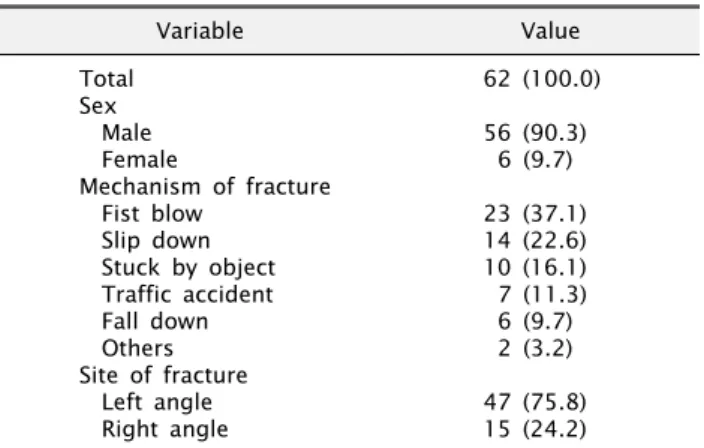
Gender distribution is 56 men (90.3%) and six women (9.7%). The fracture causes are fist blow (23 cases, 37.1%), slip down (14 cases, 22.6%), traffic accident (seven cases, 11.3%), fall down (six cases, 9.7%), hit by objects (10 cases, 16.1%), others (two cases, 3.2%). Fractures are located on the left side in 47 cases (75.8%) and on the right side in 15 cases (24.2%). We note that fracture of left mandibular angle occurs three times more frequently than the right (Table 1). We hypothesize that mandibular fractures often result from fist blows from right-handed young people.

2. Existence of mandibular third molar

The rate of patients with mandibular third molar at the

fracture line is 77.4% and of those who underwent surgery,

(3)

Fig. 2. Presence and extraction of mandibular third molar in fracture line.

Fig. 4. (A) Loosening screw on fixed plate and exposure to oral cavity. (B) After removal of exposed plate.

Fig. 3. Loosening screw on fixed plate.

Table 3. Complication after operation

Variable Value

Nerve injury Pain

Loosening of screw Malocclusion Infection Plate exposure

17 (28.3) 4 (6.7) 3 (5.1) 2 (3.3) 1 (1.7) 1 (1.7) Values are presented as number (%).

56.3% (27 cases) had the mandibular third molar extracted (Table 2). This shows that mandibular third molar can affect the risk of mandibular angle fracture (Fig. 2).

3. Fracture pattern and number of used plates

The direction of fracture is unfavorable for all patients.

Fifty-three patients received one metal plate, seven patients received two, and no patients received absorbable plate.

If there was comminuted fracture or masseter muscle hy- pertrophy, two plates were used to increase rigidity.

4. Complications

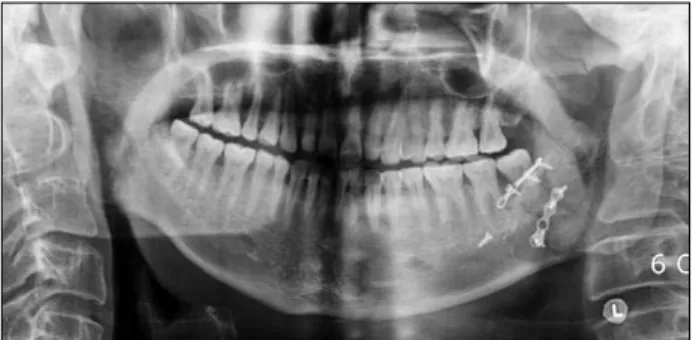
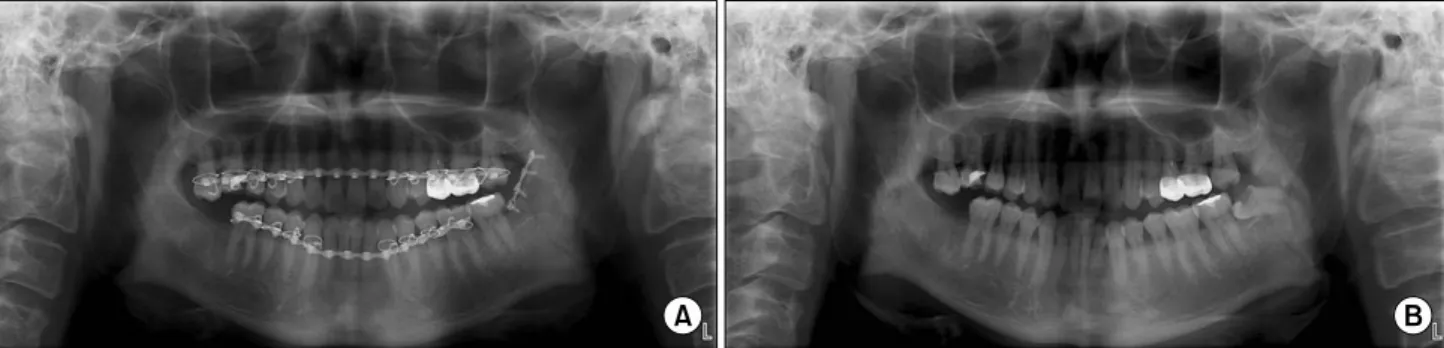
Post-surgical complications include 17 cases (28.3%) of hypoesthesia caused by neurologic damage, but this symp- tom was present before surgery. There were four cases (6.7%) of mandible pain during opening and closing, three cases (5.1%) of screw loosening (Fig. 3, 4), two cases (3.3%) of malocclusion, one case (1.7%) of infection at the surgical site, and one case (1.7%) of plate exposure.

The rate of the post-surgical complications after operation

is 9.8%. There was no osteomyelitis, non-union of bone fragment, or displacement of metal plate (Table 3).

Discussion

1. Relation of mandibular third molar and risk of angle fracture

An impacted third molar can weaken the mandibular

angle area by replacing osseous space, depending on its

position and angulation[5]. In cross-section, the angle area

is thinner than the tooth-bearing region, and the angle

can function as a lever biomechanically[6]. Thus the angle

region is prone to fracture, comprising 25% to 33% of all

(4)

Fig. 6. (A) Preoperation. (B) After open reduction internal fixation with miniplate not extracting third molar.

Fig. 5. (A) Preoperation. (B) After open reduction internal fixation with miniplate extracting impacted third molar.

mandibular fractures[3].

Schwimmer et al .[7] found early removal of impacted teeth to be an effective way of preventing mandibular frac- ture in athletes who are exposed to trauma. Reitzik et al .[8]

reported that mandibles with impacted third molars can be fractured at 60% of the force needed when there is no tooth. In this study, mandible fractures with impacted third molars occurred four times more than that fractures with no tooth.

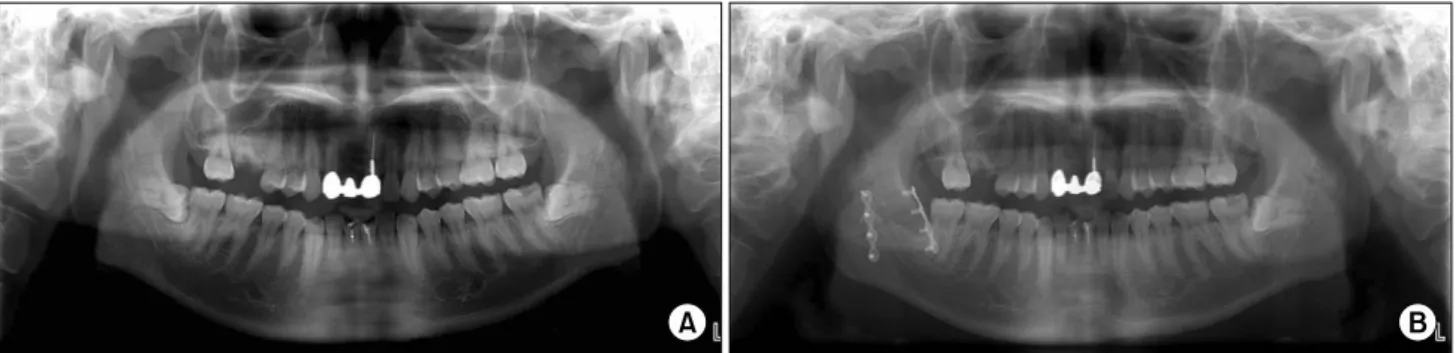
When performing open reduction, extraction of the man- dibular third molar is still controversial[9]. Some scholars reported that extraction of the tooth may make the fracture site unstable, leading to additional damage (Fig. 5)[9]. On the other hand, retaining a tooth within the fracture line may lead to certain complications because of decreased bone contact and blood supply (Fig. 6)[9].

Our patients were divided evenly between extraction and retention of the mandibular third molar during the operation (Table 2). If completely impacted or malposi- tioned, disturbing reduction in the fractured segment, ex- traction is recommended. If there is no difficulty in reduc- tion or the third molar is erupted, retention of third molar would be a better choice, considering the risk of infection

to the extraction socket and possibility of delayed bone union[10].

2. Factors affecting risk and treatment of mandibular angle fracture

In the mandible, unlike fractures of other hard tissues, the form of fracture, direction and degree of segment tran- sition are affected by the anatomic structure, muscle in- sertion and bite force[11]. The angle is a common site for mandible fracture and has many active muscles that can displace segments. There is a high complication rate and the fracture only can rarely be adequately reduced by sim- ple intermaxillary fixation. Therefore, the primary techni- que is open reduction[4]. In this study, except with those unsuitable for surgery, all patients were treated by open reduction. There are literature perspectives stating that the pterygomasseteric muscle sling provides protection against external forces to the angle region of the mandible[5].

3. Treatment criteria for mandibular angle fracture

Champy et al .[12] found that in a centered inferior alveo-

lar canal, the tensile forces are generated on the upper

border of mandibular angle and compressive forces are

(5)

Fig. 7. (A) Preoperation. (B) After open reduction internal fixation with 2 miniplates.

generated on the lower border, so ideal single plate fixation is possible on the external oblique line. But in cases of comminuted fracture and when reduction of interdental fixation is impossible after surgery, more than two plates are placed to improve bone healing and stabilize fixation under the functional load (Fig. 7). Postoperative complica- tions such as the infection caused by reduced bone fixation and malunion can be decreased using lag screws and re- construction plates[9,13]. Functionally, fixation with two metal plates increases stability of the mandibular angle frac- ture but the possibilities of infection due to increased surgi- cal time or flap elevation, facial nerve injury, high price of the plates and difficulty of plate removal should be considered[6,14,15]. To overcome these drawbacks, lag screws can be used. Lag screw fixation offers firm fracture stabilization, reduction of tissue exposure compared to us- ing metal plates, and short operation time[16]. The fact that an absorbable plate has lesser resistibility and stability at an average occlusal load than a metal plate after surgery has been demonstrated in several studies[17], so this is not a general method for the angle fracture. In this study, no cases were fixed by absorbable plate.

4. Complications

Many postoperative complications have been reported, but hypoesthesia by inferior alveolar nerve injury was more frequently found than other complications in this study.

This is not only because of surgical procedure but also nerve injury from trauma or movement of bone segments.

Pain on mandibular movement is another possible complication. It can lead to trismus with the risk of damag- ing elevated muscles that are attached to the angle region.

Other risks include posterior open bite at the fracture site

right after surgery, infections through failure of primary suture and loosening of metal plates or screws[13].

5. Duration of intermaxillary fixation

Although the ideal period of maxillomandibular fixation for the angle fracture is unclear, two weeks of fixation after surgery is regarded as the proper period in various studies as well as our study[15].

Conclusion

We can draw some conclusions from this study of 62 patients with unilateral fracture in the mandibular angle area.

1. Mandibular angle fracture often occurs in younger males by violence at the left side.

2. Existence of a mandibular third molar can increase risk of fracture, and preventive extraction might be in- dicated, especially for those involved in sports.

3. Because of attached muscle, favorable fractures oc- curred predominantly in the mandibular angle area so open reduction is universal.

4. By biomechanical aspects, fixation can be possible by an ideal single plate on the external oblique line, but an absorbable plate is not suitable for in this area.

5. Inferior alveolar nerve damage is the most common complication.

References

1. Tevepaugh DB, Dodson TB. Are mandibular third molars a risk factor for angle fractures? A retrospective cohort study.

J Oral Maxillofac Surg 1995;53:646-9; discussion 649-50.

2. Seemann R, Schicho K, Wutzl A, et al . Complication rates in

(6)

the operative treatment of mandibular angle fractures: a 10-year retrospective. J Oral Maxillofac Surg 2010;68:647-50.

3. Meisami T, Sojat A, Sàndor GK, Lawrence HP, Clokie CM.

Impacted third molars and risk of angle fracture. Int J Oral Maxillofac Surg 2002;31:140-4.

4. Singh S, Fry RR, Joshi A, Sharma G, Singh S. Fractures of angle of mandible: a retrospective study. J Oral Biol Craniofac Res 2012;2:154-8.

5. Lee JT, Dodson TB. The effect of mandibular third molar presence and position on the risk of an angle fracture. J Oral Maxillofac Surg 2000;58:394-8; discussion 399.

6. Ellis E 3rd. Treatment methods for fractures of the mandibular angle. Int J Oral Maxillofac Surg 1999;28:243-52.

7. Schwimmer A, Stern R, Kritchman D. Impacted third molars:

a contributing factor in mandibular fractures in contact sports.

Am J Sports Med 1983;11:262-6.

8. Reitzik M, Lownie JF, Cleaton-jones P, Austin J. Experimental fractures of monkey mandibles. Int J Oral Surg 1978;7:100-3.

9. Patil PM. Lower third molar in the line of mandibular angle fractures treated with stable internal fixation: to remove or re- tain? J Oral Maxillofac Surg Med Pathol 2013;25:115-8.

10. Bobrowski AN, Sonego CL, Chagas Junior OL. Postoperative infection associated with mandibular angle fracture treatment in the presence of teeth on the fracture line: a systematic review and meta-analysis. Int J Oral Maxillofac Surg 2013;42:1041-8.

11. Duan DH, Zhang Y. Does the presence of mandibular third

molars increase the risk of angle fracture and simultaneously decrease the risk of condylar fracture? Int J Oral Maxillofac Surg 2008;37:25-8.

12. Champy M, Loddé JP, Schmitt R, Jaeger JH, Muster D.

Mandibular osteosynthesis by miniature screwed plates via a buccal approach. J Maxillofac Surg 1978;6:14-21.

13. Choi BH, Kim HJ, Kim MK, et al . Management of mandibular angle fractures using the mandibular angle reduction forceps.

Int J Oral Maxillofac Surg 2005;34:257-61.

14. Siddiqui A, Markose G, Moos KF, McMahon J, Ayoub AF. One miniplate versus two in the management of mandibular angle fractures: a prospective randomised study. Br J Oral Maxillofac Surg 2007;45:223-5.

15. Danda AK. Comparison of a single noncompression miniplate versus 2 noncompression miniplates in the treatment of man- dibular angle fractures: a prospective, randomized clinical trial. J Oral Maxillofac Surg 2010;68:1565-7.

16. Schaaf H, Kaubruegge S, Streckbein P, Wilbrand JF, Kerkmann H, Howaldt HP. Comparison of miniplate versus lag-screw osteosynthesis for fractures of the mandibular angle.

Oral Surg Oral Med Oral Pathol Oral Radiol Endod 2011;111:

34-40.

17. Esen A, Ataoğlu H, Gemi L. Comparison of stability of tita-

nium and absorbable plate and screw fixation for mandibular

angle fractures. Oral Surg Oral Med Oral Pathol Oral Radiol

Endod 2008;106:806-11.

수치

Fig. 1. Age distribution.
Fig. 2. Presence and extraction of mandibular third molar in  fracture line.
Fig. 6. (A) Preoperation. (B) After open reduction internal fixation with miniplate not extracting third molar.
Fig. 7. (A) Preoperation. (B) After open reduction internal fixation with 2 miniplates.

참조

관련 문서

Purpose: Calcaneal fracture is a rare fracture, which accounts for about 2% of all fractures, but is one of the most common fractures in the ankle bone.. There is

When the fiber orientation angle is small, the member absorbed energy by laminar bending.. As the fiber orientation angle increases, the member was

The purpose of this study was to analyze the impaction pattern of the impacted mandibular third molar and the relationship with the inferior alveolar nerve

chair and boat conformation (free of angle strain); not planer with 120° bond angle (fully eclipsed). planer with 120 bond

3,4 Therefore, to date, studies have been conducted to examine the absorbable fixation plate manufactured using polymer and a fixation screw that can

Conclusion: In Neer type II distal clavicle fracture treatment, both groups showed satisfactory result in clinical and radiological outcomes, but the hook plate

The purpose of this study was to evaluate the curvature of Vertucci's type II mesial canals of mandibular molar using new method; The radius and angle

mandibular P-18 inncisor from Nfic-deficient mice (×3,000)... In this study, histological and immunohistochemical studies were carried out to investigate