− 444 − 대한지역사회영양학회지 23(5): 444~455, 2018
https://doi.org/10.5720/kjcn.2018.23.5.444 ISSN 1226-0983 (print) / 2287-1624 (on-line)
국가 영양조사에서 가구 방문 조사 체계의 개선 방안
양나래1)·이승민2)·임영숙3)·박혜련3)·김기랑4)†
1)단국대학교 식품영양학과, 학생, 2)성신여자대학교 식품영양학과, 교수
3)명지대학교 식품영양학과, 교수, 4)단국대학교 식품영양학과, 교수
Development of Strategies to Improve the National Nutrition Survey System
Narae yang1), Seungmin Lee2), Youngsuk Lim3), Haeryun Park3), Kirang Kim4)†
1)Department of Food Science and Nutrition, Dankook University, Cheonan, Korea, Student
2)Department of Food Science and Nutrition, Sungshin Women's University, Seoul, Korea, Professor
3)Department of Department of Food and Nutrition, Myongji University, Yongin, Korea, Professor
4)Department of Food Science and Nutrition, Dankook University, Cheonan, Korea, Professor
†Corresponding author Kirang Kim
Department of Food Science and Nutrition, Dankook University, Cheonan 31116, Korea
Tel: (041) 550-3472 Fax: (041) 559-7955 E-mail:
[email protected] ORCID: 0000-0003-3054-8758
Acknowledgments
*This research was supported by a grant from the Korea Centers for Disease Control and Prevention (No. 2017-E34010-00).
Received: August 13, 2018 Revised: October 2, 2018 Accepted: October 2, 2018
ABSTRACT
Objectives: The current survey environment is changing and participation rates in national nutrition surveys are decreasing. Therefore, the purpose of this study was to develop strategies for improving the nutrition survey system in the Korea National Health and Nutrition Examination Survey (KNHANES).
Methods: To develop an alternative system for conducting the KNHANES nutritional survey, we conducted focus group interviews with stakeholders of the survey, SWOT (Strengths, Weaknesses, Opportunities, and Threats) analysis, and expert reviews. In addition, spatial analysis of potential sites for conducting surveys instead of relying on household visits was performed, and the perception of nutritional surveys in the population eligible for KNHANES was evaluated.
Results: Based on the results of the focus group interviews, SWOT analysis, and expert reviews, we propose two options for survey sites: vehicles specifically prepared for nutritional surveys and public facilities such as community service centers or public health centers. Among public facilities, community service centers were found to be more appropriate sites than public health centers because they were considered more accessible. About 90% of respondents would participate in the survey in public facilities and about 74% would in vehicles.
Conclusions: Conducting national nutrition surveys in specially designed vehicles and public facilities could be a viable alternative to home visits. Next, the validity of these newly proposed nutrition survey methods needs to be compared to the results of the current national nutrition survey.
Korean J Community Nutr 23(5): 444~455, 2018
KEY WORDS nutrition survey, strategies, KNHANES, survey method
This is an Open-Access article distributed under the terms of the Creative Commons Attribution Non-Commercial License (http://
creativecommons.org/licenses/by-nc/3.0) which permits unrestricted non-commercial use, distribution, and reproduction in any medium, provided the original work is properly cited.
RESEARCH ARTICLE
—————————————————————————
서 론
—————————————————————————
국민건강영양조사는 국민건강증진법 제 16조에 의거하여 2005년 전까지는 매 3년 조사에서 2007년부터는 조사체계 개편을 통해 매년 조사되는 국가조사로 검진조사, 건강설문 조사, 영양조사로 구성되어 있다. 이 중 영양조사는 특히 국 민의 식품 및 영양소 섭취 현황, 식생활 습관 등 건강과 관련 되는 사항들을 종합적이고 다각적으로 파악하는 것을 목적 으로 하고 있다. 영양조사는 전문조사원(영양사)이 대상 가 구를 직접 방문하여 대상자를 면접하는 형식으로 조사하고 있으며 조사 항목으로는 식생활 조사, 식품안정성, 식품섭취 빈도조사, 1일 24시간 회상법에 의한 식품섭취조사를 포함 한다[1].
현재의 국가영양조사 체계는 2007년 조사체계 개편이 이 루어진 이후 동일한 형태로 유지되어 왔다. 그러나 지난 10 년 간 지속해온 표본으로 추출된 가구를 직접 방문하여 실시 되고 있는 영양조사 체계는 역동적으로 변화하고 있는 사회 경제적 및 식생활 환경으로 인해 그 효용성이 저하될 우려가 있다. 실제 최근의 국민건강영양조사의 조사 참여율은 지속 적으로 하락하고 있는 추세인데, 제 5기 영양조사 참여율에 비해 제 6기 영양조사의 참여율(78.3%)이 약 2.5%의 감소 비율을 보였다[2].
국가영양조사의 참여율 감소는 국내뿐만 아니라 국외조사 에서도 유사하게 지속적으로 감소하는 추세를 보이고 있다 [3-10]. 미국 국민건강영양조사에서는 낮아지고 있는 조사 참여율에 대한 해결을 위하여 참여자의 연령별, 조사항목별 조사 사례비 차등 지급, 참여자들의 이동거리에 따른 교통비 지급, 가정 외 공공장소나 직장에서의 조사 등 다양한 전략 들을 통해 참여율 증가를 위한 노력들이 이루어지고 있다 [11]. 과거 국내 영양조사의 참여율 감소에 대한 원인을 분 석한 연구 결과에 의하면 예산 부족으로 인한 홍보가 절대적 으로 부족하여 주민들의 조사에 대한 인지율이 낮은 점, 조 사를 수행함에 있어 대상자의 부담과 불편이 큰 것에 비해 답 례품으로 낮은 가격의 상품권, 조사 결과지가 조사 완료 이 후 오랜 시간이 지나서 통보되어 참여 대상자에 대한 조사 이 점으로 작용하지 못한 점이 보고되었다[12]. 최근에는 기존 연구에서 제시된 원인 이외에도 사생활 보호에 대한 의식 강 화, 1인 가구의 증가, 맞벌이 부부의 증가, 지역주민 사이의 유대감 저하 등으로 대상자들이 가구 방문 조사에 대한 부담 감이 증가하면서 조사 거부 가능성이 조사 현장에서 보고되 었다.[13, 14]. 이에 지난 10년 동안 유지해왔던 가구방문 조사 체계로 나타날 수 있는 문제점을 해결할 수 있는 방안
으로 가구 방문 이외 조사체계에 대한 필요성이 제기되고 있 다. 따라서 본 연구는 변화하는 조사 환경에 대처하기 위하 여 국가 영양조사에서 가구 방문 이외의 조사 체계 방안을 제 시함으로써 가구 방문에 의한 국가 영양조사의 보완을 통한 영양조사 자료의 질 향상에 기여하고자 하였다.
—————————————————————————
연구 방법
—————————————————————————
1. 국가 영양조사 체계 개선 전략 개발 과정
국가 영양조사에서 가구 방문 이외의 조사 체계 방안을 제 시하기 위하여 현재 국가차원의 영양조사에서 조사를 수행 하고 있는 조사원과 조사 관련 담당자, 지역사회 복지기관 영 양사, 보건관련 전문가를 대상으로 포커스 그룹 조사를 수행 하였다. 포커스 그룹 조사를 기반으로 가구 방문 이외 영양 조사 방안을 도출하고, 각 방안에 대한 SWOT 분석을 실시 하였으며 SWOT 분석 결과에 대하여 보건 및 영양 관련 전 문가들의 검토 의견을 받았다. 가구 이외 조사 후보 장소로 도출된 보건소와 주민센터에 대한 조사 대상자들의 접근성 파악을 위하여 공간 분석을 실시하였고, 국가 영양조사 대상 자로 가능성이 있는 일부 지역사회 주민들을 대상으로 국가 영양조사 참여에 대한 인식도를 조사하였다. 조사 및 분석 결 과를 토대로 개발된 국가 영양 조사 방법 개편 방안은 보건 및 영양 관련 전문가의 검토 및 논의를 거쳐 최종 안을 마련 하였다. 포커스 그룹 조사와 국가 영양조사 참여에 대한 인 식도 조사 과정은 단국대학교 연구심의위원회(Institutional Review Board: IRB)의 사전 승인(DKU 2017-05- 025-001)후 조사 대상자의 설문 조사에 대한 서면 동의서 를 받았다.
2. 포커스 그룹 조사
포커스 그룹 조사 대상자는 국민건강영양조사 조사원, 지 역사회건강조사 조사원, 보건소 및 주민센터 내 국민건강영 양조사 업무 담당자, 복지관 영양사, 보건 관련 전문가 총 33 명이 포커스 그룹 인터뷰에 참여하였고, 면담은 2017년 07 월에서 2017년 08월에 실시하였다.
면담은 직군 별로 나눠 진행이 되었고, 개방형 질문을 통 하여 대상자들의 생각과 의견을 최대한 듣고자 하였다. 1회 평균 면담 시간은 1시간~2시간 정도로 하였으며, 면담 시작 에 앞서 대상자들에게 진행하는 내용을 녹음한다는 내용을 알리고 동의를 받은 후 녹음을 하였다. 포커스그룹 인터뷰 분 석은 대상자의 응답 내용을 청취하며 있는 그대로 녹취하였 으며, 이를 반복하여 읽으며 맥락, 내적 일관성 등을 고려하 여 의미를 분류하였다[15].
양나래·이승민·임영숙·박혜련·김기랑·446
포커스 그룹 조사 질문 내용은 방문조사의 불편한 점, 대 상자들이 영양조사에 불참하는 이유, 가구 방문 이외 영양조 사로 적합한 장소에 대한 의견, 소속 기관에서 영양조사의 가 능성 여부, 영양조사 참여율을 증진시키기 위한 방안이었다.
3. 가구 방문 이외 영양 조사 방안도출 및 개선 방안에 대한 SWOT 분석
포커스 그룹 조사 결과와 연구진 회의를 통하여 가구 방문 이외 영양조사 장소의 현장 적용 가능 여부를 고려하여 개선 안을 도출하였다. 도출된 개선안의 장단점을 파악하기 위하 여 SWOT 분석을 실시하였다. SWOT 분석은 내부의 강점 및 약점, 외부의 기회 및 위협을 파악하여 약점을 최소화하 고 기회를 최대한 활용할 수 있도록 하는 방법이다[16]. 분 석 결과는 전문가 자문 회의를 통하여 검토를 받았다.
4. 조사장소로 공공기관에 대한 접근성 파악을 위한 공간 분석
국민건강영양조사 조사구 자료는 통/반으로 구분되어 있 었으며 통/반은 안전행정부 내부 처리용으로 공간정보를 생 산하지 않아 조사구에 해당하는 통/반의 지번 주소지 자료를 바탕으로 공간을 정의하였고, 주소지는 텍스트로 이루어져 지오코딩(Geocoding)을 통해 위치정보 자료로 변환하였다 [17]. 각 통/반에 해당하는 지번 주소지들은 점(point) 자료 로 변환을 하였고, 점들의 중심점을 기준으로 반경 250 m 버 퍼를 조사구 공간 단위로 구성하였다. 보건소, 보건지소, 주 민센터가 서비스 하는 인구를 계산하기 위하여 집계구 자료 를 활용하였으며, 집계구 자료는 통계청에서 인구를 집계하 는 최소단위이다. 행정 보건시설로 주민센터, 면사무소, 보건 지소, 보건진료소, 보건(의료원)소 데이터를 분석하였으며 데이터는 인·허가 업종별 데이터개방(http://localdata.kr) 에서 수집하였다.
본 연구에서는 전국 보건시설의 분포 및 특성, 행정·보건 시설이 서비스하는 조사구의 인구비율을 산출하였으며, 조 사구에 포함되는 행정·보건 시설들의 수, 조사구 중심으로 부터 가장 가까운 행정·보건 시설까지의 직선거리, 조사구 와 시설까지의 접근성 거리는 조사구 중심 반경 500 m, 750 m, 1000 m로 제한하여 분석하였다[18-20].
5. 국가 영양조사 대상자로 가능성이 있는 일부 지역사회 주민들의 국가 영양조사 참여 인식도 조사 및 통계 분석 대도시(서울시 강북구), 중소도시(경기도 하남시), 읍·
면지역(경기도 양평군)의 각 1개 보건소를 선정하여 총 3개 의 보건소 내 홍보를 통하여 모집된 만 20~64세의 남·여
지원자 109명을 대상으로 2017년 09월에 설문을 진행하 였다. 대상자의 만 나이는 45.2 ± 12.8세 이었고, 성별 분 포는 여성이 84.4%로 다수를 차지하였다. 대상자의 월 가구 소득으로 200만원 이하는 25.7%, 200-300만원 이하는 26.7%, 300-500만원 이하는 33.3%, 500만원 초과는 14.3%였으며 거주 지역의 분포는 대도시, 중소도시, 읍·면 지역이 각각 45.9%, 26.6%, 27.5%로 분포하였다. 거주 지 역 간의 연령과 성별 분포는 차이가 없었다. 가구 방문 외 영 양조사 참여 인식도 설문조사 내용은 가구 방문을 통한 영양 조사 참여 의향 및 이유, 선호하는 영양조사 요일 및 시간, 공 공기관에서의 영양조사 참여 의향, 차량을 이용한 영양조사 참여 의향, 공공기관 영양조사 참여의 보상 방법에 대해 조 사하였다. 자료는 SAS version 9.4(SAS Inc., Cary, NC, USA)를 사용하였으며, 분포의 차이는 카이제곱 검정 을 통해 유의성을 검정하였다. 모든 분석은 유의수준 0.05 에서 양측검정으로 실시되었다.
—————————————————————————
결 과
—————————————————————————
1. 가구방문 이외 영양조사 시 조사 장소 및 방법에 대한 포커스 그룹 조사
가구방문 이외 영양조사 시 조사 장소 및 방법에 대한 포 커스 그룹 조사 결과는 Table 1과 같다. 조사원들이 방문조 사 시 불편한 점으로는 계절에 의한 영향이 있으며, 대상자 에 따라 조사 환경이 적절하지 않거나 대상자의 부적절한 언 행으로 인한 조사 부담감, 일정 조율이 어려운 점이 있었다.
국가 영양조사 불참 이유로는 단순 거부, 사생활이 침해받는 다는 생각, 조사에 대한 정보 미비, 조사 참여에 대한 동기 부 족, 조사대상자들의 시간 부족 등을 원인으로 응답하였다.
가구 방문 이외 영양조사 시 활용할 수 있는 조사 장소로 주민센터, 보건소, 조사차량, 경로당 또는 복지관이 제안되어 해당 장소에 대한 구체적인 의견을 조사하였다. 주민센터는 접근성이 좋고, 조사 시 활용 가능한 장소가 있으나(야간, 주 말 포함), 주차 공간이 협소할 수 있으며, 주민센터 별 협조 를 얻기 위해 법적 근거를 마련해야 한다는 의견이 있었다.
보건소는 대상자 거주지 혹은 특성 별로 접근성이 매우 상이 하며, 독립된 조사 공간의 제공은 어려우나, 활용 가능한 장 소 제공은 가능하고, 야간 및 토요일 오전에도 활용이 가능 한 것으로 조사 되었다. 조사차량을 이용할 경우에는 사생활 침해를 받지 않아도 되며, 차량을 통한 홍보효과를 기대할 수 있고, 대상자가 직접 공공기관을 방문하는 것에 비해 접근성 이 좋은 편이나, 주차 장소를 마련하는 것이 어려운 곳이 있 을 수 있다고 조사되었다. 경로당의 경우 야간에도 개방하는
·국가 영양조사의 개선 방안 Table 1. The result of the focus group interviews about the survey system and sites
Theme Contents
Inconvenience of the home-visit survey system
- Due to high temperatures and discomfort in the summer, it is difficult to carry out the nutrition survey.
- The investigator felt burdened by the survey because the subjects sometimes refused to participate in the survey or became angry when she visited, even though they had earlier agreed to the visit. In addition, sometimes the houses were too dirty to even sit down, or the subject was drunk and began asking unnecessary questions or started making physical contact.
- The variation in the survey times could be very large, depending on the subjects(in the case of shift work, 8:00 am at the earliest or 11:00 pm at the latest). Additionally, it was often difficult to allocate time because subjects prefer same time zone for the nutrition survey, and thus occasionally a visit by one household twice a day is required.
- The subjects preferred to be surveyed shortly after work; therefore, they were often preparing their meals or eating at the time they were visited and answered questions insincerely to finish the survey quickly.
Reasons for not participating in the nutrition survey
- No reason given.
- The subject tended to dislike the investigator visiting the home and seeing the state of their kitchen.
- The subject refused to spend enough time on the nutrition survey because they thought health examination survey before was too long.
- The subject participated in the survey out of curiosity or with the expectation of medical benefits. However, the nutrition examination survey had fewer connections with the health examination survey
- The subjects have less prior knowledge of the survey, and lack of motivation to participate.
- The subjects were very busy with work and did not have enough time for an appointment.
Opinions on conducting surveys in community service centers
- Although community service centers may be better in terms of accessibility than public health centers, it seems that the latter may be more efficient for establishing legal grounds for the survey, since the degree of cooperativeness with the investigation may differ at each community service center.
- Parking lots can be small or absent in some areas. If visiting surveys are implemented, the level of respondent participation will be low.
- In Seoul, there seems to be insufficient space to rent for use as investigation sites. A community service center can rent conference rooms during the week and even at the weekends, addressing safety concerns and providing space for citizens’ programs.
Opinions on conducting surveys in public health centers
- Public health centers have the advantage of being used by the elderly; however, accessibility is low at many health centers.
- The waiting time of the next person will be lengthened, leading to inconvenience if the investigation time is exceeded. Since it is not easy to carry infants, families with infants would be particularly affected.
- It is difficult to provide an independent space as an investigation site; however, the education or counseling rooms are possibilities. In addition, there are officials on duty at night (6 p.m. to 9 p.m.); therefore, it may be possible to provide a venue at night.
- Many places in Seoul are open every Saturday morning; however, it is unclear whether the subjects will be able to take the time to participate in a survey at the weekend.
Opinions of the regular employee for the survey at the public health center
- The employee can be in charge of other works of public health center rather than only survey-specific works.
- Employing an investigator as a part-time civil servant is possible. Many administrative tasks would be expected for the employee when using matching funds from cities, provinces, and autonomous regions; therefore, existing dieticians may feel burdened by the responsibility of managing the employee. If this is the case, it may be a good idea to use regular personnel from the Korea Center for Disease Control and Prevention(KCDC).
- The biggest problems are hiring, work space location, and labor costs.
Opinions on the surveys in suitably-prepared vehicles
- High accessibility.
- The participation rate may vary depending on the subject.
- May be good for avoiding invasion of privacy.
- Apartments have parking space, so this may be a good place to survey in vehicles; however, parking may be difficult to arrange at some apartments.
- Likely to have a promotional effect for the survey.
양나래·이승민·임영숙·박혜련·김기랑·448 Table 1. continued
Theme Contents
Opinions on surveys in senior-citizen or community welfare centers
- A senior-citizen center is likely to be good option because there are more senior citizens in rural areas, but it is unlikely to be included in the total age group.
- The senior citizen center is the most accessible place in rural areas and is open from 9 a.m. to 10 p.m. It is possible to conduct surveys in the senior citizen center at night.
- Community service centers in rural areas are located far from the subjects’ residences; therefore, the senior citizen center is more accessible than the community service center is.
- It is possible to provide a place for surveys at the community welfare center at weekends; however, it is burdensome to have to go to work on these days.
Ways to improve participation
- Promotion of surveys, survey times, questionnaires, and incentives using leaflets or media could be expected to increase participation.
- Providing dietary information to people with diabetes and high blood pressure can attract attention to nutrition examination surveys and lead to promotional effects.
- Improving incentives or paying for cash.
- Simplified questionnaires.
- A method of providing consultation on the results of a health examination survey while providing an incentive for the health and nutrition examination survey at the same time.
- If the people responsible for recruiting subjects co-operate with groups such as local government employees and representatives of residents of the area, the participation rates will increase in rural areas.
- Improvements in the survey method in Seoul, the region with the lowest participation, will increase nationwide participation.
- Content adjustment, such as providing free health checkup to participants is necessary. In addition, providing subjects a desired test (colonoscopy, etc.) free of charge is likely to be viewed favorably by those in their 40s.
- It would be better for an investigator to visit with the nurses of public health centers.
- To increase the participation, it is important to visit households for surveys and to include nutritional counseling.
곳이 있어 야간 조사가 가능하고, 농어촌의 경우 주민센터 보 다 접근성이 높다는 장점이 있으나 대상자 특성별로 장소에 대한 선호도가 차이가 있을 것 같다는 의견이 있었으며, 복 지관에서는 조사 시 장소 제공이 가능하지만 초과 근무에 대 한 부담감을 호소하였다.
가구 방문 이외 영양조사 방법으로는 공공기관에 조사원 을 상시적으로 배치하여 조사하는 방법이 제안되었다. 이 방 법은 상시 인원의 채용, 업무 공간 배치, 업무 범위 지정, 상 시 인원 관리자 선정, 인건비 등의 문제가 제기되었다. 이와 같은 문제 해결을 위하여 타 사업과의 통합 사업의 인력으로 담당자를 채용하여 조사 업무 외에 타 업무를 병행하도록 하 는 의견이 제안되었으나 이는 담당자의 과도한 업무 및 관리 자의 부담으로 인한 채용의 거부감으로 이어질 수도 있어 다 른 대안으로 질병관리본부 소속 직원을 파견하는 방법이 제 안되었다.
영양 조사 참여율 증진을 위한 추가 방안으로 조사에 대한 홍보, 사례비 지급액 및 방법 조정, 영양 조사 시 검진 결과 상담 제공, 영양 조사 후 검진 및 영양조사 사례비 지급하는 방안이 나왔으며, 참여율이 저조한 지역에서의 조사율을 높 이기 위한 방법 강구, 무료 검진 제공, 영양상담 제공에 대한 의견이 조사되었다.
2. 가구 방문 이외 영양조사 방안 도출 및 개선 방안에 대한 SWOT 분석
국내외 문헌고찰, 포커스 그룹 조사 및 연구진의 논의를 통 하여 가구 외 영양조사 방안으로 세 가지 안이 선정되었다.
1안으로 영양 조사 전용 차량을 이용한 조사, 2안으로 주민 센터와 보건소와 같은 공공기관을 이용하여 조사하되 기존 과 같이 조사원이 파견되어 조사, 3안으로 보건소 내 조사원 상시 배치를 통한 조사로 결정되었다. 각 방안에 대하여 SWOT 분석한 결과는 Table 2와 같다.
가구 방문 이외 영양조사를 할 경우 모든 방안들은 공통적 으로 가구 내 방문에 부담을 갖는 대상자의 조사 참여율이 증 가할 가능성이 있다는 장점이 있다. 그러나 신체적 장애 및 거동불편 대상자 참여율이 감소하고, 예약 후 오지 않는 경 우에 대한 문제가 있을 수 있으며, 주차 공간이 협소할 수 있 어 그에 대한 대비책을 마련해야 한다는 단점이 있다.
첫 번째 안인 영양조사 전용 차량을 이용한 조사는 내부요 인으로 공공기관에 비해 상대적으로 대상자의 접근성이 높 으나, 협소한 차량공간에 대한 불편함으로 조사 거부 가능성 이 있을 수 있다. 외부요인으로 외부 기관 도움 없이 자체적 운영 관리가 가능하여 조사 효율성이 증가, 차량을 통한 홍 보 가능성, 검진조사와 연계가능성이 있으나, 차량운영으로
인한 운영비 증가, 안전 관리, 주차 공간 확보에 대한 위협 요 인이 있다.
두 번째 안인 공공기관을 이용하여 조사원 파견을 통한 조 사를 할 경우 내부요인으로 장소에 대한 신뢰도 증가, 대상 자 특성 별 공공기관 선택 시 접근성 향상, 조사원의 조사 수 행이 용이해질 수 있다. 그러나 가구원의 조사 장소로의 이 동에 대한 부담, 가구원 별 조사에 따른 조사 대기시간, 대상 자 특성 별 공공기관 선택 시 결과의 차이에 대한 해석이 어 려울 수 있다. 외부요인으로 공공기관 내 프로그램 연계를 통 한 홍보가 가능하며, 조사 장소의 관리 비용이 절감이 되나 공공기관의 행정적, 공간적 협조가 필수적이라는 위협 요인 이 있다.
세 번째 안인 보건소 내 조사원 상시 배치를 통한 조사를 할 경우 장소에 대한 신뢰도 증가, 조사 일정의 융통성 증가, 조사원의 조사 수행이 용이해질 수 있다. 그러나 가구원의 조 사 장소로의 이동에 대한 부담, 가구원 별 조사에 따른 조사 대기시간이 발생한다. 외부요인으로 보건소 내 프로그램 연 계를 통한 홍보가 가능하며, 전문 인력 충원으로 조사 질 증 가가 기대되나, 추가적인 조사원 운영과 질 관리를 위한 비 용과 시스템 개발이 필요하며, 질병관리본부와 공공기관 간 의 업무 분배에 대한 이해 및 논의가 필요하고, 보건소 내 행 정적, 공간적 협조가 필수적이라는 위협 요인이 있다.
영양조사 방안의 SWOT 분석한 결과에 대한 전문가 검토 결과, 제안된 방안에 대한 우선순위 선정의 필요성을 제기하 였고, 그 결과 영양 조사 전용 차량을 이용한 조사, 조사원의 공공기관 방문에 의한 공공기관시설 내에서 영양 조사, 조사 원 상시 배치에 의한 공공기관시설 내에서 영양조사 순으로 우선순위를 선정하였다. 또한 공공기관 방문 시 조사 참여율 을 높이기 위해서는 조사 대상 가구에서 기관까지의 접근성 이 중요한데 이를 위한 공간 분석을 할 경우, 과거 국가 영양 조사에 참여했던 대상자의 거주지 자료를 활용하는 것이 중 요하다는 의견을 제시하였다.
3. 행정·보건시설의 접근성 파악을 위한 공간 분석
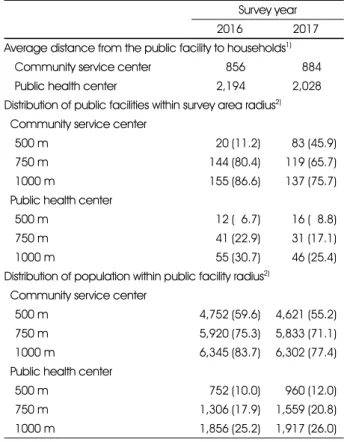
영양조사 장소로 보건소(또는 보건지소)와 주민센터(또 는 면사무소)를 선정할 경우, 조사대상자들이 쉽게 방문할 수 있는 거리인지 파악하기 위하여 공간분석을 실시한 결과 조사구 중심에서 가장 가까운 주민센터까지의 평균 거리는 약 870 m인 반면, 보건소까지의 평균 거리는 약 2.1 km인 것으로 산출되어 조사구에서 공공기관에 대한 접근성 면에 서는 보건소보다는 주민센터가 영양조사 장소로서 더 적절 한 것으로 나타났다.
2016년도와 2017년도 조사구 1 km 반경 내 주민센터
양나래·이승민·임영숙·박혜련·김기랑·450 Table 2. SWOT analysis of an alternative system for the nutritional survey
Strategies Internal factor External factor
Strengths Weaknesses Opportunities Threats
Survey in
suitably-prepared vehicles
•Accessibility is relatively high compared to public facilities.
•Increased participation of subjects who do not wish to be visited in their homes
•Reduced participation of physically handicapped and mobility impaired persons
•Possibility of rejection due to inconvenience of narrow and confined spaces
•Problems with not appearing after making a reservation
•Increase in survey efficiency from self-management
•Possibility of promoting the survey through the use of the vehicle
•Possibility of linking to the health examination survey
•Expense of purchase of vehicle and maintenance costs, driver's labor,
•etc.Need to manage the safety of vehicle operation
•Difficulty arranging for a parking space at the survey site
Survey at a public facility
•Increased participation of subjects who do not wish to be visited in their homes
•Improving compliance with safety of the site
•Improvement of subjects’ accessibility when selecting public facilities targeted to age group and regions as the survey site
•Allowing investigators to easily survey
•Due to decreased accessibility, low participation rates
•Reduced participation of physically handicapped and mobility impaired individuals
•Reduced participation because of the burden of bringing all the members of the household to the facility
•Reduced participation due to increased waiting time from the time taken to survey all the members of the household
•Difficulty in interpreting the differences in the results due to the different survey sites when selecting a public facility that matches the
characteristics of each age group and region
•Bias in certain age groups (health center vs. community welfare center)
•Problems with not visiting after making a reservation
•Possibility of promoting the survey through programs in public facilities
•Reduced costs, such as renting and managing the survey site
•Administrative and spatial cooperation of public facilities is essential
•Difficulty of arranging for a parking space at the survey site and lack of research space
•Increased burden of work hours for employees inside the organization
Survey by
employee in charge of survey-specific works in public health centers
•Increased participation of subjects who do not wish to be visited in their homes
•Improving compliance with safety of the site
•Increased flexibility of the survey schedule
•Allowing investigators to easily survey
•Decreased participation due to decreased accessibility
•Reduced participation of physically handicapped and mobility impaired persons
•Reduced participation due to increased waiting time from the time taken to survey all the members of the household
•Problems with not visiting after making a reservation
•Possibility of promoting the investigation through programs in health center
•Reduced costs, such as renting and managing the survey site
•Increased quality of survey due to the recruitment of professional staff
•Administrative and spatial cooperation of the health center is essential
•Difficulty arranging for a parking space at the survey site and lack of research space
•Need of costs for operation, quality control, management and system development
•Understanding and discussing the distribution of work between the KCDC and the health center
(면사무소)는 각 86.6%와 75.7%가 분포하고 있는 반면 보 건소(보건지소)는 각 30.7%와 25.4%가 포함되어 있었으 며, 1 km 반경 내 주민센터(면사무소)의 평균 서비스 인구 는 6,324명이고, 보건소(보건지소)는 1,887명이었다.
4. 일부 지역사회 주민들의 국가 영양조사 참여 인식도 연구 대상자의 만 나이는 45.2 ± 12.8세 이었고, 성별 분 포는 여성이 84.4%로 다수를 차지하였다. 거주 지역의 분포 는 서울시(강북구), 중소도시(경기도 하남시), 읍·면지역 (경기도 양편군)이 각각 45.9%, 26.6%, 27.5%로 분포하 였다.
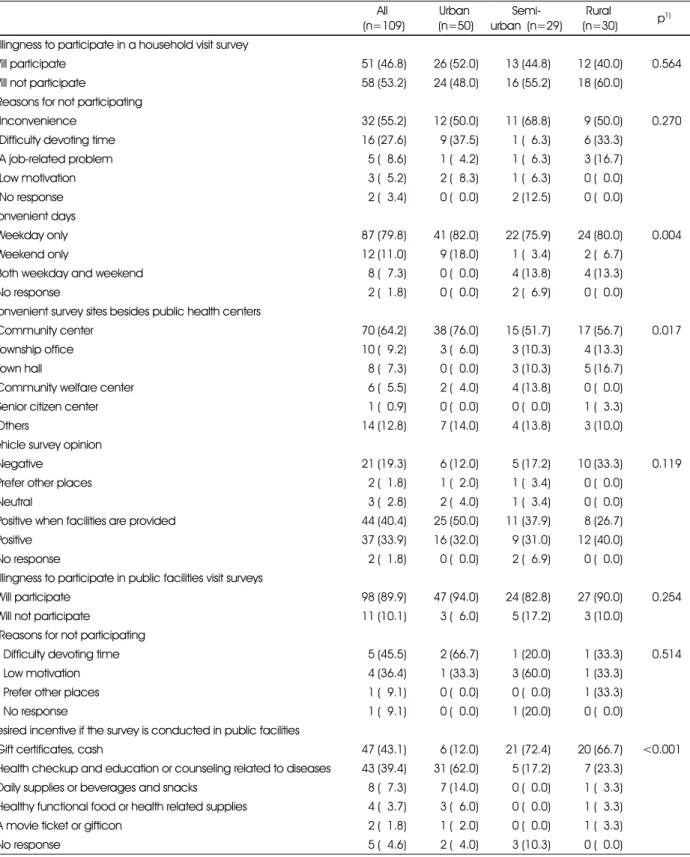
전체 대상자의 과반 이상인 53.2%가 가구 방문에 의한 조 사 참여 의향이 없다고 응답하였고, 그 이유로는 불편하다는 의견이 가장 많았다. 영양조사 참여 시 편한 요일로는 주중 이 많았으며, 특히 다른 지역에 비하여 서울은 주말에 편하 다는 응답이 유의하게 많았다. 대상자들은 만약 보건소 이외 에서 영양조사를 받을 경우 조사 받기 편한 장소로 주민센터 및 면사무소를 가장 높게 응답하였다. 조사 차량에서 영양조 사를 받을 경우, 조사 참여 여부에서는 약 74%가 긍정적인 응답을 하였다. 공공기관에서의 영양조사 시 참여한다는 의 견이 약 90%였고, 그렇지 않다고 응답한 경우에 그 이유로 는 시간을 할애하는 것이 어렵다거나, 참여 의향이 낮다고 응 답하였다. 공공기관 조사 시 희망하는 혜택으로는 상품권 혹 은 사례금과 건강검진 교육 및 상담이라는 의견이 약 83%
였고, 특히 다른 지역에 비하여 서울은 건강검진 교육 및 상 담을 원하는 대상자가 유의하게 많았다.
5. 국가 영양 조사 방법 개편 방안 제시
국가 영양 조사 방법 개편 방안을 크게 두 가지로 차량에 서 조사하는 방안과 공공기관에서 조사하는 방안을 선정하 였다. 첫 번째 안으로 차량을 이용한 영양조사는 영양조사 전 용 차량을 활용하여 조사하는 방안과 현재 검진과 건강 설문 조사에 사용되고 있는 조사 차량을 활용하여 조사하는 방안 이다. 먼저 영양조사 전용 차량을 활용한 영양조사는 주차가 용이하며 내부 조사 시설 설비가 가능한 수준의 차량(예, 10 인용 차량)을 활용하여 조사 대상자 가구 주변의 가장 가까 운 장소에 주차하고 조사를 하는 방안이다. 다른 장소에서 조 사하는 방법과 비교 시 조사 중 확인이 필요한 사항에 대하 여 상대적으로 빠른 시간 내 확인이 가능하며, 조사 전까지 가구에 있을 수 있어 조사대기의 불편함이나 날씨와 같은 외 부 환경에 상대적으로 영향이 적다는 장점이 있다. 다음으로 검진조사 차량을 활용한 영양조사는 현재 검진 차량이 주중 3일 동안 조사하므로 검진조사기간 전후 영양조사를 실시하
는 방안이다. 검진으로 인한 식사행태의 변경을 최소화하기 위하여 검진 전 또는 후의 2-3일의 기간을 두고 영양조사 하는 것이 필요하다. 동일한 장소에서 검진과 영양 조사를 함 으로써 조사 운영의 효율성이 증대되나, 검진차량 내 영양조 사를 위한 별도 공간 확보가 필요하며 야간 조사에 따른 차 량시설 관리비용(냉난방, 조명시설 등) 소요 가능성이 있고, 검진차량의 장기적 주차에 대한 부담감이 높아 주차장소 섭 외의 어려움이 예상된다.
두 번째 안은 공공기관(보건소, 주민센터)을 이용한 조사 로 조사원이 공공기관에 방문하여 영양조사를 하는 체계와 공공기관에 조사원의 상시 배치를 통하여 영양조사 모니터 링 체계 시스템을 구축하여 조사하는 방안이다. 조사 대상자 의 참여율을 높이기 위하여 대상자에게 공공기관 조사 장소 에 대한 선택 사항을 제시하는 방법이 있으나 장소에 따른 결 과의 차이 설명이 어려울 수 있다. 공공기관 중 보건소와 주 민센터에 대한 대상자의 접근성 면에서는 보건소보다는 주 민센터가 영양조사 장소로서 더 적절한 것으로 나타났다. 그 러나 가구조사로 인한 가구원 전체의 이동에 대한 부담, 가 구원의 조사대기 시간 등의 불편함으로 가구원 내에서의 조
Table 3. Results of spatial analysis to examine accessibility of public facilities to households which was surveyed in the KNHANES
Survey year 2016 2017 Average distance from the public facility to households1)
Community service center 856 884
Public health center 2,194 2,028
Distribution of public facilities within survey area radius2) Community service center
500 m 20 (11.2) 83 (45.9)
750 m 144 (80.4) 119 (65.7)
1000 m 155 (86.6) 137 (75.7)
Public health center
500 m 12 (96.7) 16 (98.8)
750 m 41 (22.9) 31 (17.1)
1000 m 55 (30.7) 46 (25.4)
Distribution of population within public facility radius2) Community service center
500 m 4,752 (59.6) 4,621 (55.2)
750 m 5,920 (75.3) 5,833 (71.1)
1000 m 6,345 (83.7) 6,302 (77.4)
Public health center
500 m 752 (10.0) 960 (12.0)
750 m 1,306 (17.9) 1,559 (20.8)
1000 m 1,856 (25.2) 1,917 (26.0)
1) m 2) N (%)
양나래·이승민·임영숙·박혜련·김기랑·452
사 참여율 변이가 높을 수 있다. 다음으로 조사원의 공공기 관 상시 배치에 의한 공공기관에서의 영양조사는 조사구를
권역별로 구분하여 권역별 공공기간 내 조사원을 상시 배치 하여 영양조사 감시체계의 시스템을 구축하여 조사함으로써
Table 4. Perception of nutritional surveys in the population eligible for KNHANES All (n=109)
Urban (n=50)
Semi- urban (n=29)
Rural
(n=30) p1) Willingness to participate in a household visit survey
Will participate 51 (46.8) 26 (52.0) 13 (44.8) 12 (40.0) 0.564
Will not participate 58 (53.2) 24 (48.0) 16 (55.2) 18 (60.0)
Reasons for not participating
Inconvenience 32 (55.2) 12 (50.0) 11 (68.8) 9 (50.0) 0.270
Difficulty devoting time 16 (27.6) 9 (37.5) 1 (86.3) 6 (33.3)
A job-related problem 5 (88.6) 1 (84.2) 1 (86.3) 3 (16.7)
Low motivation 3 (85.2) 2 (88.3) 1 (86.3) 0 (80.0)
No response 2 (83.4) 0 (80.0) 2 (12.5) 0 (80.0)
Convenient days
Weekday only 87 (79.8) 41 (82.0) 22 (75.9) 24 (80.0) 0.004
Weekend only 12 (11.0) 9 (18.0) 1 (83.4) 2 (86.7)
Both weekday and weekend 8 (87.3) 0 (80.0) 4 (13.8) 4 (13.3)
No response 2 (81.8) 0 (80.0) 2 (86.9) 0 (80.0)
Convenient survey sites besides public health centers
Community center 70 (64.2) 38 (76.0) 15 (51.7) 17 (56.7) 0.017
Township office 10 (89.2) 3 (86.0) 3 (10.3) 4 (13.3)
Town hall 8 (87.3) 0 (80.0) 3 (10.3) 5 (16.7)
Community welfare center 6 (85.5) 2 (84.0) 4 (13.8) 0 (80.0)
Senior citizen center 1 (80.9) 0 (80.0) 0 (80.0) 1 (83.3)
Others 14 (12.8) 7 (14.0) 4 (13.8) 3 (10.0)
Vehicle survey opinion
Negative 21 (19.3) 6 (12.0) 5 (17.2) 10 (33.3) 0.119
Prefer other places 2 (81.8) 1 (82.0) 1 (83.4) 0 (80.0)
Neutral 3 (82.8) 2 (84.0) 1 (83.4) 0 (80.0)
Positive when facilities are provided 44 (40.4) 25 (50.0) 11 (37.9) 8 (26.7)
Positive 37 (33.9) 16 (32.0) 9 (31.0) 12 (40.0)
No response 2 (81.8) 0 (80.0) 2 (86.9) 0 (80.0)
Willingness to participate in public facilities visit surveys
Will participate 98 (89.9) 47 (94.0) 24 (82.8) 27 (90.0) 0.254
Will not participate 11 (10.1) 3 (86.0) 5 (17.2) 3 (10.0)
Reasons for not participating
Difficulty devoting time 5 (45.5) 2 (66.7) 1 (20.0) 1 (33.3) 0.514
Low motivation 4 (36.4) 1 (33.3) 3 (60.0) 1 (33.3)
Prefer other places 1 (89.1) 0 (80.0) 0 (80.0) 1 (33.3)
No response 1 (89.1) 0 (80.0) 1 (20.0) 0 (80.0)
Desired incentive if the survey is conducted in public facilities
Gift certificates, cash 47 (43.1) 6 (12.0) 21 (72.4) 20 (66.7) <0.001
Health checkup and education or counseling related to diseases 43 (39.4) 31 (62.0) 5 (17.2) 7 (23.3)
Daily supplies or beverages and snacks 8 (87.3) 7 (14.0) 0 (80.0) 1 (83.3)
Healthy functional food or health related supplies 4 (83.7) 3 (86.0) 0 (80.0) 1 (83.3)
A movie ticket or gifticon 2 (81.8) 1 (82.0) 0 (80.0) 1 (83.3)
No response 5 (84.6) 2 (84.0) 3 (10.3) 0 (80.0)
1)The difference among three groups was tested based on p<0.05
조사의 안정성을 확보할 수 있다. 기존 조사의 참여율 감소 의 원인 중에는 한 지역 내에서 영양조사 기간이 2-3일로 인해 시간 부족으로 조사 약속 시간 잡기가 어렵다는 응답이 높게 조사되었는데, 조사원의 기관 내 상시 배치를 통하여 기 존 조사체계보다는 해당 조사구에 대한 조사 기간 연장이 가 능하므로 대상자 조사 참여 기회 가능성이 증가할 것으로 예 상된다. 조사원은 타 국가건강조사와 연계하여 권역 내 해당 조사구의 대상자 영양(또는 건강 및 설문)조사, 조사 자료 입 력 및 DB 구축, 결과 산출, 조사결과에 대해 대상자 교육 및 상담을 전담하여 연중 업무가 가능하도록 할 경우 조사원의 활용도가 높을 것으로 예상되며, 해당 주민들에게 지속적인 건강영양관리 서비스를 제공함으로써 주민들의 지자체 내 관 련 기관의 긍정적인 인식을 기대할 수 있다. 조사원의 질 관 리를 위해서는 체계 구축이 필요하며 조사원 인력 증가에 따 른 비용 또한 필요하다. 조사원의 상시배치를 위해서는 질병 관리본부에서 조사원의 모집 파견 및 질 관리(교육 포함)·
감독을 전담해야하고, 각 지자체 행정구역 내 공공기관에서 는 공간 및 업무 협조가 필요하다.
—————————————————————————
고 찰
—————————————————————————
국민건강영양조사는 국민의 전반적인 건강과 영양 상태 및 그 추이에 대한 대표성과 신뢰성 있는 통계 산출을 위해 전 국 조사로 시행되어 왔으며, 국민건강증진을 위한 목표설정 및 평가, 효과적인 건강증진사업 프로그램 개발에 필요한 기 초 자료 및 OECD 회원국으로서 국제 비교가 가능한 통계치 를 제공하는 데 기여하고 있다[1]. 특히 영양조사는 국내 영 양조사들 중에서 가장 규모가 크고 다양한 영양 지표들을 생 산하고 있어 국가 영양정책 수립 및 정책효과 평가를 위해서 는 매우 중요한 조사이다.
최근 1인 가구 및 맞벌이 가구 등의 빠른 증가, 생활환경 의 변화 등으로 조사거부 및 접촉 불가 등의 가구방문조사의 환경이 갈수록 열악해지고 있다[13]. 이와 같이 가구 대상 자들의 접근성 감소는 조사 자료의 질을 감소시킬 수 있어 이 를 예방하기 위한 대책이 무엇보다 중요하다. 이에 본 연구 에서는 지난 10년 동안 유지해왔던 가구방문 영양조사 체계 에 대한 검토를 통해 가구 방문 이외의 조사 체계를 제안하 였다. 조사 현장의 특성을 최대한 반영하기 위하여 조사와 관 련된 이해관계자들의 의견을 최대 수렴하고자 하였고 제안 된 안에 대해서는 SWOT 분석과 전문가 자문을 통하여 현 장 적용 가능한 조사 체계를 도출하였다.
본 연구에서 도출된 가구 방문 이외 조사 가능한 장소는 조 사 차량과 보건소와 주민센터와 같은 공공기관이었다. 영양
조사 전용 차량에서의 조사 경우, 접근성 측면에서의 효율성 이 높고 차량 조사에 대한 수용도 결과에서 약 74%가 긍정 적인 의견을 보였으나 차량 구매와 차량기사 관리를 포함한 차량 유지비 등의 조사비 증가 문제가 제기되었고 실질적으 로 차량과 같은 협소한 공간에서 조사했을 시 대상자의 반응 에 대한 조사가 필요하다. 현재 검진과 건강 설문이 조사되 고 있는 차량에서 영양조사를 병행할 경우에는 검진 조사 일 정의 고려, 장기간의 주차 공간 확보 등의 문제가 예상된다.
공공기관에서 조사할 경우에는 공공기관 장소에 대한 수용 도 결과에서 약 90%가 긍정적이었고, 공공시설을 활용함으 로써 조사 신뢰도 향상을 기대해 볼 수 있다. 그러나 관련 시 설(면접 장소, 화장실 등) 이용, 야간 조사 시 시설 이용 여 부와 안전성 문제 등에 대하여 기관 간의 행정적인 협의가 필 수적일 수 있다. 또한 대상자가 조사 예약 후 방문하지 않을 경우에 대한 대책 및 조사 사례비 이외 기관 방문에 대한 교 통비 지급에 대한 고려도 필요할 수 있다.
공공기관에서의 조사는 특히 지역별, 조사 대상자 특성별, 대상자 가구로부터의 접근 거리 등이 조사 참여율에 영향을 미칠 수 있으므로[13] 향후 이에 대한 면밀한 검토가 필요 하다. 대상자 가구로부터 공공기관까지의 접근성 분석 결과 에서는 보건소보다는 주민센터에 대한 접근성이 높았으므로 주민센터의 활용 범위를 높일 수 있는 방안이 고려되어야 할 것이다. 최근 서울시에서는 찾아가는 동주민센터 프로그램 을 통하여 주민센터의 동 단위의 행정기관을 복지와 보건을 결합시킴으로써 행정 역할에서 벗어난 기능 확대를 도모하 고 있으며 이를 전국으로 확대 시도하려고 한다[21]. 따라 서 국가 영양조사 또한 변화하고 있는 지역사회기관의 시스 템 활용을 통한 조사 체계 개선이 중요할 수 있겠다.
—————————————————————————
요약 및 결론
—————————————————————————
본 연구에서는 국민건강영양조사에서 유지해왔던 가구방 문조사 체계로 나타날 수 있는 문제점을 해결할 수 있는 전 략으로 가구 방문 이외의 조사 체계 방안을 제시하고자 하였 다. 조사 현장의 특성을 최대한 반영하기 위하여 조사와 관 련된 이해관계자들을 대상으로 포커스 그룹 조사를 실시하 였고, 가구 방문 이외 영양 조사 방안 대한 SWOT 분석, 영 양조사 장소로 공공기관에 대한 접근성 분석, 일부 지역사회 주민들을 대상으로 국가 영양조사 참여에 대한 인식도 조사, 전문가 자문 검토를 통하여 현장 적용 가능한 영양 조사 체 계를 제안하였다. 본 연구에서 도출된 가구 방문 이외 영양 조사 방안은 다음과 같다.
1. 차량을 이용한 영양조사로 영양조사 전용 차량을 활용
양나래·이승민·임영숙·박혜련·김기랑·454
하여 조사하는 방안과 현재 검진과 건강설문 조사에 사용되 고 있는 조사 차량을 활용하여 조사하는 방안이다.
2. 보건소와 주민센터와 같은 공공기관에서 영양조사를 하 는 방안이다. 현재 조사체계와 같이 조사원이 공공기관에 방 문하여 조사하는 방안으로 공공기관을 조사 장소로 대여하 여 조사하는 체계와 공공기관에 조사원의 상시 배치를 통하 여 영양조사 모니터링 체계 시스템을 구축하여 조사하는 방 안이다.
3. 영양조사 장소로서 공공기관에 대한 접근성은 보건소보 다 주민센터가 더 높은 것으로 나타났으며, 지역사회 주민들 을 대상으로 가구 방문 이외 영양조사의 방안에 대한 수용도 조사 결과에서는 조사 차량에서의 조사보다는 공공기관에서 의 조사를 더 선호하는 것으로 나타났다.
본 연구에서 제안된 영양조사 방안은 향후 타당도 연구를 통하여 현장 적용 가능성의 면밀한 검토가 필요하며 제안된 영양조사 전략들은 가구 방문에 의한 국가 영양조사의 보완 을 통한 조사 자료의 질 향상에 기여할 수 있을 것으로 생각 된다.
—————————————————————————
사 사
—————————————————————————
본 연구는 2017년도 질병관리본부의 지원을 받아 수행된 정책연구용역사업임(No. 2017-E34010-00)을 밝힌다.
—————————————————————————
References
—————————————————————————
1. Kweon S, Kim Y, Jang MJ, Kim Y, Kim K, Choi S et al. Data resource profile: The Korea National Health and Nutrition Examination Survey (KNHANES). Int J Epidemiol 2014; 43(1):
69-77.
2. Ministry of Health and Welfare, Korea Centers for Disease Control and Prevention. Korea national health and nutrition examination survey raw data use guidelines [Internet]. Korea Centers for Disease Control and Prevention; 2015 [updated 2017 Jan ; cited 2018 Aug 8]. Available from: https://knhanes.cdc.
go.kr/knhanes/sub03/sub03_06_02.do.
3. Ikeda N, Takimoto H, Imai S, Miyachi M, Nishi N. Data resource profile: The Japan National Health and Nutrition Survey (NHNS). Int J Epidemiol 2015; 44(6): 1842-1849.
4. Public Health England, Food Standards Agency. Results of the National Diet and Nutrition Survey (NDNS) rolling programme for 2008 and 2009 to 2011 and 2012 [Internet]. Public Health England; 2014 [updated 2017 Feb 2; cited 2018 Aug 8].
Available from: https://www.gov.uk/government/statistics/national- diet-and-nutrition-survey-results-from-years-1-to-4-combined-of- the-rolling-programme-for-2008-and-2009-to-2011-and-2012.
5. Public Health England, Food Standards Agency. Results of the National Diet and Nutrition Survey (NDNS) rolling programme
for 2012 to 2013 and 2013 to 2014 [Internet]. Public Health England; 2016 [cited 2018 Aug 8]. Available from: https://
www.gov.uk/government/statistics/ndns-results-from-years-5-and- 6-combined.
6. Public Health England, Food Standards Agency. Results of the National Diet and Nutrition Survey (NDNS) rolling programme for 2014 to 2015 and 2015 to 2016 [Internet]. Public Health England; 2018 [updated 2018 Apr 11; cited 2018 Aug 8].
Available from: https://www.gov.uk/government/statistics/ndns- results-from-years-7-and-8-combined.
7. Centers for Disease Control and Prevention (CDC), National Center for Health Statistics (NCHS). National Health and Nutrition Examination Survey [Internet]. U.S. Department of Health and Human Services, Centers for Disease Control and Prevention [cited 2018 Aug 8]. Available from: https://wwwn.
cdc.gov/nchs/nhanes/ResponseRates.aspx.
8. Australian Bureau of Statistics. National health survey: Users' guide - electronic publication, 2007-08 [Internet]. Australian Bureau of Statistics; 2009 [updated 2012 Dec 6; cited 2018 Aug 8]. Available from: http://www.abs.gov.au/AUSSTATS/[email protected]/
Previousproducts/4363.0.55.001Main%20Features32007-08?
opendocument&tabname=Summary&prodno=4363.0.55.001&issu e=2007-08&num=&view=.
9. Australian Bureau of Statistics. Australian health survey: Users' guide, 2011-13 [Internet]. Australian Bureau of Statistics; 2013 [updated 2015 Mar 3; cited 2018 Aug 8]. Available from: http://
www.abs.gov.au/ausstats/[email protected]/Lookup/F87826FDF716EB94 CA257B8D00229E83?opendocument.
10. Australian Bureau of Statistics. National health survey: Users' guide, 2014-15 [Internet]. Australian Bureau of Statistics; 2017 [updated 2017 Jul 28; cited 2018 Aug 8]. Available from: http://
www.abs.gov.au/ausstats/[email protected]/Lookup/by%20Subject/4363.0~
2014-15~Main%20Features~Introduction~2.
11. Zipf GCM, Porter KS, Ostchega Y, Lewis BG, Dostal J. National health and nutrition examination survey: plan and operations, 1999-2010. Vital Health Stat 1 2013; 56: 1-37.
12. Kim MK, Kim K, Kim CI, Oh K, Oh YJ, Chol BY. The current status and the perspectives of nutrition survey. Korean J Epidemiol 2007; 29(2): 111-128.
13. Lee MJ. The improvement strategy for the survey methodology of community health survey. Korea Centers for Disease Control and Prevention; 2014 Dec. Report No. 11-1352159-000245-01.
14. Kim SW. A study on strategies for improving the 2015 community health survey performance monitoring. Korea Centers for Disease Control and Prevention; 2016 Feb. Report No. 11- 1352159-000348-01.
15. Silverman D. Interpreting qualitative data: A guide to the principles of qualitative research. 4th ed. Los Angeles: Sage;
2011. p. 57-86.
16. Gurel E. SWOT Analysis: A theoretical review. J Int Soc Res 2017; 10(51): 994-1006.
17. Wade T, Sommer S. A to Z GIS: An illustrated dictionary of geographic information systems. 2nd ed. California: Esri Press;
2006. p. 1-288.
18. Lee YS, Shon DW. A relationship analysis between subway transit demand and urban spatial characteristics in the subway
station area. Urban Des 2012; 13(4): 23-32.
19. Kim SY. Density management of subway station areas considering the identification of TOD planning factors: the case of Seoul, Korea [Master's thesis]. Hanyang University; 2014.
20. Park SH, Shon DW, Lee JH. A spatial analysis of transit centers in Seoul metropolitan region for developing transit oriented
urban environments. J Korean Soc Civ Eng 2009; 29(1D): 111- 120.
21. Hwang GY. The outreach community centers initiative: Policy recommendations for improvement. Sejong: Korea Institute for Health and Social Affairs; 2017. p. 115-123.